Recognition: unknown
Classical counterparts of shortcuts to adiabaticity in nonlinear dissipative Lagrangian systems
Pith reviewed 2026-05-10 04:08 UTC · model grok-4.3
The pith
Shortcuts to adiabaticity from quantum dynamics extend to classical nonlinear dissipative Lagrangian systems via inverse engineering of trajectories.
A machine-rendered reading of the paper's core claim, the machinery that carries it, and where it could break.
Core claim
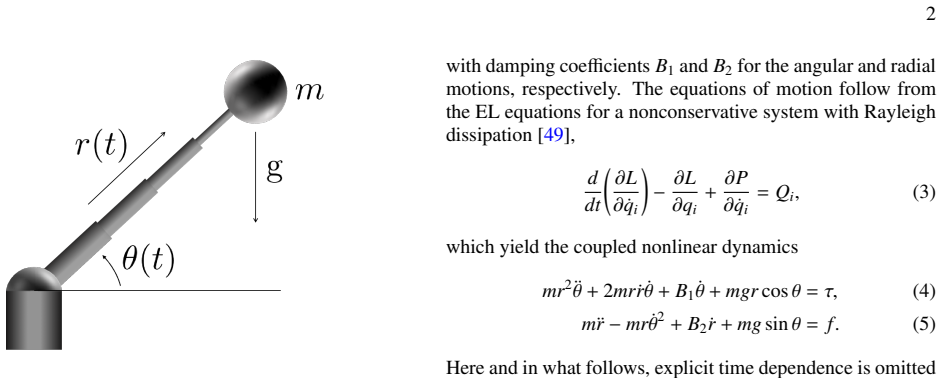
In the coupled r-θ manipulator, inverse engineering of the Euler-Lagrange equations with Rayleigh dissipation, achieved by prescribing endpoint-stationary trajectories, generates explicit force and torque profiles that suppress residual energy after rapid transformations, while geometric coupling is shown to increase sensitivity to timing inaccuracies, and a mid-course measurement correction is introduced to mitigate early errors.
What carries the argument
Inverse engineering of the Euler-Lagrange equations with Rayleigh dissipation by prescribing endpoint-stationary trajectories in the nonlinear coupled r-θ manipulator model.
Load-bearing premise
That endpoint-stationary trajectories can be prescribed to produce well-defined force and torque profiles that suppress residual energy without additional unstated constraints on system parameters or dissipation strength.
What would settle it
Applying the inverse-engineered force and torque profiles to a physical coupled r-θ manipulator and measuring whether the final residual kinetic energy is substantially lower than that from a direct fast ramp under identical dissipation conditions.
Figures


read the original abstract
Shortcuts to adiabaticity (STA) were first developed in quantum dynamics to realize rapid transformations with suppressed residual excitations. Here we show how the same idea can be implemented in classical nonlinear dissipative Lagrangian systems. Using a coupled $r$-$\theta$ manipulator as an illustrative model, we perform inverse engineering on the Euler-Lagrange equations with Rayleigh dissipation by prescribing endpoint-stationary trajectories, obtaining the corresponding force and torque profiles and quantifying how geometric coupling amplifies errors and residual energy. We further compare smooth STA protocols with actuator-bounded time-optimal solutions and with proportional-integral-derivative tracking, which highlights a trade-off among smoothness, speed, and robustness. Finally, we introduce a single-shot correction based on one mid-course measurement to reduce the effect of early deviations while keeping the inputs nearly smooth. These results provide a practical bridge between quantum STA concepts and their classical counterparts.
Editorial analysis
A structured set of objections, weighed in public.
Referee Report
Summary. The paper extends shortcuts to adiabaticity (STA) concepts from quantum dynamics to classical nonlinear dissipative Lagrangian systems. It uses inverse engineering on the Euler-Lagrange equations with Rayleigh dissipation for a coupled r-θ manipulator model, by prescribing endpoint-stationary trajectories to derive the required force and torque inputs. The work quantifies geometric coupling effects on error amplification and residual energy, compares smooth STA protocols against actuator-bounded time-optimal and PID tracking solutions, and proposes an optional single-shot mid-course correction based on one measurement to improve robustness while preserving smoothness.
Significance. If the derivations and simulations hold, the manuscript provides a concrete bridge from quantum STA techniques to classical control of nonlinear dissipative systems, with explicit trade-off analysis among smoothness, speed, and robustness. The use of a specific manipulator example, quantification of coupling-induced errors, and the mid-course correction add practical utility for mechanical and robotic applications where rapid low-excitation transitions are needed.
minor comments (3)
- The abstract and introduction would benefit from a brief statement of the specific residual-energy metric used (e.g., kinetic plus potential energy at final time) and how it is computed from the numerical trajectories.
- In the section comparing STA, time-optimal, and PID protocols, the actuator bounds and dissipation coefficients should be stated explicitly so that the reported speed-robustness trade-off can be reproduced.
- The single-shot correction is presented as optional; a short discussion of the measurement noise level at which the correction itself begins to increase residual energy would strengthen the robustness claim.
Simulated Author's Rebuttal
We thank the referee for the positive and accurate summary of our work, for recognizing its potential as a bridge between quantum STA methods and classical nonlinear dissipative control, and for recommending minor revision. No specific major comments were raised in the report.
Circularity Check
No significant circularity detected in derivation chain
full rationale
The paper applies standard inverse engineering to the Euler-Lagrange equations augmented with Rayleigh dissipation by directly prescribing endpoint-stationary trajectories for the coupled r-θ manipulator model. Force and torque profiles are obtained by solving the resulting differential equations for the controls, with subsequent quantification of geometric coupling effects and numerical comparisons to time-optimal and PID baselines. No equations reduce by construction to redefinitions of the input trajectories, no fitted parameters are relabeled as predictions, and no load-bearing self-citations or uniqueness theorems imported from prior author work are invoked to justify the central results. The approach remains self-contained against the standard Lagrangian formalism and external benchmarks.
Axiom & Free-Parameter Ledger
Reference graph
Works this paper leans on
-
[1]
consistent with Eq. (14). The motion first accelerates at the maximal admissible acceleration until the velocity bound is reached, then evolves with a coasting phase, and finally de- celerates to satisfy the endpoint conditions. The correspond- ingτ(t) andf(t) are obtained by inverse substitution into the equations of motion. Because the two coordinates m...
-
[2]
As a benchmark for feedback stabilization, we intro- duce a proportional-integral-derivative (PID) tracking scheme [52]
PID tracking The results above highlight a generic limitation of open- loop protocols in coupled nonlinear dynamics: performance degrades in the presence of model mismatch and disturbances because deviations cannot be corrected once the evolution starts. As a benchmark for feedback stabilization, we intro- duce a proportional-integral-derivative (PID) tra...
-
[3]
Single-shot corrected STA Continuous feedback can strongly improve robustness but requires high-rate sensing and real-time computation and typ- 0.0 0.2 0.4 0.6 0.8 1.0 t / tf 0 10 20 30 40 ( ) (a) 0.0 0.2 0.4 0.6 0.8 1.0 t / tf 1.0 1.5 2.0 2.5 3.0 3.5 4.0 r (m) (b) 0.0 0.2 0.4 0.6 0.8 1.0 t / tf 400 200 0 200 (kg m2 s 2) and f (N) (c)difference of differe...
-
[4]
Torrontegui, S
E. Torrontegui, S. Ib´a˜nez, S. Mart´ınez-Garaot, M. Modugno, A. del Campo, D. Gu ´ery-Odelin, A. Ruschhaupt, X. Chen, and J. G. Muga, Shortcuts to Adiabaticity, Adv. At. Mol. Opt. Phys. 62, 117-169 (2013)
2013
-
[5]
Gu ´ery-Odelin, A
D. Gu ´ery-Odelin, A. Ruschhaupt, A. Kiely, E. Torrontegui, S. Mart ´ınez-Garaot, and J. G. Muga, Shortcuts to adiabatic- ity: Concepts, methods, and applications, Rev. Mod. Phys.91, 045001 (2019)
2019
-
[6]
Masuda and K
S. Masuda and K. Nakamura, Fast-forward problem in quantum mechanics, Phys. Rev. A78, 062108 (2008)
2008
-
[7]
Masuda and K
S. Masuda and K. Nakamura, Fast-forward of adiabatic dynam- ics in quantum mechanics, Proc. R. Soc. A: Math. Phys. Eng. Sci.466, 1135-1154 (2010)
2010
-
[8]
Torrontegui, S
E. Torrontegui, S. Mart ´ınez-Garaot, A. Ruschhaupt, and J. G. Muga, Shortcuts to adiabaticity: fast-forward approach, Phys. Rev. A86, 013601 (2012)
2012
-
[9]
Demirplak and S
M. Demirplak and S. A. Rice, J. Phys. Chem. A107, 9937 (2003)
2003
-
[10]
Demirplak and S
M. Demirplak and S. A. Rice, J. Chem. Phys.129, 154111 (2008)
2008
-
[11]
M. V . Berry, Transitionless quantum driving. J. Phys. A: Math. Theor.42, 365303 (2009)
2009
-
[12]
Deffner, C
S. Deffner, C. Jarzynski, and A. del Campo, Classical and quan- tum shortcuts to adiabaticity for scale-invariant driving, Phys. Rev. X4, 021013 (2014)
2014
-
[13]
del Campo, Shortcuts to adiabaticity by counterdiabatic driv- ing, Phys
A. del Campo, Shortcuts to adiabaticity by counterdiabatic driv- ing, Phys. Rev. Lett.111, 100502 (2013)
2013
-
[14]
X. Chen, I. Lizuain, A. Ruschhaupt, D. Gu ´ery-Odelin, J. G. Muga, Phys. Rev. Lett.105, 123003 (2010)
2010
-
[15]
Chen, A.Ruschhaupt, S
X. Chen, A.Ruschhaupt, S. Schmidt, A.del Campo, D. Gu ´ery- Odelin, and J. G. Muga, Fast Optimal Frictionless Atom Cool- ing in Harmonic Traps: Shortcut to Adiabaticity, Phys. Rev. Lett.104, 063002 (2010)
2010
-
[16]
Schaff, X.-L
J.-F. Schaff, X.-L. Song, P. Vignolo, and G. Labeyrie, Fast opti- mal transition between two equilibrium states, Phys. Rev. A82, 033430 (2010)
2010
-
[17]
Schaff, X.-L
J.-F. Schaff, X.-L. Song, P. Capuzzi, P. Vignolo, and G. Labeyrie, Shortcut to adiabaticity for an interacting Bose- Einstein condensate, Europhys. Lett.93, 23001 (2011)
2011
-
[18]
Couvert, T
A. Couvert, T. Kawalec, G. Reinaudi, and D. Gu ´ery-Odelin, Optimal transport of ultracold atoms in the non-adiabatic regime, Europhys. Lett.83, 13001 (2008)
2008
-
[19]
Torrontegui, S
E. Torrontegui, S. Ib ´a˜nez, X. Chen, A. Ruschhaupt, D. Gu ´ery- Odelin, and J. G. Muga, Fast atomic transport without vibra- tional heating, Phys. Rev. A83, 013415 (2011)
2011
-
[20]
Palmero, R
M. Palmero, R. Bowler, J. P. Gaebler, D. Leibfried, and J. G. Muga, Fast transport of mixed-species ion chains within a Paul trap, Phys. Rev. A90, 053408 (2014)
2014
-
[21]
S. An, D. Lv, A. del Campo, and K. Kim, Shortcuts to adiabatic- ity by counterdiabatic driving for trapped-ion displacement in phase space, Nat. Commun.7, 12999 (2016)
2016
-
[22]
Corgier, S
R. Corgier, S. Amri, W. Herr, H. Ahlers, J. Rudolph, D. Gu´ery- Odelin, E. M. Rasel, E. Charron, and N. Gaaloul, Fast manipu- lation of Bose-Einstein condensates with an atom chip, New J. Phys.20, 055002 (2018)
2018
-
[23]
G. T. Hickman and M. Saffman, Speed, retention loss, and mo- tional heating of atoms in an optical conveyor belt, Phys. Rev. A 101, 063411 (2020)
2020
-
[24]
Stefanatos, J
D. Stefanatos, J. Ruths, and J.-S. Li, Frictionless atom cooling in harmonic traps: A time-optimal approach, Phys. Rev. A82, 063422 (2010)
2010
-
[25]
X.-J. Lu, X. Chen, J. Alonso, and J. G. Muga, Fast transition- less expansions of Gaussian anharmonic traps for cold atoms: Bangsingular- bang control, Phys. Rev. A89, 023627 (2014)
2014
-
[26]
X. Chen, E. Torrontegui, D. Stefanatos, J.-S. Li, and J. G. Muga, Optimal trajectories for efficient atomic transport without final excitation, Phys. Rev. A84, 043415 (2011)
2011
-
[27]
X.-J. Lu, J. G. Muga, X. Chen, U. G. Poschinger, F. Schmidt- Kaler, and A. Ruschhaupt, Fast shuttling of a trapped ion in the presence of noise, Phys. Rev. A89, 063414 (2014)
2014
-
[28]
Y . C. Ding, T.-Y . Huang, K. Paul, M.-J. Hao, and X. Chen, Smooth bang-bang shortcuts to adiabaticity for atomic transport in a moving harmonic trap, Phys. Rev. A101, 063410 (2020)
2020
-
[29]
Li, L.-Ao Wu, and Z
Y . Li, L.-Ao Wu, and Z. D. Wang Fast ground-state cooling of mechanical resonators with time-dependent optical cavities, Phys. Rev. A83, 043804 (2011)
2011
-
[30]
Stefanatos, Design of a photonic lattice using shortcuts to adiabaticity, Phys
D. Stefanatos, Design of a photonic lattice using shortcuts to adiabaticity, Phys. Rev. A90, 023811 (2014)
2014
-
[31]
W. Wang, Y . Ban, and X. Chen, Efficient broadband polariza- tion retarder via shortcuts to adiabaticity, Opt. Lett.48, 4472 (2023)
2023
-
[32]
Faure, S
S. Faure, S. Ciliberto, E. Trizac, and D. Gu´ery-Odelin, Shortcut 10 to stationary regimes: A simple experimental demonstration, Am. J. Phys.87, 125 (2019)
2019
-
[33]
Faure, D
S. Faure, D. Gu ´ery-Odelin, C. A. Plata, A. Prados, Active charge and discharge of a capacitor: Scaling solution and en- ergy optimization, Am. J. Phys.93, 328–335 (2025)
2025
-
[34]
S. Iram, E. Dolson, J. Chiel, J. Pelesko, N. Krishnan, ¨O. G¨ung¨or, B. Kuznets-Speck, S. Deffner, E. Ilker, J. G. Scott, and M. Hinczewski, Controlling the speed and trajectory of evolution with counterdiabatic driving, Nat. Phys.17, 135–142 (2021)
2021
-
[35]
Mart ´ınez, I. A., A. Petrosyan, D. Gu´ery-Odelin, E. Trizac, and S. Ciliberto, Engineered swift equilibration of a Brownian par- ticle, Nat. Phys.12, 843 (2016)
2016
-
[36]
X. Chen. E. Torrontegui, and J. G. Muga, Lewis-Riesenfeld in- variants and transitionless quantum driving, Phys. Rev. A,83, 062116 (2011)
2011
-
[37]
V . M. P´erez-Garc´ıa, H. Michinel, J. I. Cirac, M. Lewenstein, and P. Zoller, Low energy excitations of a Bose-Einstein Con- densate: A time-dependent variational analysis, Phys. Rev. Lett. 77, 5320 (1996)
1996
-
[38]
V . M. P´erez-Garc´ıa, H. Michinel, J. I. Cirac, M. Lewenstein, and P. Zoller, Dynamics of Bose-Einstein condensates: Varia- tional solutions of the Gross-Pitaevskii equation, Phys. Rev. A 56, 1424 (1997)
1997
-
[39]
J. Li, K. Sun, and X. Chen, Shortcut to adiabatic control of soliton matter waves by tunable interaction, Sci. Rep.6, 38258 (2016)
2016
-
[40]
Huang, B
T.-Y . Huang, B. A. Malomed, and X. Chen, Shortcuts to adi- abaticity for an interacting Bose-Einstein condensate via ex- act solutions of the generalized Ermakov equation, Chaos30, 053131 (2020)
2020
-
[41]
T.-N. Xu, J. Li, T. Busch, X. Chen, and T. Fogarty, Effects of coherence on quantum speed limits and shortcuts to adiabaticity in many-particle systems, Phys. Rev. Res.2, 023125 (2020)
2020
-
[42]
Y .-J. Li, K. Paul, D. Novoa, and Xi Chen, Shortcuts to adia- batic soliton compression in active nonlinear Kerr media, Opt. Express32, 7940-7953 (2024)
2024
-
[43]
Jarzynski, Generating shortcuts to adiabaticity in quantum and classical dynamics, Phys
C. Jarzynski, Generating shortcuts to adiabaticity in quantum and classical dynamics, Phys. Rev. A88, 040101(R) (2013)
2013
-
[44]
Jarzynski, S
C. Jarzynski, S. Deffner, A. Patra, and Yi ˘git Subas ¸ı, Fast for- ward to the classical adiabatic invariant, Phys. Rev. E95, 032122 (2017)
2017
-
[45]
Okuyama, and K
M. Okuyama, and K. Takahashi, Quantum-Classical Corre- spondence of Shortcuts to Adiabaticity, J. Phys. Soc. Jpn.86, 043002 (2017)
2017
-
[46]
Gu ´ery-Odelin, A
Gonz ´alez-Resines, S., D. Gu ´ery-Odelin, A. Tobalina, I. Lizuain, E. Torrontegui, and J. G. Muga, Invariant-based in- verse engineering of crane control parameters, Phys. Rev. Ap- plied8, 054008 (2017)
2017
-
[47]
Mart ´ınez-Cerc´os, D
D. Mart ´ınez-Cerc´os, D. Gu´ery-Odelin, J. G. Muga, Robust load transport by an overhead crane with respect to cable length un- certainties, J. Vib. Control,0, 1-9 (2020)
2020
-
[48]
Stefanatos, Fast control of a gun-turret using shortcuts to adiabaticity, J
D. Stefanatos, Fast control of a gun-turret using shortcuts to adiabaticity, J. Appl. Math. Bioinformatics,8, 17-28 (2018)
2018
-
[49]
Kong, Optimal Shortcuts to Adiabatic Con- trol by Lagrange Mechanics, Entropy25, 719 (2023)
Lanlan Ma and Q. Kong, Optimal Shortcuts to Adiabatic Con- trol by Lagrange Mechanics, Entropy25, 719 (2023)
2023
-
[50]
Lizuain, A
I. Lizuain, A. Tobalina, and A. Rodriguez-Prieto, Invariant- Based Inverse Engineering for Balanced Displacement of a Cartpole System, Mathematics13, 1220 (2025)
2025
-
[51]
J. Li, X. Chen, and A. Ruschhaupt, Fast transport of Bose–Einstein condensates in anharmonic traps, Phil. Trans. R. Soc. A380, 20210280 (2022)
2022
-
[52]
C. R. Galley, Classical mechanics of nonconservative systems, Phys. Rev. Lett.110, 174301 (2013)
2013
-
[53]
Siciliano, L
B. Siciliano, L. Sciavicco, L. Villani, and G. Oriolo, Robotics: modelling, planning and control, Springer-Verlag London 2009
2009
-
[54]
Zhang, X
Q. Zhang, X. Chen, and D.Gu ´ery-Odelin, Connection between Inverse Engineering and Optimal Control in Shortcuts to Adia- baticity, Entropy23, 84 (2021)
2021
-
[55]
Bechhoefer, Control Theory for Physicists (Cambridge Uni- versity Press, Cambridge, UK, 2021)
J. Bechhoefer, Control Theory for Physicists (Cambridge Uni- versity Press, Cambridge, UK, 2021)
2021
- [56]
-
[57]
Tobalina, J
A. Tobalina, J. G. Muga, I. Lizuain and M. Palmero, Shortcuts to adiabatic rotation of a two-ion chain, Quantum Sci. Technol. 6, 045023 (2021)
2021
-
[58]
Simsek and F
S. Simsek and F. Mintert, Quantum control with a multi- dimensional Gaussian quantum invariant, Quantum5, 409 (2021)
2021
-
[59]
X.-J. Lu, I. Lizuain, and J. G. Muga, Inverse engineering of fast state transfer among coupled oscillators, Quantum6, 740 (2022)
2022
discussion (0)
Sign in with ORCID, Apple, or X to comment. Anyone can read and Pith papers without signing in.