Recognition: unknown
High-power attosecond X-ray free-electron lasers: physics and design strategy
Pith reviewed 2026-05-10 03:08 UTC · model grok-4.3
The pith
The effective lasing length of the electron beam determines both the peak power and pulse duration of attosecond X-ray pulses in free-electron lasers.
A machine-rendered reading of the paper's core claim, the machinery that carries it, and where it could break.
Core claim
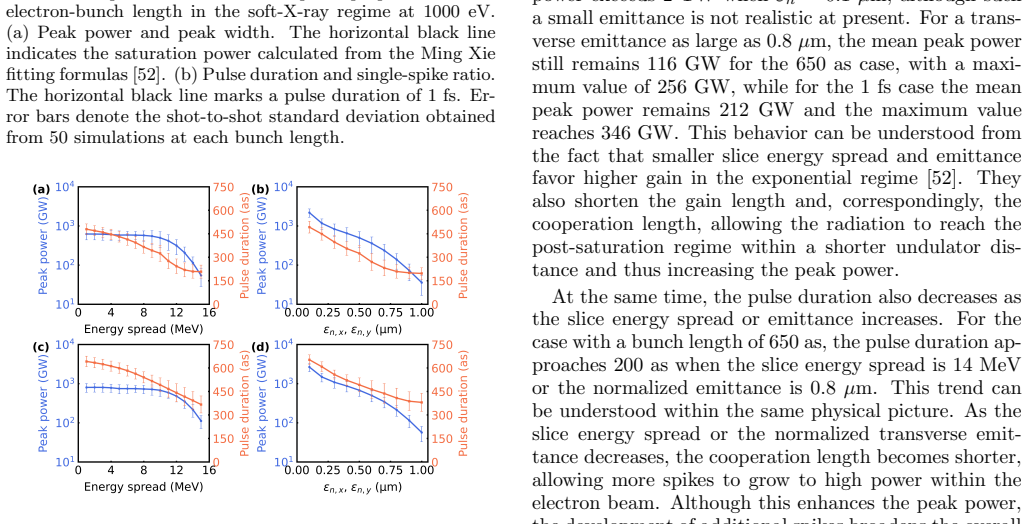
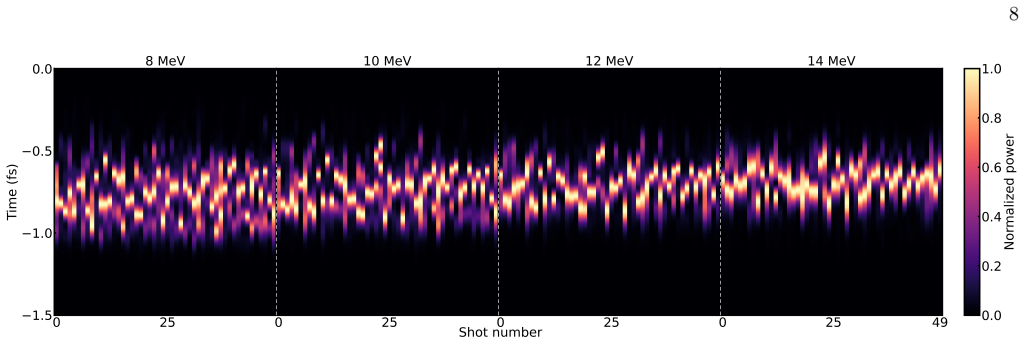
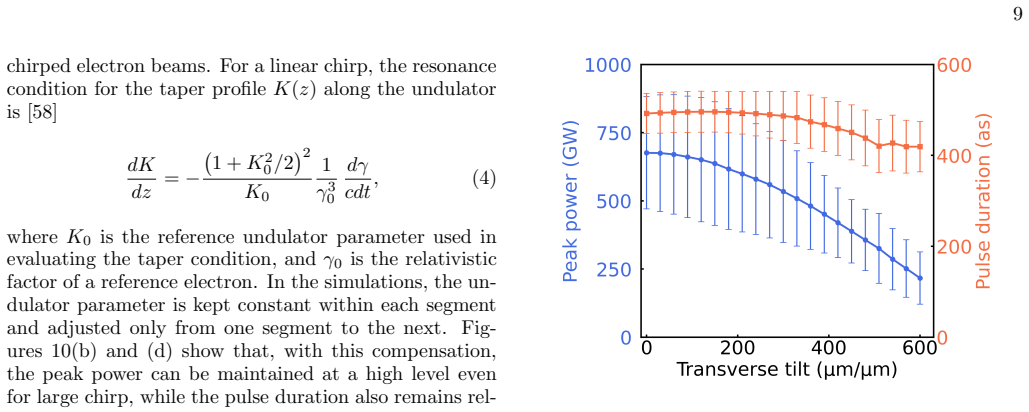
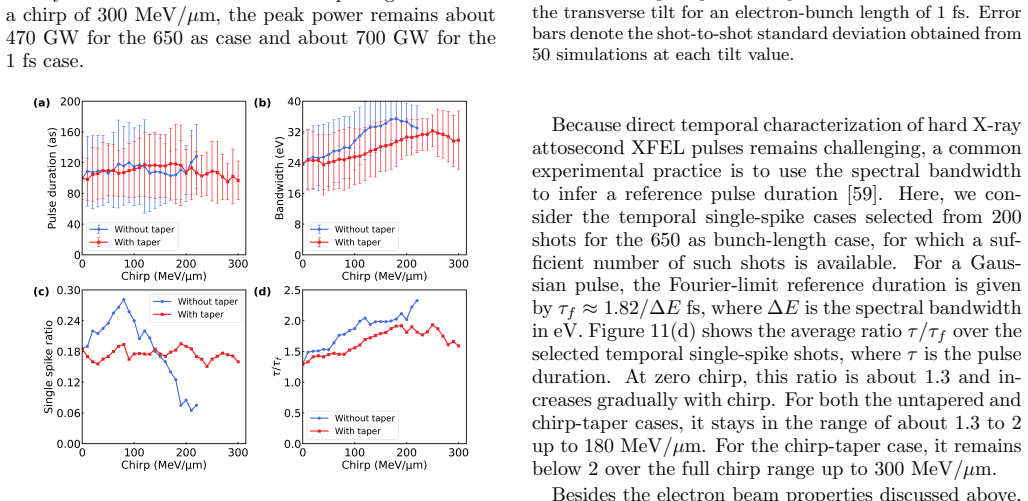
From the perspective of post-saturation superradiant evolution, the effective lasing length of the electron beam governs both the attainable peak power and the pulse duration. The work examines how slice energy spread, slice emittance, energy chirp, undulator tapering, and transverse beam tilt affect this, revealing trade-offs between peak power, pulse shortening, and single-spike probability, and providing guidelines for terawatt-class operation.
What carries the argument
The effective lasing length of the electron beam, which confines XFEL amplification to a short window in the current spike and through post-saturation superradiant evolution sets the output power and duration.
If this is right
- The effective lasing length directly limits the maximum peak power attainable.
- Shorter effective lasing lengths enable shorter pulse durations but may reduce single-spike probability.
- Parameters such as slice energy spread and emittance must be optimized to balance power and pulse quality.
- Undulator tapering and energy chirp play distinct roles in controlling the superradiant evolution.
- These relations hold independently of the specific spike-generation scheme.
Where Pith is reading between the lines
- If the scaling holds, facilities could use it to set beam quality targets without scheme-specific simulations.
- The approach implies that efforts to reduce slice energy spread would directly improve attosecond performance across methods.
- Testable by comparing post-saturation behavior in different spike generation techniques.
- This framework might extend to predicting performance in other ultrafast X-ray sources beyond XFELs.
Load-bearing premise
XFEL amplification in short current spikes is always limited to a short effective lasing window, and post-saturation superradiant evolution quantitatively describes the output for any spike generation method.
What would settle it
Direct measurement of peak power and pulse duration as a function of the effective lasing length in an XFEL experiment, checking if they follow the predicted scaling independent of how the current spike was created.
Figures





read the original abstract
Attosecond pulses from X-ray free-electron laser (XFEL) have opened new opportunities for probing ultrafast electronic dynamics on the Angstrom--attosecond spatiotemporal scale. Most attosecond XFEL concepts rely on generating an ultrashort high-current spike through either external laser modulation or accelerator-based beam manipulation. Despite their different implementations, these approaches share the same essential physics, namely that the XFEL amplification is confined to a short effective lasing window within the electron beam. However, existing studies are often scheme-specific and do not yet provide a unified quantitative picture of how fundamental electron-beam properties constrain high-power attosecond performance. In this work, we investigate the general physics and scheme-independent requirements for generating high-power attosecond X-ray pulses from a short current spike. From the perspective of post-saturation superradiant evolution, we show that the effective lasing length of the electron beam governs both the attainable peak power and the pulse duration. We further examine the distinct roles of slice energy spread, slice emittance, energy chirp, undulator tapering, and transverse beam tilt. Our results reveal the trade-off between peak power, pulse shortening, and single-spike probability, and provide facility-independent guidelines for optimizing electron-beam phase-space manipulation toward terawatt-class attosecond XFEL operation.
Editorial analysis
A structured set of objections, weighed in public.
Referee Report
Summary. The manuscript develops a unified, scheme-independent framework for high-power attosecond XFELs generated from short current spikes in the electron beam. It argues that the effective lasing length within the spike governs both attainable peak power and pulse duration via post-saturation superradiant evolution, examines the distinct roles of slice energy spread, emittance, energy chirp, undulator tapering, and transverse tilt, and identifies trade-offs between peak power, pulse shortening, and single-spike probability to guide optimization toward terawatt-class operation.
Significance. If the central relations hold with quantitative support, the work provides a valuable general perspective that could streamline design strategies across laser-modulation and accelerator-based spike-generation approaches. The focus on effective lasing length as the dominant parameter and the explicit treatment of higher-order phase-space effects represent a strength for the field, particularly if accompanied by reproducible derivations or simulations.
major comments (2)
- [Abstract and central physics section] The central claim that post-saturation superradiant evolution provides a general quantitative description applicable across generation schemes requires explicit demonstration that the effective lasing length is uniquely defined and independent of the spike-generation method (e.g., external laser modulation versus accelerator-based manipulation). Without this, the scheme-independent trade-offs between power, duration, and single-spike probability do not necessarily follow.
- [Sections discussing beam properties and trade-offs] The assertion that higher-order effects (slice energy spread, emittance, chirp, tapering, tilt) enter only as corrections rather than altering the superradiant scaling itself needs concrete validation, such as through parameter scans or comparisons showing that fixing the effective length yields equivalent performance metrics regardless of the underlying phase-space manipulation.
minor comments (2)
- [Abstract] The abstract states the key relations but supplies no equations, derivations, or validation data; including at least the defining relation for effective lasing length and the resulting scaling for power/duration would improve clarity and allow immediate assessment of the claims.
- [Introduction and methods] Notation for 'effective lasing length' and related quantities should be defined consistently and early, with explicit reference to how it is extracted from the current spike profile.
Simulated Author's Rebuttal
We thank the referee for the constructive and detailed review, which highlights key areas where the manuscript can be strengthened. We agree that explicit demonstrations of the scheme-independence of the effective lasing length and concrete validation of higher-order effects as corrections will improve the clarity and impact of the work. We address each major comment below and will revise the manuscript accordingly.
read point-by-point responses
-
Referee: [Abstract and central physics section] The central claim that post-saturation superradiant evolution provides a general quantitative description applicable across generation schemes requires explicit demonstration that the effective lasing length is uniquely defined and independent of the spike-generation method (e.g., external laser modulation versus accelerator-based manipulation). Without this, the scheme-independent trade-offs between power, duration, and single-spike probability do not necessarily follow.
Authors: We appreciate this observation. The effective lasing length is defined in the manuscript as the longitudinal region of the current spike where the local current density exceeds the FEL threshold, determined solely from the spike's current profile and independent of its generation mechanism. The post-saturation superradiant dynamics then follow from 1D FEL theory applied to this length. To address the request for explicit demonstration, we will add a dedicated subsection (with supporting analytical derivations) that compares the resulting power and duration scalings for equivalent effective lengths produced by laser modulation versus accelerator-based methods (e.g., emittance spoiler or dogleg compression). This will include references to existing literature simulations confirming equivalence and will explicitly link the definition to the observed trade-offs in single-spike probability. We believe this addition will make the scheme-independent framework fully rigorous. revision: yes
-
Referee: [Sections discussing beam properties and trade-offs] The assertion that higher-order effects (slice energy spread, emittance, chirp, tapering, tilt) enter only as corrections rather than altering the superradiant scaling itself needs concrete validation, such as through parameter scans or comparisons showing that fixing the effective length yields equivalent performance metrics regardless of the underlying phase-space manipulation.
Authors: We agree that additional concrete validation is warranted. The manuscript derives that these effects primarily reduce the effective lasing length (via dephasing or gain suppression) or introduce secondary corrections to the superradiant pulse shortening, without modifying the core scaling relations derived from the 1D superradiant equations. To provide the requested evidence, we will incorporate parameter scans (via both analytical estimates and 1D FEL simulations) in a new figure and appendix. These scans will hold the effective lasing length fixed while varying slice energy spread, emittance, chirp, tapering, and tilt, demonstrating that peak power and duration remain consistent with the predicted scalings. The revised text will clarify the separation between fundamental scaling and these corrections. revision: yes
Circularity Check
No significant circularity; derivation remains self-contained
full rationale
The paper's central claim—that the effective lasing length governs peak power and pulse duration via post-saturation superradiant evolution—is framed as a general physics perspective applicable across schemes, without any quoted equations, fitted parameters, or self-citations that reduce the result to its own inputs by construction. The abstract and description examine distinct roles of slice energy spread, emittance, chirp, tapering, and tilt as separate factors rather than re-deriving them from the main result. No evidence of self-definitional loops, predictions forced by fits, or ansatzes smuggled via prior self-work appears in the provided material, so the chain is independent and externally grounded in standard XFEL physics.
Axiom & Free-Parameter Ledger
axioms (2)
- domain assumption XFEL amplification is confined to a short effective lasing window within the electron beam
- domain assumption Post-saturation superradiant evolution governs the relationship between lasing length, power, and duration
Reference graph
Works this paper leans on
-
[1]
Driver, M
T. Driver, M. Mountney, J. Wang, L. Ortmann, A. Al- Haddad, N. Berrah, C. Bostedt, E. G. Champenois, L. F. DiMauro, J. Duris,et al., Nature632, 762 (2024)
2024
-
[2]
Goulielmakis, Z.-H
E. Goulielmakis, Z.-H. Loh, A. Wirth, R. Santra, N. Rohringer, V. S. Yakovlev, S. Zherebtsov, T. Pfeifer, A. M. Azzeer, M. F. Kling,et al., Nature466, 739 (2010)
2010
-
[3]
P. M. Kraus, B. Mignolet, D. Baykusheva, A. Ru- penyan, L. Horn` y, E. F. Penka, G. Grassi, O. I. Tol- stikhin, J. Schneider, F. Jensen,et al., Science350, 790 (2015)
2015
-
[4]
Pertot, C
Y. Pertot, C. Schmidt, M. Matthews, A. Chauvet, M. Huppert, V. Svoboda, A. Von Conta, A. Tehlar, D. Baykusheva, J.-P. Wolf,et al., Science355, 264 (2017)
2017
-
[5]
P. M. Paul, E. S. Toma, P. Breger, G. Mullot, F. Aug´ e, P. Balcou, H. G. Muller, and P. Agostini, Science292, 1689 (2001)
2001
-
[6]
Hentschel, R
M. Hentschel, R. Kienberger, C. Spielmann,et al., Na- ture414, 509 (2001)
2001
-
[7]
Mashiko, S
H. Mashiko, S. Gilbertson, C. Li, S. D. Khan, M. M. Shakya, E. Moon, and Z. Chang, Phys. Rev. Lett.100, 103906 (2008)
2008
-
[8]
Krausz and M
F. Krausz and M. Ivanov, Rev. Mod. Phys.81, 163 (2009)
2009
-
[9]
Vincenti and F
H. Vincenti and F. Qu´ er´ e, Phys. Rev. Lett.108, 113904 (2012)
2012
-
[10]
J. Yan, W. Qin, Y. Chen, W. Decking, P. Dijk- stal, M. Guetg, I. Inoue, N. Kujala, S. Liu, T. Long, N. Mirian, and G. Geloni, Nature Photonics18, 1293 (2024)
2024
-
[11]
E. Prat, A. Malyzhenkov, G. L. Orlandi, T. Weilbach, and S. Reiche, Phys. Rev. Res.7, L042060 (2025)
2025
-
[12]
Franz, S
P. Franz, S. Li, T. Driver, R. R. Robles, D. Cesar, E. Isele, Z. Guo, J. Wang, J. P. Duris, K. Larsen,et al., Nature Photonics18, 698 (2024)
2024
-
[13]
Short pulses and 2-color capabilities at the sase3 fel line of the european xfel,
S. Serkez, “Short pulses and 2-color capabilities at the sase3 fel line of the european xfel,” Oral presentation slides at the 40th International Free Electron Laser Con- ference (FEL2022)
-
[14]
Huang, H
N. Huang, H. Deng, B. Liu, D. Wang, and Z. Zhao, The Innovation2, 100097 (2021)
2021
-
[15]
Berrah, J
N. Berrah, J. Cryan, R. Robles, T. Driver, A. Marinelli, and P. Bucksbaum, Adv. Opt. Photon.17, 623 (2025)
2025
-
[17]
I. Inoue, R. Robles, A. Halavanau, V. Guo, T. M. Linker, A. Benediktovitch, S. Chuchurka, M. H. Seaberg, Y. Sun, D. Zhu, D. Cesar, Y. Ding, V. Es- posito, P. Franz, N. S. Sudar, Z. Zhang, T. Osaka, G. Yamaguchi, Y. Sano, K. Yamauchi, J. Yamada, U. Bergmann, M. F. Kling, C. Pellegrini, M. Yabashi, N. Rohringer, T. Sato, and A. Marinelli, “Experimental demo...
-
[18]
Zhu and D
D. Zhu and D. A. Reis, Nature Photonics18, 1232 (2024)
2024
-
[19]
Pellegrini, A
C. Pellegrini, A. Marinelli, and S. Reiche, Rev. Mod. Phys.88, 015006 (2016)
2016
-
[20]
L. H. Yu, Phys. Rev. A44, 5178 (1991)
1991
-
[21]
A. A. Zholents, Physical Review Special Topics – Accel- erators and Beams8, 040701 (2005)
2005
-
[22]
Duris, S
J. Duris, S. Li, T. Driver, and et al., Nature Photonics 14, 30 (2020)
2020
-
[23]
A. A. Zholents and G. Penn, Phys. Rev. ST Accel. Beams8, 050704 (2005)
2005
-
[24]
Y. Ding, Z. Huang, D. Ratner, P. Bucksbaum, and H. Merdji, Phys. Rev. ST Accel. Beams12, 060703 (2009)
2009
-
[25]
Y. Xiao, T. Chen, B. Liu, Z. Huang, M. Pang, Y. Leng, and C. Feng, Ultrafast Science5, 0099 (2025)
2025
-
[26]
J. B. Rosenzweig, D. Alesini, G. Andonian,et al., Nucl. Instrum. Methods Phys. Res. A593, 39 (2008)
2008
-
[27]
Reiche, P
S. Reiche, P. Musumeci, C. Pellegrini, and J. B. Rosen- zweig, Nucl. Instrum. Methods Phys. Res. A593, 45 (2008)
2008
-
[28]
Malyzhenkov, Y
A. Malyzhenkov, Y. P. Arbelo, P. Craievich, P. Dijkstal, E. Ferrari, S. Reiche, T. Schietinger, P. Jurani´ c, and E. Prat, Physical Review Research2, 042018 (2020)
2020
-
[29]
E. Prat, A. Malyzhenkov, C. Arrell,et al., APL Pho- tonics8, 111302 (2023)
2023
-
[30]
B. Yan, C. Xu, S. Chen, D. Gu, Y. Chen, J. Yan, and H. Deng, Ultrafast Science6, 0143 (2026)
2026
-
[31]
Soutome, T
K. Soutome, T. Hara, E. Iwai, K. Yasutome, H. Mae- saka, and H. Tanaka, Phys. Rev. Accel. Beams29, 020701 (2026)
2026
-
[32]
Zhang, J
Z. Zhang, J. Duris, J. P. MacArthur, A. Zholents, Z. Huang, and A. Marinelli, New Journal of Physics 22, 083030 (2020)
2020
-
[33]
S. Li, Z. Zhang, S. Alverson,et al., Appl. Phys. Lett. 125, 191101 (2024)
2024
-
[34]
C. Emma, X. Xu, A. Fisher, R. Robles, J. P. MacArthur, J. Cryan, M. J. Hogan, P. Musumeci, G. White, and A. Marinelli, APL Photonics6, 076107 (2021)
2021
-
[35]
C. H. Shim, Y. W. Parc, S. Kumar, I. S. Ko, and D. E. Kim, Scientific Reports8, 7463 (2018)
2018
-
[36]
C. H. Shim, Y. W. Parc, and D. E. Kim, Scientific Reports10, 1312 (2020)
2020
-
[37]
Baxevanis, J
P. Baxevanis, J. Duris, Z. Huang, and A. Marinelli, Phys. Rev. Accel. Beams21, 110702 (2018)
2018
-
[38]
Bonifacio, L
R. Bonifacio, L. De Salvo Souza, P. Pierini, and N. Pi- ovella, Nuclear Instruments and Methods in Physics Re- 14 search Section A296, 358 (1990)
1990
-
[39]
Bonifacio, L
R. Bonifacio, L. De Salvo, P. Pierini, N. Piovella, and C. Pellegrini, Physical Review Letters73, 70 (1994)
1994
-
[40]
Bonifacio, C
R. Bonifacio, C. Pellegrini, and L. Narducci, Optics Communications50, 373 (1984)
1984
-
[41]
Huang and K.-J
Z. Huang and K.-J. Kim, Phys. Rev. ST Accel. Beams 10, 034801 (2007)
2007
-
[42]
Hemsing, Phys
E. Hemsing, Phys. Rev. Accel. Beams23, 120703 (2020)
2020
-
[43]
Curcio, G
A. Curcio, G. Dattoli, E. Di Palma, and S. Pagnutti, Journal of Applied Physics134, 133103 (2023)
2023
-
[44]
Watanabe, X
T. Watanabe, X. J. Wang, J. B. Murphy, J. Rose, Y. Shen, T. Tsang, L. Giannessi, P. Musumeci, and S. Reiche, Phys. Rev. Lett.98, 034802 (2007)
2007
-
[45]
X. Yang, N. Mirian, and L. Giannessi, Physical Review Accelerators and Beams23, 010703 (2020)
2020
-
[46]
N. S. Mirian, M. Di Fraia, S. Spampinati, F. Sot- tocorona, E. Allaria, L. Badano, M. B. Danailov, A. Demidovich, G. De Ninno, S. Di Mitri, G. Penco, P. Rebernik Ribiˇ c, C. Spezzani, G. Gaio, M. Trov´ o, N. Mahne, M. Manfredda, L. Raimondi, M. Zangrando, O. Plekan, K. C. Prince, T. Mazza, R. J. Squibb, C. Cal- legari, X. Yang, and L. Giannessi, Nature Ph...
2021
-
[47]
Pongchalee and B
P. Pongchalee and B. W. McNeil, Results in Physics60, 107673 (2024)
2024
-
[48]
R. R. Robles, L. Giannessi, and A. Marinelli, Physical Review Research6, 033158 (2024)
2024
-
[49]
Reiche, Nuclear Instruments and Methods in Physics Research Section A: Accelerators, Spectrometers, De- tectors and Associated Equipment429, 243 (1999)
S. Reiche, Nuclear Instruments and Methods in Physics Research Section A: Accelerators, Spectrometers, De- tectors and Associated Equipment429, 243 (1999)
1999
-
[50]
Genesis 1.3 version 4,
S. Reiche, “Genesis 1.3 version 4,”https://github. com/svenreiche/Genesis-1.3-Version4(2022), ac- cessed: 2025-08-07
2022
-
[51]
Reiche and C
S. Reiche and C. Lechner, inProc. 15th International Particle Accelerator Conference (IPAC’24)(JACoW,
-
[52]
Xie, inProceedings of the Particle Accelerator Con- ference (PAC), Vol
M. Xie, inProceedings of the Particle Accelerator Con- ference (PAC), Vol. 1 (IEEE, Dallas, TX, USA, 1995) pp. 183–185
1995
-
[53]
Bonifacio, N
R. Bonifacio, N. Piovella, and G. Robb, Nuclear In- struments and Methods in Physics Research Section A: Accelerators, Spectrometers, Detectors and Associated Equipment543, 645 (2005)
2005
-
[54]
An ultra- stable hard x-ray attosecond split-delay line,
Y. Sun, H. Li, Y. Ichii, and D. Zhu, “An ultra- stable hard x-ray attosecond split-delay line,” (2025), arXiv:2505.06865 [physics.optics]
-
[55]
Huang, M
Z. Huang, M. Borland, P. Emma, J. Wu, C. Limborg, G. Stupakov, and J. Welch, Phys. Rev. ST Accel. Beams7, 074401 (2004)
2004
-
[56]
Ferrario, M
M. Ferrario, M. Migliorati, and L. Palumbo, inProceed- ings of the CAS–CERN Accelerator School: Advanced Accelerator Physics, Vol. 331, edited by W. Herr (Trond- heim, Norway, 2014) cERN-2014-009
2014
-
[57]
Saldin, E
E. Saldin, E. Schneidmiller, and M. Yurkov, Nuclear In- struments and Methods in Physics Research Section A: Accelerators, Spectrometers, Detectors and Associated Equipment398, 373 (1997)
1997
-
[58]
E. L. Saldin, E. A. Schneidmiller, and M. V. Yurkov, Physical Review Special Topics - Accelerators and Beams9, 050702 (2006)
2006
-
[59]
Huang, Y
S. Huang, Y. Ding, Y. Feng, E. Hemsing, Z. Huang, J. Krzywinski, A. A. Lutman, A. Marinelli, T. J. Maxwell, and D. Zhu, Phys. Rev. Lett.119, 154801 (2017)
2017
-
[60]
Emma and Z
P. Emma and Z. Huang, inFree Electron Lasers 2003, edited by E. J. Minehara, R. Hajima, and M. Sawamura (Elsevier, Amsterdam, 2004) pp. 458–462
2003
-
[61]
E. Prat, F. L¨ ohl, and S. Reiche, Phys. Rev. ST Accel. Beams18, 100701 (2015)
2015
-
[62]
Lutman, T
A. Lutman, T. Maxwell, J. MacArthur,et al., Nat. Pho- ton.10, 745 (2016)
2016
-
[63]
M. W. Guetg, A. A. Lutman, Y. Ding, T. J. Maxwell, and Z. Huang, Phys. Rev. Lett.120, 264802 (2018)
2018
-
[64]
Dijkstal, A
P. Dijkstal, A. Malyzhenkov, S. Reiche, and E. Prat, Phys. Rev. Accel. Beams23, 030703 (2020)
2020
-
[65]
Di Mitri, M
S. Di Mitri, M. Cornacchia, and S. Spampinati, Phys. Rev. Lett.110, 014801 (2013)
2013
-
[66]
Y. Jiao, X. Cui, X. Huang, and G. Xu, Phys. Rev. ST Accel. Beams17, 060701 (2014)
2014
-
[67]
T. L. et al., inProc. FEL2022, International Free Electron Laser Conference No. 40 (JACoW Publishing, Geneva, Switzerland, 2022) pp. 246–250
2022
-
[68]
Tanaka, Y
T. Tanaka, Y. W. Parc, Y. Kida, R. Kinjo, C. H. Shim, I. S. Ko, B. Kim, D. E. Kim, and E. Prat, J. Syn- chrotron Radiat.23, 1273 (2016)
2016
-
[69]
E. Prat, Z. Geng, C. Kittel, A. Malyzhenkov, F. Mar- cellini, S. Reiche, T. Schietinger, and P. Craievich, Ad- vanced Photonics7, 026002 (2025)
2025
-
[70]
Pile, Nature Photonics5, 456 (2011)
D. Pile, Nature Photonics5, 456 (2011)
2011
-
[71]
E. Prat, R. Abela, M. Aiba, A. Alarcon, J. Alex, Y. Ar- belo, C. Arrell, V. Arsov, C. Bacellar, C. Beard,et al., Nature Photonics14, 748 (2020)
2020
-
[72]
J. F. Schmerge, A. Brachmann, D. H. Dowell, A. R. Fry, R. Li, Z. Li, T. O. Raubenheimer, T. Vecchione, F. Zhou, A. Bartnik, I. Bazarov, B. M. Dunham, C. Gul- liford, C. Mayes, U. Cornell, A.Lunin, N. A. Solyak, A. Vivoli, D. Filippetto, R. Huang, C. F. Papadopou- los, G. J. Portmann, and B. Lbnl (2015)
2015
-
[73]
F. Zhou, C. Adolphsen, A. Benwell, G. Brown, D. H. Dowell, M. Dunning, S. Gilevich, K. Grouev, G. Huang, B. Jacobson,et al., Physical Review Accelerators and Beams24, 073401 (2021)
2021
-
[74]
Zhao and H
Z. Zhao and H. Ding, inProceedings of the 15th In- ternational Particle Accelerator Conference (IPAC’24), Nashville, TN(2024) pp. 967–972
2024
-
[75]
Zheng, H
L. Zheng, H. Chen, B. Gao, Z. Dong, Z. Li, Y. Jia, Q. Tian, Q. Xia, Y. Zhu, J. You,et al., Physical Review Accelerators and Beams26, 103402 (2023)
2023
-
[76]
X. Wang, L. Zeng, J. Shao, Y. Liang, H. Yi, Y. Yu, J. Sun, X. Li, C. Feng, Z. Wang,et al., inProceedings of the 14th International Particle Accelerator Conference (IPAC’23), Venice, Italy(2023) pp. 1852–1855
2023
-
[77]
Z. Zhu, D. Gu, J. Yan, Z. Wang, H. Yang, M. Zhang, H. Deng, and Q. Gu, Nuclear Instruments and Meth- ods in Physics Research Section A: Accelerators, Spec- trometers, Detectors and Associated Equipment1026, 166172 (2022)
2022
-
[78]
Yamada, S
J. Yamada, S. Matsuyama, I. Inoue,et al., Nat. Photon. 18, 685 (2024)
2024
-
[79]
Inoue, T
I. Inoue, T. Sato, R. Robles,et al., Optica12, 309 (2025)
2025
-
[80]
Duris, Z
J. Duris, Z. Zhang, J. MacArthur, Z. Huang, and A. Marinelli, Phys. Rev. Accel. Beams23, 020702 (2020)
2020
-
[81]
Yan and H
J. Yan and H. Deng, Phys. Rev. Accel. Beams22, 090701 (2019)
2019
discussion (0)
Sign in with ORCID, Apple, or X to comment. Anyone can read and Pith papers without signing in.