Recognition: unknown
Steadily moving semi-infinite fracture in plane poroelasticity
Pith reviewed 2026-05-10 02:42 UTC · model grok-4.3
The pith
The paper develops a boundary integral formulation for steadily moving semi-infinite fractures in poroelastic media.
A machine-rendered reading of the paper's core claim, the machinery that carries it, and where it could break.
Core claim
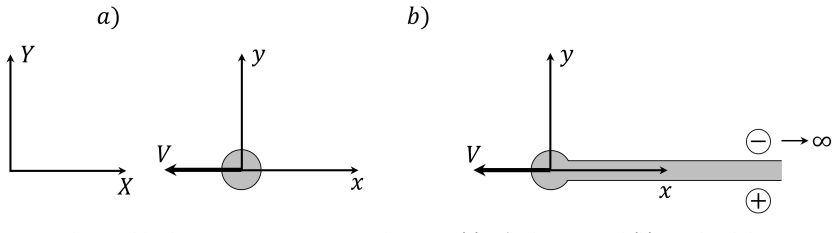
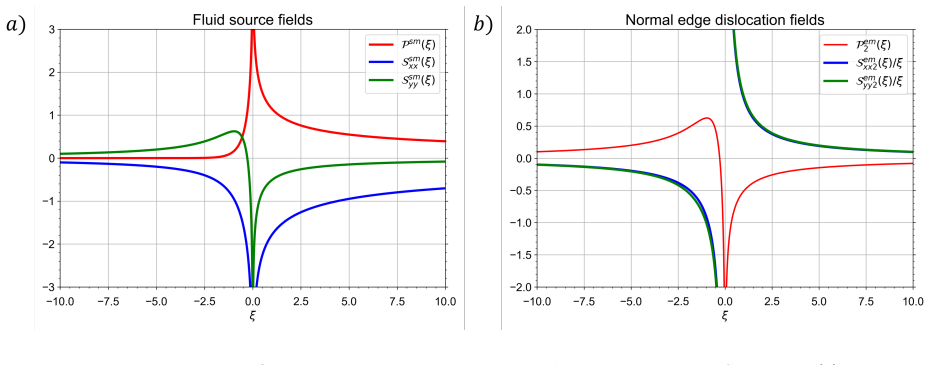
We present a fully coupled boundary integral formulation for modeling steadily propagating semi-infinite plane strain fractures in poroelastic media. By combining fundamental solutions of plane strain poroelasticity for instantaneous fluid source and edge dislocations with temporal and spatial superposition principles, we derive boundary integral equations governing the tractions and pore fluid pressure on the fracture surfaces. Assuming prescribed tractions and pore fluid pressure profiles, we develop a numerical methodology to solve the governing equations for fracture opening, slip, and cumulative fluid exchange rate. The formulation is systematically verified on several relevant problems
What carries the argument
The fully coupled boundary integral formulation derived from temporal and spatial superposition of poroelastic fundamental solutions for an instantaneous fluid source and for edge dislocations (normal and slip modes) in a steadily moving semi-infinite plane strain geometry.
If this is right
- The numerical method computes fracture opening, slip, and cumulative fluid exchange rate from prescribed surface tractions and pore pressures.
- The model captures the full coupling between mechanical stresses and pore fluid diffusion during steady propagation.
- The framework provides a robust tool for analyzing coupled fracture-fluid interactions in permeable poroelastic media.
- The method can be adapted to broader classes of elasto-diffusive problems by modifying the underlying physical parameters.
Where Pith is reading between the lines
- If the steady-state assumption holds, this method could approximate segments of variable-speed fracture growth in larger models.
- Applying the formulation to field data from hydraulic fracturing operations would test its practical utility for predicting fluid leak-off.
- Similar superposition techniques might extend to other moving boundary problems in diffusive materials.
Load-bearing premise
The tractions and pore fluid pressures on the fracture surfaces must be known ahead of time, and the propagation must be steady and semi-infinite for the superposition of fundamental solutions to hold directly.
What would settle it
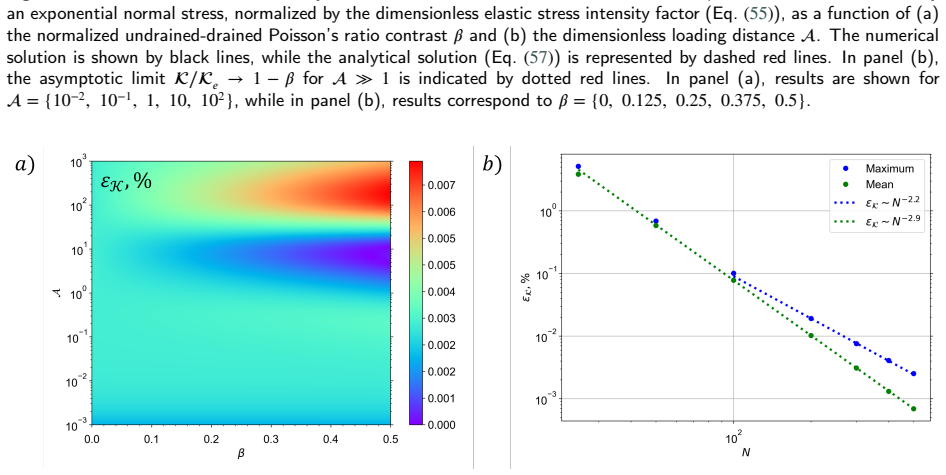
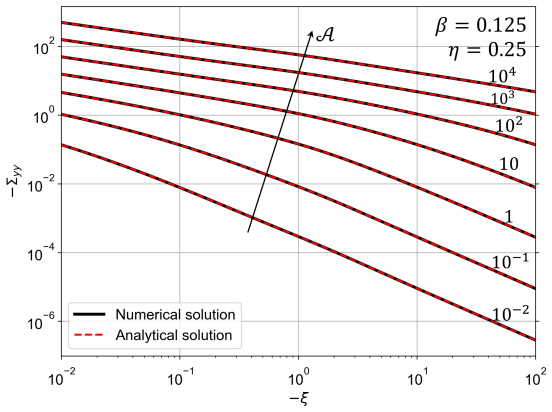
Comparing the numerically obtained fracture opening profile and fluid exchange rate to the exact analytical solution for the case of a stress-free tensile fracture with imposed exponential pore fluid pressure would directly test the correctness of the derived boundary integral equations.
Figures







read the original abstract
We present a fully coupled boundary integral formulation for modeling steadily propagating semi-infinite plane strain fractures in poroelastic media. By combining fundamental solutions of plain strain poroelasticity for instantaneous fluid source and edge dislocations (normal and slip modes) with temporal and spatial superposition principles, we derive boundary integral equations governing the tractions (normal and shear stresses) and pore fluid pressure on the fracture surfaces. Assuming prescribed tractions and pore fluid pressure profiles, we develop a numerical methodology to solve the governing equations for fracture opening, slip, and cumulative fluid exchange rate. The formulation is systematically verified on several relevant problems, including the case of a tensile fracture with exponential normal loading, a stress-free tensile fracture with an imposed exponential pore fluid pressure, and a shear fracture under uniform shear loading over a finite region, demonstrating excellent agreement with analytical solutions. The framework provides a robust tool for analyzing coupled fracture-fluid interactions in permeable poroelastic media and can be adapted to broader classes of elasto-diffusive problems by modifying the underlying physical parameters.
Editorial analysis
A structured set of objections, weighed in public.
Referee Report
Summary. The paper presents a fully coupled boundary integral equation (BIE) formulation for steadily propagating semi-infinite plane-strain fractures in poroelastic media. It combines fundamental solutions for instantaneous fluid sources and normal/slip edge dislocations with spatial-temporal superposition in the moving frame to obtain integral equations relating surface tractions, pore pressure, opening, slip, and fluid exchange. Assuming prescribed traction and pressure profiles on the fracture faces, a numerical scheme is developed and verified against closed-form analytical solutions on three test problems (exponential normal loading on a tensile fracture, imposed exponential pore pressure on a stress-free tensile fracture, and uniform shear over a finite patch on a shear fracture), with reported pointwise agreement.
Significance. If the central formulation and verifications hold, the work supplies a parameter-free, reproducible numerical tool for coupled hydro-mechanical analysis of propagating fractures in permeable poroelastic solids. This is directly relevant to geophysical applications such as hydraulic fracturing and fault slip. The explicit use of established poroelastic fundamental solutions plus linear superposition, together with systematic comparison to analytical benchmarks on three distinct loading configurations, constitutes a clear strength that supports extensibility to other elasto-diffusive problems.
major comments (2)
- [Numerical methodology and verification] The numerical methodology section does not specify the discretization (collocation vs. Galerkin, element type, quadrature rule for singular kernels) or the convergence criteria employed when solving the resulting system for opening and slip; without these details the reported excellent agreement with the three analytical solutions cannot be independently reproduced or assessed for robustness under mesh refinement.
- [Formulation and governing equations] The derivation assumes that the fracture propagates at constant speed with all fields steady in the moving frame; the manuscript should explicitly state the range of validity (e.g., when transient diffusion length scales remain comparable to the process zone) because violation of this assumption would invalidate the superposition used to obtain the BIE kernels.
minor comments (2)
- A short table summarizing the three verification cases (loading type, analytical solution reference, reported error metric) would improve readability and allow quick comparison of accuracy across normal, pressure-driven, and shear modes.
- Notation for the poroelastic parameters (e.g., Biot coefficient, diffusivity) should be collected in a single nomenclature table or defined at first appearance to avoid ambiguity when the formulation is adapted to other materials.
Simulated Author's Rebuttal
We thank the referee for their constructive comments and positive recommendation. We address each major point below and will revise the manuscript to improve reproducibility and clarity.
read point-by-point responses
-
Referee: [Numerical methodology and verification] The numerical methodology section does not specify the discretization (collocation vs. Galerkin, element type, quadrature rule for singular kernels) or the convergence criteria employed when solving the resulting system for opening and slip; without these details the reported excellent agreement with the three analytical solutions cannot be independently reproduced or assessed for robustness under mesh refinement.
Authors: We agree that these implementation details are required for independent reproduction and assessment of robustness. The manuscript currently lacks an explicit description of the discretization approach, quadrature rules, and convergence criteria. In the revised version we will add a dedicated paragraph in the numerical methodology section specifying the collocation scheme, element type, treatment of singular kernels, and the residual-based convergence tolerance used for the reported solutions. revision: yes
-
Referee: [Formulation and governing equations] The derivation assumes that the fracture propagates at constant speed with all fields steady in the moving frame; the manuscript should explicitly state the range of validity (e.g., when transient diffusion length scales remain comparable to the process zone) because violation of this assumption would invalidate the superposition used to obtain the BIE kernels.
Authors: The steady-state assumption in the moving frame is fundamental to the superposition that yields the time-independent kernels. We will revise the formulation section to include an explicit statement of the validity range, noting that the approach holds when the fracture velocity is sufficiently high that diffusive transients remain negligible relative to the process-zone length scale (i.e., when the diffusion length is comparable to or smaller than the characteristic length over which the prescribed tractions or pressures vary). revision: yes
Circularity Check
Derivation relies on standard fundamental solutions and superposition; no circularity
full rationale
The paper constructs its boundary integral formulation by superposing established fundamental solutions (instantaneous fluid source and normal/slip edge dislocations) from plane poroelasticity together with temporal-spatial superposition in the moving frame. These kernels are external, pre-existing results rather than derived or fitted inside the paper. The governing equations are solved numerically under explicitly prescribed surface tractions and pore pressure, then verified pointwise against independent closed-form analytical solutions on three separate test problems. No step equates a derived quantity to its own input by definition, renames a fitted parameter as a prediction, or rests on a self-citation chain whose validity is presupposed by the present work. The derivation is therefore self-contained against external benchmarks.
Axiom & Free-Parameter Ledger
axioms (2)
- standard math Linear superposition in space and time holds for the governing poroelastic equations
- domain assumption Fundamental solutions exist for an instantaneous fluid source and for normal/slip edge dislocations in plane-strain poroelasticity
Reference graph
Works this paper leans on
-
[1]
Pergamon Press
Fundamentals of poroelasticity, in: Comprehensive Rock Engineering. Pergamon Press. Detournay,E.,Garagash,D.,2003. Thenear-tipregionofafluid-drivenfracturepropagatinginapermeableelasticsolid. JournalofFluidMechanics 494, 1–32. Dontsov, E.,
2003
-
[2]
Computer Methods in Applied Mechanics and Engineering 313, 53–84
A multiscale implicit level set algorithm (ilsa) to model hydraulic fracture propagation incorporating combined viscous, toughness, and leak-off asymptotics. Computer Methods in Applied Mechanics and Engineering 313, 53–84. Dontsov,E.V.,2016. Anapproximatesolutionforapenny-shapedhydraulicfracturethataccountsforfracturetoughness,fluidviscosityandleak-off. ...
2016
-
[3]
International Journal of Rock Mechanics and Mining Sciences 108, 198–208
Influence of pore pressure on the development of a hydraulic fracture in poroelastic medium. International Journal of Rock Mechanics and Mining Sciences 108, 198–208. Hills,D.A.,Kelly,P.,Dai,D.,Korsunsky,A.,2013. Solutionofcrackproblems: thedistributeddislocationtechnique.volume44. SpringerScience & Business Media. Irwin, G.R.,
2013
-
[4]
Computer Methods in Preprint submitted to Journal of the Mechanics and Physics of SolidsPage 35 of 36 Applied Mechanics and Engineering 283, 881–908
Modeling multi-scale processes in hydraulic fracture propagation using the implicit level set algorithm. Computer Methods in Preprint submitted to Journal of the Mechanics and Physics of SolidsPage 35 of 36 Applied Mechanics and Engineering 283, 881–908. Peirce,A.,Detournay,E.,2008. Animplicitlevelsetmethodformodelinghydraulicallydrivenfractures. Computer...
2008
-
[5]
International Journal for Numerical and Analytical Methods in Geomechanics 13, 215–224
A two-dimensional poroelastic displacement discontinuity method for hydraulic fracture simu- lation. International Journal for Numerical and Analytical Methods in Geomechanics 13, 215–224. Viesca,R.C.,Garagash,D.I.,2018. Numericalmethodsforcoupledfractureproblems. JournaloftheMechanicsandPhysicsofSolids113,13–34. Weertman, J.,
2018
-
[6]
Journal of the Mechanics and Physics of Solids 118, 15–39
Steady-state crack growth in polymer gels: a linear poroelastic analysis. Journal of the Mechanics and Physics of Solids 118, 15–39. Yu,Y.,Landis,C.M.,Huang,R.,2020b. Poroelasticeffectsonsteadystatecrackgrowthinpolymergelsunderplanestress. MechanicsofMaterials 143, 103320. Zhou,S.,Zhuang,X.,Rabczuk,T.,2018. Aphase-fieldmodelingapproachoffracturepropagatio...
2018
discussion (0)
Sign in with ORCID, Apple, or X to comment. Anyone can read and Pith papers without signing in.