Recognition: unknown
A Census of Na D-traced neutral ISM and outflows at 0.6<z<4
Pith reviewed 2026-05-10 04:14 UTC · model grok-4.3
The pith
Na D absorption shows AGN drive neutral outflows in quiescent galaxies at 0.6<z<4 while star formation drives them in active systems.
A machine-rendered reading of the paper's core claim, the machinery that carries it, and where it could break.
Core claim
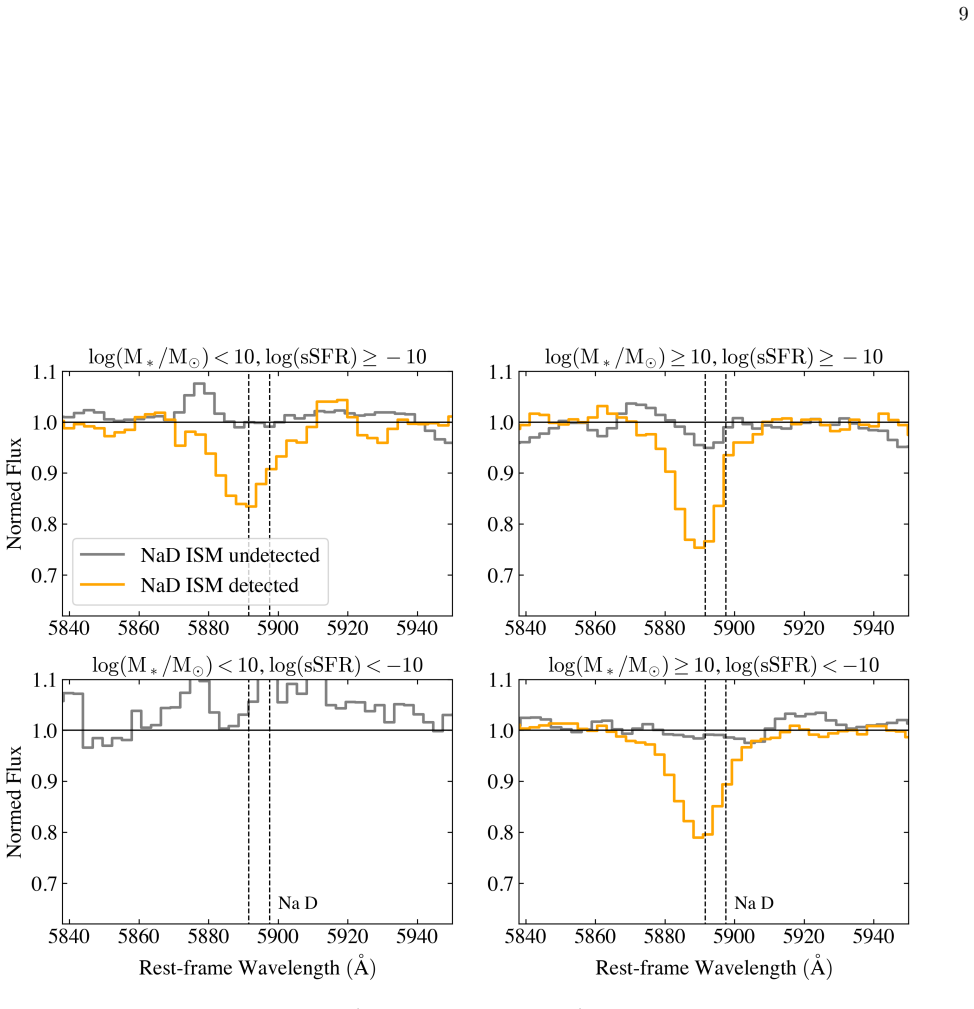
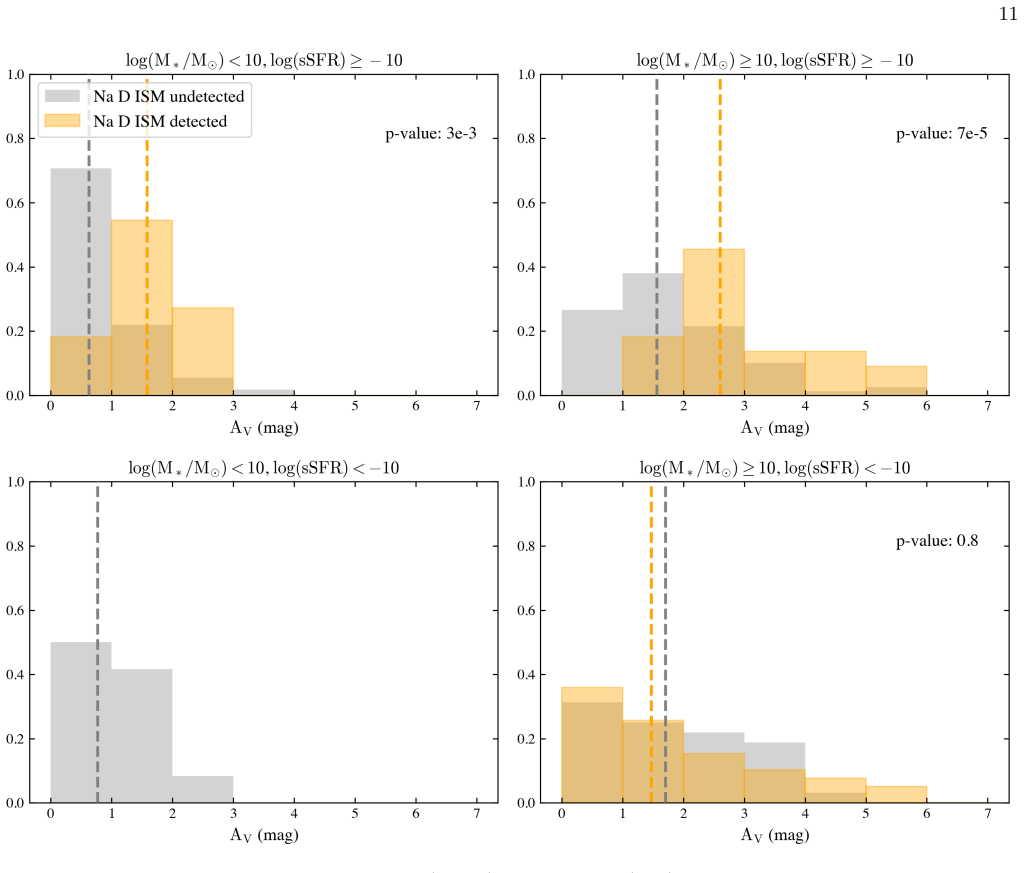
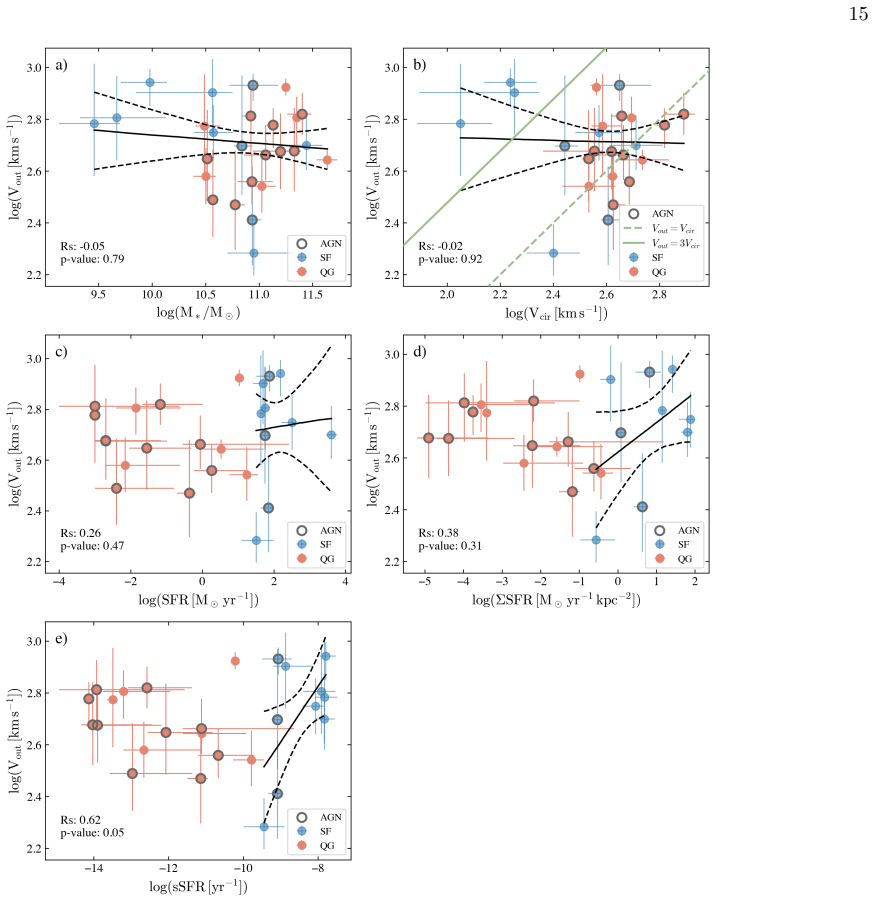
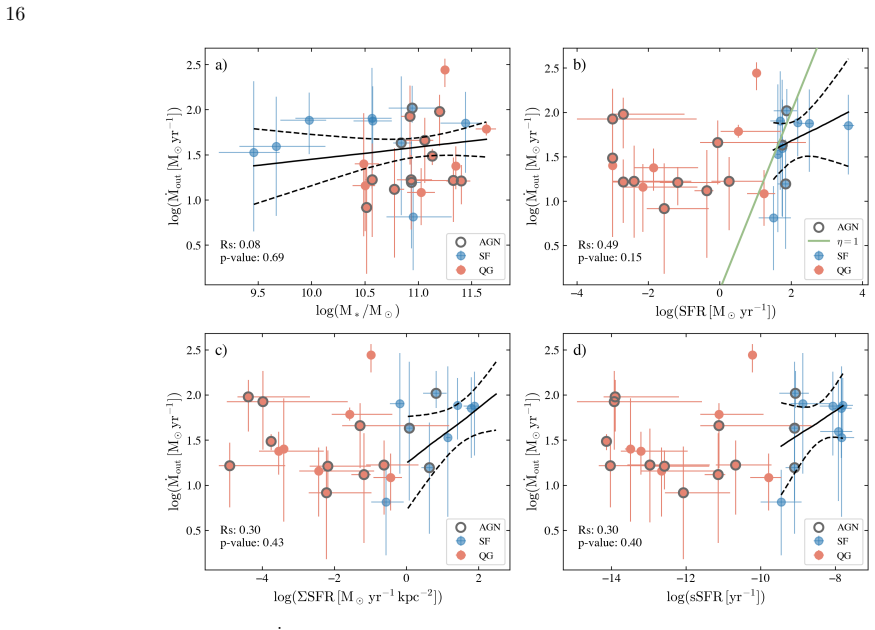
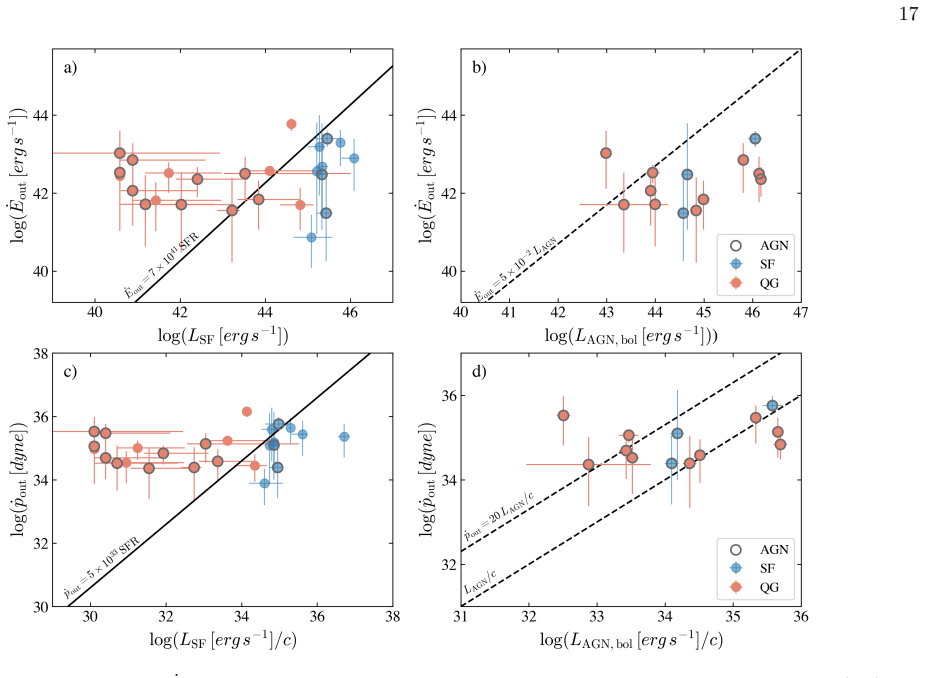
After stellar continuum subtraction, Na D absorption traces neutral ISM in 76 galaxies and outflows in 26. In massive quiescent galaxies detection correlates with older stellar populations or recent rapid quenching. Outflow velocities and equivalent widths in star-forming galaxies scale with star-formation rate, consistent with stellar feedback. In quiescent galaxies the outflows lack this correlation, exceed the energy budget of residual star formation, and coincide with a high AGN fraction, indicating AGN dominance and the existence of lingering AGN-driven outflows after accretion has ceased.
What carries the argument
Na D λλ5890,5896 absorption lines modeled after stellar continuum subtraction to isolate neutral gas kinematics and column densities.
If this is right
- Neutral outflows in star-forming galaxies at these redshifts are primarily powered by stellar processes.
- AGN activity can sustain neutral outflows in galaxies that have already quenched star formation.
- Fossil AGN outflows may continue to regulate gas in quiescent systems after the black hole has stopped accreting.
- Na D absorption provides a practical tracer for neutral gas even in massive quiescent galaxies at cosmic noon.
Where Pith is reading between the lines
- Galaxy evolution models that quench star formation must include a mechanism for long-lived neutral outflows to prevent gas re-accretion.
- Multi-wavelength follow-up could test whether the same galaxies show ionized or molecular outflows with matching kinematics.
- The preference for older or recently quenched massive galaxies suggests Na D detectability may mark different stages of the quenching sequence.
Load-bearing premise
The energy budget calculations for outflows in quiescent galaxies are accurate enough to show they exceed what residual star formation can supply, and the high AGN fraction is not an artifact of modeling choices or selection biases.
What would settle it
A direct measurement of residual star-formation rates in the 26 outflow hosts that finds enough young stars or supernovae to match the observed outflow energy in the quiescent subset.
Figures






read the original abstract
We present a statistical census of the Na D-traced neutral interstellar medium (ISM) and outflows in 309 galaxies at $0.6<z<4$ using JWST/NIRSpec medium-resolution grating spectroscopy from the SMILES, JADES, Blue Jay, and Aurora surveys. After subtracting the stellar continuum, we model the Na D $\lambda\lambda 5890, 5896$ \AA and detect neutral ISM absorption in 76 galaxies. Of the Na D-traced ISM detections, 85\% are found in massive galaxies ($\log(M_*/M_\odot)>10$), and only 15\% in lower-mass systems. In the massive regime, ISM absorption is seen in both star-forming and quiescent galaxies, whereas in lower-mass systems it is observed only in star-forming galaxies. In massive quiescent galaxies, Na D detectability appears linked to star formation history: it is preferentially detected in older systems with larger 4000 \AA breaks, as well as younger, rapidly quenching galaxies with strong Balmer absorption H$\delta_A$. We identify Na D outflows in 26 galaxies, revealing a possible dichotomy in their driving mechanisms between star-forming and quiescent galaxies. In star-forming galaxies, outflow properties correlate with star-formation properties, consistent with a star-formation-driven origin. In quiescent galaxies, however, outflows are not associated with residual star formation and often require more energy than such star formation can provide. Together with the high AGN fraction among outflow-detected quiescent galaxies, this suggests that AGN dominate Na D-traced neutral outflows in cosmic noon quiescent systems. We further identify five quiescent galaxies with possible AGN fossil outflows, suggesting that AGN-driven outflows can persist beyond the active accretion phase and may help maintain quiescence.
Editorial analysis