Recognition: unknown
Photoinduced orbital polarization and Jahn-Teller effect in RNiO₃
Pith reviewed 2026-05-10 03:40 UTC · model grok-4.3
The pith
Linearly polarized light induces orbital polarization and drives Jahn-Teller distortions in rare-earth nickelates.
A machine-rendered reading of the paper's core claim, the machinery that carries it, and where it could break.
Core claim
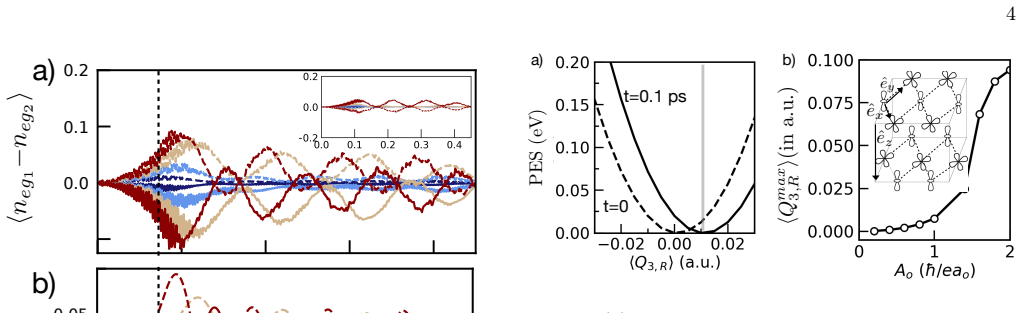
Using an interacting multiband tight-binding model together with real-time simulations of electron-ion-spin dynamics, the authors demonstrate that photoinduced d-d transitions reduce local magnetic moments at Ni sites and suppress effective Hund's coupling J. When the light polarization is chosen to make the transitions orbital-selective, an imbalance appears in the eg orbital occupancies. The resulting nonequilibrium configuration with lowered J and unequal orbital populations is unstable toward Jahn-Teller distortions, so the lattice relaxes along coherently excited JT modes.
What carries the argument
Orbital-selective d-d transitions driven by linearly polarized light, which suppress effective Hund's coupling and create eg orbital population imbalance that destabilizes the system toward Jahn-Teller distortions.
If this is right
- Polarization control of the pump light opens a pathway to nonthermal phases that exhibit emergent orbital order.
- The nonequilibrium state relaxes structurally along coherently excited Jahn-Teller modes on ultrafast timescales.
- Local Ni magnetic moments are reduced while effective Hund's coupling is suppressed in the excited state.
- Charge, spin, and lattice degrees of freedom become coherently coupled through the photoinduced orbital imbalance.
Where Pith is reading between the lines
- Similar polarization-selective excitation might activate hidden orbital degrees of freedom in other transition-metal oxides that show breathing-mode distortions.
- The mechanism suggests a route to ultrafast, light-controlled switching of orbital and structural order without heating the sample.
- Time-resolved measurements with variable pump polarization could map the threshold for JT instability as a function of orbital imbalance.
Load-bearing premise
The interacting multiband tight-binding model with real-time electron-ion-spin dynamics faithfully reproduces the photoinduced reduction in Hund's coupling and the resulting instability to lattice distortions.
What would settle it
Time-resolved X-ray diffraction or spectroscopy that shows polarization-dependent coherent oscillations along JT modes or signatures of eg orbital imbalance only for specific linear polarizations of the pump pulse.
Figures


read the original abstract
The orbital degree of freedom in rare-earth nickelates is typically inactive across the temperature-driven metal-insulator transition, where the system develops two inequivalent Ni sites associated with Ni-O bond disproportionation and breathing-mode distortions of NiO$_6$ octahedra. Here, we show that orbital polarization can be induced by optical excitation with linearly polarized light. Using an interacting multiband tight-binding model combined with real-time simulations of coupled electron-ion-spin dynamics, we find that photoinduced $d$-$d$ transitions reduce the local magnetic moments at Ni sites and effectively suppress Hund's coupling $J$ in the excited state. Importantly, these transitions can be made strongly orbital-selective by tuning the light polarization, leading to an imbalance in $e_g$ orbital occupancies. The resulting nonequilibrium state, characterized by reduced effective $J$ and unequal orbital populations, becomes unstable toward Jahn-Teller (JT) distortions, driving structural relaxation along coherently excited JT modes. Our results demonstrate that polarization-controlled optical excitation provides a pathway to access hidden nonthermal phases with emergent orbital order, enabling coherent control of coupled charge, spin, and lattice degrees of freedom on ultrafast timescales.
Editorial analysis
A structured set of objections, weighed in public.
Referee Report
Summary. The manuscript claims that in rare-earth nickelates RNiO3, optical excitation with linearly polarized light induces orbital-selective d-d transitions within an interacting multiband tight-binding model. Real-time simulations of coupled electron-ion-spin dynamics show that these transitions reduce local Ni magnetic moments and suppress effective Hund's coupling J, creating an imbalance in eg orbital occupancies. The resulting nonequilibrium state is unstable to Jahn-Teller distortions, leading to coherent structural relaxation along JT modes and access to nonthermal orbital-ordered phases.
Significance. If the results hold, the work identifies a polarization-tunable pathway to emergent orbital order and JT-driven structural changes on ultrafast timescales in correlated oxides. A clear strength is the explicit construction of the Hamiltonian with listed tight-binding parameters, dipole matrix elements for linear polarization, and the time-dependent equations of motion for electrons, spins, and ions, which supports reproducibility and avoids circularity in the derivation of orbital selectivity and effective-J reduction.
minor comments (2)
- [Methods/Results] The time-dependent equations of motion for the ionic displacements along the JT coordinates (likely in the methods or results section) would benefit from an explicit statement of the effective potential or force term used to observe the coherent relaxation.
- [Model description] A summary table collecting all Hamiltonian parameters (hopping amplitudes, J, interaction strengths, and dipole matrix elements) would improve clarity and allow readers to reproduce the orbital-selectivity results without searching the text.
Simulated Author's Rebuttal
We thank the referee for the positive assessment of our work and the recommendation for minor revision. The referee's summary accurately captures the central claims regarding polarization-controlled photoinduced orbital selectivity, effective Hund's coupling suppression, and the resulting instability toward Jahn-Teller distortions in RNiO3.
Circularity Check
No significant circularity detected
full rationale
The derivation proceeds from an explicit interacting multiband tight-binding Hamiltonian whose light-matter term contains polarization-dependent dipole matrix elements, followed by real-time integration of coupled electron-ion-spin equations of motion. Orbital imbalance, effective-J suppression, and coherent JT-mode relaxation are direct numerical outputs of these dynamics once the nonequilibrium orbital populations are established; none of these quantities is presupposed by definition, obtained by fitting a subset and relabeling the fit as a prediction, or justified solely by a self-citation chain. The model parameters and equations are stated independently of the target phenomena, rendering the reported pathway self-contained.
Axiom & Free-Parameter Ledger
free parameters (2)
- Hund's coupling J
- Tight-binding parameters
axioms (2)
- domain assumption The multiband tight-binding Hamiltonian accurately represents the electronic structure and interactions in RNiO3.
- domain assumption Real-time simulations of coupled electron-ion-spin dynamics faithfully reproduce the photoinduced orbital and structural evolution.
Forward citations
Cited by 1 Pith paper
-
Non-magnetic insulating phase induced by Jahn-Teller effect in RNiO$_3$
A tight-binding model for RNiO3 predicts a non-magnetic insulating phase with charge and orbital order induced by Jahn-Teller distortions, showing magnetism is not required for the metal-insulator transition.
Reference graph
Works this paper leans on
-
[1]
J. A. Alonso, J. L. García-Muñoz, M. T. Fernández-Díaz, M. A. G. Aranda, M. J. Martínez-Lope, and M. T. Ca- sais, Phys. Rev. Lett.82, 3871 (1999)
1999
-
[2]
J. A. Alonso, M. J. Martínez-Lope, M. T. Casais, J. L. García-Muñoz, M. T. Fernández-Díaz, and M. A. G. Aranda, Phys. Rev. B64, 094102 (2001)
2001
-
[3]
M. L. Medarde, Journal of Physics: Condensed Matter 9, 1679 (1997)
1997
-
[4]
Mizokawa, D
T. Mizokawa, D. I. Khomskii, and G. A. Sawatzky, Phys. Rev. B61, 11263 (2000)
2000
-
[5]
Varignon, M
J. Varignon, M. N. Grisolia, J. Íñiguez, A. Barthélémy, and M. Bibes, npj Quantum Materials2, 21 (2017)
2017
-
[6]
H. Park, A. J. Millis, and C. A. Marianetti, Phys. Rev. Lett.109, 156402 (2012)
2012
-
[7]
M. K. Stewart, J. Liu, M. Kareev, J. Chakhalian, and D. N. Basov, Phys. Rev. Lett.107, 176401 (2011)
2011
-
[8]
Chakhalian, J
J. Chakhalian, J. M. Rondinelli, J. Liu, B. A. Gray, M. Kareev, E. J. Moon, N. Prasai, J. L. Cohn, M. Varela, I. C. Tung, M. J. Bedzyk, S. G. Altendorf, F. Strigari, B. Dabrowski, L. H. Tjeng, P. J. Ryan, and J. W. Free- land, Phys. Rev. Lett.107, 116805 (2011)
2011
-
[9]
J. B. Torrance, P. Lacorre, A. I. Nazzal, E. J. Ansaldo, and C. Niedermayer, Phys. Rev. B45, 8209 (1992)
1992
-
[10]
D. Nicoletti and A. Cavalleri, Advances in Optics and Photonics8, 401 (2016), arXiv:1608.05611 [cond-mat.str- el]
-
[11]
A. D. Caviglia, M. Först, R. Scherwitzl, V. Khanna, H. Bromberger, R. Mankowsky, R. Singla, Y.-D. Chuang, W. S. Lee, O. Krupin, W. F. Schlotter, J. J. Turner, G. L. Dakovski, M. P. Minitti, J. Robinson, V. Scagnoli, S. B. Wilkins, S. A. Cavill, M. Gibert, S. Gariglio, P. Zubko, J.-M. Triscone, J. P. Hill, S. S. Dhesi, and A. Cavalleri, Phys. Rev. B88, 220...
2013
-
[12]
V. A. Stoica, D. Puggioni, J. Zhang, R. Singla, G. L. Dakovski, G. Coslovich, M. H. Seaberg, M. Kareev, S. Middey, P. Kissin, R. D. Averitt, J. Chakhalian, H. Wen, J. M. Rondinelli, and J. W. Freeland, Phys. Rev. B106, 165104 (2022)
2022
-
[13]
O. E. Peil, M. Ferrero, and A. Georges, Phys. Rev. B 90, 045128 (2014)
2014
-
[14]
He and A
Z. He and A. J. Millis, Phys. Rev. B91, 195138 (2015)
2015
-
[15]
Kanamori, Progress of Theoretical Physics30, 275 (1963), https://academic.oup.com/ptp/article- pdf/30/3/275/5278869/30-3-275.pdf
J. Kanamori, Progress of Theoretical Physics30, 275 (1963), https://academic.oup.com/ptp/article- pdf/30/3/275/5278869/30-3-275.pdf
1963
-
[16]
Georges, L
A. Georges, L. d. Medici, and J. Mravlje, Annual Review of Condensed Matter Physics4, 137 (2013)
2013
-
[17]
M. Sotoudeh, S. Rajpurohit, P. Blöchl, D. Mierwaldt, J. Norpoth, V. Roddatis, S. Mildner, B. Kressdorf, B. Ifland, and C. Jooss, ArXiv e-prints (2016), arXiv:1610.07548 [cond-mat.mtrl-sci]
-
[18]
I. I. Mazin, D. I. Khomskii, R. Lengsdorf, J. A. Alonso, W. G. Marshall, R. M. Ibberson, A. Podlesnyak, M. J. Martínez-Lope, and M. M. Abd-Elmeguid, Phys. Rev. Lett.98, 176406 (2007)
2007
-
[19]
D. R. Hofstadter, Phys. Rev. B14, 2239 (1976)
1976
-
[20]
A. S. Moskvin, A. A. Makhnev, L. V. Nomerovannaya, N. N. Loshkareva, and A. M. Balbashov, Phys. Rev. B 82, 035106 (2010)
2010
-
[21]
Ifland, J
B. Ifland, J. Hoffmann, B. Kressdorf, V. Roddatis, M. Seibt, and C. Jooss, New Journal of Physics19, 063046 (2017)
2017
-
[22]
Torriss, J
B. Torriss, J. Margot, and M. Chaker, Scientific Reports 7, 40915 (2017)
2017
-
[23]
D. R. Baykusheva, H. Jang, A. A. Husain, S. Lee, S. F. R. TenHuisen, P. Zhou, S. Park, H. Kim, J.-K. Kim, H.-D. Kim, M. Kim, S.-Y. Park, P. Abbamonte, B. J. Kim, G. D. Gu, Y. Wang, and M. Mitrano, Phys. Rev. X12, 011013 (2022)
2022
-
[24]
Grånäs, I
O. Grånäs, I. Vaskivskyi, X. Wang, P. Thunström, S. Ghimire, R. Knut, J. Söderström, L. Kjellsson, D. Turenne, R. Y. Engel, M. Beye, J. Lu, D. J. Higley, A. H. Reid, W. Schlotter, G. Coslovich, M. Hoffmann, G. Kolesov, C. Schüßler-Langeheine, A. Styervoyedov, N. Tancogne-Dejean, M. A. Sentef, D. A. Reis, A. Rubio, S. S. P. Parkin, O. Karis, J.-E. Rubensso...
2022
-
[25]
Tancogne-Dejean, M
N. Tancogne-Dejean, M. A. Sentef, and A. Rubio, Phys. Rev. Lett.121, 097402 (2018)
2018
-
[26]
Ehrke, R
H. Ehrke, R. I. Tobey, S. Wall, S. A. Cavill, M. Först, V. Khanna, T. Garl, N. Stojanovic, D. Prabhakaran, A. T. Boothroyd, M. Gensch, A. Mirone, P. Reutler, A. Revcolevschi, S. S. Dhesi, and A. Cavalleri, Phys. Rev. Lett.106, 217401 (2011)
2011
-
[27]
J. A. Johnson, T. Kubacka, M. C. Hoffmann, C. Vi- cario, S. de Jong, P. Beaud, S. Grübel, S.-W. Huang, L. Huber, Y. W. Windsor, E. M. Bothschafter, L. Ret- tig, M. Ramakrishnan, A. Alberca, L. Patthey, Y.-D. Chuang, J. J. Turner, G. L. Dakovski, W.-S. Lee, M. P. Minitti, W. Schlotter, R. G. Moore, C. P. Hauri, S. M. Koohpayeh, V. Scagnoli, G. Ingold, S. L...
2015
-
[28]
Beaud, S
P. Beaud, S. L. Johnson, A. Streun, R. Abela, D. Abram- sohn, D. Grolimund, F. Krasniqi, T. Schmidt, V. Schlott, and G. Ingold, Phys. Rev. Lett.99, 174801 (2007)
2007
-
[29]
M. P. M. Dean, Y. Cao, X. Liu, S. Wall, D. Zhu, R. Mankowsky, V. Thampy, X. M. Chen, J. G. Vale, D. Casa, J. Kim, A. H. Said, P. Juhas, R. Alonso-Mori, J. M. Glownia, A. Robert, J. Robinson, M. Sikorski, S. Song, M. Kozina, H. Lemke, L. Patthey, S. Owada, T. Katayama, M. Yabashi, Y. Tanaka, T. Togashi, J. Liu, C. Rayan Serrao, B. J. Kim, L. Huber, C. L. C...
2016
-
[30]
M. Mitrano, S. Lee, A. A. Husain, L. Delacretaz, M. Zhu, G. de la Peña Munoz, S. X.-L. Sun, Y. I. Joe, A. H. Reid, S. F. Wandel, G. Coslovich, W. Schlotter, T. van Driel, J. Schneeloch, G. D. Gu, S. Hartnoll, N. Goldenfeld, andP.Abbamonte,ScienceAdvances5,eaax3346(2019), https://www.science.org/doi/pdf/10.1126/sciadv.aax3346
-
[31]
Y. Cao, D. G. Mazzone, D. Meyers, J. P. Hill, X. Liu, S. Wall, and M. P. M. Dean, Philosophical Transactions of the Royal Society A: Mathematical, Physical and Engineering Sciences377, 20170480 (2019), https://royalsocietypublishing.org/doi/pdf/10.1098/rsta.2017.0480
discussion (0)
Sign in with ORCID, Apple, or X to comment. Anyone can read and Pith papers without signing in.