Recognition: unknown
On the curlometer measurement of field-aligned and perpendicular currents in low Earth orbit: Swarm observations and whole geospace simulations
Pith reviewed 2026-05-10 02:39 UTC · model grok-4.3
The pith
Time-shifted magnetic measurements from spacecraft tetrahedra diverge from true field-aligned currents even at scales of hundreds of kilometers.
A machine-rendered reading of the paper's core claim, the machinery that carries it, and where it could break.
Core claim
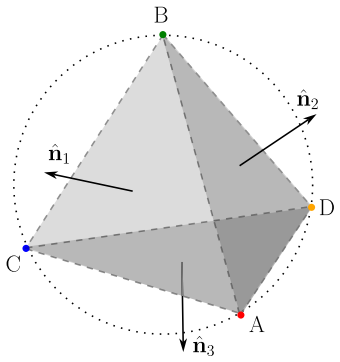
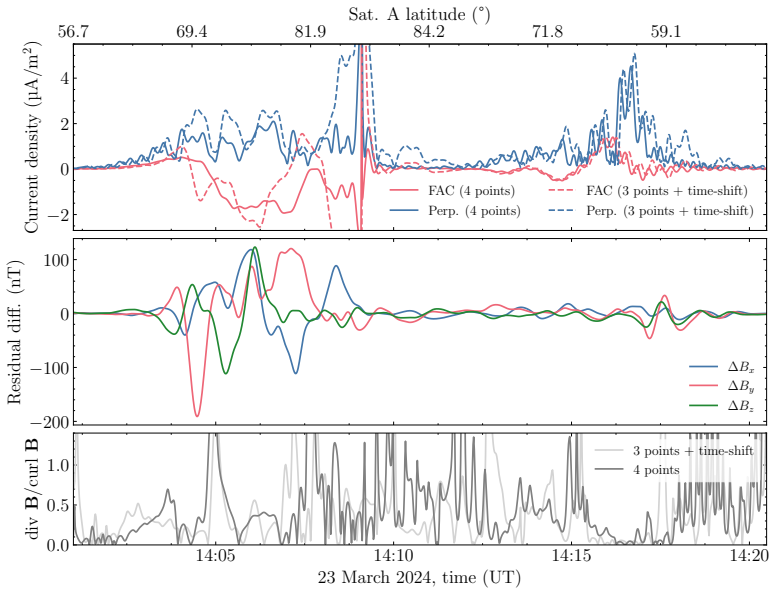
Even at meso-scales of hundreds of kilometres, time-shifted FAC estimates can diverge significantly from ground truth, and poor tetrahedral configurations produce spurious perpendicular currents due to numerical instability in the inversion process. This can be mitigated using appropriate quality metrics and high-quality FAC reconstructions still achieved with a tetrahedral face well-aligned to the local magnetic field.
What carries the argument
The curlometer technique that derives current density from the curl of the magnetic field sampled at four points forming a tetrahedron.
Load-bearing premise
The magnetic field measurements from the four points can be treated as simultaneous and the current density is approximately uniform across the tetrahedron volume at the scales examined.
What would settle it
A direct comparison in which time-shifted curlometer estimates from tetrahedra of hundreds of kilometers match the known current density in the simulations would falsify the reported divergence.
Figures


read the original abstract
Measuring field-aligned currents (FACs) using magnetic field observations provides a powerful means to probe the multi-scale interactions between the magnetosphere, ionosphere and thermosphere. In this study, we apply the curlometer technique to Swarm spacecraft observations and to simulations of the coupled magnetosphere-ionosphere system. We begin by correlating current density curlometer estimates derived from Swarm tetrahedra with varying spatial scales and barycentre locations. This confirms an apparent departure from stationarity for FACs at spatio-temporal scales below 100 km where measurements appear highly uncorrelated. We then analyse simulated magnetic perturbations, where true four-point measurements are available. This shows how, even at meso-scales of hundreds of kilometres, time-shifted FAC estimates can diverge significantly from this ground truth. In both observational and simulated data we find poor tetrahedral configurations can produce spurious perpendicular currents due to numerical instability in the inversion process. This can be mitigated using appropriate quality metrics and high-quality FAC reconstructions still achieved with a tetrahedral face well-aligned to the local magnetic field. These results highlight the dynamic nature of FACs at large as well as small scales, and underscore the substantial advantages of true four-point observations for their accurate analysis.
Editorial analysis
A structured set of objections, weighed in public.
Referee Report
Summary. The paper applies the curlometer technique to Swarm constellation magnetic field data and to coupled magnetosphere-ionosphere simulations. It reports that FAC estimates from tetrahedra become highly uncorrelated at scales below 100 km, that time-shifted four-point estimates diverge from simulation ground-truth currents even at meso-scales of hundreds of km, and that poorly conditioned tetrahedra generate spurious perpendicular currents via numerical instability in the inversion; these artifacts can be reduced by quality metrics and by aligning a tetrahedron face with the local magnetic field. The work concludes that true simultaneous four-point sampling offers substantial advantages over time-shifted reconstructions.
Significance. If the central comparisons hold, the manuscript supplies direct, simulation-validated evidence that the simultaneity and uniformity assumptions underlying the curlometer break at observationally relevant scales. The use of independent ground-truth current density from the geospace model is a clear strength, as is the explicit link between inversion-matrix condition number and spurious perpendicular currents. The practical guidance on quality metrics and tetrahedron orientation will be useful to the community analyzing multi-spacecraft current measurements in low Earth orbit.
major comments (2)
- [Simulation analysis section] The central claim that time-shifted FAC estimates diverge significantly from ground truth even at meso-scales rests on the simulation comparison; however, the quantitative metric (e.g., RMS difference, correlation coefficient, or fractional error) used to establish 'significant' divergence is not stated, making it difficult to judge the scale dependence.
- [Swarm observations and correlation analysis] The Swarm tetrahedron correlation results are load-bearing for the non-stationarity conclusion; the manuscript must specify the exact tetrahedron selection criteria, barycentre filtering, and any post-hoc time-shift handling to allow assessment of possible selection bias.
minor comments (3)
- [Abstract] The abstract refers to 'whole geospace simulations' without naming the model or its key resolution and boundary conditions; this information should appear in the first paragraph of the methods.
- [Throughout] Notation for the current-density vector components (J∥ vs J⊥) is occasionally inconsistent between text and figure labels; a single, explicit definition early in the paper would improve clarity.
- [Figure captions] Figure captions describing tetrahedron geometries should include the condition number of the inversion matrix or the face-normal angle to B for each example shown.
Simulated Author's Rebuttal
We thank the referee for their constructive and positive review, including the recommendation for minor revision. We address each major comment below and will revise the manuscript to incorporate the requested clarifications and quantitative details.
read point-by-point responses
-
Referee: [Simulation analysis section] The central claim that time-shifted FAC estimates diverge significantly from ground truth even at meso-scales rests on the simulation comparison; however, the quantitative metric (e.g., RMS difference, correlation coefficient, or fractional error) used to establish 'significant' divergence is not stated, making it difficult to judge the scale dependence.
Authors: We agree that explicit quantitative metrics are needed to support the claim of divergence. The simulation analysis section currently relies on side-by-side visual comparisons of time-shifted curlometer FACs against the model's ground-truth current densities, along with qualitative descriptions of increasing mismatch at smaller scales. In the revised manuscript we will add the Pearson correlation coefficient and normalized RMS difference (RMS divided by the mean absolute current density) between the time-shifted estimates and the simulation truth, computed and plotted as functions of tetrahedron scale. These metrics will be included in a new panel or supplementary table to allow readers to assess the scale dependence quantitatively. revision: yes
-
Referee: [Swarm observations and correlation analysis] The Swarm tetrahedron correlation results are load-bearing for the non-stationarity conclusion; the manuscript must specify the exact tetrahedron selection criteria, barycentre filtering, and any post-hoc time-shift handling to allow assessment of possible selection bias.
Authors: We acknowledge that the current description of the Swarm analysis is insufficiently detailed for full reproducibility and bias assessment. The manuscript states that we correlate curlometer estimates from tetrahedra with varying spatial scales and barycentre locations, but does not list the precise thresholds. In the revised version we will expand the methods section to specify: (i) the tetrahedron selection criteria (maximum spacecraft separation, minimum eigenvalue ratio of the geometry matrix, and quality factor threshold); (ii) the barycentre filtering (latitude/longitude bounds and altitude range); and (iii) confirmation that all estimates use the four simultaneous Swarm measurements with no additional post-hoc time shifting. These additions will enable readers to evaluate potential selection effects on the reported decorrelation below 100 km. revision: yes
Circularity Check
No significant circularity detected
full rationale
The paper establishes its claims through direct empirical comparisons between curlometer outputs and independent references: Swarm tetrahedron correlations at varying scales, plus simulated magnetic perturbations where the geospace model supplies separate ground-truth current density for simultaneous four-point sampling. Divergence of time-shifted estimates and spurious perpendicular currents from poor tetrahedra are diagnosed via the inversion matrix condition number and quality metrics, which are standard numerical diagnostics rather than fitted parameters or self-defined quantities. No load-bearing step reduces by construction to an input, self-citation chain, ansatz, or renamed empirical pattern; the derivation remains self-contained against external benchmarks.
Axiom & Free-Parameter Ledger
axioms (2)
- standard math Magnetic field can be linearly interpolated across the tetrahedron volume
- domain assumption Displacement current is negligible compared with conduction current at the frequencies of interest
Reference graph
Works this paper leans on
-
[1]
Aschelhoug & Co., Christiania,
Birkeland, K.,The Norwegian Aurora Polaris Expedition, 1902–1903, 998 pp., H. Aschelhoug & Co., Christiania,
1902
-
[2]
Birn, J., and M. Hesse, The substorm current wedge in mhd simulations,Journal of Geophysical Research: Space Physics,118, 3364–3376, doi:10.1002/jgra.50187,
-
[3]
Desai, R.T., M.P.Freeman, J.P.Eastwood, J.W.B.Eggington, M.O.Archer, Y.Y.Shprits, etal., Inter- planetary shock-induced magnetopause motion: Comparison between theory and global magnetohydro- dynamic simulations,Geophysical Research Letters,48, e2021GL092,554, doi:10.1029/2021GL092554,
-
[4]
Dunlop, M., D. Southwood, K.-H. Glassmeier, and F. Neubauer, Analysis of multipoint magnetometer data,Advances in Space Research,8(9), 273–277, doi:https://doi.org/10.1016/0273-1177(88)90141-X,
-
[5]
Dunlop, M. W.,Ionospheric Multi-Spacecraft Analysis Tools: Approaches for Deriving Ionospheric Pa- rameters, 1 ed., Springer International Publishing, doi:10.1007/978-3-030-26732-2,
-
[6]
Dunlop, M. W., J. Y. Yang, Y. Y. Yang, H. Lühr, and J. B. Cao, Multi-spacecraft current estimates at swarm, inIonospheric Multi-Spacecraft Analysis Tools,ISSI Scientific Report Series, vol. 17, edited by M. W. Dunlop and H. Lühr, Springer, Cham, doi:10.1007/978-3-030-26732-2_5,
-
[7]
Dunlop, M. W., H.-S. Fu, C. Shen, X. Tan, X.-C. Dong, Y.-Y. Yang, P. Robert, and C. P. Escoubet, Curlometer and gradient techniques: past and future applications,Frontiers in Astronomy and Space Sciences,Volume 11 - 2024, doi:10.3389/fspas.2024.1422341,
-
[8]
Dunlop, M. W., et al., Multispacecraft current estimates at swarm,Journal of Geophysical Research: Space Physics,120(10), 8307–8316, doi:https://doi.org/10.1002/2015JA021707,
-
[9]
Ebihara, Y., and T. Tanaka, Generation mechanism of region 1 field-aligned current and energy transfer from solar wind to polar ionosphere,Reviews of Modern Plasma Physics,8, 20, doi: 10.1007/s41614-024-00154-7,
-
[10]
Fillion, M., G. Hulot, P. Alken, A. Chulliat, and P. Vigneron, Multispacecraft current density estimates in the low- and mid-latitude f-region ionosphere using the swarm constellation,Journal of Geophysical Research: Space Physics,126, e2020JA028,872, doi:10.1029/2020JA028872,
-
[11]
Forsyth, C., M. Lester, A. Fazakerley, C. Owen, and A. Walsh, On the effect of line current width and relative position on the multi-spacecraft curlometer technique,Planetary and Space Science,59(7), 598–605, doi:https://doi.org/10.1016/j.pss.2009.12.007, cross-Scale Coupling in Plasmas,
-
[12]
Forsyth, C., I. J. Rae, I. R. Mann, and I. P. Pakhotin, Identifying intervals of temporally invariant field-aligned currents from swarm: Assessing the validity of single-spacecraft methods,Journal of Geophysical Research: Space Physics,122(3), 3411–3419, doi:https://doi.org/10.1002/2016JA023708,
-
[13]
Gary, J. B., L. J. Zanetti, B. J. Anderson, T. A. Potemra, J. H. Clemmons, J. D. Wilmingham, and J. R. Sharber, Identification of auroral oval boundaries from in situ magnetic field measurements,Journal of Geophysical Research: Space Physics,103(A3), 4187–4197, doi:10.1029/97JA02814,
-
[14]
Hallinan, T. J., and H. C. Stenbaek-Nielsen, The connection between auroral acceleration and auroral morphology,Physics and Chemistry of the Earth, Part C: Solar, Terrestrial & Planetary Science, 26(1–3), 169–177, doi:10.1016/S1464-1917(00)00104-5,
-
[15]
Hnat, B., S. Chapman, and N. Watkins, Topology of turbulence within collisionless plasma reconnection, Scientific Reports,13, 18,665, doi:10.1038/s41598-023-45650-x,
-
[16]
W., and J
Hockney, R. W., and J. W. Eastwood,Computer simulation using particles, Bristol: Hilger, 1988,
1988
-
[17]
Liu, J., V.Angelopoulos, X.Chu, X.Zhou, andC.Yue, Substormcurrentwedgecompositionbywedgelets, Geophysical Research Letters,42, 1669–1676, doi:10.1002/2015GL063289,
-
[18]
Lühr, H., and Y.-L. Zhou, Small-scale and mesoscale field-aligned auroral current structures: their spatial andtemporalcharacteristicsdeducedbytheswarmconstellation,Annales Geophysicae,43(2), 447–468, doi:10.5194/angeo-43-447-2025,
-
[19]
14 Lühr, H., J. Park, J. W. Gjerloev, J. Rauberg, I. Michaelis, J. M. G. Merayo, and P. Brauer, Field-aligned currents’ scale analysis performed with the swarm constellation,Geophysical Research Letters,42, 1–8, doi:10.1002/2014GL062453,
-
[20]
Lysak, R. L., Kinetic alfvén waves and auroral particle acceleration: a review,Reviews of Modern Plasma Physics,7(1), 6, doi:10.1007/s41614-022-00111-2,
-
[21]
Merkin, V. G., and J. G. Lyon, Effects of the low-latitude ionospheric boundary condition on the global magnetosphere,Journal of Geophysical Research,115(A10), A10,202, doi:10.1029/2010JA015461,
-
[22]
Merkin, V. G., H. Arnold, S. Bao, J. Garretson, D. Lin, J. G. Lyon, et al., Jhuapl/kaiju: Mage-1.0.5, doi:10.5281/zenodo.16818682,
-
[23]
Milan, S.E., L.B.N.Clausen, J.C.Coxon, andetal., Overviewofsolarwind–magnetosphere–ionosphere– atmosphere coupling and the generation of magnetospheric currents,Space Science Reviews,206, 547– 573, doi:10.1007/s11214-017-0333-0,
-
[24]
Panov, E. V., W. Baumjohann, R. Nakamura, J. M. Weygand, B. L. Giles, C. T. Russell, et al., Continent- wide r1/r2 current system and ohmic losses by broad dipolarization-injection fronts,Journal of Geo- physical Research: Space Physics,124, 4064–4082, doi:10.1029/2019JA026521,
-
[25]
Ritter, P., H. Lühr, and J. Rauberg, Determining field-aligned currents with the swarm constellation mission,Earth, Planets and Space,65, 1285–1294, doi:10.5047/eps.2013.09.006,
-
[26]
Sorathia, K. A., et al., Multiscale magnetosphere-ionosphere coupling during stormtime: A case study of thedawnsidecurrentwedge,Journal of Geophysical Research: Space Physics,128(11), e2023JA031,594, doi:10.1029/2023JA031594,
-
[27]
Tian, S., and et al., Evidence for alfvén waves powering auroral arc via a static electric potential drop, Nature Communications,17(1), 297, doi:10.1038/s41467-025-65819-4,
-
[28]
Toffoletto, F. R., S. Sazykin, R. W. Spiro, and R. A. Wolf, Inner magnetospheric modeling with the rice convection model,Space Science Reviews,107(1), 175–196, doi:10.1023/A:1025532008047,
-
[29]
Vogel, C. R.,Computational Methods for Inverse Problems, Society for Industrial and Applied Mathe- matics, doi:10.1137/1.9780898717570,
-
[30]
Vogt, J., A. Blagau, and L. Pick, Robust adaptive spacecraft array derivative analysis,Earth and Space Science,7, e2019EA000,953, doi:10.1029/2019EA000953,
-
[31]
15 Wang, W., D. Lin, K. Pham, and V. Merkin, Mage simulations of thermosphere and ionosphere re- sponses to subauroral polarization streams (saps), in2025 International Conference on Electromagnet- ics in Advanced Applications (ICEAA), pp. 1309–1312, Palermo, Italy, doi:10.1109/ICEAA65662.2025. 11305966,
-
[32]
Zhang, B., K. A. Sorathia, J. G. Lyon, V. G. Merkin, J. S. Garretson, and M. Wiltberger, Gamera: A three-dimensional finite-volume mhd solver for non-orthogonal curvilinear geometries,The Astrophys- ical Journal Supplement Series,244(1), 20, doi:10.3847/1538-4365/ab3a4c,
-
[33]
Zhou, Y.-L., and H. Lühr, Properties of large-amplitude kilometer-scale field-aligned currents at au- roral latitudes, as derived from swarm satellites,Annales Geophysicae,43, 667–686, doi:10.5194/ angeo-43-667-2025,
2025
discussion (0)
Sign in with ORCID, Apple, or X to comment. Anyone can read and Pith papers without signing in.