Recognition: unknown
ReCap: Lightweight Referential Grounding for Coherent Story Visualization
Pith reviewed 2026-05-10 04:46 UTC · model grok-4.3
The pith
ReCap maintains character identity across story images by activating previous-frame conditioning only on pronouns and aligning features to visual embeddings during training.
A machine-rendered reading of the paper's core claim, the machinery that carries it, and where it could break.
Core claim
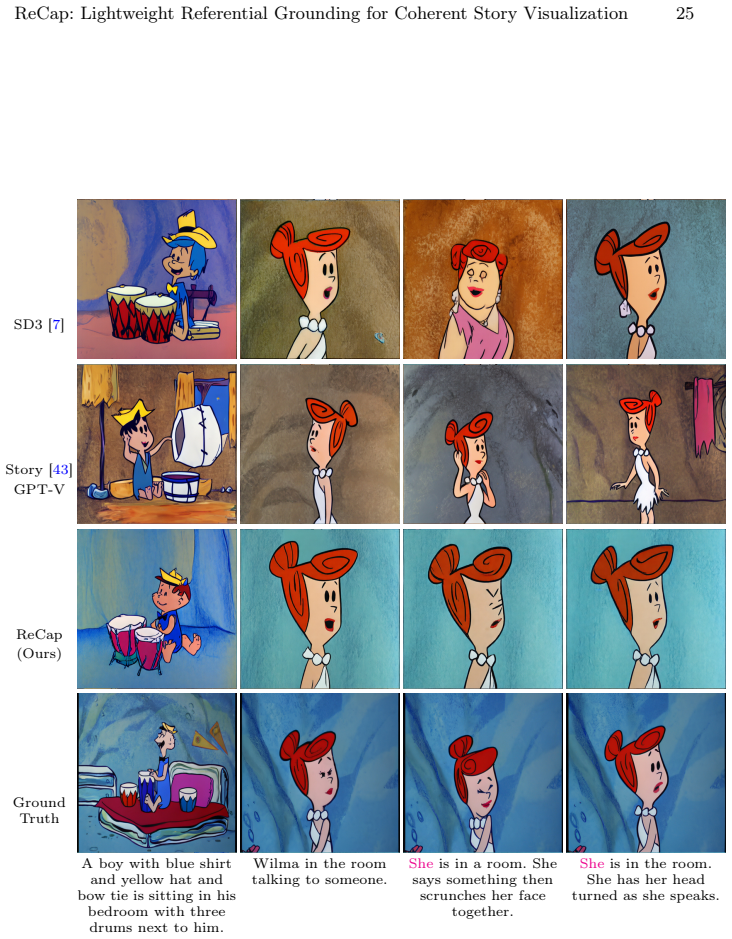
ReCap's central claim is that treating pronouns as visual anchors via the CORE module allows selective conditioning on the preceding frame to propagate character identity, while SemDrift aligns denoiser representations with DINOv3 embeddings during training to enforce stability when text references are vague, all without unconditional cross-frame links or added inference cost, resulting in new state-of-the-art character consistency on the main benchmarks.
What carries the argument
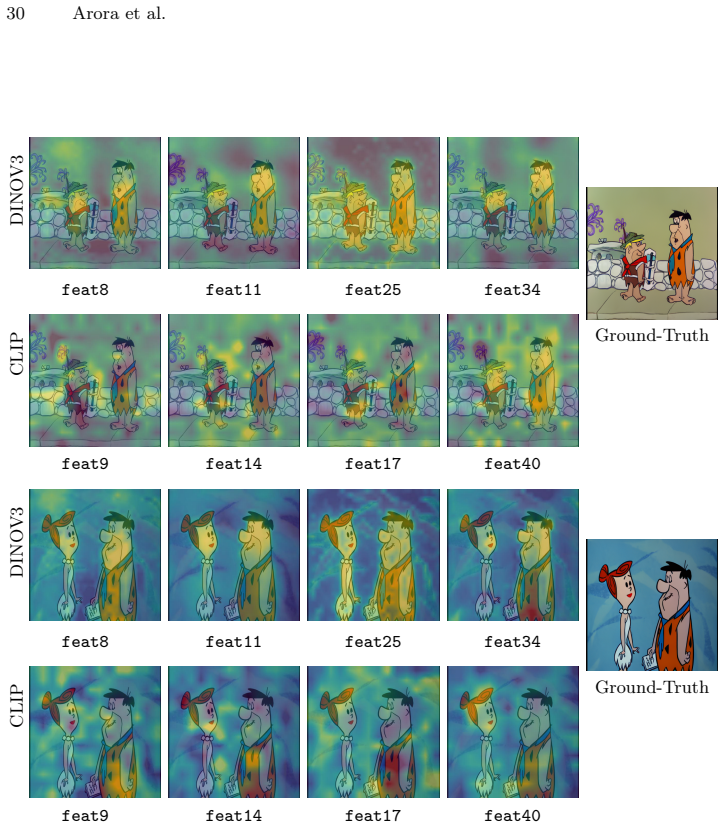
The CORE module for conditional frame referencing that activates only on pronouns as anchors to propagate visual identity from the prior frame, paired with SemDrift for training-time alignment to DINOv3 embeddings to correct semantic drift.
If this is right
- It achieves new state-of-the-art character accuracy on the FlintstonesSV and PororoSV benchmarks.
- The full approach adds only 149K parameters and incurs zero extra cost at inference time.
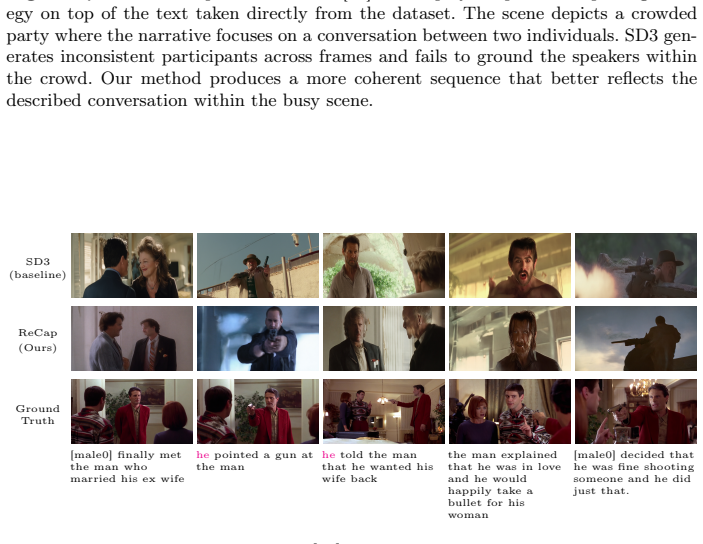
- Story visualization extends successfully to human-centric scenes drawn from real films.
- Unconditional cross-frame conditioning and large auxiliary components become unnecessary for basic consistency.
Where Pith is reading between the lines
- Pronoun selectivity may generalize if augmented with other referential cues such as proper names for broader narrative coverage.
- Training-only alignment offers a template for stabilizing other sequential generative tasks without runtime overhead.
- The design could reduce parameter demands in related domains like consistent character generation for comics or short videos.
- If pronouns prove sufficient anchors, full memory banks may be replaceable in many identity-tracking scenarios.
Load-bearing premise
That activating consistency mechanisms only on pronouns and correcting drift solely at training time will suffice to prevent identity changes across all narrative cases without full cross-frame attention or memory structures.
What would settle it
A new benchmark of story texts that mostly use character names instead of pronouns, where ReCap's character accuracy fails to exceed that of prior methods like StoryGPT-V.
Figures





read the original abstract
Story Visualization aims to generate a sequence of images that faithfully depicts a textual narrative that preserve character identity, spatial configuration, and stylistic coherence as the narratives unfold. Maintaining such cross-frame consistency has traditionally relied on explicit memory banks, architectural expansion, or auxiliary language models, resulting in substantial parameter growth and inference overhead. We introduce ReCap, a lightweight consistency framework that improves character stability and visual fidelity without modifying the base diffusion backbone. ReCap's CORE (COnditional frame REferencing) module treats anaphors, in our case pronouns, as visual anchors, activating only when characters are referred to by a pronoun and conditioning on the preceding frame to propagate visual identity. This selective design avoids unconditional cross-frame conditioning and introduces only 149K additional parameters, a fraction of the cost of memory-bank and LLM-augmented approaches. To further stabilize identity, we incorporate SemDrift (Guided Semantic Drift Correction) applied only during training. When text is vague or referential, the denoiser lacks a visual anchor for identity-defining attributes, causing character appearance to drift across frames, SemDrift corrects this by aligning denoiser representations with pretrained DINOv3 visual embeddings, enforcing semantic identity stability at zero inference cost. ReCap outperforms previous state-of-the-art, StoryGPT-V, on the two main benchmarks for story visualization by 2.63% Character-Accuracy on FlintstonesSV and by 5.65% on PororoSV, establishing a new state-of-the-art character consistency on both benchmarks. Furthermore, we extend story visualization to human-centric narratives derived from real films, demonstrating the capability of ReCap beyond stylized cartoon domains.
Editorial analysis
A structured set of objections, weighed in public.
Referee Report
Summary. The manuscript introduces ReCap, a lightweight consistency framework for story visualization. It features the CORE module that selectively activates on pronouns to condition the current frame on the previous one for identity propagation, adding only 149K parameters, and SemDrift which aligns denoiser features to DINOv3 embeddings solely during training to prevent semantic drift. The method claims to achieve new state-of-the-art character accuracy on FlintstonesSV (improvement of 2.63% over StoryGPT-V) and PororoSV (5.65% improvement), and extends to human-centric film narratives.
Significance. If the reported improvements hold under scrutiny, ReCap represents a significant advance in efficient story visualization by avoiding the parameter bloat of memory banks or auxiliary models while maintaining or improving consistency. The training-only alignment is particularly attractive for deployment. The lightweight design and zero-inference-cost component are clear strengths that could influence practical applications in coherent image sequence generation.
major comments (3)
- [Experiments] Experiments section: The headline gains of 2.63% Character-Accuracy on FlintstonesSV and 5.65% on PororoSV are presented without error bars, standard deviations, or results across multiple random seeds or data splits, preventing assessment of whether the new SOTA is statistically reliable or reproducible.
- [Method (CORE)] CORE module description: The selective pronoun-only activation is claimed to propagate identity without unconditional conditioning or memory banks, but no experiments or analysis evaluate performance on narratives with low pronoun frequency, use of proper names, or descriptive references; this directly tests the weakest assumption underlying the consistency claim.
- [Method (SemDrift)] SemDrift section: Alignment to DINOv3 embeddings occurs only at training time with zero inference cost, yet no ablation isolates its contribution or shows that train-time alignment alone suffices to block drift at inference when visual attributes diverge from DINOv3 pretraining or when pronouns are absent.
minor comments (2)
- [Abstract] Abstract and method: The phrase 'in our case pronouns' is used without detailing the pronoun detection implementation, its accuracy, or failure modes.
- [Experiments] Related work or experiments: A table comparing parameter counts, inference latency, and memory usage against all baselines (including StoryGPT-V) would clarify the lightweight advantage.
Simulated Author's Rebuttal
We thank the referee for their constructive and detailed feedback. The comments raise valid points about experimental rigor and the need for further validation of our design choices. We address each major comment below and will incorporate revisions to strengthen the manuscript.
read point-by-point responses
-
Referee: [Experiments] Experiments section: The headline gains of 2.63% Character-Accuracy on FlintstonesSV and 5.65% on PororoSV are presented without error bars, standard deviations, or results across multiple random seeds or data splits, preventing assessment of whether the new SOTA is statistically reliable or reproducible.
Authors: We agree that reporting variability measures is important for assessing the reliability of the reported gains. In the revised manuscript, we will add standard deviations computed over multiple random seeds (at least three) for the character accuracy metrics on both FlintstonesSV and PororoSV, along with the corresponding results to demonstrate reproducibility. revision: yes
-
Referee: [Method (CORE)] CORE module description: The selective pronoun-only activation is claimed to propagate identity without unconditional conditioning or memory banks, but no experiments or analysis evaluate performance on narratives with low pronoun frequency, use of proper names, or descriptive references; this directly tests the weakest assumption underlying the consistency claim.
Authors: The CORE module selectively conditions on pronouns because they serve as common referential anchors in the story visualization benchmarks. To directly address the concern, we will add a new analysis subsection with quantitative results on narrative subsets stratified by pronoun frequency, as well as qualitative and quantitative evaluations on cases using proper names and descriptive references. revision: yes
-
Referee: [Method (SemDrift)] SemDrift section: Alignment to DINOv3 embeddings occurs only at training time with zero inference cost, yet no ablation isolates its contribution or shows that train-time alignment alone suffices to block drift at inference when visual attributes diverge from DINOv3 pretraining or when pronouns are absent.
Authors: We will include an ablation study in the revised paper that isolates the contribution of SemDrift by comparing performance with and without the alignment loss. We will also add analysis and results on scenarios with absent pronouns and potential divergence from DINOv3 pretraining to demonstrate that the training-time correction helps maintain consistency at inference. revision: yes
Circularity Check
No circularity: empirical benchmark claims with no derivations or self-referential reductions
full rationale
The paper describes ReCap's CORE module (pronoun-selective conditioning on prior frames) and SemDrift (training-only DINOv3 alignment) as design choices, then reports direct empirical gains (2.63% and 5.65% Character-Accuracy) versus StoryGPT-V on FlintstonesSV and PororoSV. No equations, first-principles derivations, fitted-parameter predictions, or self-citation chains appear in the abstract or described text. Claims rest on benchmark comparisons rather than any tautological reduction of outputs to inputs by construction. The method's sufficiency assumptions are empirical hypotheses, not circular definitions.
Axiom & Free-Parameter Ledger
Reference graph
Works this paper leans on
-
[1]
In: ICCV (2023) 4
Ahn, D., Kim, D., Song, G., Kim, S.H., Lee, H., Kang, D., Choi, J.: Story visualization by online text augmentation with context memory. In: ICCV (2023) 4
2023
-
[2]
In: SIGGRAPH (2024) 7
Avrahami, O., Hertz, A., Vinker, Y., Arar, M., Fruchter, S., Fried, O., Cohen-Or, D., Lischinski, D.: The chosen one: Consistent characters in text- to-image diffusion models. In: SIGGRAPH (2024) 7
2024
-
[3]
In: ICCV (2025) 22
Barsellotti, L., Bianchi, L., Messina, N., Carrara, F., Cornia, M., Baraldi, L., Falchi, F., Cucchiara, R.: Talking to DINO: Bridging self-supervised vi- sion backbones with language for open-vocabulary segmentation. In: ICCV (2025) 22
2025
-
[4]
In: ICCV (2021) 4
Caron, M., Touvron, H., Misra, I., Jégou, H., Mairal, J., Bojanowski, P., Joulin, A.: Emerging properties in self-supervised vision transformers. In: ICCV (2021) 4
2021
-
[5]
In: EMNLP (2022) 3
Chen, H., Han, R., Wu, T.L., Nakayama, H., Peng, N.: Character-centric story visualization via visual planning and token alignment. In: EMNLP (2022) 3
2022
-
[6]
In: CVPR (2017) 4
Das, A., Kottur, S., Gupta, K., Singh, A., Yadav, D., Moura, J.M., Parikh, D., Batra, D.: Visual dialog. In: CVPR (2017) 4
2017
-
[7]
In: ICML (2024) 1, 3, 4, 8, 12, 13, 14, 21, 22, 24, 25
Esser, P., Kulal, S., Blattmann, A., Entezari, R., Müller, J., Saini, H., Levi, Y., Lorenz, D., Sauer, A., Boesel, F., et al.: Scaling rectified flow transform- ers for high-resolution image synthesis. In: ICML (2024) 1, 3, 4, 8, 12, 13, 14, 21, 22, 24, 25
2024
-
[8]
In: ICCV (2023) 2, 4
Goel, A., Fernando, B., Keller, F., Bilen, H.: Who are you referring to? coreference resolution in image narrations. In: ICCV (2023) 2, 4
2023
-
[9]
In: SIGGRAPH Asia (2023) 3
Gong, Y., Guo, Z., Gao, D., Xu, R., Zhang, W., He, X., Shen, Y.: Interactive story visualization with multiple characters. In: SIGGRAPH Asia (2023) 3
2023
-
[10]
In: ECCV (2018) 3, 8, 9, 10, 11, 12, 13, 24, 25
Gupta, T., Schwenk, D., Farhadi, A., Hoiem, D., Kembhavi, A.: Imagine this! scripts to compositions to videos. In: ECCV (2018) 3, 8, 9, 10, 11, 12, 13, 24, 25
2018
-
[11]
TPAMI (2025) 1
He, H., Yang, H., Tuo, Z., Zhou, Y., Wang, Q., Zhang, Y., Liu, Z., Huang, W., Chao, H., Yin, J.: Dreamstory: Open-domain story visualization by llm-guided multi-subject consistent diffusion. TPAMI (2025) 1
2025
-
[12]
In: CVPR (2022) 7
He, K., Chen, X., Xie, S., Li, Y., Dollár, P., Girshick, R.: Masked autoen- coders are scalable vision learners. In: CVPR (2022) 7
2022
-
[13]
NeurIPS (2020) 2
Ho, J., Jain, A., Abbeel, P.: Denoising diffusion probabilistic models. NeurIPS (2020) 2
2020
-
[14]
TACL (2023) 3, 4, 8, 14, 20, 28, 29
Hong, X., Sayeed, A., Mehra, K., Demberg, V., Schiele, B.: Visual writ- ing prompts: Character-grounded story generation with curated image se- quences. TACL (2023) 3, 4, 8, 14, 20, 28, 29
2023
-
[15]
In: AAAI (2023) 21 ReCap: Lightweight Referential Grounding for Coherent Story Visualization 17
Huang, R., Long, Y., Han, J., Xu, H., Liang, X., Xu, C., Liang, X.: Nlip: Noise-robust language-image pre-training. In: AAAI (2023) 21 ReCap: Lightweight Referential Grounding for Coherent Story Visualization 17
2023
-
[16]
In: CVPR (2024) 9, 12, 14
Huang, Z., He, Y., Yu, J., Zhang, F., Si, C., Jiang, Y., Zhang, Y., Wu, T., Jin, Q., Chanpaisit, N., et al.: Vbench: Comprehensive benchmark suite for video generative models. In: CVPR (2024) 9, 12, 14
2024
-
[17]
In: CVPR (2025) 21
Jose, C., Moutakanni, T., Kang, D., Baldassarre, F., Darcet, T., Xu, H., Li, D., Szafraniec, M., Ramamonjisoa, M., Oquab, M., et al.: DINOv2 meets text: A unified framework for image- and pixel-level vision-language align- ment. In: CVPR (2025) 21
2025
-
[18]
In: EMNLP-IJCNLP (2019) 2, 4
Joshi, M., Levy, O., Zettlemoyer, L., Weld, D.: Bert for coreference resolu- tion: Baselines and analysis. In: EMNLP-IJCNLP (2019) 2, 4
2019
-
[19]
In: Proceedings of the European Conference on Computer Vision (ECCV) (September 2018) 4
Kottur, S., Moura, J.M.F., Parikh, D., Batra, D., Rohrbach, M.: Visual coreference resolution in visual dialog using neural module networks. In: Proceedings of the European Conference on Computer Vision (ECCV) (September 2018) 4
2018
-
[20]
FLUX.1 Kontext: Flow Matching for In-Context Image Generation and Editing in Latent Space
Labs, B.F., Batifol, S., Blattmann, A., Boesel, F., Consul, S., Diagne, C., Dockhorn, T., English, J., English, Z., Esser, P., et al.: Flux. 1 kontext: Flow matching for in-context image generation and editing in latent space. arXiv preprint arXiv:2506.15742 (2025) 1
work page internal anchor Pith review arXiv 2025
-
[21]
In: EMNLP (2017) 2, 4
Lee, K., He, L., Lewis, M., Zettlemoyer, L.: End-to-end neural coreference resolution. In: EMNLP (2017) 2, 4
2017
-
[22]
In: EMNLP Findings (2022) 3
Li, B., Lukasiewicz, T.: Learning to model multimodal semantic alignment for story visualization. In: EMNLP Findings (2022) 3
2022
-
[23]
In: CVPR (2019) 2, 3, 6, 8, 9, 12, 13, 22, 26, 27
Li, Y., Gan, Z., Shen, Y., Liu, J., Cheng, Y., Wu, Y., Carin, L., Carlson, D., Gao, J.: Storygan: A sequential conditional gan for story visualization. In: CVPR (2019) 2, 3, 6, 8, 9, 12, 13, 22, 26, 27
2019
-
[24]
In: ICLR (2023) 6, 8
Lipman, Y., Chen, R.T.Q., Ben-Hamu, H., Nickel, M., Le, M.: Flow match- ing for generative modeling. In: ICLR (2023) 6, 8
2023
-
[25]
In: CVPR (2024) 1
Liu,C.,Wu,H.,Zhong,Y.,Zhang,X.,Wang,Y.,Xie,W.:Intelligentgrimm- open-ended visual storytelling via latent diffusion models. In: CVPR (2024) 1
2024
-
[26]
In: EMNLP (2021) 2, 3, 9
Maharana, A., Bansal, M.: Integrating visuospatial, linguistic and common- sense structure into story visualization. In: EMNLP (2021) 2, 3, 9
2021
-
[27]
In: NAACL (2021) 3
Maharana, A., Hannan, D., Bansal, M.: Improving generation and evalua- tion of visual stories via semantic consistency. In: NAACL (2021) 3
2021
-
[28]
In: ECCV (2022) 2, 3, 6, 9, 10, 12, 13, 26, 27
Maharana, A., Hannan, D., Bansal, M.: Storydall-e: Adapting pretrained text-to-image transformers for story continuation. In: ECCV (2022) 2, 3, 6, 9, 10, 12, 13, 26, 27
2022
-
[29]
DINOv2: Learning Robust Visual Features without Supervision
Oquab, M., Darcet, T., Moutakanni, T., Vo, H., Szafraniec, M., Khalidov, V.,Fernandez,P.,Haziza,D.,Massa,F.,El-Nouby,A.,etal.:Dinov2:Learn- ing robust visual features without supervision. arXiv:2304.07193 (2023) 4, 7
work page internal anchor Pith review Pith/arXiv arXiv 2023
-
[30]
In: WACV (2024) 3, 6
Pan, X., Qin, P., Li, Y., Xue, H., Chen, W.: Synthesizing coherent story with auto-regressive latent diffusion models. In: WACV (2024) 3, 6
2024
-
[31]
In: ICCV (2023) 2, 3, 4, 6
Peebles, W., Xie, S.: Scalable diffusion models with transformers. In: ICCV (2023) 2, 3, 4, 6
2023
-
[32]
In: ICCV (2025) 1 18 Arora et al
Qin, Q., Zhuo, L., Xin, Y., Du, R., Li, Z., Fu, B., Lu, Y., Li, X., Liu, D., Zhu, X., et al.: Lumina-image 2.0: A unified and efficient image generative framework. In: ICCV (2025) 1 18 Arora et al
2025
-
[33]
In: ICML (2021) 7, 11
Radford, A., Kim, J.W., Hallacy, C., Ramesh, A., Goh, G., Agarwal, S., Sastry, G., Askell, A., Mishkin, P., Clark, J., et al.: Learning transferable visual models from natural language supervision. In: ICML (2021) 7, 11
2021
-
[34]
In: CVPR (2023) 2, 4, 6, 7, 8, 9, 10, 22, 23
Rahman, T., Lee, H.Y., Ren, J., Tulyakov, S., Mahajan, S., Sigal, L.: Make- a-story: Visual memory conditioned consistent story generation. In: CVPR (2023) 2, 4, 6, 7, 8, 9, 10, 22, 23
2023
-
[36]
Hierarchical Text-Conditional Image Generation with CLIP Latents
Ramesh, A., Dhariwal, P., Nichol, A., Chu, C., Chen, M.: Hierarchi- cal text-conditional image generation with clip latents. arXiv preprint arXiv:2204.06125 (2022) 3
work page internal anchor Pith review arXiv 2022
-
[37]
In: ICML (2021) 3
Ramesh, A., Pavlov, M., Goh, G., Gray, S., Voss, C., Radford, A., Chen, M., Sutskever, I.: Zero-shot text-to-image generation. In: ICML (2021) 3
2021
-
[38]
In: CVPR (2017) 4
Rohrbach, A., Rohrbach, M., Tang, S., Joon Oh, S., Schiele, B.: Generating descriptions with grounded and co-referenced people. In: CVPR (2017) 4
2017
-
[39]
In: CVPR (2022) 2, 3, 6, 22
Rombach, R., Blattmann, A., Lorenz, D., Esser, P., Ommer, B.: High- resolution image synthesis with latent diffusion models. In: CVPR (2022) 2, 3, 6, 22
2022
-
[40]
NeurIPS (2022) 1, 3
Saharia, C., Chan, W., Saxena, S., Li, L., Whang, J., Denton, E.L., Ghasemipour, K., Gontijo Lopes, R., Karagol Ayan, B., Salimans, T., et al.: Photorealistic text-to-image diffusion models with deep language under- standing. NeurIPS (2022) 1, 3
2022
-
[41]
In: ICLR (2023) 21
Santurkar, S., Dubois, Y., Taori, R., Liang, P., Hashimoto, T.: Is a caption worth a thousand images? a controlled study for representation learning. In: ICLR (2023) 21
2023
-
[42]
In: AAAI (2025) 2
Shen, F., Ye, H., Liu, S., Zhang, J., Wang, C., Han, X., Wei, Y.: Boosting consistency in story visualization with rich-contextual conditional diffusion models. In: AAAI (2025) 2
2025
-
[43]
In: CVPR (2025) 1, 2, 4, 7, 9, 10, 12, 13, 22, 24, 25, 26, 27
Shen, X., Elhoseiny, M.: Storygpt-v: Large language models as consistent story visualizers. In: CVPR (2025) 1, 2, 4, 7, 9, 10, 12, 13, 22, 24, 25, 26, 27
2025
-
[44]
Siméoni, O., Vo, H.V., Seitzer, M., Baldassarre, F., Oquab, M., Jose, C., Khalidov, V., Szafraniec, M., Yi, S., Ramamonjisoa, M., et al.: Dinov3. arXiv preprint arXiv:2508.10104 (2025) 3, 6, 7, 11, 22
work page internal anchor Pith review Pith/arXiv arXiv 2025
-
[45]
In: ECCV (2020) 3
Song, Y.Z., Tam, Z.R., Chen, H.J., Lu, H.H., Shuai, H.H.: Character- preserving coherent story visualization. In: ECCV (2020) 3
2020
-
[46]
In: ECCV (2024) 3, 4
Tao, M., Bao, B.K., Tang, H., Wang, Y., Xu, C.: Storyimager: A unified and efficient framework for coherent story visualization and completion. In: ECCV (2024) 3, 4
2024
-
[47]
In: NeurIPS (2017) 4, 6
Vaswani, A., Shazeer, N., Parmar, N., Uszkoreit, J., Jones, L., Gomez, A.N., Kaiser, L., Polosukhin, I.: Attention is all you need. In: NeurIPS (2017) 4, 6
2017
-
[48]
In: ECCVW (2018) 21 ReCap: Lightweight Referential Grounding for Coherent Story Visualization 19
Wang, X., Yu, K., Wu, S., Gu, J., Liu, Y., Dong, C., Qiao, Y., Change Loy, C.: Esrgan: Enhanced super-resolution generative adversarial networks. In: ECCVW (2018) 21 ReCap: Lightweight Referential Grounding for Coherent Story Visualization 19
2018
-
[49]
In: ECCV (2018) 21
Woo, S., Park, J., Lee, J.Y., Kweon, I.S.: Cbam: Convolutional block atten- tion module. In: ECCV (2018) 21
2018
-
[50]
In: ECCV (2024) 21
Wysoczańska, M., Siméoni, O., Ramamonjisoa, M., Bursuc, A., Trzciński, T., Pérez, P.: CLIP-DINOiser: Teaching CLIP a few DINO tricks for open- vocabulary semantic segmentation. In: ECCV (2024) 21
2024
-
[51]
In: EMNLP- IJCNLP (2019) 2, 4
Yu, X., Zhang, H., Song, Y., Song, Y., Zhang, C.: What you see is what you get: Visual pronoun coreference resolution in dialogues. In: EMNLP- IJCNLP (2019) 2, 4
2019
-
[52]
In: NeurIPS (2023) 7, 21
Zhang, J., Herrmann, C., Hur, J., Polania Cabrera, L., Jampani, V., Sun, D., Yang, M.H.: A tale of two features: Stable diffusion complements DINO for zero-shot semantic correspondence. In: NeurIPS (2023) 7, 21
2023
-
[53]
he” for male char- acters, “she
Zhou, Y., Zhou, D., Cheng, M.M., Feng, J., Hou, Q.: Storydiffusion: Con- sistent self-attention for long-range image and video generation. NeurIPS (2024) 7 20 Arora et al. ReCap: Lightweight Referential Grounding for Coherent Story Visualization (Supplementary Material) In this supplementary material, we provide additional details and results to support t...
2024
discussion (0)
Sign in with ORCID, Apple, or X to comment. Anyone can read and Pith papers without signing in.