Recognition: unknown
Optimising Urban Flood Resilience
Pith reviewed 2026-05-10 06:30 UTC · model grok-4.3
The pith
A multi-objective optimization tool couples a full hydrodynamic model with a bespoke evolutionary algorithm to design optimal blue-green infrastructure for urban flood resilience.
A machine-rendered reading of the paper's core claim, the machinery that carries it, and where it could break.
Core claim
By linking a state-of-the-art hydrodynamic model directly to a tailored evolutionary algorithm, the tool accurately assesses blue-green infrastructure effectiveness at property scale while efficiently searching the design space, delivering greater certainty about solution optimality than methods using simplified inundation models.
What carries the argument
The bespoke evolutionary algorithm that minimizes the number of full hydrodynamic simulations needed to evaluate candidate blue-green infrastructure configurations.
If this is right
- Compared to traditional design practices, it provides an automated way to examine many more potential solutions.
- Decision-makers receive a set of optimal solutions to support informed choices on flood management investments.
- The approach creates a robust framework for optimizing different types of blue-green features in complex urban areas.
- Validation shows reliable convergence in simple cases and competitive performance against other algorithms in complex ones.
Where Pith is reading between the lines
- If the method works, cities could shift from manual or approximate planning to data-driven placement of flood defenses that better match actual risks.
- The same coupling of accurate simulation and efficient search might apply to optimizing other urban systems like drainage or green spaces for heat or pollution control.
- Future testing could involve applying the tool to a specific city district and comparing predicted outcomes with real flood events after implementation.
Load-bearing premise
The bespoke evolutionary algorithm consistently locates near-optimal solutions in large urban design spaces and the hydrodynamic model correctly represents property-level flood behavior without major inaccuracies.
What would settle it
Implement the tool's top recommended blue-green infrastructure layout in a real neighborhood and compare its actual flood performance during storms against both a traditional design and the tool's predictions.
Figures






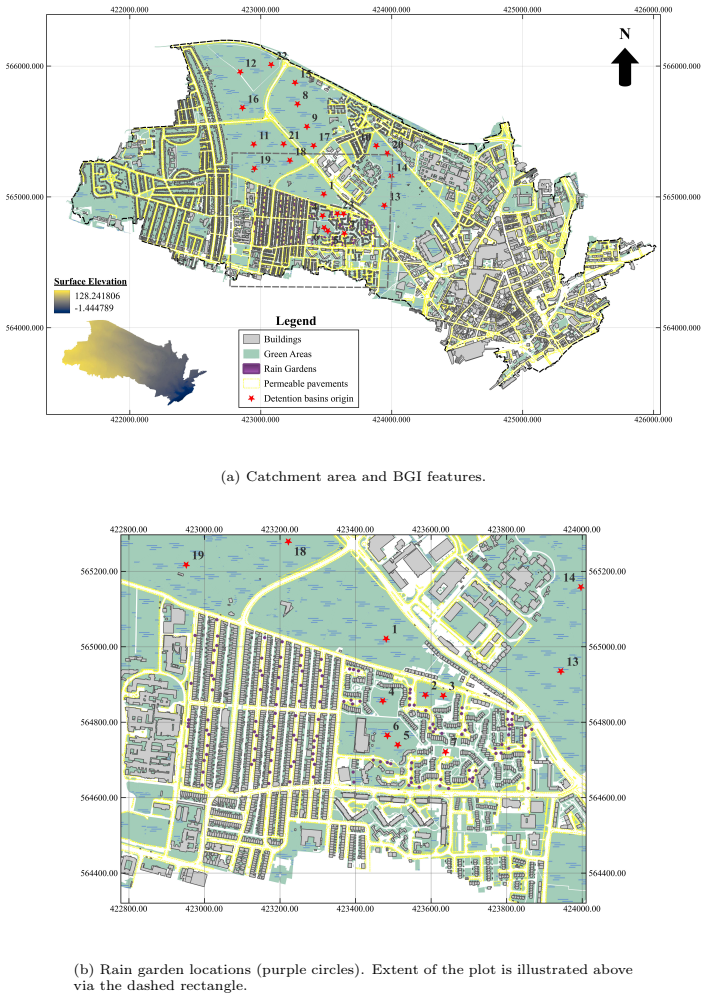


read the original abstract
Due to the increasing frequency and severity of storm events, driven by the escalation of anthropogenic climate change and urban expansion, there is a requirement for increasingly efficient flood risk management strategies. While Blue-Green Infrastructure (BGI) offers a sustainable solution for managing flood risk, optimal implementation is challenging. To help overcome this challenge, this study presents a novel multi-objective optimisation tool that couples a state-of-the-art hydrodynamic model with a bespoke evolutionary algorithm. The use of a fully dynamic hydrodynamic model enables the tool to accurately evaluate the effectiveness of proposed BGI features with respect to property scale flood vulnerability and hazard analysis. This contrasts with alternative approaches which utilise simplified models, which can only reliably predict inundation extents, thus the proposed optimisation tool provides greater certainty regarding the optimality of the solutions. As a hydrodynamic simulation is required to evaluate each candidate solution, the bespoke evolutionary algorithm is specifically designed to minimise the number of simulations required, ensuring the tool is computationally practical. The effectiveness of the tool in this regard is validated via the derivation of exact convergence measures, for a tractable search space, and via comparisons with benchmark algorithms, for an intractable search space. Compared with traditional design practices, the proposed tool offers an automated approach capable of efficiently exploring a wide range of solutions, providing decision-makers with a set of optimal solutions from which they can make informed investment decisions. The presented methods provide a robust framework for optimising a variety of BGI features in complex urban environments.
Editorial analysis
A structured set of objections, weighed in public.
Referee Report
Summary. The manuscript presents a multi-objective optimisation tool that couples a fully dynamic hydrodynamic model with a bespoke evolutionary algorithm to optimise Blue-Green Infrastructure (BGI) placement for urban flood resilience. It claims this yields solutions with greater certainty of optimality than approaches relying on simplified inundation models, because the hydrodynamic model enables accurate property-scale flood vulnerability and hazard evaluation. Computational practicality is asserted via an EA designed to minimise simulations, with validation through exact convergence measures on a tractable search space and benchmark comparisons on an intractable one. The tool is positioned as an automated framework to support informed investment decisions in complex urban environments.
Significance. If the central claims hold, the work offers a practical advance in applying evolutionary computation to real-world flood management by integrating accurate dynamic modeling with optimisation. The explicit validation via exact convergence measures on tractable subspaces is a methodological strength that supports reproducibility and rigor in the EA component. This could meaningfully aid decision-makers facing climate-driven flood risks, provided the near-optimality and model fidelity assumptions are substantiated.
major comments (1)
- [Abstract (validation paragraph)] The central claim of 'greater certainty regarding the optimality of the solutions' (Abstract) rests on the bespoke EA reliably identifying near-optimal points in high-dimensional urban search spaces when evaluated under the hydrodynamic model. However, the validation for intractable spaces relies solely on benchmark comparisons, which establish only relative performance among algorithms. This does not rule out the possibility that all compared methods remain far from the true optimum, weakening the asserted gain in certainty over simplified-model approaches. A concrete test or additional analysis (e.g., on smaller tractable instances with known optima or theoretical bounds) is needed to support the load-bearing claim.
Simulated Author's Rebuttal
We are grateful to the referee for their detailed review and for recognizing the potential of our work in advancing evolutionary computation applications to flood management. We address the major comment point by point below.
read point-by-point responses
-
Referee: [Abstract (validation paragraph)] The central claim of 'greater certainty regarding the optimality of the solutions' (Abstract) rests on the bespoke EA reliably identifying near-optimal points in high-dimensional urban search spaces when evaluated under the hydrodynamic model. However, the validation for intractable spaces relies solely on benchmark comparisons, which establish only relative performance among algorithms. This does not rule out the possibility that all compared methods remain far from the true optimum, weakening the asserted gain in certainty over simplified-model approaches. A concrete test or additional analysis (e.g., on smaller tractable instances with known optima or theoretical bounds) is needed to support the load-bearing claim.
Authors: We acknowledge the validity of this observation. Benchmark comparisons indeed only demonstrate relative performance and cannot confirm absolute near-optimality in intractable spaces. The manuscript's claim of greater certainty is grounded in the accurate property-scale flood vulnerability assessment enabled by the full hydrodynamic model, as opposed to simplified models that are limited to inundation extents. The bespoke EA is validated through exact convergence to the known optimum in tractable search spaces, and through superior performance against several benchmark algorithms in the intractable case. To strengthen the support for the claim, we will include additional analysis on smaller tractable instances where exhaustive search provides known optima, and add a section discussing the relative nature of benchmark validations and the assumptions involved. We will also revise the abstract to more precisely articulate the source of the increased certainty. These changes will be incorporated in the revised manuscript. revision: yes
Circularity Check
No circularity: validation relies on external benchmarks and exact measures, not self-definition or fitted inputs
full rationale
The paper's core claim is that coupling a full hydrodynamic model with a bespoke EA yields greater certainty on BGI optimality than simplified inundation models. Validation proceeds via derivation of exact convergence measures on a tractable subspace and relative benchmark comparisons on an intractable one; neither step reduces by construction to the inputs, nor renames a fit as a prediction, nor imports uniqueness via self-citation. The derivation chain remains self-contained against the stated external benchmarks and does not exhibit any of the enumerated circular patterns.
Axiom & Free-Parameter Ledger
Reference graph
Works this paper leans on
-
[1]
L. Vasiliades, Hydrological hazards: The 4Ms — Modelling, Monitoring, Management, and Mit- igation, in: P. Koundouri, A. Alamanos (Eds.), Elgar Encyclopedia of Water Policy, Eco- nomics and Management, Edward Elgar Publishing, Cheltenham, UK, 2024, Ch. 26, pp. 112–117. doi:10.4337/9781802202946.00033
-
[2]
E. Mignot, B. Dewals, Hydraulic modelling of inland urban flooding: Recent advances, Journal of Hydrology 609 (2022). doi:10.1016/j.jhydrol.2022.127763
-
[3]
E. O’Donnell, C. Thorne, S. Ahilan, S. Arthur, S. Birkinshaw, D. Butler, D. Dawson, G. Everett, R. Fenner, V. Glenis, L. Kapetas, C. Kilsby, V. Krivtsov, J. Lamond, S. Maskrey, G. O’Donnell, K. Potter, K. Vercruysse, T. Vilcan, N. Wright, The blue-green path to urban flood resilience, Blue- Green Systems 2 (1) (2020) 28–45. doi:10.2166/bgs.2019.199
-
[4]
P. Galiatsatou, C. Iliadis, Intensity-duration-frequency curves at ungauged sites in a changing climate for sustainable stormwater networks, Sustainability 14 (3) (2022). doi:10.3390/su14031229
-
[5]
B. R. Rosenzweig, P. Herreros Cantis, Y. Kim, A. Cohn, K. Grove, J. Brock, J. Yesuf, P. Mistry, C. Welty, T. McPhearson, J. Sauer, H. Chang, The value of urban flood modeling, Earth’s Future 9 (1) (2021) e2020EF001739. doi:10.1029/2020EF001739
-
[6]
V. Glenis, V. Kutija, C. Kilsby, A fully hydrodynamic urban flood modelling system representing buildings, green space and interventions, Environmental Modelling & Software 109 (2018) 272–292. doi:10.1016/j.envsoft.2018.07.018
-
[7]
K. Guo, M. Guan, D. Yu, Urban surface water flood modelling – a comprehensive review of current models and future challenges, Hydrol. Earth Syst. Sci. 25 (5) (2021) 2843–2860, hESS. doi:10.5194/hess-25-2843-2021
-
[8]
B. F. Sanders, Hydrodynamic modeling of urban flood flows and disaster risk reduction (2017-03-29 2017). doi:10.1093/acrefore/9780199389407.013.127
-
[9]
J. Teng, A. J. Jakeman, J. Vaze, B. F. Croke, D. Dutta, S. Kim, Flood inundation modelling: A review of methods, recent advances and uncertainty analysis, Environmental Modelling and Software 90 (2017) 201–216. doi:10.1016/j.envsoft.2017.01.006
-
[10]
URLhttps://downloads.tuflow.com/_archive/TUFLOW/Releases/2018-03/TUFLOW%20Manual.2018-03.pdf
TUFLOW, 1D/2D Fixed Grid Hydraulic Modelling: TUFLOW Classic/HPC User Manual, build 2018-03-ad Edition, TUFLOW, 2018. URLhttps://downloads.tuflow.com/_archive/TUFLOW/Releases/2018-03/TUFLOW%20Manual.2018-03.pdf
2018
-
[11]
A. Alves, A. Sanchez, B. Gersonius, Z. Vojinovic, A model-based framework for selection and devel- opment of multi-functional and adaptive strategies to cope with urban floods, Procedia Engineering 154 (2016) 877–884. doi:10.1016/j.proeng.2016.07.463
-
[12]
M. Morgan, R. Fenner, Spatial evaluation of the multiple benefits of sustainable drainage sys- tems, Proceedings of the Institution of Civil Engineers - Water Management 172 (1) (2019) 39–52. doi:10.1680/jwama.16.00048
-
[13]
A. Singh, D. Dawson, M. Trigg, N. Wright, A review of modelling methodologies for flood source area (FSA) identification, Natural Hazards 107 (2) (2021) 1047–1068. doi:10.1007/s11069-021-04672-2
-
[14]
P. Ferrans, J. D. Reyes-Silva, P. Krebs, J. Temprano, Flood management with SUDS: A simula- tion–optimization framework (2023). doi:10.3390/w15030426. 42
-
[15]
X. Xie, Q. Chu, Z. Qiu, G. Liu, S. Jia, Identifying the optimal layout of low-impact development measures at an urban watershed scale using a multi-objective decision-making framework (2024). doi:10.3390/w16141969
-
[16]
S. Djordjević, D. Prodanović, C. Maksimović, An approach to simulation of dual drainage, Water Science and Technology 39 (9) (1999) 95–103. doi:10.1016/S0273-1223(99)00221-8
-
[17]
Costabile, et al., Flood mapping using LIDAR DEM
P. Costabile, et al., Flood mapping using LIDAR DEM. limitations of the 1-D modeling highlighted by the 2-D approach, Natural Hazards 77 (1) (2015) 181–204. doi:10.1007/s11069-015-1606-0
-
[18]
P. Costabile, F. Macchione, Analysis of one-dimensional modelling for flood routing in compound channels, Water Resources Management 26 (5) (2012) 1065–1087. doi:10.1007/s11269-011-9947-2
-
[19]
G. Petaccia, et al., Flood wave propagation in steep mountain rivers, Journal of Hydroinformatics 15 (1) (2012) 120–137. doi:10.2166/hydro.2012.122
-
[20]
P. D. Bates, M. S. Horritt, T. J. Fewtrell, A simple inertial formulation of the shallow water equations for efficient two-dimensional flood inundation modelling, Journal of Hydrology 387 (1) (2010) 33–45. doi:10.1016/j.jhydrol.2010.03.027
-
[21]
P. Costabile, C. Costanzo, F. Macchione, Performances and limitations of the diffusive approximation of the 2-d shallow water equations for flood simulation in urban and rural areas, Applied Numerical Mathematics 116 (2017) 141–156. doi:10.1016/j.apnum.2016.07.003
-
[22]
J. E. Miller, Basic concepts of kinematic-wave models, Report 1302, U.S. Geological Survey (1984). doi:10.3133/pp1302. URLhttps://pubs.usgs.gov/publication/pp1302
-
[23]
P. Costabile, C. Costanzo, G. De Lorenzo, F. Macchione, Is local flood hazard assessment in urban areas significantly influenced by the physical complexity of the hydrodynamic inundation model?, Journal of Hydrology 580 (2020) 124231. doi:10.1016/j.jhydrol.2019.124231
-
[24]
B. e. a. Dewals, Can the 2D shallow water equations model flow intrusion into buildings during urban floods?, Journal of Hydrology 619 (2023) 129231. doi:10.1016/j.jhydrol.2023.129231
-
[25]
L. e. a. Liu, Building performance in dam-break flow - an experimental study, Urban Water Journal 15 (3) (2018) 251–258. doi:10.1080/1573062X.2018.1433862
-
[26]
E. Mignot, L. Camusson, N. Riviere, Measuring the flow intrusion towards building areas during urban floods: Impact of the obstacles located in the streets and on the facade, Journal of Hydrology 583 (2020) 124607. doi:10.1016/j.jhydrol.2020.124607
-
[27]
P.-H. Bazin, E. Mignot, A. Paquier, Computing flooding of crossroads with obstacles using a 2d numer- ical model, Journal of Hydraulic Research 55 (1) (2017) 72–84. doi:10.1080/00221686.2016.1217947
-
[28]
A. Paquié, E. Mignot, P.-H. Bazin, From hydraulic modelling to urban flood risk, Procedia Engineering 115 (2015) 37–44. doi:10.1016/j.proeng.2015.07.352
-
[29]
P. H. e. a. Bazin, Influence of detailed topography when modeling flows in street junction during urban flood, Journal of Disaster Research 7 (5) (2012) 560–566. URLhttps://hal.inrae.fr/hal-02597823
2012
-
[30]
L. Cozzolino, L. Cimorelli, R. Della Morte, G. Pugliano, V. Piscopo, D. Pianese, Flood propagation modeling with the local inertia approximation: Theoretical and numerical analysis of its physical limitations, Advances in Water Resources 133 (2019) 103422. doi:10.1016/j.advwatres.2019.103422. 43
-
[31]
URLhttp://data.europa.eu/eli/dir/2000/60/oj
The European Parliament and the Council of the European Union, Directive 2000/60/ec of the euro- pean parliament and of the council (Oct 2000). URLhttp://data.europa.eu/eli/dir/2000/60/oj
2000
-
[32]
Woods Ballard, S
B. Woods Ballard, S. Wilson, H. Udale-Clarke, S. Illman, T. Scott, R. Ashley, R. Kellagher, The SuDS Manual (C753F), CIRIA (Construction Industry Research and Information Association), 2015. URLhttps://www.ciria.org/ItemDetail?iProductCode=C753F&Category=FREEPUBS
2015
-
[33]
J. Luo, P. Hu, J. Sun, N. Yang, Q. Liu, N. Qin, Y. Yuan, G. Xu, Research on multiobjective optimiza- tion of sponge city based on SWMM model, Mobile Information Systems 2022 (1) (2022) 2677518. doi:10.1155/2022/2677518
-
[34]
K. Deb, S. Agrawal, A. Pratab, T. Meyarivan, A fast elitist non-dominated sorting genetic algorithm for multi-objective optimization: NSGA-II, in: M. e. a. Schoenauer (Ed.), Proceedings of the Parallel Problem Solving from Nature VI Conference, Springer, 2000, pp. 849–858
2000
-
[35]
Metcalf, Storm water management model, volume i-final report, EPA Report 11024 DOC 07/71 (NTIS PB-203289), Environmental Protection Agency, Washington, DC (1971)
E. Metcalf, Storm water management model, volume i-final report, EPA Report 11024 DOC 07/71 (NTIS PB-203289), Environmental Protection Agency, Washington, DC (1971)
1971
-
[36]
S. Wan, L. Xu, Q. Qi, H. Yang, Y. Zhou, Building a multi-objective optimization model for sponge city projects, Urban Climate 43 (2022) 101171. doi:10.1016/j.uclim.2022.101171
-
[37]
X. Li, X. Zhou, J. Hou, Y. Liu, S. Xue, H. Ma, B. Su, A hydrodynamic model and data-driven evolutionary multi-objective optimization algorithm based optimal operation method for multi-barrage flood control, Water Resources Management 38 (11) (2024) 4323–4341. doi:10.1007/s11269-024-03867- z
-
[38]
Y. Zhu, C. Xu, Z. Liu, D. Yin, H. Jia, Y. Guan, Spatial layout optimization of green infrastructure based on life-cycle multi-objective optimization algorithm and swmm model, Resources, Conservation and Recycling 191 (2023) 106906. doi:10.1016/j.resconrec.2023.106906
-
[39]
B. Yang, T. Zhang, J. Li, P. Feng, Y. Miao, Optimal designs of LID based on LID experiments and SWMM for a small-scale community in tianjin, north china, Journal of Environmental Management 334 (2023) 117442. doi:10.1016/j.jenvman.2023.117442
-
[40]
H. Zhou, C. Gao, Q. Luan, L. Shi, Z. Lu, J. Liu, Multi-objective optimization of distributed green in- frastructure for effective stormwater management in space-constrained highly urbanized areas, Journal of Hydrology 644 (2024) 132065. doi:10.1016/j.jhydrol.2024.132065
-
[41]
M. Duarte Lopes, G. Barbosa Lima da Silva, An efficient simulation-optimization approach based on genetic algorithms and hydrologic modeling to assist in identifying optimal low impact development designs, Landscape and Urban Planning 216 (2021) 104251. doi:10.1016/j.landurbplan.2021.104251
-
[42]
M. R. Hassani, M. H. Niksokhan, S. F. Mousavi Janbehsarayi, M. R. Nikoo, Multi-objective robust decision-making for LIDs implementation under climatic change, Journal of Hydrology 617 (2023) 128954. doi:10.1016/j.jhydrol.2022.128954
-
[43]
M. R. Hassani, S. F. Mousavi Janbehsarayi, M. H. Niksokhan, A. Sharma, Intersecting social welfare with resilience to streamline urban flood management, Sustainable Cities and Society 116 (2024) 105927. doi:10.1016/j.scs.2024.105927
-
[44]
S. F. Mousavi Janbehsarayi, M. H. Niksokhan, M. R. Hassani, M. Ardestani, Multi-objective decision- making based on theories of cooperative game and social choice to incentivize implementation of low-impact development practices, Journal of Environmental Management 330 (2023) 117243. doi:10.1016/j.jenvman.2023.117243. 44
-
[45]
H. Tansar, H.-F. Duan, O. Mark, A multi-objective decision-making framework for implementing green-grey infrastructures to enhance urban drainage system resilience, Journal of Hydrology 620 (2023) 129381. doi:10.1016/j.jhydrol.2023.129381
-
[46]
S. Li, Z. Wang, X. Wu, Z. Zeng, P. Shen, C. Lai, A novel spatial optimization approach for the cost-effectiveness improvement of LID practices based on SWMM-FTC, Journal of Environmental Management 307 (2022) 114574. doi:10.1016/j.jenvman.2022.114574
-
[47]
Y. Yu, Y. Zhou, Z. Guo, B. van Duin, W. Zhang, A new LID spatial allocation optimization system at neighborhood scale: Integrated SWMM with PICEA-g using MATLAB as the platform, Science of The Total Environment 831 (2022) 154843. doi:10.1016/j.scitotenv.2022.154843
-
[48]
J. Wu, J. Xu, M. Lu, H. Ming, An integrated modelling framework for optimization of the place- ment of grey-green-blue infrastructure to mitigate and adapt flood risk: An application to the Upper Ting River Watershed, China, Journal of Hydrology: Regional Studies 57 (2025) 102156. doi:10.1016/j.ejrh.2024.102156
-
[49]
S. Taghizadeh, S. Khani, T. Rajaee, Hybrid SWMM and particle swarm optimization model for urban runoff water quality control by using green infrastructures (LID-BMPs), Urban Forestry & Urban Greening 60 (2021) 127032. doi:10.1016/j.ufug.2021.127032
-
[50]
K. Macro, L. S. Matott, A. Rabideau, S. H. Ghodsi, Z. Zhu, OSTRICH-SWMM: A new multi-objective optimization tool for green infrastructure planning with SWMM, Environmental Modelling & Software 113 (2019) 42–47. doi:10.1016/j.envsoft.2018.12.004
-
[51]
A. Shojaeizadeh, M. Geza, T. S. Hogue, GIP-SWMM: A new green infrastructure place- ment tool coupled with SWMM, Journal of Environmental Management 277 (2021) 111409. doi:10.1016/j.jenvman.2020.111409
-
[52]
A. Talebi, M. Dolatshahi, R. Kerachian, A framework for real-time operation of urban detention reservoirs: Application of the cellular automata and rainfall nowcasting, Journal of Environmental Management 350 (2024) 119638. doi:10.1016/j.jenvman.2023.119638
-
[53]
W. Chen, W. Wang, C. Mei, Y. Chen, P. Zhang, P. Cong, Multi-objective decision-making for green infrastructure planning: Impacts of rainfall characteristics and infrastructure configuration, Journal of Hydrology 628 (2024) 130572. doi:10.1016/j.jhydrol.2023.130572
-
[54]
K. Eckart, Z. McPhee, T. Bolisetti, Multiobjective optimization of low impact development stormwater controls, Journal of Hydrology 562 (2018) 564–576. doi:10.1016/j.jhydrol.2018.04.068
-
[55]
V. Singh, D. Frevert (Eds.), Watershed Models, 1st Edition, CRC Press, 2010. doi:10.1201/9781420037432
-
[56]
L. A. Rossman, Storm Water Management Model Reference Manual, Volume II – Hydraulics, U.S. Environmental Protection Agency, Cincinnati, OH (May 2017)
2017
-
[57]
A. Ur Rehman, V. Glenis, E. Lewis, C. Kilsby, Multi-objective optimisation framework for Blue- Green infrastructure placement using detailed flood model, Journal of Hydrology 638 (2024) 131571. doi:10.1016/j.jhydrol.2024.131571
-
[58]
A. E. Eiben, J. E. Smith, Introduction to Evolutionary Computing, 2nd Edition, Natural Computing Series, Springer, Berlin, Heidelberg, 2015. doi:10.1007/978-3-662-44874-8
-
[59]
D. E. Goldberg, Genetic Algorithms in Search, Optimization, and Machine Learning, Addison-Wesley, Reading, MA, 1989. 45
1989
-
[60]
J. H. Holland, Adaptation in Natural and Artificial Systems, University of Michigan Press, Ann Arbor, 1975
1975
-
[61]
D. E. Goldberg, Real-coded genetic algorithms, virtual alphabets, and blocking, Complex Systems 5 (2) (1991) 139–167
1991
-
[62]
F. Rothlauf, D. E. Goldberg, Redundant representations in evolutionary computation, Evolutionary Computation 11 (4) (2003) 381–415. doi:10.1162/106365603322519288
-
[63]
F.Rothlauf, RepresentationsforGeneticandEvolutionaryAlgorithms, 2ndEdition, Vol.104ofStudies in Fuzziness and Soft Computing, Springer-Verlag Berlin Heidelberg, 2006. doi:10.1007/3-540-32444-5
-
[64]
M. Laumanns, L. Thiele, E. Zitzler, Running time analysis of multiobjective evolutionary algorithms on pseudo-Boolean functions, IEEE Transactions on Evolutionary Computation 8 (2) (2004) 170–182. doi:10.1109/TEVC.2004.823470
-
[65]
O. Giel, P. K. Lehre, On the effect of populations in evolutionary multi-objective optimisation, Evo- lutionary Computation 18 (3) (2010) 335–356. doi:10.1162/EVCO_a_00013
-
[66]
E. Covantes Osuna, W. Gao, F. Neumann, D. Sudholt, Design and analysis of diversity-based parent selection schemes for speeding up evolutionary multi-objective optimisation, Theoretical Computer Science 832 (2020) 123–142, theory of Evolutionary Computation. doi:10.1016/j.tcs.2018.06.009
-
[67]
Doerr, Z
B. Doerr, Z. Qu, A first runtime analysis of the NSGA-II on a multimodal problem, in: G. Rudolph, A. V. Kononova, H. Aguirre, P. Kerschke, G. Ochoa, T. Tušar (Eds.), Parallel Problem Solving from Nature – PPSN XVII, Springer International Publishing, Cham, 2022, pp. 399–412
2022
-
[68]
W. Zheng, Y. Liu, B. Doerr, A first mathematical runtime analysis of the Non-dominated Sorting Genetic Algorithm II (NSGA-II), in: Proceedings of the 36th Conference on Artificial Intelligence, Vol. 36, 2022, pp. 10408–10416. doi:10.1609/aaai.v36i9.21283
-
[69]
B. Doerr, Z. Qu, From understanding the population dynamics of the NSGA-II to the first proven lower bounds, in: Proceedings of the Thirty-Seventh AAAI Conference on Artificial Intelligence and Thirty- Fifth Conference on Innovative Applications of Artificial Intelligence and Thirteenth Symposium on Educational Advances in Artificial Intelligence, AAAI’23...
-
[70]
M. Lim, A. Teoh, K. Toh, An analysis on equal width quantization and linearly separable subcode encoding-based discretization and its performance resemblances, EURASIP Journal on Advances in Signal Processing 2011 (2011) 82. doi:10.1186/1687-6180-2011-82
-
[71]
Hinterding, H
R. Hinterding, H. Gielewski, T. C. Peachey, The nature of mutation in genetic algorithms, in: Pro- ceedings of the 6th International Conference on Genetic Algorithms, Morgan Kaufmann Publishers Inc., San Francisco, CA, USA, 1995, p. 65–72
1995
-
[72]
D. A. V. Veldhuizen, G. B. Lamont, Multiobjective evolutionary algorithm test suites, in: Proceedings of the 1999 ACM Symposium on Applied Computing, 1999, pp. 351–357
1999
-
[73]
Gray, Pulse code communications (1953)
F. Gray, Pulse code communications (1953)
1953
-
[74]
U. K. Chakraborty, C. Z. Janikow, An analysis of gray versus binary encoding in genetic search, Information Sciences: An International Journal; Special Issue: Evolutionary Computation 156 (2003) 253–269
2003
-
[75]
K. E. Mathias, D. Whitley, Transforming the search space with Gray coding, in: IEEE International Conference on Evolutionary Computation, IEEE Service Center, 1994, pp. 513–518. 46
1994
-
[77]
Whitley, A Free Lunch proof for Gray versus binary encodings, in: GECCO-99, Morgan Kaufmann, 1999, pp
D. Whitley, A Free Lunch proof for Gray versus binary encodings, in: GECCO-99, Morgan Kaufmann, 1999, pp. 726–733
1999
-
[78]
S. C. Chiam, C. K. Goh, K. C. Tan, Issues of binary representation in evolutionary algorithms, in: 2006 IEEE Conference on Cybernetics and Intelligent Systems, IEEE, 2006, pp. 1–8
2006
-
[79]
Shackleton, R
M. Shackleton, R. Shipman, M. Ebner, An investigation of redundant genotype-phenotype mappings and their role in evolutionary search, in: Proceedings of the 2000 Congress on Evolutionary Compu- tation CEC00, IEEE Press, La Jolla Marriott Hotel, La Jolla, California, USA, 2000, pp. 493–500
2000
-
[80]
Wolpert, W
D. Wolpert, W. Macready, No Free Lunch theorems for optimisation, IEEE Transactions on Evolu- tionary Computation 1 (1) (1997) 67–82
1997
-
[81]
H. Shastri, E. Frachtenberg, Revisiting locality in binary-integer representations (2020). arXiv:2007.12159, doi:10.48550/arXiv.2007.12159
discussion (0)
Sign in with ORCID, Apple, or X to comment. Anyone can read and Pith papers without signing in.