Recognition: unknown
Quantum-Like Models of Cognition and Decision Making: Open-Systems and Gorini--Kossakowski--Sudarshan--Lindblad Dynamics
Pith reviewed 2026-05-10 04:57 UTC · model grok-4.3
The pith
Non-commuting Hamiltonians in open quantum models mark cognitive agency by enabling escape from classical equilibria in decisions.
A machine-rendered reading of the paper's core claim, the machinery that carries it, and where it could break.
Core claim
The central claim is that applying GKSL dynamics to cognition distinguishes passive and active Hamiltonians, with non-commutation serving as the mathematical signature of cognitive agency and quantum escape from classical equilibria. This allows stabilization of non-Nash outcomes in games like the Prisoner's Dilemma. Cognitive beats emerge from structural tension between Liouvillian channels at equal frequencies, generating a secondary slow-scale modulation of conviction that dictates peak readiness and hesitation, offering a spectral diagnostic for the depth of cognitive agency and complexity of deliberation.
What carries the argument
The Gorini-Kossakowski-Sudarshan-Lindblad (GKSL) master equation applied to open quantum systems, particularly the non-commutation of active Hamiltonians with decision projections and the resulting cognitive beats from competing dissipative channels.
Load-bearing premise
The mathematical structures of open quantum systems, including non-commuting Hamiltonians and competing Liouvillian channels, directly correspond to and can be interpreted as features of human cognition and decision processes.
What would settle it
A controlled experiment in the Prisoner's Dilemma where human participants fail to show the predicted stabilization of non-Nash outcomes or lack measurable slow-scale modulations in conviction levels consistent with the cognitive beat model.
Figures
read the original abstract
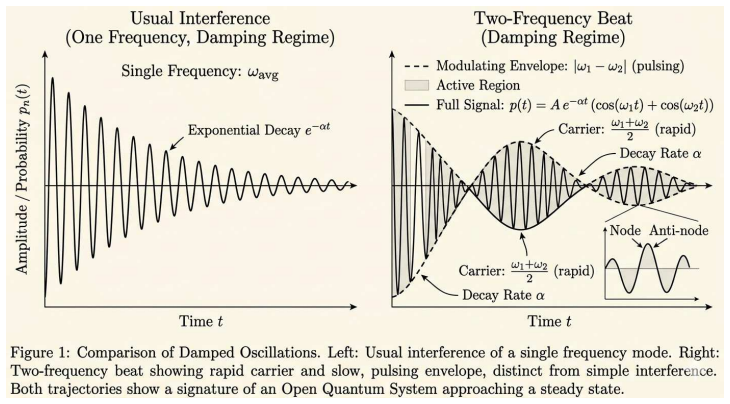
This paper starts with surveying the evolution of quantum-like models of cognition and decision making, transitioning from static kinematic representations to a robust dynamical framework based on open quantum systems. We provide a comprehensive analysis of the Gorini-Kossakowski-Sudarshan-Lindblad (GKSL) master equation's application in cognitive psychology and decision making, illustrating how it models mental state evolution as a dissipative process influenced by an informational environment. We categorize dynamical regimes into Passive and Active Hamiltonians, demonstrating how non-commutation with projections on decision basis serves as a mathematical signature of cognitive agency and Quantum Escape from classical equilibria. The utility of this framework is further explored through its ability to stabilize non-Nash outcomes in strategic games, such as the Prisoner's Dilemma. Building upon this dynamical foundation, we identify ``cognitive beats'' as a signature of the internal struggle between competing ``flows of mind'' deliberated at approximately equal frequencies. Distinct from the damped oscillations of simple interference, these beats emerge from a structural tension between Liouvillian channels that generates a secondary, slow-scale modulation of conviction. This beat envelope dictates the timing of peak readiness and hesitation, providing a mathematical map of the transition between conflicting cognitive states. By resolving these nested time scales, we provide a new spectral diagnostic for the depth of cognitive agency and the complexity of the underlying deliberation process. This paper develops a theoretical framework linking GKSL dynamics with quantum-like cognition and decision-making (QCDM), highlighting how dissipative quantum models can capture features of human thought and decision processes.
Editorial analysis
A structured set of objections, weighed in public.
Referee Report
Summary. This manuscript surveys the progression of quantum-like models of cognition and decision making from static kinematic representations to dynamical frameworks based on open quantum systems. It provides an analysis of the Gorini-Kossakowski-Sudarshan-Lindblad (GKSL) master equation applied to mental state evolution as a dissipative process. The paper categorizes dynamical regimes into Passive and Active Hamiltonians, interpreting non-commutation with projections on the decision basis as a mathematical signature of cognitive agency that enables Quantum Escape from classical equilibria. It explores the framework's application to strategic games such as the Prisoner's Dilemma for stabilizing non-Nash outcomes. The work further identifies 'cognitive beats' emerging from structural tension between competing Liouvillian channels, generating a secondary slow-scale modulation of conviction that serves as a spectral diagnostic for the depth of cognitive agency and deliberation complexity.
Significance. If the interpretive mappings from GKSL dynamics to cognitive features are supported by explicit derivations, this framework could offer a useful dynamical extension to quantum-like cognition models, potentially capturing agency, internal conflict, and timed deliberation through dissipative evolution and spectral features. The concept of cognitive beats provides a novel angle on nested timescales in decision processes. However, the current significance is constrained by the absence of concrete operator constructions and solved dynamics, limiting immediate applicability or falsifiability.
major comments (3)
- [section on strategic games] In the section on strategic games and the Prisoner's Dilemma, the claim that GKSL dynamics stabilize non-Nash outcomes is asserted without the explicit Hamiltonian, Lindblad operators, or the solved master-equation steady-state populations that would demonstrate the non-classical distribution.
- [section on cognitive beats] In the section introducing cognitive beats, the emergence of a secondary slow-scale modulation from tension between Liouvillian channels is described without specifying the competing frequencies, the explicit form of the channels, or the derived beat envelope frequency that would support the spectral diagnostic for agency depth.
- [categorization of dynamical regimes] In the categorization of dynamical regimes into Passive and Active Hamiltonians, non-commutation with decision-basis projections is presented as the signature of cognitive agency and Quantum Escape, yet no worked example derives how this non-commutation produces escape from classical equilibria in a concrete decision model.
minor comments (2)
- The manuscript would benefit from a clearer statement distinguishing the novel elements (such as the cognitive beats diagnostic) from prior surveys of GKSL applications in quantum cognition.
- Notation for the GKSL equation and Liouvillian channels should include explicit references to standard forms to aid readability for readers outside the immediate subfield.
Simulated Author's Rebuttal
We thank the referee for the detailed and constructive review of our manuscript. The comments identify opportunities to strengthen the explicit support for our interpretive framework, and we will revise the paper accordingly to address these points while preserving its survey character.
read point-by-point responses
-
Referee: In the section on strategic games and the Prisoner's Dilemma, the claim that GKSL dynamics stabilize non-Nash outcomes is asserted without the explicit Hamiltonian, Lindblad operators, or the solved master-equation steady-state populations that would demonstrate the non-classical distribution.
Authors: We agree that the strategic-games section would benefit from greater concreteness. In the revision we will supply explicit forms for the Hamiltonian and Lindblad operators appropriate to the Prisoner's Dilemma, together with the analytic or numerical steady-state solution of the master equation. These additions will directly exhibit the non-classical population distribution and thereby substantiate the stabilization claim. revision: yes
-
Referee: In the section introducing cognitive beats, the emergence of a secondary slow-scale modulation from tension between Liouvillian channels is described without specifying the competing frequencies, the explicit form of the channels, or the derived beat envelope frequency that would support the spectral diagnostic for agency depth.
Authors: We accept that the cognitive-beats discussion remains at a descriptive level. The revised manuscript will define the two competing Liouvillian channels with their respective frequencies, derive the beat-envelope frequency from their structural mismatch, and show how this frequency serves as the proposed spectral diagnostic. This will make the claimed link between channel tension and deliberation complexity explicit. revision: yes
-
Referee: In the categorization of dynamical regimes into Passive and Active Hamiltonians, non-commutation with decision-basis projections is presented as the signature of cognitive agency and Quantum Escape, yet no worked example derives how this non-commutation produces escape from classical equilibria in a concrete decision model.
Authors: The categorization is offered as a general mathematical signature, yet we recognize that a concrete derivation would improve accessibility. We will insert a worked example of a simple binary decision task in which the active Hamiltonian is constructed explicitly, its non-commutation with the decision-basis projectors is verified, and the resulting GKSL evolution is solved to demonstrate departure from the classical equilibrium. This example will illustrate the Quantum-Escape mechanism without altering the overall framework. revision: yes
Circularity Check
Non-commutation with decision-basis projectors and Liouvillian beats are labeled as signatures of agency by definitional categorization within the GKSL model.
specific steps
-
self definitional
[Abstract]
"We categorize dynamical regimes into Passive and Active Hamiltonians, demonstrating how non-commutation with projections on decision basis serves as a mathematical signature of cognitive agency and Quantum Escape from classical equilibria."
The paper defines the Active/Passive distinction via the commutation property and then asserts that this same property 'serves as' the signature of agency; the claimed mathematical signature is therefore the definition itself rather than a derived consequence.
-
self definitional
[Abstract]
"we identify ``cognitive beats'' as a signature of the internal struggle between competing ``flows of mind'' deliberated at approximately equal frequencies. [...] This beat envelope dictates the timing of peak readiness and hesitation, providing a mathematical map of the transition between conflicting cognitive states. [...] we provide a new spectral diagnostic for the depth of cognitive agency and the complexity of the underlying deliberation process."
The slow modulation arising from competing Liouvillian channels is identified and then immediately labeled as the 'signature' and 'spectral diagnostic' of cognitive agency depth; the interpretive mapping is introduced by the paper's own identification step.
full rationale
The paper's derivation chain begins with standard GKSL mathematics and then categorizes regimes and identifies features (non-commutation as agency signature; beats as diagnostic of deliberation depth) directly within that framework. These interpretive mappings are presented as demonstrated outcomes but reduce to the model's own labeling and structural assumptions rather than independent derivation, empirical fit, or external theorem. No explicit solved dynamics, concrete operators for the Prisoner's Dilemma, or parameter-fitting steps are shown that would allow falsification outside the definitions. This produces moderate circularity confined to the cognitive interpretation layer, while the underlying open-systems formalism remains non-circular.
Axiom & Free-Parameter Ledger
axioms (2)
- domain assumption Mental states evolve according to the GKSL master equation in an informational environment
- ad hoc to paper Non-commutation of Hamiltonian with decision-basis projections indicates cognitive agency
invented entities (1)
-
Cognitive beats
no independent evidence
Reference graph
Works this paper leans on
-
[1]
Alicki and K
R. Alicki and K. Lendi, Quantum Dynamical Semigroups and Applica- tions, Springer, Berlin (1987)
1987
-
[2]
Asano, M
M. Asano, M. Ohya, Y. Tanaka, A. Khrennikov and I. Basieva , On ap- plication of Gorini–Kossakowski–Sudarshan–Lindblad equ ation in cog- nitive psychology, OSID 18(1), 55–69 (2011)
2011
-
[3]
Asano, M
M. Asano, M. Ohya and A. Khrennikov, Quantum-like model f or deci- sion making process in two players game: A non-Kolmogorovia n model, Found. Phys. 41(3), 538–548 (2011)
2011
-
[4]
Asano, M
M. Asano, M. Ohya, Y. Tanaka, A. Khrennikov and I. Basieva , Quantum-like model of brain’s functioning: Decision makin g from de- coherence, J. Theor. Biology 281, 56–64 (2011)
2011
-
[5]
Asano, Y
M. Asano, Y. Tanaka and A. Khrennikov, Quantum-like dyna mics of decision-making in Prisoner’s Dilemma, Physica A 391(5), 2083–2099 (2012)
2083
-
[6]
and Yamat o, I.: Quantum Adaptivity in Biology: from Genetics to Cognition
Asano, M., Khrennikov, A., Ohya, M., Tanaka, Y. and Yamat o, I.: Quantum Adaptivity in Biology: from Genetics to Cognition. Springer, Heidelberg-Berlin-New York (2015)
2015
-
[7]
Bagarello, F. (2019). Quantum Concepts in the Social, Ecological and Biological Sciences. Cambridge University Press: Cambridge, UK
2019
-
[8]
Bagarello, F., Gargano, F., & Oliveri, F. (2023). Quantu m tools for macroscopic systems. Cham, Switzerland: Springer
2023
-
[9]
Bagarello, F., Gargano, F., Gorgone, M., & Oliveri, F. (2 023). Spread- ing of information on a network: a quantum view. Entropy, 25( 10), 1438
-
[10]
Basieva, A
I. Basieva, A. Khrennikov, M. Ozawa, Quantum-like mode ling in bi- ology with open quantum systems and instruments, Biosystem s, 201, 2021, 104328
2021
-
[11]
M. M. Botvinick, T. S. Braver, D. M. Barch, C. S. Carter an d J. D. Co- hen, Conflict monitoring and cognitive control, Psychological Review 108(3), 624–652 (2001). 36
2001
-
[12]
Breuer and F
H.-P. Breuer and F. Petruccione, The Theory of Open Quantum Sys- tems, Oxford University Press, Oxford (2002)
2002
-
[13]
D., Kitto, K., Ramm, B
Bruza, P. D., Kitto, K., Ramm, B. J., and Sitbon, L. (2015 ). A prob- abilistic framework for analysing the compositionality of conceptual combinations. J. Math. Psych., 67, 26-38
2015
-
[14]
D., Fell, L., Hoyte, P., Dehdashti, S., Obeid, A., Gibson, A., & Moreira, C
Bruza, P. D., Fell, L., Hoyte, P., Dehdashti, S., Obeid, A., Gibson, A., & Moreira, C. (2023). Contextuality and context-sensitivi ty in proba- bilistic models of cognition. Cognitive Psychology, 140, 1 01529
2023
-
[15]
J. R. Busemeyer, Z. Wang, and J. T. Townsend, (2006). Qua ntum dy- namics of human decision-making. J. Math. Psych. , 50, 220–241
2006
-
[16]
Quantum Models of Cogniti on and Deci- sion
Busemeyer, J.R.; Bruza, P.D. Quantum Models of Cogniti on and Deci- sion. Cambridge University Press: Cambridge, UK, 2012; 2nd Edition, 2024
2012
-
[17]
R., & Pothos, E
Busemeyer, J. R., & Pothos, E. M. (2013). Theoretical an d Empirical Aspects of Quantum Models of Cognition. Topics in Cognitive Science, 5(4), 672–688
2013
-
[18]
R., Wang, Z., Khrennikov, A., & Basieva, I
Busemeyer, J. R., Wang, Z., Khrennikov, A., & Basieva, I . (2014). Applying quantum principles to psychology. Physica Scripta , T163, 014007
2014
-
[19]
Busemeyer, J. R. (2023). Measurement Models in Quantum Cognition. In The Quantum-Like Revolution: A Festschrift for Andrei Kh rennikov (pp. 269-279). Cham: Springer International Publishing
2023
-
[20]
C. F. Camerer, Behavioral Game Theory: Experiments in Strategic Interaction, Princeton University Press, Princeton (2003)
2003
-
[21]
E. B. Davies, Markovian master equations, Communications in Math- ematical Physics 39(2), 91–110 (1974)
1974
-
[22]
De Neys, Bias and conflict: A case for logical intuitio ns, Perspectives on Psychological Science 7(1), 28–38 (2012)
W. De Neys, Bias and conflict: A case for logical intuitio ns, Perspectives on Psychological Science 7(1), 28–38 (2012)
2012
-
[23]
Diehl et al
S. Diehl et al. , Quantum states and phases in driven open quantum systems, Nature Physics 4(11), 878–883 (2008)
2008
-
[24]
Frigerio, A. (1978). Stationary States of Quantum Dyna mical Semi- groups. Comm. Math. Phys. , 63, 269–276. 37
1978
-
[25]
Gorini, A
V. Gorini, A. Kossakowski and E. C. G. Sudarshan, Comple tely positive dynamical semigroups of N -level systems, J. Math. Phys. 17(5), 821– 825 (1976)
1976
-
[26]
Henrich, R
J. Henrich, R. Boyd, S. Bowles, C. Camerer, E. Fehr, H. Gi ntis and R. McElreath, In search of Homo economicus: Behavioral expe riments in 15 small-scale societies, American Economic Review 91(2), 73–78 (2001)
2001
-
[27]
Hiesmayr, B. C. (2018). The GKLS Master Equation in High Energy Physics. Open Systems & Information Dynamics
2018
-
[28]
Kahneman and A
D. Kahneman and A. Tversky, Prospect theory: An analysi s of decision under risk, Econometrica 47(2), 263–291 (1979)
1979
-
[29]
Khrennikov, A. Yu. (1999)(2nd edition: 2009) Interpretations of Prob- ability. VSP Int. Sc. Publishers: Utrecht/Tokyo (1999); De Gruyter : Berlin (2009)
1999
-
[30]
Information Dynamics in Cognitive, Psycholog- ical, Social, and Anomalous Phenomena
Khrennikov, A.(2004). Information Dynamics in Cognitive, Psycholog- ical, Social, and Anomalous Phenomena . Series: Fundamental Theories of Physics. Kluwer, Dordrecht
2004
-
[31]
Khrennikov, A. (2010). Ubiquitous Quantum Structure: From Psychol- ogy to Finances . Springer: Berlin/Heidelberg, Germany; New York, NY, USA
2010
-
[32]
Khrennikov, A., Basieva, I., Dzhafarov, E.N., and Buse meyer, J. R. (2014). Quantum models for psychological measurements: An unsolved problem. PLOS One 9, Art. e110909
2014
-
[33]
Khrennikov, A. (2015). Quantum version of Aumann’s app roach to common knowledge: sufficient conditions of impossibility to agree on disagree. Journal of Mathematical Economics , 60, 89-104
2015
-
[34]
Khrennikov, A. (2016). ‘Social Laser’: action amplific ation by stim- ulated emission of social energy. Philosophical Transactions of the Royal Society A: Mathematical, Physical and Engineering Sc iences, 374(2058), 20150094
2016
-
[35]
Khrennikov, A. (2023). Open Quantum Systems in Biology, Cognitive and Social Sciences , Springer. 38
2023
-
[36]
Khrennikov, A., Iriki, A., & Basieva, I. (2025). Constr ucting a bridge between functioning of oscillatory neuronal networks and q uantum-like cognition along with quantum-inspired computation and AI. BioSys- tems, 257, 105573
2025
-
[37]
Khrennikova and E
P. Khrennikova and E. Haven, Instability of political p references and the role of mass media: A dynamical representation in a quant um framework, Phil. Trans. Royal Soc. A 374, 20150106 (2016)
2016
-
[38]
Kossakowski, A
A. Kossakowski, A. Frigerio, V. Gorini and M. Verri, Qua ntum detailed balance and KMS condition. Comm. Math. Phys. 57(2), 97–110 (1977)
1977
-
[39]
Lindblad, On the generators of quantum dynamical sem igroups, Communications in Mathematical Physics 48(2), 119–130 (1976)
G. Lindblad, On the generators of quantum dynamical sem igroups, Communications in Mathematical Physics 48(2), 119–130 (1976)
1976
-
[40]
Meier, C. A. (Ed.). (2001). Atom and Archetype: The Paul i/Jung Let- ters, 1932–1958. Princeton University Press
2001
-
[41]
Minganti, F., Biella, A., Bartolo, N., and Ciuti, C. (20 18). Spectral theory of Liouvillians for dissipative phase transitions. Physical Review A
-
[42]
E. W. Montroll and G. H. Weiss, Random walks on lattices. II. Continuous-time random walks and the Montroll–Weiss equat ion. J. Math. Phys. , 6, 167–181 (1965)
1965
-
[43]
Ozawa, M., & Khrennikov, A. (2020). Application of theo ry of quantum instruments to psychology: Combination of question order e ffect with response replicability effect. Entropy, 22(1), 37.1–9436
2020
-
[44]
Ozawa M., & Khrennikov A. (2021). Modeling combination of question order effect, response replicability effect, and QQ-equality w ith quan- tum instruments. Journal of Mathematical Psychology , 100, 102491
2021
-
[45]
Pauli, W. (1955). The influence of archetypal ideas on th e scientific theories of Kepler. In C. G. Jung & W. Pauli, The Interpretati on of Nature and the Psyche. Pantheon Books
1955
-
[46]
Plotnitsky, A. (2023). The agency of observation not to be neglected: complementarity, causality and the arrow of events in quant um and quantum-like theories. Phil. Trans. Royal Soc. A, 381(2256 ), 20220295
2023
-
[47]
Plotnitsky and E
A. Plotnitsky and E. Haven, The Quantum-Like Revolutio n. A Festschrift for Andrei Khrennikov with a foreword by 2022 No bel Lau- reate Anton Zeilinger. Springer Nature, Berli, 2023. 39
2022
-
[48]
M., & Busemeyer, J
Pothos, E. M., & Busemeyer, J. R. (2009). A quantum proba bility explanation for violations of ‘rational’decision theory. Proceedings of the Royal Society B: Biological Sciences, 276(1665), 2171- 2178
2009
-
[49]
E. M. Pothos and J. R. Busemeyer, (2013). Can quantum pro bability provide a new direction for cognitive modeling? Behavioral and Brain Sciences, 36, 255–327
2013
-
[50]
Pothos, E.M., Busemeyer, J.R. (2022). Quantum Cogniti on. Ann. Rev. Psych. 73, 749-778
2022
-
[51]
K. R. Ridderinkhof, W. P. van den Wildenberg, S. J. Segal owitz and C. S. Carter, Neurocognitive mechanisms of cognitive contr ol: The role of the medial frontal cortex in action selection, response m onitoring and self-regulation, Brain and Cognition 56(2), 129–140 (2004)
2004
-
[52]
Rosner, A., Basieva, I., Barque-Duran A., Gl¨ ockner, A ., von Helversen, B., Khrennikov, A., Pothos E.M. (2022). Ambivalence in deci sion mak- ing: An eye tracking study, Cognitive Psychology,134,1014 64
2022
-
[53]
O., and Zubairy, M
Scully, M. O., and Zubairy, M. S. (1997). Quantum Optics . Cambridge University Press
1997
-
[54]
Schlosshauer, Decoherence and the Quantum-to-Classical Transi- tion, Springer, Berlin (2007)
M. Schlosshauer, Decoherence and the Quantum-to-Classical Transi- tion, Springer, Berlin (2007)
2007
-
[55]
Shafir and A
E. Shafir and A. Tversky, Thinking through uncertainty: Nonconse- quentialist reasoning and choice, Cognitive Psychology 24(4), 449–474 (1992)
1992
-
[56]
H. A. Simon, A behavioral model of rational choice, Quarterly Journal of Economics 69(1), 99–118 (1955)
1955
-
[57]
Spohn, An algebraic condition for the existence of a u nique sta- tionary state of a dissipative quantum system, Lett
H. Spohn, An algebraic condition for the existence of a u nique sta- tionary state of a dissipative quantum system, Lett. Math. Phys. 2(1), 33–38 (1977)
1977
-
[58]
Thaler, Toward a positive theory of consumer choice, Journal of Economic Behavior & Organization 1(1), 39–60 (1980)
R. Thaler, Toward a positive theory of consumer choice, Journal of Economic Behavior & Organization 1(1), 39–60 (1980)
1980
-
[59]
Tsarev, D., Trofimova, A., Alodjants, A., & Khrennikov, A. (2019). Phase transitions, collective emotions and decision-maki ng problem in heterogeneous social systems. Scientific reports, 9(1), 18039. 40
2019
-
[60]
Tversky and D
A. Tversky and D. Kahneman, Judgment under uncertainty : Heuristics and biases, Science 185(4157), 1124–1131 (1974)
1974
-
[61]
Zwanzig, Nonequilibrium Statistical Mechanics , Oxford University Press, 2001
R. Zwanzig, Nonequilibrium Statistical Mechanics , Oxford University Press, 2001
2001
-
[62]
N. G. van Kampen, Stochastic Processes in Physics and Chemistry , 3rd ed., North-Holland, 2007. 41
2007
discussion (0)
Sign in with ORCID, Apple, or X to comment. Anyone can read and Pith papers without signing in.