Recognition: unknown
Hunting Sterile Neutrino Dark Matter in the MeV Gap
Pith reviewed 2026-05-10 03:54 UTC · model grok-4.3
The pith
Future MeV gamma-ray telescopes can improve existing limits on sterile neutrino dark matter by several orders of magnitude.
A machine-rendered reading of the paper's core claim, the machinery that carries it, and where it could break.
Core claim
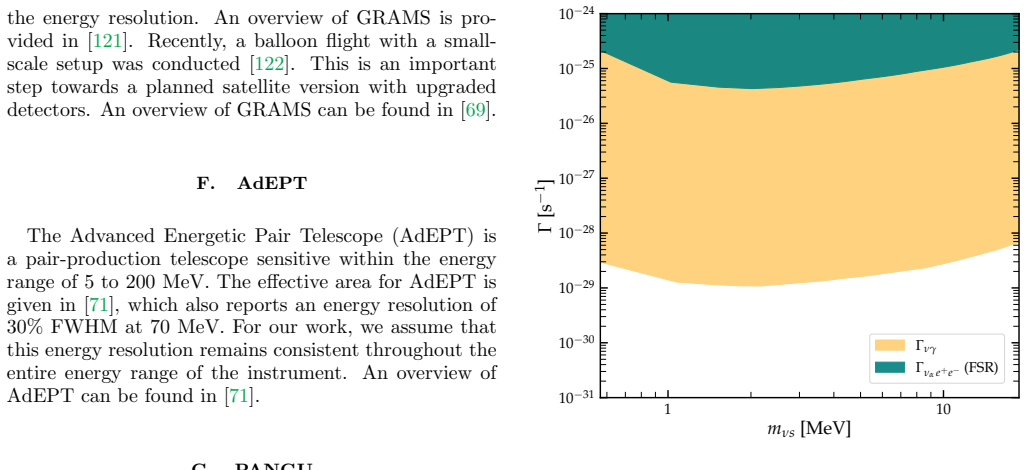
Sterile neutrinos in the 0.2-100 MeV range can produce observable photon signals through radiative two-body decays and three-body decays with final-state radiation. Performing a Fisher forecasting analysis that incorporates realistic astrophysical background modeling and detector response yields projected constraints on the sterile neutrino decay rate. Future MeV instruments can improve existing limits by several orders of magnitude across a wide region of parameter space.
What carries the argument
Fisher forecasting analysis with realistic astrophysical background modeling and detector response applied to photon signals from sterile neutrino radiative decays.
If this is right
- Projected constraints on sterile neutrino decay rates become stronger by orders of magnitude over much of the MeV mass range.
- A wide region of the sterile neutrino mixing and mass parameter space enters the testable domain.
- Next-generation MeV telescopes gain explicit discovery potential for this dark matter candidate.
- The MeV gap in existing dark matter searches receives targeted coverage through gamma-ray observations.
Where Pith is reading between the lines
- The same forecasting method could extend to other light dark matter candidates that produce MeV photons via decays.
- Instrument design choices for background rejection and energy resolution directly determine how much parameter space can be covered.
- Positive signals would require follow-up with multiple targets to distinguish dark matter decay from astrophysical sources.
- Negative results would still narrow viable sterile neutrino dark matter models even if other candidates remain.
Load-bearing premise
The Fisher forecasting analysis with realistic astrophysical background modeling and detector response accurately represents the actual observational conditions without major unaccounted systematics or signal confusion.
What would settle it
Actual data from a next-generation MeV gamma-ray telescope either detecting a photon excess matching the predicted sterile neutrino decay spectrum in dark-matter-rich targets or setting new decay-rate limits at the forecasted level.
Figures



read the original abstract
We investigate the sensitivities of upcoming MeV gamma-ray telescopes to sterile neutrino dark matter in the mass range $(0.2-100)\,{\rm MeV}$. Sterile neutrinos in this regime can produce observable photon signals through radiative two-body decays and three-body decays with final-state radiation. We perform a Fisher forecasting analysis incorporating realistic astrophysical background modeling and detector response to derive projected constraints on the sterile neutrino decay rate. We find that future MeV instruments can improve existing limits by several orders of magnitude across a wide region of parameter space. Our results highlight the discovery potential of next-generation MeV telescopes in probing sterile neutrino dark matter.
Editorial analysis
A structured set of objections, weighed in public.
Referee Report
Summary. The manuscript investigates the sensitivity of future MeV gamma-ray telescopes to sterile neutrino dark matter in the 0.2-100 MeV mass range. Sterile neutrinos are assumed to produce photons via radiative two-body decays and three-body decays with final-state radiation. A Fisher forecasting analysis is performed that incorporates realistic astrophysical background modeling and detector response, leading to the claim that next-generation instruments can improve existing limits by several orders of magnitude across a wide region of parameter space.
Significance. If the projected sensitivities hold, the work would be significant for dark matter phenomenology by targeting the poorly constrained MeV mass gap with a concrete observational strategy. The incorporation of realistic background modeling and detector response is a positive feature that distinguishes the forecast from purely theoretical projections.
major comments (2)
- [Fisher forecasting analysis (methods section)] Fisher forecasting analysis (methods section): the central claim of several-orders-of-magnitude improvement rests on the Fisher-matrix projection under Gaussian likelihoods and linear response. For the low-event-count regime expected from sterile-neutrino decays, this approximation is known to be unreliable; the manuscript does not demonstrate its validity via Monte Carlo validation or full-likelihood comparison, which directly undermines the quoted sensitivity gains.
- [Background modeling subsection] Background modeling subsection: while the abstract states that 'realistic astrophysical background modeling' is included, the treatment of systematic uncertainties in cosmic-ray-induced and diffuse Galactic components is not quantified (e.g., no marginalization over nuisance parameters or assessment of residual systematics). These systematics typically dominate MeV observations and, if omitted, render the projected limits optimistic by an undetermined factor.
minor comments (1)
- [Abstract] The abstract summarizes the analysis but does not name the specific future instruments or telescope specifications used in the forecast; adding this information would improve clarity.
Simulated Author's Rebuttal
We thank the referee for the detailed and constructive report. The comments highlight important methodological considerations for our Fisher forecasting analysis and background treatment. We address each major comment below and describe the revisions we will implement to strengthen the manuscript.
read point-by-point responses
-
Referee: Fisher forecasting analysis (methods section): the central claim of several-orders-of-magnitude improvement rests on the Fisher-matrix projection under Gaussian likelihoods and linear response. For the low-event-count regime expected from sterile-neutrino decays, this approximation is known to be unreliable; the manuscript does not demonstrate its validity via Monte Carlo validation or full-likelihood comparison, which directly undermines the quoted sensitivity gains.
Authors: We agree that the Fisher matrix relies on Gaussian and linear-response assumptions that can be inaccurate in the low-event regime relevant to sterile-neutrino signals. Although our background model already employs Poisson statistics, we did not perform explicit Monte Carlo validation against full likelihoods. In the revised manuscript we will add a dedicated validation subsection that compares Fisher forecasts to Monte Carlo realizations and full-likelihood scans for representative low-count cases across the 0.2–100 MeV range. This will either confirm the quoted sensitivity gains or provide corrected projections. revision: yes
-
Referee: Background modeling subsection: while the abstract states that 'realistic astrophysical background modeling' is included, the treatment of systematic uncertainties in cosmic-ray-induced and diffuse Galactic components is not quantified (e.g., no marginalization over nuisance parameters or assessment of residual systematics). These systematics typically dominate MeV observations and, if omitted, render the projected limits optimistic by an undetermined factor.
Authors: Our background model incorporates the primary astrophysical components (cosmic-ray-induced and diffuse Galactic emission) with spectra and normalizations drawn from existing MeV data. However, we did not introduce nuisance parameters or marginalize over their systematic uncertainties. In the revised manuscript we will add nuisance parameters for the normalizations and spectral indices of these components, marginalize over them within the Fisher formalism, and quantify the resulting degradation in sensitivity. We will also report the residual systematic floor after marginalization. revision: yes
Circularity Check
No circularity: forecasting analysis derives projected limits from external models and instrument specs
full rationale
The paper performs a forward Fisher-matrix projection of future MeV telescope sensitivities to sterile-neutrino decay signals, incorporating modeled astrophysical backgrounds and detector responses. No parameters are fitted to existing data and then re-used as 'predictions' of the same quantities; the derivation chain consists of standard signal modeling (radiative decays) plus external inputs (background spectra, instrument response functions) that are not defined in terms of the output limits. No load-bearing self-citations or uniqueness theorems are invoked to close the argument, and the claimed orders-of-magnitude improvement follows directly from the assumed telescope performance rather than reducing to a tautology.
Axiom & Free-Parameter Ledger
Reference graph
Works this paper leans on
-
[1]
M. Cirelli, A. Strumia and J. Zupan,Dark Matter, 2406.01705
work page internal anchor Pith review arXiv
- [2]
- [3]
-
[4]
A. Kusenko,Sterile neutrinos: The Dark side of the light fermions,Phys. Rept.481(2009) 1–28, [0906.2968]
- [5]
-
[6]
A White Paper on keV Sterile Neutrino Dark Matter
M. Drewes et al.,A White Paper on keV Sterile Neutrino Dark Matter,JCAP01(2017) 025, [1602.04816]
work page Pith review arXiv 2017
-
[7]
B. Dasgupta and J. Kopp,Sterile Neutrinos,Phys. Rept.928(2021) 1–63, [2106.05913]
- [8]
-
[9]
A. Boyarsky, A. Neronov, O. Ruchayskiy and M. Shaposhnikov,The Masses of active neutrinos in the nuMSM from X-ray astronomy,JETP Lett.83 (2006) 133–135, [hep-ph/0601098]
- [10]
-
[11]
L. Canetti, M. Drewes, T. Frossard and M. Shaposhnikov,Dark Matter, Baryogenesis and Neutrino Oscillations from Right Handed Neutrinos, Phys. Rev. D87(2013) 093006, [1208.4607]
-
[12]
S. Dodelson and L. M. Widrow,Sterile-neutrinos as dark matter,Phys. Rev. Lett.72(1994) 17–20, [hep-ph/9303287]
- [13]
-
[14]
M. Shaposhnikov and I. Tkachev,The nuMSM, inflation, and dark matter,Phys. Lett. B639(2006) 414–417, [hep-ph/0604236]
-
[15]
K. Petraki and A. Kusenko,Dark-matter sterile neutrinos in models with a gauge singlet in the Higgs sector,Phys. Rev. D77(2008) 065014, [0711.4646]
- [16]
-
[17]
B. Shuve and I. Yavin,Dark matter progenitor: Light vector boson decay into sterile neutrinos,Phys. Rev. D 89(2014) 113004, [1403.2727]
-
[18]
Shakya,Sterile Neutrino Dark Matter from Freeze-In,Mod
B. Shakya,Sterile Neutrino Dark Matter from Freeze-In,Mod. Phys. Lett. A31(2016) 1630005, [1512.02751]
-
[19]
B. Shakya and J. D. Wells,Sterile Neutrino Dark Matter with Supersymmetry,Phys. Rev. D96(2017) 031702, [1611.01517]
- [20]
- [21]
- [22]
-
[23]
F. Bezrukov, A. Chudaykin and D. Gorbunov,Hiding an elephant: heavy sterile neutrino with large mixing angle does not contradict cosmology,JCAP06(2017) 051, [1705.02184]
-
[24]
F. Bezrukov, A. Chudaykin and D. Gorbunov,Induced resonance makes light sterile neutrino Dark Matter cool,Phys. Rev. D99(2019) 083507, [1809.09123]
-
[25]
F. Bezrukov, A. Chudaykin and D. Gorbunov,Scalar induced resonant sterile neutrino production in the early Universe,Phys. Rev. D101(2020) 103516, [1911.08502]
- [26]
- [27]
- [28]
-
[29]
Constraining Light Dark Matter with Diffuse X-Ray and Gamma-Ray Observations
R. Essig, E. Kuflik, S. D. McDermott, T. Volansky and K. M. Zurek,Constraining Light Dark Matter with Diffuse X-Ray and Gamma-Ray Observations,JHEP 11(2013) 193, [1309.4091]
work page Pith review arXiv 2013
-
[30]
Constraints on light decaying dark matter candidates from 16 yr of INTEGRAL/SPI observations,
F. Calore, A. Dekker, P. D. Serpico and T. Siegert, Constraints on light decaying dark matter candidates from 16 yr of INTEGRAL/SPI observations,Mon. Not. Roy. Astron. Soc.520(2023) 4167–4172, [2209.06299]
-
[31]
A. Boyarsky, D. Malyshev, A. Neronov and O. Ruchayskiy,Constraining DM properties with SPI, Mon. Not. Roy. Astron. Soc.387(2008) 1345, [0710.4922]
- [32]
- [33]
-
[34]
M. Loewenstein, A. Kusenko and P. L. Biermann,New Limits on Sterile Neutrinos from Suzaku Observations of the Ursa Minor Dwarf Spheroidal Galaxy, Astrophys. J.700(2009) 426–435, [0812.2710]
- [35]
-
[36]
A. Boyarsky, D. Iakubovskyi, O. Ruchayskiy and V. Savchenko,Constraints on decaying Dark Matter 9 from XMM-Newton observations of M31,Mon. Not. Roy. Astron. Soc.387(2008) 1361, [0709.2301]
-
[37]
Riemer-Sørensen and S
S. Riemer-Sørensen and S. H. Hansen,Decaying dark matter in the draco dwarf galaxy,Astronomy & Astrophysics500(2009) L37–L40
2009
-
[38]
S. Horiuchi, P. J. Humphrey, J. Onorbe, K. N. Abazajian, M. Kaplinghat and S. Garrison-Kimmel, Sterile neutrino dark matter bounds from galaxies of the Local Group,Phys. Rev. D89(2014) 025017, [1311.0282]
- [39]
- [40]
-
[41]
A. Neronov, D. Malyshev and D. Eckert,Decaying dark matter search with NuSTAR deep sky observations, Phys. Rev. D94(2016) 123504, [1607.07328]
-
[42]
Almost closing theνMSM sterile neutrino dark matter window with NuSTAR,
K. Perez, K. C. Y. Ng, J. F. Beacom, C. Hersh, S. Horiuchi and R. Krivonos,Almost closing theνMSM sterile neutrino dark matter window with NuSTAR, Phys. Rev. D95(2017) 123002, [1609.00667]
- [43]
-
[44]
D. Sicilian, N. Cappelluti, E. Bulbul, F. Civano, M. Moscetti and C. S. Reynolds,Probing the Milky Way’s Dark Matter Halo for the 3.5 keV Line, Astrophys. J.905(2020) 146, [2008.02283]
- [45]
- [46]
- [47]
- [48]
-
[49]
A. Boyarsky, O. Ruchayskiy, D. Iakubovskyi and J. Franse,Unidentified Line in X-Ray Spectra of the Andromeda Galaxy and Perseus Galaxy Cluster,Phys. Rev. Lett.113(2014) 251301, [1402.4119]
- [50]
-
[51]
A. Boyarsky, J. Franse, D. Iakubovskyi and O. Ruchayskiy,Checking the Dark Matter Origin of a 3.53 keV Line with the Milky Way Center,Phys. Rev. Lett.115(2015) 161301, [1408.2503]
-
[52]
N. Cappelluti, E. Bulbul, A. Foster, P. Natarajan, M. C. Urry, M. W. Bautz et al.,Searching for the 3.5 keV Line in the Deep Fields with Chandra: the 10 Ms observations,Astrophys. J.854(2018) 179, [1701.07932]
-
[53]
D. Malyshev, A. Neronov and D. Eckert,Constraints on 3.55 keV line emission from stacked observations of dwarf spheroidal galaxies,Phys. Rev. D90(2014) 103506, [1408.3531]
- [54]
- [55]
-
[56]
T. E. Jeltema and S. Profumo,Deep XMM Observations of Draco rule out at the 99% Confidence Level a Dark Matter Decay Origin for the 3.5 keV Line,Mon. Not. Roy. Astron. Soc.458(2016) 3592–3596, [1512.01239]. [57]Hitomicollaboration, F. A. Aharonian et al.,Hitomi constraints on the 3.5 keV line in the Perseus galaxy cluster,Astrophys. J. Lett.837(2017) L15,...
-
[57]
C. Dessert, N. L. Rodd and B. R. Safdi,The dark matter interpretation of the 3.5-keV line is inconsistent with blank-sky observations,Science367 (2020) 1465–1467, [1812.06976]
-
[58]
C. Dessert, J. W. Foster, Y. Park and B. R. Safdi, Was There a 3.5 keV Line?,Astrophys. J.964(2024) 185, [2309.03254]
-
[59]
Schoenfelder, H
V. Schoenfelder, H. Aarts, K. Bennett, H. de Boer, J. Clear, W. Collmar et al.,Instrument Description and Performance of the Imaging Gamma-Ray Telescope COMPTEL aboard the Compton Gamma-Ray Observatory, ApJS86(June, 1993) 657
1993
-
[60]
G. Lucchetta, M. Ackermann, D. Berge and R. B¨ uhler, Introducing the MeVCube concept: a CubeSat for MeV observations,JCAP08(2022) 013, [2204.01325]
-
[61]
E. O. et al.,Exploring the MeV sky with a combined coded mask and Compton telescope: the Galactic Explorer with a Coded aperture mask Compton telescope (GECCO),Journal of Cosmology and Astroparticle Physics2022(Jul, 2022) 036
2022
-
[62]
E. Orlando et al.,Exploring the MeV sky with a combined coded mask and Compton telescope: the Galactic Explorer with a Coded aperture mask Compton telescope (GECCO),JCAP07(2022) 036, [2112.07190]. [64]AMEGO Teamcollaboration, C. A. Kierans, AMEGO: Exploring the Extreme Multimessenger Universe,Proc. SPIE Int. Soc. Opt. Eng.11444 (2020) 1144431, [2101.03105...
-
[63]
H. Fleischhack,AMEGO-X: MeV gamma-ray Astronomy in the Multi-messenger Era,PoS ICRC2021(2021) 649, [2108.02860]
-
[64]
A. D. et al.,Science with e-ASTROGAM: A space mission for MeV–GeV gamma-ray astrophysics, Journal of High Energy Astrophysics19(2018) 1–106. [68]e-ASTROGAMcollaboration, M. Tavani et al., Science with e-ASTROGAM: A space mission for MeV–GeV gamma-ray astrophysics,JHEAp19(2018) 1–106, [1711.01265]
-
[65]
Aramaki, P
T. Aramaki, P. O. H. Adrian, G. Karagiorgi and H. Odaka,Dual MeV gamma-ray and dark matter observatory - Project,Astroparticle Physics114(2020) 107–114
2020
-
[66]
T. Aramaki, P. Hansson Adrian, G. Karagiorgi and H. Odaka,Dual MeV Gamma-Ray and Dark Matter Observatory - GRAMS Project,Astropart. Phys.114 (2020) 107–114, [1901.03430]
-
[67]
S. D. H. et al.,A pair production telescope for medium-energy gamma-ray polarimetry,Astroparticle Physics59(2014) 18–28
2014
- [68]
-
[69]
C. Boehm and P. Fayet,Scalar dark matter candidates, Nucl. Phys. B683(2004) 219–263, [hep-ph/0305261]
-
[70]
M. Pospelov, A. Ritz and M. B. Voloshin,Secluded WIMP Dark Matter,Phys. Lett. B662(2008) 53–61, [0711.4866]
work page Pith review arXiv 2008
-
[71]
Y. Hochberg, E. Kuflik, T. Volansky and J. G. Wacker, Mechanism for Thermal Relic Dark Matter of Strongly Interacting Massive Particles,Phys. Rev. Lett.113 (2014) 171301, [1402.5143]
-
[72]
A. Boyarsky, M. Drewes, T. Lasserre, S. Mertens and O. Ruchayskiy,Sterile neutrino Dark Matter,Prog. Part. Nucl. Phys.104(2019) 1–45, [1807.07938]
- [73]
-
[74]
F. Compagnin, S. Profumo and N. Fornengo,MeV dark matter with MeV dark photons in Abelian kinetic mixing theories,JCAP03(2023) 061, [2211.13825]
- [75]
- [76]
- [77]
-
[78]
S. Balan et al.,Resonant or asymmetric: the status of sub-GeV dark matter,JCAP01(2025) 053, [2405.17548]
- [79]
- [80]
discussion (0)
Sign in with ORCID, Apple, or X to comment. Anyone can read and Pith papers without signing in.