Recognition: unknown
P-wave Orbital Magnetism
Pith reviewed 2026-05-10 03:32 UTC · model grok-4.3
The pith
Loop currents in a two-dimensional lattice induce an orbital texture that produces p-wave orbital magnetism protected by combined translation and time-reversal symmetry.
A machine-rendered reading of the paper's core claim, the machinery that carries it, and where it could break.
Core claim
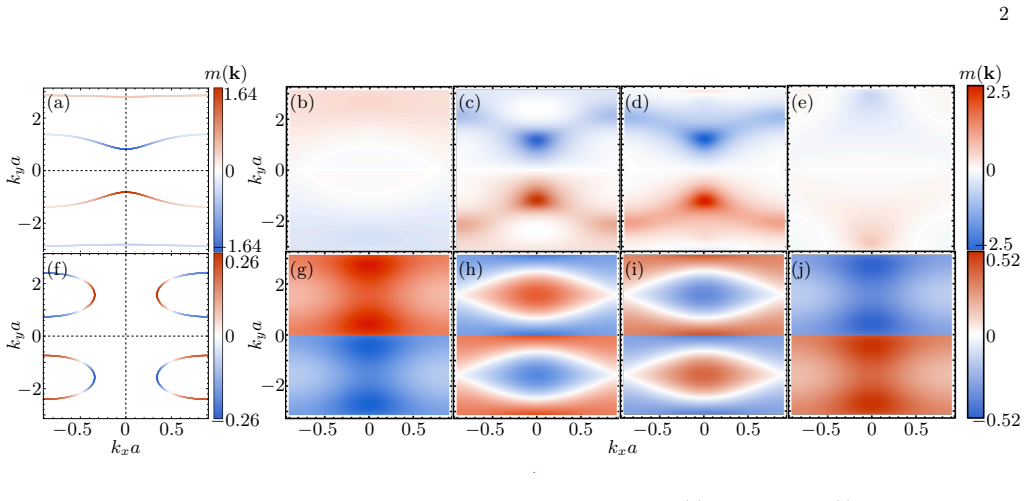
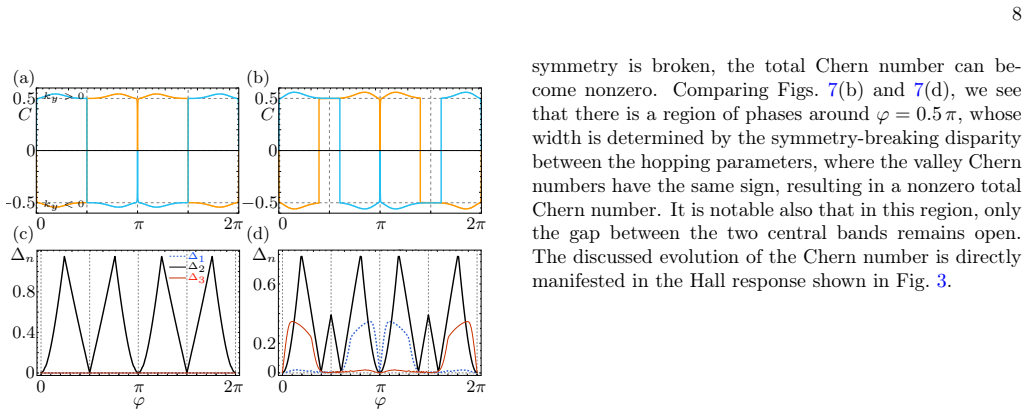
The central discovery is a p-wave orbital magnetism that stems from an orbital texture generated by loop currents on a two-dimensional lattice. This form of magnetism is protected by the combined translation and time-reversal symmetry, and even-parity components emerge upon breaking this symmetry. The lattice model's spectrum contains Dirac points, and its topology is governed by the magnitude of the loop currents. Since odd-parity magnetism produces no net magnetization, the orbital Hall conductivity is identified as a suitable probe. This framework positions orbital degrees of freedom as a new arena for unconventional p-wave magnetism separate from noncollinear spin textures and connectsit
What carries the argument
The orbital texture induced by loop currents, which generates the symmetry-protected p-wave orbital magnetism in the two-dimensional lattice model.
If this is right
- Odd-parity p-wave orbital magnetism produces no macroscopic magnetization.
- Orbital Hall conductivity provides a measurable signature for this magnetism.
- Dirac points appear in the energy spectrum, with their properties and the overall topology determined by the loop current magnitude.
- Breaking the combined translation and time-reversal symmetry introduces even-parity magnetic components.
- Orbital degrees of freedom offer a platform for p-wave magnetism independent of spin textures.
Where Pith is reading between the lines
- If correct, the absence of net magnetization would distinguish this from conventional magnets while still allowing Hall-like responses.
- Varying loop currents could serve as a control knob for switching between topological phases and different magnetic parities.
- Detection via orbital Hall conductivity opens a route to probe hidden magnetic orders without direct magnetization measurements.
Load-bearing premise
The assumption that loop currents generate an orbital texture sufficient to produce p-wave orbital magnetism protected specifically by combined translation and time-reversal symmetry.
What would settle it
A calculation showing that the orbital magnetic response in the lattice model lacks odd-parity character or that the orbital Hall conductivity does not exhibit the expected dependence on loop current magnitude would falsify the proposal.
Figures


read the original abstract
Realization of unconventional odd-parity magnets usually requires noncollinear spin textures of the underlying lattice. We propose a different concept of $p$-wave magnetism that originates from an orbital texture induced by loop currents. The resulting $p$-wave orbital magnetism is protected by the combined translation and time-reversal symmetry, with even-parity components arising when the symmetry is broken. Our proposal is exemplified by a two-dimensional (2D) lattice model whose energy spectrum contains Dirac points and which is characterized by a nontrivial topology controlled by the magnitude of the loop currents. Since the odd-parity magnetism precludes macroscopic magnetization, we suggest measuring it via orbital Hall conductivity. Our work establishes orbital degrees of freedom as an additional platform for unconventional $p$-wave magnetism beyond noncollinear spin textures, as well as makes a step forward to bridging odd-parity magnetism and topology.
Editorial analysis
A structured set of objections, weighed in public.
Referee Report
Summary. The manuscript proposes a new form of p-wave orbital magnetism arising from an orbital texture induced by loop currents on a 2D lattice. This magnetism is claimed to be protected by the combined translation-plus-time-reversal symmetry (with even-parity components appearing when that symmetry is broken), the model spectrum is said to contain Dirac points whose topology is tuned by the loop-current magnitude, and orbital Hall conductivity is suggested as the experimental probe since net magnetization is precluded.
Significance. If the symmetry protection and orbital-texture claims are rigorously established, the work would supply an orbital-based route to odd-parity magnetism that is distinct from non-collinear spin textures and that connects directly to tunable Dirac topology. This could enlarge the set of platforms for realizing and detecting unconventional magnetism.
major comments (3)
- [Model Hamiltonian] Model section (Hamiltonian definition): the explicit tight-binding terms that implement the loop currents are not written out, so it is impossible to verify that the resulting site-dependent orbital moments are odd under spatial parity yet invariant under the combined translation-plus-time-reversal operator. This symmetry property is load-bearing for the entire p-wave classification.
- [Symmetry analysis] Symmetry-protection paragraph: the statement that the combined symmetry protects the odd-parity orbital magnetism is asserted without an explicit operator calculation or table showing how the orbital-moment operator transforms. A concrete check (e.g., action of T·T_x on the local orbital moment) is required.
- [Energy spectrum and topology] Topology and spectrum claims: the abstract and text state that Dirac-point topology is controlled by loop-current magnitude, yet no band-structure plots, Chern-number calculations, or explicit diagonalization results are referenced. Without these, the topological tuning cannot be confirmed.
minor comments (2)
- Notation for the orbital-moment operator should be introduced once and used consistently; the current text mixes “orbital texture” and “orbital magnetism” without a clear definition.
- The orbital Hall conductivity proposal is mentioned only qualitatively; a brief Kubo-formula sketch or symmetry argument showing why it is nonzero while net magnetization vanishes would strengthen the experimental section.
Simulated Author's Rebuttal
We thank the referee for the careful reading and constructive comments. We address each major point below and will revise the manuscript to incorporate the requested details.
read point-by-point responses
-
Referee: [Model Hamiltonian] Model section (Hamiltonian definition): the explicit tight-binding terms that implement the loop currents are not written out, so it is impossible to verify that the resulting site-dependent orbital moments are odd under spatial parity yet invariant under the combined translation-plus-time-reversal operator. This symmetry property is load-bearing for the entire p-wave classification.
Authors: We agree that the explicit tight-binding terms were not provided in the submitted version. In the revised manuscript we will write out the full real-space Hamiltonian, including the loop-current hopping amplitudes on the 2D lattice. This will make it possible to verify directly that the induced orbital moments are odd under spatial inversion while remaining invariant under the combined translation-plus-time-reversal operator. revision: yes
-
Referee: [Symmetry analysis] Symmetry-protection paragraph: the statement that the combined symmetry protects the odd-parity orbital magnetism is asserted without an explicit operator calculation or table showing how the orbital-moment operator transforms. A concrete check (e.g., action of T·T_x on the local orbital moment) is required.
Authors: We acknowledge that an explicit operator-level demonstration was missing. We will add a short symmetry-analysis subsection (or appendix) that computes the transformation of the local orbital-moment operator under the combined T·T_x symmetry, including the explicit action on site-resolved moments. This will rigorously establish the protection of the p-wave component. revision: yes
-
Referee: [Energy spectrum and topology] Topology and spectrum claims: the abstract and text state that Dirac-point topology is controlled by loop-current magnitude, yet no band-structure plots, Chern-number calculations, or explicit diagonalization results are referenced. Without these, the topological tuning cannot be confirmed.
Authors: The manuscript contains the underlying diagonalization and topological analysis, but we failed to reference the supporting figures and calculations in the text. In the revision we will add explicit citations to the band-structure plots (for several values of the loop-current strength), the computed Chern numbers, and a brief description of the diagonalization procedure, thereby confirming the tuning of the Dirac-point topology. revision: yes
Circularity Check
No significant circularity; p-wave orbital magnetism follows from explicit model symmetries and loop-current Hamiltonian
full rationale
The paper defines a 2D lattice Hamiltonian incorporating loop currents that induce site-dependent orbital texture. The claimed p-wave (odd-parity) character and protection under combined translation-plus-time-reversal symmetry are direct consequences of how the Hamiltonian is constructed to respect those symmetries while breaking others. Dirac points, topology, and the absence of net magnetization are likewise controlled by the loop-current parameter as stated model properties, not fitted outputs or renamed inputs. No load-bearing self-citations or uniqueness theorems are invoked to force the result; the orbital Hall conductivity is offered as an experimental probe rather than a derived prediction that reduces to the input. The derivation chain is self-contained against the model's explicit assumptions and does not exhibit any of the enumerated circular patterns.
Axiom & Free-Parameter Ledger
free parameters (1)
- magnitude of the loop currents
axioms (2)
- domain assumption Combined translation and time-reversal symmetry protects the p-wave orbital magnetism and precludes macroscopic magnetization.
- domain assumption The 2D lattice model possesses Dirac points whose topology is controlled by loop-current magnitude.
invented entities (1)
-
p-wave orbital magnetism
no independent evidence
Reference graph
Works this paper leans on
-
[1]
L. ˇSmejkal, J. Sinova, and T. Jungwirth, Emerging Re- search Landscape of Altermagnetism, Phys. Rev. X12, 040501 (2022), arXiv:2204.10844
-
[2]
L. ˇSmejkal, J. Sinova, and T. Jungwirth, Beyond Conventional Ferromagnetism and Antiferromagnetism: A Phase with Nonrelativistic Spin and Crystal Ro- tation Symmetry, Phys. Rev. X12, 031042 (2022), arXiv:2105.05820
- [3]
-
[4]
T. Jungwirth, R. M. Fernandes, E. Fradkin, A. H. Mac- Donald, J. Sinova, and L.ˇSmejkal, Altermagnetism: An unconventional spin-ordered phase of matter, Newton , 10016 (2025), arXiv:2411.00717 [cond-mat]
-
[5]
C. Song, H. Bai, Z. Zhou, L. Han, H. Reichlova, J. H. Dil, J. Liu, X. Chen, and F. Pan, Altermagnets as a new class of functional materials, Nat Rev Mater10, 473 (2025)
2025
-
[6]
T. Jungwirth, J. Sinova, R. M. Fernandes, Q. Liu, H.Watanabe, S.Murakami, S.Nakatsuji,andL. ˇSmejkal, Symmetry, microscopy and spectroscopy signatures of al- termagnetism, Nature649, 837 (2026), arXiv:2506.22860 [cond-mat]
-
[7]
Jiang, M
B. Jiang, M. Hu, J. Bai, Z. Song, C. Mu, G. Qu, W. Li, W. Zhu, H. Pi, Z. Wei, Y.-J. Sun, Y. Huang, X. Zheng, Y. Peng, L. He, S. Li, J. Luo, Z. Li, G. Chen, H. Li, H. Weng, and T. Qian, A metallic room-temperature d- wave altermagnet, Nat. Phys.21, 754 (2025)
2025
-
[8]
M. Naka, Y. Motome, and H. Seo, Altermagnetic per- ovskites, npj Spintronics3, 1 (2025)
2025
- [9]
- [10]
-
[11]
Q. Song, S. Stavri´ c, P. Barone, A. Droghetti, D. S. An- tonenko, J. W. F. Venderbos, C. A. Occhialini, B. Ilyas, E. Erge¸ cen, N. Gedik, S.-W. Cheong, R. M. Fernandes, S. Picozzi, and R. Comin, Electrical switching of a p- wave magnet, Nature642, 64 (2025), arXiv:2504.21086 [cond-mat]
-
[12]
T. Jungwirth, J. Sinova, P. Wadley, D. Kriegner, H. Re- ichlova, F. Krizek, H. Ohno, and L. Smejkal, Altermag- netic spintronics (2025), arXiv:2508.09748 [cond-mat]
- [13]
- [14]
- [15]
-
[16]
J. Mitscherling, J. Priessnitz, C. K. Geschner, and L. ˇSmejkal, Microscopic origin ofp-wave magnetism (2026), arXiv:2603.09736 [cond-mat]
- [17]
- [18]
-
[19]
H. Moritz M., F. Akira, and H. Max, Symmetry-Enforced Nodalf-Wave Magnets (2026), arXiv:2603.17406 [cond- mat]
- [20]
-
[21]
M. Ezawa, Third-order and fifth-order nonlinear spin- current generation in g -wave and i -wave altermagnets and perfectly nonreciprocal spin current in f -wave mag- nets, Phys. Rev. B111, 125420 (2025), arXiv:2411.16036 [cond-mat]
-
[22]
H. Zhou, M. Wang, X. Ma, G. Li, D.-F. Shao, B. Liu, and S. Li, Anisotropic resistivity of ap-wave magnet candi- date CeNiAsO (2025), arXiv:2509.07351 [cond-mat]
work page internal anchor Pith review Pith/arXiv arXiv 2025
-
[23]
Tunneling magnetoresistance in a junction made of $X$-wave magnets with $X=p,d,f,g,i$
M. Ezawa, Tunneling magnetoresistance in a junction made of X -wave magnets with X = p , d , f , g , i, Phys. Rev.B113,155303(2026),arXiv:2509.16867[cond-mat]
work page internal anchor Pith review Pith/arXiv arXiv 2026
-
[24]
A. Chakraborty, A. B. Hellenes, R. Jaeschke-Ubiergo, T. Jungwirth, L.ˇSmejkal, and J. Sinova, Highly efficient non-relativistic Edelstein effect in nodal p-wave magnets, Nat Commun16, 7270 (2024), arXiv:2411.16378 [cond- mat]
-
[25]
Ezawa, Out-of-plane Edelstein effects: Electric field induced magnetization in p -wave magnets, Phys
M. Ezawa, Out-of-plane Edelstein effects: Electric field induced magnetization in p -wave magnets, Phys. Rev. B 111, L161301 (2025), arXiv:2501.01888 [cond-mat]
- [26]
- [27]
- [28]
-
[29]
P. Sukhachov, H. G. Giil, B. Brekke, and J. Linder, Coexistence of p-wave magnetism and superconductiv- ity, Phys. Rev. B111, L220403 (2025), arXiv:2412.14245 [cond-mat]
- [30]
-
[31]
T. Kokkeler, I. Tokatly, and F. S. Bergeret, Quantum transport theory for unconventional magnets: Interplay of altermagnetism and p-wave magnetism with supercon- ductivity,SciPostPhys.18,178(2025),arXiv:2412.10236 [cond-mat.supr-con]
- [32]
- [33]
- [34]
- [35]
- [36]
- [37]
- [38]
- [39]
- [40]
-
[41]
Y.-P. Lin and M. Vila, Odd-parity altermag- netism through sublattice currents: From Haldane- Hubbard model to general bipartite lattices (2026), arXiv:2503.09602 [cond-mat]
-
[42]
Odd-Parity Altermagnetism Originated from Orbital Orders
Z.-Y. Zhuang, D. Zhu, D. Liu, Z. Wu, and Z. Yan, Odd- Parity Altermagnetism Originated from Orbital Orders (2025), arXiv:2508.18361 [cond-mat]
work page internal anchor Pith review Pith/arXiv arXiv 2025
-
[43]
V. Leeb and J. Knolle, Collinearp-wave magnetism and hidden orbital ferrimagnetism (2026), arXiv:2601.07418 6 [cond-mat]
- [44]
- [45]
-
[46]
H. Kontani, T. Tanaka, D. S. Hirashima, K. Yamada, and J. Inoue, Giant Orbital Hall Effect in Transition Metals: Origin of Large Spin and Anomalous Hall Effects, Phys. Rev. Lett.102, 016601 (2009), arXiv:0806.0210 [cond- mat]
- [47]
- [48]
-
[49]
1(b), one has to use a non-Abelian version of orbital magneti- zation, see, e.g., Refs
Note that since our model has bands crossing along lines rather than points, see red and blue bands in Fig. 1(b), one has to use a non-Abelian version of orbital magneti- zation, see, e.g., Refs. [66, 67] for a discussion. In writing Eq. (3), we retained only the Abelian part, which is the only part relevant for total magnetization calculated as a trace o...
-
[50]
L¨ owdin, A Note on the Quantum-Mechanical Per- turbation Theory, J
P.-O. L¨ owdin, A Note on the Quantum-Mechanical Per- turbation Theory, J. Chem. Phys.19, 1396 (1951)
1951
-
[51]
J. R. Schrieffer and P. A. Wolff, Relation between the Anderson and Kondo Hamiltonians, Phys. Rev.149, 491 (1966)
1966
-
[52]
Coleman,Introduction to Many-Body Physics(Cam- bridge University Press, Cambridge, 2015)
P. Coleman,Introduction to Many-Body Physics(Cam- bridge University Press, Cambridge, 2015)
2015
-
[53]
While the effective model (5) captures the essential odd- parity property of the orbital magnetism, it, by construc- tion, fails to describe Dirac points
- [54]
- [55]
-
[56]
Bhowal and G
S. Bhowal and G. Vignale, Orbital hall effect as an al- ternative to valley hall effect in gapped graphene, Phys. Rev. B103, 195309 (2021)
2021
-
[57]
Yao and Z
Y. Yao and Z. Fang, Sign changes of intrinsic spin hall effect in semiconductors and simple metals: First- principles calculations, Phys. Rev. Lett.95, 156601 (2005)
2005
-
[58]
Lyalin, S
I. Lyalin, S. Alikhah, M. Berritta, P. M. Oppeneer, and R.K.Kawakami,Magneto-opticaldetectionoftheorbital hall effect in chromium, Phys. Rev. Lett.131, 156702 (2023)
2023
-
[59]
Hayashi, D
H. Hayashi, D. Jo, D. Go, T. Gao, S. Haku, Y. Mokrousov, H.-W. Lee, and K. Ando, Observation of long-range orbital transport and giant orbital torque, Communications Physics6, 32 (2023)
2023
-
[60]
K.-H. Ko, D. Jo, P. M. Oppeneer, H.-W. Lee, and G.- M. Choi, Magneto-optical observation of electrically gen- erated orbital polarization in pristine cu and oxidized cu, Communications Physics 10.1038/s42005-026-02595- 7 (2026)
-
[61]
Chirality-driven orbital textures in the bulk electronic structure of CoSi were successfully mapped out in Ref. [68]
- [62]
-
[63]
P. Das, V. Leeb, J. Knolle, and M. Knap, Realizing altermagnetism in fermi-hubbard models with ultracold atoms, Phys. Rev. Lett.132, 263402 (2024)
2024
-
[64]
T. Chen, C. Huang, I. Velkovsky, T. Ozawa, H. Price, J. P. Covey, and B. Gadway, Interaction-driven break- down of aharonov–bohm caging in flat-band rydberg lat- tices, Nature Physics21, 221 (2025)
2025
-
[65]
Zhang, W
J. Zhang, W. Huang, J. Chu, J. Qiu, X. Sun, Z. Tao, J. Zhang, L. Zhang, Y. Zhou, Y. Chen, Y. Liu, S. Liu, Y. Zhong, J.-J. Miao, J. Niu, and D. Yu, Synthetic multi- dimensional aharonov-bohm cages in fock state lattices, Phys. Rev. Lett.134, 070601 (2025)
2025
- [66]
-
[67]
T. P. Cysne, I. Souza, and T. G. Rappoport, Description of the orbital Hall effect from orbital magnetic moments of Bloch states: The role of a new correction term in bilayer systems (2025), arXiv:2511.03901 [cond-mat]
work page internal anchor Pith review Pith/arXiv arXiv 2025
-
[68]
S. S. Brinkman, X. L. Tan, B. Brekke, A. C. Mathisen, Ø. Finnseth, R. J. Schenk, K. Hagiwara, M.-J. Huang, J. Buck, M. Kall¨ ane, M. Hoesch, K. Rossnagel, K.-H. Ou Yang, M.-T. Lin, G.-J. Shu, Y.-J. Chen, C. Tusche, and H. Bentmann, Chirality-Driven Orbital Angular Mo- mentum and Circular Dichroism in CoSi, Phys. Rev. Lett.132, 196402 (2024)
2024
-
[69]
M. V. Berry, Quantal phase factors accompanying adia- batic changes, Proceedings of the Royal Society of Lon- don. A. Mathematical and Physical Sciences392, 45 (1984). 7 End Matter Model and Band Structure.— Our model is detailed in the main text. We show the explicit form of the near- est neighbor bond vectorsδi, see also Fig. 1(a), as follows δ1 =δ 5 = ...
1984
discussion (0)
Sign in with ORCID, Apple, or X to comment. Anyone can read and Pith papers without signing in.