Recognition: unknown
Model-independent reconstruction of cosmic thermodynamics and dark energy dynamics
Pith reviewed 2026-05-10 03:15 UTC · model grok-4.3
The pith
Reconstructed expansion history confirms the generalized second law holds and the universe approaches thermodynamic equilibrium with dark energy consistent with a cosmological constant today.
A machine-rendered reading of the paper's core claim, the machinery that carries it, and where it could break.
Core claim
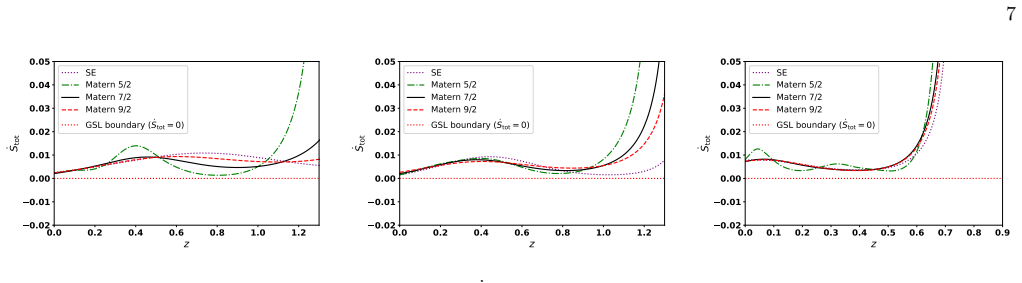
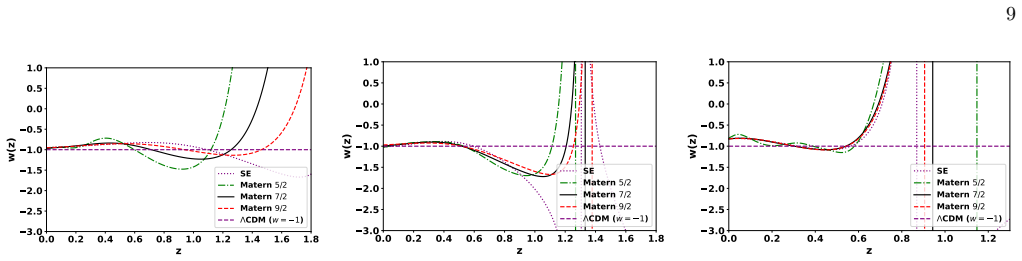
Gaussian Process regression on CC32 plus DESI DR2 combined with Pantheon+, Union3, or DES Y5 data reconstructs the Hubble parameter from redshift zero to two. This supplies the derivatives needed to evaluate the apparent-horizon thermodynamic diagnostic P(z), the entropy production rate dot S_tot, and its second derivative ddot S_tot. The results show P(z) positive everywhere, dot S_tot positive throughout, and ddot S_tot negative at low redshifts, establishing that the generalized second law is satisfied and the universe is moving toward thermodynamic equilibrium. The identical reconstruction gives a dark energy equation of state consistent with the value negative one at the present time.
What carries the argument
Gaussian Process regression using Squared Exponential and Matern kernels with nu equal to 5/2, 7/2, and 9/2 to obtain the Hubble parameter and its first and second derivatives from combined observational datasets for thermodynamic evaluation.
If this is right
- The generalized second law of thermodynamics remains valid for the apparent horizon over the full redshift range studied.
- Positive entropy production rate confirms that cosmic expansion is irreversible.
- Negative second derivative of total entropy at low redshifts indicates the universe is approaching a state of stable thermodynamic equilibrium.
- Dark energy equation of state shows no statistically significant evolution away from a cosmological constant at the present epoch.
Where Pith is reading between the lines
- Extending the same reconstruction to higher redshifts with future surveys could test whether the approach to equilibrium continues or changes.
- The method provides a template for checking other horizon-based thermodynamic relations in a model-independent way once more precise distance data become available.
- If small deviations from LambdaCDM appear in future higher-precision samples, they would have to be large enough to flip the sign of P(z) to contradict the current thermodynamic conclusions.
Load-bearing premise
The chosen Gaussian Process kernels recover the true underlying Hubble parameter and its derivatives from the data without introducing systematic errors that would distort the thermodynamic quantities.
What would settle it
New observations at any redshift in 0 to 2 that yield a negative value for the thermodynamic diagnostic P(z) or a statistically significant departure of the reconstructed dark energy equation of state from negative one at low redshift.
Figures


read the original abstract
We perform a model-independent investigation of the thermodynamic evolution of the Universe by reconstructing the expansion history from observational data using Gaussian Process regression. We consider three independent combinations of datasets, namely CC32+DESI DR2+Pantheon+, CC32+DESI DR2+Union3, and CC32+DESI DR2+DES Y5, allowing us to assess the impact of different supernova samples on the reconstruction. From the reconstructed Hubble parameter and its derivatives over the redshift range 0 to 2, we evaluate key thermodynamic quantities associated with the apparent horizon, including the diagnostic function $P(z)$, the entropy production rate $\dot{S}_{\mathrm{tot}}$, and its second derivative $\ddot{S}_{\mathrm{tot}}$. We find that $P(z)$ remains positive across all redshifts, ensuring the validity of the generalized second law of thermodynamics. Correspondingly, $\dot{S}_{\mathrm{tot}} > 0$ throughout, while $\ddot{S}_{\mathrm{tot}} < 0$ at low redshifts, indicating that the Universe evolves toward stable thermodynamic equilibrium. To assess methodological robustness, the reconstruction is performed using multiple covariance kernels, including the Squared Exponential and Mat\'ern kernels with $\nu = 5/2, 7/2,$ and $9/2$, all of which yield consistent results within uncertainties. We also reconstruct the dark energy equation of state in a fully model-independent manner and find it to be consistent with a cosmological constant at the present epoch, with no statistically significant deviation from $\Lambda$CDM.
Editorial analysis
A structured set of objections, weighed in public.
Referee Report
Summary. The paper performs a model-independent reconstruction of the Hubble parameter H(z) and its first two derivatives over 0 < z < 2 using Gaussian Process regression on three combinations of cosmic chronometer (CC32), DESI DR2, and supernova (Pantheon+, Union3, DES Y5) datasets. From these reconstructions it computes the thermodynamic diagnostic P(z) for the apparent horizon, the total entropy production rate dot S_tot, and its second derivative ddot S_tot, reporting that P(z) > 0 everywhere, dot S_tot > 0 at all redshifts, and ddot S_tot < 0 at low redshifts. It additionally reconstructs the dark-energy equation-of-state parameter w(z) and finds it consistent with a cosmological constant at z = 0. Robustness is tested by repeating the analysis with four covariance kernels (Squared Exponential and Matern nu = 5/2, 7/2, 9/2).
Significance. If the reported signs of P(z), dot S_tot and ddot S_tot survive a more explicit treatment of derivative-error propagation, the work supplies direct, data-driven evidence that the generalized second law holds and that the Universe is approaching thermodynamic equilibrium, without assuming any specific dark-energy or modified-gravity model. The multi-dataset, multi-kernel consistency and the model-independent w(z) reconstruction are genuine strengths that would be of interest to both cosmologists and thermodynamic-gravity researchers.
major comments (2)
- [Methods / Gaussian Process reconstruction] Methods section on Gaussian Process reconstruction: the propagation of uncertainties from the reconstructed H(z) and its first derivative into the second derivative of total entropy (ddot S_tot) is not described. Because ddot S_tot involves second derivatives of H(z), an explicit statement of the error-propagation procedure (analytic covariance or Monte-Carlo sampling) is required to substantiate the claim that ddot S_tot < 0 at low redshifts.
- [Data and reconstruction procedure] Section describing the combined datasets: the construction of the joint covariance matrix for CC32 + DESI DR2 + supernova data and the choice of redshift binning are not specified. These choices directly affect the stability of the higher-order derivatives used for the thermodynamic diagnostics.
minor comments (2)
- [Abstract] The abstract should briefly state how the covariance matrix for the combined probes is assembled and how derivative uncertainties are propagated; this information is currently absent and would improve readability.
- [Thermodynamic quantities] Notation for the diagnostic function P(z) and the entropy rates should be defined once in the main text before being used in figures and results.
Simulated Author's Rebuttal
We thank the referee for the positive evaluation and constructive comments. We address the two major comments point by point below and will incorporate the requested clarifications in the revised manuscript.
read point-by-point responses
-
Referee: [Methods / Gaussian Process reconstruction] Methods section on Gaussian Process reconstruction: the propagation of uncertainties from the reconstructed H(z) and its first derivative into the second derivative of total entropy (ddot S_tot) is not described. Because ddot S_tot involves second derivatives of H(z), an explicit statement of the error-propagation procedure (analytic covariance or Monte-Carlo sampling) is required to substantiate the claim that ddot S_tot < 0 at low redshifts.
Authors: We agree that an explicit description of the uncertainty propagation for ddot S_tot is required. In the revised manuscript we will add a dedicated paragraph in the Methods section explaining that uncertainties are obtained by Monte Carlo sampling of 5000 realizations drawn from the full multivariate Gaussian posterior of the Gaussian Process, which automatically incorporates the covariances among H(z), H'(z) and H''(z). This procedure confirms that ddot S_tot remains negative at low redshifts within the reported 1-sigma uncertainties for all kernels and dataset combinations. revision: yes
-
Referee: [Data and reconstruction procedure] Section describing the combined datasets: the construction of the joint covariance matrix for CC32 + DESI DR2 + supernova data and the choice of redshift binning are not specified. These choices directly affect the stability of the higher-order derivatives used for the thermodynamic diagnostics.
Authors: We will revise the manuscript to provide a complete description of the joint covariance matrix and redshift handling. The total covariance is assembled as a block-diagonal matrix by concatenating the individual covariance matrices of CC32, DESI DR2 and the supernova sample under the assumption of statistical independence between probes. We will also state that the Gaussian Process is fitted directly to the unbinned data points; any redshift binning is applied only for post-processing visualization and does not enter the derivative calculations or thermodynamic diagnostics. revision: yes
Circularity Check
No significant circularity identified
full rationale
The paper's central procedure reconstructs H(z) and its first two derivatives via Gaussian Process regression applied directly to external observational datasets (CC32 cosmic chronometers, DESI DR2 BAO, and three independent supernova compilations). Thermodynamic diagnostics P(z), dot S_tot, and ddot S_tot are then obtained by substituting these reconstructed functions into the standard apparent-horizon thermodynamic identities; the identities themselves are not altered or fitted to the target quantities. Because the GP inputs are independent data and the kernels are fixed standard choices (Squared Exponential, Matern nu=5/2,7/2,9/2) rather than being optimized against the thermodynamic outputs, no step reduces to a self-definition or to a fitted parameter renamed as a prediction. No load-bearing self-citation or uniqueness theorem imported from the authors' prior work appears in the derivation chain.
Axiom & Free-Parameter Ledger
axioms (2)
- domain assumption Gaussian Process regression with the listed kernels can recover the true Hubble parameter and its first two derivatives from discrete, noisy cosmological data without model bias
- standard math The apparent horizon entropy and its time derivatives are correctly given by the standard expressions involving H and its derivatives
Forward citations
Cited by 1 Pith paper
-
Exponential Quintessence: Analytic Relationship Between the Current Equation of State Parameter and the Potential Parameter
For an exponential quintessence potential, an analytic formula links the current equation-of-state w_φ0 to the potential slope λ while enforcing prior radiation and matter domination, yielding the bound λ < 1.94 at Ω_...
Reference graph
Works this paper leans on
-
[1]
Perlmutter, et al., Measurements of Ω and Λ from 42 high redshift supernovae, Astrophys
S. Perlmutter, et al., Measurements of Ω and Λ from 42 high redshift supernovae, Astrophys. J. 517 (1999) 565–
1999
-
[2]
arXiv:astro-ph/9812133, doi:10.1086/307221
work page internal anchor Pith review doi:10.1086/307221
-
[3]
A. G. Riess, et al., Observational evidence from su- pernovae for an accelerating universe and a cosmologi- cal constant, Astron. J. 116 (1998) 1009–1038. arXiv: astro-ph/9805201, doi:10.1086/300499
-
[4]
D. M. Scolnic, et al., The Complete Light-curve Sam- ple of Spectroscopically Confirmed SNe Ia from Pan- STARRS1 and Cosmological Constraints from the Com- bined Pantheon Sample, Astrophys. J. 859 (2) (2018)
2018
-
[5]
arXiv:1710.00845, doi:10.3847/1538-4357/ aab9bb
-
[6]
The Pantheon+ Analysis: Cosmological Constraints
D. Brout, et al., The Pantheon+ Analysis: The Full Data Set and Light-Curve Release, Astrophys. J. 938 (2) (2022) 110. arXiv:2202.04077, doi:10.3847/ 1538-4357/ac8e04
work page internal anchor Pith review arXiv 2022
-
[7]
T. M. C. Abbott, et al., The Dark Energy Survey: Cos- mology Results with ∼1500 New High-redshift Type Ia Supernovae Using the Full 5 yr Data Set, Astrophys. J. Lett. 973 (1) (2024) L14. arXiv:2401.02929, doi: 10.3847/2041-8213/ad6f9f
-
[8]
D. Rubin, et al., Union Through UNITY: Cosmology with 2,000 SNe Using a Unified Bayesian Framework, Astrophys. J. 986 (2) (2025) 231. arXiv:2311.12098, doi:10.3847/1538-4357/adc0a5
-
[9]
P. A. R. Ade, et al., Planck 2013 results. XVI. Cosmo- logical parameters, Astron. Astrophys. 571 (2014) A16. arXiv:1303.5076, doi:10.1051/0004-6361/201321591
-
[10]
N. Aghanim, et al., Planck 2018 results. VI. Cosmological parameters, Astron. Astrophys. 641 (2020) A6, [Erratum: Astron.Astrophys. 652, C4 (2021)]. arXiv:1807.06209, doi:10.1051/0004-6361/201833910
-
[11]
K. Lodha, et al., DESI 2024: Constraints on physics- focused aspects of dark energy using DESI DR1 BAO data, Phys. Rev. D 111 (2) (2025) 023532. arXiv:2405. 13588, doi:10.1103/PhysRevD.111.023532
-
[12]
A. J. Ross, L. Samushia, C. Howlett, W. J. Per- cival, A. Burden, M. Manera, The clustering of the SDSS DR7 main Galaxy sample – I. A 4 per 10 cent distance measure at z = 0.15 , Monthly No- tices of the Royal Astronomical Society 449 (1) (2015) 835–847. arXiv:https://academic.oup.com/ mnras/article-pdf/449/1/835/13767551/stv154.pdf, doi:10.1093/mnras/stv...
-
[13]
P. Zarrouk, et al., The clustering of the SDSS-IV ex- tended Baryon Oscillation Spectroscopic Survey DR14 quasar sample: measurement of the growth rate of struc- ture from the anisotropic correlation function between redshift 0.8 and 2.2, Mon. Not. Roy. Astron. Soc. 477 (2) (2018) 1639–1663. arXiv:1801.03062, doi:10.1093/ mnras/sty506
-
[14]
S. A. et al., The clustering of galaxies in the com- pleted SDSS-III Baryon Oscillation Spectroscopic Sur- vey: cosmological analysis of the DR12 galaxy sample, mnras 470 (3) (2017) 2617–2652. arXiv:1607.03155, doi:10.1093/mnras/stx721
-
[15]
d. et al., Baryon acoustic oscillations from the complete SDSS-III Ly α-quasar cross-correlation function at z = 2.4, aap 608 (2017) A130. arXiv:1708.02225, doi:10. 1051/0004-6361/201731731
-
[16]
A. G. Adame, et al., DESI 2024 VI: cosmological con- straints from the measurements of baryon acoustic os- cillations, JCAP 02 (2025) 021. arXiv:2404.03002, doi:10.1088/1475-7516/2025/02/021
-
[17]
A. G. Adame, et al., DESI 2024 III: baryon acoustic oscillations from galaxies and quasars, JCAP 04 (2025)
2024
-
[19]
A. G. Adame, et al., DESI 2024 IV: Baryon Acoustic Os- cillations from the Lyman alpha forest, JCAP 01 (2025)
2024
-
[20]
arXiv:2404.03001, doi:10.1088/1475-7516/2025/ 01/124
-
[21]
R. Calderon, et al., DESI 2024: reconstructing dark energy using crossing statistics with DESI DR1 BAO data, JCAP 10 (2024) 048. arXiv:2405.04216, doi: 10.1088/1475-7516/2024/10/048
-
[22]
M. Abdul Karim, et al., DESI DR2 results. II. Mea- surements of baryon acoustic oscillations and cosmolog- ical constraints, Phys. Rev. D 112 (8) (2025) 083515. arXiv:2503.14738, doi:10.1103/tr6y-kpc6
-
[23]
A. G. Riess, S. Casertano, W. Yuan, J. B. Bowers, L. Macri, J. C. Zinn, D. Scolnic, Cosmic Distances Cal- ibrated to 1% Precision with Gaia EDR3 Parallaxes and Hubble Space Telescope Photometry of 75 Milky Way Cepheids Confirm Tension with ΛCDM, Astro- phys. J. Lett. 908 (1) (2021) L6. arXiv:2012.08534, doi:10.3847/2041-8213/abdbaf
-
[24]
A. G. Riess, et al., A Comprehensive Measurement of the Local Value of the Hubble Constant with 1 km s −1 Mpc−1 Uncertainty from the Hubble Space Telescope and the SH0ES Team, Astrophys. J. Lett. 934 (1) (2022) L7. arXiv:2112.04510, doi:10.3847/2041-$8213/ac5c5b
-
[25]
G., Casertano, S., Yuan, W., Macri, L
L. Breuval, A. G. Riess, S. Casertano, W. Yuan, L. M. Macri, M. Romaniello, Y. S. Murakami, D. Scolnic, G. S. Anand, I. Soszyński, Small Magellanic Cloud Cepheids Observed with the Hubble Space Telescope Provide a New Anchor for the SH0ES Distance Ladder, Astro- phys. J. 973 (1) (2024) 30. arXiv:2404.08038, doi: 10.3847/1538-4357/ad630e
-
[26]
Z. C. et al, Four new observational h(z) data from lu- minous red galaxies in the sloan digital sky survey data release seven , Research in Astronomy and Astrophysics. 14 (10) (2014) 1221. doi:10.1088/1674-4527/14/10/ 002. URL https://doi.org/10.1088/1674-4527/14/10/002
-
[27]
Cosmic Chronometers: Constraining the Equation of State of Dark Energy. I: H(z) Measurements
D. Stern, R. Jimenez, L. Verde, M. Kamionkowski, S. A. Stanford, Cosmic chronometers: constraining the equa- tion of state of dark energy. I: H(z) measurements, JCAP 02 (2010) 008. arXiv:0907.3149, doi:10.1088/ 1475-7516/2010/02/008
work page Pith review arXiv 2010
-
[28]
Moresco, A
M. Moresco, A. Cimatti, R. Jimenez, L. Pozzetti, G. Zamorani, et al., Improved constraints on the expan- sion rate of the Universe up to z ∼ 1.1 from the spectro- scopic evolution of cosmic chronometers, JCAP 08 (2012)
2012
-
[29]
arXiv:1201.3609, doi:10.1088/1475-7516/2012/ 08/006
-
[30]
M. Moresco, L. Pozzetti, A. Cimatti, R. Jimenez, C. Maraston, L. Verde, D. Thomas, A. Citro, R. Tojeiro, D. Wilkinson, A 6% measurement of the Hubble param- eter at z ∼ 0.45: direct evidence of the epoch of cosmic re-acceleration, JCAP 05 (2016) 014. arXiv:1601.01701, doi:10.1088/1475-7516/2016/05/014
-
[31]
A. L. Ratsimbazafy, S. I. Loubser, S. M. Crawford, C. M. Cress, B. A. Bassett, R. C. Nichol, P. Väisänen, Age- dating luminous red galaxies observed with the southern african large telescope, Monthly Notices of the Royal As- tronomical Society 467 (3) (2017) 3239–3254
2017
-
[32]
M. Moresco, Raising the bar: new constraints on the hubble parameter with cosmic chronometers at z ∼ 2, Monthly Notices of the Royal Astronomical Society: Let- ters 450 (1) (2015) L16–L20
2015
-
[33]
M. Moresco, R. Jimenez, L. Verde, A. Cimatti, L. Pozzetti, Setting the Stage for Cosmic Chronome- ters. II. Impact of Stellar Population Synthesis Models Systematics and Full Covariance Matrix, Astrophys. J. 898 (1) (2020) 82. arXiv:2003.07362, doi:10.3847/ 1538-4357/ab9eb0
-
[34]
Moresco, Measuring the expansion history of the Universe with cosmic chronometers (12 2024)
M. Moresco, Measuring the expansion history of the Universe with cosmic chronometers (12 2024). arXiv: 2412.01994
-
[35]
2022, Living Reviews in Relativity, 25, 6, doi: 10.1007/s41114-022-00040-z
M. Moresco, et al., Unveiling the Universe with emerging cosmological probes, Living Rev. Rel. 25 (1) (2022) 6. arXiv:2201.07241, doi:10.1007/s41114-022-00040-z
-
[36]
C. E. Rasmussen, C. K. I. Williams, Gaussian Processes for Machine Learning, Adaptive Computation and Ma- chine Learning, MIT Press, Cambridge, MA, 2005
2005
-
[37]
Nonparametric Dark Energy Reconstruction from Supernova Data
T. Holsclaw, U. Alam, B. Sanso, H. Lee, K. Heitmann, S. Habib, D. Higdon, Nonparametric Dark Energy Re- construction from Supernova Data, Phys. Rev. Lett. 105 (2010) 241302. arXiv:1011.3079, doi:10.1103/ PhysRevLett.105.241302
work page Pith review arXiv 2010
-
[38]
Nonparametric Reconstruction of the Dark Energy Equation of State
T. Holsclaw, U. Alam, B. Sanso, H. Lee, K. Heit- mann, S. Habib, D. Higdon, Nonparametric Reconstruc- tion of the Dark Energy Equation of State, Phys. Rev. D 82 (2010) 103502. arXiv:1009.5443, doi:10.1103/ PhysRevD.82.103502
work page Pith review arXiv 2010
-
[39]
T. Holsclaw, U. Alam, B. Sanso, H. Lee, K. Heitmann, S. Habib, D. Higdon, Nonparametric Reconstruction of the Dark Energy Equation of State from Diverse Data Sets, Phys. Rev. D 84 (2011) 083501. arXiv:1104.2041, doi:10.1103/PhysRevD.84.083501
-
[40]
V. C. Busti, C. Clarkson, M. Seikel, The Value of H0 from Gaussian Processes, IAU Symp. 306 (2014) 25–27. arXiv:1407.5227, doi:10.1017/S1743921314013751
-
[41]
V. C. Busti, C. Clarkson, M. Seikel, Evidence for a Lower Value for H0 from Cosmic Chronometers Data?, Mon. 11 Not. Roy. Astron. Soc. 441 (2014) 11. arXiv:1402.5429, doi:10.1093/mnrasl/slu035
-
[42]
M. Seikel, C. Clarkson, M. Smith, Reconstruction of dark energy and expansion dynamics using Gaussian pro- cesses, JCAP 06 (2012) 036. arXiv:1204.2832, doi: 10.1088/1475-7516/2012/06/036
- [43]
-
[44]
Optimising Gaussian processes for reconstructing dark energy dynamics from supernovae
M. Seikel, C. Clarkson, Optimising Gaussian processes for reconstructing dark energy dynamics from supernovae (11 2013). arXiv:1311.6678
work page Pith review arXiv 2013
-
[45]
A. Shafieloo, A. G. Kim, E. V. Linder, Gaussian Process Cosmography, Phys. Rev. D 85 (2012) 123530. arXiv: 1204.2272, doi:10.1103/PhysRevD.85.123530
-
[46]
P. Mukherjee, J. Levi Said, J. Mifsud, Neural network reconstruction of H’(z) and its application in teleparallel gravity, JCAP 12 (2022) 029. arXiv:2209.01113, doi: 10.1088/1475-7516/2022/12/029
-
[47]
Mukherjee, Non-parametric Reconstruction Of Some Cosmological Parameters, Ph.D
P. Mukherjee, Non-parametric Reconstruction Of Some Cosmological Parameters, Ph.D. thesis, IISER, Kolkata (2022). arXiv:2207.07857
-
[48]
P. Mukherjee, N. Banerjee, Revisiting a non-parametric reconstruction of the deceleration parameter from com- bined background and the growth rate data, Phys. Dark Univ. 36 (2022) 100998. arXiv:2007.15941, doi:10. 1016/j.dark.2022.100998
-
[49]
Ruchika, P. Mukherjee, A. Favale, Revisiting Gaussian Process Reconstruction for Cosmological Inference: The Generalised GP (Gen GP) Framework (10 2025). arXiv: 2510.03742
-
[50]
J. d. J. Velázquez, L. A. Escamilla, P. Mukherjee, J. A. Vázquez, Non-Parametric Reconstruction of Cosmolog- ical Observables Using Gaussian Processes Regression, Universe 10 (12) (2024) 464. arXiv:2410.02061, doi: 10.3390/universe10120464
-
[51]
P. Mukherjee, A. A. Sen, Model-independent cosmologi- cal inference post DESI DR1 BAO measurements, Phys. Rev. D 110 (12) (2024) 123502. arXiv:2405.19178, doi:10.1103/PhysRevD.110.123502
-
[52]
A. Favale, A. Gómez-Valent, M. Migliaccio, Cosmic chronometers to calibrate the ladders and measure the curvature of the Universe. A model-independent study, Mon. Not. Roy. Astron. Soc. 523 (3) (2023) 3406–3422. arXiv:2301.09591, doi:10.1093/mnras/stad1621
-
[53]
J.-y. Jiang, K. Jiao, T.-J. Zhang, Optimizing gaussian process kernels using nested sampling and ABC rejection for H(z) reconstruction, JCAP 11 (2025) 065. arXiv: 2506.21238, doi:10.1088/1475-7516/2025/11/065
- [54]
-
[55]
J.-Q. Jiang, D. Pedrotti, S. S. da Costa, S. Vagnozzi, Nonparametric late-time expansion history reconstruc- tion and implications for the Hubble tension in light of recent DESI and type Ia supernovae data, Phys. Rev. D 110 (12) (2024) 123519. arXiv:2408.02365, doi: 10.1103/PhysRevD.110.123519
-
[56]
J. P. Johnson, H. K. Jassal, Kernel dependence of the Gaussian process reconstruction of late Universe expan- sion history, Eur. Phys. J. C 85 (9) (2025) 996. arXiv: 2503.04273, doi:10.1140/epjc/s10052-025-14732-7
-
[57]
A. N. Ormondroyd, W. J. Handley, M. P. Hobson, A. N. Lasenby, Non-parametric reconstructions of dy- namical dark energy via flexknots, Mon. Not. Roy. As- tron. Soc. 541 (4) (2025) 3388–3400. arXiv:2503.08658, doi:10.1093/mnras/staf1144
-
[58]
A. Sangwan, A. Mukherjee, H. K. Jassal, Reconstructing the dark energy potential, JCAP 01 (2018) 018. arXiv: 1712.05143, doi:10.1088/1475-7516/2018/01/018
-
[59]
J.-X. Li, S. Wang, Reconstructing dark energy with model independent methods after DESI DR2, Eur. Phys. J. C 85 (11) (2025) 1308. arXiv:2506.22953, doi: 10.1140/epjc/s10052-025-15065-1
-
[60]
J.-L. Ling, G.-H. Du, T.-N. Li, J.-F. Zhang, S.-J. Wang, X. Zhang, Model-independent cosmological inference af- ter the DESI DR2 data with improved inverse distance ladder, Phys. Rev. D 112 (8) (2025) 083528. arXiv: 2505.22369, doi:10.1103/p8nz-djjm
-
[61]
A. Maqsood, Derivative Hierarchy as the Origin of Kernel-Dependent Trends in Gaussian Process Re- constructions of the Hubble Parameter, Physics Let- ters B (2026) 140456 doi:https://doi.org/10.1016/j. physletb.2026.140456
work page doi:10.1016/j 2026
- [62]
-
[63]
The Pantheon+ Analysis: The Full Dataset and Light-Curve Release
D. Scolnic, et al., The Pantheon+ Analysis: The Full Data Set and Light-curve Release, Astrophys. J. 938 (2) (2022) 113. arXiv:2112.03863, doi:10.3847/ 1538-4357/ac8b7a
work page internal anchor Pith review arXiv 2022
-
[64]
P. Adhikary, S. Das, S. D. Odintsov, T. Paul, Dark energy era with a resolution of Hubble tension in generalized entropic cosmology, Phys. Dark Univ. 49 (2025) 102037. arXiv:2507.15273, doi:10.1016/j.dark.2025.102037
-
[65]
J. Juárez-Jiménez, A. A. A vilez-López, M. Cruz, Ther- modynamics of an universe with decaying cold dark mat- ter, Eur. Phys. J. C 85 (7) (2025) 734. arXiv:2507. 03143, doi:10.1140/epjc/s10052-025-14465-7
-
[66]
D. P. Knobles, M. F. Westling, Maximum Entropy Es- timates of Hubble Constant from Planck Measurements, Entropy 27 (7) (2025) 760. doi:10.3390/e27070760
- [67]
-
[68]
U. Anwar, N. Azhar, A. Jawad, N. Myrzakulov, S. Shay- matov, O. Razina, P. Tsyba, Cosmic and thermodynamic aspects of f (R, A) gravity, Commun. Theor. Phys. 78 (3) (2026) 035401. doi:10.1088/1572-9494/ae11fc
-
[69]
Komatsu, Dissipative cosmology with Λ from the first law of thermodynamics (12 2025)
N. Komatsu, Dissipative cosmology with Λ from the first law of thermodynamics (12 2025). arXiv:2512.19911
- [70]
- [71]
- [72]
-
[73]
G. G. Luciano, E. N. Saridakis, New modified cosmology from a new generalized entropy (2 2026). arXiv:2602. 20004
2026
-
[74]
D. Mukherjee, H. S. Sahota, S. Gavas, A dynamical sys- tems perspective on the thermodynamics of late-time cosmology (9 2025). arXiv:2509.04964, doi:10.1002/ prop.70094
-
[75]
A. Corichi, O. Gallegos, Entropy in Loop Quantum Cos- mology (5 2025). arXiv:2505.09055
-
[76]
U. K. Tyagi, S. Haridasu, S. Basak, Constraints on gen- eralized gravity-thermodynamic cosmology from DESI DR2, Phys. Rev. D 113 (6) (2026) 063507. arXiv: 2504.11308, doi:10.1103/7jkz-l38r
- [77]
-
[78]
P. C. Ferreira, D. Pavon, Thermodynamics of non- singular bouncing universes, Eur. Phys. J. C 76 (1) (2016) 37. arXiv:1509.03725, doi:10.1140/epjc/ s10052-016-3886-2
-
[79]
Faraoni, Cosmological and Black Hole Apparent Hori- zons, Vol
V. Faraoni, Cosmological and Black Hole Apparent Hori- zons, Vol. 907, 2015. doi:10.1007/978-3-319-19240-6
-
[80]
R.-G. Cai, S. P. Kim, First law of thermodynamics and Friedmann equations of Friedmann-Robertson-Walker universe, JHEP 02 (2005) 050. arXiv:hep-th/0501055, doi:10.1088/1126-6708/2005/02/050
- [81]
discussion (0)
Sign in with ORCID, Apple, or X to comment. Anyone can read and Pith papers without signing in.