Recognition: unknown
New constraints on stellar feedback through [O III] emission: interpreting ALMA and JWST observations with SPICE simulations
Pith reviewed 2026-05-10 03:41 UTC · model grok-4.3
The pith
Bursty supernova feedback produces fewer bright [OIII] emitters than smooth feedback by z=5.
A machine-rendered reading of the paper's core claim, the machinery that carries it, and where it could break.
Core claim
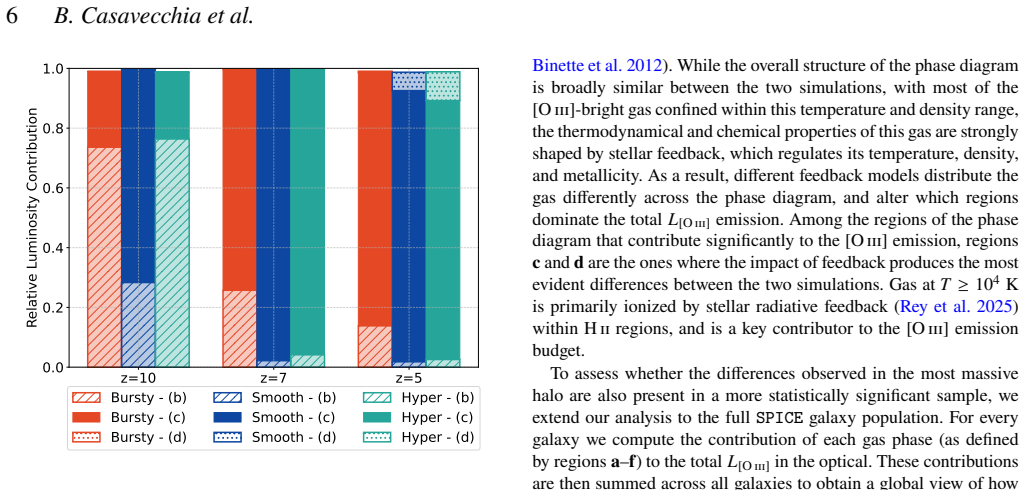
We have developed a post-processing pipeline that implements a sub-grid model for [OIII] line emission within the SPICE radiation-hydrodynamical simulations exploring three supernova feedback prescriptions: bursty-sn, smooth-sn, and hyper-sn. [OIII] emission predominantly originates from gas that is both shock-heated and radiatively ionized. The bursty-sn model efficiently ionizes gas but enriches galaxies less effectively by z = 5, leading to fewer bright [OIII] emitters compared to the smooth-sn model, while both bursty-sn and hyper-sn produce suppressed luminosity functions. Spatially resolved maps show that smooth-sn tends to generate more compact galaxies and slightly higher V/σ values,
What carries the argument
Post-processing pipeline for [OIII] line emission that applies a sub-grid model of combined shock heating and radiative ionization to the output of SPICE simulations run with three distinct supernova feedback prescriptions.
If this is right
- [OIII] emission acts as a sensitive tracer of stellar feedback at high redshift.
- Bursty and hypernova models both suppress the bright end of the [OIII] luminosity function relative to smooth feedback.
- Smooth feedback produces more compact galaxies with modestly higher V/σ ratios, though substantial overlap remains between models.
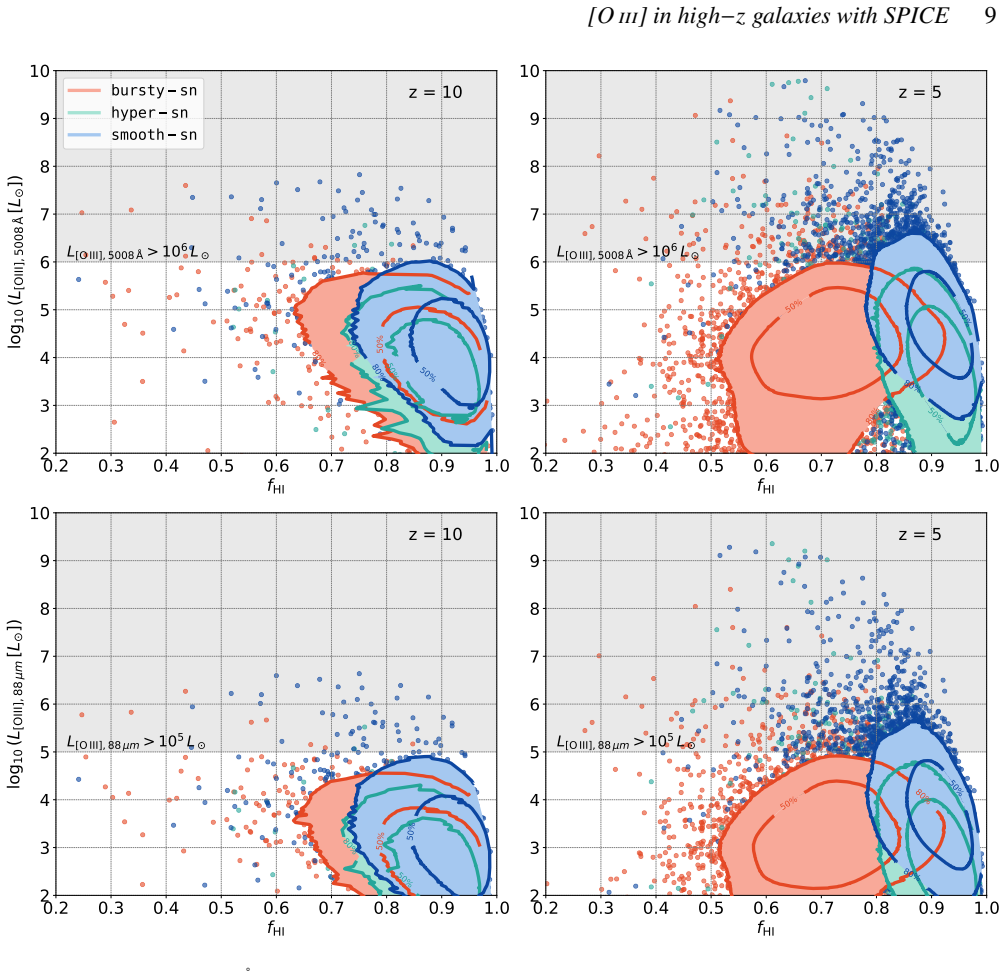
- The correlation between neutral gas fraction and [OIII] luminosity differs across feedback prescriptions.
- Observations must reach fainter luminosities to capture the strongest effects of feedback on [OIII] emission.
Where Pith is reading between the lines
- If the models are correct, wide-field JWST [OIII] surveys at z greater than 6 could discriminate among supernova feedback implementations used in galaxy formation simulations.
- The significant overlap in morphological and kinematic properties suggests that multi-line or spatially resolved data will be required to break degeneracies between feedback models.
- The same post-processing approach could be applied to other rest-frame optical or far-infrared lines to test consistency of the inferred feedback effects.
Load-bearing premise
The sub-grid model for [OIII] line emission accurately represents the combined effects of shock heating and radiative ionization across unresolved scales in the simulations.
What would settle it
Comparison of the predicted [OIII] luminosity functions at z approximately 5 to 7 from each feedback model against the number counts of bright emitters measured in JWST or ALMA surveys; mismatch at the bright end would falsify the differential effect of bursty versus smooth feedback.
Figures






read the original abstract
ALMA and JWST have recently detected emission lines from the interstellar medium of star-forming galaxies during the Epoch of Reionization, reaching redshifts up to z = 14. Among these, [OIII] lines provide a powerful diagnostic of metal enrichment, gas ionization, and the impact of stellar feedback in galaxies at z > 6. Modeling this emission in cosmological simulations is challenging due to the wide range of spatial scales and physical processes involved. To address this, we have developed a post-processing pipeline that implements a sub-grid model for [OIII] line emission within the SPICE radiation-hydrodynamical simulations. These simulations explore three supernova feedback prescriptions: bursty-sn, smooth-sn, and the hypernova-based hyper-sn. We investigate how these feedback models affect metal enrichment, the neutral gas fraction, and the size and morphology of ionized halos traced by [OIII] emission in both the optical and far-infrared. We find that [OIII] emission predominantly originates from gas that is both shock-heated and radiatively ionized. We also examine the mass-metallicity relation and the correlation between neutral gas fraction and [OIII] luminosity. Our results show that the bursty-sn model efficiently ionizes gas but enriches galaxies less effectively by z = 5, leading to fewer bright [OIII] emitters compared to the smooth-sn model. Both bursty-sn and hyper-sn produce suppressed luminosity functions. Spatially resolved [OIII] emission further indicates that smooth-sn tends to generate more compact galaxies and slightly higher V/{\sigma} values, although there is significant overlap between models. Overall, our findings demonstrate that [OIII] emission is a sensitive tracer of stellar feedback at high redshift and highlight the importance of observations probing fainter luminosities, where feedback effects are strongest.
Editorial analysis
A structured set of objections, weighed in public.
Referee Report
Summary. The manuscript introduces a post-processing pipeline implementing a sub-grid model for [O III] line emission applied to SPICE radiation-hydrodynamical simulations. These simulations compare three supernova feedback prescriptions: bursty-sn, smooth-sn, and hyper-sn. The analysis focuses on how these models influence metal enrichment, neutral gas fractions, ionized halo morphologies, and [O III] luminosity functions at high redshifts (z > 5). The paper concludes that [O III] emission primarily comes from gas that is both shock-heated and radiatively ionized, that the bursty-sn model ionizes gas efficiently but enriches less effectively leading to fewer bright [O III] emitters by z=5, and that both bursty-sn and hyper-sn produce suppressed luminosity functions compared to smooth-sn.
Significance. Should the sub-grid [O III] model prove reliable, the results offer significant implications for interpreting JWST and ALMA observations of high-redshift galaxies. By linking specific feedback implementations to observable [O III] properties, the work highlights [O III] as a useful tracer for stellar feedback effects during the Epoch of Reionization. The multi-model comparison and emphasis on faint luminosity regimes where feedback impacts are pronounced represent valuable contributions to the field.
major comments (2)
- [Post-processing pipeline description] All reported differences between the feedback models in terms of [O III] luminosity functions, ionization efficiency, and enrichment (e.g., bursty-sn producing fewer bright emitters) depend on the sub-grid prescription for [O III] emissivity. The manuscript should include explicit validation tests of this model, such as comparisons to higher-resolution simulations or analytic models of shock and photo-ionization, to confirm that the joint effects are accurately captured rather than being dominated by the approximation.
- [Results section on luminosity functions and correlations] The claims of suppressed luminosity functions for bursty-sn and hyper-sn lack accompanying quantitative measures of uncertainty, such as Poisson errors or cosmic variance estimates, and do not discuss how sensitive these suppressions are to the sub-grid parameters. This makes it challenging to evaluate the robustness of the conclusion that these models are distinguishable from smooth-sn.
minor comments (1)
- [Discussion of spatially resolved properties] The statement regarding significant overlap between models in V/σ values could be expanded with quantitative metrics or histograms to better illustrate the degree of overlap.
Simulated Author's Rebuttal
We thank the referee for their constructive and insightful report. Their comments correctly identify areas where additional validation and quantitative robustness checks would strengthen the manuscript. We address each major comment below and describe the revisions we will implement.
read point-by-point responses
-
Referee: [Post-processing pipeline description] All reported differences between the feedback models in terms of [O III] luminosity functions, ionization efficiency, and enrichment (e.g., bursty-sn producing fewer bright emitters) depend on the sub-grid prescription for [O III] emissivity. The manuscript should include explicit validation tests of this model, such as comparisons to higher-resolution simulations or analytic models of shock and photo-ionization, to confirm that the joint effects are accurately captured rather than being dominated by the approximation.
Authors: We agree that the sub-grid [O III] model is foundational to all reported differences and that explicit validation strengthens the interpretation. The model combines standard treatments of collisional excitation in shock-heated gas with radiative ionization, calibrated to local benchmarks and theoretical expectations as outlined in the methods. However, the original manuscript did not present dedicated validation tests against higher-resolution simulations or analytic ionization models. In the revised version we will add a new subsection containing such tests, including direct comparisons to analytic shock and photo-ionization calculations and, where feasible, to results from higher-resolution zoom simulations. These additions will demonstrate that the model captures the joint effects without dominating the differences between feedback prescriptions. revision: yes
-
Referee: [Results section on luminosity functions and correlations] The claims of suppressed luminosity functions for bursty-sn and hyper-sn lack accompanying quantitative measures of uncertainty, such as Poisson errors or cosmic variance estimates, and do not discuss how sensitive these suppressions are to the sub-grid parameters. This makes it challenging to evaluate the robustness of the conclusion that these models are distinguishable from smooth-sn.
Authors: We accept that the luminosity-function figures would benefit from explicit uncertainty quantification. The simulations occupy large cosmological volumes, but Poisson errors and cosmic-variance estimates were not reported. In the revised manuscript we will add Poisson error bars to the luminosity-function panels and include a brief assessment of cosmic variance based on the box size and halo statistics. Regarding sensitivity to sub-grid parameters, we will expand the discussion with results from parameter-variation tests performed during model development; these tests show that the main trends (suppression in bursty-sn and hyper-sn relative to smooth-sn) persist across plausible ranges of the key parameters, and we will quantify this robustness explicitly. revision: yes
Circularity Check
No circularity: inter-model differences arise from distinct feedback prescriptions
full rationale
The paper executes SPICE radiation-hydrodynamical simulations under three separate supernova feedback prescriptions (bursty-sn, smooth-sn, hyper-sn) and applies the same sub-grid post-processing pipeline to derive [OIII] emissivities. Reported contrasts in metal enrichment, neutral gas fractions, ionized halo sizes, and luminosity functions are direct simulation outputs driven by the differing feedback implementations. No step reduces a claimed prediction to a fitted parameter by construction, invokes a self-citation as the sole justification for a uniqueness claim, or renames an input as an output. The sub-grid [OIII] model is a uniform modeling assumption rather than a definitional loop, leaving the derivation chain self-contained against the simulation inputs.
Axiom & Free-Parameter Ledger
Reference graph
Works this paper leans on
-
[1]
Physics of the Interstellar and Intergalactic Medium
-
[2]
RAMSES-RTZ: non-equilibrium metal chemistry and cooling coupled to on-the-fly radiation hydrodynamics. , keywords =. doi:10.1093/mnras/stac423 , archivePrefix =. 2202.04083 , primaryClass =
-
[3]
Non-equilibrium ionization and cooling of metal-enriched gas in the presence of a photoionization background. , keywords =. doi:10.1093/mnras/stt1043 , archivePrefix =. 1302.5710 , primaryClass =
-
[4]
Atomic Data and Nuclear Data Tables , year = 1997, month = jan, volume =
A Practical Fit Formula for Ionization Rate Coefficients of Atoms and Ions by Electron Impact: Z = 1-28. Atomic Data and Nuclear Data Tables , year = 1997, month = jan, volume =. doi:10.1006/adnd.1997.0732 , adsurl =
-
[5]
R., 2006, @doi [The Astrophysical Journal Supplement Series] 10.1086/508465 , 167, 334–342
Radiative Recombination Data for Modeling Dynamic Finite-Density Plasmas. , keywords =. doi:10.1086/508465 , archivePrefix =. astro-ph/0604144 , primaryClass =
-
[6]
Atomic Data for Astrophysics. II. New Analytic Fits for Photoionization Cross Sections of Atoms and Ions. , keywords =. doi:10.1086/177435 , archivePrefix =. astro-ph/9601009 , primaryClass =
-
[7]
Analytical strong line diagnostics and their redshift evolution. , keywords =. doi:10.1093/mnras/stae2337 , archivePrefix =. 2312.09213 , primaryClass =
-
[8]
A New Framework for ISM Emission Line Models: Connecting Multi-Scale Simulations Across Cosmological Volumes. arXiv e-prints , keywords =. doi:10.48550/arXiv.2409.03997 , archivePrefix =. 2409.03997 , primaryClass =
-
[9]
CEERS Key Paper. I. An Early Look into the First 500 Myr of Galaxy Formation with JWST. , keywords =. doi:10.3847/2041-8213/acade4 , archivePrefix =. 2211.05792 , primaryClass =
-
[10]
A Comprehensive Study of Galaxies at z 9-16 Found in the Early JWST Data: Ultraviolet Luminosity Functions and Cosmic Star Formation History at the Pre-reionization Epoch. , keywords =. doi:10.3847/1538-4365/acaaa9 , archivePrefix =. 2208.01612 , primaryClass =
-
[11]
Two Remarkably Luminous Galaxy Candidates at z 10-12 Revealed by JWST. , keywords =. doi:10.3847/2041-8213/ac9b22 , archivePrefix =. 2207.09434 , primaryClass =
-
[12]
UV luminosity density results at z > 8 from the first JWST/NIRCam fields: limitations of early data sets and the need for spectroscopy. , keywords =. doi:10.1093/mnras/stad1014 , archivePrefix =. 2212.06683 , primaryClass =
-
[13]
Evolution of the UV LF from z 15 to z 8 using new JWST NIRCam medium-band observations over the HUDF/XDF. , keywords =. doi:10.1093/mnras/stad1145 , archivePrefix =. 2211.02607 , primaryClass =
-
[14]
Spectroscopic confirmation of four metal-poor galaxies at z = 10.3-13.2. Nature Astronomy , keywords =. doi:10.1038/s41550-023-01918-w , archivePrefix =. 2212.04568 , primaryClass =
-
[15]
Identification and properties of intense star-forming galaxies at redshifts z > 10. Nature Astronomy , keywords =. doi:10.1038/s41550-023-01921-1 , archivePrefix =. 2212.04480 , primaryClass =
-
[16]
ALMA Detection of [O III] 88 m at z = 12.33: Exploring the Nature and Evolution of GHZ2 as a Massive Compact Stellar System. , keywords =. doi:10.3847/2041-8213/ad8f38 , archivePrefix =. 2411.03593 , primaryClass =
-
[17]
The onset of star formation 250 million years after the Big Bang. , keywords =. doi:10.1038/s41586-018-0117-z , archivePrefix =. 1805.05966 , primaryClass =
-
[18]
Big Three Dragons: A z = 7.15 Lyman-break galaxy detected in [O III] 88 m, [C II] 158 m, and dust continuum with ALMA. , keywords =. doi:10.1093/pasj/psz049 , archivePrefix =. 1806.00486 , primaryClass =
-
[19]
Survey strategy, observations, and sample properties of 118 star-forming galaxies at 4 < z < 6
The ALPINE-ALMA [CII] survey. Survey strategy, observations, and sample properties of 118 star-forming galaxies at 4 < z < 6. , keywords =. doi:10.1051/0004-6361/201936965 , archivePrefix =. 1910.09517 , primaryClass =
-
[20]
A Long Time Ago in a Galaxy Far, Far Away: A Candidate z 12 Galaxy in Early JWST CEERS Imaging. , keywords =. doi:10.3847/2041-8213/ac966e , archivePrefix =. 2207.12474 , primaryClass =
-
[21]
2024, ApJ, 972, 143, doi: 10.3847/1538-4357/ad5f88
JWST NIRSpec Spectroscopy of the Remarkable Bright Galaxy GHZ2/GLASS-z12 at Redshift 12.34. , keywords =. doi:10.3847/1538-4357/ad5f88 , archivePrefix =. 2403.10238 , primaryClass =
-
[22]
Spectroscopic confirmation of two luminous galaxies at a redshift of 14. , keywords =. doi:10.1038/s41586-024-07860-9 , archivePrefix =. 2405.18485 , primaryClass =
-
[23]
2025, A&A, 696, A87, doi: 10.1051/0004-6361/202452451
The eventful life of a luminous galaxy at z = 14: metal enrichment, feedback, and low gas fraction?. , keywords =. doi:10.1051/0004-6361/202452451 , archivePrefix =. 2409.20533 , primaryClass =
-
[24]
2024, arXiv e-prints, arXiv:2410.18763
The dual nature of GHZ9: coexisting AGN and star formation activity in a remote X-ray source at z=10.145. arXiv e-prints , keywords =. doi:10.48550/arXiv.2410.18763 , archivePrefix =. 2410.18763 , primaryClass =
-
[25]
The abundance of z 10 galaxy candidates in the HUDF using deep JWST NIRCam medium-band imaging. , keywords =. doi:10.1093/mnras/stad471 , archivePrefix =. 2212.10126 , primaryClass =
-
[26]
The evolution of the galaxy UV luminosity function at redshifts z ≃ 8 - 15 from deep JWST and ground-based near-infrared imaging. , keywords =. doi:10.1093/mnras/stac3472 , archivePrefix =. 2207.12356 , primaryClass =
-
[27]
The z rsim 9 galaxy UV luminosity function from the JWST Advanced Deep Extragalactic Survey: insights into early galaxy evolution and reionization. arXiv e-prints , keywords =. doi:10.48550/arXiv.2501.00984 , archivePrefix =. 2501.00984 , primaryClass =
-
[28]
2024, MNRAS, 529, 3563, doi: 10.1093/mnras/stae651
Exploring the nature of UV-bright z 10 galaxies detected by JWST: star formation, black hole accretion, or a non-universal IMF?. , keywords =. doi:10.1093/mnras/stae651 , archivePrefix =. 2305.04944 , primaryClass =
-
[29]
Seven wonders of Cosmic Dawn: JWST confirms a high abundance of galaxies and AGN at z ≃ 9 11 in the GLASS field. , keywords =. doi:10.1051/0004-6361/202452090 , archivePrefix =. 2410.10967 , primaryClass =
-
[30]
2023, MNRAS, 522, 3986, doi: 10.1093/mnras/stad1095
On the stunning abundance of super-early, luminous galaxies revealed by JWST. , keywords =. doi:10.1093/mnras/stad1095 , archivePrefix =. 2208.00720 , primaryClass =
-
[31]
The eventful life of GS-z14-0, the most distant galaxy at redshift z = 14.32. , keywords =. doi:10.1051/0004-6361/202450944 , archivePrefix =. 2405.20370 , primaryClass =
-
[32]
The brightest galaxies at cosmic dawn. , keywords =. doi:10.1093/mnras/stad035 , archivePrefix =. 2207.14808 , primaryClass =
-
[33]
Balancing the efficiency and stochasticity of star formation with dust extinction in z 10 galaxies observed by JWST. , keywords =. doi:10.1093/mnras/stac3578 , archivePrefix =. 2208.12826 , primaryClass =
-
[34]
2023, MNRAS, 525, 3254, doi: 10.1093/mnras/stad2508
The impact of UV variability on the abundance of bright galaxies at z 9. , keywords =. doi:10.1093/mnras/stad2508 , archivePrefix =. 2305.05679 , primaryClass =
-
[35]
A Lower Bound of Star Formation Activity in Ultra-high-redshift Galaxies Detected with JWST: Implications for Stellar Populations and Radiation Sources. , keywords =. doi:10.3847/2041-8213/ac9310 , archivePrefix =. 2208.06872 , primaryClass =
-
[36]
2023, MNRAS, 523, 3201, doi: 10.1093/mnras/stad1557
Efficient formation of massive galaxies at cosmic dawn by feedback-free starbursts. , keywords =. doi:10.1093/mnras/stad1557 , archivePrefix =. 2303.04827 , primaryClass =
-
[37]
Feedback-free starbursts at cosmic dawn: Observable predictions for JWST. , keywords =. doi:10.1051/0004-6361/202348727 , archivePrefix =. 2311.14662 , primaryClass =
-
[38]
Redshift-dependent galaxy formation efficiency at z = 5 ‑ 13 in the FirstLight Simulations. , keywords =. doi:10.1051/0004-6361/202450224 , archivePrefix =. 2404.02537 , primaryClass =
-
[39]
Elevated UV luminosity density at Cosmic Dawn explained by non-evolving, weakly mass-dependent star formation efficiency. , keywords =. doi:10.1093/mnras/stae2633 , archivePrefix =. 2407.02674 , primaryClass =
-
[40]
Detection of [OIII]88 m in JADES-GS-z14-0 at z=14.1793. arXiv e-prints , keywords =. doi:10.48550/arXiv.2409.20549 , archivePrefix =. 2409.20549 , primaryClass =
-
[41]
Cold dust and low [O III]/[C II] ratios: an evolved star-forming population at redshift 7. , keywords =. doi:10.1093/mnras/stad3111 , archivePrefix =. 2301.09659 , primaryClass =
-
[42]
JWST and ALMA Multiple-line Study in and around a Galaxy at z = 8.496: Optical to Far-Infrared Line Ratios and the Onset of an Outflow Promoting Ionizing Photon Escape. , keywords =. doi:10.3847/1538-4357/ad235c , archivePrefix =. 2212.06863 , primaryClass =
-
[43]
The nature of high [O III] _ 88 m /[C II] _ 158 m galaxies in the epoch of reionization: Low carbon abundance and a top-heavy IMF?. , keywords =. doi:10.1093/mnras/stac028 , archivePrefix =. 2108.01074 , primaryClass =
-
[44]
A theoretical investigation of far-infrared fine structure lines at z>6 and of the origin of the [OIII]88/[CII]158 enhancement. arXiv e-prints , keywords =. doi:10.48550/arXiv.2410.18471 , archivePrefix =. 2410.18471 , primaryClass =
-
[45]
Deep Constraints on [CII]158 m in JADES-GS-z14-0: Further Evidence for a Galaxy with Low Gas Content at z=14.2. arXiv e-prints , keywords =. doi:10.48550/arXiv.2502.01610 , archivePrefix =. 2502.01610 , primaryClass =
-
[46]
First Peek with JWST/NIRCam Wide-field Slitless Spectroscopy: Serendipitous Discovery of a Strong [O III]/H Emitter at z = 6.11. , keywords =. doi:10.3847/2041-8213/ac8938 , archivePrefix =. 2207.11259 , primaryClass =
-
[47]
ALMA Lensing Cluster Survey: ALMA-Herschel Joint Study of Lensed Dusty Star-forming Galaxies across z ≃ 0.5 - 6. , keywords =. doi:10.3847/1538-4357/ac6e3f , archivePrefix =. 2204.07187 , primaryClass =
-
[48]
2023, PASP, 135, 048001, doi: 10.1088/1538-3873/acb293
The Science Performance of JWST as Characterized in Commissioning. , keywords =. doi:10.1088/1538-3873/acb293 , archivePrefix =. 2207.05632 , primaryClass =
-
[49]
2023, MNRAS, 525, 2087, doi: 10.1093/mnras/stad1704
High-z galaxies with JWST and local analogues - it is not only star formation. , keywords =. doi:10.1093/mnras/stad1704 , archivePrefix =. 2208.07467 , primaryClass =
-
[50]
A first look at the SMACS0723 JWST ERO: spectroscopic redshifts, stellar masses, and star-formation histories. , keywords =. doi:10.1093/mnrasl/slac136 , archivePrefix =. 2207.08778 , primaryClass =
-
[51]
Direct T _ e -based Metallicities of z = 2─9 Galaxies with JWST/NIRSpec: Empirical Metallicity Calibrations Applicable from Reionization to Cosmic Noon. , keywords =. doi:10.3847/1538-4357/ad15fc , archivePrefix =. 2303.08149 , primaryClass =
-
[52]
JADES: Detecting [OIII] 4363 emitters and testing strong line calibrations in the high-z Universe with ultra-deep JWST/NIRSpec spectroscopy up to z 9.5. , keywords =. doi:10.1051/0004-6361/202347133 , archivePrefix =. 2306.03120 , primaryClass =
-
[53]
2023, MNRAS, 518, 425, doi: 10.1093/mnras/stac2737 Dav´ e, R., Finlator, K., & Oppenheimer, B
The chemical enrichment in the early Universe as probed by JWST via direct metallicity measurements at z 8. , keywords =. doi:10.1093/mnras/stac2737 , archivePrefix =. 2207.12375 , primaryClass =
-
[54]
First insights into the ISM at z > 8 with JWST: possible physical implications of a high [O III] 4363/[O III] 5007. , keywords =. doi:10.1093/mnras/stac2657 , archivePrefix =. 2207.13693 , primaryClass =
-
[55]
Finding Peas in the Early Universe with JWST. , keywords =. doi:10.3847/2041-8213/acaaaf , archivePrefix =. 2207.13020 , primaryClass =
-
[56]
First look with JWST spectroscopy: Resemblance among z 8 galaxies and local analogs. , keywords =. doi:10.1051/0004-6361/202244556 , archivePrefix =. 2207.10034 , primaryClass =
-
[57]
On the Stellar Populations of Galaxies at z = 9-11: The Growth of Metals and Stellar Mass at Early Times. , keywords =. doi:10.3847/1538-4357/ac4cad , archivePrefix =. 2111.05351 , primaryClass =
-
[58]
Metallicities of Five z > 5 Emission-line Galaxies in SMACS 0723 Revealed by JWST. , keywords =. doi:10.3847/2041-8213/ac959d , archivePrefix =. 2208.06418 , primaryClass =
-
[59]
The Physical Conditions of Emission-line Galaxies at Cosmic Dawn from JWST/NIRSpec Spectroscopy in the SMACS 0723 Early Release Observations. , keywords =. doi:10.3847/1538-4357/acba8a , archivePrefix =. 2207.12388 , primaryClass =
-
[60]
Spatially resolved Kennicutt-Schmidt relation at z 7 and its connection with the interstellar medium properties. , keywords =. doi:10.1093/mnras/stad3150 , archivePrefix =. 2309.07957 , primaryClass =
-
[61]
Gas-phase metallicity gradients in galaxies at z 6 8. , keywords =. doi:10.1051/0004-6361/202449855 , archivePrefix =. 2403.03977 , primaryClass =
-
[62]
The 2017 Release Cloudy. , keywords =. doi:10.48550/arXiv.1705.10877 , archivePrefix =. 1705.10877 , primaryClass =
-
[63]
Radiative shock-wave theory. II. High-velocity shocks and thermal instabilities. , keywords =. doi:10.1086/163544 , adsurl =
-
[64]
Cooling Functions for Low-Density Astrophysical Plasmas. , keywords =. doi:10.1086/191823 , adsurl =
-
[65]
MAPPINGS V: Astrophysical plasma modeling code
-
[66]
The THESAN project: Lyman- emission and transmission during the Epoch of Reionization. , keywords =. doi:10.1093/mnras/stac713 , archivePrefix =. 2110.02966 , primaryClass =
-
[67]
Introducing the THESAN project: radiation-magnetohydrodynamic simulations of the epoch of reionization. , keywords =. doi:10.1093/mnras/stab3710 , archivePrefix =. 2110.00584 , primaryClass =
-
[68]
H emission in local galaxies: star formation, time variability, and the diffuse ionized gas. , keywords =. doi:10.1093/mnras/stac818 , archivePrefix =. 2112.00027 , primaryClass =
-
[69]
Ly with SPICE: Interpreting Ly emission at z>5. arXiv e-prints , keywords =. doi:10.48550/arXiv.2408.16063 , archivePrefix =. 2408.16063 , primaryClass =
-
[70]
SPICE: the connection between cosmic reionization and stellar feedback in the first galaxies. , keywords =. doi:10.1093/mnras/stae1125 , archivePrefix =. 2310.16895 , primaryClass =
-
[71]
Variability of the UV luminosity function with SPICE. arXiv e-prints , keywords =. doi:10.48550/arXiv.2501.18559 , archivePrefix =. 2501.18559 , primaryClass =
-
[72]
Suppression of star formation in dwarf galaxies by photoelectric grain heating feedback. , keywords =. doi:10.1038/nature18292 , archivePrefix =. 1605.00650 , primaryClass =
-
[73]
Variable interstellar radiation fields in simulated dwarf galaxies: supernovae versus photoelectric heating. , keywords =. doi:10.1093/mnras/stx1773 , archivePrefix =. 1701.08779 , primaryClass =
-
[74]
Stellar Radiation Is Critical for Regulating Star Formation and Driving Outflows in Low-mass Dwarf Galaxies. , keywords =. doi:10.3847/2041-8213/aae315 , archivePrefix =. 1808.00468 , primaryClass =
-
[75]
The Formation of Low-metallicity Globular Clusters in Dwarf Galaxy Mergers. , keywords =. doi:10.3847/2041-8213/ab2a13 , archivePrefix =. 1905.09840 , primaryClass =
-
[76]
EDGE: the mass-metallicity relation as a critical test of galaxy formation physics. , keywords =. doi:10.1093/mnras/stz3053 , archivePrefix =. 1904.02723 , primaryClass =
-
[77]
Simulations of the star-forming molecular gas in an interacting M51-like galaxy. , keywords =. doi:10.1093/mnras/stz3600 , archivePrefix =. 1909.10520 , primaryClass =
-
[78]
Pre-supernova feedback sets the star cluster mass function to a power law and reduces the cluster formation efficiency. , keywords =. doi:10.1051/0004-6361/202347792 , archivePrefix =. 2308.12363 , primaryClass =
-
[79]
The masses, structure, and lifetimes of cold clouds in a high-resolution simulation of a low-metallicity starburst. , keywords =. doi:10.1093/mnras/stae2072 , archivePrefix =. 2408.16887 , primaryClass =
-
[80]
SILCC -- VIII: The impact of far-ultraviolet radiation on star formation and the interstellar medium. arXiv e-prints , keywords =. doi:10.48550/arXiv.2410.00124 , archivePrefix =. 2410.00124 , primaryClass =
discussion (0)
Sign in with ORCID, Apple, or X to comment. Anyone can read and Pith papers without signing in.