Recognition: unknown
Mathematical modeling and intuition in microbiology: a perspective
Pith reviewed 2026-05-10 02:31 UTC · model grok-4.3
The pith
Mathematical models advance microbiology by enforcing logical consistency, enabling quantitative predictions, extracting hidden parameters from data, and generating intuitive understanding.
A machine-rendered reading of the paper's core claim, the machinery that carries it, and where it could break.
Core claim
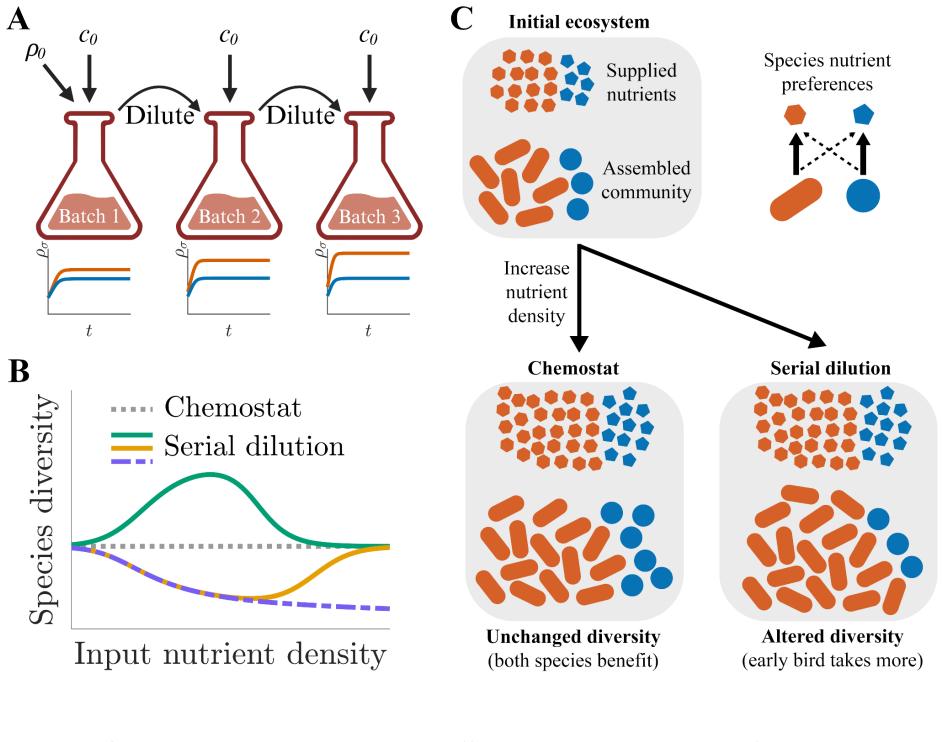
Mathematical models advance the discipline by enforcing logical consistency, enabling quantitative prediction, extracting hidden parameters from data, and generating intuitive understanding. We map a spectrum of modeling frameworks from whole-cell simulations to minimal logistic growth equations, provide interactive examples, outline pragmatic criteria for choosing an appropriate level of description, and present a case study in modeling of microbial ecosystems that yields generalizable intuition.
What carries the argument
A spectrum of modeling frameworks from whole-cell simulations to minimal logistic growth equations, plus pragmatic criteria for selecting the right level of description for the phenomenon of interest.
If this is right
- Models require researchers to state assumptions explicitly, reducing hidden contradictions in hypotheses.
- Quantitative predictions from models can be directly compared against experimental measurements to test understanding.
- Fitting models to data reveals parameter values that experiments cannot measure directly.
- Exploring even simple models generates intuition about thresholds, trade-offs, and emergent behaviors in microbial populations.
- The ecosystem case study demonstrates how mechanistic models can produce rules that apply across different microbial communities.
Where Pith is reading between the lines
- The same criteria for balancing model detail could help researchers in neighboring fields such as synthetic biology decide when to add molecular mechanisms versus using population-level descriptions.
- Interactive examples of the frameworks could serve as teaching tools that let students manipulate parameters and immediately see effects on growth curves or community dynamics.
- If the four contributions hold across subfields, experimental groups might systematically allocate part of their effort to building minimal models early in a project rather than only after data collection.
- The emphasis on intuition suggests models function as thought experiments that can guide which measurements are worth making next.
Load-bearing premise
That the pragmatic criteria for choosing modeling level and the case study of microbial ecosystems will translate into improved research practices for readers working on different microbiological phenomena.
What would settle it
A controlled comparison in which microbiologists trained on the paper's criteria for model selection show no measurable gains in logical consistency, predictive accuracy, or intuitive insight compared with those using ad-hoc modeling choices on the same systems.
Figures

read the original abstract
Mathematical models are increasingly a part of microbiological research. Here, we share our perspective on how modeling advances the discipline by: (i) enforcing logical consistency, (ii) enabling quantitative prediction, (iii) extracting hidden parameters from data, and (iv) generating intuitive understanding. We map a spectrum of modeling frameworks, from whole-cell simulations to minimal logistic growth equations, and provide interactive examples for some common frameworks. Building on this overview, we outline pragmatic criteria for choosing an appropriate level of description to capture phenomena of interest. Finally, we present a case study in modeling of microbial ecosystems from our own work to illustrate how mechanistic modeling can yield generalizable intuition. This perspective aims to be an introductory roadmap for integrating mathematical modeling into experimental microbiology.
Editorial analysis
A structured set of objections, weighed in public.
Referee Report
Summary. The manuscript is a perspective piece arguing that mathematical models advance microbiology by (i) enforcing logical consistency, (ii) enabling quantitative prediction, (iii) extracting hidden parameters from data, and (iv) generating intuitive understanding. It maps a spectrum of frameworks from whole-cell simulations to minimal logistic growth equations, supplies pragmatic criteria for selecting modeling level, includes interactive examples, and illustrates the approach with a case study from the authors' work on microbial ecosystems to show generation of generalizable intuition.
Significance. If adopted, this perspective could function as a practical introductory roadmap for experimental microbiologists, encouraging more systematic integration of modeling with experiments. The explicit listing of four benefits, the spectrum overview, pragmatic selection criteria, and provision of interactive examples represent concrete strengths that could improve research practices when readers apply them to their own systems.
minor comments (2)
- The interactive examples referenced in the abstract and overview would benefit from explicit links, platform specifications, or repository citations in the main text to maximize accessibility for readers.
- A concise summary table or figure comparing the modeling frameworks across the spectrum (e.g., by resolution, data needs, and intuition-generation potential) would improve clarity of the mapping section.
Simulated Author's Rebuttal
We thank the referee for their positive evaluation of the manuscript and their recommendation to accept. The summary accurately reflects our intent to provide a practical introductory roadmap for integrating mathematical modeling with experimental microbiology.
Circularity Check
No significant circularity; perspective piece with no derivations or self-referential reductions
full rationale
This is a perspective and overview article that asserts conceptual benefits of modeling (logical consistency, quantitative prediction, parameter extraction, intuition) and pragmatic criteria for model selection, illustrated by a spectrum of frameworks and one case study from the authors' prior work. No equations, parameter fits, predictions, or derivation chains are present that could reduce to inputs by construction, self-definition, or load-bearing self-citation. The case study is presented as illustration rather than a foundational premise that loops back on itself. The text is self-contained as an opinion roadmap without any load-bearing steps that qualify under the enumerated circularity patterns.
Axiom & Free-Parameter Ledger
axioms (1)
- domain assumption Mathematical models can enforce logical consistency, enable quantitative prediction, extract hidden parameters, and generate intuitive understanding in microbiological contexts.
Reference graph
Works this paper leans on
-
[1]
redox tower
successfully developed a model considering only carbon balance, energy balance, and proteome allocation. Indeed, for many applications, one can entirely neglect cellular processes and consider only thermodynamics. To predict whether a cell can grow in a given condition, one can determine whether that cell’s metabolism is thermodynamically favorable, i.e.,...
1977
-
[2]
R. M. May, Uses and Abuses of Mathematics in Biology, Science 303, 790 (2004)
2004
-
[3]
N. I. van den Berg, D. Machado, S. Santos, I. Rocha, J. Chacón, W. Harcombe, S. Mitri, and K. R. Patil, Ecological modelling approaches for predicting emergent properties in microbial communities, Nat. Ecol. Evol. 6, 855 (2022)
2022
-
[4]
Nagarajan, C
K. Nagarajan, C. Ni, and T. Lu, Agent-Based Modeling of Microbial Communities, ACS Synth. Biol. 11, 3564 (2022)
2022
-
[5]
J. D. Orth, I. Thiele, and B. Ø. Palsson, What is flux balance analysis?, Nat. Biotechnol. 28, 245 (2010)
2010
-
[6]
J. R. Karr, J. C. Sanghvi, D. N. Macklin, M. V. Gutschow, J. M. Jacobs, B. Bolival, N. Assad-Garcia, J. I. Glass, and M. W. Covert, A Whole-Cell Computational Model Predicts Phenotype from Genotype, Cell 150, 389 (2012)
2012
-
[7]
C. Gu, G. B. Kim, W. J. Kim, H. U. Kim, and S. Y. Lee, Current status and applications of genome-scale metabolic models, Genome Biol. 20, 121 (2019)
2019
-
[8]
J. H. Park, K. H. Lee, T. Y. Kim, and S. Y. Lee, Metabolic engineering of Escherichia coli for the production of l-valine based on transcriptome analysis and in silico gene knockout simulation, Proc. Natl. Acad. Sci. 104, 7797 (2007)
2007
-
[9]
Basan, S
M. Basan, S. Hui, H. Okano, Z. Zhang, Y. Shen, J. R. Williamson, and T. Hwa, Overflow metabolism in Escherichia coli results from efficient proteome allocation, Nature 528, 99 (2015)
2015
-
[10]
M. T. Madigan, J. M. Martinko, K. S. Bender, D. H. Buckley, D. A. Stahl, and T. Brock, Brock Biology of Microorganisms (Pearson, Boston, 2015)
2015
-
[11]
Broda, Two kinds of lithotrophs missing in nature, Z
E. Broda, Two kinds of lithotrophs missing in nature, Z. Für Allg. Mikrobiol. 17, 491 (1977)
1977
-
[12]
A. A. van de Graaf, A. Mulder, P. de Bruijn, M. S. Jetten, L. A. Robertson, and J. G. Kuenen, Anaerobic oxidation of ammonium is a biologically mediated process, Appl. Environ. Microbiol. (1995)
1995
-
[13]
Amarnath et al., Stress-induced metabolic exchanges between complementary bacterial types underly a dynamic mechanism of inter-species stress resistance, Nat
K. Amarnath et al., Stress-induced metabolic exchanges between complementary bacterial types underly a dynamic mechanism of inter-species stress resistance, Nat. Commun. 14, 3165 (2023)
2023
-
[14]
Grilli, Macroecological laws describe variation and diversity in microbial communities, Nat
J. Grilli, Macroecological laws describe variation and diversity in microbial communities, Nat. Commun. 11, 1 (2020)
2020
-
[15]
Piccardi, B
P. Piccardi, B. Vessman, and S. Mitri, Toxicity drives facilitation between 4 bacterial species, Proc. Natl. Acad. Sci. 116, 15979 (2019)
2019
-
[16]
Beroz, J
F. Beroz, J. Yan, Y. Meir, B. Sabass, H. A. Stone, B. L. Bassler, and N. S. Wingreen, Verticalization of bacterial biofilms, Nat. Phys. 14, 954 (2018)
2018
-
[17]
E. F. Keller and L. A. Segel, Model for chemotaxis, J. Theor. Biol. 30, 225 (1971)
1971
-
[18]
Copenhagen, R
K. Copenhagen, R. Alert, N. S. Wingreen, and J. W. Shaevitz, Topological defects promote layer formation in Myxococcus xanthus colonies, Nat. Phys. 17, 211 (2021)
2021
-
[19]
R. R. Stein, V. Bucci, N. C. Toussaint, C. G. Buffie, G. Rätsch, E. G. Pamer, C. Sander, and J. B. Xavier, Ecological Modeling from Time-Series Inference: Insight into Dynamics and Stability of Intestinal Microbiota, PLoS Comput. Biol. 9, e1003388 (2013)
2013
-
[20]
Bunin, Ecological communities with Lotka-Volterra dynamics, Phys Rev E 95, 042414 (2017)
G. Bunin, Ecological communities with Lotka-Volterra dynamics, Phys Rev E 95, 042414 (2017)
2017
-
[21]
Momeni, L
B. Momeni, L. Xie, and W. Shou, Lotka-Volterra pairwise modeling fails to capture diverse pairwise microbial interactions, eLife 6, e25051 (2017)
2017
-
[22]
MacArthur, Species packing and competitive equilibrium for many species, Theor
R. MacArthur, Species packing and competitive equilibrium for many species, Theor. Popul. Biol. 1, 1 (1970)
1970
-
[23]
Chesson, MacArthur’s consumer-resource model, Theor
P. Chesson, MacArthur’s consumer-resource model, Theor. Popul. Biol. 37, 26 (1990)
1990
-
[24]
R. H. MacArthur and E. O. Wilson, The Theory of Island Biogeography (Princeton U. Press, 2001)
2001
-
[25]
Gowda, D
K. Gowda, D. Ping, M. Mani, and S. Kuehn, Genomic structure predicts metabolite dynamics in microbial communities, Cell 185, 530 (2022)
2022
-
[26]
D. J. Batstone, J. Keller, I. Angelidaki, S. V. Kalyuzhnyi, S. G. Pavlostathis, A. Rozzi, W. T. M. Sanders, H. Siegrist, and V. A. Vavilin, The IWA Anaerobic Digestion Model No 1 (ADM1), Water Sci. Technol. 45, 65 (2002)
2002
-
[27]
J. E. Goldford, N. Lu, D. Bajić, S. Estrela, M. Tikhonov, A. Sanchez-Gorostiaga, D. Segrè, P. Mehta, and A. Sanchez, Emergent simplicity in microbial community assembly, Science 361, 469 (2018)
2018
-
[28]
J. E. Keymer, R. G. Endres, M. Skoge, Y. Meir, and N. S. Wingreen, Chemosensing in Escherichia coli: Two regimes of two-state receptors, Proc. Natl. Acad. Sci. 103, 1786 (2006)
2006
-
[29]
Levins, The Strategy of Model Building in Population Biology, Am
R. Levins, The Strategy of Model Building in Population Biology, Am. Sci. 54, 421 (1966)
1966
-
[30]
D. H. de Groot, J. Lischke, R. Muolo, R. Planqué, F. J. Bruggeman, and B. Teusink, The common message of constraint-based optimization approaches: overflow metabolism is caused by two growth-limiting constraints, Cell. Mol. Life Sci. 77, 441 (2020)
2020
-
[31]
A. J. Lotka, Analytical Note on Certain Rhythmic Relations in Organic Systems, Proc. Natl. Acad. Sci. 6, 410 (1920)
1920
-
[32]
J. H. Lawton, Are There General Laws in Ecology?, Oikos 84, 177 (1999)
1999
-
[33]
R. M. May, Will a Large Complex System be Stable?, Nature 238, 5364 (1972)
1972
-
[34]
Yonatan, G
Y. Yonatan, G. Amit, J. Friedman, and A. Bashan, Complexity–stability trade-off in empirical microbial ecosystems, Nat. Ecol. Evol. 6, 693 (2022)
2022
-
[35]
R. M. Iii, W. Cui, J. Goldford, A. Sanchez, K. Korolev, and P. Mehta, Available energy fluxes drive a transition in the diversity, stability, and functional structure of microbial communities, PLOS Comput. Biol. 15, e1006793 (2019)
2019
-
[36]
Biroli, G
G. Biroli, G. Bunin, and C. Cammarota, Marginally stable equilibria in critical ecosystems, New J. Phys. 20, 083051 (2018)
2018
-
[37]
X. Sun, P. J. Buchanan, I. H. Zhang, M. San Roman, A. R. Babbin, and E. J. Zakem, Ecological dynamics explain modular denitrification in the ocean, Proc. Natl. Acad. Sci. 121, e2417421121 (2024)
2024
-
[38]
T. Wang, H. D. Holscher, S. Maslov, F. B. Hu, S. T. Weiss, and Y.-Y. Liu, Predicting metabolite response to dietary intervention using deep learning, Nat. Commun. 16, 815 (2025)
2025
-
[39]
C. A. Suttle, The significance of viruses to mortality in aquatic microbial communities, Microb. Ecol. 28, 237 (1994)
1994
-
[40]
Breitbart, C
M. Breitbart, C. Bonnain, K. Malki, and N. A. Sawaya, Phage puppet masters of the marine microbial realm, Nat. Microbiol. 3, 754 (2018)
2018
-
[41]
Mulla, J
Y. Mulla, J. Müller, D. Trimcev, and T. Bollenbach, Extreme diversity of phage amplification rates and phage–antibiotic interactions revealed by PHORCE, PLOS Biol. 23, e3003065 (2025)
2025
-
[42]
S. E. Luria and M. Delbrück, MUTATIONS OF BACTERIA FROM VIRUS SENSITIVITY TO VIRUS RESISTANCE, Genetics 28, 491 (1943)
1943
-
[43]
Hallatschek, Selection-Like Biases Emerge in Population Models with Recurrent Jackpot Events, Genetics 210, 1053 (2018)
O. Hallatschek, Selection-Like Biases Emerge in Population Models with Recurrent Jackpot Events, Genetics 210, 1053 (2018)
2018
-
[44]
Scott, C
M. Scott, C. W. Gunderson, E. M. Mateescu, Z. Zhang, and T. Hwa, Interdependence of Cell Growth and Gene Expression: Origins and Consequences, Science 330, 1099 (2010)
2010
-
[45]
TILMAN, A Consumer-Resource Approach to Community Structure1, Am
D. TILMAN, A Consumer-Resource Approach to Community Structure1, Am. Zool. 26, 5 (1986)
1986
-
[46]
Marsland, W
R. Marsland, W. Cui, and P. Mehta, A minimal model for microbial biodiversity can reproduce experimentally observed ecological patterns, Sci. Rep. 10, 1 (2020)
2020
-
[47]
A. Erez, J. G. Lopez, B. G. Weiner, Y. Meir, and N. S. Wingreen, Nutrient levels and trade-offs control diversity in a serial dilution ecosystem, eLife 9, e57790 (2020)
2020
-
[48]
Novick and L
A. Novick and L. Szilard, Experiments with the Chemostat on Spontaneous Mutations of Bacteria, Proc. Natl. Acad. Sci. 36, 708 (1950)
1950
-
[49]
H. L. Smith and P. Waltman, The Theory of the Chemostat: Dynamics of Microbial Competition (Cambridge University Press, 1995)
1995
-
[50]
Posfai, T
A. Posfai, T. Taillefumier, and N. S. Wingreen, Metabolic Trade-Offs Promote Diversity in a Model Ecosystem, Phys. Rev. Lett. 118, 028103 (2017)
2017
-
[51]
T. Egli, U. Lendenmann, and M. Snozzi, Kinetics of microbial growth with mixtures of carbon sources, Antonie Van Leeuwenhoek 63, 289 (1993)
1993
-
[52]
Lendenmann, M
U. Lendenmann, M. Snozzi, and T. Egli, Kinetics of the simultaneous utilization of sugar mixtures by Escherichia coli in continuous culture, Appl Env. Microbiol 62, 1493 (1996)
1996
-
[53]
R. E. Lenski and M. Travisano, Dynamics of adaptation and diversification: a 10,000-generation experiment with bacterial populations, Proc. Natl. Acad. Sci. 91, 6808 (1994)
1994
-
[54]
E. A. Yurtsev, A. Conwill, and J. Gore, Oscillatory dynamics in a bacterial cross-protection mutualism, Proc Natl Acad Sci USA 113, 6236 (2016)
2016
-
[55]
C. A. Thaiss et al., Microbiota Diurnal Rhythmicity Programs Host Transcriptome Oscillations, Cell 167, 1495 (2016)
2016
-
[56]
G. V. Bossa, S. Bel, A. Mugler, and A. Erez, Optimal antimicrobial response to a changing microbial background at a mucus interface, Phys. Rev. Res. 6, 023027 (2024)
2024
-
[57]
P.-Y. Ho, B. H. Good, and K. C. Huang, Competition for fluctuating resources reproduces statistics of species abundance over time across wide-ranging microbiotas, eLife 11, e75168 (2022)
2022
-
[58]
S. A. Smits et al., Seasonal cycling in the gut microbiome of the Hadza hunter-gatherers of Tanzania, Science 357, 802 (2017)
2017
-
[59]
Berger, M
A. Berger, M. Gatt Harari, A. Gross, and A. Erez, Diversity loss in microbial ecosystems undergoing gradual environmental changes, Cell Rep. Sustain. 1, 100242 (2024)
2024
-
[60]
F. M. Stewart and B. R. Levin, Partitioning of Resources and the Outcome of Interspecific Competition : A Model and Some General Considerations, Am Nat 107, 171 (1973)
1973
-
[61]
H. L. Smith, Bacterial competition in serial transfer culture, Math. Biosci. 229, 149 (2011)
2011
-
[62]
A. Erez, J. G. Lopez, Y. Meir, and N. S. Wingreen, Enzyme regulation and mutation in a model serial-dilution ecosystem, Phys. Rev. E 104, 044412 (2021)
2021
-
[63]
Debray, R
R. Debray, R. A. Herbert, A. L. Jaffe, A. Crits-Christoph, M. E. Power, and B. Koskella, Priority effects in microbiome assembly, Nat. Rev. Microbiol. 20, 109 (2022)
2022
-
[64]
early-bird
A. Aranda-Díaz et al., Assembly of stool-derived bacterial communities follows “early-bird” resource utilization dynamics, Cell Syst. 0, (2025)
2025
-
[65]
J. G. Lopez, Y. Hein, and A. Erez, Grow now, pay later: When should a bacterium go into debt?, Proc. Natl. Acad. Sci. 121, e2314900121 (2024)
2024
-
[66]
V. H. Smith, Microbial diversity–productivity relationships in aquatic ecosystems, FEMS Microbiol. Ecol. 62, 181 (2007)
2007
-
[67]
Chesson, Mechanisms of Maintenance of Species Diversity, Annu
P. Chesson, Mechanisms of Maintenance of Species Diversity, Annu. Rev. Ecol. Syst. 31, 343 (2000)
2000
discussion (0)
Sign in with ORCID, Apple, or X to comment. Anyone can read and Pith papers without signing in.