Recognition: unknown
Nonuniform Iterative Phasing Framework and Sampling Requirements for 3D Dynamical Inversion from Coherent Surface Scattering Imaging
Pith reviewed 2026-05-10 02:41 UTC · model grok-4.3
The pith
A nonuniform iterative phasing method reconstructs high-resolution 3D nanostructures from CSSI data at only one or two incident angles despite dynamical scattering.
A machine-rendered reading of the paper's core claim, the machinery that carries it, and where it could break.
Core claim
The central claim is that an iterative-projection phasing framework combined with fast nonuniform Fourier inversion methods can efficiently reconstruct isolated 3D structures from CSSI rotation-series data involving nonuniformly sampled Fourier values and dynamical scattering, with data from as few as one or two incident angles sufficing for high-resolution results.
What carries the argument
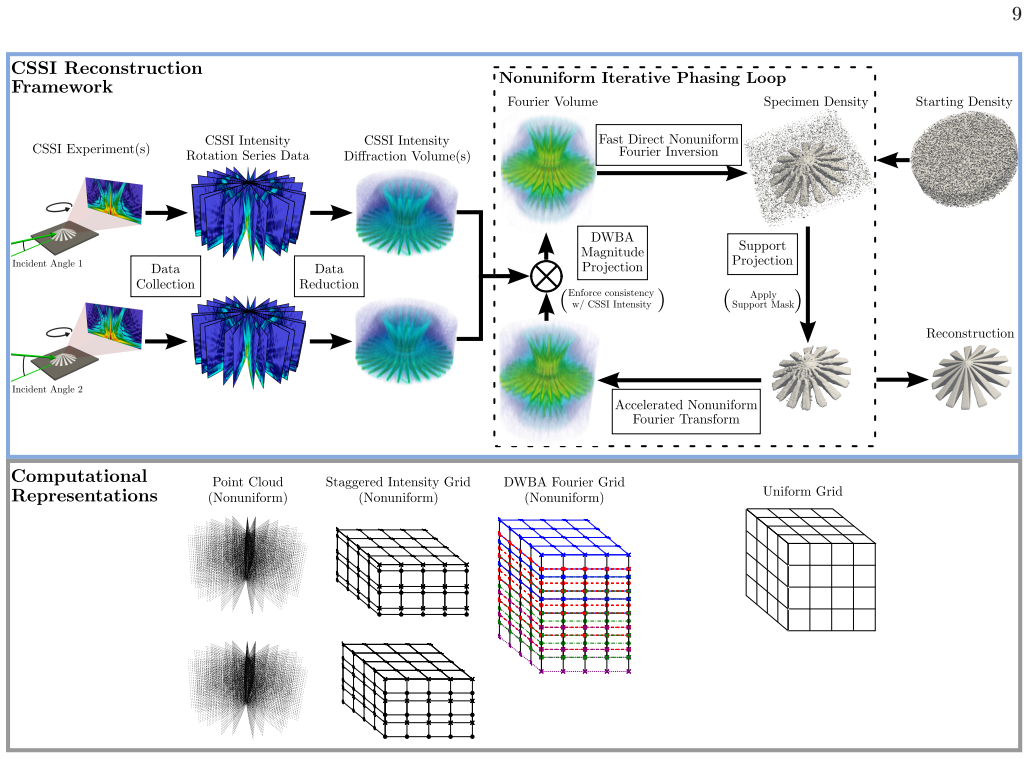
The nonuniform iterative phasing framework, which integrates iterative-projection-based phasing techniques with fast nonuniform Fourier inversion methods to handle nonuniform sampling and dynamical scattering in the data.
If this is right
- High-resolution 3D structures can be recovered from CSSI data collected at only one or two incident angles even with significant dynamical scattering present.
- Theoretical analysis yields specific requirements on experimental parameters such as angular sampling and characterizes conditions for unique solutions.
- The same nonuniform reconstruction approach supplies a foundation for other phase-retrieval problems that involve nonlinear combinations of nonuniformly sampled Fourier values.
- The method works for both isolated nanostructures and porous media when the dynamical scattering is accounted for inside the iterative projections.
Where Pith is reading between the lines
- Reducing the number of required angles could shorten beamtime at synchrotron facilities for 3D nanostructure imaging.
- The uniqueness conditions derived here may guide experimental design choices in related coherent scattering geometries beyond CSSI.
- The framework's handling of nonuniform Fourier data opens a path to generalizations that incorporate additional physical effects such as partial coherence without new parameters.
- Application to experimental rather than simulated CSSI datasets would test whether the isolated-specimen assumption holds under realistic substrate interactions.
Load-bearing premise
The specimen is isolated and dynamical scattering effects can be incorporated or mitigated inside the iterative projection framework without introducing extra unknown parameters.
What would settle it
A reconstruction from real one-angle CSSI data on a known test structure such as a conical Siemens star that fails to match the true 3D density or produces persistent artifacts inconsistent with the input model would falsify the central claim.
Figures








read the original abstract
Coherent surface scattering imaging (CSSI) is an emerging experimental technique uniquely suited to probing the structure of thin nanostructures. In these experiments, a specimen is placed on a substrate, and a series of X-ray diffraction patterns is collected at grazing incidence angles as the specimen is rotated. However, reconstructing the specimen's 3D structure from the data is challenging due to dynamical scattering effects induced by the experimental geometry and the lack of direct phase measurements. Specifically, the data involves nonuniformly sampled Fourier-transform values of the specimen density, and failure to effectively address this nonuniformity can lead to errors or degraded performance. Here we introduce a mathematical inversion framework that combines iterative-projection-based phasing techniques with new fast nonuniform Fourier inversion methods to efficiently reconstruct isolated 3D structures from their CSSI rotation-series data. We also analyze the theoretical properties of CSSI reconstruction to derive requirements on experimental parameters and characterize solution uniqueness. We validate our approach using CSSI data simulated from a conical Siemens star and a porous medium, demonstrating that high-resolution 3D structures can be reconstructed even in the presence of significant dynamical scattering, from data collected at as few as one or two incident angles. More broadly, the presented nonuniform reconstruction framework provides a foundation for solving challenging generalizations of the phase problem in which measurements involve nonlinear combinations of nonuniformly sampled Fourier values.
Editorial analysis
A structured set of objections, weighed in public.
Referee Report
Summary. The paper introduces a nonuniform iterative phasing framework for 3D reconstruction of isolated structures from Coherent Surface Scattering Imaging (CSSI) rotation-series data. It combines established iterative projection phasing methods with fast nonuniform Fourier transform techniques to handle nonuniformly sampled Fourier values and dynamical scattering effects. The authors derive theoretical sampling requirements and solution uniqueness conditions under the isolated-specimen model, then validate the approach via simulations on a conical Siemens star and a porous medium, claiming that high-resolution 3D reconstructions remain feasible from as few as one or two incident angles despite significant dynamical scattering.
Significance. If the central claim holds, the work would provide a useful computational foundation for CSSI-based 3D imaging of thin nanostructures, reducing the experimental burden of multi-angle data collection. The application of standard phasing and NUFFT tools to this specific nonuniform geometry, together with the explicit sampling/uniqueness analysis, represents a clear incremental advance. The simulated validations on two distinct test objects lend concrete support, though the absence of real experimental data and quantitative error metrics in the reported results limits the immediate strength of the robustness claims.
major comments (2)
- [Validation section] Validation section: The simulated reconstructions on the conical Siemens star and porous medium are presented as evidence that high-resolution 3D recovery is possible from one or two angles even with dynamical scattering, but no quantitative error metrics (e.g., R-factor, MSE, or Fourier shell correlation values) or resolution estimates are reported. This omission is load-bearing for the central claim of robustness, as visual inspection alone does not substantiate the 'high-resolution' or 'significant dynamical scattering' assertions.
- [Theoretical analysis] Theoretical analysis: The uniqueness and sampling requirements are derived under the isolated-specimen model with dynamical scattering incorporated into the forward operator. The paper should explicitly test or bound the sensitivity of the reconstruction to violations of isolation (e.g., extended substrate effects or model mismatch), as this assumption underpins the claim that no additional free parameters are needed.
minor comments (3)
- [Abstract] Abstract: The claim of successful reconstruction 'even in the presence of significant dynamical scattering' would be strengthened by including at least one quantitative performance metric from the simulations.
- [Discussion] The manuscript would benefit from a brief discussion of how the framework behaves under realistic noise levels or partial coherence, even if only as a forward-looking remark.
- [Methods] Notation for the nonuniform sampling operator and the projection operators could be introduced with a small table or explicit equation reference to improve readability for readers unfamiliar with CSSI geometry.
Simulated Author's Rebuttal
We thank the referee for the constructive review and recommendation of minor revision. We address each major comment below and will revise the manuscript accordingly.
read point-by-point responses
-
Referee: [Validation section] Validation section: The simulated reconstructions on the conical Siemens star and porous medium are presented as evidence that high-resolution 3D recovery is possible from one or two angles even with dynamical scattering, but no quantitative error metrics (e.g., R-factor, MSE, or Fourier shell correlation values) or resolution estimates are reported. This omission is load-bearing for the central claim of robustness, as visual inspection alone does not substantiate the 'high-resolution' or 'significant dynamical scattering' assertions.
Authors: We agree that quantitative metrics would strengthen the validation. In the revised manuscript we will add R-factor, MSE, and Fourier shell correlation (FSC) curves comparing the reconstructions to ground truth for both test objects, computed across the one- and two-angle cases with varying dynamical scattering strengths. These additions will quantify resolution and reconstruction fidelity beyond visual inspection. revision: yes
-
Referee: [Theoretical analysis] Theoretical analysis: The uniqueness and sampling requirements are derived under the isolated-specimen model with dynamical scattering incorporated into the forward operator. The paper should explicitly test or bound the sensitivity of the reconstruction to violations of isolation (e.g., extended substrate effects or model mismatch), as this assumption underpins the claim that no additional free parameters are needed.
Authors: The isolated-specimen model is essential to our derivation of sampling requirements and uniqueness conditions. We will revise the theoretical analysis section to include an explicit discussion bounding the sensitivity to small violations of isolation, such as weak substrate scattering terms, and note that the approximation holds for the thin nanostructures targeted by CSSI. A full numerical sensitivity study lies outside the present scope, but the added bounds will clarify the robustness of the no-extra-parameter claim. revision: partial
Circularity Check
Established phasing and NUFFT methods applied to CSSI geometry; no equations reduce output to fitted inputs or self-citations
full rationale
The derivation combines standard iterative projection phasing with nonuniform FFT inversion for the CSSI rotation series under an isolated-specimen model. Uniqueness and sampling requirements are derived directly from the nonuniform Fourier sampling geometry without reducing to fitted parameters or prior self-citations as load-bearing premises. Simulations use forward models consistent with the inverse but do not force the reconstruction result by construction. No self-definitional loops, fitted inputs renamed as predictions, or ansatz smuggling appear in the framework description.
Axiom & Free-Parameter Ledger
axioms (2)
- domain assumption Measurements correspond to nonuniformly sampled Fourier transforms of an isolated specimen density.
- standard math Iterative projections can enforce consistency with the measured magnitudes and support constraints.
Reference graph
Works this paper leans on
-
[1]
Clipped cylindrical grid, constructed with 1621 angles uniformly spaced in [0 , 2π), 258 radii uniformly spaced in [0, √ 2 2 ), and 15 heights uniformly spaced in [0 , 1 2), with all points outside of the box [ − 1 2 , 1 2] × [− 1 2 , 1 2] × [− 1 2 , 1 2] removed
-
[2]
DWBA grid, described in Section V C, forJ= 1 inci- dent angle αi = 0.26 and (2·121−1)×(2·121−1)×(8·31) grid points
-
[3]
ILLUMINE - Intelligent Learning for Light Source and Neutron Source User Mea- surements Including Navigation and Experiment Steering
8 · 121 · 121 · 31 random 3D coordinates whose com- ponents are sampled from a uniform distribution over the interval [− 1 2 , 1 2]. The Fourier data for each object is simulated on each of the above sampling sets via an NUFFT. For each of these Fourier sampling sets, we compute the weights w using two choices of pre-weight factors. The first set of weigh...
2000
-
[4]
T. Sun, Z. Jiang, J. Strzalka, L. Ocola, and J. Wang, Three-dimensional coherent X-ray surface scattering imag- ing near total external reflection, Nat. Photon.6, 586 (2012)
2012
-
[5]
Akinwande, N
D. Akinwande, N. Petrone, and J. Hone, Two-dimensional flexible nanoelectronics, Nat. Commun.5, 5678 (2014)
2014
-
[6]
W. L. Tan and C. R. McNeill, X-ray diffraction of pho- tovoltaic perovskites: Principles and applications, Appl. Phys. Rev.9(2022)
2022
-
[7]
P. R. Brown, D. Kim, R. R. Lunt, N. Zhao, M. G. Bawendi, J. C. Grossman, and V. Bulovic, Energy level modification in lead sulfide quantum dot thin films through ligand exchange, ACS Nano8, 5863 (2014)
2014
-
[8]
Paracini, P
N. Paracini, P. Gutfreund, R. Welbourn, J. F. Gonzalez- Martinez, K. Zhu, Y. Miao, N. Yepuri, T. A. Darwish, C. Garvey, S. Waldie,et al., Structural characterization of nanoparticle-supported lipid bilayer arrays by grazing incidence X-ray and neutron scattering, ACS Appl. Mater. Interfaces15, 3772 (2023)
2023
-
[9]
D. N. Azulay, O. Spaeker, M. Ghrayeb, M. Wilsch- Br¨ auninger, E. Scoppola, M. Burghammer, I. Zizak, L. Bertinetti, Y. Politi, and L. Chai, Multiscale X-ray study of Bacillus subtilis biofilms reveals interlinked struc- tural hierarchy and elemental heterogeneity, Proc. Natl. Acad. Sci. U.S.A.119, e2118107119 (2022)
2022
-
[10]
Jiang, J
Z. Jiang, J. Anton, S. Kearney, S. Bean, M. Chu, J. Wang, D. Shu, and S. Narayanan, Design and performance of the coherent surface-scattering imaging solid sample station for the advanced photon source upgrade, inOptomechani- cal Engineering 2025, Vol. 13599 (SPIE, 2025) pp. 13–19
2025
-
[11]
Kerby, The advanced photon source upgrade: A brighter future for X-ray science, Synchrotron Radiat
J. Kerby, The advanced photon source upgrade: A brighter future for X-ray science, Synchrotron Radiat. News36, 26 (2023)
2023
-
[12]
Shi, Y.-C
X. Shi, Y.-C. Lin, J. Zhao, T. Toellner, M. Y. Hu, S. Seifert, B. Lee, W. Grizolli, M. J. Wojcik, L. Rebuffi, et al., Measurements of source emittance and beam coher- ence properties of the upgraded Advanced Photon Source, J. Synchrotron Radiat.32(2025)
2025
-
[13]
H. N. Chapman, Fourth-generation light sources, IUCrJ 10, 246 (2023)
2023
-
[14]
Hellert, S
T. Hellert, S. Borra, M. Dach, B. Flugstad, T. Ford, S. Leemann, H. Nishimura, S. Omolayo, G. Portmann, T. Scarvie,et al., Status of the advanced light source, in Proc. IPAC’24, IPAC’24 - 15th International Particle Ac- celerator Conference No. 15 (JACoW Publishing, Geneva, Switzerland, 2024) pp. 1309–1312
2024
-
[15]
Sinha, E
S. Sinha, E. Sirota, S. Garoff, and H. Stanley, X-ray and neutron scattering from rough surfaces, Phys. Rev. B38, 2297 (1988)
1988
-
[16]
R. W. Gerchberg, A practical algorithm for the determi- nation of phase from image and diffraction plane pictures, Optik35, 237 (1972)
1972
-
[17]
J. R. Fienup, Reconstruction of an object from the mod- ulus of its Fourier transform, Opt. Lett.3, 27 (1978)
1978
-
[18]
R. P. Millane, Phase retrieval in crystallography and optics, J. Opt. Soc. Am. A7, 394 (1990)
1990
-
[19]
R. P. Millane, Recent advances in phase retrieval, in Image Reconstruction from Incomplete Data IV, Vol. 6316, edited by P. J. Bones, M. A. Fiddy, and R. P. Millane (SPIE, 2006) p. 63160E
2006
-
[20]
D. R. Luke, Relaxed averaged alternating reflections for diffraction imaging, Inverse Probl.21, 37 (2004)
2004
-
[21]
Elser, Phase retrieval by iterated projections, J
V. Elser, Phase retrieval by iterated projections, J. Opt. Soc. Am. A20, 40 (2003)
2003
-
[22]
Elser, I
V. Elser, I. Rankenburg, and P. Thibault, Searching with iterated maps, Proc. Natl. Acad. Sci. U.S.A.104, 418 (2007)
2007
-
[23]
Venkatakrishnan, J
S. Venkatakrishnan, J. Donatelli, D. Kumar, A. Sarje, S. K. Sinha, X. S. Li, and A. Hexemer, A multi-slice simulation algorithm for grazing-incidence small-angle X-ray scattering, J. Appl. Crystallogr.49, 1876 (2016)
2016
-
[24]
Myint, M
P. Myint, M. Chu, A. Tripathi, M. J. Wojcik, J. Zhou, M. J. Cherukara, S. Narayanan, J. Wang, and Z. Jiang, Multislice forward modeling of coherent surface scattering imaging on surface and interfacial structures, Opt. Express 31, 11261 (2023)
2023
-
[25]
M. Chu, Z. Jiang, M. Wojcik, T. Sun, M. Sprung, and J. Wang, Probing three-dimensional mesoscopic interfacial structures in a single view using multibeam X-ray coherent surface scattering and holography imaging, Nat. Commun. 14, 5795 (2023)
2023
-
[26]
Myint, A
P. Myint, A. Tripathi, M. J. Wojcik, J. Deng, M. J. Cherukara, N. Schwarz, S. Narayanan, J. Wang, M. Chu, and Z. Jiang, Three-dimensional hard X-ray ptycho- graphic reflectometry imaging on extended mesoscopic surface structures, APL Photon.9(2024). 34
2024
-
[27]
J. Sung, Y. Gao, J. Griffith, Z. Gao, X. Huang, G. Williams, and Y. S. Chu, Automatic differentiation for X-ray grazing-incidence surface imaging using ptychogra- phy, inX-Ray Nanoimaging: Instruments and Methods VII, Vol. 13622 (SPIE, 2025) pp. 61–66
2025
-
[28]
Marathe, S
S. Marathe, S. Kim, S. Kim, C. Kim, H. Kang, P. Nick- les, and D. Noh, Coherent diffraction surface imaging in reflection geometry, Opt. Express18, 7253 (2010)
2010
-
[29]
S. Roy, D. Parks, K. Seu, R. Su, J. Turner, W. Chao, E. Anderson, S. Cabrini, and S. Kevan, Lensless X-ray imaging in reflection geometry, Nat. Photon.5, 243 (2011)
2011
-
[30]
Yefanov and I
O. Yefanov and I. Vartanyants, Three dimensional re- construction of nanoislands from grazing-incidence small- angle X-ray scattering, Eur. Phys. J. Spec. Top.167, 81 (2009)
2009
-
[31]
J. W. Kim, M. J. Cherukara, A. Tripathi, Z. Jiang, and J. Wang, Inversion of coherent surface scattering images via deep learning network, Appl. Phys. Lett.119(2021)
2021
-
[32]
Liu and K
J. Liu and K. G. Yager, Unwarping GISAXS data, IUCrJ 5, 737 (2018)
2018
-
[33]
Yang and S
Y. Yang and S. K. Sinha, Three-dimensional imaging using coherent x rays at grazing incidence geometry, J. Opt. Soc. Am. A40, 1500 (2023)
2023
-
[34]
Dutt and V
A. Dutt and V. Rokhlin, Fast Fourier transforms for nonequispaced data, SIAM J. Sci. Comput.14, 1368 (1993)
1993
-
[35]
Greengard and J.-Y
L. Greengard and J.-Y. Lee, Accelerating the nonuniform fast Fourier transform, SIAM Rev.46, 443 (2004)
2004
-
[36]
Wiener, Generalized harmonic analysis, Acta Math
N. Wiener, Generalized harmonic analysis, Acta Math. 55, 117 (1930)
1930
-
[37]
G. H. Vineyard, Grazing-incidence diffraction and the distorted-wave approximation for the study of surfaces, Phys. Rev. B26, 4146 (1982)
1982
-
[38]
J. A. Fessler and B. P. Sutton, Nonuniform fast Fourier transforms using min-max interpolation, IEEE Trans. Sig- nal Process.51, 560 (2003)
2003
-
[39]
Exponential of semicircle
A. H. Barnett, J. Magland, and L. af Klinteberg, A parallel nonuniform fast Fourier transform library based on an “Exponential of semicircle” kernel, SIAM J. Sci. Comput. 41, C479 (2019)
2019
-
[40]
A. H. Barnett, Aliasing error of the exp(β √ 1−z 2) kernel in the nonuniform fast Fourier transform, Appl. Comput. Harmon. Anal.51, 1 (2021)
2021
-
[41]
Kircheis and D
M. Kircheis and D. Potts, Fast and direct inversion meth- ods for the multivariate nonequispaced fast Fourier trans- form, Front. Appl. Math. Stat.9, 1155484 (2023)
2023
-
[42]
Wajer and K
F. Wajer and K. Pruessmann, Major speedup of recon- struction for sensitivity encoding with arbitrary trajecto- ries, inProc. Intl. Soc. Mag. Reson. Med 9(2001)
2001
-
[43]
Ou,gNUFFTW: auto-tuning for high-performance GPU-accelerated non-uniform fast Fourier transforms, Tech
T. Ou,gNUFFTW: auto-tuning for high-performance GPU-accelerated non-uniform fast Fourier transforms, Tech. Rep. UCB/EECS-2017-90 (University of California, Berkeley, 2017) http://www2.eecs.berkeley.edu/Pubs/ TechRpts/2017/EECS-2017-90.pdf
2017
- [44]
-
[45]
Choi and D
H. Choi and D. C. Munson, Analysis and design of minimax-optimal interpolators, IEEE Trans. Signal Pro- cess.46, 1571 (1998)
1998
-
[46]
J. G. Pipe and P. Menon, Sampling density compensation in MRI: rationale and an iterative numerical solution, Magn. Reson. Med.41, 179 (1999)
1999
-
[47]
Rasche, R
V. Rasche, R. Proksa, R. Sinkus, P. Bornert, and H. Eg- gers, Resampling of data between arbitrary grids using convolution interpolation, IEEE Trans. Med. Imaging18, 385 (2002)
2002
-
[48]
Greengard, J.-Y
L. Greengard, J.-Y. Lee, and S. Inati, The fast sinc trans- form and image reconstruction from nonuniform samples in k-space, Commun. Appl. Math. Comput. Sci.1, 121 (2007)
2007
-
[49]
Dutt and V
A. Dutt and V. Rokhlin, Fast Fourier transforms for nonequispaced data, II, Appl. Comput. Harmon. Anal.2, 85 (1995)
1995
-
[50]
Gelb and G
A. Gelb and G. Song, A frame theoretic approach to the nonuniform fast Fourier transform, SIAM J. Numer. Anal. 52, 1222 (2014)
2014
-
[51]
Selva, Efficient type-4 and type-5 non-uniform FFT methods in the one-dimensional case, IET Signal Process
J. Selva, Efficient type-4 and type-5 non-uniform FFT methods in the one-dimensional case, IET Signal Process. 12, 74 (2018)
2018
-
[52]
Kircheis and D
M. Kircheis and D. Potts, Direct inversion of the nonequi- spaced fast fourier transform, Linear Algebra Appl.575, 106 (2019)
2019
-
[53]
Wilber, E
H. Wilber, E. N. Epperly, and A. H. Barnett, Superfast direct inversion of the nonuniform discrete Fourier trans- form via hierarchically semiseparable least squares, SIAM J. Sci. Comput.47, A1702 (2025)
2025
-
[54]
Hayes, The reconstruction of a multidimensional se- quence from the phase or magnitude of its Fourier trans- form, IEEE Trans
M. Hayes, The reconstruction of a multidimensional se- quence from the phase or magnitude of its Fourier trans- form, IEEE Trans. Acoust. Speech Signal Process.30, 140 (1982)
1982
-
[55]
L. M. Bregman, The relaxation method of finding the common point of convex sets and its application to the solution of problems in convex programming, USSR Com- put. Math. Math. Phys.7, 200 (1967)
1967
-
[56]
H. H. Bauschke, P. L. Combettes, and D. R. Luke, Hybrid projection–reflection method for phase retrieval, J. Opt. Soc. Am. A20, 1025 (2003)
2003
-
[57]
Elser, T.-Y
V. Elser, T.-Y. Lan, and T. Bendory, Benchmark problems for phase retrieval, SIAM J. Imaging Sci.11, 2429 (2018)
2018
-
[58]
Marchesini, H
S. Marchesini, H. He, H. N. Chapman, S. P. Hau-Riege, A. Noy, M. R. Howells, U. Weierstall, and J. C. Spence, X-ray image reconstruction from a diffraction pattern alone, Phys. Rev. B68, 140101 (2003)
2003
-
[59]
J. J. Donatelli, P. H. Zwart, and J. A. Sethian, Iterative phasing for fluctuation X-ray scattering, Proc. Natl. Acad. Sci. U.S.A.112, 10286 (2015)
2015
-
[60]
Calvetti and E
D. Calvetti and E. Somersalo, Inverse problems: From regularization to Bayesian inference, Wiley Interdiscip. Rev. Comput. Stat.10, e1427 (2018)
2018
-
[61]
J. J. Donatelli, J. A. Sethian, and P. H. Zwart, Recon- struction from limited single-particle diffraction data via simultaneous determination of state, orientation, inten- sity, and phase, Proc. Natl. Acad. Sci. U.S.A.114, 7222 (2017)
2017
-
[62]
Vertu, J.-J
S. Vertu, J.-J. Delaunay, I. Yamada, and O. Haeberl´ e, Diffraction microtomography with sample rotation: in- fluence of a missing apple core in the recorded frequency space, Cent. Eur. J. Phys.7, 22 (2009)
2009
-
[63]
J. Lim, K. Lee, K. H. Jin, S. Shin, S. Lee, Y. Park, and J. C. Ye, Comparative study of iterative reconstruction algorithms for missing cone problems in optical diffraction tomography, Opt. Express23, 16933 (2015)
2015
-
[64]
Pospelov, W
G. Pospelov, W. Van Herck, J. Burle, J. M. Car- mona Loaiza, C. Durniak, J. M. Fisher, M. Ganeva, D. Yurov, and J. Wuttke, Bornagain: software for simu- lating and fitting grazing-incidence small-angle scattering, J. Appl. Crystallogr.53, 262 (2020). 35
2020
-
[65]
R. P. Kurta, J. J. Donatelli, C. H. Yoon, P. Berntsen, J. Bielecki, B. J. Daurer, H. DeMirci, P. Fromme, M. F. Hantke, F. R. Maia,et al., Correlations in scattered X-ray laser pulses reveal nanoscale structural features of viruses, Phys. Rev. Lett.119, 158102 (2017)
2017
-
[66]
Pande, J
K. Pande, J. J. Donatelli, E. Malmerberg, L. Foucar, C. Bostedt, I. Schlichting, and P. H. Zwart, Ab initio structure determination from experimental fluctuation X-ray scattering data, Proc. Natl. Acad. Sci. U.S.A.115, 11772 (2018)
2018
-
[67]
J. P. Chen and R. A. Kirian, Phase retrieval in the pres- ence of multiplicative noise, inUnconventional and In- direct Imaging, Image Reconstruction, and Wavefront Sensing 2017, Vol. 10410 (SPIE, 2017) pp. 140–144
2017
-
[68]
Pande, J
K. Pande, J. Donatelli, D. Parkinson, H. Yan, and J. Sethian, Joint iterative reconstruction and 3D rigid alignment for X-ray tomography, Opt. Express30, 8898 (2022)
2022
-
[69]
C. Yang, E. G. Ng, and P. A. Penczek, Unified 3-D struc- ture and projection orientation refinement using quasi- Newton algorithm, J. Struct. Biol.149, 53 (2005)
2005
-
[70]
Ramos, J
T. Ramos, J. S. Jørgensen, and J. W. Andreasen, Auto- mated angular and translational tomographic alignment and application to phase-contrast imaging, J. Opt. Soc. Am. A34, 1830 (2017)
2017
-
[71]
H. Yu, S. Xia, C. Wei, Y. Mao, D. Larsson, X. Xiao, P. Pianetta, Y.-S. Yu, and Y. Liu, Automatic projec- tion image registration for nanoscale X-ray tomographic reconstruction, J. Synchrotron Radiat.25, 1819 (2018)
2018
-
[72]
L´ erondel and R
G. L´ erondel and R. Romestain, Fresnel coefficients of a rough interface, Appl. Phys. Lett.74, 2740 (1999). 36 FIG. 20. Ground truth and reconstructions of the porous medium from staggered CSSI intensity grid data. For each example, the top two rows display different orientations of the density isosurfaces at ρ = 0.5 for test cases 1, 2, 3, and 5 and ρ =...
1999
-
[73]
Pospelov, W
G. Pospelov, W. Van Herck, J. Burle, J. M. Carmona Loaiza, C. Durniak, J. M. Fisher, M. Ganeva, D. Yurov, and J. Wuttke, Bornagain: software for simulating and fitting grazing- incidence small-angle scattering, J. Appl. Crystallogr.53, 262 (2020). 22
2020
discussion (0)
Sign in with ORCID, Apple, or X to comment. Anyone can read and Pith papers without signing in.