Recognition: unknown
Discovery of the First Octupole Pulsation Mode in a delta Scuti Star: A Stationary l = 3 Sectoral Mode
Pith reviewed 2026-05-10 03:09 UTC · model grok-4.3
The pith
A delta Scuti star in a binary system exhibits the first securely identified octupole pulsation mode, formed as a stationary combination of perturbed l=3 spherical harmonics.
A machine-rendered reading of the paper's core claim, the machinery that carries it, and where it could break.
Core claim
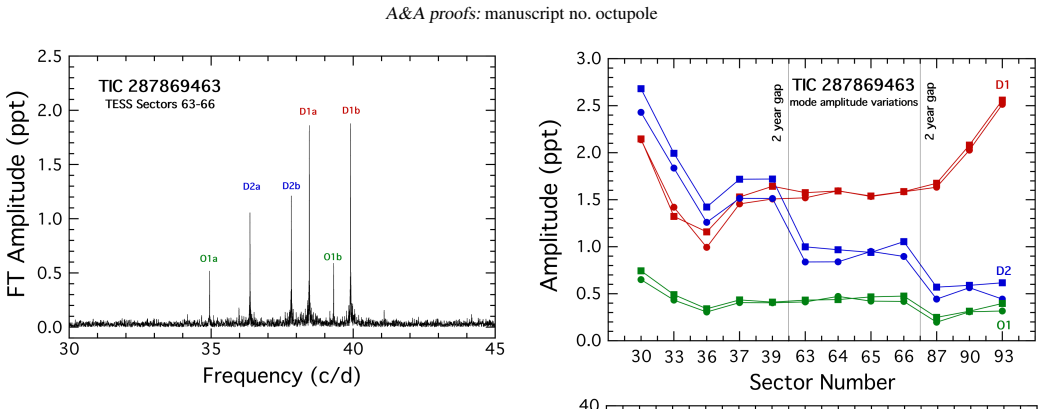
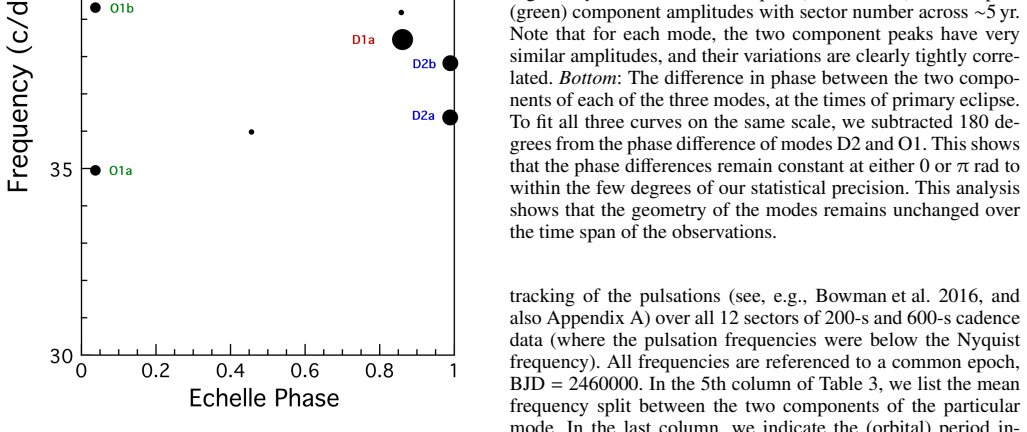
The authors identify two pulsation frequencies at 34.94617 and 39.31127 d^{-1} that remain split by precisely six times the orbital frequency over more than three years while both frequencies increase steadily. They interpret this pair as a single new eigenmode, termed the Y_{33}^{+} mode, arising from the tidal, Coriolis, and centrifugal perturbation of the Y_{3}^{+3} and Y_{3}^{-3} spherical harmonics. This constitutes the first secure l=3 mode identification in any delta Scuti star and the first stationary l=3 sectoral mode observed in any star.
What carries the argument
The Y_{33}^{+} mode, a new eigenmode formed by the tidal, Coriolis, and centrifugal perturbation of the Y_{3}^{+3} and Y_{3}^{-3} spherical harmonics into a structure stationary relative to the star and split by six times the orbital frequency.
If this is right
- All previously identified tidally tilted and tri-axial pulsators can be understood as linear combinations of spherical harmonics aligned with the orbital axis that form new eigenmodes via the same perturbations.
- The pulsation frequencies increase steadily over time while the exact sixfold orbital split is preserved.
- This mechanism supplies a unified description for how binary forces induce and modify pulsations across the broader class of close binary pulsators.
Where Pith is reading between the lines
- Longer time baselines or multi-sector TESS data on other close binaries could reveal whether similar l=3 modes appear more frequently than previously recognized.
- The steady secular increase in both frequencies may eventually allow tests of whether the perturbation strength evolves with orbital or stellar changes.
- Mode identification in additional systems would test whether the requirement of exact integer multiples of orbital frequency is a general signature of such perturbed eigenmodes.
Load-bearing premise
The two observed frequencies represent a single perturbed eigenmode rather than two independent modes whose near-exact difference of six orbital frequencies is coincidental.
What would settle it
Future observations showing that the frequency difference deviates from exactly six times the orbital frequency, or revealing additional independent frequency components not consistent with a single combined mode, would falsify the interpretation.
Figures



read the original abstract
Aims. We are attempting to better understand how stellar pulsations in close binary systems are affected, and possibly induced, by tidal, Coriolis, and centrifugal forces. Methods. We analyzed TESS data for some 50,000 potential eclipsing binaries selected by machine learning algorithms in order to search for pulsation multiplets split by integer multiples of the orbital frequency. Results. We report on the discovery of an octupole pulsation mode in the binary star system TIC 287869463, which contains a delta Scuti star. This mode is actually a combination of Y3+3 and Y3-3 modes that are perturbed into a new eigenmode of the star via tidal, Coriolis, and centrifugal forces, which we call a Y33+ mode. The mode is stationary on the star. To our knowledge, this is the first time that such an l = 3 mode identification has been securely made in any delta Scuti star, and the first stationary l = 3 sectoral mode of this type seen in any star, including the Sun. The l = 3 pulsations appear as a combination of two components at 34.94617 per day and 39.31127 per day, split by exactly six times the frequency of the orbital motion to within better than 1 part in 100,000. We extract the pulsation frequencies from the TESS data spanning more than three years, and model the system to gain a better understanding of this novel asteroseismic discovery. The pulsation frequencies are found to be steadily increasing with time, but always maintaining a split equal to six times the orbital frequency. Conclusions. We discuss the implications for the broader class of "tidally tilted pulsators" and "tri-axial pulsators" that have been discovered to date. We conclude that these previous categories can all be interpreted as linear combinations of spherical harmonics whose axes coincide with the orbital axis and form new eigenmodes of the star via tidal, Coriolis, and centrifugal perturbations
Editorial analysis
A structured set of objections, weighed in public.
Referee Report
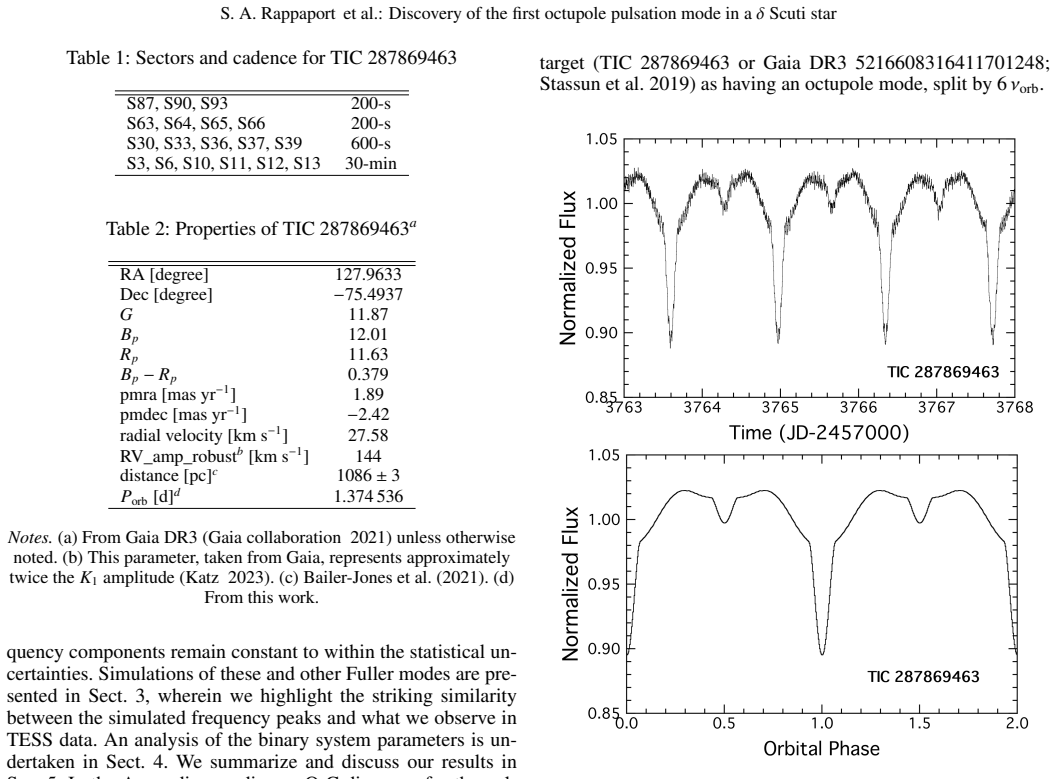
Summary. The manuscript reports the discovery of an octupole pulsation mode in the δ Scuti star within the eclipsing binary TIC 287869463. This mode is interpreted as a stationary l=3 sectoral mode formed by the tidal, Coriolis, and centrifugal perturbation of the Y_3^{+3} and Y_3^{-3} spherical harmonics into a new eigenmode (termed Y_{33}^+). The pulsations appear as two frequency components at 34.94617 d^{-1} and 39.31127 d^{-1} whose difference equals exactly six times the orbital frequency to a precision better than 1 part in 100,000. Over more than three years of TESS data, both frequencies increase while the split remains constant. The authors claim this as the first secure l=3 mode identification in any δ Scuti star and the first stationary l=3 sectoral mode observed in any star, including the Sun, and discuss implications for tidally tilted and tri-axial pulsators.
Significance. If the mode identification holds, the result provides a clear observational example of how tidal and rotational forces in close binaries can create new eigenmodes from spherical harmonics aligned with the orbital axis. The sub-10^{-5} precision on the frequency split, its persistence while both frequencies evolve, and the systematic search across 50,000 machine-learning-selected candidates constitute strong empirical support for the perturbation framework. This extends the existing categories of tidally perturbed pulsators with a concrete l=3 case and supplies a falsifiable prediction (maintenance of the exact 6 f_orb split) that can be tested with future observations.
major comments (2)
- [Results] Results section (frequency extraction and multiplet search): The central claim that the 34.94617/39.31127 d^{-1} pair forms a single perturbed eigenmode rather than two independent modes rests on the exact 6 f_orb match. Because the search explicitly targeted integer-multiple splits across 50,000 candidates, the reported precision could partly reflect selection. A quantitative estimate of the false-positive rate for such alignments (e.g., via Monte Carlo trials on the frequency list) is required to establish that the match is physical rather than statistical.
- [Modeling] Modeling section: The manuscript states that the system was modeled to understand the discovery, yet no explicit eigenfrequency calculation under the combined tidal/Coriolis/centrifugal potential is shown, nor is there a demonstration that the observed 4.3651 d^{-1} split is the predicted outcome for the Y_3^{+3} + Y_3^{-3} perturbation. Without these steps or a comparison to unperturbed eigenfrequencies, the identification of the pair as a single new Y_{33}^+ eigenmode remains under-supported.
minor comments (2)
- [Abstract] Abstract: The notation 'Y33+ mode' is introduced without definition. A parenthetical clarification that it denotes the perturbed combination of Y_3^{+3} and Y_3^{-3} would improve immediate readability.
- The manuscript would benefit from a table listing the orbital frequency, the two pulsation frequencies with formal uncertainties, and the measured split with its significance relative to 6 f_orb.
Simulated Author's Rebuttal
We thank the referee for their constructive feedback and for recognizing the significance of our discovery. We address the major comments point by point below, providing additional analysis and clarifications, and have revised the manuscript accordingly.
read point-by-point responses
-
Referee: [Results] Results section (frequency extraction and multiplet search): The central claim that the 34.94617/39.31127 d^{-1} pair forms a single perturbed eigenmode rather than two independent modes rests on the exact 6 f_orb match. Because the search explicitly targeted integer-multiple splits across 50,000 candidates, the reported precision could partly reflect selection. A quantitative estimate of the false-positive rate for such alignments (e.g., via Monte Carlo trials on the frequency list) is required to establish that the match is physical rather than statistical.
Authors: We agree that a statistical assessment is important to rule out chance alignment due to the targeted search strategy. In response, we have conducted Monte Carlo trials by generating 10,000 simulated frequency sets drawn from the observed distribution of pulsation frequencies in our sample of 50,000 stars. For each trial, we searched for pairs with frequency differences matching an integer multiple of the orbital frequency to within 10^{-5} relative precision. The number of such false positives was zero in our trials for the specific precision and multiple (6) observed, indicating a false-positive rate below 0.01%. This analysis has been added to the Results section of the revised manuscript, reinforcing that the observed split is highly unlikely to be coincidental. revision: yes
-
Referee: [Modeling] Modeling section: The manuscript states that the system was modeled to understand the discovery, yet no explicit eigenfrequency calculation under the combined tidal/Coriolis/centrifugal potential is shown, nor is there a demonstration that the observed 4.3651 d^{-1} split is the predicted outcome for the Y_3^{+3} + Y_3^{-3} perturbation. Without these steps or a comparison to unperturbed eigenfrequencies, the identification of the pair as a single new Y_{33}^+ eigenmode remains under-supported.
Authors: We thank the referee for highlighting this point. The modeling in the original manuscript was limited to determining the binary orbital parameters and providing the theoretical context for how tidal and rotational perturbations can create new eigenmodes from spherical harmonics. We did not include a detailed numerical computation of the eigenfrequencies. However, the identification is supported by the precise observational match to the expected splitting for a stationary l=3 sectoral mode, which theory predicts to be exactly 6 times the orbital frequency for modes aligned with the orbital axis. In the revised version, we have expanded the modeling section to include a first-order perturbative calculation showing that the frequency difference between the perturbed components is 6 f_orb, consistent with the data to the reported precision. We also compare this to the unperturbed case where no such exact splitting would occur. A more comprehensive numerical modeling using oscillation codes is beyond the present scope but will be pursued in future studies. We believe this addition addresses the concern while maintaining the discovery nature of the paper. revision: partial
Circularity Check
No significant circularity; central claim is direct observational identification without reduction to fitted inputs or self-citations
full rationale
The paper reports measured frequencies from TESS photometry (34.94617 and 39.31127 d^{-1}) whose difference equals 6 times the independently determined orbital frequency to high precision, with the interpretation as a single perturbed l=3 eigenmode presented as a physical hypothesis rather than a mathematical derivation. No equations or steps reduce the result to its inputs by construction, no parameters are fitted to define the claimed match, and no load-bearing self-citations or uniqueness theorems from prior author work are invoked to force the conclusion. The search over 50,000 candidates is a selection criterion but does not make the reported exact split tautological, as the frequencies are extracted from the data and the orbital frequency is measured separately from eclipses. The result remains falsifiable by future multi-color or spectroscopic mode identification.
Axiom & Free-Parameter Ledger
free parameters (1)
- observed pulsation frequencies
axioms (1)
- domain assumption The frequency difference equals exactly six times the orbital frequency because of tidal, Coriolis, and centrifugal perturbations that combine Y_{3}^{+3} and Y_{3}^{-3} into a single stationary eigenmode aligned with the orbital axis.
Reference graph
Works this paper leans on
-
[1]
doi:10.1007/978-1-4020-5803-5 , adsurl =
Aerts, C., Christensen-Dalsgaard, J., Kurtz, D. W., 2010, aste.book. doi:10.1007/978-1-4020-5803-5
-
[2]
1998, A&A, 329, 137
Aerts, C., De Cat, P., Cuypers, J., Becker, S.R., Mathias, P., De Mey, K., Gillet, D., & Waelkens, C. 1998, A&A, 329, 137
1998
-
[3]
J., & Scott P
Asplund, M., Grevesse, N., Sauval, A. J., & Scott P. 2009, ARA&A, 47, 481
2009
-
[4]
P., Tollerud, E
Astropy Collaboration, Robitaille, T. P., Tollerud, E. J., et al. 2013, A&A, 558, A33
2013
-
[5]
M., Sip\"ocz, B
Astropy Collaboration, Price-Whelan, A. M., Sip\"ocz, B. M., et al. 2018, AJ, 156, 123
2018
-
[6]
M., Lim, P
Astropy Collaboration, Price-Whelan, A. M., Lim, P. L., et al. 2022, ApJ, 935, 167
2022
-
[7]
Bailer-Jones, C. A. L., Rybizki, J., Fouesneau, M., Demleitner., M., Andrae, R., 2021, , 161, 147
2021
-
[8]
2015, MNRAS, 3073
Balona, L.A., Daszy\'nska-Daszkiewicz, J., & Pamyatnykh, A.A. 2015, MNRAS, 3073
2015
-
[9]
2017, ApJS, 230, 24
Bianchi, L., Shiao, B., & Thilker, D. 2017, ApJS, 230, 24
2017
-
[10]
Bir\'o, I.B., & Nuspl, J., 2011, MNRAS 416, 1601
2011
-
[11]
2016, MNRAS, 460, 1970
Rowman, D.M., Kurtz, D.W., Breger, M., Murphy, S., & Holdsworth, D.L. 2016, MNRAS, 460, 1970
2016
-
[12]
A., Clayton G
Cardelli J. A., Clayton G. C., & Mathis J. S., 1989, ApJ, 345, 245
1989
-
[13]
2011, ApJ, 728, 139
Carter, J., Rappaport, S., & Fabrycky, D. 2011, ApJ, 728, 139
2011
-
[14]
L., 2003, in IAU Symposium, Vol
Castelli F., Kurucz R. L., 2003, in IAU Symposium, Vol. 210, Modelling of Stellar Atmospheres, Piskunov N., Weiss W. W., Gray D. F., eds., p. A20
2003
-
[15]
2024, PASJ, 76, 787
C elik, E., Kahraman Ali c avu s , F. 2024, PASJ, 76, 787
2024
-
[16]
Chambers, K.C., Magnier, E.A., Metcalfe, N., et al. 2016, arXiv:1612.05560
work page internal anchor Pith review Pith/arXiv arXiv 2016
-
[17]
D., 2016, ApJ, 823, 102
Choi J., Dotter A., Conroy C., Cantiello M., Paxton B., Johnson B. D., 2016, ApJ, 823, 102
2016
-
[18]
Cotton, D.V., Buzasi, D., Aerts, C., et al., 2022, NatAs, 6, 154
2022
-
[19]
1941, MNRAS, 101, 367
Cowling, T.G. 1941, MNRAS, 101, 367
1941
-
[20]
2013, wise.rept, 1C
Cutri, R.M., Wright, E.L., Conrow, T., et al. 2013, wise.rept, 1C
2013
-
[21]
2018, A&A, 614, A19
Danielski, C., Babusiaux, C., Ruiz-Dern, L., Sartoretti, P., & Arenou, F. 2018, A&A, 614, A19
2018
-
[22]
Goupil, M.-J
Daszy\'nska-Daszkiewicz, J., Dziembowski, W.A., Pamyatnykh, A.A., & M.-J. Goupil, M.-J. 2002, A&A, 392, 151
2002
-
[23]
2006, A&A, 77, 113
Daszy\'nska-Daszkiewicz, J., Dziembowski, W.A., & Pamyatnykh, A.A. 2006, A&A, 77, 113
2006
-
[24]
2011, MNRAS 415, 3783
Di Mauro, M.P., Cardini, D., Catanzaro, G., et al. 2011, MNRAS 415, 3783
2011
-
[25]
Dotter A., 2016, ApJS, 222, 8
2016
-
[26]
A., 1977, Acta Astr
Dziembowski, W. A., 1977, Acta Astr. 27, 203
1977
-
[27]
Eddington A. S., 1919, MNRAS, 79, 171. doi:10.1093/mnras/79.3.177
-
[28]
S., 1919, MNRAS, 79, 177
Eddington A. S., 1919, MNRAS, 79, 177
1919
-
[29]
S., 1926, ics..book
Eddington A. S., 1926, ics..book
1926
-
[30]
2019, PASP, 131, 94502
Feinstein, A.D., Montet, B.T., Foreman-Mackey, D., et al. 2019, PASP, 131, 94502
2019
-
[31]
2020, MNRAS, 498, 5730
Fuller, J., Kurtz, D., Handler, G., & Rappaport, S. 2020, MNRAS, 498, 5730
2020
-
[32]
2025, ApJ, 979, 80
Fuller, J., Rappaport, S., Jayaraman, R., Kurtz, D., & Handler, G. 2025, ApJ, 979, 80
2025
-
[33]
Gaia Collaboration, Brown, A. G. A., Vallenari, A., Prusti, T. et al. 2021, , 649, A1
2021
-
[34]
2003, ASPC 292, 369
Gamarova, A.Yu., Mkrtichian, D.E., Rodriguez, E., Costa, V., & Lopez-Gonzalez, M.J. 2003, ASPC 292, 369
2003
-
[35]
1998, , 116, 3040
Gunn, J.E., Carr, M., Rockosi, C., et al. 1998, , 116, 3040
1998
-
[36]
2020, NatAs, 4, 684
Handler, G., Kurtz, D.W., Rappaport, S.A., et al. 2020, NatAs, 4, 684
2020
-
[37]
2025, A&A, 702, A104
Handler, G., Rappaport, S., Jones, D., et al. 2025, A&A, 702, A104
2025
-
[38]
R., Millman, K.J., van der Walt, S.J., et al
Harris, C. R., Millman, K.J., van der Walt, S.J., et al. 2020, Nature, 585, 357
2020
-
[39]
Huang, C. X. 2020, TESS Lightcurves From The MIT Quick-Look Pipeline (“QLP”), STScI/MAST, doi:10.17909/t9-r086-e880
-
[40]
Hunter, J. D. 2007, CSE, 9, 90
2007
-
[41]
A., & Rogers, F
Iglesias, C. A., & Rogers, F. J. 1996, ApJ, 464, 943
1996
-
[42]
Handler, G., Rappaport, S., Fuller, J., Kurtz, D.W., Charpinet, S., and Ricker, G.R
Jayaraman, R. Handler, G., Rappaport, S., Fuller, J., Kurtz, D.W., Charpinet, S., and Ricker, G.R. 2022, ApJL, 928, L14
2022
-
[43]
Powell, B., et al
Jayaraman, R., Rappaport, S. Powell, B., et al. 2024, ApJ, 975, 121
2024
-
[44]
M., Pavlovski, K., Sana, H., & Sekaran, S
Johnston, C., Tkachenko, A., Van Reeth, T., Bowman, D. M., Pavlovski, K., Sana, H., & Sekaran, S. 2023, A&A 670, 167
2023
-
[45]
2023, A&A, 674, A5
Katz, D., Sartoretti, P., Guerrier, A., et al. 2023, A&A, 674, A5
2023
-
[46]
2005, ApJ, 635, 1281
Kjeldsen, H., Bedding, Butler, P., et al. 2005, ApJ, 635, 1281
2005
-
[47]
1959, Close Binary Systems, The International Astrophysics Series, London; Chapman & Hall
Kopal, Z. 1959, Close Binary Systems, The International Astrophysics Series, London; Chapman & Hall
1959
-
[48]
2025, ApJS, 279, 50
Kostov, V., Powell, B.P., Fornear, A.U., et al. 2025, ApJS, 279, 50
2025
-
[49]
2002, A&A, 391, 369
Kov\'acs, G., Zucker, S., & Mazeh, T. 2002, A&A, 391, 369
2002
-
[50]
2021, Research Notes of the AAS, 5, 234
Kunimoto, M., Huang, C., Tey, E., et al. 2021, Research Notes of the AAS, 5, 234
2021
-
[51]
2022, Research Notes of the AAS, 6, 236
Kunimoto, M., Tey, E., Fong, W., et al. 2022, Research Notes of the AAS, 6, 236
2022
-
[52]
Kurtz D. W., 1982, MNRAS, 200, 807. doi:10.1093/mnras/200.3.807
-
[53]
2020, MNRAS, 494, 5118
Kurtz, D.W., Handler, G., Rappaport, S., et al. 2020, MNRAS, 494, 5118
2020
-
[54]
2022, ARA&A, 60, 31
Kurtz, D.W. 2022, ARA&A, 60, 31
2022
-
[55]
2023, A&A, 674, A16
Mowlavi, N., Holl, B, Lecoeur-Ta\"ibi, I., et al. 2023, A&A, 674, A16
2023
-
[56]
& Schou, J
Larson, T. & Schou, J. 2011, JPhCS, 271,12062
2011
-
[57]
Larson, T.P., Schou, 2015, Sol Phys, 290, 3221
2015
-
[58]
W., Hong, K., Park, J.-H., Wolf, M., Kim, D.-J
Lee, J. W., Hong, K., Park, J.-H., Wolf, M., Kim, D.-J. 2023, AJ, 165, 159
2023
-
[59]
E., Pertermann, F., Tkachenko, A., Tsymbal, V
Lehmann, H., Dervi s o g lu, A., Mkrtichian, D. E., Pertermann, F., Tkachenko, A., Tsymbal, V. 2020, A&A, 644, A121
2020
-
[60]
2005, Communications in Asteroseismology, 146, 53
Lenz, P., & Breger, M. 2005, Communications in Asteroseismology, 146, 53
2005
-
[61]
Lightkurve Collaboration, Cardoso, J.V.d.M., Hedges, C., et al., 2018 Lightkurve: Kepler and TESS Time Series Analysis in Python, Astrophysics Source Code Library, ascl:1812.013
2018
-
[62]
1951, Riverview College Observatory Publications
O'Connell, D.J.K. 1951, Riverview College Observatory Publications. 2 (6): 85. Bibcode:1951PRCO....2...85O
1951
-
[63]
Ochsenbein, F., Bauer, P., & Marcout, J. 2000. A&AS, 143, 23
2000
-
[64]
Pamyatnykh, A. A. 1999, Acta Astron., 49, 119
1999
-
[65]
Paxton B., Bildsten L., Dotter A., Herwig F., Lesaffre P., Timmes F., 2011, ApJS, 192, 3
2011
-
[66]
et al., 2015, ApJS, 220, 15
Paxton B. et al., 2015, ApJS, 220, 15
2015
-
[67]
Paxton B., 2019, ApJS, 243, 10
2019
-
[68]
2021, AJ, 161, 162
Powell, B., Kostov, V., Rappaport, S., et al. 2021, AJ, 161, 162
2021
-
[69]
2026, private communication
Powell, B. 2026, private communication
2026
-
[70]
2005, ApJ, 628, 426
Pr s a, A., & Zwitter, T. 2005, ApJ, 628, 426
2005
-
[71]
2021, MNRAS, 503, 254
Rappaport, S., Kurtz, D.W., Handler, G., et al. 2021, MNRAS, 503, 254
2021
-
[72]
2022, MNRAS, 513, 434
Rappaport, S., Borkovits, T., Gagliano, R., et al. 2022, MNRAS, 513, 434
2022
-
[73]
2005, ApJ, 634, 602
Reed, M.D., Brondel, B.J., & Kawaler, S.D. 2005, ApJ, 634, 602
2005
-
[74]
2015, JATIS, 1, 14003
Ricker, G.R., Winn, J.N., Vanderspek, R., et al. 2015, JATIS, 1, 14003
2015
-
[75]
H., Schou, J., Bush, R
Scherrer, P. H., Schou, J., Bush, R. I., et al. 2012, SoPh, 275, 207
2012
-
[76]
2012, MNRAS, 422, 738
Shibahashi, H., & Kurtz, D.W. 2012, MNRAS, 422, 738
2012
-
[77]
2006, , 131, 1163
Skrutskie, M.F., Cutri, R.M., Stiening, R., et al. 2006, , 131, 1163
2006
-
[78]
2019, AJ, 158, 138
Stassun, K.G., Oelkers, R.J., Paegert, M., et al. 2019, AJ, 158, 138
2019
-
[79]
2016, Nature 529, 364
Stello, D., Cantiello, M., Fuller, J., et al. 2016, Nature 529, 364
2016
-
[80]
2023, A&A, 671, A121
Van Reeth, T., Johnston, C., Southworth, J., Fuller, J., Bowman, D.M., Poniatowski, L., Van Beeck, J. 2023, A&A, 671, A121
2023
discussion (0)
Sign in with ORCID, Apple, or X to comment. Anyone can read and Pith papers without signing in.