Recognition: unknown
Electrochemical reactions under reverse bias create additional mobile ions that enable hole tunneling in metal halide perovskite diodes
Pith reviewed 2026-05-10 02:42 UTC · model grok-4.3
The pith
Reverse bias in perovskite diodes drives electrochemical reactions that increase mobile ion concentrations over 100-fold, enabling hole tunneling.
A machine-rendered reading of the paper's core claim, the machinery that carries it, and where it could break.
Core claim
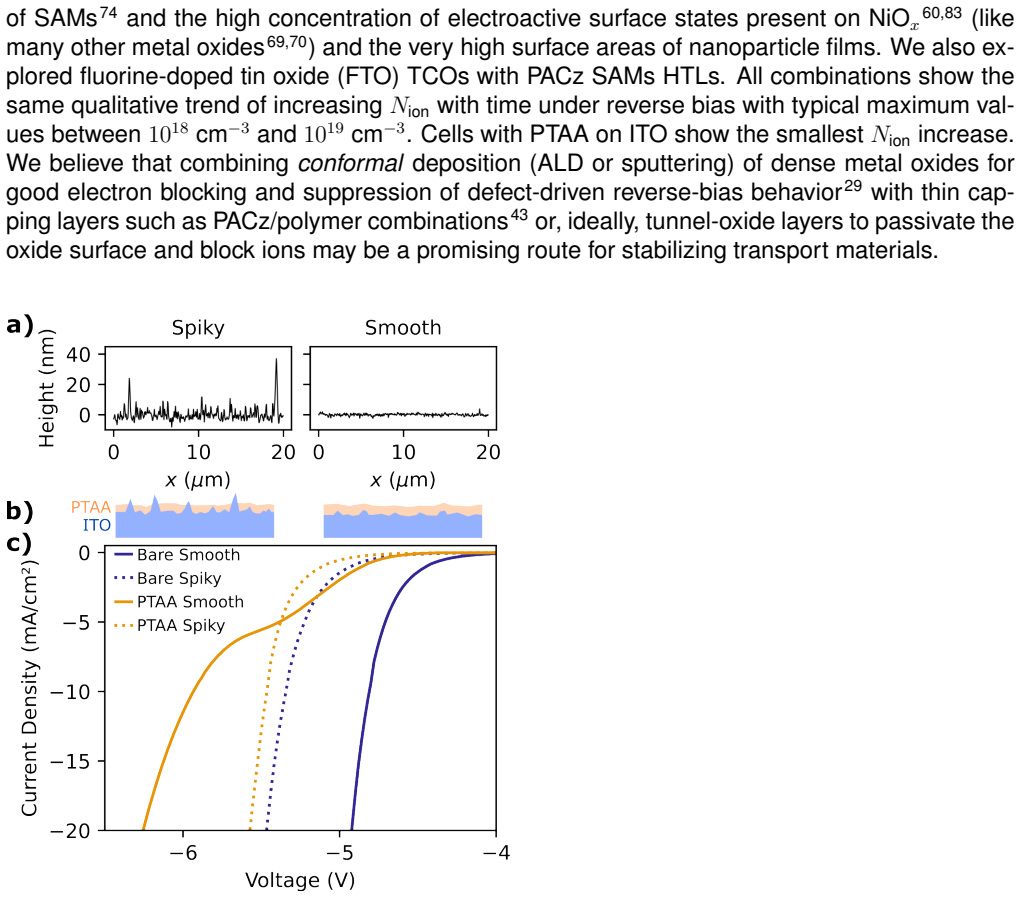
We show that inferred mobile ion concentrations in p-i-n perovskite diodes increase by more than 100 times, reaching over 1×10^{18} cm^{-3}, after only three minutes of reverse bias at -6.0 V. This increase arises from iodide oxidation that creates iodine vacancies, which must be balanced by reduction reactions near the hole transport layer. Thin HTL coverage permits direct contact between the transparent electrode and perovskite, facilitating electron transfer and enabling even larger ion concentrations around 1×10^{19} cm^{-3} along with faster degradation. The resulting elevated ion densities produce the steep depletion region near the electron transport layer that permits substantial and
What carries the argument
Electrochemical iodide oxidation under reverse bias that creates additional iodine vacancies balanced by reduction near the HTL, raising mobile ion density and enabling hole tunneling through the ionic depletion region.
If this is right
- Mobile ion concentrations can exceed 1×10^{18} cm^{-3} after brief reverse bias, sufficient to produce observable tunneling currents.
- Sub-optimal thin HTL layers enable ion densities near 1×10^{19} cm^{-3} and accelerate reverse-bias degradation.
- Thick and uniform HTLs suppress electron transfer, raise breakdown voltages, and improve stability under reverse bias.
- The higher ion densities make hole tunneling through the depletion region near the ETL quantitatively consistent with breakdown near -5 V.
Where Pith is reading between the lines
- Interface engineering focused on preventing direct electrode-perovskite contact could systematically improve reverse-bias tolerance in perovskite devices.
- The same oxidation-reduction cycle may operate in other biased devices that contain mobile halides, suggesting a general stability limit.
- Varying bias magnitude and duration while monitoring ion density would yield kinetic rates usable for lifetime predictions.
Load-bearing premise
The observed changes in device response under reverse bias reflect a genuine increase in mobile ion concentration produced by iodide oxidation that is balanced by reduction reactions near the HTL.
What would settle it
Direct chemical detection of increased iodine or iodide species after reverse bias, or experiments showing that complete HTL coverage that blocks electron transfer prevents the ion concentration rise, would test the proposed electrochemical mechanism.
Figures


read the original abstract
Gradual reverse-bias breakdown in metal-halide perovskite diodes and solar cells is thought to originate from hole tunneling through steep bands in an ionic depletion region near the electron transport layer after positively charged iodine vacancies accumulate near the hole-transport layer (HTL). However, typical reported mobile ion concentrations near $1\times10^{17}$ cm$^{-3}$ are too small to quantitatively explain significant tunneling current densities and (Zener) breakdown observed near $-5$ V. Here, we show that inferred mobile ion concentrations increase by more than 100$\times$, to over $1\times10^{18}$ cm$^{-3}$, within just three minutes of reverse bias at $-6.0$ V in p-i-n perovskite diodes. We attribute the increase in mobile ion concentration to iodide oxidation and the resulting iodine vacancy creation which must be balanced by reduction reactions near the HTL. Thin and sub-optimal HTL coverage leads to direct contact between the transparent conducting electrode and perovskite and facilitates electron transfer and reduction, enabling the creation of even larger inferred mobile ion concentrations ($\sim1\times10^{19}$ cm$^{-3}$) and leading to faster degradation under reverse bias. This explains previous work that showed increased breakdown voltages and improved reverse-bias stability by implementing thick, uniform HTLs.
Editorial analysis
A structured set of objections, weighed in public.
Referee Report
Summary. The manuscript claims that reverse bias in p-i-n metal-halide perovskite diodes triggers electrochemical reactions, specifically iodide oxidation that generates additional mobile iodine vacancies. These vacancies increase the inferred mobile ion concentration by more than 100× (to >1×10^{18} cm^{-3}) within three minutes at −6 V, enabling hole tunneling through a steep depletion region near the ETL and explaining gradual breakdown. Thin or incomplete HTL coverage is said to exacerbate the effect by permitting direct TCO-perovskite contact and facilitating balancing reduction reactions, leading to even higher inferred concentrations (~10^{19} cm^{-3}) and faster degradation; thick, uniform HTLs are proposed to mitigate this.
Significance. If the quantitative inference and redox attribution hold, the work would provide a concrete mechanistic link between applied bias, ion generation, and reverse-bias instability, offering a clear design rule for HTL thickness and coverage to improve device longevity. The emphasis on in-operando ion creation rather than static pre-existing ions is a useful conceptual advance for the field.
major comments (3)
- [Abstract] Abstract: The central claim of a >100× rise in mobile ion concentration (to >1×10^{18} cm^{-3}) is obtained solely by matching observed reverse-bias currents to a depletion-region plus tunneling model. No explicit model equations, fitted parameters, raw I-V traces, error bars, or sensitivity analysis are supplied, and no independent measurement (C-V profiling, impedance spectroscopy, or post-bias chemical analysis) is reported to corroborate the inferred concentrations. This renders the quantitative result model-dependent and potentially circular.
- [Results/Discussion] Results/Discussion: The attribution of the inferred ion increase to iodide oxidation at one interface balanced by reduction near the HTL assumes that (i) the additional current is entirely ionic, (ii) the ions are uniformly distributed vacancies whose density sets the depletion width, and (iii) no concurrent electronic doping or interface-state evolution occurs. The manuscript provides no direct evidence (e.g., XPS, cyclic voltammetry, or control experiments suppressing redox) for these steps or for ruling out alternative electronic mechanisms.
- [Results] Results: The claim that thin HTL coverage directly enables larger ion creation via electron transfer is supported only by comparative device behavior; no spatially resolved or in-situ characterization of the TCO-perovskite interface under bias is shown to confirm the proposed contact and reduction pathway.
minor comments (2)
- [Abstract] Abstract: The phrase 'inferred mobile ion concentrations' should be accompanied by a brief parenthetical reference to the model or method used for inference.
- [Methods/Results] The manuscript should include at least one representative raw I-V curve (with and without prior reverse bias) and the corresponding depletion-width calculation to allow readers to reproduce the concentration estimate.
Simulated Author's Rebuttal
We thank the referee for the constructive report and positive assessment of the work's significance. We address each major comment below, indicating where revisions will be made to improve clarity and transparency while maintaining the core claims supported by the data.
read point-by-point responses
-
Referee: [Abstract] Abstract: The central claim of a >100× rise in mobile ion concentration (to >1×10^{18} cm^{-3}) is obtained solely by matching observed reverse-bias currents to a depletion-region plus tunneling model. No explicit model equations, fitted parameters, raw I-V traces, error bars, or sensitivity analysis are supplied, and no independent measurement (C-V profiling, impedance spectroscopy, or post-bias chemical analysis) is reported to corroborate the inferred concentrations. This renders the quantitative result model-dependent and potentially circular.
Authors: We agree that the reported concentrations are inferred by fitting time-dependent reverse-bias currents to a standard depletion-plus-tunneling model. In the revised manuscript we will add the explicit model equations, the fitting procedure, representative raw I-V traces with error bars, and a sensitivity analysis to the supplementary information. The inference is not circular: the observed gradual current rise under constant bias occurs only when mobile-ion density is permitted to increase with time, and the model parameters remain within physically plausible bounds for depletion width and tunneling probability. While independent corroboration (C-V or post-bias analysis) would be valuable, the in-operando current evolution itself constitutes direct evidence of rising ion density on the experimental timescale. revision: partial
-
Referee: [Results/Discussion] Results/Discussion: The attribution of the inferred ion increase to iodide oxidation at one interface balanced by reduction near the HTL assumes that (i) the additional current is entirely ionic, (ii) the ions are uniformly distributed vacancies whose density sets the depletion width, and (iii) no concurrent electronic doping or interface-state evolution occurs. The manuscript provides no direct evidence (e.g., XPS, cyclic voltammetry, or control experiments suppressing redox) for these steps or for ruling out alternative electronic mechanisms.
Authors: The mechanistic attribution rests on the well-documented electrochemistry of iodide oxidation in metal-halide perovskites under reverse bias. We will expand the discussion to state the assumptions explicitly, justify the predominantly ionic nature of the current from its slow timescale and lack of recovery upon bias removal, and explain why concurrent electronic doping is inconsistent with the irreversible, bias-dependent increase. Additional control data (temperature dependence and bias-recovery cycles) will be included to further discriminate against purely electronic interpretations. Direct in-operando XPS or cyclic voltammetry would strengthen the claim but requires specialized instrumentation beyond the present study; we therefore limit the revision to clearer articulation of the supporting evidence already in hand. revision: partial
-
Referee: [Results] Results: The claim that thin HTL coverage directly enables larger ion creation via electron transfer is supported only by comparative device behavior; no spatially resolved or in-situ characterization of the TCO-perovskite interface under bias is shown to confirm the proposed contact and reduction pathway.
Authors: The link between HTL coverage and enhanced ion generation is drawn from systematic device comparisons in which poorer HTL uniformity correlates reproducibly with faster current rise and higher final inferred ion densities. In the revision we will add quantitative morphology data (AFM/SEM) of the HTL layers and place the proposed electron-transfer pathway in the context of prior literature on TCO-perovskite interfaces. Spatially resolved, in-operando characterization of the buried interface under bias is technically demanding and not available in our current experimental setup; the device-level correlations therefore remain the primary evidence. revision: partial
- Direct in-operando spectroscopic confirmation (XPS, cyclic voltammetry, or spatially resolved imaging) of the redox reactions at the interfaces, which would require new specialized instrumentation and experiments not present in the current work.
Circularity Check
Inference of >100× mobile ion increase is by construction from fitting a depletion+tunneling model to observed reverse-bias currents
specific steps
-
fitted input called prediction
[Abstract (and corresponding results/derivation of ion density)]
"we show that inferred mobile ion concentrations increase by more than 100×, to over 1×10^{18} cm^{-3}, within just three minutes of reverse bias at -6.0 V in p-i-n perovskite diodes. We attribute the increase in mobile ion concentration to iodide oxidation and the resulting iodine vacancy creation which must be balanced by reduction reactions near the HTL."
The ion concentration is not measured directly; it is the free parameter in a tunneling model whose depletion width and tunneling probability are tuned until the calculated current matches the observed reverse-bias current density. The 'increase' is therefore the difference between two successive fits to the same class of data, making the reported 100× jump a statistical consequence of the fitting procedure rather than a prediction or external observation.
full rationale
The paper's strongest quantitative claim (mobile ion density rising from ~10^17 to >10^18 cm^{-3} in 3 min) is obtained by inferring the ion concentration that makes a hole-tunneling-through-ionic-depletion model reproduce the measured current densities at -6 V. Because the model parameters are adjusted to the same I-V data whose magnitude is being explained, the reported increase is a direct output of the fit rather than an independent measurement or first-principles derivation. The redox attribution supplies a separate mechanistic story but does not supply an independent numerical value for the ion density. No direct chemical quantification or external cross-check is cited in the abstract or the load-bearing claim, producing partial circularity confined to the central inference step.
Axiom & Free-Parameter Ledger
free parameters (1)
- inferred mobile ion concentration
axioms (2)
- domain assumption Hole tunneling current is quantitatively described by a standard Zener model once the depletion width and field are set by mobile ion density.
- ad hoc to paper Iodide oxidation at one interface is exactly balanced by reduction at the HTL, producing net mobile vacancies.
Reference graph
Works this paper leans on
-
[1]
Interactive best research-cell efficiency chart — photovoltaic research — nrel.https: //www.nrel.gov/pv/interactive-cell-efficiency
(). Interactive best research-cell efficiency chart — photovoltaic research — nrel.https: //www.nrel.gov/pv/interactive-cell-efficiency. . Accessed: 2025-10-21
2025
-
[2]
Chen, H., Liu, C., Xu, J., Maxwell, A., Zhou, W., Y ang, Y ., Zhou, Q., Bati, A.S.R., Wan, H., Wang, Z., Zeng, L., Wang, J., Serles, P ., Liu, Y ., Teale, S., Liu, Y ., Saidaminov, M.I., Li, M., Rolston, N., Hoogland, S., Filleter, T., Kanatzidis, M.G., Chen, B., Ning, Z., and Sargent, E.H. (). Improved charge extraction in inverted perovskite solar cells...
-
[3]
Jamesh, M.I., Tong, H., Du, M., Niu, W., Jia, G., Cheng, K.C., Hsieh, C.W., Shen, H.H., Xu, B., Tian, Y ., Xu, X., and Hsu, H.Y . (). Advancement of technology towards developing perovskite-based solar cells for renewable energy harvesting and energy transformation applications. npj Materials Sustainability3, 29. URL:https://www.nature.com/articles/ s4429...
-
[4]
Zhao, L., Kerner, R.A., Xiao, Z., Lin, Y .L., Lee, K.M., Schwartz, J., and Rand, B.P . (2016). Redox Chemistry Dominates the Degradation and Decomposition of Metal Halide Per- ovskite Optoelectronic Devices. ACS Energy Lett.1, 595–602. URL:https://doi.org/10. 1021/acsenergylett.6b00320. doi:10.1021/acsenergylett.6b00320. Publisher: Ameri- can Chemical Society
-
[5]
Domanski, K., Correa-Baena, J.P ., Mine, N., Nazeeruddin, M.K., Abate, A., Saliba, M., Tress, W., Hagfeldt, A., and Gr ¨atzel, M. (2016). Not All That Glitters Is Gold: Metal- Migration-Induced Degradation in Perovskite Solar Cells. ACS Nano10, 6306–6314. URL: https://doi.org/10.1021/acsnano.6b02613. doi:10.1021/acsnano.6b02613. Publisher: American Chemic...
-
[6]
Li, J., Dong, Q., Li, N., and Wang, L. (2017). Direct Evidence of Ion Diffu- sion for the Silver-Electrode-Induced Thermal Degradation of Inverted Perovskite So- lar Cells. Advanced Energy Materials7, 1602922. URL:https://onlinelibrary. wiley.com/doi/abs/10.1002/aenm.201602922. doi:10.1002/aenm.201602922. eprint: https://onlinelibrary.wiley.com/doi/pdf/10...
-
[7]
Kim, G.Y ., Senocrate, A., Y ang, T.Y ., Gregori, G., Gr ¨atzel, M., and Maier, J. (2018). Large tunable photoeffect on ion conduction in halide perovskites and implications for pho- todecomposition. Nature Mater17, 445–449. URL:https://www.nature.com/articles/ s41563-018-0038-0. doi:10.1038/s41563-018-0038-0
-
[8]
Kerner, R.A., and Rand, B.P . (2019). Electrochemical and Thermal Etching of Indium Tin Oxide by Solid-State Hybrid Organic–Inorganic Perovskites. ACS Appl. Energy Mater. 2, 6097–6101. URL:https://doi.org/10.1021/acsaem.9b01356. doi:10.1021/acsaem. 9b01356. Publisher: American Chemical Society
-
[10]
Bertoluzzi, L., Patel, J.B., Bush, K.A., Boyd, C.C., Kerner, R.A., O’Regan, B.C., and McGehee, M.D. (2021). Incorporating Electrochemical Halide Oxidation into Drift-Diffusion Models to Explain Performance Losses in Perovskite Solar Cells under Prolonged Re- verse Bias. Advanced Energy Materials11, 2002614. URL:https://onlinelibrary. wiley.com/doi/abs/10....
-
[11]
Ni, Z., Jiao, H., Fei, C., Gu, H., Xu, S., Yu, Z., Y ang, G., Deng, Y ., Jiang, Q., Liu, Y ., Y an, Y ., and Huang, J. (2021). Evolution of defects during the degradation of metal halide perovskite solar cells under reverse bias and illumination. Nat Energy7, 65–73. URL:https://www. nature.com/articles/s41560-021-00949-9. doi:10.1038/s41560-021-00949-9
-
[12]
Xu, Z., Kerner, R.A., Harvey, S.P ., Zhu, K., Berry, J.J., and Rand, B.P . (2023). Halogen Redox Shuttle Explains Voltage-Induced Halide Redistribution in Mixed-Halide Perovskite Devices. ACS Energy Lett.8, 513–520. URL:https://doi.org/10.1021/acsenergylett. 2c02385. doi:10.1021/acsenergylett.2c02385. Publisher: American Chemical Society
-
[13]
Xu, Z., Astridge, D.D., Kerner, R.A., Zhong, X., Hu, J., Hong, J., Wisch, J.A., Zhu, K., Berry, J.J., Kahn, A., Sellinger, A., and Rand, B.P . (2023). Origins of Photoluminescence Instabilities at Halide Perovskite/Organic Hole Transport Layer Interfaces. J. Am. Chem. Soc. pp. jacs.3c03539. URL:https://pubs.acs.org/doi/10.1021/jacs.3c03539. doi:10. 1021/j...
-
[14]
Xu, Z., Kerner, R.A., Kronik, L., and Rand, B.P . (2024). Beyond Ion Migration in Metal Halide Perovskites: Toward a Broader Photoelectrochemistry Perspective. ACS En- ergy Lett.9, 4645–4654. URL:https://doi.org/10.1021/acsenergylett.4c02033. doi: 10.1021/acsenergylett.4c02033. Publisher: American Chemical Society
-
[15]
Zhan, C., Luo, C., Gao, F ., Wang, X., Li, Y ., and Zhao, Q. (2024). Indium Tin Oxide Induced Internal Positive Feedback and Indium Ion Transport in Perovskite Solar Cells. Angewandte Chemie International Edition63, e202403824. URL:https://onlinelibrary. wiley.com/doi/abs/10.1002/anie.202403824. doi:10.1002/anie.202403824. eprint: https://onlinelibrary.wi...
-
[16]
Seyedmahmoudian, M., Rahmani, R., Mekhilef, S., Maung Than Oo, A., Stojcevski, A., Soon, T.K., and Ghandhari, A.S. (). Simulation and hardware implementation of new maximum power point tracking technique for partially shaded PV system using hybrid DEPSO method. IEEE Transactions on Sustainable Energy6, 850–862. URL:https: //ieeexplore.ieee.org/abstract/do...
-
[17]
Qian, J., Ernst, M., Walter, D., Mahmud, M.A., Hacke, P ., Weber, K., Al-Jassim, M., and Blakers, A. (). Destructive reverse bias pinning in perovskite/silicon tandem solar mod- ules caused by perovskite hysteresis under dynamic shading. Sustainable Energy & Fu- els4, 4067–4075. URL:https://pubs.rsc.org/en/content/articlelanding/2020/se/ c9se01246j. doi:1...
-
[18]
Xu, Z., Bristow, H., Babics, M., Vishal, B., Aydin, E., Azmi, R., Ugur, E., Yildirim, B.K., Liu, J., Kerner, R.A., De Wolf, S., and Rand, B.P . (). Reverse-bias resilience of monolithic per- ovskite/silicon tandem solar cells. Joule7, 1992–2002. URL:https://www.sciencedirect. com/science/article/pii/S254243512300315X. doi:10.1016/j.joule.2023.07.017
-
[19]
Islam, S., Dumre, B.B., and Kurtz, S.R. (). Modeling local bias in partially shaded solar modules as a basis for assessing stress on the cells. In 2025 IEEE 53rd Photovoltaic 22 Specialists Conference (PVSC). pp. 0408–0412. URL:https://ieeexplore.ieee.org/ document/11133221. doi:10.1109/PVSC59419.2025.11133221ISSN: 2995-1755
-
[20]
Bowring, A.R., Bertoluzzi, L., O’Regan, B.C., and McGehee, M.D. (2018). Reverse Bias Behavior of Halide Perovskite Solar Cells. Advanced Energy Materials8, 1702365. URL:https://onlinelibrary.wiley.com/doi/10.1002/aenm.201702365. doi:10.1002/ aenm.201702365
-
[21]
Razera, R.A.Z., Jacobs, D.A., Fu, F ., Fiala, P ., Dussouillez, M., Sahli, F ., Y ang, T.C.J., Ding, L., Walter, A., Feil, A.F ., Boudinov, H.I., Nicolay, S., Ballif, C., and Jeangros, Q. (2019). Instability of p–i–n perovskite solar cells under reverse bias. J. Mater. Chem. A8, 242–250. URL:https://pubs.rsc.org/en/content/articlelanding/2020/ta/c9ta12032...
2019
-
[22]
Li, W., Huang, K., Chang, J., Hu, C., Long, C., Zhang, H., Maldague, X., Liu, B., Meng, J., Duan, Y ., and Y ang, J. (2022). Sparkling hot spots in perovskite solar cells under re- verse bias. ChemPhysMater1, 71–76. URL:https://www.sciencedirect.com/science/ article/pii/S2772571521000085. doi:10.1016/j.chphma.2021.10.001
-
[23]
Bogachuk, D., Saddedine, K., Martineau, D., Narbey, S., Verma, A., Gebhardt, P ., Herterich, J.P ., Glissmann, N., Zouhair, S., Markert, J., Gould, I.E., McGehee, M.D., W¨urfel, U., Hinsch, A., and Wagner, L. (2022). Perovskite Photovoltaic Devices with Carbon-Based Electrodes Withstanding Reverse-Bias Voltages up to –9 V and Surpassing IEC 61215:2016 Int...
-
[24]
Jiang, F ., Shi, Y ., Rana, T.R., Morales, D., Gould, I.E., McCarthy, D.P ., Smith, J.A., Christo- foro, M.G., Y aman, M.Y ., Mandani, F ., Terlier, T., Contreras, H., Barlow, S., Mohite, A.D., Snaith, H.J., Marder, S.R., MacKenzie, J.D., McGehee, M.D., and Ginger, D.S. (2024). Im- proved reverse bias stability in p–i–n perovskite solar cells with optimiz...
-
[25]
Lanzetta, L., Huerta Hernandez, L., Vishal, B., Xu, H., Sharma, A., De Wolf, S., and Baran, D. (2025). Tin–lead perovskite solar cells with enhanced reverse bias stability. ACS Energy Letters10, 2093–2095. URL:https://doi.org/10.1021/acsenergylett.5c00727. doi:10. 1021/acsenergylett.5c00727. Publisher: American Chemical Society
-
[26]
Johnson, S., Morales, D., Fremouw, K., Gould, I.E., Borsa, T., Johnston, S., Palmstrom, A., DeCrescent, R.A., and McGehee, M.D. (2025). How non-ohmic contact-layer diodes in perovskite pinholes affect abrupt low-voltage reverse-bias breakdown and destruction of solar cells. Joule pp. 102102. URL:https://www.sciencedirect.com/science/article/ pii/S25424351...
-
[27]
Tan, D., Zhang, X., Liu, X., Zhang, H., and Ma, D. (2020). Stability enhancement of inverted perovskite solar cells using LiF in electron transport layer. Organic Electronics80, 105613. URL:https://www.sciencedirect.com/science/article/pii/S1566119919306408. doi: 10.1016/j.orgel.2019.105613
-
[28]
Li, N., Shi, Z., Fei, C., Jiao, H., Li, M., Gu, H., Harvey, S.P ., Dong, Y ., Beard, M.C., and Huang, J. (2024). Barrier reinforcement for enhanced perovskite solar cell stabil- ity under reverse bias. Nat Energy pp. 1–11. URL:https://www.nature.com/articles/ 23 s41560-024-01579-7. doi:10.1038/s41560-024-01579-7. Publisher: Nature Publishing Group
-
[29]
Morales, D., Sindt, C., Fremouw, K., Mao, K., Poma, M., Stewart, T., A
A. Morales, D., Sindt, C., Fremouw, K., Mao, K., Poma, M., Stewart, T., A. DeCrescent, R., and D. McGehee, M. (2026). Nickel-oxide hole-transport layers prevent abrupt reverse- bias breakdown and permanent shorting of perovskite solar cells caused by pinhole de- fects. EES Solar. URL:https://pubs.rsc.org/en/content/articlelanding/2026/el/ d5el00206k. doi:...
-
[30]
Henzel, J., Bakker, K., Najafi, M., Zardetto, V., Veenstra, S., Isabella, O., Mazzarella, L., Weeber, A., and Theelen, M. (2023). Impact of the Current on Reverse Bias Degradation of Perovskite Solar Cells. ACS Appl. Energy Mater.6, 11429–11432. URL:https://doi.org/ 10.1021/acsaem.3c02273. doi:10.1021/acsaem.3c02273. Publisher: American Chemical Society
-
[31]
Ren, X., Wang, J., Lin, Y ., Wang, Y ., Xie, H., Huang, H., Y ang, B., Y an, Y ., Gao, Y ., He, J., Huang, J., and Yuan, Y . (2024). Mobile iodides capture for highly photolysis- and reverse- bias-stable perovskite solar cells. Nature Materials23, 810–817. URL:https://www. nature.com/articles/s41563-024-01876-2. doi:10.1038/s41563-024-01876-2. Pub- lisher...
-
[32]
Bertoluzzi, L., Boyd, C.C., Rolston, N., Xu, J., Prasanna, R., O’Regan, B.C., and McGe- hee, M.D. (2020). Mobile Ion Concentration Measurement and Open-Access Band Di- agram Simulation Platform for Halide Perovskite Solar Cells. Joule4, 109–127. URL: https://linkinghub.elsevier.com/retrieve/pii/S2542435119304854. doi:10.1016/j. joule.2019.10.003
work page doi:10.1016/j 2020
-
[33]
Schmidt, M.C. (). Characterization of mobile ions in perovskite solar cells with capacitance and current measurements by approximating drift-diffusion simulations. PRX Energy4. doi: 10.1103/mr3l-jg9h
-
[34]
Bao, Y ., Ma, T., Zhang, Y ., Shi, L., Qin, L., Cao, G., Wang, C., Li, X., and Y ang, Z. (2025). Reverse-Bias Breakdown Mechanisms and Mitigation Strategies in Perovskite Cells and Tandems. Advanced Functional Materials pp. e24250. URL:https://advanced. onlinelibrary.wiley.com/doi/10.1002/adfm.202524250. doi:10.1002/adfm.202524250
-
[35]
Eames, C., Frost, J.M., Barnes, P .R.F ., O’Regan, B.C., Walsh, A., and Islam, M.S. (2015). Ionic transport in hybrid lead iodide perovskite solar cells. Nat Commun6, 7497. URL: https://www.nature.com/articles/ncomms8497. doi:10.1038/ncomms8497
-
[36]
Senocrate, A., Moudrakovski, I., Kim, G.Y ., Y ang, T.Y ., Gregori, G., Gr ¨atzel, M., and Maier, J. (2017). The Nature of Ion Conduction in Methylammonium Lead Iodide: A Multimethod Approach. Angewandte Chemie International Edition56, 7755–7759. URL: https://onlinelibrary.wiley.com/doi/abs/10.1002/anie.201701724. doi:10.1002/ anie.201701724. eprint: http...
-
[37]
Weber, S.A.L., Hermes, I.M., Turren-Cruz, S.H., Gort, C., Bergmann, V.W., Gilson, L., Hagfeldt, A., Graetzel, M., Tress, W., and Berger, R. (2018). How the formation of interfacial charge causes hysteresis in perovskite solar cells. Energy Environ. Sci.11, 2404–2413. URL:https://xlink.rsc.org/?DOI=C8EE01447G. doi:10.1039/C8EE01447G. 24
-
[38]
Birkhold, S.T., Precht, J.T., Giridharagopal, R., Eperon, G.E., Schmidt-Mende, L., and Ginger, D.S. (2018). Direct Observation and Quantitative Analysis of Mobile Frenkel De- fects in Metal Halide Perovskites Using Scanning Kelvin Probe Microscopy. J. Phys. Chem. C122, 12633–12639. URL:https://doi.org/10.1021/acs.jpcc.8b03255. doi: 10.1021/acs.jpcc.8b0325...
-
[39]
De Keersmaecker, M., Tirado, J., Armstrong, N.R., and Ratcliff, E.L. (2024). Defect Quan- tification in Metal Halide Perovskites Anticipates Photoluminescence and Photovoltaic Per- formance. ACS Energy Letters9, 243–252. URL:https://pubs.acs.org/doi/10.1021/ acsenergylett.3c02157. doi:10.1021/acsenergylett.3c02157
-
[40]
Almora, O., Zarazua, I., Mas-Marza, E., Mora-Sero, I., Bisquert, J., and Garcia-Belmonte, G. (2015). Capacitive Dark Currents, Hysteresis, and Electrode Polarization in Lead Halide Perovskite Solar Cells. J. Phys. Chem. Lett.6, 1645–1652. URL:https://doi.org/10. 1021/acs.jpclett.5b00480. doi:10.1021/acs.jpclett.5b00480. Publisher: American Chemical Society
-
[41]
Bertoluzzi, L., Belisle, R.A., Bush, K.A., Cheacharoen, R., McGehee, M.D., and O’Regan, B.C. (2018). In situ measurement of electric-field screening in hysteresis-free PTAA/FA0.83Cs0.17Pb(I0.83Br0.17)3/C60 perovskite solar cells gives an ion mobility of∼3 × 10⁻⁷ cm2/(v s), 2 orders of magnitude faster than reported for metal-oxide-contacted perovskite cel...
-
[42]
Penukula, S., Estrada Torrejon, R., and Rolston, N. (2023). Quantifying and Reducing Ion Migration in Metal Halide Perovskites through Control of Mobile Ions. Molecules28, 5026. URL:https://www.mdpi.com/1420-3049/28/13/5026. doi:10.3390/molecules28135026. Number: 13 Publisher: Multidisciplinary Digital Publishing Institute
-
[43]
Zhao, C., Wang, F ., Hu, X., Zhang, Y ., Liu, T., Liu, Y ., Wang, L., Luo, S., Shi, X., Tang, X., Y an, H., Wang, W., and Chen, S. (2025). Ambient blade-coated perovskite solar cells with high reverse bias stability enabled by polymeric hole transporter design. Nature Commu- nications16, 10355. URL:https://www.nature.com/articles/s41467-025-65341-7. doi: ...
-
[44]
Motti, S.G., Meggiolaro, D., Barker, A.J., Mosconi, E., Perini, C.A.R., Ball, J.M., Gandini, M., Kim, M., De Angelis, F ., and Petrozza, A. (2019). Controlling competing photochemical re- actions stabilizes perovskite solar cells. Nature Photonics13, 532–539. URL:https://www. nature.com/articles/s41566-019-0435-1. doi:10.1038/s41566-019-0435-1. Publisher:...
-
[45]
Diekmann, J., Pe ˜na-Camargo, F ., Tokmoldin, N., Thiesbrummel, J., Warby, J., Gutierrez- Partida, E., Shah, S., Neher, D., and Stolterfoht, M. (). Determination of mobile ion densities in halide perovskites via low-frequency capacitance and charge extraction techniques. The Journal of Physical Chemistry Letters14, 4200–4210. URL:https://doi.org/10.1021/ ...
-
[46]
Thiesbrummel, J., Shah, S., Gutierrez-Partida, E., Zu, F ., Pe ˜na-Camargo, F ., Zeiske, S., Diekmann, J., Y e, F ., Peters, K.P ., Brinkmann, K.O., Caprioglio, P ., Dasgupta, A., Seo, S., Adeleye, F .A., Warby, J., Jeangros, Q., Lang, F ., Zhang, S., Albrecht, S., Riedl, T., Armin, 25 A., Neher, D., Koch, N., Wu, Y ., Le Corre, V.M., Snaith, H., and Stol...
-
[47]
Seid, B.A., Ozen, S., Castro-M ´endez, A.F ., Neher, D., Stolterfoht, M., and Lang, F . (). Mitigating mobile-ion-induced instabilities and performance losses in 2d passivated per- ovskite solar cells. Advanced Materials37, 2501588. URL:https://onlinelibrary. wiley.com/doi/abs/10.1002/adma.202501588. doi:10.1002/adma.202501588. eprint: https://advanced.on...
-
[48]
Calado, P ., Gelmetti, I., Hilton, B., Azzouzi, M., Nelson, J., and Barnes, P .R.F . (2022). Drift- fusion: an open source code for simulating ordered semiconductor devices with mixed ionic-electronic conducting materials in one dimension. Journal of Computational Elec- tronics21, 960–991. URL:https://doi.org/10.1007/s10825-021-01827-z. doi:10.1007/ s1082...
-
[49]
Chang, C.Y ., and Sze, S.M. (1970). Carrier transport across metal-semiconductor barriers. Solid-State Electronics13, 727–740. URL:https://www.sciencedirect.com/science/ article/pii/0038110170900602. doi:10.1016/0038-1101(70)90060-2
-
[50]
Schmidt, M.C. (). Impact of mobile ions on transient capacitance measurements of per- ovskite solar cells. PRX Energy2. doi:10.1103/PRXEnergy.2.043011
-
[51]
Aeberhard, U., Natsch, N., Schneider, A., Zeder, S.J., Carrillo-Nu ˜nez, H., Bl¨ulle, B., and Ruhstaller, B. (2024). Multi-Scale Simulation of Reverse-Bias Breakdown in All-Perovskite Tandem Photovoltaic Modules under Partial Shad- ing Conditions. Solar RRL8, 2400492. URL:https://onlinelibrary.wiley. com/doi/abs/10.1002/solr.202400492. doi:10.1002/solr.20...
-
[52]
Schmidt, M.C., and Ehrler, B. (2025). How Many Mobile Ions Can Electrical Measurements Detect in Perovskite Solar Cells? ACS Energy Letters10, 2457–2460. URL:https://doi. org/10.1021/acsenergylett.5c00887. doi:10.1021/acsenergylett.5c00887. Publisher: American Chemical Society
-
[53]
De Keersmaecker, M., Dietrich, P ., Bahri, M., Browning, N.D., Armstrong, N.R., and Rat- cliff, E.L. (2025). Activated Corrosion and Recovery in Lead Mixed-Halide Perovskites Re- vealed by Dynamic Near-Ambient Pressure X-ray Photoelectron Spectroscopy. Journal of the American Chemical Society147, 8881–8892. URL:https://pubs.acs.org/doi/10. 1021/jacs.5c006...
-
[54]
De Keersmaecker, M., Armstrong, N.R., and Ratcliff, E.L. (). How low can you go? de- fect quantification at the 1015 cm–3 level in mixed-cation perovskites using differential pulse voltammetry. ACS Energy Letters7, 4017–4027. URL:https://doi.org/10.1021/ acsenergylett.2c02033. doi:10.1021/acsenergylett.2c02033. Publisher: American Chemical Society
-
[55]
Kerner, R.A., Xu, Z., Larson, B.W., and Rand, B.P . (2021). The role of halide oxidation in per- ovskite halide phase separation. Joule5, 2273–2295. URL:https://www.sciencedirect. com/science/article/pii/S2542435121003494. doi:10.1016/j.joule.2021.07.011. 26
-
[56]
Xu, Z., Zhong, X., Hu, T., Hu, J., Kahn, A., and Rand, B.P . (2024). Correlating halide seg- regation with photolysis in mixed-halide perovskites via in situ opto-gravimetric analysis. Journal of the American Chemical Society146, 33368–33377. URL:https://doi.org/10. 1021/jacs.4c08939. doi:10.1021/jacs.4c08939. Publisher: American Chemical Society
-
[57]
Kerner, R.A., Heo, S., Roh, K., MacMillan, K., Larson, B.W., and Rand, B.P . (2021). Organic Hole Transport Material Ionization Potential Dictates Diffusion Kinetics of Iodine Species in Halide Perovskite Devices. ACS Energy Letters6, 501–508. URL:https://doi.org/10. 1021/acsenergylett.0c02495. doi:10.1021/acsenergylett.0c02495. Publisher: Ameri- can Chem...
-
[58]
Y amilova, O.R., Danilov, A.V., Mangrulkar, M., Fedotov, Y .S., Luchkin, S.Y ., Babenko, S.D., Bredikhin, S.I., Aldoshin, S.M., Stevenson, K.J., and Troshin, P .A. (2020). Reduction of Methylammonium Cations as a Major Electrochemical Degradation Pathway in MAPbI3 Per- ovskite Solar Cells. The Journal of Physical Chemistry Letters11, 221–228. URL:https://...
-
[59]
Tormena, N., Caria, A., Buffolo, M., De Santi, C., Cester, A., Meneghesso, G., Zanoni, E., Matteocci, F ., Di Carlo, A., Trivellin, N., and Meneghini, M. (). Recoverable degradation of FAPbBr3 perovskite solar cells under reverse-bias: A combined electro-optical investigation. Solar Energy Materials and Solar Cells285, 113547. URL:https://www.sciencedirec...
-
[60]
Boyd, C.C., Shallcross, R.C., Moot, T., Kerner, R., Bertoluzzi, L., Onno, A., Kavadiya, S., Chosy, C., Wolf, E.J., Werner, J., Raiford, J.A., De Paula, C., Palmstrom, A.F ., Yu, Z.J., Berry, J.J., Bent, S.F ., Holman, Z.C., Luther, J.M., Ratcliff, E.L., Armstrong, N.R., and McGe- hee, M.D. (2020). Overcoming Redox Reactions at Perovskite-Nickel Oxide Inte...
-
[61]
Shallcross, R.C., Zheng, Y ., Saavedra, S.S., and Armstrong, N.R. (2017). Determining Band-Edge Energies and Morphology-Dependent Stability of Formamidinium Lead Per- ovskite Films Using Spectroelectrochemistry and Photoelectron Spectroscopy. Journal of the American Chemical Society139, 4866–4878. URL:https://doi.org/10.1021/jacs. 7b00516. doi:10.1021/jac...
-
[62]
Birkhold, S.T., Precht, J.T., Liu, H., Giridharagopal, R., Eperon, G.E., Schmidt-Mende, L., Li, X., and Ginger, D.S. (). Interplay of mobile ions and injected carriers creates recombi- nation centers in metal halide perovskites under bias. ACS Energy Letters3, 1279–1286. URL:https://doi.org/10.1021/acsenergylett.8b00505. doi:10.1021/acsenergylett. 8b00505...
-
[63]
Azpiroz, J.M., Mosconi, E., Bisquert, J., and Angelis, F .D. (2015). Defect migration in methy- lammonium lead iodide and its role in perovskite solar cell operation. Energy & Environmen- tal Science8, 2118–2127. URL:https://pubs.rsc.org/en/content/articlelanding/ 2015/ee/c5ee01265a. doi:10.1039/C5EE01265A. Publisher: The Royal Society of Chem- istry
-
[64]
Shao, Y ., Fang, Y ., Li, T., Wang, Q., Dong, Q., Deng, Y ., Yuan, Y ., Wei, H., Wang, M., Gruverman, A., Shield, J., and Huang, J. (2016). Grain boundary dominated ion migration 27 in polycrystalline organic–inorganic halide perovskite films. Energy & Environmental Sci- ence9, 1752–1759. URL:https://pubs.rsc.org/en/content/articlelanding/2016/ee/ c6ee004...
-
[65]
McGovern, L., Koschany, I., Grimaldi, G., Muscarella, L.A., and Ehrler, B. (). Grain size influences activation energy and migration pathways in MAPbBr3 perovskite solar cells. The Journal of Physical Chemistry Letters12, 2423–2428. URL:https://doi.org/10.1021/ acs.jpclett.1c00205. doi:10.1021/acs.jpclett.1c00205. Publisher: American Chemical Society
-
[66]
Pering, S.R., and Cameron, P .J. (). The effect of multiple ion substitutions on halide ion mi- gration in perovskite solar cells. Materials Advances3, 7918–7924. URL:https://pubs. rsc.org/en/content/articlelanding/2022/ma/d2ma00619g. doi:10.1039/D2MA00619G. Publisher: RSC
-
[67]
Tyagi, V., Pols, M., Brocks, G., and Tao, S. (). Tracing ion migration in halide per- ovskites with machine learned force fields. The Journal of Physical Chemistry Letters16, 5153–5159. URL:https://doi.org/10.1021/acs.jpclett.5c01139. doi:10.1021/acs. jpclett.5c01139. Publisher: American Chemical Society
-
[68]
Schmidt, M.C., Alvarez, A.O., Pallotta, R., Seid, B.A., de Boer, J.J., Thiesbrummel, J., Lang, F ., Grancini, G., and Ehrler, B. (2026). Quantification of Mobile Ions in Perovskite Solar Cells with Thermally Activated Ion Current Measurements. ACS Energy Letters11, 409–418. URL:https://doi.org/10.1021/acsenergylett.5c02224. doi:10.1021/acsenergylett. 5c02...
-
[69]
Y ang, J., Siempelkamp, B.D., Mosconi, E., De Angelis, F ., and Kelly, T.L. (2015). Origin of the thermal instability in CH3nh3pbi3 thin films deposited on ZnO. Chemistry of Materials 27, 4229–4236. URL:https://doi.org/10.1021/acs.chemmater.5b01598. doi:10.1021/ acs.chemmater.5b01598. Publisher: American Chemical Society
-
[70]
Thampy, S., Zhang, B., Hong, K.H., Cho, K., and Hsu, J.W.P . (2020). Altered Stabil- ity and Degradation Pathway of CH3NH3PbI3 in Contact with Metal Oxide. ACS En- ergy Lett.5, 1147–1152. URL:https://doi.org/10.1021/acsenergylett.0c00041. doi: 10.1021/acsenergylett.0c00041. Publisher: American Chemical Society
-
[71]
Matveeva, E. (2005). Electrochemistry of the indium-tin oxide electrode in 1 m NaOH elec- trolyte. Journal of The Electrochemical Society152, H138. URL:https://iopscience.iop. org/article/10.1149/1.1984348/meta. doi:10.1149/1.1984348. Publisher: IOP Publish- ing
-
[72]
Minenkov, A., Hollweger, S., Duchoslav, J., Erdene-Ochir, O., Weise, M., Ermilova, E., Her- twig, A., and Schiek, M. (2024). Monitoring the electrochemical failure of indium tin ox- ide electrodes via operando ellipsometry complemented by electron microscopy and spec- troscopy. ACS Applied Materials & Interfaces16, 9517–9531. URL:https://doi.org/10. 1021/...
-
[73]
Sun, J., Shou, C., Sun, J., Wang, X., Y ang, Z., Chen, Y ., Wu, J., Y ang, W., Long, H., Ying, Z., Y ang, X., Sheng, J., Y an, B., and Y e, J. (2021). NiOx-Seeded Self- Assembled Monolayers as Highly Hole-Selective Passivating Contacts for Efficient In- verted Perovskite Solar Cells. Solar RRL5, 2100663. URL:https://onlinelibrary. 28 wiley.com/doi/abs/10....
-
[74]
Phung, N., Verheijen, M., Todinova, A., Datta, K., Verhage, M., Al-Ashouri, A., K¨obler, H., Li, X., Abate, A., Albrecht, S., and Creatore, M. (2022). Enhanced Self-Assembled Monolayer Surface Coverage by ALD NiO in p-i-n Perovskite Solar Cells. ACS Appl. Mater. Interfaces 14, 2166–2176. URL:https://doi.org/10.1021/acsami.1c15860. doi:10.1021/acsami. 1c15...
-
[75]
Jiang, Q., Tirawat, R., Kerner, R.A., Gaulding, E.A., Xian, Y ., Wang, X., Newkirk, J.M., Y an, Y ., Berry, J.J., and Zhu, K. (2023). Towards linking lab and field lifetimes of per- ovskite solar cells. Nature623, 313–318. URL:https://www.nature.com/articles/ s41586-023-06610-7. doi:10.1038/s41586-023-06610-7
-
[76]
Fei, C., Kuvayskaya, A., Shi, X., Wang, M., Shi, Z., Jiao, H., Silverman, T.J., Owen-Bellini, M., Dong, Y ., Xian, Y ., Scheidt, R., Wang, X., Y ang, G., Gu, H., Li, N., Dolan, C.J., Deng, Z.J.D., Cakan, D.N., Fenning, D.P ., Y an, Y ., Beard, M.C., Schelhas, L.T., Sellinger, A., and Huang, J. (2024). Strong-bonding hole-transport layers reduce ultraviole...
-
[77]
Contreras, H., O’Brien, A., Taddei, M., Shi, Y ., Jiang, F ., Westbrook, R.J.E., Zhang, Y ., Juarez, J., Giridharagopal, R., Lee, P .A., Barlow, S., Marder, S.R., Armstrong, N.R., and Ginger, D.S. (2025). Deposition-dependent coverage and performance of phospho- nic acid interface modifiers in halide perovskite optoelectronics. ACS Applied Materi- als & I...
-
[78]
Qi, X., Wang, J., Y eddu, V., Trefz, T., Ahmed, Y ., Delmage, J., Cheong, I.T., San- dor, N., Zhang, D., Qiu, S., Amaro, A., Dayneko, S., Granot, O., Wang, W., Zhang, W., Chen, H., Paci, I., De Wolf, S., and Saidaminov, M.I. (2026). Disaggregation of self-assembling molecules for efficient inverted perovskite solar cells. ACS Nano. URL: https://doi.org/10...
-
[79]
Jonda, C., Mayer, A.B.R., Stolz, U., Elschner, A., and Karbach, A. (2000). Surface rough- ness effects and their influence on the degradation of organic light emitting devices. Journal of Materials Science35, 5645–5651. URL:https://doi.org/10.1023/A:1004842004640. doi:10.1023/A:1004842004640
-
[80]
Tak, Y .H., Kim, K.B., Park, H.G., Lee, K.H., and Lee, J.R. (2002). Criteria for ITO (indium–tin-oxide) thin film as the bottom electrode of an organic light emitting diode. Thin Solid Films411, 12–16. URL:https://www.sciencedirect.com/science/article/pii/ S0040609002001657. doi:10.1016/S0040-6090(02)00165-7
-
[81]
Betz, U., Olsson, M.K., Marthy, J., and Escol ´a, M.F . (2008). On the synthesis of ul- tra smooth ITO thin films by conventional direct current magnetron sputtering. Thin Solid Films516, 1334–1340. URL:https://www.sciencedirect.com/science/article/ pii/S0040609007004178. doi:10.1016/j.tsf.2007.03.094
discussion (0)
Sign in with ORCID, Apple, or X to comment. Anyone can read and Pith papers without signing in.