Recognition: unknown
Chiral solitary waves in a nonlinear topological insulator model
Pith reviewed 2026-05-10 02:22 UTC · model grok-4.3
The pith
A nonlinear tight-binding model for topological insulators supports robust chiral solitary waves that propagate along the edges.
A machine-rendered reading of the paper's core claim, the machinery that carries it, and where it could break.
Core claim
The paper establishes that its nonlinear tight-binding model possesses a nontrivial local Chern topology and supports soliton-like states capable of traveling along the edges without significant radiation. These chiral solitary waves interact inelastically upon collision with stationary modes. The results indicate that such a system can maintain coherent traveling edge states despite nonlinear effects.
What carries the argument
The nonlinear tight-binding model incorporating local Chern topology, which stabilizes chiral solitary waves as traveling edge states.
If this is right
- Nonlinear Chern insulators can support coherent traveling waves.
- Inelastic interactions between solitary waves and stationary modes provide a mechanism for wave control.
- The model suggests directions for physical realization in lattices like photonic or mechanical systems.
- Applications may include robust signal transmission in nonlinear environments.
Where Pith is reading between the lines
- This approach might be extended to other topological classes beyond Chern insulators to stabilize traveling states.
- Experimental verification could involve fabricating the tight-binding lattice in optical or acoustic media to observe the inelastic collisions.
- The inelastic nature of collisions could lead to energy transfer mechanisms useful in nonlinear optics.
Load-bearing premise
The assumption that the nonlinear tight-binding model approximates real physical systems without incurring significant radiation losses or instabilities that would eliminate the traveling edge states.
What would settle it
A long-distance propagation simulation of the solitary wave that reveals substantial energy radiation or decay of the wave amplitude.
Figures





read the original abstract
An outstanding challenge in the field of topological insulators is the realization of nonlinear systems that support coherent traveling waves. Highly nonlinear lattices can suffer from significant radiation losses due to Peierls-Nabarro effects. In this work a nonlinear tight-binding model that supports robust traveling edge states is proposed and examined. This system possess a nontrivial local Chern topology and soliton-like states. When a traveling solitary wave collides with a stationary mode, the two are observed to interact inelastically. These results suggest future directions for the modeling, realization, and application of nonlinear Chern insulators.
Editorial analysis
A structured set of objections, weighed in public.
Referee Report
Summary. The paper proposes a nonlinear tight-binding model supporting chiral solitary waves in a topological insulator setting. It claims the system has nontrivial local Chern topology, hosts soliton-like traveling edge states that avoid significant radiation losses, and exhibits inelastic collisions between a traveling solitary wave and a stationary mode. These observations are presented as model-internal results verified through the equations and numerics, with suggestions for future physical realization.
Significance. If the central claims hold, the work addresses an outstanding challenge in nonlinear topological insulators by providing a concrete model for robust traveling edge states. The direct verification of topology and soliton dynamics within the tight-binding equations, together with the inelastic collision result, constitutes a useful contribution. The absence of free parameters in the core model and the explicit framing of physical realization as a future direction are strengths.
minor comments (3)
- [Abstract] The abstract states that the system 'possess a nontrivial local Chern topology' but does not indicate the precise definition or computational method used for the local Chern number; add a short clarifying sentence or pointer to the relevant methods section.
- [Introduction] The discussion of Peierls-Nabarro effects and radiation losses would benefit from one or two additional citations to prior literature on nonlinear lattice instabilities to better situate the proposed model.
- [Numerical results] Figure captions for any collision simulations should explicitly state the initial conditions, integration method, and boundary conditions used, to allow reproducibility of the inelastic interaction result.
Simulated Author's Rebuttal
We thank the referee for their positive summary, recognition of the significance of our results on chiral solitary waves in a nonlinear topological insulator model, and recommendation for minor revision. No specific major comments were listed in the report.
Circularity Check
No significant circularity detected
full rationale
The paper introduces a nonlinear tight-binding model and reports its topological and dynamical properties as direct numerical observations from the model's equations. Claims of nontrivial local Chern topology and soliton-like traveling edge states are verified internally via the proposed lattice dynamics without any fitted parameters renamed as predictions, self-definitional loops, or load-bearing self-citations that reduce the central results to prior inputs by construction. The inelastic collision behavior is likewise a model-specific simulation outcome. No derivation chain collapses to tautology or ansatz smuggling; the work is self-contained against external benchmarks.
Axiom & Free-Parameter Ledger
Reference graph
Works this paper leans on
-
[1]
The lattice vectors relative to the honeycomb lattice are shown in Fig
Thea-sites are located atmv 1 +nv 2 andb-sites atmv 1 +nv 2 +dfor m, n∈Zandd=(1,0)so that the nearest neighbor distance is scaled to unity. The lattice vectors relative to the honeycomb lattice are shown in Fig. 1. Define the linear Haldane operators [8], for thea-site andb-site equations, respectively, as Ha[amn, bmn]≡M amn +t 1(bmn +b m−1,n+b m,n−1) +t2...
-
[2]
A spatial scan of the local topology is shown in Fig
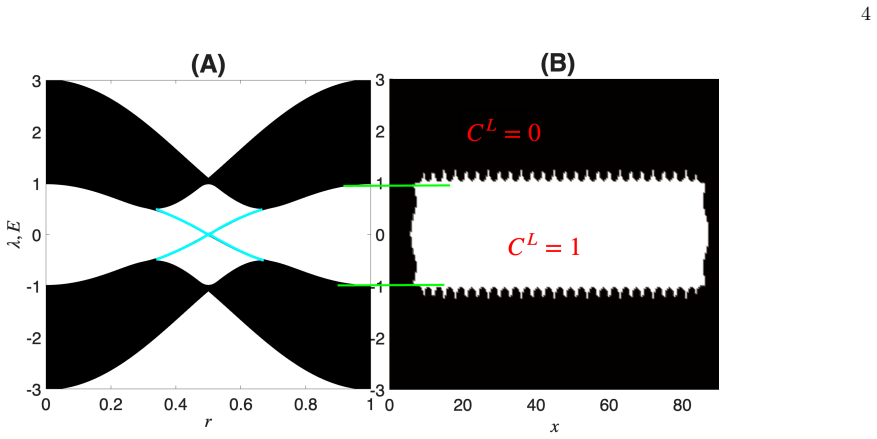
White (black) corresponds to a local Chern number of 1(0). A spatial scan of the local topology is shown in Fig. 3. FIG. 3. Calculation of the local Chern number in the (linear) Haldane model atE=0. The white (black) region corre- sponds to a local Chern number (10) of 1(0). The parameters used areN=30,κ y =0.1 andκ x =κ y/ √ 3 withM=0,t 1 =1, t2 =0.1 and...
-
[3]
This slight modification permits a more direct conduit with little effect on the overall form of the edge state
To avoid hanging corners, the sites at the corners,a1,1 andb 30,30, are removed. This slight modification permits a more direct conduit with little effect on the overall form of the edge state. For all cases considered below, we fix the standard parameters asσ=1,M=0,t 1 =1,t 2 =0.1 andϕ= π 2 . In the linear Haldane model (3), these values correspond to a ...
-
[4]
von Klitzing, G
K. von Klitzing, G. Dorda, and M. Pepper, Phys. Rev. Lett.45(1980) 494-497
1980
-
[5]
Coutant, A
A. Coutant, A. Sivadon, L. Zheng, and V. Achilleos, O. Richoux, G. Theocharis, and V. Pagneux, Phys. Rev. B 103(2021) 224309. 11 FIG. 12. (A)-(B) Evolution snapshots showing∣amn∣,∣bmn∣solutions of the ALH model (12) using the initial condition in Fig. 8 with a sech envelope (20). (C) Side profile snapshot of the evolution highlighting a localized soliton-...
2021
-
[6]
M. C. Rechtsman, J. M. Zeuner, Y. Plotnik, Y. Lumer, D. Podolsky, F. Dreisow, S. Nolte, M. Segev, A. Szameit, Nature496(2013) 196–200
2013
-
[7]
Ozawa, H
T. Ozawa, H. M. Price, A. Amo, N. Goldman, M. Hafezi, L. Lu, M. C. Rechtsman, D. Schuster, J. Simon, O. Zil- berberg, I. Carusotto, Rev. Mod. Phys.91(2019) 015006
2019
-
[8]
Z. Wang, Y. Chong, J. D. Joannopoulos, M. Soljaˇ ci´ c, Nature461(2009) 772-775
2009
-
[9]
Jotzu, M
G. Jotzu, M. Messer, R. Desbuquois, M. Lebrat, T. Uehlinger, D. Greif and T. Esslinger, Nature515(2014) 237-240
2014
-
[10]
D. J. Thouless, M. Kohmoto, M. P. Nightingale, and M. den Nijs, Phys. Rev. Lett.49(1982) 405-408
1982
-
[11]
F. D. Haldane, Phys. Rev. Lett.61(1988) 2015-2018
1988
-
[12]
M. J. Ablowitz, J. T. Cole and S. D. Nixon, SIAM J. Appl. Math.83(2023) 1623-1653
2023
-
[13]
M. J. Ablowitz and J. T. Cole, Phys. Rev. A109(2024) 033503
2024
-
[14]
Lanneb` ere and M
S. Lanneb` ere and M. G. Silveirinha, Phys. Rev. B97 (2018) 165128
2018
-
[15]
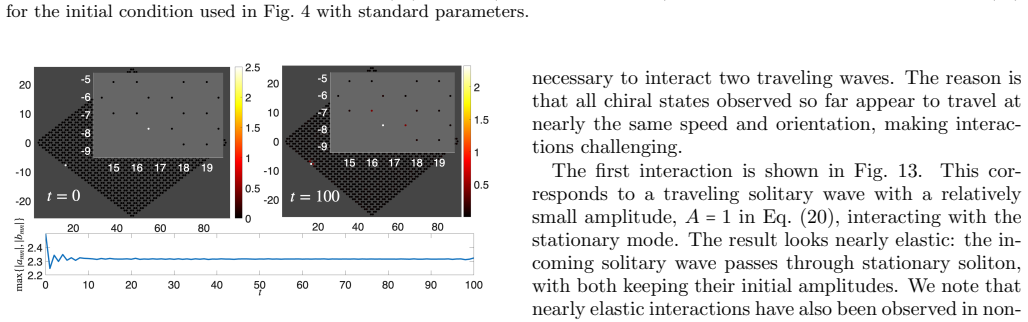
R. W. Boyd,Nonlinear Optics4th ed., Academic Press (2020). 12 FIG. 14. Typical results of a nonlinear traveling wave from Sec. IV B with a moderate amplitude (A=2) secant hyperbolic envelope and a stationary mode from Appendix B with eigenvalueλ=4.9. (Top row) Snapshots of∣a mn∣,∣bmn∣before, during, and after the interaction; the traveling mode moves the ...
2020
-
[16]
Y. S. Kivshar and G. P. Agrawal,Optical Solitons, Aca- demic Press (2003)
2003
-
[17]
Lumer, Y
Y. Lumer, Y. Plotnik, M. C. Rechtsman, M. Segev, Phys. Rev. Lett.111(2013) 243905
2013
-
[18]
Mukherjee, M
S. Mukherjee, M. C. Rechtsman, Science368(2020) 856- 859
2020
-
[19]
Kartashov and D
Y. Kartashov and D. V. Skryabin, Optica3(2016) 1228- 1236
2016
-
[20]
Leykam, E
D. Leykam, E. Smolina, A. Maluckov, S. Flach, and D. A Smirnova, Phys. Rev. Lett.126(2021) 073901
2021
-
[21]
X. Zhou,Y. Wang, D. Leykam, and Y. D. Chong, New J. Phys.19(2019) 095002
2019
-
[22]
S. Wong, T. A. Loring, and A. Cerjan, Phys. Rev. B108 (2023) 195142
2023
-
[23]
Isobe, T
T. Isobe, T. Yoshida, Y. Hatsugai, Phys. Rev. Lett.132 (2024) 126601
2024
-
[24]
K. Sone, M. Ezawa, Y. Ashida, N. Yoshioka, and T. Sagawa, Nat. Phys.20(2024) 1164-1170
2024
-
[25]
Smimova, D
D. Smimova, D. Leykam, Y. Chong and Y. Kivshar, Appl. Phys. Rev7(2020)
2020
-
[26]
M. J. Ablowitz and J. T. Cole, Physica D440(2022) 133440
2022
-
[27]
J. Kang, R. Wei, Q. Zhang and G. Dong Adv. Phys. Research5(2023) 2200053
2023
-
[28]
Szameit and M
A. Szameit and M. C. Rechtsman, Nature Physics20 (2024) 905-912
2024
-
[29]
M. J. Ablowitz, C. W. Curtis and Y. Ma, Phys. Rev. A 90(2014) 023813. 13
2014
-
[30]
Leykam, Y
D. Leykam, Y. D. Chong, Phys. Rev. Lett.117(2016) 143901
2016
-
[31]
M. J. Ablowitz, J. T. Cole, P. Hu and P. Rosenthal, Phys. Rev. E103(2021) 042214
2021
-
[32]
Mukherjee and M
S. Mukherjee and M. C. Rechtsman, Phys. Rev. X11 (2021) 041057
2021
-
[33]
P. G. Kevrekidis,The discrete nonlinear Schr¨ odinger equation: mathematical analysis, numerical computa- tions and physical perspectives, Springer232(2009)
2009
-
[34]
Y. S. Kivshar and D. K. Campbell, Phys. Rev. E48 (1993) 3077-3081
1993
-
[35]
Jenkinson and M
M. Jenkinson and M. I. Weinstein, Nonlinearity29 (2015) 27–86
2015
-
[36]
M. J. Ablowitz and J. F. Ladik, J. Math. Phys.16(1975) 598–603
1975
-
[37]
M. J. Ablowitz and J. F. Ladik, Stud. in Appl. Math.55 (1976) 213-229
1976
-
[38]
V. V. Konotop and S. Takeno, Phys. Rev. B55(1997) 342-352
1997
-
[39]
A. B. Aceves, C. De Angelis, T. Peschel, R. Muschall, F. Lederer, S. Trillo, and S. Wabnitz, Phys. Rev. E53 (1996) 1172-1189
1996
-
[40]
F. D. M. Haldane, J. Phys. C: Solid State Phys.15(1982) L1309-L1313
1982
-
[41]
Ishimori, J
Y. Ishimori, J. Phys. Soc. Jpn.51(1982) 3417-3418
1982
-
[42]
Fittipaldi de Castro and W
P. Fittipaldi de Castro and W. A. Benalcazar, Phys. Rev. B112(2025) L121107
2025
-
[43]
F. J. Mu˜ noz, S. K. Turitsyn, Y. S. Kivshar, and M. I. Molina, Phys. Rev. A95(2017) 033833
2017
-
[44]
Asb´ oth L
J. Asb´ oth L. Oroszl´ any and A. P´ alyi,A short course on topological insulators, Springer Lecture Notes in Physics 919(2016)
2016
-
[45]
Cerjan and T
A. Cerjan and T. A. Loring, APL Photonics9(2024) 111102
2024
-
[46]
Cerjan and T
A. Cerjan and T. A. Loring, Phys. Rev. B106(2022) 064109
2022
-
[47]
D. N. Christodoulides and R. I. Joseph, Opt. Lett.13 (1988) 794-796
1988
-
[48]
B. A. Malomed and J. Yang, Phys. Lett. A302(2002) 163-170
2002
-
[49]
Flach, Y
S. Flach, Y. Zolotaryuk, and K. Kladko, Phys. Rev. E 59(1999) 6105–6115
1999
-
[50]
M. J. Ablowitz, B. Prinari, and A. D. Trubatch,Discrete and continuous nonlinear Schr¨ odinger systems, Cam- bridge Press203(2004)
2004
-
[51]
Zhang, et al., Nature Comm.11(2020) 1902
Z. Zhang, et al., Nature Comm.11(2020) 1902
2020
-
[52]
N. J. Zabusky and M. D. Kruskal, Phys. Rev. Lett.15 (1965) 249-243
1965
-
[53]
M. J. Ablowitz and H. Segur,Solitons and the inverse scattering transform, SIAM (1981)
1981
-
[54]
Kodama and K
Y. Kodama and K. Nozaki, Opt. Lett.12(1987) 1038- 1040
1987
-
[55]
Rotschild, B
C. Rotschild, B. Alfassi, O. Cohen, M. Segev, Nature Phys.2(2006) 769-774
2006
-
[56]
S. K. Ivanov, Y. V. Kartashov, L. J. Maczewsky, A. Sza- meit, and V. V. Konotop, Opt. Lett.45(2020) 1459- 1462
2020
-
[57]
Mukherjee and M
S. Mukherjee and M. C. Rechtsman, Science368(2020) 856-859
2020
-
[58]
Hasegawa and Y
A. Hasegawa and Y. Kodama,Solitons in optical com- munications, Oxford (1995)
1995
-
[59]
M. J. Ablowitz, C. W. Curtis and Y. Zhu, Phys. Rev. A 88(2013) 013850
2013
-
[60]
N. G. Vakhitov and A. A. Kolokolov, Radiophys. Quan- tum Electron.16(1973) 783–789
1973
-
[61]
M. J. Ablowitz and Z. H. Musslimani, Opt. Lett.30 (2005) 2140-2142. Appendix A: V arying the Nonlinearity of the Nonlinear Haldane Model In this section we detail the results of decreasing the strength of the nonlinearity in the NH model (11). We use the same standard parameters as in Sec. IV:M=0, t1 =1,t 2 =0.1 andϕ= π 2 , except now we setσ=0.1. The evo...
2005
-
[62]
Namely, when the spatial dispersion of edge profiles balancesweakself-focusing nonlinearity, to leading-order, edge solitons exist
and enter the asymptotic regime described in [26, 28]. Namely, when the spatial dispersion of edge profiles balancesweakself-focusing nonlinearity, to leading-order, edge solitons exist. Appendix B: Stationary modes of the Ablowitz-Ladik-Haldane equation In this section we discuss finding families of surface modes for the ALH model (12) using spectral ren...
discussion (0)
Sign in with ORCID, Apple, or X to comment. Anyone can read and Pith papers without signing in.