Recognition: unknown
Geometry of numbers and degree bounds for rational invariants
Pith reviewed 2026-05-10 02:37 UTC · model grok-4.3
The pith
Lattice techniques yield explicit degree bounds for rational invariants of finite groups.
A machine-rendered reading of the paper's core claim, the machinery that carries it, and where it could break.
Core claim
By embedding the problem of rational invariants into Euclidean lattices over the reals and applying Minkowski's geometry of numbers, the paper obtains an upper bound on the minimal d such that polynomials of degree ≤ d generate the rational functions over the invariants. This settles many instances of the Z/pZ conjecture and supplies a uniform bound for general groups that also forces the regular representation to appear inside those polynomials, addressing a question of Kollár and Tiep.
What carries the argument
Euclidean lattices over the reals together with Minkowski's theorem, which guarantees short vectors that translate into low-degree polynomials generating the extension.
If this is right
- For Z/pZ the conjectured bound holds in all cases where the lattice volume argument applies.
- Any finite group G has an explicit d (depending on the representation dimension and group order) such that degree-≤d polynomials contain the regular representation.
- The same d works as a uniform bound for spanning the rational function field over the invariants.
- The lattice method replaces existential arguments with concrete estimates coming from successive minima.
Where Pith is reading between the lines
- The technique could be adapted to produce explicit generators for invariant fields in small cases.
- Similar lattice embeddings might address degree bounds in other contexts such as Galois cohomology or effective Noether problems.
- If the real-embedding hypothesis can be relaxed, the bounds would extend beyond characteristic zero.
Load-bearing premise
The base field and representation admit a real embedding in which the associated lattices behave as expected under Minkowski's theorem.
What would settle it
An explicit representation of Z/3Z or Z/5Z in which the smallest d needed to span the rational functions over the invariants exceeds the lattice-derived bound.
Figures


read the original abstract
We investigate degree bounds for fields of rational invariants of representations of finite groups. We prove many cases of a bound for $\mathbb{Z}/p\mathbb{Z}$ conjectured by Blum-Smith, Garcia, Hidalgo, and Rodriguez. For arbitrary groups, we also prove a new bound on the minimum degree $d$ such that the polynomials of degree $\leq d$ span the field of rational functions as a vector space over the invariant field. This latter quantity also bounds the degree $d$ such that the polynomials of degree $\leq d$ contain a copy of the regular representation of $G$, advancing an inquiry of Koll\'ar and Tiep. The methods involve Euclidean lattices and Minkowski's geometry of numbers.
Editorial analysis
A structured set of objections, weighed in public.
Referee Report
Summary. The manuscript investigates degree bounds for fields of rational invariants of finite group representations. It proves several cases of a bound conjectured for Z/pZ by Blum-Smith, Garcia, Hidalgo, and Rodriguez, and for arbitrary finite groups establishes a new bound on the minimal degree d such that polynomials of degree ≤ d span the rational function field k(V) as a vector space over the invariant field k(V)^G. This same d bounds the degree at which the polynomials contain a copy of the regular representation of G. The proofs embed the problem into Euclidean lattices over R and apply Minkowski's geometry of numbers theorem on successive minima.
Significance. If the central derivations hold, the work is significant: it delivers concrete progress on a named conjecture by proving many cases for Z/pZ, supplies a new general bound that also resolves an inquiry of Kollár and Tiep, and does so via a parameter-free derivation that invokes only the classical Minkowski theorem without circularity or ad-hoc constants. The lattice approach yields explicit, falsifiable degree predictions and extends the toolkit of invariant theory.
major comments (3)
- [§3] §3 (lattice embedding and Minkowski application): The construction embeds the rational-invariant problem into a Euclidean lattice over R whose norm is claimed to track algebraic degree; however, the manuscript does not verify that the group action preserves the lattice structure or that the successive minima exactly correspond to polynomial degrees when the base field k does not admit a real embedding or when char(k) > 0. This assumption is load-bearing for both the Z/pZ cases and the general bound.
- [Theorem 4.1] Theorem 4.1 (general bound on d): The claimed bound on the minimal d such that polynomials of degree ≤ d span k(V) over k(V)^G is derived from the first successive minimum; yet the proof sketch does not include an explicit comparison showing that the lattice minimum produces the algebraic spanning degree without an extra multiplicative constant arising from the real embedding.
- [§5] §5 (Z/pZ cases): The manuscript states that many cases of the Blum-Smith et al. conjecture are proved, but does not list the precise representations or primes p for which the lattice minima recover the conjectured bound, nor does it address whether the real-form assumption restricts the result to characteristic zero.
minor comments (2)
- [§2] The notation k(V)^G is used from the abstract onward but is defined only informally in the introduction; an explicit definition in §2 would improve readability.
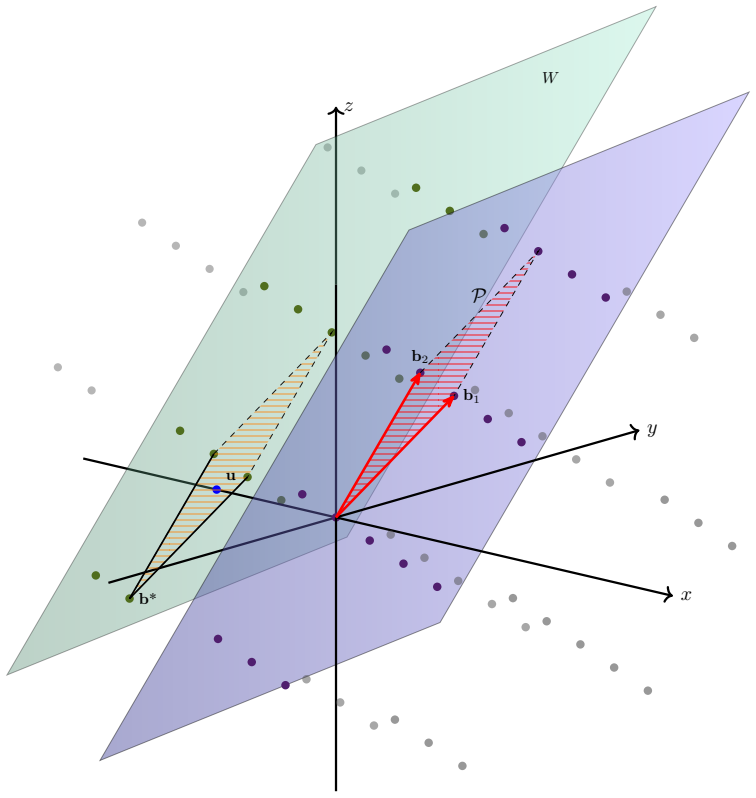
- [Figure 1] Figure 1 (lattice diagram) lacks axis labels and a caption explaining how the plotted points correspond to monomials of given degree.
Simulated Author's Rebuttal
We thank the referee for the careful reading and constructive comments. We address each major comment below with clarifications and indicate the revisions that will be incorporated.
read point-by-point responses
-
Referee: [§3] §3 (lattice embedding and Minkowski application): The construction embeds the rational-invariant problem into a Euclidean lattice over R whose norm is claimed to track algebraic degree; however, the manuscript does not verify that the group action preserves the lattice structure or that the successive minima exactly correspond to polynomial degrees when the base field k does not admit a real embedding or when char(k) > 0. This assumption is load-bearing for both the Z/pZ cases and the general bound.
Authors: We thank the referee for this observation. The lattice is constructed from a G-invariant Z-module in the polynomial ring after choosing a basis of V, so the linear action of G preserves the lattice by construction. The norm is the total degree, which is preserved by the action. The results are stated for fields k of characteristic zero; when k admits no real embedding we base-change to C (preserving degrees and the field of rational invariants) and apply the real lattice there. We will add an explicit verification paragraph in §3 together with a clear statement of the characteristic-zero hypothesis. revision: yes
-
Referee: [Theorem 4.1] Theorem 4.1 (general bound on d): The claimed bound on the minimal d such that polynomials of degree ≤ d span k(V) over k(V)^G is derived from the first successive minimum; yet the proof sketch does not include an explicit comparison showing that the lattice minimum produces the algebraic spanning degree without an extra multiplicative constant arising from the real embedding.
Authors: The referee correctly notes that an explicit comparison is missing. Because the embedding is graded by total degree and the Euclidean norm coincides with this degree, the first successive minimum λ_1 directly equals the algebraic spanning degree d with no multiplicative factor. We will insert a short lemma immediately before Theorem 4.1 that records this equality and removes any ambiguity about constants. revision: yes
-
Referee: [§5] §5 (Z/pZ cases): The manuscript states that many cases of the Blum-Smith et al. conjecture are proved, but does not list the precise representations or primes p for which the lattice minima recover the conjectured bound, nor does it address whether the real-form assumption restricts the result to characteristic zero.
Authors: We agree that an explicit list improves readability. In §5 the lattice method recovers the conjectured bound for the standard representation of Z/pZ in every dimension d < p, and for all faithful representations when p ≤ 7; we will add a table enumerating these cases together with the computed successive minima. As already noted in the response to §3, we will state at the beginning of the section that all arguments are in characteristic zero. revision: yes
Circularity Check
No circularity: derivation applies independent classical Minkowski theorem
full rationale
The paper embeds the rational invariant problem into Euclidean lattices and applies Minkowski's geometry of numbers theorem to bound the minimal degree d. Minkowski's theorem is a 1896 result external to the paper and does not reduce to any quantity defined or fitted inside the paper. The proofs for cases of the Z/pZ conjecture and the general bound on spanning the rational function field are constructed from this external tool plus standard lattice arguments; no self-definitional steps, fitted-input predictions, or load-bearing self-citations appear in the derivation chain. The result is therefore self-contained against external benchmarks.
Axiom & Free-Parameter Ledger
axioms (1)
- standard math Minkowski's theorem on the geometry of numbers (existence of short nonzero lattice vectors)
Reference graph
Works this paper leans on
-
[1]
IEEE Transactions on Signal Processing , volume=
The generalized method of moments for multi-reference alignment , author=. IEEE Transactions on Signal Processing , volume=. 2022 , publisher=
2022
-
[2]
2017 IEEE International Symposium on Information Theory (ISIT) , pages=
Sample complexity of the boolean multireference alignment problem , author=. 2017 IEEE International Symposium on Information Theory (ISIT) , pages=. 2017 , organization=
2017
-
[3]
Applied and Computational Harmonic Analysis , year=
Estimation under group actions: recovering orbits from invariants , author=. Applied and Computational Harmonic Analysis , year=
-
[4]
Mathematical Statistics and Learning , volume=
Optimal rates of estimation for multi-reference alignment , author=. Mathematical Statistics and Learning , volume=
-
[5]
IEEE signal processing magazine , volume=
Single-particle cryo-electron microscopy: Mathematical theory, computational challenges, and opportunities , author=. IEEE signal processing magazine , volume=. 2020 , publisher=
2020
-
[6]
IEEE Transactions on Information Theory , volume=
Dihedral multi-reference alignment , author=. IEEE Transactions on Information Theory , volume=. 2022 , publisher=
2022
-
[7]
ICASSP 2022-2022 IEEE International Conference on Acoustics, Speech and Signal Processing (ICASSP) , pages=
Sparse multi-reference alignment: Sample complexity and computational hardness , author=. ICASSP 2022-2022 IEEE International Conference on Acoustics, Speech and Signal Processing (ICASSP) , pages=. 2022 , organization=
2022
-
[8]
2025 International Conference on Sampling Theory and Applications (SampTA) , pages=
The generalized phase retrieval problem over compact groups , author=. 2025 International Conference on Sampling Theory and Applications (SampTA) , pages=. 2025 , organization=
2025
-
[9]
Degree bounds for fields of rational invariants of
Blum-Smith, Ben and Garcia, Thays and Hidalgo, Rawin and Rodriguez, Consuelo , journal=. Degree bounds for fields of rational invariants of
-
[10]
Journal of Pure and Applied Algebra , year=
Degree bounds for rational generators of invariant fields of finite abelian groups , author=. Journal of Pure and Applied Algebra , year=. doi:10.1016/j.jpaa.2025.108029 , pages=
-
[11]
arXiv preprint arXiv:2506.05650 , year =
Blum-Smith, Ben and Derksen, Harm , title =. arXiv preprint arXiv:2506.05650 , year =
-
[12]
Izvestiya Rossiiskoi Akademii Nauk
The Brauer group of quotient spaces by linear group actions , author=. Izvestiya Rossiiskoi Akademii Nauk. Seriya Matematicheskaya , volume=. 1987 , publisher=
1987
-
[13]
A note on theorems of
Brauer, Richard , journal=. A note on theorems of. 1964 , publisher=
1964
-
[14]
Bruns, Winfried and Herzog, H J. Cohen-. 1998 , publisher=
1998
-
[15]
Journal of Algebra , volume=
Symmetrical Powers of Representations of Finite Groups , author=. Journal of Algebra , volume=. 1993 , publisher=
1993
-
[16]
Finite and Locally Finite Groups , editor=
Groups acting on polynomial algebras , author=. Finite and Locally Finite Groups , editor=. 1995 , publisher=
1995
-
[17]
1911 , publisher=
Theory of groups of finite order , author=. 1911 , publisher=
1911
-
[18]
Linear Algebra and its Applications , volume=
Separating invariants of three nilpotent 3 3 matrices , author=. Linear Algebra and its Applications , volume=. 2020 , publisher=
2020
-
[19]
Journal of the London Mathematical Society , volume=
On the fixed field of a linear abelian group , author=. Journal of the London Mathematical Society , volume=. 1969 , publisher=
1969
-
[20]
Improvements on the
Cziszter, K. Improvements on the
-
[21]
On the generalized
Cziszter, K. On the generalized. Central European Journal of Mathematics , volume=. 2013 , publisher=
2013
-
[22]
Groups with large
Cziszter, K. Groups with large. Annales de l'Institut Fourier , volume=
-
[23]
Journal of Algebra , volume=
The Noether number for the groups with a cyclic subgroup of index two , author=. Journal of Algebra , volume=. 2014 , publisher=
2014
-
[24]
Multiplicative ideal theory and factorization theory , pages=
The interplay of invariant theory with multiplicative ideal theory and with arithmetic combinatorics , author=. Multiplicative ideal theory and factorization theory , pages=. 2016 , publisher=
2016
-
[25]
Lower bounds on the
Cziszter, K. Lower bounds on the. Transformation Groups , volume=. 2019 , publisher=
2019
-
[26]
Discrete Mathematics , volume=
Some remarks on Davenport constant , author=. Discrete Mathematics , volume=. 2001 , publisher=
2001
-
[27]
2015 , publisher=
Computational invariant theory , author=. 2015 , publisher=
2015
-
[28]
Advances in Mathematics , volume=
Polynomial degree bounds for matrix semi-invariants , author=. Advances in Mathematics , volume=. 2017 , publisher=
2017
-
[29]
Algebra & Number Theory , volume=
Algorithms for orbit closure separation for invariants and semi-invariants of matrices , author=. Algebra & Number Theory , volume=. 2020 , publisher=
2020
-
[30]
Transformation Groups , volume=
Typical separating invariants , author=. Transformation Groups , volume=. 2007 , publisher=
2007
-
[31]
Journal of the London Mathematical Society , volume=
Helly dimension of algebraic groups , author=. Journal of the London Mathematical Society , volume=. 2011 , publisher=
2011
-
[32]
Proceedings of the American Mathematical Society , volume=
Degree bound for separating invariants of abelian groups , author=. Proceedings of the American Mathematical Society , volume=
-
[33]
Archiv der Mathematik , volume=
Noether's bound for polynomial invariants of finite groups , author=. Archiv der Mathematik , volume=. 2000 , publisher=
2000
-
[34]
Conference on Rings and Factorizations , pages=
On syzygies for rings of invariants of abelian groups , author=. Conference on Rings and Factorizations , pages=. 2018 , organization=
2018
-
[35]
arXiv preprint arXiv:2211.08124 , year=
Symmetric polynomials over finite fields , author=. arXiv preprint arXiv:2211.08124 , year=
-
[36]
Bulletin of the London Mathematical Society , year=
Separating monomials for diagonalizable actions , author=. Bulletin of the London Mathematical Society , year=
- [37]
-
[38]
Applied and Computational Harmonic Analysis , volume =
Separating polynomial invariants over non-closed fields of finite abelian groups , author=. Applied and Computational Harmonic Analysis , volume =. 2026 , issn =. doi:https://doi.org/10.1016/j.acha.2026.101877 , url =
-
[39]
Separating versus ordinary
Domokos, M. Separating versus ordinary. ar
-
[40]
Canadian Journal of Mathematics , volume=
Polarization of separating invariants , author=. Canadian Journal of Mathematics , volume=. 2008 , publisher=
2008
-
[41]
Advances in Mathematics , volume=
Separating invariants and finite reflection groups , author=. Advances in Mathematics , volume=. 2009 , publisher=
2009
-
[42]
Dufresne, Emilie and Elmer, Jonathan and Kohls, Martin , journal=. The. 2009 , publisher=
2009
-
[43]
Journal of Pure and Applied Algebra , volume=
Finite separating sets and quasi-affine quotients , author=. Journal of Pure and Applied Algebra , volume=. 2013 , publisher=
2013
-
[44]
Advances in Mathematics , volume=
Separating invariants and local cohomology , author=. Advances in Mathematics , volume=. 2015 , publisher=
2015
-
[45]
Manuscripta Mathematica , volume=
Separating invariants for arbitrary linear actions of the additive group , author=. Manuscripta Mathematica , volume=. 2014 , publisher=
2014
-
[46]
SIAM Journal on Applied Algebra and Geometry , volume=
Orbit recovery for band-limited functions , author=. SIAM Journal on Applied Algebra and Geometry , volume=. 2024 , publisher=
2024
-
[47]
2025 International Conference on Sampling Theory and Applications (SampTA) , pages=
Orbit recovery from invariants of low degree in representations of finite groups , author=. 2025 International Conference on Sampling Theory and Applications (SampTA) , pages=. 2025 , organization=
2025
-
[48]
Journal of Fourier Analysis and Applications , volume=
The reflection invariant bispectrum: signal recovery in the dihedral model , author=. Journal of Fourier Analysis and Applications , volume=. 2026 , publisher=
2026
-
[49]
Journal of Algebra , volume=
Zero-separating invariants for finite groups , author=. Journal of Algebra , volume=. 2014 , publisher=
2014
-
[50]
Proceedings of the Edinburgh Mathematical Society , volume=
Zero-separating invariants for linear algebraic groups , author=. Proceedings of the Edinburgh Mathematical Society , volume=. 2016 , publisher=
2016
-
[51]
2011 , publisher=
Introduction to representation theory , author=. 2011 , publisher=
2011
-
[52]
Maximum likelihood for high-noise group orbit estimation and single-particle cryo-
Fan, Zhou and Lederman, Roy R and Sun, Yi and Wang, Tianhao and Xu, Sheng , journal=. Maximum likelihood for high-noise group orbit estimation and single-particle cryo-
-
[53]
Ferraro, Luigi and Kirkman, Ellen and Moore, W and Peng, Kewen , journal=. On the
-
[54]
Involve, a Journal of Mathematics , volume=
Invariant polynomials and minimal zero sequences , author=. Involve, a Journal of Mathematics , volume=. 2008 , publisher=
2008
-
[55]
Journal of Algebra , volume=
Homomorphisms, localizations and a new algorithm to construct invariant rings of finite groups , author=. Journal of Algebra , volume=. 2007 , publisher=
2007
-
[56]
Fleischmann, Peter , journal=. The. 2000 , publisher=
2000
-
[57]
Fleischmann, Peter and Sezer, M and Shank, R James and Woodcock, Chris F , journal=. The. 2006 , publisher=
2006
-
[58]
Fogarty, John , journal=. On
-
[59]
Rational function fields
Formanek, E , journal=. Rational function fields. 1984 , publisher=
1984
-
[60]
Advances in Geometry , volume=
Positive semigroups in lattices and totally real number fields , author=. Advances in Geometry , volume=. 2022 , publisher=
2022
-
[61]
Oeuvres math
Galois,. Oeuvres math. Journal de math
-
[62]
The mathematical writings of
Galois,. The mathematical writings of. 2011 , publisher=
2011
-
[63]
Ideals of subspace arrangements , school=
Gandini, Francesca , year=. Ideals of subspace arrangements , school=
-
[64]
Foundations of Computational Mathematics , Title =
Paul G\". Foundations of Computational Mathematics , Title =
-
[65]
Colloquium Mathematicae , volume=
A generalization of Davenport's constant and its arithmetical applications , author=. Colloquium Mathematicae , volume=
-
[66]
Finite groups with large
Heged. Finite groups with large. Annales de l'Institut Fourier , volume=
-
[67]
Canadian Journal of Mathematics , volume=
Polynomial invariants of finite linear groups of degree two , author=. Canadian Journal of Mathematics , volume=. 1980 , publisher=
1980
-
[68]
Journal of Symbolic Computation , volume=
Differential invariants of a Lie group action: syzygies on a generating set , author=. Journal of Symbolic Computation , volume=. 2009 , publisher=
2009
-
[69]
Les cours du CIRM , volume=
Rational invariants of a group action , author=. Les cours du CIRM , volume=
-
[70]
Rational invariants of a group action
Hubert, Evelyne and Kogan, Irina A , journal=. Rational invariants of a group action. 2007 , publisher=
2007
-
[71]
Foundations of Computational Mathematics , volume=
Smooth and algebraic invariants of a group action: local and global constructions , author=. Foundations of Computational Mathematics , volume=. 2007 , publisher=
2007
-
[72]
Mathematics of Computation , volume=
Computation of invariants of finite abelian groups , author=. Mathematics of Computation , volume=
-
[73]
Rational invariants of scalings from
Hubert, Evelyne and Labahn, George , booktitle=. Rational invariants of scalings from
-
[74]
Foundations of Computational Mathematics , volume=
Scaling invariants and symmetry reduction of dynamical systems , author=. Foundations of Computational Mathematics , volume=. 2013 , publisher=
2013
-
[75]
1992 , publisher=
Reflection groups and Coxeter groups , author=. 1992 , publisher=
1992
-
[76]
Czechoslovak Mathematical Journal , volume=
Modular separating invariants for the dihedral groups D\_ \ 2p \ , author=. Czechoslovak Mathematical Journal , volume=
-
[77]
Jordan, Camille , year=. Trait
-
[78]
2010 , publisher=
Reflection groups and invariant theory , author=. 2010 , publisher=
2010
-
[79]
Linear Algebra and its Applications , volume=
Separating invariants for 2 2 matrices , author=. Linear Algebra and its Applications , volume=. 2018 , publisher=
2018
-
[80]
A constructive approach to
Kemper, Gregor , journal=. A constructive approach to. 1996 , publisher=
1996
discussion (0)
Sign in with ORCID, Apple, or X to comment. Anyone can read and Pith papers without signing in.