pith. machine review for the scientific record. sign in

math.AC

Commutative Algebra

Commutative rings, modules, ideals, homological algebra, computational aspects, invariant theory, connections to algebraic geometry and combinatorics

0
math.AC 2026-05-13 1 theorem

Bass numbers of graded local cohomology stabilize in key cases

Bass numbers of graded components of local cohomology modules

Sequences μ^i(p0, H^j_{R+}(M)_n) show specific long-term patterns when i is low, R0 regular, or M relative Cohen-Macaulay.

abstract click to expand
Let $R=\bigoplus_{n\in \NN_0}R_n$ be a standard graded ring, $R_+=\bigoplus_{n\in \NN}R_n$ its irrelevant ideal, and $M$ a finitely generated graded $R$-module. In this paper, we study the asymptotic behavior of the sequence $\{\mu^i(\p_0, H^j_{R_+}(M)_n)\}_{n\in \Z}$ of Bass numbers of graded components of local cohomology modules with respect to an ideal $\p_0\in \Spec(R_0)$ in each of the following cases: (1) $i=0$ or $i= 1$ and $j\leq f_{R_+}(M)$, (2) $R_0$ is regular, $i= \hei(\p_0)$ or $i= \hei(\p_0)- 1$ and $j= \cd_{R_+}(M)$, (3) $M$ is relative Cohen-Macaulay with respect to $R_+$. Here, $\cd_{R_+}(M)$ and $f_{R_+}(M)$ denote the cohomological dimension and finiteness dimension of $M$ with respect to $R_+$, respectively.
0
0
math.AC 2026-05-12 2 theorems

This paper defines generalized Andrásfai graphs GA(t,k) that include complete graphs and…

Generalized Andr\'asfai graphs and special Betti diagrams of edge ideals

Removing a suitable Hamiltonian cycle from generalized Andrásfai graphs GA(t,k) yields edge ideals with regularity t+2, projective…

Figure from the paper full image
abstract click to expand
Edge ideals of graphs were introduced by Villarreal in 1990, and have been the subject of many studies since then. In the same year, Fr\"oberg characterized edge ideals with regularity 2 in combinatorial terms. This result was generalized by Fern\'andez-Ramos and Gimenez to regularity 3 for bipartite graphs. A key ingredient in these results is the particular shape of the Betti diagrams of the edge ideals of the graphs obtained after removing a Hamiltonian cycle from either a complete graph $ K_k$ or a complete bipartite graph $K_{k,k}$. In this work, we consider the family of Generalized Andr\'asfai graphs ${\rm GA}(t,k)$ with $t\geq 1 $ and $k \geq 2$. This family extends the families of complete graphs, since $K_{k+1} = {\rm GA}(1,k)$, and complete bipartite $k$-regular graphs, since $K_{k,k} = {\rm GA}(2,k)$. We show that the results known for $ K_k$ and $ K_{k,k}$ can be naturally extended to this family. More precisely, when removing a suitable Hamiltonian cycle from ${\rm GA}(t,k)$, the resulting edge ideal has regularity $t+2$, projective dimension $t(k-2)$ and a Betti diagram exhibiting a generalized version of the same special shape.
0
0
math.AC 2026-05-12 Recognition

Polynomial Betti growth characterizes derived complete intersections

Derived complete intersections and polynomial growth of Betti numbers over dg-algebras

This structure theorem for dg-algebras extends Gulliksen's and Halperin's results from local rings to the derived setting.

abstract click to expand
A theorem of Gulliksen states that a local ring is a complete intersection if and only if the Betti numbers of its finitely generated modules grow polynomially. We prove a derived version of Gulliksen's Theorem. More precisely, we prove a structure theorem for dg-algebras whose modules exhibit polynomial Betti growth. As a key ingredient in the proof, we establish the existence and uniqueness of minimal models and acyclic closures of morphisms of dg-algebras in a broader setting than was previously known. We also extend to dg-algebras a theorem of Halperin on the vanishing of deviations of local rings, recovering Gulliksen's Theorem as an immediate consequence.
0
0
math.AC 2026-05-11 2 theorems

Polynomial matrix equals Smith form when minors generate unit ideal

Matrix equivalence to Smith normal form: new theoretical results for multivariate polynomial matrices

The condition confirms a 1978 conjecture for broad classes and extends further through polynomial ring automorphisms

abstract click to expand
This paper investigates the Smith normal form equivalence problem for multivariate polynomial matrices. Using methods from matrix theory and polynomial ideal theory, we prove that Frost and Storey's 1978 conjecture holds for a broad class of matrices: such a matrix is equivalent to its Smith normal form if and only if its reduced minors of each order generate the unit ideal. Moreover, by extending the original matrix class via automorphisms of the polynomial ring, we show that our framework applies in a substantially more general setting.
0
0
math.AC 2026-05-11 Recognition

Prime of height h needs at most h squared quadratic generators

Quadratic linear strands of prime ideals

Sharp bounds on the quadratic strand of its resolution depend only on height and are attained by explicit examples

abstract click to expand
We prove sharp estimates on the quadratic strand of the resolution of any homogeneous prime ideal in a standard graded polynomial ring over an arbitrary field. Our bounds only depend on the height of the prime ideal, and they are optimal since for every $h \geq 1$ we show that there exists a prime ideal of height $h$ achieving them. In particular, we show that a prime ideal of height $h$ can contain at most $h^2$ quadratic minimal generators, and that there exists a prime ideal minimally generated by $h^2$ quadrics.
0
0
math.AC 2026-05-11 1 theorem

Annihilator dimension detects Cohen-Macaulay formal fibers

Cohen-Macaulayness of formal fibers and dimension of local cohomology modules

In Noetherian local rings, dim(R/a(M)) falls below module dimension d exactly when maximal support primes give unmixed rings with Cohen-Maca

abstract click to expand
Let $(R, \mathfrak{m} )$ be a Noetherian local ring, $M$ a finitely generated $R$-module of dimension $d$. Set $\mathfrak{a}(M):=\mathfrak{a}_0(M)\cdots \mathfrak{a}_{d-1}(M)$, where $\mathfrak{a}_i(M):={\rm Ann}_RH^i_{\mathfrak{m}}(M)$ for $i\geq 0$. In this paper, we study the Cohen-Macaulayness of formal fibers of $R$ in the relation with the dimension ${\rm dim} (R/\mathfrak{a}(M)).$ We prove that ${\rm dim} (R/\mathfrak{a}(M))<d$ if and only if $R/\mathfrak{p}$ is unmixed and the generic formal fiber of $R/\mathfrak{p}$ is Cohen-Macaulay for all $\mathfrak{p}\in{\rm Supp}_R(M)$ with ${\rm dim} (R/\mathfrak{p})=d.$ In general, $R/\mathfrak{p}$ is unmixed and the generic formal fiber of $R/\mathfrak{p}$ is Cohen-Macaulay for all $\mathfrak{p}\in{\rm Supp}_R(M)$ with ${\rm dim} (R/\mathfrak{p})>{\rm dim} (R/\mathfrak{a}(M)).$ As applications, we explore the structure of local rings and the dimension, the closedness of non Cohen-Macaulay locus of finitely generated modules.
0
0
math.AC 2026-05-08 2 theorems

Derived depth formula extends to finite quasi-projective dimension modules

The derived depth formula for modules of finite quasi-projective dimension

The identities relate depths and widths even when complete intersection dimension vanishes.

abstract click to expand
Let $R$ be a commutative Noetherian local ring. We prove a variety of new formulae for modules of finite quasi-projective or finite quasi-injective dimension. These include the Derived Depth Formula, itself an extension of Auslander famous depth formula, a variation of the Derived Depth Formula for width, an extended version of Ischebeck's Formula, and a Dependency formula in the vein of Jorgensen. Several special cases of our main results are new even under stronger assumptions on the vanishing of various complete intersection dimensions.
0
0
math.AC 2026-05-08

S2-sheaves decompose by codim-1 support components

Connectedness in Codimension One and the Non-S₂ Locus

The decomposition extends Hochster-Huneke results and identifies the non-S2 locus as the support of the cokernel in the S2-ification exact

abstract click to expand
We formulate a structural principle for finite $S_2$-objects: coherent $S_2$-sheaves and finitely generated graded $S_2$-modules decompose canonically according to the connected components in codimension $1$ of their support. This gives criteria relating indecomposability of $S_2$-objects to connectedness in codimension $1$ of their supports, and extends the Hochster--Huneke correspondences for complete local rings between connectedness in codimension $1$, indecomposability of canonical modules, and localness of the $S_2$-ifications. As a consequence, if $A$ is a local ring admitting a canonical module $\omega_A$, there are canonical decompositions of both $\omega_A$ and the $S_2$-ification $\operatorname{End}_A(\omega_A)$ whose indecomposable summands are the canonical modules and $S_2$-ifications of the quotient rings associated to the connected components in codimension $1$. We then apply this viewpoint to the non-$S_2$ locus. For $A$ equidimensional and unmixed, this locus is naturally realized as $\operatorname{Supp}_A C$ via the $S_2$-ification sequence $0 \to A \to \operatorname{End}_A(\omega_A) \to C \to 0$. The natural map between deficiency modules $K^{\dim C+1}(A)\to K^{\dim C}(C)$ identifies the canonical module $K^{\dim C}(C)$ with the $S_2$-hull of $K^{\dim C+1}(A)$. Under suitable conditions, this allows codimension-$1$ connectedness of the non-$S_2$ locus to be detected by the deficiency module $K^{\dim C+1}(A)$. We illustrate the theory with examples and apply it to codimension $2$ lattice ideals, obtaining connectedness-in-codimension-$1$ results for the non-$S_2$ loci of certain toric and lattice rings.
0
0
math.AC 2026-05-07

Quasi sdf-absorbing ideals generalize sdf-absorbing ones

Quasi sdf-absorbing ideals in commutative rings

They remain stable under localization and idealization, their radicals are prime under listed conditions, and they are classified completely

abstract click to expand
This paper introduces and studies quasi sdf-absorbing ideals as a generalization of sdf-absorbing ideals. We investigate the stability of this property under various constructions, including localization, surjective images, Nagata idealizations, and amalgamations. We establish conditions under which the radical of such ideals is prime and discuss a specific class of rings where quasi sdf-absorption implies the sdf-absorbing primary property. The study concludes with a classification of these ideals in Z and examples distinguishing them from related ideal classes.
0
0
math.AC 2026-05-07

Connectivity fixes sharp lower bounds on edge-ideal depths

Depth of edge ideals and vertex connectivity of finite graphs

For graphs on n vertices, depth S/I(G^c) and its powers receive explicit lower bounds from vertex connectivity κ(G).

Figure from the paper full image
abstract click to expand
Let $G$ be a finite graph on $[n]:=\{1, \ldots, n\}$ and $\kappa(G)$ its vertex connectivity. Let $S=K[x_1, \ldots, x_n]$ denote the polynomial ring in $n$ variables over a field $K$ and $I(G^c)$ the edge ideal of the complementary graph $G^c$ of $G$. It is a classical result that ${\rm depth} S/I(G^c) \leq \kappa(G) + 1$. We give a sharp lower bound of ${\rm depth} S/I(G^c)$ in terms of $n$ and $\kappa(G)$. Furthermore, a sharp lower bound of ${\rm depth} S/I(G^c)^2$ as well as that of ${\rm depth} S/I(G^c)^{(2)}$ in terms of $n$ and $\kappa(G)$ is given.
0
0
math.AC 2026-05-06

Generic forms satisfy Fröberg conjecture in second degree

Independence of generic forms and the Fr\"oberg conjecture

Holds for degree d>2 ideals and extends to degree 2d-1 when the number of variables is large enough.

abstract click to expand
We show that the Fr\"oberg conjecture holds in the second non-trivial degree for an ideal generated by generic forms of degree $d>2$. We also show that the conjecture is true up to degree $2d-1$ provided that the number of variables is sufficiently large.
0
0
math.AC 2026-05-06

Epsilon multiplicity equals colon-family version

Epsilon multiplicity, multiplicity=volume formula and analytic spread of family of ideals

The equality yields limit expressions and a multiplicity-equals-volume formula for filtrations in analytically unramified rings.

abstract click to expand
In an analytically unramified local ring $(R,\mathfrak m)$ of dimension $d\geq 1$, for a filtration of ideals $\mathfrak {I}=\{I_m\}_{m\in\mathbb N}$ satisfying $\mathfrak A(r)$ condition and for any $\mathfrak m$-primary ideal $K$, it is shown in $[18]$ that the epsilon multiplicity of the weakly graded family of ideals $\{(I_m:K)\}_{m\in\mathbb N}$ exists as a limit and it is bounded above by the epsilon multiplicity of $\mathfrak I$, $\epsilon(\mathfrak I)$. In this article, we first show that $\epsilon(\mathfrak I)$ coincides with the epsilon multiplicity of $\{(I_m:K)\}_{m\in\mathbb N}$ and this leads to the following: $(a)$ an expression for $\epsilon(\mathfrak I)$ as a limit of the epsilon multiplicities of other graded families of ideals and $(b)$ a multiplicity=volume formula for the epsilon multiplicity of an ideal $I$ in $R$. In the final part of the article, we investigate the maximality of the analytic spread of filtrations of ideals.
0
0
math.AC 2026-05-06

Variant large homomorphisms confirm new cases of homotopy Quillen analog

Large homomorphisms on the homotopy lie coalgebra

The definition modeled on Levin's maps allows verification of additional instances in Briggs' proposed analog for homotopy Lie coalgebras.

abstract click to expand
We introduce and study a notion of large homomorphisms on the homotopy lie coalgebra; these homomorphisms are a variant of the large homomorphisms of Levin. As a consequence of our work, we establish new cases of a homotopy lie coalgebra analog of a conjecture of Quillen as proposed by Briggs.
0
0
math.AC 2026-05-06

Depth of cycle cover ideal symbolic powers is n-1 minus floor(tn/(2t+1))

Admissible subgraphs and the depth of symbolic powers of cover ideals of graphs

t-admissible subgraphs turn the algebraic depth into a combinatorial count that simplifies to the floor formula for every cycle and t at or

abstract click to expand
Let $G$ be a simple graph. We introduce the notion of $t$-admissible subgraphs of $G$ and show how to use them to compute the depth of the $t$-th symbolic powers of the cover ideal of $G$. As an application, we prove that \[ \depth\big(S/J(C_n)^{(t)}\big) = n - 1 - \left\lfloor \frac{tn}{2t+1} \right\rfloor \] for all $t \ge 2$ and $n \ge 3$, where $S = K[x_1,\ldots,x_n]$ and $J(C_n)$ is the cover ideal of the cycle on $n$ vertices.
0
0
math.AC 2026-05-05

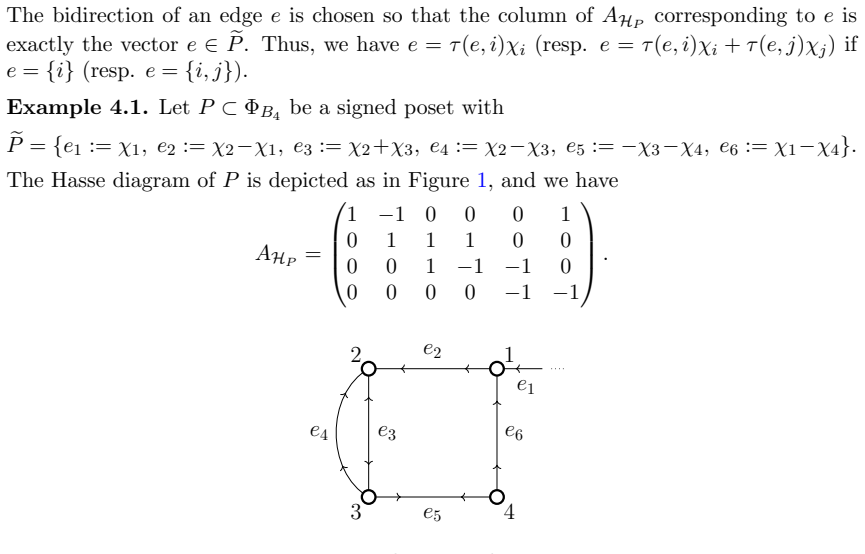
Matroids compute class groups of signed poset toric rings

Toric rings of signed posets and conic divisorial ideals via matroid theory

The divisor class group and Q-Gorenstein property of R_P are expressed directly from the signed poset P, extending Hibi ring results.

Figure from the paper full image
abstract click to expand
We study conic divisorial ideals from the viewpoint of matroid theory and apply the resulting framework to toric rings arising from signed posets. For a toric ring, we describe the polytope representing divisor classes corresponding to conic divisorial ideals in terms of matroids. We then turn to the toric ring $R_P$ associated with a signed poset $P$. We compute the divisor class group and characterize the ($\mathbb{Q}$-)Gorenstein property of $R_P$ in terms of $P$. Moreover, we also construct a polytope characterizing the conic divisorial ideals of $R_P$. This recovers and extends previous results on Hibi rings to the setting of signed posets.
0
0
math.AC 2026-05-05

Frobenius action on volume maps yields g-theorem for spheres

Frobenius identities for the volume map on Cohen--Macaulay rings

The interaction produces Parseval-Rayleigh identities that establish Hard Lefschetz for Gorenstein rings and deduce the Ohsugi-Hibi and g-2

Figure from the paper full image
abstract click to expand
We study the volume map on Artinian quotients of Cohen-Macaulay algebras in characteristic $p$, and the interaction between it and the action of Frobenius on resolutions. This allows us to provide a general, conceptual way to understand Parseval-Rayleigh identities, curious inhomogeneous identities on the volume map which were developed for the proof of the Ohsugi-Hibi conjecture. This general perspective gives a new approach to generic Lefschetz theory. We use this perspective to do the following: we give sufficient conditions for anisotropy and the Hard Lefschetz property for generic Artinian reductions of graded Gorenstein rings; we study the codimension-$3$ Gorenstein quotient of a polynomial ring by the ideal generated by Pfaffians, proving a Parseval-Rayleigh identity and deriving anisotropy and Hard Lefschetz in characteristic $2$; we deduce the $g$-theorem for simplicial spheres and the Ohsugi-Hibi conjecture following previous work of Adiprasito, Papadakis, and Petrotou; and we provide further examples of Parseval-Rayleigh identities for Gorenstein rings.
0
0
math.AC 2026-05-04 2 theorems

Quasi-Gorenstein morphisms get Gorenstein characterization

Quasi-Gorenstein morphisms of commutative local dg-algebras

A Gorenstein form of the virtually small property identifies the morphisms for dg-algebras and even for ordinary local ring maps.

abstract click to expand
We introduce quasi-Gorenstein morphisms of commutative local dg-algebras and use a Gorenstein version of the virtually small property to characterize them, a result which is new even for homomorphisms of local rings. In a different direction, we characterize exact sequences in a noetherian local ring, in the sense of Avramov, Henriques, and \c{S}ega, in terms of quasi-Gorenstein morphisms involving Koszul complexes.
0
0
math.AC 2026-05-04

Rings gain i-extended cozero-divisor graphs via bounded powers

The i-extended ideal-based cozero-divisor graph of a commutative ring

Vertices outside J connect when no powers up to i fall inside each other's principal ideal plus J.

abstract click to expand
Let R be a commutative ring with identity and let J be an ideal of R. In this paper, we introduce and investigate the notion of the i-extended ideal-based cozero-divisor graph of R. This graph, denoted by $\overline{\Gamma''}_{Ji}(R)$, is a simple graph of R whose vertex set is ${x \in R \ J : xR + J \not= R}$. Two distinct vertices $x$ and $y$ are adjacent if and only if $x^m \not \in y^nR+J$ and $y^n \not \in x^mR+J$ for some positive integers m and n with $n\leq i$ and $m\leq i$.
0
0
math.AC 2026-05-04

Hilbert-Serre rings obey dim ≤ GKdim ≤ Poincaré pole order

On Krull's Dimension Theorem for Certain Graded Rings and Its Applications

The bounds generalize Krull and Smoke theorems, force equality in monomial algebras, and permit strict inequality in some domains.

abstract click to expand
This paper explores the dimension theory of non-Noetherian graded rings by introducing the class of Hilbert-Serre rings. We generalize Krull's dimension theorem and Smoke's dimension theorem by establishing the fundamental inequalities $\dim(R) \le \operatorname{GKdim}_k(R) \le d(R)$ for any Hilbert-Serre ring $R$, where $d(R)$ is the pole order of its Poincar\'e series at $t=1$. Furthermore, we apply these results to initial algebras, proving that all these dimensions, including the transcendence degree, coincide for monomial algebras. Finally, we provide explicit examples demonstrating that these inequalities can be strict in general, even for integral domains.
0
0
math.AC 2026-05-04

Trace ideals characterize polynomial ranks and singular loci of rings

Trace ideals of exterior powers of the module of differentials

The ideals recover the maximal number of variables in polynomial or power series extensions and exactly locate singular points in reduced, 0

abstract click to expand
For each $i \geq 0$, we study the trace ideal of the $i$-th exterior power of the module of differentials. We show that these ideals characterize the polynomial rank of graded rings and the formal power series rank of complete local rings, namely the maximal number of variables for a polynomial or formal power series extension over a subring. For the top exterior power, we introduce the top differential trace and prove that it precisely defines the singular locus of reduced equidimensional local or graded rings. Motivated by this, we introduce and investigate nearly regular rings, which are Noetherian rings whose top differential trace contains the maximal ideal.
0
0
math.AC 2026-05-01

Macaulay2 package builds automatic solvers for parametric polynomial systems

Elimination Templates in Macaulay2

Elimination templates specialize to solve zero-dimensional radical ideals with independent parameters, shown on computer-vision examples.

abstract click to expand
We introduce the package \texttt{EliminationTemplates} for the Macaulay2 computer algebra system, which provides tools for constructing automatic solvers for families of zero-dimensional radical ideals depending on algebraically independent parameters. This article provides a self-contained description of how elimination templates are constructed for such families and their specialization properties. Additionally, we describe the main functionality and datatypes provided by our package, and illustrate its usage on several examples, including applications from computer vision from which elimination templates originated.
0
0
math.AC 2026-05-01

Graded Artinian Gorenstein algebras obey Parseval-Rayleigh identities

Parseval-Rayleigh identities for graded Artinian Gorenstein algebras

The general result also supplies an alternative proof for identities on reductions of Stanley-Reisner rings of oriented simplicial spheres.

abstract click to expand
We formulate and prove Parseval-Rayleigh identities for graded Artinian Gorenstein algebras over fields of positive characteristic. Specializing the general result, we provide an alternative proof of the Parseval-Rayleigh identities of generic Artinian reductions of Stanley-Reisner rings of oriented simplicial spheres.
1 0
0
math.AC 2026-05-01

Group theory links H4 prepotential coordinates

Flat coordinates of Frobenius prepotentials related with the reflection groups of types H₃ and H₄

The interpretation from the H3 case produces an explicit relation for the H4 polynomial and algebraic flat coordinates

abstract click to expand
In this article, we first explain a group theoretic interpretation of the derivation of the relation between the flat coordinates of the polynomial prepotential $(H_3)$ and those of the algebraic prepotential $(H_3)'$ given in \cite{KMS2} constructed by M. Feigin, D. Valeri and J. Wright \cite{FVW}. By the same idea explained in the case of $(H_3)$, we will show a relation between the flat coordinates of the polynomial prepotential $(H_4)$ and those of the algebraic prepotential $H_4(9)$ given in \cite{Se}.
0
0
math.AC 2026-05-01

Transfer map image for S_n depends only on floor(n/p) in char p

Syzygies of the transfer ideal of the symmetric group

The image of averaging polynomials over the group action equals an elimination ideal that stays constant for fixed quotient q when n grows.

abstract click to expand
We consider the modular action of the symmetric group $S_n$ on $R = k[x_1,\ldots,x_n]$ when $\mathrm{char}(k) = p \leq n$. We show that the image of the transfer map $R\to R^{S_n}$ is an elimination ideal $J\cap R^{S_n}$, where $J\subset R^{S_n}[t]$ is generated by $p$ polynomials with generic coefficients. The structure of this elimination ideal depends only on the quotient $q$ when writing $n = qp + r$ with unique remainder $0 \leq r < p$, implying that the image of the transfer also enjoys this stability. We conjecture a determinantal presentation of the elimination ideal and prove it in the case that $q = 2$. Furthermore, we exhibit a GL-equivariant, linear minimal free resolution of a certain initial ideal, allowing us to extract the graded Betti numbers of the elimination ideal.
0
0
math.AC 2026-04-30

Factorization of invariants proves component map surjectivity

Reverse Tableaux and the Surjectivity of the Component Map in Type A

Benlolo-Sanderson invariants factor over pseudo-neighbouring column pairs to reach every irreducible component of the nilfibre in type A.

Figure from the paper full image
abstract click to expand
Let $G = \mathrm{SL}(n,\mathbb{C})$, let $B$ be a fixed Borel subgroup, and let $P \supset B$ be a parabolic subgroup determined by a composition $(c_1,\dots,c_k)$ of $n$. Write $P'$ for the derived group of $P$ and $\mathfrak{m}$ for the Lie algebra of the nilradical of $P$. By Richardson's theorem the algebra of semi-invariants $\mathscr{I} := \mathbb{C}[\mathfrak{m}]^{P'}$ is polynomial; in type $A$ its generators may be taken to be the Benlolo--Sanderson (BS) invariants. The \emph{nilfibre} is the common zero locus $\mathscr{N} := V(\mathscr{I}_{+}) \subset \mathfrak{m}$. A set of \emph{component tableaux}, each encoding combinatorial data summarised in a multi-set called the \emph{Red Set}, was constructed in earlier work by Y. Fittouhi and A. Joseph in The reverse tableau: a gateway to the surjectivity of the component map. The resulting \emph{component map} $\phi : \{\text{component tableaux}\} \to \Irr(\mathscr{N})$ was shown to be injective. In the present article, we develop the Factorization Principle for Benlolo--Sanderson invariants in order to give a rigorous proof of the surjectivity of the component map $\phi$. While the combinatorial framework of reverse tableaux was introduced in a work by Y. Fittouhi and A. Joseph cited above, the surjectivity of $\phi$ remained conjectural: the linearization method used there did not exclude the possible loss or merging of irreducible components. The present paper resolves this geometric difficulty by showing that the relevant invariants factorize into products indexed by pseudo-neighbouring column pairs, thereby ensuring that every component is reached in a controlled and accountable way.
0
0
math.AC 2026-04-30

Weight diagrams of CP² foliations analyzed via Hilbert-Mumford

Analysis of the weight Diagram Associated with Foliations on the mathbb{CP}²

Algebraic multiplicity and invariant curves act as the main invariants in the geometric invariant theory approach.

Figure from the paper full image
abstract click to expand
We analyze the weight diagram associated with foliations on the complex projective plane through the Hilbert-Mumford criterion in Geometric Invariant Theory, focusing in particular on invariants such as the algebraic multiplicity and the existence of invariant curves.
0
0
math.AC 2026-04-30

GD1 and 1GD relations form partial orders on finite potent endomorphisms

On the binary relations defined using GD1 and 1GD inverses over infinite dimensional vector spaces

Characterization via AST decomposition extends the theory to endomorphisms on infinite-dimensional spaces.

abstract click to expand
The purpose of this article is to study certain binary relations of endomorphisms over infinite dimensional vector spaces defined by GD1 and 1GD generalized inverses. In order to do so, these generalized inverses are studied over arbitrary vector spaces (namely, infinite dimensional ones) using finite potent endomorphisms. We characterize them in terms of the AST decomposition of a finite potent endomorphism and we obtain algorithms for their respective computation. This theory is then used to characterize the GD1 and 1GD binary relations for finite potent endomorphisms in terms of the AST decomposition and to prove that they define partial orders in the set of finite potent endomorphisms, thus, completing the theory of these generalized inverses for matrices.
0
0
math.AC 2026-04-30

Core-nilpotent decomposition extends to any vector space

k[x]-modules and Core-Nilpotent endomorphisms

k[x]-module structures on the space let every endomorphism split into core and nilpotent parts, generalizing the matrix case and producing a

abstract click to expand
Core-nilpotent endomorphisms over an arbitrary vector space form the largest subset of the ring of endomorphisms over that arbitrary vector space which admit a decomposition as sum of two endomorphisms satisfying the analogous properties as the well known core-nilpotent decomposition of matrices. In this paper we present a new description of core-nilpotent endomorphisms using the $k[x]-$module structure they define in the base vector space. Moreover, our approach provides us with a ``new'' generalized inverse that restricts to the well known Drazin inverse under certain conditions. Similarly, we present a generalized core-nilpotent decomposition for endomorphisms over arbitrary vector spaces.
0
0
math.AC 2026-04-29

S-Noetherian lattices have unique S-primary decompositions

On S-Noetherian Lattices

The generalization of Noetherian rings to lattices also yields a Cohen-Kaplansky theorem on the compactness of S-primes.

abstract click to expand
In this paper, we define and study $S$-Noetherian lattices as a natural generalization of Noetherian rings. We prove that a ring $R$ is $S$-Noetherian if and only if its ideal lattice, $Id(R)$, is $S_L$-Noetherian. Furthermore, we establish a Cohen-Kaplansky type theorem for $S$-Noetherian lattices, showing that $L$ is $S$-Noetherian if and only if every $S$-prime element of $L$ is $S$-compact. Finally, we introduce the concept of $S$-primary elements-a generalization of primary elements in multiplicative lattices and demonstrate the existence and uniqueness of $S$-primary decomposition in $S$-Noetherian lattices.
0
0
math.AC 2026-04-28

Spectral sequences bound projective dimension over complete intersections

Finite projective dimension and a question of Jorgensen

Jorgensen's fifteen-year-old question receives an affirmative answer via generalized local cohomology for modules over these rings.

abstract click to expand
This paper studies finite projective dimension of finitely generated modules over a Noetherian local ring, by means of spectral sequence methods related to generalized local cohomology. Our main goal is to address a question raised by D. Jorgensen over fifteen years ago, concerning a prescribed bound (via Ext vanishing) for projective dimension over a complete intersection local ring. We obtain similar results involving other homological dimensions as well. Also we make use of weakly full ideals to derive further criteria for prescribed bound on projective dimension.
0
0
math.AC 2026-04-28

1960s uniqueness condition for Euclidean division still holds

A Necessary and Sufficient Condition for Uniqueness of Euclidean Division

The necessary and sufficient criterion for unique quotients and remainders applies under the modern definition of Euclidean domains.

abstract click to expand
A well-known result from the 1960s characterizes all Euclidean domains in which division is guaranteed to produce a unique quotient and remainder. As this relies on the historical (and more restrictive) definition of a Euclidean domain, the question of whether the result still holds under the modern definition was left open. In this paper, we prove the answer is afirmative.
0
0
math.AC 2026-04-27

Maximal ideal associates to ideal power only if graph diameter ≤ 7t-8

Associated primes of powers of closed neighborhood ideals and diameters of graphs

The bound 7t-8 is shown to be sharp by constructions where the algebraic condition holds at exactly that diameter.

Figure from the paper full image
abstract click to expand
Let $G$ be a simple connected graph and $t \ge 2$ an integer. We prove that if the maximal homogeneous ideal is an associated prime of the $t$th power of the closed neighborhood ideal of $G$, then the diameter of $G$ is at most $7t - 8$. We further show that this bound is sharp for all $t \ge 2$.
0
0
math.AC 2026-04-23

S-Prime Principle unifies prime-element proofs in lattices

On S-Prime Element Principle

Specializing to S={1} recovers existence results for primes in multiplicative lattices in a single step.

Figure from the paper full image
abstract click to expand
In this paper, we introduce $S$-prime elements in $V$-lattices, where $S$ is a multiplicatively closed subset of a $V$-lattice $L$. In addition, we introduce the $S$-Prime Element Principle to prove that certain elements in $V$-lattices are $S$-prime elements. This principle leads to a direct and uniform approach to the results on the existence of prime elements in multiplicative lattices when $S=\{1\}$.
1 0
0
math.AC 2026-04-23

Nested Cartesian codes stabilize distance at v-number of ideal

On the regularity index of the minimum distance function in projective nested Cartesian codes

Least-degree indicator functions for each point give the exact regularity index, plus an arithmetic test for the Cayley-Bacharach property.

abstract click to expand
Let $X$ be a projective nested product of fields and let $\delta_X(d)$ be the minimum distance in degree $d\geq 1$ of the projective nested Cartesian code $C_X(d)$. The regularity index ${\rm reg}(\delta_X)$ of the minimum distance function $\delta_X$ is the minimum integer $d_0\geq 0$ such that $\delta_X(d)=1$ for $d\geq d_0$. We give a formula for ${\rm reg}(\delta_X)$ by determining an indicator function of least degree for each point of $X$ and using the fact that ${\rm reg}(\delta_X)$ is the ${\rm v}$-number of the vanishing ideal $I_X$ of $X$. Then we give an arithmetical criterion that characterizes when $X$ is Cayley--Bacharach.
0
0
math.AC 2026-04-23

Rigidity of Tor modules extends from two ideals to any number

Multiple Tor modules: rigidity and Mayer-Vietoris spectral sequences

Spectral sequences from multiple complexes relate homologies of sums and products of ideals

abstract click to expand
We extend some properties of a pair of ideals described in terms of Tor modules to any number of ideals, including the well-known rigidity property. Those extensions require the development of a homological theory for spectral sequences arising from multiple complexes. Out of this theory, two new complexes associated with quotients by sums and quotients by products of the given ideals emerge, and their homologies are related via the Tor-independence property. In the multigraded setting, we describe the support regions of Tor modules for quotients by sums and products of ideals generated by variables in terms of each other.
0
0
math.AC 2026-04-23

Isomorphisms characterize Smith form for polynomial matrices

Smith Form Equivalence for Several Classes of Multivariate Polynomial Matrices

Criteria for several classes extend to non-square and rank-deficient cases and allow algorithmic verification.

abstract click to expand
This paper investigates the equivalence reduction for several classes of multivariate polynomial matrices and their Smith forms, establishing some criteria for such reduction. In particular, we employ algebra isomorphisms as a key tool to study this equivalence problem. We then leverage the Quillen-Suslin and Lin-Bose theorems to extend these results to non-square and rank-deficient matrices. Moreover, the verification of our criteria is achievable algorithmically via existing Gr\"{o}bner basis methods.
0
0
math.AC 2026-04-23

Tighter bounds on regularity of monomial curves

New bounds on Castelnuovo--Mumford regularity of monomial curves and application to sumsets

Apery-set methods tighten the regularity bound below the sum of two largest gaps for qualifying sequences and provide Cohen-Macaulay and sum

abstract click to expand
A monomial curve $C$ is defined by a sequence of coprime integers $0 = a_0 < a_1 < \cdots < a_k =: d$. One gap of this sequence is $a_{i+1} - a_i - 1$. Gruson--Lazarsfeld--Peskine bound (1983) says that $reg (C) \le d - k +2$, which is equal to the sum of all gaps plus 2. Lvovsky (1996) showed that it is enough to take the sum of two largest gaps plus 2. In this paper, under some specific conditions, we give several new bounds which are better than Lvovsky's bound. Our method relies on the study of Apery sets and Frobenius numbers. From this we can give new criteria to check the (arithmetically) Cohen--Macaulay and Buchsbaum property of $C$. Algorithms are provided to check these properties as well as to compute $ reg(C)$ and other invariants. We also give an application to study the structure of sumsets.
0
0
math.AC 2026-04-23

Cohomological dimension equals height for cML rings

Epimorphisms of local cohomology modules, a general Peskine-Szpiro theorem, and an application to sheaf cohomology vanishing for thickenings

Prime-characteristic rings with Mittag-Leffler local cohomology extend the Peskine-Szpiro theorem and give vanishing on thickenings.

abstract click to expand
We study the surjectivity of certain maps involving local cohomology modules, which we can realize as a dual version of part of the investigation developed by Bhatt, Blickle, Lyubeznik, Singh and Zhang on the sheaf cohomology of thickenings (i.e., subschemes defined by powers of ideals), where injectivity played a central role. To this end, we introduce and investigate properties of cohomologically Mittag-Leffler (cML) rings, associated to a given flat local endomorphism (for instance the Frobenius map of a regular ring of prime characteristic), a class which we show to contain, in our setting, the so-called cohomologically full rings of Dao, De Stefani and Ma (in particular, Cohen-Macaulay, Stanley-Reisner, and Du Bois singularities) as well as rings with an ideal inducing a pure endomorphism of the quotient. Our two major specific goals rely upon the prime characteristic setting. First, we extend for the class of cML rings a classical result of Peskine and Szpiro that relates the cohomological dimension and the height of a given Cohen-Macaulay ideal. Second, we prove and illustrate a Kodaira type vanishing result on the sheaf cohomology of thickenings.
0
0
math.AC 2026-04-22

Prime ideal graphs give edge ideals with polymatroidal powers

Edge Ideals of Prime Ideal Graphs: Ordinary Powers, Polymatroidality, and Analytic Spread

Explicit generator conditions on the powers imply they are polymatroidal and possess 2n-linear free resolutions.

abstract click to expand
Let $R$ be a finite commutative ring with identity, and let $P$ be a proper prime ideal of $R$. The prime ideal graph $\Gamma_P(R)$ has vertex set of $R\setminus\{0\}$, where two distinct vertices $x$ and $y$ are adjacent if and only if $xy\in P$. We prove that $\Gamma_P(R)\cong K_{|P|-1}\vee \overline{K}_{|R|-|P|}$, so prime ideal graphs form a ring-induced family of complete split graphs. Using this description, we determine the minimal vertex covers and obtain an irredundant primary decomposition of the edge ideal $I(\Gamma_P(R))$. For every $n\geq 1$, we characterize the minimal monomial generators of the ordinary power $I(\Gamma_P(R))^n$: a monomial $x^\alpha y^\beta$ belongs to $G(I(\Gamma_P(R))^n)$ if and only if $|\alpha|+|\beta|=2n, \ |\beta|\leq n$, and $0\leq \alpha_i\leq n$ for all $i$. Consequently, we derive a closed formula for $\mu(I(\Gamma_P(R))^n)$. We also prove that every ordinary power is polymatroidal and hence has linear quotients and a $2n-$linear resolution. Finally, we interpret $\mu(I(\Gamma_P(R))^n)$ as the Hilbert function of the special fiber ring and compute the analytic spread of $I(\Gamma_P(R))$.
0
0
math.AC 2026-04-22

Reciprocal complement of surfaces has dimension 2 under geometric criteria

The reciprocal complement of a surface

Sufficient conditions tie the algebraic object to surface geometry and fix its dimension for all irreducible quadrics.

abstract click to expand
We study the reciprocal complement $\mathcal{R}(D)$ of a two-dimensional finitely generated $K$-algebra $D$ by linking it with the properties of a surface with coordinate ring $D$. We give several sufficient criteria to have $\dim\mathcal{R}(D)=2$, and we use them to show several explicit examples; in particular, we determine the dimension of $\mathcal{R}(D)$ when $D$ is the quotient of $K[X,Y,Z]$ by an irreducible polynomial of degree $2$. We also study the integral closure of the localizations of $\mathcal{R}(K[X,Y])$.
0
0
math.AC 2026-04-22

Change-of-rings theorems bound small finitistic dimension

Change-of-Rings Theorems for the Small Finitistic Dimension

Finitistic flat dimension gives quotient, polynomial and localization results that characterize the longest finite projective resolutions on

abstract click to expand
In this paper, we study the small finitistic dimension of a commutative ring from the viewpoint of finitistic flat homological algebra. Using the class $FPR(R)$ of modules admitting finite projective resolutions, we investigate the finitistic flat ($FT$-flat) dimension and establish several of its basic properties. We prove change-of-rings results for the $FT$-flat dimension, including quotient and polynomial extension results, as well as localization inequalities. As applications, we obtain characterizations of the small finitistic dimension in terms of $FT$-flat dimension, derive quotient and polynomial extension theorems for the small finitistic dimension, and establish local upper bounds in terms of the small finitistic dimensions of localizations.
0
0
math.AC 2026-04-21

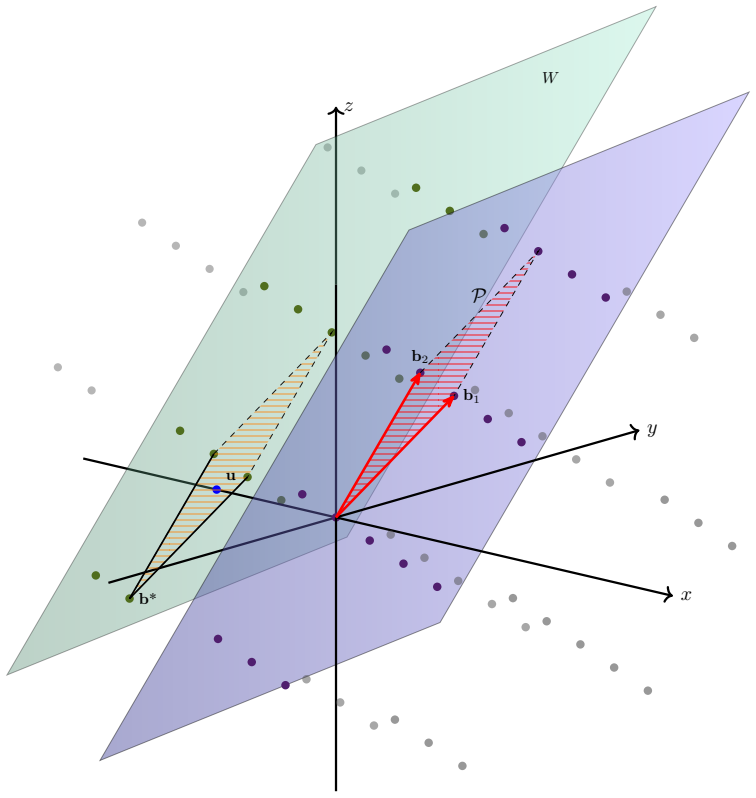
Lattices give degree bounds for group invariants

Geometry of numbers and degree bounds for rational invariants

Settles many cases of Z/pZ conjecture and supplies explicit d for rational functions and regular representations.

Figure from the paper full image
abstract click to expand
We investigate degree bounds for fields of rational invariants of representations of finite groups. We prove many cases of a bound for $\mathbb{Z}/p\mathbb{Z}$ conjectured by Blum-Smith, Garcia, Hidalgo, and Rodriguez. For arbitrary groups, we also prove a new bound on the minimum degree $d$ such that the polynomials of degree $\leq d$ span the field of rational functions as a vector space over the invariant field. This latter quantity also bounds the degree $d$ such that the polynomials of degree $\leq d$ contain a copy of the regular representation of $G$, advancing an inquiry of Koll\'ar and Tiep. The methods involve Euclidean lattices and Minkowski's geometry of numbers.
0
0
math.AC 2026-04-21

Divisible weighted spaces give sharp bounds on minimal degrees

Varieties of minimal degree in weighted projective space

Weighted determinantal scrolls meet these bounds and satisfy N_p properties once regularity conditions hold.

abstract click to expand
We initiate a study of varieties of minimal degree in weighted projective spaces. We call a weighted projective space $\mathbf{P}(w_0,\dots,w_n)$ divisible if $w_i \mid w_{i+1}$ for all $i$. We provide sharp bounds for when a non-degenerate subvariety of a divisible weighted projective space has minimal degree. We define a weighted notion of $1$-generic matrices and, in analogy with the classical theory, show that there is a theory of weighted determinantal scrolls. Moreover, we characterize precisely when these have minimal degree and determine their weighted $N_p$ properties, and tie this to two weighted notions of regularity. Finally, we propose conjectural bounds for more general weighted threefolds and pose several natural questions. Throughout, we highlight the differences between this theory and the classical case.
0
0
math.AC 2026-04-20

Log FW-differentials give criterion for log regularity

A criterion for log regularity via log Frobenius-Witt differentials

The paper defines logarithmic versions of these differential modules and shows they detect log regular rings.

abstract click to expand
T. Saito introduced FW-derivations and the modules of FW-differentials. He gave a regularity criterion in terms of the modules of FW-differentials. In this paper, we introduce logarithmic analogues of FW-derivations and the modules of FW-differentials. We study basic properties of them and give a logarithmic regularity criterion in terms of the modules of logarithmic FW-differentials.
0
0
math.AC 2026-04-20

Exact regularity of squarefree powers on whiskered cycles is 2q + floor((n-q-1)/2)

Regularity of Squarefree Powers of Edge Ideals of Whiskered Cycles

The closed formula holds for every q up to the matching number and confirms the earlier conjecture for this graph family.

abstract click to expand
Let $G$ be a finite simple graph and let $I(G)$ denote its edge ideal. For $q \ge 1$, the $q$-th squarefree power $I(G)^{[q]}$ is generated by squarefree monomials corresponding to matchings of size $q$ in $G$. We denote by $\operatorname{reg}(-)$ the Castelnuovo-Mumford regularity. Das, Roy, and Saha conjectured that if $G = W(C_n)$ is a whiskered cycle, then \[ \operatorname{reg}\big(I(G)^{[q]}\big) = 2q + \left\lfloor \frac{n - q - 1}{2} \right\rfloor ~ \text{for all } 1 \le q \le \nu(G), \] where $\nu(G)$ denotes the matching number of $G$. In this paper, we confirm this conjecture by determining the exact value of $\operatorname{reg}(I(G)^{[q]})$.
0
0
math.AC 2026-04-17

Lean 4 certifies Wu-Ritt decomposition of polynomial systems

Formalizing Wu-Ritt Method in Lean 4

Formal proofs establish termination and show that zero sets decompose into unions of triangular sets excluding initial zeros.

abstract click to expand
We formalize the Wu-Ritt characteristic set method for the triangular decomposition of polynomial systems in the Lean 4 theorem prover. Our development includes the core algebraic notions of the method, such as polynomial initials, orders, pseudo-division, pseudo-remainders with respect to a polynomial or a triangular set, and standard and weak ascending sets. On this basis, we formalize algorithms for computing basic sets, characteristic sets, and zero decompositions, and prove their termination and correctness. In particular, we formalize the well-ordering principle relating a polynomial system to its characteristic set and verify that zero decomposition expresses the zero set of the original system as a union of zero sets of triangular sets away from the zeros of the corresponding initials. This work provides a machine-checked verification of Wu-Ritt's method in Lean 4 and establishes a foundation for certified polynomial system solving and geometric theorem proving.
0
0
math.AC 2026-04-16

Numerical semigroups get two linkage theories for relative ideals

A semigroup-theoretic linkage theory for relative ideals: principal and canonical links

Principal links via semigroup translates and canonical links via ideal translates mirror liaison while adapting invariants to the discrete,

abstract click to expand
We develop a semigroup-theoretic analogue of liaison for relative ideals of a numerical semigroup. Two parallel linkage notions are proposed: a theory based on translates of the semigroup and a theory based on translates of the canonical ideal.
0
0
math.AC 2026-04-16

Surjective map from submodule to module is always an isomorphism

A constructive proof of Orzech's theorem

A constructive argument using the Cayley-Hamilton theorem establishes the result for any finitely generated module over a commutative ring.

abstract click to expand
Let $A$ be a commutative ring with unity, and $M$ a finitely generated $A$-module. In 1971, Morris Orzech showed that any surjective $A$-module homomorphism from a submodule of $M$ to $M$ must be an isomorphism. We give a constructive proof of this fact using the Cayley--Hamilton theorem.
0
0
math.AC 2026-04-15

Finite reducing invariant forces module to satisfy Auslander condition

Homological properties and finiteness of reducing invariants

When the target is the uniform Auslander condition, generalized AR conjecture or total reflexivity dependence, finiteness of the reducing w.

abstract click to expand
We study reducing invariants of modules related to certain homological properties. For modules of finite reducing projective dimension, we establish grade inequalities. We prove that if $\mathbb{P}$ is the (uniform) Auslander condition, or the generalized Auslander--Reiten conjecture, or dependence of the total reflexivity conditions, then a module satisfies $\mathbb{P}$ provided that it has finite reducing invariant with respect to $\mathbb{P}$.
0
0
math.AC 2026-04-14

Strongly nilpotent automorphisms are Pascal finite

The inclusion is strict, since Nagata's automorphism is Pascal finite but not strongly nilpotent and some quadratic automorphisms are not.

abstract click to expand
We compare two classes of polynomial automorphisms, strongly nilpotent and Pascal finite. We conclude that every strongly nilpotent automorphism is a Pascal finite one, but not vice versa. We observe that Nagata's automorphism is Pascal finite, but not strongly nilpotent. Considering Vasyunin example leads us to conclusion that not every quadratic polynomial automorphism is Pascal finite.
0
0
math.AC 2026-04-14

Finite generation requires algebraic alpha to be weak Perron

Finite Generation in Polynomial Semirings

The additive monoid N_0[alpha] is finitely generated in the atomic case only when alpha satisfies the weak Perron condition, with explicit 0

abstract click to expand
We study the semiring $\mathbb{N}_0[\alpha]$ as an additive monoid where $\alpha$ is a positive real algebraic number. In the atomic case, the atoms of $\mathbb{N}_0[\alpha]$ are precisely the powers $\alpha^n$ up to a certain nonnegative integer $n$, and finite generation is governed by divisibility of the minimal polynomial by a negative-tail polynomial. Our first main result gives a complete characterization when the minimal polynomial has the form $\mathfrak{m}_\alpha(X)=p_\alpha(X)-c$ with $c\in\mathbb{N}$. Our second main result shows that finite generation forces $\alpha$ to be a weak Perron number. As an application, we analyze cubic minimal polynomials and obtain a partial classification of rank-$3$ monoids $\mathbb{N}_0[\alpha]$ by generation and factorization type, including coefficient constraints, non--length-factoriality results for a large family, and examples with prescribed numbers of atoms.
0
0
math.AC 2026-04-14

Monomial ideals stabilize colon powers after finite index

Strong persistence index and fluctuations in colon powers of monomial ideals

The strong persistence index marks permanent equality of (I^{ℓ+1} : I) with I^ℓ, yet some monomial ideals fluctuate before settling

abstract click to expand
Let $I$ be an ideal in a commutative Noetherian ring $R$. We say that a positive integer $\ell_0$ is the strong persistence index of $I$ if $\ell_0$ is the smallest integer such that $(I^{\ell+1} :_R I) = I^{\ell}$ for all $\ell \geq \ell_0$. The first aim of this paper is to study this notion for monomial ideals. We also say that $I$ has the phenomenon of fluctuation in colon powers if there exist positive integers $a < b < c$ such that at least one of the following cases occurs: (i) $(I^{a} : I) = I^{a-1}$, $(I^{b} : I) \neq I^{b-1}$, but $(I^{c} : I) = I^{c-1}$. (ii) $(I^{a} : I) \neq I^{a-1}$, $(I^{b} : I) = I^{b-1}$, but $(I^{c} : I) \neq I^{c-1}$. The second purpose of this work is to explore this phenomenon for monomial ideals.
0
0
math.AC 2026-04-14

Local cohomology over ramified rings can have infinitely many associated primes

Infinitely many associated primes of local cohomology modules of ramified regular local rings

The construction shows infinitude of associated primes and Bass numbers arises in ramified regular local rings.

abstract click to expand
We construct examples of local cohomology modules of ramified regular local rings with infinitely many associated primes and infinite Bass numbers.
0
0
math.AC 2026-04-13

O-sequence counts obey sub-Fibonacci rule to multiplicity 1100

Counting finite O-sequences: sub-Fibonacci behaviour and growth estimates

Exact enumeration refines asymptotic bounds on log(O_d) and settles a 1992 question negatively.

Figure from the paper full image
abstract click to expand
Exploiting an iterative formula already introduced in a previous manuscript to count the number $O_d$ of finite $O$-sequences of multiplicity $d$, we obtain some new information about $O_d$. Letting $A_d$ be the number of the finite $O$-sequences of multiplicity $d$ whose last non-zero element is strictly larger than $1$, first we prove that the sequence $(A_{d+2})_{d\geq 1}$ is sub-Fibonacci, as was already proved for $(O_d)_d$. Then, we develop an algorithm that allows the computation of $O_d$ up to $d=1100$ and use the computed data to obtain an empirical calibration in the interval $1\leq d \leq 1100$ of the Stanley-Zanello asymptotic upper bound for $\log(O_d)$ that better fits the observed values of $\log(O_d)$ in the given interval. An analogous study of the Stanley-Zanello asymptotic lower bound for $\log(O_d)$ is also carried out. Some consequent prediction estimates are proposed. We also show that a question posed by L. G. Roberts in 1992 has a negative answer.
0
0
math.AC 2026-04-10

F-finite graded modules split into E

On the structure theorem of graded components of mathcal{F}-finite, mathcal{F}-modules over certain polynomial ring

Multiplicities of each summand stay constant across every sign-pattern region of Z^n for modules over power-series polynomial rings.

abstract click to expand
Let $K$ be a field of characteristic $p>0$, $A=K[[Y]]$ be a power series ring in one variable and $Q(A)$ be the field of fraction of $A$. Suppose that $R=A[X_1,\ldots,X_n]$ is a standard $\mathbb{N}^n$-graded polynomial ring over $A$, i.e., $\operatorname{deg} (A)=\underline{0}\in \mathbb{N}^n$ and $\operatorname{deg}(X_j)=e_j\in \mathbb{N}^n$. Assume that $M=\bigoplus_{\underline{u}\in \mathbb{Z}^n} M_{\underline{u}}$ is a $\mathbb{Z}^n$-graded $\mathcal{F}$-finite, $\mathcal{F}$-module over $R$. In this article we prove that, $\displaystyle M_{\underline{u}}\cong E(A/YA)^{a(\underline{u})}\oplus Q(A)^{b(\underline{u})}\oplus A^{c(\underline{u})}$ for some finite numbers $a(\underline{u}), b(\underline{u}), c(\underline{u})\geq 0$. Let for a subset of $U$ of $\mathcal{S}=\{1, \ldots, n\}$, define a block to be the set $\displaystyle\mathcal{B}(U)=\{\underline{u} \in \mathbb{Z}^n \mid u_i \geq 0 \mbox{ if } i \in U \mbox{ and } u_i \leq -1 \mbox{ if } i \notin U \}$. Note that $\bigcup_{U\subseteq \mathcal{S}}\mathcal{B}(U)=\mathbb{Z}^n$. We prove that the sets $\{a(\underline{u})\mid \underline{u}\in \mathbb{Z}^n\}$, $\{b(\underline{u})\mid \underline{u}\in \mathbb{Z}^n\}$ and $\{c(\underline{u})\mid \underline{u}\in \mathbb{Z}^n\}$ are constant on $\mathcal{B}(U)$ for each subset $U$ of $\{1,\ldots,n\}$. In particular, these results holds for composition of local cohomology modules of the form $ H^{i_1}_{I_1}(H^{i_2}_{I_2}(\dots H^{i_r}_{I_r}(R)\dots)$ where $I_1,\ldots,I_r$ are $\mathbb{N}^n$-graded ideals of $R$. This provides a positive characteristic analogue of the results proved in \cite{TS-23} by the authors in characteristic zero.
0
0
math.AC 2026-04-09

Explicit ring has McCoy localizations but fails to be McCoy itself

An Integrally Closed Reduced Ring with McCoy Localizations That Is Neither McCoy nor Locally a Domain

This reduced integrally closed example shows that McCoy localizations at maximal ideals do not force the ring to be McCoy or locally adomain

abstract click to expand
We construct an explicit commutative ring $R$ that is reduced and integrally closed, such that $R_{\mathfrak p}$ is an integrally closed McCoy ring for every maximal ideal $\mathfrak p$ of $R$, while $R$ itself is not a McCoy ring and is not locally a domain. This gives an affirmative answer to Problem~9 in \emph{Open Problems in Commutative Ring Theory}. The construction combines Akiba's Nagata-type example, which already yields an integrally closed reduced ring with integrally closed domain localizations and a finitely generated ideal of zero-divisors with zero annihilator, with an explicit local integrally closed McCoy ring that is not a domain. Taking the direct product of these two rings preserves the required local McCoy property while retaining the global failure of the McCoy condition. As a consequence, $R[X]$ is integrally closed by Huckaba's criterion.
0
0
math.AC 2026-04-08 Recognition

Wiles defects of maximal minor rings reduce to (m-1) minors

Congruence modules and Wiles defects of determinantal rings of maximal minors

The congruence module and Wiles defect at any map to the valuation ring are expressed using the smaller minors of the associated matrix.

abstract click to expand
Let $O$ be a discrete valuation ring and $A := O[X_{m \times n}]/I_{m}(X)$ the determinantal ring of maximal minors. We consider algebra maps $\lambda \colon A \to O$, which is tantamount to choosing rank-deficient matrices $a \in O^{m \times n}$. Following Iyengar--Khare--Manning, we compute the congruence module and the Wiles defect of $A$ at $\lambda$, expressing them in terms of the $(m - 1)$-sized minors of $a$.
0
0
math.AC 2026-04-08 Recognition

One domain over F2 disproves flatness for integer-valued polynomial rings

A Counterexample to Problem 19 on Integer-valued Polynomial Rings

A Noetherian local domain of dimension one yields a case where Int(D) is not a flat D-module because a witness polynomial lies outside the T

abstract click to expand
We give a negative answer to Problem 19 of Cahen, Fontana, Frisch, and Glaz concerning the flatness and freeness of rings of integer-valued polynomials. We construct an explicit one-dimensional Noetherian local domain D over the field with two elements and prove that the ring of integer-valued polynomials on D is not flat as a D-module. The argument shows that a certain polynomial is integer-valued on D with values in the integral closure T of D, but does not belong to the product of T with the ring of integer-valued polynomials on D. An application of Elliott's flatness criterion then yields the counterexample. In particular, the ring of integer-valued polynomials on an arbitrary integral domain need not be free.
0
0
math.AC 2026-04-08 2 theorems

Algebraic methods unlock properties of resultants and Chow forms

Everything I always wanted to know about resultants and Chow forms (but was too lazy to ask)

A personal algebraic exploration derives core facts using ring theory instead of geometry.

abstract click to expand
This note develops some fundamental properties of resultants and related notions. It represents my own personal exploration of this domain, which I found more instructive than seeking answers in the standard literature. Consequently, notation and terminology may be quite idiosyncratic, and the approach is very algebraic. Read at your own risk.
0
0
math.AC 2026-04-08 2 theorems

Cohen-Macaulay rings characterized by finite levels of perfect complexes

A characterization of Cohen-Macaulay rings in terms of levels of perfect complexes

Finiteness of levels with respect to G_C(R) for a semidualizing module C detects Cohen-Macaulayness and recovers the Gorenstein case.

abstract click to expand
Let $R$ be a commutative noetherian ring, and let $C$ be a semidualizing $R$-module. In this paper, we study levels of bounded complexes of finitely generated $R$-modules with respect to the full subcategory $\mathsf{G}_{C}(R)$ consisting of Gorenstein $C$-projective $R$-modules. Our main result provides a characterization of the Cohen-Macaulayness of $R$ in terms of the finiteness of levels of perfect complexes with respect to $\mathsf{G}_{C}(R)$. This recovers a recent theorem of Christensen, Kekkou, Lyle and Soto Levins on the Gorensteinness of $R$.
0
0
math.AC 2026-04-07 2 theorems

Lean 4 formalizes Nagata's theorem on Noetherian UFDs

A Prime-Generated Formalization of Nagata's Factoriality Theorem in Lean 4

Noetherian domains become UFDs when localized at prime-generated submonoids, with proofs for polynomial extensions following directly.

abstract click to expand
We present a Lean 4 Mathlib formalization of Nagata's factoriality theorem: if R is a noetherian domain and S <= R is a prime-generated submonoid such that S^{-1}R is a UFD, then R itself is a UFD. The prime-generated hypothesis -- every element of S is a finite product of primes belonging to S -- replaces a superficially cleaner but degenerate prime-or-unit condition that the formalization effort exposed. The development packages the theorem both for the concrete type Localization S and through abstract IsLocalization formulations. As applications, we formalize two Nagata-based proofs that R[X] is a UFD whenever R is a noetherian UFD: one via Laurent-polynomial localization at powers of X, and one via localization at the constant primes and identification with Frac(R)[X]. Reusing the same package, we also obtain the iterated polynomial corollary R[X][Y]. No public formalization of this result is known to us in Lean, Coq, or Isabelle.
0
0
math.AC 2026-04-07 Recognition

Infinite series of Gorenstein algebras fail affine homogeneity

An infinite series of Gorenstein local algebras failing the affine homogeneity property

Each A_n contains a non-socle one-dimensional subspace in its maximal ideal fixed by every automorphism

Figure from the paper full image
abstract click to expand
We provide an infinite series of commutative finite-dimensional Gorenstein local algebras $A_n$ for $n \ge 2$. We give an elementary proof that the maximal ideal of every algebra $A_n$ possesses a one-dimensional subspace that is different from the socle and invariant under the automorphism group of $A_n$. The latter implies that the algebras $A_n$ fail the affine homogeneity property. We also discuss some consequences concerning additive actions on projective hypersurfaces, related to the generalized Hassett-Tschinkel correspondence for these algebras.
0
0
math.AC 2026-04-06 Recognition

New absorbing submodule class defined and listed for Z

Generalized square-difference factor absorbing submodules of modules over commutative rings

Generalized square-difference factor absorbing submodules are introduced over commutative rings, with full characterization inside the Z asZ

abstract click to expand
In this paper, we introduce and study the class of generalized square-difference factor absorbing (gsdf-absorbing) submodules of modules over commutative rings. We provide various characterizations and properties of gsdf-absorbing submodules and examine the behavior of this class of submodules in some module extensions, including localization, homomorphic images, direct products, idealization, and amalgamation. We also characterize all gsdf-absorbing submodules of the Z-module Z. Several examples are provided to illustrate the results and to distinguish this class from related notions.
0
0
math.AC 2026-04-03 2 theorems

Valuative tree is closed in product of value groups

On topologies on the space of valuations and the valuative tree

Embedding the tree into an infinite product space shows it is topologically closed under the natural product topology.

Figure from the paper full image
abstract click to expand
In this paper, we discuss topological aspects of the space of valuations $\mathbb{V}$ and the valuative tree $\mathcal{T}(v,\Lambda)$. We present a relation between the weak tree topology and the Scott topology in $\mathcal{T}(v,\Lambda)$ and describe the supremum of an increasing family of valuations in a special subtree. We also view the valuative tree as a subset of the product $(\Lambda_\infty)^{K[x]}$ and prove that it is closed if we consider the natural product topology.
0
0
math.AC 2026-04-01

Constructing Gorenstein curves via bi-amalgamated algebras

Cohen-Macaulay and Gorenstein Properties of Bi-Amalgamated Algebras with Applications to Algebroid Curves

New conditions for Cohen-Macaulay and Gorenstein properties enable the systematic design of curve singularities.

Figure from the paper full image
abstract click to expand
Let $A \bowtie^{f,g} (J,J')$ be the bi--amalgamation of a commutative ring $A$ with $(B,C)$ along the ideals $(J,J')$ with respect to the ring homomorphisms $(f,g)$. In this article, we study the basic homological properties of the bi--amalgamated algebra construction. We first calculate the dimension and depth of the bi--amalgamated algebra under fairly general circumstances and derive necessary and sufficient conditions for Cohen--Macaulayness in terms of maximal and big Cohen--Macaulay modules of $A$. Furthermore, we characterize the Gorenstein property of the bi--amalgamated algebra through the canonical modules of $f(A)+J$ and $g(A)+J'$. We apply our results to the theory of curve singularities by constructing Gorenstein algebroid curves through bi--amalgamated and amalgamated algebras. We also give a brief remark concerning the universally catenary property of $A\bowtie^{f,g}(J,J')$.
0
0
math.AC 2026-04-01 2 theorems

Graded injective envelopes described for simplicial poset primes

Toward the theory on local cohomologies at the ideals given by simplicial posets

This builds the foundation for local cohomology theory on non-standard graded face rings from simplicial posets.

abstract click to expand
For a simplicial poset $P$, Stanley assigned the face ring $A_P$, which is the quotient of the polynomial ring $S:=K[t_x \mid x \in P \setminus \{\widehat{0} \}]$ by the ideal $I_P$. This is a generalization of Stanley-Reisner rings, but $S$ and $A_P$ are not standard graded in this case, and $I_P$ is not a monomial ideal. To establish the foundation of the theory on local cohomology $H_{I_p}^i(S)$ and its injective resolution, we give an explicit description of the graded injective envelope ${}^*\! E_S(S/\mathfrak{p}_x)$, where $\mathfrak{p}_x$is the prime ideal associated with $x \in P$, and analyze their behavior in the graded dualizing complex.
0
0
math.AC 2026-04-01 Recognition

V-number of graph ideals grows linearly with power k

The v-number of generalized binomial edge ideals of some graphs

Colon ideal analysis supplies formulas for J_{K_m,G} and classifies cases with v-number 1 or 2 when G is Cohen-Macaulay

Figure from the paper full image
abstract click to expand
Let $G$ be a finite connected simple graph, and let $\mathcal{J}_{K_m,G}$ denote its generalized binomial edge ideal. By investigating the colon ideals of $\mathcal{J}_{K_m,G}$, we derive a formula for the local $\mathrm{v}$-number of $\mathcal{J}_{K_m,G}$ with respect to the empty cut set. Furthermore, we classify graphs for which this generalized binomial edge ideal has $\mathrm{v}$-numbers $1$ or $2$. When $G$ is a connected closed graph, we compute the local $\mathrm{v}$-number of $\mathcal{J}_{K_2,G}$ by generalizing the work of Dey et al. Additionally, under the condition that $G$ is Cohen--Macaulay, we derive formulas for the $\mathrm{v}$-number of $\mathcal{J}_{K_m,G}$ and $\mathcal{J}_{K_2,G}^k$, and show that the $\mathrm{v}$-number of $\mathcal{J}_{K_2,G}^k$ is a linear function of $k$.
0
0
math.AC 2026-03-31 2 theorems

Private neighbors bound v-number of neighborhood ideals

Private neighbors, perfect codes and their relation with the mathtt{v}-number of closed neighborhood ideals

The bound lower-limits Castelnuovo-Mumford regularity for bipartite, very well-covered and chordal graphs, with explicit values from Hamming

abstract click to expand
In this work, we investigate the connections between dominating sets, private neighbors, and perfect codes in graphs, and their relationships with commutative algebra. In particular, we estimate the $\mathtt{v}$-number of closed neighborhood ideals in terms of minimal dominating sets and private neighbors. We show how the $\mathtt{v}$-number is related to other graph invariants, such as the cover number, domination number, and matching number. Moreover, we explore the relation with the Castelnuovo-Mumford regularity, proving that the $\mathtt{v}$-number is a lower bound for the regularity of bipartite, very well-covered, and chordal graphs. Finally, drawing from the relation between efficient dominating set and perfect codes, we use the redundancy of Hamming codes to present lower and upper bounds for the $\mathtt{v}$-number of some special family of graphs.
0

browse all of math.AC → full archive · search · sub-categories