Recognition: unknown
Collaborative Contextual Bayesian Optimization
Pith reviewed 2026-05-10 04:20 UTC · model grok-4.3
The pith
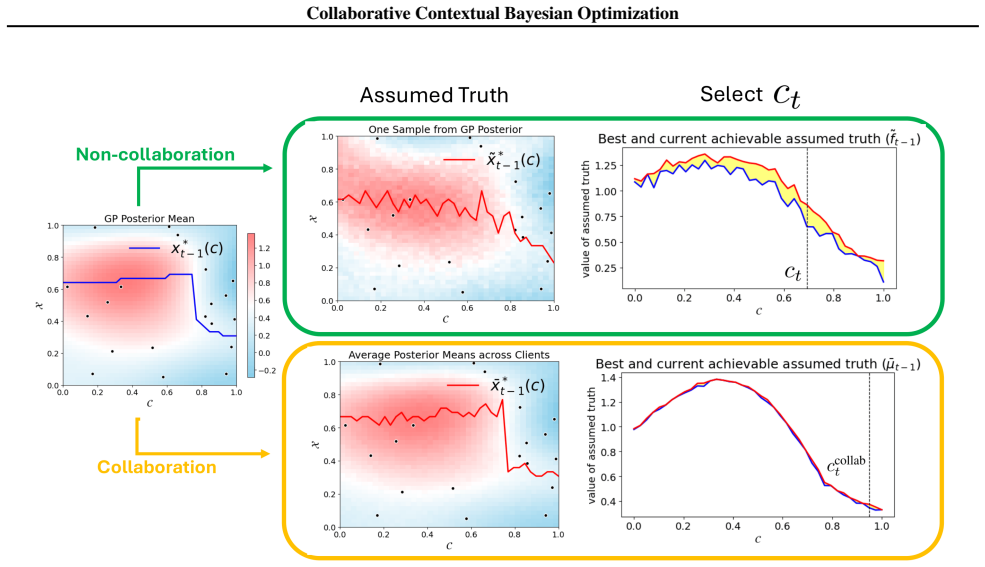
Multiple clients can jointly learn context-to-design mappings in Bayesian optimization by sharing information online or from past data, with sublinear regret even when their tasks differ.
A machine-rendered reading of the paper's core claim, the machinery that carries it, and where it could break.
Core claim
CCBO is a unified framework enabling multiple clients to jointly perform contextual Bayesian optimization with controllable contexts, supporting both online collaboration and offline initialization from peers' historical beliefs, along with an optional privacy-preserving communication mechanism, sublinear regret guarantees, and empirical improvements over non-collaborative methods under client heterogeneity.
What carries the argument
The CCBO collaboration protocol that coordinates multiple clients' belief updates on the context-to-optimal-design mapping while allowing controllable contexts and privacy options.
If this is right
- Clients require fewer sequential experiments to reach good designs for their individual contexts.
- Performance gains persist when tasks differ across clients.
- The same protocol applies to industrial processes such as hot rolling to reduce trial costs.
- Regret grows slower than linearly with the number of steps across all clients.
Where Pith is reading between the lines
- The approach could transfer to other multi-agent sequential decision tasks where contexts vary but some structure is shared.
- Privacy mechanisms open the door to applications in which raw data cannot leave each client.
- If contexts are not controllable by the clients, the collaboration benefit may shrink because the framework relies on choosing contexts to probe the mapping.
Load-bearing premise
The clients' tasks are sufficiently related for joint learning to help despite heterogeneity, and the context space permits effective approximation of the context-to-optimal-design mapping under the proposed collaboration protocol.
What would settle it
A set of trials in which clients have unrelated tasks and collaboration produces no reduction in regret or total experiments compared with running each client independently.
Figures



read the original abstract
Discovering optimal designs through sequential data collection is essential in many real-world applications. While Bayesian Optimization (BO) has achieved remarkable success in this setting, growing attention has recently turned to context-specific optimal design, formalized as Contextual Bayesian Optimization (CBO). Unlike BO, CBO is inherently more challenging as it must approximate an entire mapping from the context space to its corresponding optimal design, requiring simultaneous exploration across contexts and exploitation within each. In many modern applications, such tasks arise across multiple potentially heterogeneous but related clients, where collaboration can significantly improve learning efficiency. We propose CCBO, Collaborative Contextual Bayesian Optimization, a unified framework enabling multiple clients to jointly perform CBO with controllable contexts, supporting both online collaboration and offline initialization from peers' historical beliefs, with an optional privacy-preserving communication mechanism. We establish sublinear regret guarantees and demonstrate, through extensive simulations and a real-world hot rolling application, that CCBO achieves substantial improvements over existing approaches even under client heterogeneity. The code to reproduce the results can be found at https://github.com/cchihyu/Collaborative-Contextual-Bayesian-Optimization
Editorial analysis
A structured set of objections, weighed in public.
Referee Report
Summary. The paper proposes CCBO, a unified framework for multiple clients to jointly perform Contextual Bayesian Optimization (CBO) with controllable contexts. It supports online collaboration, offline initialization from peers' historical beliefs, and an optional privacy-preserving communication mechanism. The authors establish sublinear regret guarantees and claim substantial empirical improvements over baselines in simulations and a real-world hot rolling application, even under client heterogeneity. Reproducible code is provided via GitHub.
Significance. If the sublinear regret analysis holds under the stated collaboration protocol and the empirical gains prove robust to varying degrees of heterogeneity, this could meaningfully advance distributed BO methods for applications requiring context-specific optimization across related but heterogeneous tasks, such as manufacturing process control. The provision of reproducible code is a positive strength for verification.
major comments (2)
- [Theory/Regret Analysis] The sublinear regret claim (abstract and theory section) rests on the assumption that client tasks are sufficiently related for positive transfer via online sharing and offline initialization; no explicit heterogeneity bounds, conditions preventing negative transfer, or sensitivity analysis on task relatedness are provided, which is load-bearing for the central claim of improvements 'even under client heterogeneity'.
- [Experiments] In the experimental evaluation (simulations and hot rolling case), the protocol for approximating the context-to-optimal-design mapping and controlling contexts across clients is not detailed enough to confirm effective transfer without negative effects; this undermines assessment of whether the reported gains generalize beyond the tested setups.
minor comments (2)
- [Abstract] The abstract states 'extensive simulations' but does not specify key parameters such as number of clients, context dimensionality, or exact baseline implementations, which would aid clarity.
- [Method] Notation for the collaboration mechanism (e.g., how historical beliefs are initialized) could be made more precise in the method description to avoid ambiguity for readers implementing the approach.
Simulated Author's Rebuttal
We thank the referee for the constructive feedback on our manuscript. The comments highlight important aspects of the theoretical assumptions and experimental details that we will clarify and strengthen in the revision. We address each major comment below.
read point-by-point responses
-
Referee: [Theory/Regret Analysis] The sublinear regret claim (abstract and theory section) rests on the assumption that client tasks are sufficiently related for positive transfer via online sharing and offline initialization; no explicit heterogeneity bounds, conditions preventing negative transfer, or sensitivity analysis on task relatedness are provided, which is load-bearing for the central claim of improvements 'even under client heterogeneity'.
Authors: We appreciate the referee drawing attention to this point. Our regret analysis (Theorems 1 and 2) establishes sublinear collaborative regret under the model where clients share a common Gaussian process prior, with the collaboration protocol (online sharing of posteriors and offline initialization) inducing positive transfer when tasks are related through this shared structure. The analysis already incorporates a collaborative regret term that grows with the number of clients but remains sublinear in total observations. We agree, however, that explicit heterogeneity bounds and conditions to preclude negative transfer would make the assumptions more transparent and the claims more robust. In the revised manuscript we will add a dedicated subsection in Section 4 that (i) defines a quantitative heterogeneity measure (maximum discrepancy in mean functions or kernel hyperparameters across clients), (ii) states the precise conditions under which the shared prior guarantees non-negative transfer, and (iii) includes a brief sensitivity result showing how the regret constant scales with increasing heterogeneity. We will also move the existing simulation results that vary task dissimilarity into the main text as a new figure to illustrate the regime where gains persist. revision: yes
-
Referee: [Experiments] In the experimental evaluation (simulations and hot rolling case), the protocol for approximating the context-to-optimal-design mapping and controlling contexts across clients is not detailed enough to confirm effective transfer without negative effects; this undermines assessment of whether the reported gains generalize beyond the tested setups.
Authors: We agree that the current description of the experimental protocol is insufficiently precise. The manuscript outlines the high-level collaboration steps but omits the concrete implementation of context selection, the approximation of the context-to-optimal-design mapping, and the exact mechanism used to control contexts across clients. In the revision we will expand Section 5 and the appendix with: (i) pseudocode for the full CCBO protocol including how contexts are chosen and broadcast, (ii) a detailed description of the per-client GP approximation to the context-to-design mapping and how collaborative updates are performed, and (iii) additional ablation tables that report performance under controlled increases in context heterogeneity for both the synthetic and hot-rolling experiments. These additions will allow readers to verify that the observed gains arise from effective transfer rather than from the specific tested configurations. revision: yes
Circularity Check
No significant circularity; regret bounds rest on standard BO theory
full rationale
The paper defines CCBO as a collaborative extension of contextual BO, then states sublinear regret guarantees. These guarantees are presented as following from established Bayesian optimization analysis rather than from any internal fit, self-definition, or self-citation chain that collapses the claim back onto the paper's own inputs. No equations are shown that rename a fitted quantity as a prediction, smuggle an ansatz via prior self-work, or invoke a uniqueness theorem authored by the same team. Empirical gains are reported from simulations and a hot-rolling case study, which are external to the derivation. The derivation chain therefore remains self-contained against external benchmarks.
Axiom & Free-Parameter Ledger
axioms (2)
- domain assumption Gaussian process or equivalent surrogate models can approximate the context-to-design mapping with sublinear regret under standard regularity conditions.
- domain assumption Clients share related but heterogeneous contextual optimization tasks.
Reference graph
Works this paper leans on
-
[1]
Advances in Neural Information Processing Systems , volume=
Differentially private federated Bayesian optimization with distributed exploration , author=. Advances in Neural Information Processing Systems , volume=
-
[2]
1971 , publisher=
An introduction to probability theory and its applications , author=. 1971 , publisher=
1971
-
[3]
ACS Applied Materials & Interfaces , volume=
Scalable Accelerated Materials Discovery of Sustainable Polysaccharide-Based Hydrogels by Autonomous Experimentation and Collaborative Learning , author=. ACS Applied Materials & Interfaces , volume=. 2024 , publisher=
2024
-
[4]
IEEE Transactions on Pattern Analysis and Machine Intelligence , volume=
Federated Gaussian process: Convergence, automatic personalization and multi-fidelity modeling , author=. IEEE Transactions on Pattern Analysis and Machine Intelligence , volume=. 2024 , publisher=
2024
-
[5]
INFORMS Journal on Data Science , volume=
Gifair-fl: A framework for group and individual fairness in federated learning , author=. INFORMS Journal on Data Science , volume=. 2023 , publisher=
2023
-
[6]
2024 IEEE International Conference on Big Data (BigData) , pages=
Collaborative and federated black-box optimization: A Bayesian optimization perspective , author=. 2024 IEEE International Conference on Big Data (BigData) , pages=. 2024 , organization=
2024
-
[7]
Advances in neural information processing systems , volume=
Random features for large-scale kernel machines , author=. Advances in neural information processing systems , volume=
-
[8]
Advances in Neural Information Processing Systems , volume=
Offline contextual bayesian optimization , author=. Advances in Neural Information Processing Systems , volume=
-
[9]
International Conference on Machine Learning , pages=
Myopic posterior sampling for adaptive goal oriented design of experiments , author=. International Conference on Machine Learning , pages=. 2019 , organization=
2019
-
[10]
Journal of Artificial Intelligence Research , volume=
Adaptive submodularity: Theory and applications in active learning and stochastic optimization , author=. Journal of Artificial Intelligence Research , volume=
-
[11]
Advances in Neural Information Processing Systems , volume=
Federated Bayesian optimization via Thompson sampling , author=. Advances in Neural Information Processing Systems , volume=
-
[12]
Chang, Chih-Yu and Azvar, Milad and Okwudire, Chinedum and Kontar, Raed Al , journal=
-
[13]
Advances in neural information processing systems , volume=
Contextual gaussian process bandit optimization , author=. Advances in neural information processing systems , volume=
-
[14]
Machine learning for healthcare conference , pages=
Contextual bandits for adapting treatment in a mouse model of de novo carcinogenesis , author=. Machine learning for healthcare conference , pages=. 2018 , organization=
2018
-
[15]
Conference on learning theory , pages=
Analysis of thompson sampling for the multi-armed bandit problem , author=. Conference on learning theory , pages=. 2012 , organization=
2012
-
[16]
Transportation Research Part A: Policy and Practice , volume=
Contextual Bayesian optimization of congestion pricing with day-to-day dynamics , author=. Transportation Research Part A: Policy and Practice , volume=. 2024 , publisher=
2024
-
[17]
A Tutorial on Bayesian Optimization
A tutorial on Bayesian optimization , author=. arXiv preprint arXiv:1807.02811 , year=
work page internal anchor Pith review arXiv
-
[18]
International conference on machine learning , pages=
Thompson sampling for contextual bandits with linear payoffs , author=. International conference on machine learning , pages=. 2013 , organization=
2013
-
[19]
Proceedings of the IEEE , volume=
Taking the human out of the loop: A review of Bayesian optimization , author=. Proceedings of the IEEE , volume=. 2015 , publisher=
2015
-
[20]
Proceedings of the fourteenth international conference on artificial intelligence and statistics , pages=
Contextual bandits with linear payoff functions , author=. Proceedings of the fourteenth international conference on artificial intelligence and statistics , pages=. 2011 , organization=
2011
-
[21]
arXiv preprint arXiv:2204.11051 , year=
piBO: Augmenting acquisition functions with user beliefs for bayesian optimization , author=. arXiv preprint arXiv:2204.11051 , year=
-
[22]
and Bingham, D
Surjanovic, S. and Bingham, D. , title =
-
[23]
Advances in Neural Information Processing Systems , volume=
Principled Bayesian Optimization in Collaboration with Human Experts , author=. Advances in Neural Information Processing Systems , volume=
-
[24]
IEEE Transactions on Automation Science and Engineering , year=
Collaborative and distributed bayesian optimization via consensus , author=. IEEE Transactions on Automation Science and Engineering , year=
-
[25]
arXiv preprint arXiv:2302.13945 , year=
On differentially private federated linear contextual bandits , author=. arXiv preprint arXiv:2302.13945 , year=
-
[26]
Advances in neural information processing systems , volume=
Federated linear contextual bandits , author=. Advances in neural information processing systems , volume=
-
[27]
International Conference on Machine Learning , pages=
Federated linear contextual bandits with user-level differential privacy , author=. International Conference on Machine Learning , pages=. 2023 , organization=
2023
-
[28]
arXiv preprint arXiv:2504.10770 , year=
Collaborative Bayesian Optimization via Wasserstein Barycenters , author=. arXiv preprint arXiv:2504.10770 , year=
-
[29]
Technometrics , volume=
Multi-agent collaborative bayesian optimization via constrained gaussian processes , author=. Technometrics , volume=. 2025 , publisher=
2025
-
[30]
Algorithmica , volume=
Reinforcement learning with immediate rewards and linear hypotheses , author=. Algorithmica , volume=. 2003 , publisher=
2003
-
[31]
IEEE Robotics and Automation Letters , year=
Controller Adaptation via Learning Solutions of Contextual Bayesian Optimization , author=. IEEE Robotics and Automation Letters , year=
-
[32]
Journal of machine learning research , volume=
Using confidence bounds for exploitation-exploration trade-offs , author=. Journal of machine learning research , volume=
-
[33]
Journal of Machine Learning Research , volume=
An information-theoretic analysis of thompson sampling , author=. Journal of Machine Learning Research , volume=
-
[34]
Proceedings of the VLDB Endowment , volume=
Cgptuner: a contextual gaussian process bandit approach for the automatic tuning of it configurations under varying workload conditions , author=. Proceedings of the VLDB Endowment , volume=
-
[35]
Sustainable Energy Technologies and Assessments , volume=
Contextual Bayesian optimization with trust region (CBOTR) and its application to cooperative wind farm control in region 2 , author=. Sustainable Energy Technologies and Assessments , volume=. 2020 , publisher=
2020
-
[36]
Advances in Neural Information Processing Systems , volume=
Expected improvement for contextual bandits , author=. Advances in Neural Information Processing Systems , volume=
-
[37]
arXiv preprint arXiv:2007.07876 , year=
Upper counterfactual confidence bounds: a new optimism principle for contextual bandits , author=. arXiv preprint arXiv:2007.07876 , year=
-
[38]
Proceedings of the 24th annual Conference On Learning Theory , pages=
Contextual bandits with similarity information , author=. Proceedings of the 24th annual Conference On Learning Theory , pages=. 2011 , organization=
2011
discussion (0)
Sign in with ORCID, Apple, or X to comment. Anyone can read and Pith papers without signing in.