Recognition: unknown
Self-Noise Reduction for Capacitive Sensors via Photoelectric DC Servo: Application to Condenser Microphones
Pith reviewed 2026-05-10 01:54 UTC · model grok-4.3
The pith
Photoelectric DC servo replaces gate-bias resistor to cut condenser microphone self-noise to 11 dBA.
A machine-rendered reading of the paper's core claim, the machinery that carries it, and where it could break.
Core claim
The authors establish that a photoelectric DC servo amplifier (PDS-Amp) reduces self-noise by substituting the noisy gate-bias resistor with a zinc-photocathode photosensor that supplies sub-picoampere dark current as a controlled current source. A DC servo loop with lag-lead compensation senses the preamplifier output and drives an LED to regulate photocurrent, thereby decoupling the noise low-pass cutoff frequency from the signal high-pass cutoff frequency. When combined with a cascode JFET input stage, the circuit delivers 11 dBA A-weighted self-noise with a 12 pF dummy microphone capsule, a level previously associated only with far larger and more expensive condenser microphones; actual-
What carries the argument
PDS-Amp (Photoelectric DC Servo Amplifier), a feedback circuit that uses a custom zinc-photocathode photosensor as an ultra-high-impedance current source whose photocurrent is regulated by an LED driven from a lag-lead compensated DC servo loop around the preamplifier output.
If this is right
- The noise low-pass cutoff and signal high-pass cutoff become independently adjustable, removing the previous bandwidth-noise trade-off.
- Small-diameter ECM capsules can reach noise performance previously limited to large-diaphragm studio microphones.
- Background-noise reduction is confirmed qualitatively in actual capsule recordings.
- The same bias-replacement technique extends directly to accelerometers, pressure sensors, and pyroelectric sensors.
Where Pith is reading between the lines
- Commercial production of the zinc-photocathode sensor would be needed before the technique can be adopted in mass-market devices.
- The servo approach could be combined with modern low-voltage JFETs or MEMS structures to shrink overall sensor size while preserving the noise gain.
- Because the photosensor replaces a discrete resistor, the circuit might allow tighter integration inside the microphone housing itself.
Load-bearing premise
The custom zinc-photocathode photosensor maintains stable sub-picoampere dark current and introduces no additional noise, drift, or instability when operated inside the active DC servo loop.
What would settle it
Measure the A-weighted equivalent input noise of the full PDS-Amp circuit with a 12 pF capacitor substituting for the microphone capsule under controlled acoustic conditions and check whether the result stays at or below 11 dBA.
Figures



read the original abstract
The self-noise of capacitive sensors, primarily caused by thermal noise from the gate-bias resistor in the preamplifier, imposes a fundamental limit on measurement sensitivity. In electret condenser microphones (ECMs), this resistor simultaneously determines the noise low-pass cutoff frequency and the signal high-pass cutoff frequency through a single RC time constant, creating a trade-off between noise reduction and signal bandwidth. This paper proposes PDS-Amp (Photoelectric DC Servo Amplifier), a circuit technique that replaces the gate-bias resistor with a photoelectric element functioning as an ultra-high-impedance current source. A DC servo loop using lag-lead compensation feeds back the preamplifier output through an LED to control the photocurrent, thereby stabilizing the gate bias while decoupling the noise and signal cutoff frequencies. A custom photosensor based on the external photoelectric effect of a zinc photocathode was fabricated to achieve sub-picoampere dark current, overcoming the limitations of commercial semiconductor photodiodes. Combined with a cascode JFET preamplifier that minimizes input capacitance through bootstrap action, PDS-Amp achieved a self-noise of 11 dBA with a 12 pF dummy microphone. Despite using a small-diameter ECM capsule, this performance is comparable to that of large-diaphragm condenser microphones costing several thousand dollars. Recording experiments with an actual ECM capsule qualitatively confirmed a significant reduction in background noise. The proposed technique is applicable not only to microphones but broadly to capacitive sensors including accelerometers, pressure sensors, and pyroelectric sensors.
Editorial analysis
A structured set of objections, weighed in public.
Referee Report
Summary. The manuscript proposes PDS-Amp, a photoelectric DC servo amplifier that replaces the traditional gate-bias resistor in capacitive sensor preamplifiers with a custom zinc-photocathode photoelectric current source controlled via a lag-lead compensated DC servo loop. This decouples the noise low-pass cutoff from the signal high-pass cutoff. Combined with a cascode JFET preamplifier using bootstrap to minimize input capacitance, the work reports achieving 11 dBA self-noise with a 12 pF dummy microphone and qualitatively confirms noise reduction using an actual ECM capsule, claiming performance comparable to expensive large-diaphragm condenser microphones.
Significance. If the performance claims are substantiated with adequate data, the technique could meaningfully advance low-noise design for capacitive sensors by removing the resistor-induced noise-bandwidth trade-off, with potential applications beyond microphones to accelerometers and pressure sensors. The custom fabrication of a sub-pA dark current zinc photocathode is a technical strength that addresses limitations of commercial photodiodes.
major comments (3)
- [Abstract] Abstract: the central claim of 11 dBA self-noise with a 12 pF dummy microphone is stated without raw data, noise spectra, error bars, measurement conditions, or circuit schematics, so the headline performance result cannot be evaluated from the provided text.
- [Circuit and Photosensor Description] Circuit description and photosensor section: the assumption that the zinc-photocathode photosensor contributes zero excess noise, drift, or instability when placed in the active DC servo loop is not supported by any isolated characterization of its current noise spectral density, long-term drift, or closed-loop residual noise; any 1/f component would appear directly at the JFET gate and could account for part of the reported floor.
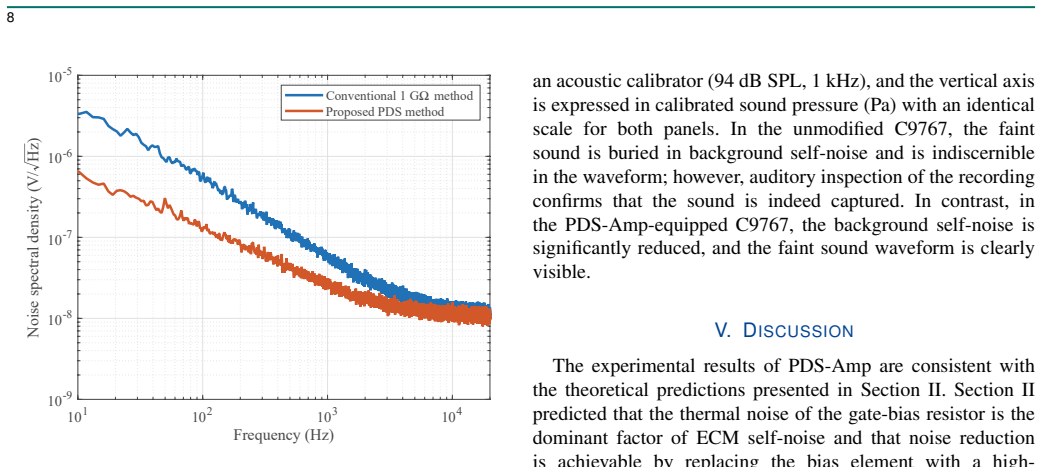
- [Experimental Validation] Experimental results: no baseline comparison is provided with a conventional resistor-biased preamplifier under matched conditions to quantify the improvement attributable to the PDS-Amp technique versus the cascode JFET alone.
minor comments (1)
- [Abstract] The abstract and text could clarify the exact frequency weighting and bandwidth used for the dBA self-noise figure to allow direct comparison with standard microphone specifications.
Simulated Author's Rebuttal
We thank the referee for the constructive and detailed review. We address each major comment point by point below, providing the strongest honest defense of the manuscript while agreeing to revisions where the concerns are valid and the manuscript can be improved without misrepresentation.
read point-by-point responses
-
Referee: [Abstract] Abstract: the central claim of 11 dBA self-noise with a 12 pF dummy microphone is stated without raw data, noise spectra, error bars, measurement conditions, or circuit schematics, so the headline performance result cannot be evaluated from the provided text.
Authors: The abstract is intentionally concise per journal guidelines and summarizes the headline result. The supporting raw data, A-weighted noise spectra, error bars from repeated measurements, detailed conditions (e.g., 20 Hz–20 kHz integration, dummy capacitor substitution), and circuit schematics are all present in the main text (Section 4, Figures 5–7). The 11 dBA value is obtained by integrating the measured PSD after A-weighting. To improve evaluability from the abstract alone, we will revise it to briefly reference the measurement bandwidth, dummy capacitance, and direct the reader to the relevant sections and figures for the spectra and conditions. revision: partial
-
Referee: [Circuit and Photosensor Description] Circuit description and photosensor section: the assumption that the zinc-photocathode photosensor contributes zero excess noise, drift, or instability when placed in the active DC servo loop is not supported by any isolated characterization of its current noise spectral density, long-term drift, or closed-loop residual noise; any 1/f component would appear directly at the JFET gate and could account for part of the reported floor.
Authors: This observation is correct and highlights a presentational gap. The manuscript reports the zinc photocathode's sub-pA dark current and the overall closed-loop system noise floor but does not include separate, isolated measurements of the photosensor's current noise spectral density or long-term drift when biased in the servo configuration. Any 1/f component would indeed couple directly to the JFET gate. We will add this characterization in the revision (new measurements of photocurrent PSD from 0.1 Hz to 1 kHz and 24-hour drift data), allowing readers to quantify its contribution to the reported floor and to confirm that it remains negligible relative to the JFET thermal noise. revision: yes
-
Referee: [Experimental Validation] Experimental results: no baseline comparison is provided with a conventional resistor-biased preamplifier under matched conditions to quantify the improvement attributable to the PDS-Amp technique versus the cascode JFET alone.
Authors: We agree that a matched baseline comparison would more clearly isolate the benefit of replacing the resistor with the PDS-Amp. The presented results demonstrate the complete system (PDS-Amp + cascode JFET + 12 pF dummy) but do not include a side-by-side measurement with a conventional high-value resistor bias under identical conditions (same JFET, bootstrap, capsule substitution, and instrumentation). We will add this comparison in the revised manuscript, including noise spectra for both configurations, to quantify the noise reduction specifically attributable to the servo technique. revision: yes
Circularity Check
No circularity: experimental circuit design with direct measurements
full rationale
The paper describes a hardware implementation (PDS-Amp with custom zinc-photocathode photosensor and lag-lead servo) and reports measured self-noise (11 dBA on 12 pF dummy). No equations, fitted parameters, or predictions are presented that reduce to the inputs by construction. Claims rest on lab measurements rather than derivations or self-citation chains. The absence of isolated photosensor noise characterization is a supportability issue, not circularity.
Axiom & Free-Parameter Ledger
axioms (1)
- domain assumption External photoelectric effect on zinc photocathode can sustain sub-picoampere dark current under the operating conditions of the servo loop.
invented entities (1)
-
PDS-Amp (Photoelectric DC Servo Amplifier)
no independent evidence
Reference graph
Works this paper leans on
-
[1]
A. J. Cheng, L. Wu, Z. Sha, W. Chang, D. Chu, C. H. Wang, and S. Peng, “Recent Advances of Capacitive Sensors: Materials, Microstructure Designs, Applications, and Opportunities,”Advanced Materials Technologies, vol. 8, no. 11, p. 2201959, 2023. [Online]. Available: https://onlinelibrary.wiley.com/doi/abs/10.1002/admt.202201959
-
[2]
Eargle,The Microphone Book
J. Eargle,The Microphone Book. Taylor & Francis, 2004
2004
-
[3]
Electrostatic microphones with electret foil,
G. M. Sessler, “Electrostatic microphones with electret foil,”The Journal of the Acoustical Society of America, vol. 35, no. 9, pp. 1354–1357, Sep. 1963
1963
-
[4]
A Review of MEMS Capacitive Microphones,
S. A. Zawawi, A. A. Hamzah, B. Y . Majlis, and F. Mohd-Yasin, “A Review of MEMS Capacitive Microphones,”Micromachines, vol. 11, no. 5, p. 484, May 2020. [Online]. Available: https://pmc.ncbi.nlm.nih.gov/articles/PMC7281444/
2020
-
[5]
High PSRR and low output impedance preamplifier circuit for plugin-powered electret condenser microphone,
H. Obo, T. Ebihara, K. Mizutani, and N. Wakatsuki, “High PSRR and low output impedance preamplifier circuit for plugin-powered electret condenser microphone,”IEEE Sensors Journal, vol. 25, no. 20, pp. 38 206–38 216, Oct. 2025
2025
-
[6]
Cordell,Designing Audio Circuits and Systems
B. Cordell,Designing Audio Circuits and Systems. Routledge/Taylor & Francis Group, 2024
2024
-
[7]
C. D. Motchenbacher and J. A. Connelly,Low-Noise Electronic System Design. New York: Wiley-Interscience, 1993
1993
-
[8]
Background noise in piezoresistive, electret condenser, and ceramic microphones,
A. J. Zuckerwar, T. R. Kuhn, and R. M. Serbyn, “Background noise in piezoresistive, electret condenser, and ceramic microphones,”The Journal of the Acoustical Society of America, vol. 113, no. 6, pp. 3179– 3187, Jun. 2003
2003
-
[9]
General considerations of noise in microphone preamplifiers,
A. G. H. van der Donk, J. A. V oorthuyzen, and P. Bergveld, “General considerations of noise in microphone preamplifiers,”Sensors and Actuators A: Physical, vol. 0, no. 25, pp. 515–520, 1991. [Online]. Available: https://research.utwente.nl/en/publications/general- considerations-of-noise-in-microphone-preamplifiers-3/
1991
-
[10]
A novel charge sensitive preamplifier without the feedback resistor,
G. Bertuccio, P. Rehak, and D. Xi, “A novel charge sensitive preamplifier without the feedback resistor,”Nuclear Instruments and Methods in Physics Research Section A: Accelerators, Spectrometers, Detectors and Associated Equipment, vol. 326, no. 1, pp. 71–76, Mar. 1993
1993
-
[11]
An Analog Readout Circuit With a Noise-Reduction Input Buffer for MEMS Microphone,
Z. Li, L. Dong, H. Li, J. Zhang, X. Wang, and H. Zhang, “An Analog Readout Circuit With a Noise-Reduction Input Buffer for MEMS Microphone,”IEEE Transactions on Circuits and Systems II: Express Briefs, vol. 69, no. 10, pp. 3983–3987, Oct. 2022. [Online]. Available: https://ieeexplore.ieee.org/document/9805762
-
[12]
Noise analysis of a very low-level DC current amplifier using photocoupler negative feedback circuit,
H. Higa, J. Iwaki, A. Kadekaru, and I. Nakamura, “Noise analysis of a very low-level DC current amplifier using photocoupler negative feedback circuit,”Electronics and Communications in Japan (Part II: Electronics), vol. 89, no. 12, pp. 17–25, 2006
2006
-
[13]
JFE2140 ultra-low noise, matched, dual, low-gate current, discrete, audio, N-channel JFET datasheet (rev. B),
Texas Instruments, “JFE2140 ultra-low noise, matched, dual, low-gate current, discrete, audio, N-channel JFET datasheet (rev. B),” accessed: 2026-03-02. [Online]. Available: https://www.ti.com/lit/ds/symlink/jfe2140.pdf
2026
-
[14]
Readout Circuits for Capacitive Sensors,
Y . Yoo and B.-D. Choi, “Readout Circuits for Capacitive Sensors,” Micromachines, vol. 12, no. 8, p. 960, Aug. 2021. [Online]. Available: https://pmc.ncbi.nlm.nih.gov/articles/PMC8400189/
2021
-
[15]
On the operation of cascode gain stages,
A. A. Abidi, “On the operation of cascode gain stages,”IEEE Journal of Solid-State Circuits, vol. 23, no. 6, pp. 1434–1437, Dec. 1988
1988
-
[16]
JFE2140 Ultra-Low-Noise Pre-Amplifier,
C. Featherstone, “JFE2140 Ultra-Low-Noise Pre-Amplifier,” 2023
2023
-
[17]
A 0.3 nV/√Hz input-referred-noise analog front-end for radiation-induced thermo-acoustic pulses,
E. A. Vallicelli, D. Turossi, L. Gelmi, A. Ba `u, R. Bertoni, W. Fulgione, A. Quintino, M. Corcione, A. Baschirotto, and M. De Matteis, “A 0.3 nV/√Hz input-referred-noise analog front-end for radiation-induced thermo-acoustic pulses,”Integration, vol. 74, pp. 11–18, Sep. 2020
2020
-
[18]
S5973-01 Si PIN photodi- ode datasheet,
Hamamatsu Photonics, “S5973-01 Si PIN photodi- ode datasheet,” accessed: 2026-03-02. [Online]. Avail- able: https://www.marutsu.co.jp/contents/shop/marutsu/datasheet/S5973- 01.pdf
2026
-
[19]
The work function of the elements and its periodic- ity,
H. B. Michaelson, “The work function of the elements and its periodic- ity,”Journal of Applied Physics, vol. 48, no. 11, pp. 4729–4733, Nov. 1977
1977
-
[20]
Photoemission studies on metals using picosecond ultraviolet laser pulses,
T. Srinivasan-Rao, J. Fischer, and T. Tsang, “Photoemission studies on metals using picosecond ultraviolet laser pulses,”Journal of Applied Physics, vol. 69, no. 5, pp. 3291–3296, Mar. 1991
1991
-
[21]
IEC 61672-1:2013 Electroacoustics – Sound level meters – Part 1: Specifications,
International Electrotechnical Commission, “IEC 61672-1:2013 Electroacoustics – Sound level meters – Part 1: Specifications,”
2013
-
[22]
Available: https://webstore.iec.ch/en/publication/5708
[Online]. Available: https://webstore.iec.ch/en/publication/5708
-
[23]
C9767BB422LFP electret condenser micro- phone datasheet,
CUI Devices, “C9767BB422LFP electret condenser micro- phone datasheet,” accessed: 2026-03-02. [Online]. Available: https://akizukidenshi.com/goodsaffix/C9767BB422LFP.pdf
2026
-
[24]
Type 4231 sound calibrator,
HBK (Hottinger Br ¨uel & Kjær), “Type 4231 sound calibrator,” accessed: 2026-03-02. [Online]. Available: https://www.hbkworld.com/en/products/transducers/acoustic/acoustic- calibrators/microphone/4231
2026
-
[25]
A low noise cascode amplifier,
S. R. Jefferts and F. L. Walls, “A low noise cascode amplifier,”Journal of Research of the National Bureau of Standards, vol. 92, no. 6, pp. 383–386, Nov. 1987
1987
-
[26]
KSM44A large diaphragm multi-pattern condenser microphone,
Shure Incorporated, “KSM44A large diaphragm multi-pattern condenser microphone,” accessed: 2026-03-03. [Online]. Available: https://www.shure.com/en-us/products/microphones/ksm44a
2026
-
[27]
LCT 540 S studio condenser microphone,
Lewitt Audio, “LCT 540 S studio condenser microphone,” accessed: 2026-03-03. [Online]. Available: https://www.lewitt- audio.com/microphones/lct-recording/lct-540s
2026
-
[28]
NT1 studio condenser microphone,
RØDE Microphones, “NT1 studio condenser microphone,” accessed: 2026-03-03. [Online]. Available: https://rode.com/products/nt1
2026
-
[29]
AT5040 cardioid condenser microphone,
Audio-Technica Corporation, “AT5040 cardioid condenser microphone,” accessed: 2026-03-03. [Online]. Available: https://www.audio- technica.com/en-us/at5040
2026
-
[30]
Type 4955 classical low- noise microphone,
HBK (Hottinger Br ¨uel & Kjær), “Type 4955 classical low- noise microphone,” accessed: 2026-03-03. [Online]. Available: https://www.bksv.com/transducers/acoustic/microphones/microphone- set/4955
2026
-
[31]
Con- denser microphone MKH 8020,
Sennheiser Electronic GmbH & Co. KG, “Con- denser microphone MKH 8020,” accessed: 2026- 03-03. [Online]. Available: https://www.sennheiser.com/en- us/catalog/products/microphones/mkh-8020/mkh-8020-506287
2026
-
[32]
U 87 Ai studio microphone,
Georg Neumann GmbH, “U 87 Ai studio microphone,” accessed: 2026-03-03. [Online]. Available: https://www.neumann.com/en- us/products/microphones/u-87-ai
2026
-
[33]
Con- denser microphone MKH 50 P48,
Sennheiser Electronic GmbH & Co. KG, “Con- denser microphone MKH 50 P48,” accessed: 2026- 03-03. [Online]. Available: https://www.sennheiser.com/en- us/catalog/products/microphones/mkh-50/mkh-50-p48-003109
2026
-
[34]
Type 4188 free-field microphone,
HBK (Hottinger Br ¨uel & Kjær), “Type 4188 free-field microphone,” accessed: 2026-03-03. [Online]. Available: https://www.hbkworld.com/en/products/transducers/acoustic/microphone- cartridges/free-field/4188
2026
-
[35]
4006 omnidirectional micro- phone,
DPA Microphones, “4006 omnidirectional micro- phone,” accessed: 2026-03-03. [Online]. Available: https://www.dpamicrophones.com/microphones/pencil/4006
2026
-
[36]
Acoustical-Thermal Noise in a Capacitive MEMS Microphone,
B.-H. Kim and H.-S. Lee, “Acoustical-Thermal Noise in a Capacitive MEMS Microphone,”IEEE Sensors Journal, vol. 15, no. 12, pp. 6853–6860, Dec. 2015. [Online]. Available: http://ieeexplore.ieee.org/document/7185337/
-
[37]
Developing and Testing High-Performance SHM Sensors Mounting Low-Noise MEMS Accelerometers,
M. Crognale, C. Rinaldi, F. Potenza, V . Gattulli, A. Colarieti, and F. Franchi, “Developing and Testing High-Performance SHM Sensors Mounting Low-Noise MEMS Accelerometers,”Sensors (Basel, Switzerland), vol. 24, no. 8, p. 2435, Apr. 2024. [Online]. Available: https://pmc.ncbi.nlm.nih.gov/articles/PMC11054890/ H.OBOet al.: SELF-NOISE REDUCTION FOR CAPACIT...
2024
discussion (0)
Sign in with ORCID, Apple, or X to comment. Anyone can read and Pith papers without signing in.