Debating the Unspoken: Role-Anchored Multi-Agent Reasoning for Half-Truth Detection
Pith reviewed 2026-07-05 10:00 UTC · model glm-5.2
The pith
Role-playing LLM agents catch what fact-checkers miss: omitted truth
A machine-rendered reading of the paper's core claim, the machinery that carries it, and where it could break.
Core claim
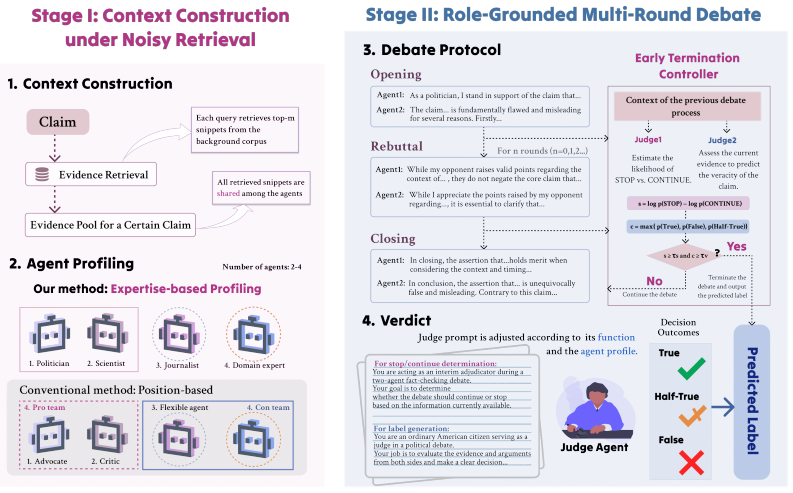
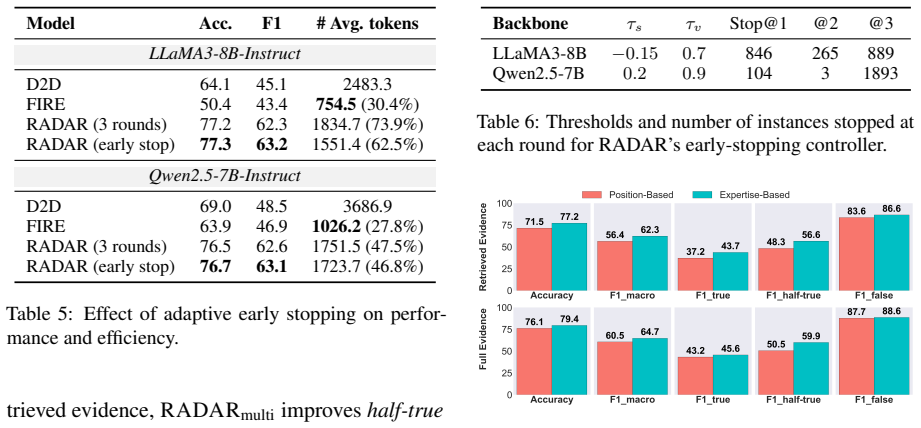
The paper's central claim is that assigning fixed, complementary adversarial roles to LLM agents (Politician, Scientist, Judge) and moderating their debate with a dual-threshold early termination controller yields a system that is both more accurate and more efficient than existing single- or multi-agent approaches for detecting half-truths — claims that are technically true but misleading due to omitted context. The discovery is that the combination of role anchoring and adaptive stopping is the load-bearing design choice: roles ensure the system reasons about what is unsaid, and the termination controller ensures it does so without runaway cost.
What carries the argument
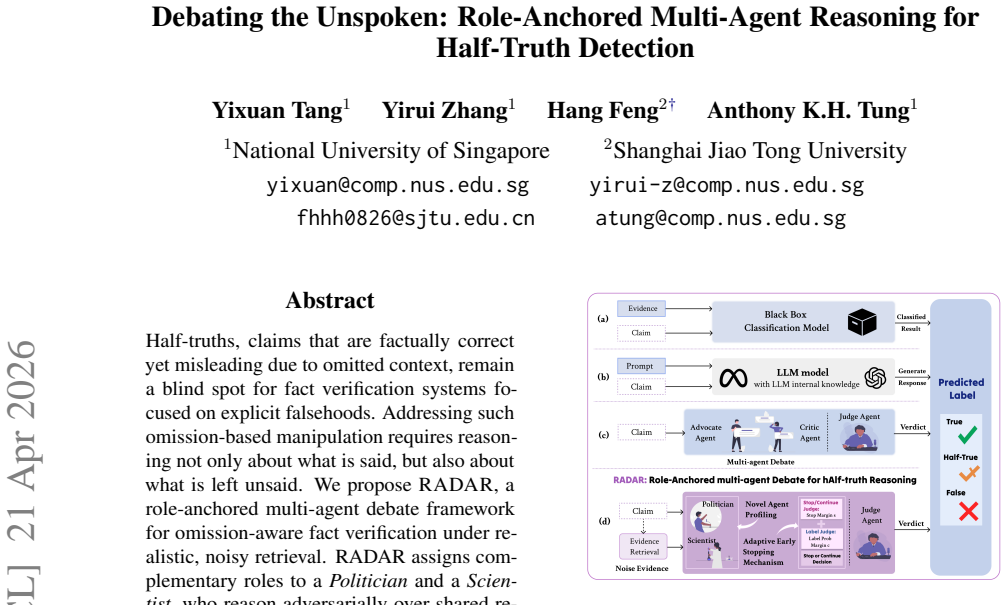
RADAR (Role-Anchored multi-Agent Reasoning): a framework with three components — (1) role assignment: a Politician agent argues the claim is misleading via omission, a Scientist agent argues it is supported by retrieved evidence, a Judge agent moderates and renders a verdict; (2) retrieval-grounded shared evidence: both reasoning agents work from the same noisy retrieved context; (3) dual-threshold early termination controller: adaptively decides when sufficient reasoning has occurred to stop debate and issue a verdict, using two thresholds to balance confidence and effort.
Load-bearing premise
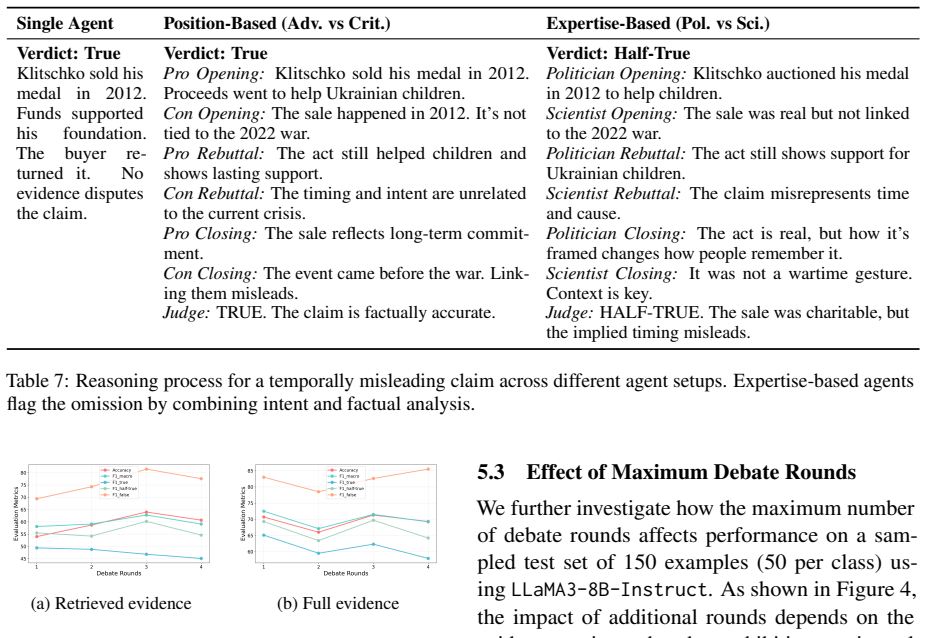
The framework assumes that assigning fixed role labels (Politician, Scientist, Judge) to LLM agents causes them to reason in genuinely different, complementary ways about omitted context — rather than producing superficially different text that collapses to the same underlying pattern-matching. The entire accuracy gain depends on this role assignment creating real cognitive diversity. The dual-threshold termination controller also assumes that 'sufficient reasoning' can be可靠地
What would settle it
RADAR would be falsified if, in controlled experiments, the role assignments (Politician, Scientist, Judge) produced no measurable difference in reasoning behavior compared to unrole-assigned agents debating the same evidence — i.e., if the accuracy gains disappeared when the role prompts were replaced with generic debate prompts. It would also be falsified if the dual-threshold controller's performance were matched or exceeded by a trivial fixed-round debate, showing the adaptive termination adds no value.
Figures
read the original abstract
Half-truths, claims that are factually correct yet misleading due to omitted context, remain a blind spot for fact verification systems focused on explicit falsehoods. Addressing such omission-based manipulation requires reasoning not only about what is said, but also about what is left unsaid. We propose RADAR, a role-anchored multi-agent debate framework for omission-aware fact verification under realistic, noisy retrieval. RADAR assigns complementary roles to a Politician and a Scientist, who reason adversarially over shared retrieved evidence, moderated by a neutral Judge. A dual-threshold early termination controller adaptively decides when sufficient reasoning has been reached to issue a verdict. Experiments show that RADAR consistently outperforms strong single- and multi-agent baselines across datasets and backbones, improving omission detection accuracy while reducing reasoning cost. These results demonstrate that role-anchored, retrieval-grounded debate with adaptive control is an effective and scalable framework for uncovering missing context in fact verification.
Editorial analysis
A structured set of objections, weighed in public.
Referee Report
Summary. The manuscript under review is arXiv:2604.19005 (cs.CL), titled 'Debating the Unspoken: Role-Anchored Multi-Agent Reasoning for Half-Truth Detection,' which proposes RADAR, a role-anchored multi-agent debate framework for omission-aware fact verification. However, the full text provided for review is from an entirely different paper: 'ExplainS2A: Explainable Spectral-Spatial Duality Model for Fast Transforming Sentinel-2 Image to AVIRIS-Level Hyperspectral Image' by Chia-Hsiang Lin and Zi-Chao Leng (arXiv:2604.19007v1, eess.IV). The full text contains no content related to RADAR, multi-agent debate, half-truth detection, or any NLP/fact verification methodology. The arXiv ID in the full text header (2604.19007v1) also differs from the one cited in the review assignment (2604.19005). This is a document-level mismatch: the abstract describes an NLP framework while the full text is a remote sensing / hyperspectral imaging paper. No substantive assessment of RADAR's correctness, novelty, experimental rigor, or empirical claims can be made from the available material.
Significance. No assessment of significance is possible. The abstract describes a potentially interesting framework for omission-aware fact verification using role-anchored multi-agent debate with adaptive termination. If the full RADAR paper were available and its claims held, the work could be significant for the fact verification community. However, the provided full text is an unrelated hyperspectral imaging paper, so no evaluation of the actual contribution can be conducted.
major comments (1)
- Document mismatch: The full text provided for review corresponds to an entirely different paper (ExplainS2A, arXiv:2604.19007v1, eess.IV) about spectral-spatial super-resolution of Sentinel-2 satellite imagery. None of RADAR's methodology, experiments, baselines, datasets, or results are present. The arXiv ID in the full text (2604.19007) also differs from the assignment (2604.19005). No assessment of the manuscript's central claims is possible until the correct full text is provided.
minor comments (2)
- The abstract alone is well-written and clearly motivates the problem of half-truth detection. If the full RADAR manuscript matches the abstract's quality, it would benefit from reporting datasets, metrics, error bars, and statistical significance tests in the experiments section.
- If the full RADAR manuscript becomes available, the dual-threshold early termination controller's parameters should be explicitly reported, along with sensitivity analysis showing robustness to threshold choices.
Simulated Author's Rebuttal
We thank the referee for their careful attention. The referee's sole major comment is correct: the full text provided for review is not our manuscript. We acknowledge the document mismatch and cannot offer any substantive defense of our paper's content against a review that, through no fault of the referee's, never received it.
read point-by-point responses
-
Referee: Document mismatch: The full text provided for review corresponds to an entirely different paper (ExplainS2A, arXiv:2604.19007v1, eess.IV) about spectral-spatial super-resolution of Sentinel-2 satellite imagery. None of RADAR's methodology, experiments, baselines, datasets, or results are present. The arXiv ID in the full text (2604.19007) also differs from the assignment (2604.19005). No assessment of the manuscript's central claims is possible until the correct full text is provided.
Authors: The referee is entirely correct. The full text provided for review is from arXiv:2604.19007 (ExplainS2A, by Lin and Leng), a hyperspectral imaging paper that has no connection whatsoever to our work on RADAR. We have confirmed that the arXiv ID in the provided full text (2604.19007) differs from our manuscript's ID (2604.19005). This is a document-level mismatch that occurred at the submission or distribution stage, not an issue with the referee's diligence. We cannot and do not attempt to defend RADAR's methodology, experiments, or claims in this response, because the referee has not seen them. We are taking immediate steps to ensure the correct full text of arXiv:2604.19005 is made available for review. We respectfully request that, once the correct manuscript is provided, the referee be given the opportunity to evaluate the actual content. We have no standing objection to the referee's report as written — it accurately describes the situation they encountered. revision: yes
Circularity Check
Document mismatch: full text is an unrelated hyperspectral imaging paper, not the RADAR paper; no circularity assessment possible
full rationale
The provided full text is from an entirely different paper (ExplainS2A by Lin and Leng, arXiv:2604.19007v1, eess.IV) about spectral-spatial super-resolution of Sentinel-2 satellite imagery. The abstract describes RADAR (arXiv:2604.19005, cs.CL), a role-anchored multi-agent debate framework for half-truth detection. None of RADAR's methodology, experiments, or derivations appear in the full text. Because the document content does not correspond to the paper under review, no derivation chain can be walked and no circularity assessment is possible. This is a document-level mismatch, not evidence of circularity in the RADAR paper itself. The score is 0 by default: no circularity can be identified when the paper's actual content is absent.
Axiom & Free-Parameter Ledger
free parameters (2)
- Dual-threshold parameters for early termination =
Not stated in abstract
- Agent role prompts and system instructions =
Not stated in abstract
axioms (3)
- domain assumption LLM agents with assigned roles produce meaningfully different reasoning patterns than unassigned agents
- domain assumption Half-truths can be reliably detected through adversarial debate over retrieved evidence
- ad hoc to paper A dual-threshold controller can reliably determine when sufficient reasoning has occurred
invented entities (1)
-
Dual-threshold early termination controller
no independent evidence
Forward citations
Cited by 1 Pith paper
-
The Warrant Gap: Claim-Conditioned Re-scoring for Fact-Checking
Introduces claim-conditioned re-scoring (SIFT) and warranted supports proportion (WSP) metric, reporting accuracy recovery up to 27.6 points and WSP calibration at AUC 0.92 on FEVER, SciFact and other benchmarks.
Reference graph
Works this paper leans on
-
[1]
We thank the National Center for Theoretical Sciences (NCTS) and the National Center for High-performance Computing (NCHC) for providing the computing resources.(Corresponding Author: Chia-Hsiang Lin) C.-H. Lin is with the Department of Electrical Engineering, Na- tional Cheng Kung University, Tainan 70101, Taiwan (e-mail: chiah- siang.steven.lin@gmail.co...
work page internal anchor Pith review Pith/arXiv arXiv 2026
-
[2]
Generalized assorted pixel camera: Postcapture control of resolution, dynamic range, and spectrum,
F. Yasuma, T. Mitsunaga, D. Iso, and S. K. Nayar, “Generalized assorted pixel camera: Postcapture control of resolution, dynamic range, and spectrum,”IEEE Transactions on Image Processing, vol. 19, no. 9, pp. 2241–2253, Sep. 2010
work page 2010
-
[3]
Spectral super-resolution meets deep learning: Achievements and challenges,
J. He, Q. Yuan, J. Li, Y . Xiao, D. Liu, H. Shen, and L. Zhang, “Spectral super-resolution meets deep learning: Achievements and challenges,” Information Fusion, vol. 97, pp. 1–22, Sep. 2023
work page 2023
-
[4]
Significant remote sensing vegetation indices: A review of developments and applications,
J. Xue and B. Su, “Significant remote sensing vegetation indices: A review of developments and applications,”Journal of Sensors, vol. 2017, no. 1, pp. 1–17, May 2017
work page 2017
-
[5]
C.-H. Lin, S.-H. Huang, T.-H. Lin, and P.-C. Wu, “Metasurface- empowered snapshot hyperspectral imaging with convex/deep (CODE) small-data learning theory,”Nature Communications, vol. 14, no. 1, pp. 1–10, Nov. 2023
work page 2023
-
[6]
A fea- sibility study for signal-in-space design for LEO-PNT solutions with miniaturized satellites,
R. M. Ferre, J. Praks, G. Seco-Granados, and E. S. Lohan, “A fea- sibility study for signal-in-space design for LEO-PNT solutions with miniaturized satellites,”IEEE Journal on Miniaturization for Air and Space Systems, vol. 3, no. 4, pp. 171–183, Sep. 2022
work page 2022
-
[7]
All-addition hyperspectral compressed sensing for metasurface-driven miniaturized satellite,
C.-H. Lin and T.-H. Lin, “All-addition hyperspectral compressed sensing for metasurface-driven miniaturized satellite,”IEEE Transactions on Geoscience and Remote Sensing, vol. 60, pp. 1–15, Mar. 2021
work page 2021
-
[8]
Advances in information processing and biological imaging using flat optics,
X. Wanget al., “Advances in information processing and biological imaging using flat optics,”Nature Reviews Electrical Engineering, vol. 1, no. 6, pp. 391–411, May 2024
work page 2024
-
[9]
HyperQUEEN: Hyperspectral quantum deep network for image restoration,
C.-H. Lin and Y .-Y . Chen, “HyperQUEEN: Hyperspectral quantum deep network for image restoration,”IEEE Transactions on Geoscience and Remote Sensing, vol. 61, pp. 1–20, May 2023
work page 2023
-
[10]
Quantum information- empowered graph neural network for hyperspectral change detection,
C.-H. Lin, T.-H. Lin, and J. Chanussot, “Quantum information- empowered graph neural network for hyperspectral change detection,” IEEE Transactions on Geoscience and Remote Sensing, vol. 62, Nov. 2024
work page 2024
-
[11]
PRIME: Unsupervised multispectral unmixing using virtual quantum prism and convex geometry,
C.-H. Lin and J.-T. Lin, “PRIME: Unsupervised multispectral unmixing using virtual quantum prism and convex geometry,”IEEE Transactions on Geoscience and Remote Sensing, vol. 63, pp. 1–15, Feb. 2025
work page 2025
-
[12]
C.-H. Lin and S.-S. Young, “Underdetermined blind source separation via weighted simplex shrinkage regularization and quantum deep image prior,”IEEE Transactions on Image Processing, pp. 1–1, 2026
work page 2026
-
[13]
MST++: Multi-stage spectral-wise transformer for effi- cient spectral reconstruction,
Y . Cai, J. Lin, Z. Lin, H. Wang, Y . Zhang, H. Pfister, R. Timofte, and L. Van-Gool, “MST++: Multi-stage spectral-wise transformer for effi- cient spectral reconstruction,” inProc. IEEE Conference on Computer Vision and Pattern Recognition, New Orleans, LA, USA, 18–24 Jun. 2022, pp. 744–754
work page 2022
-
[14]
C.-H. Lin, J.-T. Chen, Z.-C. Leng, and J.-T. Lin, “COS2A: Conversion from Sentinel-2 to A VIRIS hyperspectral data using interpretable algo- rithm with spectral–spatial duality,”IEEE Transactions on Geoscience and Remote Sensing, vol. 63, pp. 1–16, Oct. 2025
work page 2025
-
[15]
C.-H. Lin, Y .-C. Lin, and P.-W. Tang, “ADMM-ADAM: A new inverse imaging framework blending the advantages of convex optimization and deep learning,”IEEE Transactions on Geoscience and Remote Sensing, vol. 60, pp. 1–16, Sep. 2021
work page 2021
-
[16]
CODE-MM: Convex deep mangrove mapping algorithm based on optical satellite images,
C.-H. Lin, M.-C. Chu, and P.-W. Tang, “CODE-MM: Convex deep mangrove mapping algorithm based on optical satellite images,”IEEE Transactions on Geoscience and Remote Sensing, vol. 61, pp. 1–19, Sep. 2023
work page 2023
-
[17]
Hyperspectral change detection using semi- supervised graph neural network and convex deep learning,
T.-H. Lin and C.-H. Lin, “Hyperspectral change detection using semi- supervised graph neural network and convex deep learning,”IEEE Transactions on Geoscience and Remote Sensing, vol. 61, pp. 1–18, Jun. 2023
work page 2023
-
[18]
CODE-IF: A convex/deep image fusion algorithm for efficient hyperspectral super-resolution,
C.-H. Lin, C.-Y . Hsieh, and J.-T. Lin, “CODE-IF: A convex/deep image fusion algorithm for efficient hyperspectral super-resolution,”IEEE Transactions on Geoscience and Remote Sensing, vol. 62, pp. 1–18, Apr. 2024
work page 2024
-
[19]
Fast reconstruction of hyperspectral image from its RGB counterpart using ADMM-Adam theory,
C.-H. Lin, T.-H. Lin, T.-H. Lin, and T.-H. Lin, “Fast reconstruction of hyperspectral image from its RGB counterpart using ADMM-Adam theory,” inProc. Workshop on Hyperspectral Imaging and Signal Pro- cessing: Evolution in Remote Sensing, Rome, Italy, 13–16 Sep. 2022, pp. 1–5
work page 2022
- [20]
-
[21]
Adam: A method for stochastic optimization,
D. P. Kingma and J. Ba, “Adam: A method for stochastic optimization,” inProc. International Conference on Learning Representations, San Diego, CA, USA, May 7-9, 2015
work page 2015
-
[22]
J. Liu, B. Pan, and Z. Shi, “CR-Famba: A frequency-domain assisted mamba for thin cloud removal in optical remote sensing imagery,”IEEE Transactions on Multimedia, vol. 27, pp. 5659–5668, Feb. 2025
work page 2025
-
[23]
A quantum- empowered SPEI drought forecasting algorithm using spatially aware mamba network,
P.-W. Tang, C.-H. Lin, J.-K. Huang, and A. R. Huete, “A quantum- empowered SPEI drought forecasting algorithm using spatially aware mamba network,”IEEE Transactions on Geoscience and Remote Sens- ing, vol. 63, pp. 1–18, 2025
work page 2025
-
[24]
Unmixing guided unsupervised network for RGB spectral super-resolution,
Q. Qu, B. Pan, X. Xu, T. Li, and Z. Shi, “Unmixing guided unsupervised network for RGB spectral super-resolution,”IEEE Transactions on Image Processing, vol. 32, pp. 4856–4867, Aug. 2023
work page 2023
-
[25]
Spectral-cascaded diffusion model for remote sensing image spectral super-resolution,
B. Chen, L. Liu, C. Liu, Z. Zou, and Z. Shi, “Spectral-cascaded diffusion model for remote sensing image spectral super-resolution,” IEEE Transactions on Geoscience and Remote Sensing, vol. 62, pp. 1–14, Aug. 2024
work page 2024
-
[26]
Deep unfolding network for spatiospectral image super-resolution,
Q. Ma, J. Jiang, X. Liu, and J. Ma, “Deep unfolding network for spatiospectral image super-resolution,”IEEE Transactions on Compu- tational Imaging, vol. 8, pp. 28–40, Dec. 2021
work page 2021
-
[27]
Multistage spatial-spectral fusion network for spectral super-resolution,
Y . Wu, R. Dian, and S. Li, “Multistage spatial-spectral fusion network for spectral super-resolution,”IEEE Transactions on Neural Networks and Learning Systems, vol. 36, no. 7, pp. 12 736–12 746, Jul. 2025
work page 2025
-
[28]
C. Wu, J. Li, R. Song, Y . Li, and Q. Du, “RepCPSI: Coordinate- preserving proximity spectral interaction network with reparameteriza- tion for lightweight spectral super-resolution,”IEEE Transactions on Geoscience and Remote Sensing, vol. 61, pp. 1–13, Apr. 2023
work page 2023
-
[29]
W. Zhang, M. Jin, B. Zhang, Z. Li, W. Song, and J. Pan, “SSU-Net: A novel spectral–spatial dual–branch U-Net for spectral superresolution in wide-area multispectral remote sensing imagery,”IEEE Journal of Selected Topics in Applied Earth Observations and Remote Sensing, vol. 18, pp. 22 656–22 672, Jul. 2025
work page 2025
-
[30]
C.-H. Lin, F. Ma, C.-Y . Chi, and C.-H. Hsieh, “A convex optimization- based coupled nonnegative matrix factorization algorithm for hyperspec- tral and multispectral data fusion,”IEEE Transactions on Geoscience and Remote Sensing, vol. 56, no. 3, pp. 1652–1667, Nov. 2017
work page 2017
-
[31]
C.-H. Lin and J. M. Bioucas-Dias, “An explicit and scene-adapted definition of convex self-similarity prior with application to unsupervised Sentinel-2 super-resolution,”IEEE Transactions on Geoscience and Remote Sensing, vol. 58, no. 5, pp. 3352–3365, Dec. 2019
work page 2019
-
[32]
Comparison of commonly used image interpolation methods,
D. Han, “Comparison of commonly used image interpolation methods,” inProc. International Conference on Computer Science and Electronics Engineering, Hangzhou, China, 22-23 Mar. 2013, pp. 1556–1559
work page 2013
-
[33]
Sentinel-2 Google Earth Engine,
“Sentinel-2 Google Earth Engine,” [Online]. Available: https://developers.google.com/earth-engine/datasets/catalog/ COPERNICUS S2 SR HARMONIZED [Accessed: Oct. 17, 2025]
work page 2025
-
[34]
Understanding the difficulty of training deep feedforward neural networks,
X. Glorot and Y . Bengio, “Understanding the difficulty of training deep feedforward neural networks,” inProc. International Conference on Artificial Intelligence and Statistics, Sardinia, Italy, 13-15 May 2010, pp. 249–256
work page 2010
-
[35]
Hyper- spectral image superresolution: An edge-preserving convex formulation,
M. Sim ˜oes, J. Bioucas-Dias, L. B. Almeida, and J. Chanussot, “Hyper- spectral image superresolution: An edge-preserving convex formulation,” inProc. IEEE International Conference on Image Processing, Paris, France, 27-30 Oct. 2014, pp. 4166–4170
work page 2014
-
[36]
C.-H. Lin, C.-C. Hsu, S.-S. Young, C.-Y . Hsieh, and S.-C. Tai, “QR- CODE: Quasi-residual convex deep network for fusing misaligned hy- perspectral and multispectral images,”IEEE Transactions on Geoscience and Remote Sensing, vol. 62, pp. 1–15, Mar. 2024
work page 2024
-
[37]
D. Ulyanov, A. Vedaldi, and V . Lempitsky, “Deep image prior,” inProc. IEEE Conference on Computer Vision and Pattern Recognition, Salt Lake City, UT, USA, 18–23 Jun. 2018, pp. 9446–9454
work page 2018
-
[38]
Learning the parts of objects by non- negative matrix factorization,
D. D. Lee and H. S. Seung, “Learning the parts of objects by non- negative matrix factorization,”Nature, vol. 401, no. 6755, pp. 788–791, Oct. 1999
work page 1999
-
[39]
N. Parikh and S. Boyd, “Proximal algorithms,”Foundations and Trends® in Optimization, vol. 1, no. 3, pp. 127–239, Jan. 2014
work page 2014
-
[40]
Learning proximal operators: Using denoising networks for regularizing inverse imaging problems,
T. Meinhardt, M. Moller, C. Hazirbas, and D. Cremers, “Learning proximal operators: Using denoising networks for regularizing inverse imaging problems,” inProc. IEEE International Conference on Com- puter Vision, Oct. 2017, pp. 1781–1790
work page 2017
-
[41]
A. Buades, B. Coll, and J.-M. Morel, “Non-Local Means Denoising,” Image Processing On Line, vol. 1, pp. 208–212, 2011
work page 2011
-
[42]
Image denoising by sparse 3-D transform-domain collaborative filtering,
K. Dabov, A. Foi, V . Katkovnik, and K. Egiazarian, “Image denoising by sparse 3-D transform-domain collaborative filtering,”IEEE Transactions on Image Processing, vol. 16, no. 8, pp. 2080–2095, 2007
work page 2080
-
[43]
Beyond a Gaussian denoiser: Residual learning of deep CNN for image denoising,
K. Zhang, W. Zuo, Y . Chen, D. Meng, and L. Zhang, “Beyond a Gaussian denoiser: Residual learning of deep CNN for image denoising,” IEEE Transactions on Image Processing, vol. 26, no. 7, pp. 3142–3155, 2017
work page 2017
-
[44]
Reducing the carbon footprint in machine learning with eco-friendly AI training,
T. Aggarwalet al., “Reducing the carbon footprint in machine learning with eco-friendly AI training,” inSustainable Information Security in the Age of AI and Green Computing. Hershey, PA, USA: IGI Global Scientific Publishing, 2025, pp. 201–214. 16
work page 2025
-
[45]
Dense residual transformer for image denoising,
C. Yao, S. Jin, M. Liu, and X. Ban, “Dense residual transformer for image denoising,”Electronics, vol. 11, no. 3, p. 418, Jan. 2022
work page 2022
-
[46]
W.-C. Zhenget al., “Unsupervised change detection in multitemporal multispectral satellite images: A convex relaxation approach,” inIEEE International Geoscience and Remote Sensing Symposium. IEEE, 28 Jul. – 02 Aug. 2019, pp. 1546–1549
work page 2019
-
[47]
C.-C. Hsu, C.-H. Lin, C.-H. Kao, and Y .-C. Lin, “DCSN: Deep com- pressed sensing network for efficient hyperspectral data transmission of miniaturized satellite,”IEEE Transactions on Geoscience and Remote Sensing, vol. 59, no. 9, pp. 7773–7789, Sep. 2021
work page 2021
-
[48]
Transformer-driven inverse problem transform for fast blind hyperspectral image dehazing,
P.-W. Tang, C.-H. Lin, and Y . Liu, “Transformer-driven inverse problem transform for fast blind hyperspectral image dehazing,”IEEE Transac- tions on Geoscience and Remote Sensing, vol. 62, pp. 1–14, Jan. 2024
work page 2024
-
[49]
R. Sedgewick and K. Wayne,Algorithms. Boston, MA, USA: Addison- Wesley Professional, 2011
work page 2011
-
[50]
C.-H. Lin and S.-S. Young, “Signal subspace identification for incom- plete hyperspectral image with applications to various inverse problems,” IEEE Transactions on Geoscience and Remote Sensing, vol. 62, pp. 1– 16, Mar. 2024
work page 2024
-
[51]
SLIC superpixels compared to state-of-the-art superpixel methods,
R. Achanta, A. Shaji, K. Smith, A. Lucchi, P. Fua, and S. S ¨usstrunk, “SLIC superpixels compared to state-of-the-art superpixel methods,” IEEE Transactions on Pattern Analysis and Machine Intelligence, vol. 34, no. 11, pp. 2274–2282, Nov. 2012
work page 2012
-
[52]
C.-H. Lin, C.-Y . Chi, L. Chen, D. J. Miller, and Y . Wang, “Detection of sources in non-negative blind source separation by minimum description length criterion,”IEEE Transactions on Neural Networks and Learning Systems, vol. 29, no. 9, pp. 4022–4037, Sep. 2018
work page 2018
-
[53]
C.-H. Lin, C.-Y . Chi, Y .-H. Wang, and T.-H. Chan, “A fast hyperplane- based minimum-volume enclosing simplex algorithm for blind hyper- spectral unmixing,”IEEE Transactions on Signal Processing, vol. 64, no. 8, pp. 1946–1961, Dec. 2015
work page 1946
-
[54]
Vertex component analysis: A fast algorithm to unmix hyperspectral data,
J. Nascimento and J. Dias, “Vertex component analysis: A fast algorithm to unmix hyperspectral data,”IEEE Transactions on Geoscience and Remote Sensing, vol. 43, no. 4, pp. 898–910, Apr. 2005
work page 2005
-
[55]
“Google Earth,” [Online]. Available: https://earth.google.com/ [Ac- cessed: Oct. 17, 2025]
work page 2025
-
[56]
D. Heinz and C.-I. Chang, “Fully constrained least squares linear spectral mixture analysis method for material quantification in hyperspectral im- agery,”IEEE Transactions on Geoscience and Remote Sensing, vol. 39, no. 3, pp. 529–545, Mar. 2001
work page 2001
-
[57]
Nonnegative blind source separation for ill-conditioned mixtures via John ellipsoid,
C.-H. Lin and J. M. Bioucas-Dias, “Nonnegative blind source separation for ill-conditioned mixtures via John ellipsoid,”IEEE Transactions on Neural Networks and Learning Systems, vol. 32, no. 5, pp. 2209–2223, Jul. 2020
work page 2020
-
[58]
HyperKING: Quantum-classical generative adversarial networks for hyperspectral image restoration,
C.-H. Lin and S.-S. Young, “HyperKING: Quantum-classical generative adversarial networks for hyperspectral image restoration,”IEEE Trans- actions on Geoscience and Remote Sensing, vol. 63, pp. 1–19, Apr. 2025. Chia-Hsiang Lin(S’10-M’18-SM’24) received the B.S. degree in electrical engineering and the Ph.D. degree in communications engineering from Na- tio...
work page 2025
discussion (0)
Sign in with ORCID, Apple, or X to comment. Anyone can read and Pith papers without signing in.