Recognition: unknown
Neural Operator Representation of Granular Micromechanics-based Failure Envelope
Pith reviewed 2026-05-10 01:47 UTC · model grok-4.3
The pith
A differentiable neural operator learns to map granular microstructure configurations to failure envelopes while enforcing convexity.
A machine-rendered reading of the paper's core claim, the machinery that carries it, and where it could break.
Core claim
The central claim is that a DeepONet-based neural operator can be trained to approximate the implicit, non-smooth mapping from arbitrary microstructure configurations to the corresponding failure envelope. By adding a finite-difference convexity penalty to the loss, the operator produces mechanically admissible envelopes consistent with Drucker's postulate. Training on point-cloud representations of envelopes, together with uncertainty-guided active learning, yields accurate predictions across the parameter space and supports gradient-based inverse identification without new micromechanical runs.
What carries the argument
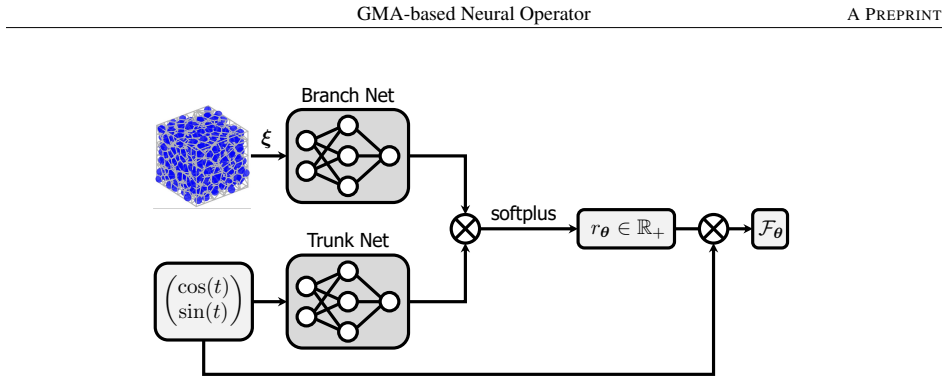
The differentiable neural operator (DeepONet architecture) that ingests microstructure parameters and outputs failure-envelope point clouds, regularized by a finite-difference convexity term that enforces consistency with Drucker's postulate.
If this is right
- Forward evaluation of failure envelopes becomes orders of magnitude faster than direct simulation for any given microstructure.
- Inverse design of microstructures that reproduce a prescribed failure response can be performed with gradient-based optimization through the operator.
- Convexity regularization eliminates non-physical artifacts in the predicted envelopes without requiring post-processing.
- Active learning reduces the total number of high-fidelity micromechanical simulations required to train the model.
- The point-cloud representation allows the operator to train on envelopes sampled at heterogeneous resolutions.
Where Pith is reading between the lines
- The same operator could be embedded inside larger multiscale simulations to provide on-the-fly failure limits for evolving microstructures.
- Uncertainty estimates produced during active learning could be used to prioritize physical experiments on the most uncertain microstructures.
- Extending the operator to cyclic or rate-dependent loading paths would allow prediction of fatigue or dynamic failure without new simulation campaigns.
Load-bearing premise
The operator can faithfully learn the complex implicit relationship between microstructure details and failure envelopes even though the underlying micromechanical simulations are nonlinear and non-smooth.
What would settle it
Generate new micromechanical simulations for a collection of previously unseen microstructure configurations and measure whether the operator's predicted envelopes match the simulated ones within a chosen error tolerance and remain convex.
Figures



read the original abstract
Micromechanics-based granular models are widely used to predict the failure behavior of porous and particulate materials, including concrete, soils, foams, and biological tissues. Although these models offer considerable flexibility through microstructural parametrization and statistical representation, their mapping to macroscopic responses, particularly failure envelopes, is implicit and requires costly nonlinear, non-smooth simulations, where each failure point is obtained by following a loading trajectory. This limitation is further amplified in inverse settings, where one seeks microstructure configurations that reproduce a target failure response. In this work, we propose a differentiable neural operator that learns the mapping from microstructure configurations to failure envelopes, enabling efficient forward prediction and inverse identification without repeated micromechanical simulations. To ensure mechanical admissibility, we incorporate a physics-informed training strategy that enforces convexity of the predicted envelopes, consistent with Drucker's postulate, thereby eliminating potential non-physical artifacts. We also compare finite difference and automatic differentiation for evaluating the proposed regularization, and find that finite difference provides a favorable practical trade-off in the present DeepONet-based setting. The operator is trained on failure envelopes represented as irregular point clouds, allowing learning from data sampled at heterogeneous resolutions. To further reduce computational cost, we introduce an active learning strategy that adaptively queries the micromechanical model in regions of high epistemic uncertainty. This leads to efficient exploration of the parameter space with fewer high-fidelity simulations. The versatility and performance of the method are demonstrated and benchmarked through several numerical examples.
Editorial analysis
A structured set of objections, weighed in public.
Referee Report
Summary. The manuscript proposes a DeepONet-based neural operator to learn the mapping from granular microstructure configurations to macroscopic failure envelopes. It incorporates a physics-informed loss enforcing convexity per Drucker's postulate (using finite differences on irregular point-cloud representations of the envelopes), compares FD to automatic differentiation for the penalty term, and adds an active-learning loop that queries the micromechanical simulator in regions of high epistemic uncertainty. The approach is presented as enabling fast forward prediction and inverse identification without repeated nonlinear simulations, with performance shown on numerical examples.
Significance. If the learned operator proves accurate and the convexity constraint demonstrably eliminates non-physical predictions, the work would provide a practical surrogate for expensive micromechanics calculations in porous and particulate materials. The handling of irregular point clouds and the explicit FD-vs-AD comparison are constructive contributions; active learning further improves data efficiency. These elements, if quantitatively validated, could support inverse microstructure design tasks that are currently intractable.
major comments (2)
- [Methods (regularization and FD/AD comparison)] The physics-informed convexity regularization (methods section describing the loss and its evaluation): finite-difference stencils applied to irregular point clouds are used instead of automatic differentiation. For the non-smooth failure surfaces typical of granular micromechanics (sharp corners, flat facets), these stencils can miss local curvature violations. The manuscript should report post-training diagnostics, e.g., the fraction of test points that violate convexity or the distance of predicted envelopes to their convex hull, to confirm mechanical admissibility.
- [Numerical examples] Numerical examples section: the abstract states that the operator is 'demonstrated and benchmarked,' yet no quantitative error metrics (e.g., mean relative error on envelope points, Hausdorff distance, or ablation on regularization weight) or baseline comparisons appear in the available text. Without these, the central claim that the mapping is learned accurately across the parameter space cannot be assessed.
minor comments (2)
- [Abstract] The abstract would benefit from including at least one concrete performance number (prediction error or reduction in micromechanical calls) from the numerical examples.
- Notation for the branch and trunk networks of the DeepONet and for the irregular point-cloud sampling should be introduced earlier and used consistently.
Simulated Author's Rebuttal
We thank the referee for the constructive and detailed review. The suggestions have prompted us to strengthen the validation aspects of the work. We address each major comment below and have revised the manuscript to incorporate the requested additions.
read point-by-point responses
-
Referee: [Methods (regularization and FD/AD comparison)] The physics-informed convexity regularization (methods section describing the loss and its evaluation): finite-difference stencils applied to irregular point clouds are used instead of automatic differentiation. For the non-smooth failure surfaces typical of granular micromechanics (sharp corners, flat facets), these stencils can miss local curvature violations. The manuscript should report post-training diagnostics, e.g., the fraction of test points that violate convexity or the distance of predicted envelopes to their convex hull, to confirm mechanical admissibility.
Authors: We appreciate the referee's observation regarding the potential limitations of finite-difference stencils on non-smooth surfaces. The manuscript already presents a comparison between finite differences and automatic differentiation, with FD selected for its practical advantages in the DeepONet setting. To directly address the concern, the revised manuscript now includes post-training diagnostics: the fraction of test points violating convexity (which remains below 1% across examples) and the mean distance of predicted envelopes to their convex hull. These metrics confirm that the physics-informed regularization maintains mechanical admissibility. revision: yes
-
Referee: [Numerical examples] Numerical examples section: the abstract states that the operator is 'demonstrated and benchmarked,' yet no quantitative error metrics (e.g., mean relative error on envelope points, Hausdorff distance, or ablation on regularization weight) or baseline comparisons appear in the available text. Without these, the central claim that the mapping is learned accurately across the parameter space cannot be assessed.
Authors: We agree that explicit quantitative metrics are needed to substantiate the benchmarking claims. Although the numerical examples illustrate the method, we have revised this section to report mean relative error on envelope points, Hausdorff distance to reference envelopes, an ablation study on the regularization weight, and comparisons to baseline surrogates (e.g., standard feed-forward networks). These additions enable a rigorous quantitative evaluation of accuracy across the parameter space. revision: yes
Circularity Check
No significant circularity; derivation relies on external simulation data and independent physics constraint
full rationale
The paper trains a DeepONet neural operator to map microstructure parameters to failure envelopes using data generated from separate micromechanical simulations. The physics-informed loss term enforces convexity consistent with Drucker's postulate, an external mechanical principle not derived from the operator itself. Finite-difference approximation of the convexity penalty is a numerical implementation choice within the DeepONet framework rather than a self-referential definition. Active learning selects new simulation points based on epistemic uncertainty but does not create fitted-input predictions. No load-bearing self-citations, ansatzes smuggled via prior work, or renamings of known results appear in the abstract or described method. The central mapping is learned from independent high-fidelity data, making the approach self-contained against external benchmarks.
Axiom & Free-Parameter Ledger
axioms (1)
- domain assumption Drucker's postulate requires that the failure envelope be convex for mechanical admissibility
Reference graph
Works this paper leans on
-
[1]
arXiv preprint arXiv:1906.03671 , year=
Jordan T Ash, Chicheng Zhang, Akshay Krishnamurthy, John Langford, and Alekh Agarwal. Deep batch active learning by diverse, uncertain gradient lower bounds.arXiv preprint arXiv:1906.03671, 2019
-
[2]
A resolution independent neural operator.Computer Methods in Applied Mechanics and Engineering, 444:118113, 2025
Bahador Bahmani, Somdatta Goswami, Ioannis G Kevrekidis, and Michael D Shields. A resolution independent neural operator.Computer Methods in Applied Mechanics and Engineering, 444:118113, 2025
2025
-
[3]
Neural chaos: A spectral stochastic neural operator.Journal of Computational Physics, page 114233, 2025
Bahador Bahmani, Ioannis G Kevrekidis, and Michael D Shields. Neural chaos: A spectral stochastic neural operator.Journal of Computational Physics, page 114233, 2025
2025
-
[4]
Microplane model for brittle-plastic material: I
Zden ˇek P Bažant and Pere C Prat. Microplane model for brittle-plastic material: I. theory.Journal of Engineering Mechanics, 114(10):1672–1688, 1988
1988
-
[5]
Microplane model m4 for concrete
Zden ˇek P Bažant, Ferhun C Caner, Ignacio Carol, Mark D Adley, and Stephen A Akers. Microplane model m4 for concrete. i: Formulation with work-conjugate deviatoric stress.Journal of Engineering Mechanics, 126(9): 944–953, 2000
2000
-
[6]
Stress field prediction in fiber-reinforced composite materials using a deep learning approach.Composites Part B: Engineering, 238:109879, 2022
Anindya Bhaduri, Ashwini Gupta, and Lori Graham-Brady. Stress field prediction in fiber-reinforced composite materials using a deep learning approach.Composites Part B: Engineering, 238:109879, 2022
2022
-
[7]
EC Bryant, KC Bennett, NA Miller, and A Misra. Multiscale plasticity of geomaterials predicted via constrained optimization-based granular micromechanics.International journal for numerical and analytical methods in geomechanics, 46(4):739–778, 2022. 20 GMA-based Neural OperatorA PREPRINT
2022
-
[8]
John Wiley & Sons, 2016
John Charles Butcher.Numerical methods for ordinary differential equations. John Wiley & Sons, 2016
2016
-
[9]
Vertex effect in strain-softening concrete at rotating principal axes.Journal of engineering mechanics, 128(1):24–33, 2002
Ferhun C Caner, Zden ˇek P Bažant, and Jan ˇCervenka. Vertex effect in strain-softening concrete at rotating principal axes.Journal of engineering mechanics, 128(1):24–33, 2002
2002
-
[10]
C. S. Chang. Micromechanical modelling of constitutive relations for granular material. In M. Satake and J. T. Jenkins, editors,Micromechanics of Granular Material, pages 271–279. Elsevier, Amsterdam, 1988
1988
-
[11]
C. S. Chang and J. Gao. Kinematic and static hypotheses for constitutive modelling of granulates considering particle rotation.Acta Mechanica, 115:213–229, 1996
1996
-
[12]
C. S. Chang and A. Misra. Packing structure and mechanical properties of granulates.Journal of Engineering Mechanics, 116(5):1077–1093, 1990
1990
-
[13]
C. S. Chang, S. S. Sundaram, and A. Misra. Initial moduli of particulated mass with frictional contacts.Interna- tional Journal for Numerical and Analytical Methods in Geomechanics, 13(6):629–644, 1989
1989
-
[14]
Automatic differentiation is essential in training neural networks for solving differential equations.Journal of scientific computing, 104(2):54, 2025
Chuqi Chen, Yahong Yang, Yang Xiang, and Wenrui Hao. Automatic differentiation is essential in training neural networks for solving differential equations.Journal of scientific computing, 104(2):54, 2025
2025
-
[15]
Making your first choice: to address cold start problem in medical active learning
Liangyu Chen, Yutong Bai, Siyu Huang, Yongyi Lu, Bihan Wen, Alan Yuille, and Zongwei Zhou. Making your first choice: to address cold start problem in medical active learning. InMedical Imaging with Deep Learning, pages 496–525. PMLR, 2024
2024
-
[16]
Pao-Hsiung Chiu, Jian Cheng Wong, Chinchun Ooi, My Ha Dao, and Yew-Soon Ong. Can-pinn: A fast physics- informed neural network based on coupled-automatic–numerical differentiation method.Computer Methods in Applied Mechanics and Engineering, 395:114909, 2022
2022
-
[17]
Separable physics-informed neural networks.Advances in Neural Information Processing Systems, 36:23761–23788, 2023
Junwoo Cho, Seungtae Nam, Hyunmo Yang, Seok-Bae Yun, Youngjoon Hong, and Eunbyung Park. Separable physics-informed neural networks.Advances in Neural Information Processing Systems, 36:23761–23788, 2023
2023
-
[18]
Parameters controlling tensile and compressive strength of artificially cemented sand.Journal of Geotechnical and Geoenvironmental Engineering, 136(5):759–763, 2010
Nilo Cesar Consoli, Rodrigo Caberlon Cruz, Márcio Felipe Floss, and Lucas Festugato. Parameters controlling tensile and compressive strength of artificially cemented sand.Journal of Geotechnical and Geoenvironmental Engineering, 136(5):759–763, 2010
2010
-
[19]
Efficient space-filling and non-collapsing sequential design strategies for simulation-based modeling.European Journal of Operational Research, 214(3):683–696, 2011
Karel Crombecq, Eric Laermans, and Tom Dhaene. Efficient space-filling and non-collapsing sequential design strategies for simulation-based modeling.European Journal of Operational Research, 214(3):683–696, 2011
2011
-
[20]
Multiscale numerical analyses of arterial tissue with embedded elements in the finite strain regime.Computer Methods in Applied Mechanics and Engineering, 381:113844, 2021
Misael Dalbosco, Thiago A Carniel, Eduardo A Fancello, and Gerhard A Holzapfel. Multiscale numerical analyses of arterial tissue with embedded elements in the finite strain regime.Computer Methods in Applied Mechanics and Engineering, 381:113844, 2021
2021
-
[21]
Multiscale computational modeling of arterial micromechanics: A review.Computer Methods in Applied Mechanics and Engineering, 425:116916, 2024
Misael Dalbosco, Eduardo A Fancello, and Gerhard A Holzapfel. Multiscale computational modeling of arterial micromechanics: A review.Computer Methods in Applied Mechanics and Engineering, 425:116916, 2024
2024
-
[22]
Adversarial active learning for sequences labeling and generation
Yue Deng, KaWai Chen, Yilin Shen, and Hongxia Jin. Adversarial active learning for sequences labeling and generation. InIJCAI, pages 4012–4018, 2018
2018
-
[23]
Modelling ten- sile/compressive strength ratio of artificially cemented clean sand.Soils and foundations, 58(1):199–211, 2018
Andrea Diambra, Lucas Festugato, Erdin Ibraim, A Peccin da Silva, and NC Consoli. Modelling ten- sile/compressive strength ratio of artificially cemented clean sand.Soils and foundations, 58(1):199–211, 2018
2018
-
[24]
Courier Dover Publications, 2016
Manfredo P Do Carmo.Differential geometry of curves and surfaces: revised and updated second edition. Courier Dover Publications, 2016
2016
-
[25]
A more fundamental approach to plastic stress-strain relations
Daniel Charles Drucker. A more fundamental approach to plastic stress-strain relations. InProceedings of the First U.S. National Congress of Applied Mechanics, pages 487–491, 1951
1951
-
[26]
A definition of stable inelastic material.Journal of Applied Mechanics, 26(1):101–106, 1959
Daniel Charles Drucker. A definition of stable inelastic material.Journal of Applied Mechanics, 26(1):101–106, 1959
1959
-
[27]
Soil mechanics and plastic analysis or limit design.Quarterly of applied mathematics, 10(2):157–165, 1952
Daniel Charles Drucker and William Prager. Soil mechanics and plastic analysis or limit design.Quarterly of applied mathematics, 10(2):157–165, 1952
1952
-
[28]
Adaptive sequential sampling for surrogate model generation with artificial neural networks.Computers & Chemical Engineering, 68:220–232, 2014
John Eason and Selen Cremaschi. Adaptive sequential sampling for surrogate model generation with artificial neural networks.Computers & Chemical Engineering, 68:220–232, 2014
2014
-
[29]
A review on data-driven constitutive laws for solids: Jn fuhg et al.Archives of Computational Methods in Engineering, 32(3):1841–1883, 2025
Jan N Fuhg, Govinda Anantha Padmanabha, Nikolaos Bouklas, Bahador Bahmani, WaiChing Sun, Nikolaos N Vlassis, Moritz Flaschel, Pietro Carrara, and Laura De Lorenzis. A review on data-driven constitutive laws for solids: Jn fuhg et al.Archives of Computational Methods in Engineering, 32(3):1841–1883, 2025
2025
-
[30]
Dropout as a bayesian approximation: Representing model uncertainty in deep learning
Yarin Gal and Zoubin Ghahramani. Dropout as a bayesian approximation: Representing model uncertainty in deep learning. Ininternational conference on machine learning, pages 1050–1059. PMLR, 2016. 21 GMA-based Neural OperatorA PREPRINT
2016
-
[31]
Homogenization methods and multiscale modeling: nonlinear problems.Encyclopedia of computational mechanics second edition, pages 1– 34, 2017
Marc GD Geers, Varvara G Kouznetsova, Karel Matouš, and Julien Yvonnet. Homogenization methods and multiscale modeling: nonlinear problems.Encyclopedia of computational mechanics second edition, pages 1– 34, 2017
2017
-
[32]
A physics-informed deep learning framework for inversion and surrogate modeling in solid mechanics.Computer Methods in Applied Mechanics and Engineering, 379:113741, 2021
Ehsan Haghighat, Maziar Raissi, Adrian Moure, Hector Gomez, and Ruben Juanes. A physics-informed deep learning framework for inversion and surrogate modeling in solid mechanics.Computer Methods in Applied Mechanics and Engineering, 379:113741, 2021
2021
-
[33]
The effect of the intermediate principal stress on fault formation and fault angle in siltstone.Journal of Structural Geology, 32(11):1701–1711, 2010
Bezalel Haimson and John W Rudnicki. The effect of the intermediate principal stress on fault formation and fault angle in siltstone.Journal of Structural Geology, 32(11):1701–1711, 2010
2010
-
[34]
Julian N Heidenreich, Maysam B Gorji, and Dirk Mohr. Modeling structure-property relationships with con- volutional neural networks: Yield surface prediction based on microstructure images.International Journal of Plasticity, 163:103506, 2023
2023
-
[35]
R. Hill. Elastic properties of reinforced solids: some theoretical principles.Journal of the Mechanics and Physics of Solids, 11(5):357–372, 1963
1963
-
[36]
Empirical strength criterion for rock masses.Journal of the geotechnical engineering division, 106(9):1013–1035, 1980
Evert Hoek and Edwin T Brown. Empirical strength criterion for rock masses.Journal of the geotechnical engineering division, 106(9):1013–1035, 1980
1980
-
[37]
The hoek–brown failure criterion and gsi–2018 edition.Journal of rock mechanics and geotechnical engineering, 11(3):445–463, 2019
Evert Hoek and ET Brown. The hoek–brown failure criterion and gsi–2018 edition.Journal of rock mechanics and geotechnical engineering, 11(3):445–463, 2019
2018
-
[38]
Applications of finite difference-based physics-informed neural networks to steady incompressible isothermal and thermal flows
Qinghua Jiang, Chang Shu, Lailai Zhu, Liming Yang, Yangyang Liu, and Zhilang Zhang. Applications of finite difference-based physics-informed neural networks to steady incompressible isothermal and thermal flows. International Journal for Numerical Methods in Fluids, 95(10):1565–1597, 2023
2023
-
[39]
Physics- informed machine learning.Nature Reviews Physics, 3(6):422–440, 2021
George Em Karniadakis, Ioannis G Kevrekidis, Lu Lu, Paris Perdikaris, Sifan Wang, and Liu Yang. Physics- informed machine learning.Nature Reviews Physics, 3(6):422–440, 2021
2021
-
[40]
Simulator-free solution of high- dimensional stochastic elliptic partial differential equations using deep neural networks.Journal of Compu- tational Physics, 404:109120, 2020
Sharmila Karumuri, Rohit Tripathy, Ilias Bilionis, and Jitesh Panchal. Simulator-free solution of high- dimensional stochastic elliptic partial differential equations using deep neural networks.Journal of Compu- tational Physics, 404:109120, 2020
2020
-
[41]
Adam: A Method for Stochastic Optimization
Diederik P Kingma and Jimmy Ba. Adam: A method for stochastic optimization.arXiv preprint arXiv:1412.6980, 2014
work page internal anchor Pith review Pith/arXiv arXiv 2014
-
[42]
Batchbald: Efficient and diverse batch acquisition for deep bayesian active learning.Advances in neural information processing systems, 32, 2019
Andreas Kirsch, Joost Van Amersfoort, and Yarin Gal. Batchbald: Efficient and diverse batch acquisition for deep bayesian active learning.Advances in neural information processing systems, 32, 2019
2019
-
[43]
Neural operator: Learning maps between function spaces with applications to pdes
Nikola Kovachki, Zongyi Li, Burigede Liu, Kamyar Azizzadenesheli, Kaushik Bhattacharya, Andrew Stuart, and Anima Anandkumar. Neural operator: Learning maps between function spaces with applications to pdes. Journal of Machine Learning Research, 24(89):1–97, 2023
2023
-
[44]
Neural network ensembles, cross validation, and active learning.Advances in neural information processing systems, 7, 1994
Anders Krogh and Jesper Vedelsby. Neural network ensembles, cross validation, and active learning.Advances in neural information processing systems, 7, 1994
1994
-
[45]
Mohr–coulomb failure criterion
Joseph F Labuz and Arno Zang. Mohr–coulomb failure criterion. InThe ISRM suggested methods for rock characterization, testing and monitoring: 2007-2014, pages 227–231. Springer, 2014
2007
-
[46]
Elastoplastic stress-strain theory for cohesionless soil.Journal of the Geotechnical Engineering Division, 101(10):1037–1053, 1975
Poul V Lade and James M Duncan. Elastoplastic stress-strain theory for cohesionless soil.Journal of the Geotechnical Engineering Division, 101(10):1037–1053, 1975
1975
-
[47]
Simple and scalable predictive uncertainty estimation using deep ensembles.Advances in neural information processing systems, 30, 2017
Balaji Lakshminarayanan, Alexander Pritzel, and Charles Blundell. Simple and scalable predictive uncertainty estimation using deep ensembles.Advances in neural information processing systems, 30, 2017
2017
-
[48]
Multi-resolution active learning of fourier neural operators
Shibo Li, Xin Yu, Wei Xing, Robert Kirby, Akil Narayan, and Shandian Zhe. Multi-resolution active learning of fourier neural operators. InInternational Conference on Artificial Intelligence and Statistics, pages 2440–2448. PMLR, 2024
2024
-
[49]
Fourier Neural Operator for Parametric Partial Differential Equations
Zongyi Li, Nikola Kovachki, Kamyar Azizzadenesheli, Burigede Liu, Kaushik Bhattacharya, Andrew Stuart, and Anima Anandkumar. Fourier neural operator for parametric partial differential equations.arXiv preprint arXiv:2010.08895, 2020
work page internal anchor Pith review arXiv 2010
-
[50]
C. L. Liao, T. C. Chan, A. S. J. Suiker, and C. S. Chang. Pressure-dependent elastic moduli of granular assem- blies.International Journal for Numerical and Analytical Methods in Geomechanics, 24(3):265–279, 2000
2000
-
[51]
Physics informed neural network using finite difference method
Kart Leong Lim, Rahul Dutta, and Mihai Rotaru. Physics informed neural network using finite difference method. In2022 IEEE international conference on Systems, Man, and Cybernetics (SMC), pages 1828–1833. IEEE, 2022. 22 GMA-based Neural OperatorA PREPRINT
2022
-
[52]
A survey of adaptive sampling for global metamodeling in support of simulation-based complex engineering design: H
Haitao Liu, Yew-Soon Ong, and Jianfei Cai. A survey of adaptive sampling for global metamodeling in support of simulation-based complex engineering design: H. liu et al.Structural and Multidisciplinary Optimization, 57 (1):393–416, 2018
2018
-
[53]
Physics-informed fourier- deeponet for a generalized eikonal solution.Computers & Geosciences, page 106026, 2025
Zhuofan Liu, Goodluck Archibong, Umair Bin Waheed, Sifan Wang, and Chao Song. Physics-informed fourier- deeponet for a generalized eikonal solution.Computers & Geosciences, page 106026, 2025
2025
-
[54]
Learning nonlinear opera- tors via deeponet based on the universal approximation theorem of operators.Nature machine intelligence, 3(3): 218–229, 2021
Lu Lu, Pengzhan Jin, Guofei Pang, Zhongqiang Zhang, and George Em Karniadakis. Learning nonlinear opera- tors via deeponet based on the universal approximation theorem of operators.Nature machine intelligence, 3(3): 218–229, 2021
2021
-
[55]
Xiaodong Ma and Bezalel C. Haimson. Failure characteristics of two porous sandstones subjected to true tri- axial stresses.Journal of Geophysical Research: Solid Earth, 121(9):6477–6498, 9 2016. ISSN 21699356. doi:10.1002/2016JB012979
-
[56]
Xiaodong Ma, John W. Rudnicki, and Bezalel C. Haimson. Failure characteristics of two porous sandstones subjected to true triaxial stresses: Applied through a novel loading path.Journal of Geophysical Research: Solid Earth, 122(4):2525–2540, 4 2017. ISSN 21699356. doi:10.1002/2016JB013637
-
[57]
Pointing the way: Active collaborative filtering
David Maltz and Kate Ehrlich. Pointing the way: Active collaborative filtering. InProceedings of the SIGCHI conference on Human factors in computing systems, pages 202–209, 1995
1995
-
[58]
Comparison of three methods for selecting values of input variables in the analysis of output from a computer code.Technometrics, 21(2):239–245, 1979
MD McKay, RJ Beckman, and WJ Conover. Comparison of three methods for selecting values of input variables in the analysis of output from a computer code.Technometrics, 21(2):239–245, 1979
1979
-
[59]
Computational micro-to-macro transitions of discretized microstructures undergoing small strains.Archive of Applied Mechanics, 72(4):300–317, 2002
Christian Miehe and Andreas Koch. Computational micro-to-macro transitions of discretized microstructures undergoing small strains.Archive of Applied Mechanics, 72(4):300–317, 2002
2002
-
[60]
Misra and V
A. Misra and V . Singh. Nonlinear granular micromechanics model for multi-axial rate-dependent behavior. International Journal of Solids and Structures, 51(13):2272–2282, 2014
2014
-
[61]
Granular micromechanics model of anisotropic elasticity derived from gibbs potential.Acta Mechanica, 227(5):1393–1413, 2016
Anil Misra and Payam Poorsolhjouy. Granular micromechanics model of anisotropic elasticity derived from gibbs potential.Acta Mechanica, 227(5):1393–1413, 2016
2016
-
[62]
Granular micromechanics model for damage and plasticity of cementitious materials based upon thermomechanics.Mathematics and Mechanics of Solids, 25(10):1778–1803, 2020
Anil Misra and Payam Poorsolhjouy. Granular micromechanics model for damage and plasticity of cementitious materials based upon thermomechanics.Mathematics and Mechanics of Solids, 25(10):1778–1803, 2020
2020
-
[63]
Micromechanical model for viscoelastic materials undergoing damage.Continuum Mechanics and Thermodynamics, 25(2):343–358, 2013
Anil Misra and Viraj Singh. Micromechanical model for viscoelastic materials undergoing damage.Continuum Mechanics and Thermodynamics, 25(2):343–358, 2013
2013
-
[64]
Micromechanical model for cohesive materials based upon pseudo-granular structure
Anil Misra and Yang Yang. Micromechanical model for cohesive materials based upon pseudo-granular structure. International Journal of Solids and Structures, 47(21):2970–2981, 2010
2010
-
[65]
Neural inverse operators for solving pde inverse problems.arXiv preprint arXiv:2301.11167, 2023
Roberto Molinaro, Yunan Yang, Björn Engquist, and Siddhartha Mishra. Neural inverse operators for solving pde inverse problems.arXiv preprint arXiv:2301.11167, 2023
-
[66]
Christos Mourlas, Benoît Pardoen, and Pierre Bésuelle. Large-scale failure prediction of clay rock from small- scale damage mechanisms of the rock medium using multiscale modelling.International Journal for Numerical and Analytical Methods in Geomechanics, 47(7):1254–1288, 2023
2023
-
[67]
Active learning for neural pde solvers.arXiv preprint arXiv:2408.01536, 2024
Daniel Musekamp, Marimuthu Kalimuthu, David Holzmüller, Makoto Takamoto, and Mathias Niepert. Active learning for neural pde solvers.arXiv preprint arXiv:2408.01536, 2024
-
[68]
A machine learning model to predict yield surfaces from crystal plasticity simulations.International Journal of Plasticity, 161:103507, 2023
Anderson Nascimento, Sharan Roongta, Martin Diehl, and Irene J Beyerlein. A machine learning model to predict yield surfaces from crystal plasticity simulations.International Journal of Plasticity, 161:103507, 2023
2023
-
[69]
Diffuse and localized failure modes: two competing mechanisms.International Journal for Numerical and Analytical Methods in Geomechanics, 35(5):586–601, 2011
François Nicot and Félix Darve. Diffuse and localized failure modes: two competing mechanisms.International Journal for Numerical and Analytical Methods in Geomechanics, 35(5):586–601, 2011
2011
-
[70]
A constitutive theory for the inelastic behavior of concrete.Mechanics of materials, 4(1):67–93, 1985
Michael Ortiz. A constitutive theory for the inelastic behavior of concrete.Mechanics of materials, 4(1):67–93, 1985
1985
-
[71]
Benoît Pardoen, Pierre Bésuelle, Stefano Dal Pont, Philippe Cosenza, and Jacques Desrues. Accounting for small-scale heterogeneity and variability of clay rock in homogenised numerical micromechanical response and microcracking.Rock Mechanics and Rock Engineering, 53:2727–2746, 2020
2020
-
[72]
Anisotropic elastic strain-gradient continuum from the macro-scale to the granular micro-scale.Journal of Elasticity, 156(3):647–680, 2024
Pouriya Pirmoradi, Akke SJ Suiker, and Payam Poorsolhjouy. Anisotropic elastic strain-gradient continuum from the macro-scale to the granular micro-scale.Journal of Elasticity, 156(3):647–680, 2024
2024
-
[73]
Payam Poorsolhjouy and Anil Misra. Effect of intermediate principal stress and loading-path on failure of cementitious materials using granular micromechanics.International Journal of Solids and Structures, 108: 139–152, 2017. 23 GMA-based Neural OperatorA PREPRINT
2017
-
[74]
Rock failure characteristics evaluated under true triaxial loading from micro-mechanical viewpoint: P
Payam Poorsolhjouy, Kim Sarah Mews, and Anil Misra. Rock failure characteristics evaluated under true triaxial loading from micro-mechanical viewpoint: P. poorsolhjouy et al.Rock Mechanics and Rock Engineering, 58(5): 5653–5672, 2025
2025
-
[75]
Tongming Qu, Yuntian Feng, Tingting Zhao, and Min Wang. A hybrid calibration approach to hertz-type con- tact parameters for discrete element models.International Journal for Numerical and Analytical Methods in Geomechanics, 44(9):1281–1300, 2020
2020
-
[76]
Towards data-driven constitutive mod- elling for granular materials via micromechanics-informed deep learning.International Journal of Plasticity, 144:103046, 2021
Tongming Qu, Shaocheng Di, YT Feng, Min Wang, and Tingting Zhao. Towards data-driven constitutive mod- elling for granular materials via micromechanics-informed deep learning.International Journal of Plasticity, 144:103046, 2021
2021
-
[77]
Tongming Qu, Shaoheng Guan, YT Feng, Gang Ma, Wei Zhou, and Jidong Zhao. Deep active learning for constitutive modelling of granular materials: From representative volume elements to implicit finite element modelling.International Journal of Plasticity, 164:103576, 2023
2023
-
[78]
On failure indicators in multidissipative materials.International journal of solids and structures, 33(20-22):3187–3214, 1996
Egidio Rizzi, Giulio Maier, and Kaspar Willam. On failure indicators in multidissipative materials.International journal of solids and structures, 33(20-22):3187–3214, 1996
1996
-
[79]
Nomad: Nonlinear manifold decoders for operator learning.Advances in Neural Information Processing Systems, 35:5601–5613, 2022
Jacob Seidman, Georgios Kissas, Paris Perdikaris, and George J Pappas. Nomad: Nonlinear manifold decoders for operator learning.Advances in Neural Information Processing Systems, 35:5601–5613, 2022
2022
-
[80]
Active Learning for Convolutional Neural Networks: A Core-Set Approach
Ozan Sener and Silvio Savarese. Active learning for convolutional neural networks: A core-set approach.arXiv preprint arXiv:1708.00489, 2017
work page Pith review arXiv 2017
discussion (0)
Sign in with ORCID, Apple, or X to comment. Anyone can read and Pith papers without signing in.