Recognition: unknown
Competition between acoustic radiation force and streaming-induced drag force in focused beams for 3D cell trapping
Pith reviewed 2026-05-10 01:52 UTC · model grok-4.3
The pith
The ratio of axial acoustic radiation force to streaming drag on a particle varies non-monotonically with focal pressure amplitude.
A machine-rendered reading of the paper's core claim, the machinery that carries it, and where it could break.
Core claim
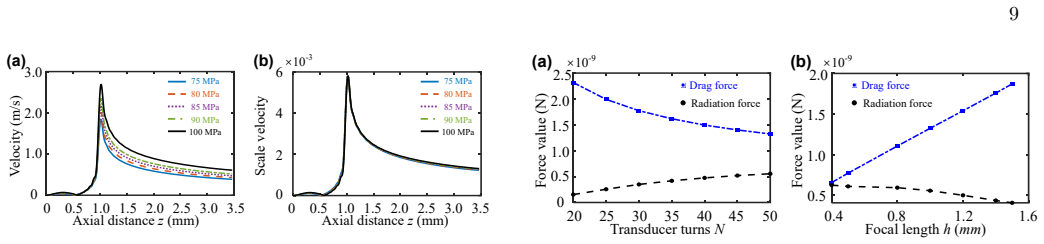
The authors show that streaming velocity scales as U0 proportional to p_foc raised to n, where n equals 2 when Re_lambda is much less than 1, n equals 4/3 when Re_lambda is much greater than 1, and n takes an intermediate value in the transition. With the Schiller-Naumann drag model applied to the particle, the ratio of axial radiation force to drag force therefore varies non-monotonically with p_foc rather than rising steadily.
What carries the argument
Scaling law for streaming velocity U0 ~ p_foc^n derived separately in viscous, transitional, and inertial regimes, combined with the Schiller-Naumann correction to the drag force.
If this is right
- Trapping stability must be evaluated at the specific pressure that maximizes the force ratio rather than at the highest available intensity.
- High-frequency designs are more likely to encounter regimes where streaming drag grows faster relative to radiation force.
- Numerical design of single-beam tweezers requires separate treatment of viscous and inertial streaming rather than a single scaling assumption.
Where Pith is reading between the lines
- The same regime-dependent scaling argument could be tested in other streaming-based particle manipulators such as surface-acoustic-wave devices.
- Varying the carrier frequency or fluid viscosity would shift the transition pressure and could be used to enlarge the useful trapping window.
- Direct particle-tracking experiments that record equilibrium position versus pressure would provide a clear test of the predicted non-monotonic ratio.
Load-bearing premise
The Schiller-Naumann drag model and a Reynolds-number classification based on the viscous penetration depth correctly describe the flow and forces around the particle inside the focused beam.
What would settle it
Measure the effective axial restoring force or the minimum pressure needed to hold a particle in place while sweeping focal pressure amplitude; a strictly monotonic rise in the force ratio with pressure would falsify the non-monotonic prediction.
Figures





read the original abstract
The ability to trap a single cell or microparticle in three dimensions is important for biomedical and microfluidic applications. Single-beam acoustic tweezers based on focused waves provide a compact and biocompatible approach because of their high spatial resolution and strong intensity gradients. However, 3D trapping remains challenging, especially at high frequencies, because the weak axial restoring radiation force may not overcome the pushing drag force caused by acoustic bulk streaming in free space. The combined effect of acoustic radiation force and streaming-induced drag force on a microparticle has not been systematically studied. Although the radiation force scales with the square of the focal pressure amplitude p_foc, the scaling of streaming-induced drag force with p_foc under different flow conditions remains unclear. Here, we establish a unified theoretical and numerical framework to compare these two effects and derive an explicit scaling law, U0 ~ p_foc^n, for the streaming velocity from the viscous to the inertial regime. We show that n = 2 in the viscous limit (Re_lambda << 1), n = 4/3 in the inertial limit (Re_lambda >> 1), and n lies between 4/3 and 2 in the transition regime (Re_lambda ~ 1). We further introduce the Schiller-Naumann model to estimate the drag force more accurately than the Stokes model. On this basis, we find that the ratio of axial radiation force to drag can vary non-monotonically with p_foc, contrary to the conventional expectation of monotonic increase. This work provides a theoretical basis for optimizing single-beam acoustic tweezers for stable 3D trapping of single cells.
Editorial analysis
A structured set of objections, weighed in public.
Referee Report
Summary. The manuscript develops a unified theoretical and numerical framework to compare the axial acoustic radiation force with the streaming-induced drag force acting on a microparticle in a focused acoustic beam. It derives explicit scaling relations for the streaming velocity U0 ~ p_foc^n, obtaining n=2 in the viscous limit (Re_λ ≪ 1), n=4/3 in the inertial limit (Re_λ ≫ 1), and intermediate values in the transition regime. Replacing the Stokes drag with the Schiller-Naumann correction, the authors report that the ratio of radiation force to drag can vary non-monotonically with focal pressure amplitude p_foc, contrary to the conventional expectation of monotonic increase. The work aims to supply a theoretical basis for optimizing single-beam acoustic tweezers for stable 3D cell trapping.
Significance. If the non-monotonic dependence survives scrutiny of the underlying flow assumptions, the result would be significant for acoustic tweezers design: it identifies a possible pressure window in which radiation force can more effectively overcome drag than monotonic scaling would suggest, directly addressing the challenge of weak axial restoring forces at high frequencies. The derivation of regime-dependent exponents directly from the Navier-Stokes equations (rather than empirical fitting) and the attempt to bridge viscous-to-inertial regimes constitute clear strengths.
major comments (2)
- [Scaling derivations and drag-force section] The central non-monotonic claim for F_rad/F_drag versus p_foc arises only after adopting the Schiller-Naumann drag coefficient and allowing the streaming exponent n to drop from 2 to 4/3 across the Re_λ ~ 1 window. The manuscript does not demonstrate that the far-field, uniform-flow drag law and wavelength-based Re_λ classification remain valid when the particle sits at the intensity maximum of a tightly focused beam, where the acoustic body force and resulting streaming jet exhibit strong axial and radial gradients on the scale of the particle diameter rather than λ. Without such justification or local-flow validation, the non-monotonic excursion may be an artifact of the assumed drag model.
- [Framework and results presentation] The abstract states that a 'unified theoretical and numerical framework' is established and that an 'explicit scaling law' is derived, yet the text provides neither the governing equations for the transition regime nor error bounds or numerical benchmarks confirming that the interpolated n values produce a genuine non-monotonic ratio rather than a monotonic trend once local inhomogeneity is accounted for.
minor comments (1)
- [Notation] Notation for the particle Reynolds number Re_p versus the wavelength-based Re_λ should be clarified to avoid confusion when the relevant length scale changes between the far-field streaming and the local particle environment.
Simulated Author's Rebuttal
We thank the referee for the constructive comments and positive evaluation of the work's significance for acoustic tweezers design. We address the concerns about the drag-force assumptions in focused beams and the completeness of the framework description. The responses below clarify our approach while outlining targeted revisions to strengthen the manuscript.
read point-by-point responses
-
Referee: [Scaling derivations and drag-force section] The central non-monotonic claim for F_rad/F_drag versus p_foc arises only after adopting the Schiller-Naumann drag coefficient and allowing the streaming exponent n to drop from 2 to 4/3 across the Re_λ ~ 1 window. The manuscript does not demonstrate that the far-field, uniform-flow drag law and wavelength-based Re_λ classification remain valid when the particle sits at the intensity maximum of a tightly focused beam, where the acoustic body force and resulting streaming jet exhibit strong axial and radial gradients on the scale of the particle diameter rather than λ. Without such justification or local-flow validation, the non-monotonic excursion may be an artifact of the assumed drag model.
Authors: We acknowledge the importance of justifying the uniform-flow approximation in the presence of spatial gradients. Our scaling for U0 is obtained from the time-averaged Navier-Stokes equations applied to the characteristic focal region, and the drag is evaluated using the local streaming velocity at the trap center. For typical microparticles (diameter ≪ focal spot width, which is ~λ), the velocity variation over the particle is small, allowing the far-field drag law as a leading-order estimate; this is consistent with standard treatments in acoustic streaming literature. The Re_λ classification remains appropriate because it governs the bulk flow regime that sets U0. We will add a dedicated paragraph with the validity condition (particle diameter relative to focal width and local particle Reynolds number) and a brief sensitivity analysis showing that moderate gradient corrections do not eliminate the non-monotonic trend. Full particle-resolved simulation of the coupled acoustic-flow problem lies beyond the present scope but is noted as future work. revision: partial
-
Referee: [Framework and results presentation] The abstract states that a 'unified theoretical and numerical framework' is established and that an 'explicit scaling law' is derived, yet the text provides neither the governing equations for the transition regime nor error bounds or numerical benchmarks confirming that the interpolated n values produce a genuine non-monotonic ratio rather than a monotonic trend once local inhomogeneity is accounted for.
Authors: We agree that the transition-regime treatment should be presented more explicitly. The unified framework solves the time-averaged continuity and momentum equations (with the acoustic body-force term retained) numerically across Re_λ values to extract the effective exponent n(p_foc); the limits Re_λ ≪ 1 and Re_λ ≫ 1 recover the analytic scalings n=2 and n=4/3, respectively. In the revised manuscript we will insert the governing equations, describe the numerical scheme and mesh convergence, and report error bounds on n obtained from the simulations. We will also include a supplementary calculation that incorporates a first-order correction for axial velocity variation over the particle diameter and demonstrate that the non-monotonic excursion in F_rad/F_drag persists for the parameter range of interest. revision: yes
Circularity Check
Scaling laws and drag model derived from Navier-Stokes limits and established empirics; non-monotonic ratio emerges without reduction to inputs
full rationale
The paper derives the streaming velocity exponents (n=2 viscous, n=4/3 inertial) directly from the first-principles limits of the Navier-Stokes equations under the stated Re_λ regimes, without fitting them to the target force ratio. The Schiller-Naumann drag correction is invoked as a standard empirical model rather than calibrated to the present data or geometry. Radiation force scaling with p_foc² is the conventional acoustic result. The non-monotonic excursion in the ratio therefore follows from combining these independent elements; it is not presupposed by construction in any input parameter or self-citation. No load-bearing step reduces to a self-definition, fitted prediction, or author-unique ansatz.
Axiom & Free-Parameter Ledger
axioms (2)
- domain assumption The Reynolds number Re_lambda correctly delineates viscous, transition, and inertial regimes for the streaming flow around the particle.
- domain assumption The Schiller-Naumann correction provides a sufficiently accurate drag coefficient for the particle Reynolds numbers encountered.
Reference graph
Works this paper leans on
-
[1]
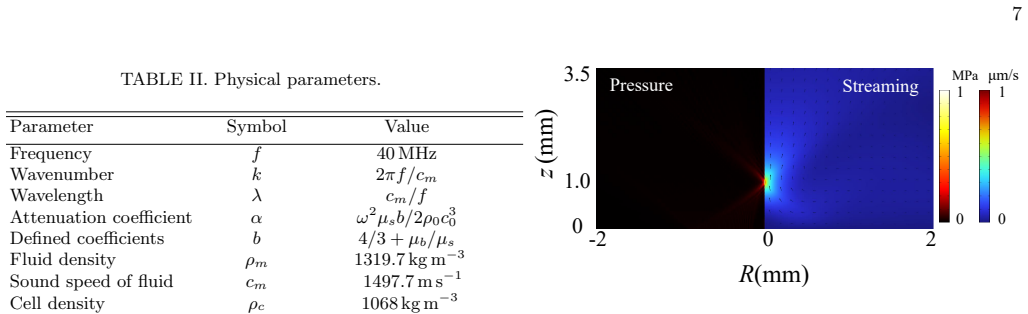
Streaming flow structure Owing to the axial symmetry of the acoustic system, the numerically simulated acoustic streaming field ex- hibits a correspondingly symmetric structure, as illus- trated in Fig.3. This figure highlights the intrinsic cou- pling between the spatial distributions of the acoustic pressure field and the induced streaming flow, both of...
-
[2]
Jetting velocity scaling law In acoustofluidic systems, the total force acting on suspended particles results from the combined effects of acoustic radiation force and streaming-induced drag. While the radiation force can be analytically described, estimating the drag force depends on knowledge of the steady-state streaming velocity, which often requires ...
2030
-
[3]
Scaling law in the viscosity–dominated regime At sufficiently low focal pressures (Re λ ≪1), the streaming is governed by a balance between the acoustic power input and viscous dissipation. The corresponding energy budget over the control volume is expressed as ZZZ V fs ·vdV∼ ZZZ V 2µs D:DdV,(A2) whereDis the rate of strain tensor andf s denotes the acous...
-
[4]
Scaling law in the inertia–dominated regime At sufficiently high focal pressures (Re λ ≫1), inertial transport balances the acoustic power input. The cor- responding energy transfer within the control volume is given by: ρmU2 0 ∼ αR2 beam cmw2 jet Z L 0 I(z)e −2z/La dz,(A10a) I(z) =I foc G2(z)e −2z/La .(A10b) At the axial location where the streaming velo...
-
[5]
Scaling law in the transitional regime In the transitional regime (Re λ ∼1), acoustic body force, inertial transport, and viscous dissipation con- tribute at comparable orders. The corresponding control- volume balance for the steady streaming field is therefore given by: ZZZ V ρm v· ∇e c dV∼ ZZZ V −2µs D:DdV + ZZZ V fs ·vdV, (A15) wheree c = 1 2 v·vis th...
-
[6]
W. Zhou, Y. Li, Y. Liu, H. Quan, P. Li, F. Li, L. Niu, H. Zheng, and L. Meng, An acoustic squeezer for assess- ment of multiparameter cell mechanical properties, Ul- trasonics , 107622 (2025)
2025
-
[7]
A. D. Barrow, M. A. Edeling, V. Trifonov, J. Luo, P. Goyal, B. Bohl, J. K. Bando, A. H. Kim, J. Walker, M. Andahazy,et al., Natural killer cells control tumor growth by sensing a growth factor, Cell172, 534 (2018)
2018
-
[8]
Landsberg, J
J. Landsberg, J. Kohlmeyer, M. Renn, T. Bald, M. Ro- gava, M. Cron, M. Fatho, V. Lennerz, T. W¨ olfel, M. H¨ olzel,et al., Melanomas resist t-cell therapy through inflammation-induced reversible dedifferentiation, Na- ture490, 412 (2012)
2012
-
[9]
Vl` es, Recherches sur une d´ eformation m´ ecanique des œufs d’oursin, Arch Zool exp gin75, 421 (1933)
F. Vl` es, Recherches sur une d´ eformation m´ ecanique des œufs d’oursin, Arch Zool exp gin75, 421 (1933)
1933
-
[10]
R. M. Hochmuth, Micropipette aspiration of living cells, Journal of biomechanics33, 15 (2000)
2000
-
[11]
S. Yang, J. Rufo, R. Zhong, J. Rich, Z. Wang, L. P. Lee, and T. J. Huang, Acoustic tweezers for high-throughput single-cell analysis, Nature protocols18, 2441 (2023)
2023
-
[12]
Ashkin, J
A. Ashkin, J. M. Dziedzic, J. E. Bjorkholm, and S. Chu, Observation of a single-beam gradient force optical trap for dielectric particles, Optics letters11, 288 (1986)
1986
-
[13]
De Vlaminck and C
I. De Vlaminck and C. Dekker, Recent advances in magnetic tweezers, Annual review of biophysics41, 453 (2012)
2012
-
[14]
Baudoin and J.-L
M. Baudoin and J.-L. Thomas, Acoustic tweezers for particle and fluid micromanipulation, Annual Review of Fluid Mechanics52, 205 (2020)
2020
-
[15]
Bl´ azquez-Castro, Optical tweezers: Phototoxicity and thermal stress in cells and biomolecules, Micromachines 10, 507 (2019)
A. Bl´ azquez-Castro, Optical tweezers: Phototoxicity and thermal stress in cells and biomolecules, Micromachines 10, 507 (2019)
2019
-
[16]
K. C. Neuman and A. Nagy, Single-molecule force spec- troscopy: optical tweezers, magnetic tweezers and atomic force microscopy, Nature methods5, 491 (2008)
2008
-
[17]
Baudoin, J.-L
M. Baudoin, J.-L. Thomas, R. A. Sahely, J.-C. Gerbe- doen, Z. Gong, A. Sivery, O. B. Matar, N. Smagin, P. Favreau, and A. Vlandas, Spatially selective manipula- tion of cells with single-beam acoustical tweezers, Nature communications11, 4244 (2020)
2020
-
[18]
Gong and M
Z. Gong and M. Baudoin, Single beam acoustical tweez- ers based on focused beams: a numerical analysis of two- dimensional and three-dimensional trapping capabilities, Physical Review Applied18, 044033 (2022)
2022
-
[19]
Li and Z
S. Li and Z. Gong, Reversing the acoustic contrast factor by tuning the medium can make focused beams trap cells in three dimensions, Physics of Fluids37, 012003 (2025)
2025
-
[20]
Baresch, J.-L
D. Baresch, J.-L. Thomas, and R. Marchiano, Observa- tion of a single-beam gradient force acoustical trap for elastic particles: acoustical tweezers, Physical review let- ters116, 024301 (2016)
2016
-
[21]
Gong and M
Z. Gong and M. Baudoin, Three-dimensional trapping and dynamic axial manipulation with frequency-tuned spiraling acoustical tweezers: a theoretical study, Physi- cal Review Applied16, 024034 (2021)
2021
-
[22]
Li and Z
S. Li and Z. Gong, Combined effect of acoustic radiation force and acoustic streaming for focused beams to trap cells in three dimensions, The Journal of the Acoustical Society of America156, A43 (2024)
2024
-
[23]
N. Nama, R. Barnkob, Z. Mao, C. J. K¨ ahler, F. Costanzo, and T. J. Huang, Numerical study of acoustophoretic mo- tion of particles in a pdms microchannel driven by surface acoustic waves, Lab on a Chip15, 2700 (2015)
2015
-
[24]
P. B. Muller, R. Barnkob, M. R. Jensen, and H. Bruus, Acoustic force trapping of particles in microfluidic sys- tems, Lab on a Chip12, 4617 (2012)
2012
-
[25]
Baudoin, J.-C
M. Baudoin, J.-C. Gerbedoen, A. Riaud, O. B. Matar, N. Smagin, and J.-L. Thomas, Folding a focalized acous- tical vortex on a flat holographic transducer: Miniatur- ized selective acoustical tweezers, Science advances5, eaav1967 (2019)
2019
-
[26]
Bruus, Acoustofluidics 7: The acoustic radiation force on small particles, Lab on a Chip12, 1014 (2012)
H. Bruus, Acoustofluidics 7: The acoustic radiation force on small particles, Lab on a Chip12, 1014 (2012)
2012
-
[27]
Friend and L
J. Friend and L. Y. Yeo, Microscale acoustofluidics: Mi- crofluidics driven via acoustics and ultrasonics, Reviews of Modern Physics83, 647 (2011). 15
2011
-
[28]
W. L. Nyborg, Acoustic streaming near a boundary, The Journal of the Acoustical Society of America30, 329 (1958)
1958
-
[29]
W. L. M. Nyborg, Acoustic streaming, inPhysical acous- tics, Vol. 2 (Elsevier, 1965) pp. 265–331
1965
-
[30]
S. Li, W. Cui, T. Baasch, B. Wang, and Z. Gong, Eckart streaming with nonlinear high-order harmonics: An ex- ample at gigahertz, Physical Review Fluids9, 084201 (2024)
2024
-
[31]
Hasegawa, T
T. Hasegawa, T. Kido, C. W. Min, T. Iizuka, and C. Mat- suoka, Frequency dependence of the acoustic radiation pressure on a solid sphere in water, Acoustical Science and Technology22, 273 (2001)
2001
-
[32]
W. Qiu, J. H. Joergensen, E. Corato, H. Bruus, and P. Augustsson, Fast microscale acoustic streaming driven by a temperature-gradient-induced nondissipative acous- tic body force, Physical review letters127, 064501 (2021)
2021
-
[33]
V. Daru, C. Weisman, D. Baltean-Carl` es, and H. Bailliet, Acoustically induced thermal effects on rayleigh stream- ing, Journal of Fluid Mechanics911, A7 (2021)
2021
-
[34]
P. K. Das and V. R. Bhethanabotla, Acoustothermal ef- fect: mechanism and quantification of the heat source, Journal of Fluid Mechanics1012, A11 (2025)
2025
-
[35]
Zhang and P
L. Zhang and P. L. Marston, Geometrical interpretation of negative radiation forces of acoustical bessel beams on spheres, Physical Review E—Statistical, Nonlinear, and Soft Matter Physics84, 035601 (2011)
2011
-
[36]
P. L. Marston, Viscous contributions to low-frequency scattering, power absorption, radiation force, and radia- tion torque for spheres in acoustic beams, inProceedings of Meetings on Acoustics, Vol. 19 (Acoustical Society of America, 2013) p. 045005
2013
-
[37]
P. L. Marston and L. Zhang, Unphysical consequences of negative absorbed power in linear passive scattering: Implications for radiation force and torque, The Journal of the Acoustical Society of America139, 3139 (2016)
2016
-
[38]
P. L. Marston and L. Zhang, Relationship of scatter- ing phase shifts to special radiation force conditions for spheres in axisymmetric wave-fields, The Journal of the Acoustical Society of America141, 3042 (2017)
2017
-
[39]
B. G. Winckelmann and H. Bruus, Acoustic radiation force on a spherical thermoviscous particle in a ther- moviscous fluid including scattering and microstreaming, Physical Review E107, 065103 (2023)
2023
-
[40]
J. S. Bach and H. Bruus, Theory of pressure acoustics with viscous boundary layers and streaming in curved elastic cavities, The Journal of the Acoustical Society of America144, 766 (2018)
2018
-
[41]
P. B. Muller, R. Barnkob, M. J. H. Jensen, and H. Bruus, A numerical study of microparticle acoustophoresis driven by acoustic radiation forces and streaming- induced drag forces, Lab on a Chip12, 4617 (2012)
2012
-
[42]
Augustsson, J
P. Augustsson, J. T. Karlsen, H.-W. Su, H. Bruus, and J. Voldman, Iso-acoustic focusing of cells for size-insensitive acousto-mechanical phenotyping, Nature communications7, 11556 (2016)
2016
-
[43]
J. T. Karlsen, P. Augustsson, and H. Bruus, Acoustic force density acting on inhomogeneous fluids in acoustic fields, Physical review letters117, 114504 (2016)
2016
-
[44]
O. A. Sapozhnikov and M. R. Bailey, Radiation force of an arbitrary acoustic beam on an elastic sphere in a fluid, The Journal of the Acoustical Society of America133, 661 (2013)
2013
-
[45]
B. R. Mace and E. Manconi, Modelling wave propagation in two-dimensional structures using finite element analy- sis, Journal of Sound and Vibration318, 884 (2008)
2008
-
[46]
V. L. Schiller, Uber die grundlegenden berechnungen bei der schwerkraftaufbereitung, Z. Vereines Deutscher Inge. 77, 318 (1933)
1933
-
[47]
G. G. Stokes, On the effect of the internal friction of fluids on the motion of pendulums, Transactions of the Cambridge Philosophical Society9, 8 (1851)
-
[48]
Cicek, N
A. Cicek, N. Korozlu, O. Adem Kaya, and B. Ulug, Acoustophoretic separation of airborne millimeter-size particles by a fresnel lens, Scientific reports7, 43374 (2017)
2017
-
[49]
N. Li, A. Kale, and A. C. Stevenson, Axial acoustic field barrier for fluidic particle manipulation, Applied Physics Letters114, 013702 (2019)
2019
-
[50]
Moudjed, V
B. Moudjed, V. Botton, D. Henry, H. Ben Hadid, and J.- P. Garandet, Scaling and dimensional analysis of acoustic streaming jets, Physics of Fluids26, 093602 (2014)
2014
-
[51]
R. B. H. Slama, B. Gilles, M. B. Chiekh, and J.-C. Bera, Characterization of focused-ultrasound-induced acoustic streaming, Experimental Thermal and Fluid Science101, 37 (2019)
2019
-
[52]
Dubrovski, J
O. Dubrovski, J. Friend, and O. Manor, Theory of acous- tic streaming for arbitrary reynolds number flow, Journal of Fluid Mechanics975, A4 (2023)
2023
-
[53]
S ¸en, Mechanical index and ultrasound safety, Journal of Ultrasound in Medicine34, 1 (2015)
S. S ¸en, Mechanical index and ultrasound safety, Journal of Ultrasound in Medicine34, 1 (2015)
2015
-
[54]
American Institute of Ultrasound in Medicine, Aium statement on the biological effects of ultrasound, Jour- nal of Ultrasound in Medicine40, E1 (2021)
2021
-
[55]
V. Daru, B. Vincent, and M. Baudoin, High-speed and acceleration micrometric jets induced by ghz streaming: A numerical study with direct numerical simulations, The Journal of the Acoustical Society of America155, 2470 (2024)
2024
discussion (0)
Sign in with ORCID, Apple, or X to comment. Anyone can read and Pith papers without signing in.