Recognition: unknown
ATRIE: Adaptive Tuning for Robust Inference and Emotion in Persona-Driven Speech Synthesis
Pith reviewed 2026-05-10 02:07 UTC · model grok-4.3
The pith
ATRIE uses a dual-track architecture to keep character identity consistent while varying emotional prosody in speech synthesis.
A machine-rendered reading of the paper's core claim, the machinery that carries it, and where it could break.
Core claim
ATRIE disentangles timbre and prosody into separate tracks within a unified model, enabling robust zero-shot speaker verification and emotional expression on the AnimeTTS-Bench by distilling from a 14B LLM teacher through scalar quantization for the timbre track and hierarchical flow-matching for the prosody track.
What carries the argument
The Persona-Prosody Dual-Track (P2-DT) architecture, which processes static timbre via scalar quantization in one track and dynamic prosody via hierarchical flow-matching in the other, distilled from the LLM teacher.
If this is right
- Character voices remain recognizable across anger, sadness, joy and other states without additional per-emotion fine-tuning.
- Cross-modal retrieval of voice clips by text or image descriptions becomes more reliable for multimedia search.
- The distilled model supports zero-shot inference on new characters while preserving the teacher's emotional range.
- Persona-driven synthesis scales to longer dialogues without drift in speaker identity.
Where Pith is reading between the lines
- The approach could reduce the data needed per character by reusing the distilled timbre track across many prosody variations.
- Similar dual-track separation might apply to other modalities like facial animation where identity and expression also need disentangling.
- If the quantization and flow steps prove general, they could replace heavier joint modeling in other controllable generation tasks.
Load-bearing premise
The dual-track split with scalar quantization and flow-matching fully separates timbre from prosody without losing the information needed for consistent identity or natural emotion across contexts.
What would settle it
Training a single-track baseline model on the same data and benchmark that matches or exceeds ATRIE's reported EER of 0.04 and mAP of 0.75 would indicate the dual-track separation is not necessary for the claimed performance.
Figures


read the original abstract
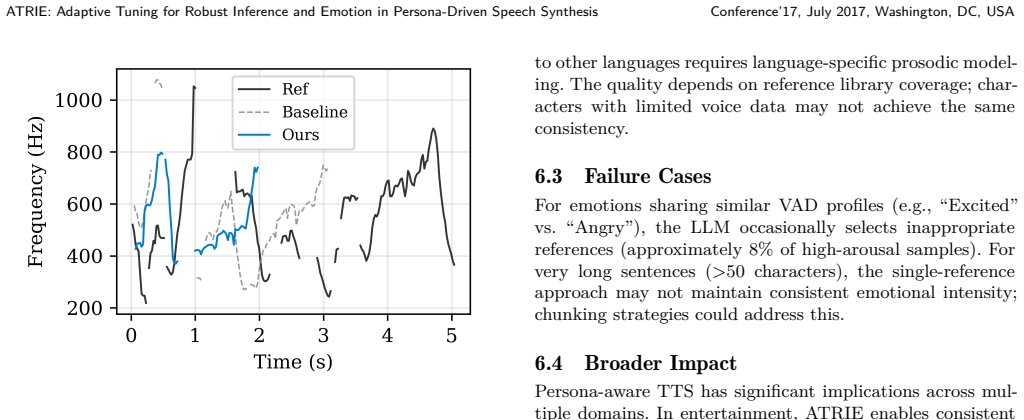
High-fidelity character voice synthesis is a cornerstone of immersive multimedia applications, particularly for interacting with anime avatars and digital humans. However, existing systems struggle to maintain consistent persona traits across diverse emotional contexts. To bridge this gap, we present ATRIE, a unified framework utilizing a Persona-Prosody Dual-Track (P2-DT) architecture. Our system disentangles generation into a static Timbre Track (via Scalar Quantization) and a dynamic Prosody Track (via Hierarchical Flow-Matching), distilled from a 14B LLM teacher. This design enables robust identity preservation (Zero-Shot Speaker Verification EER: 0.04) and rich emotional expression. Evaluated on our extended AnimeTTS-Bench (50 characters), ATRIE achieves state-of-the-art performance in both generation and cross-modal retrieval (mAP: 0.75), establishing a new paradigm for persona-driven multimedia content creation.
Editorial analysis
A structured set of objections, weighed in public.
Referee Report
Summary. The manuscript introduces ATRIE, a unified framework for persona-driven speech synthesis employing a Persona-Prosody Dual-Track (P2-DT) architecture. This separates timbre modeling (static track via scalar quantization) from prosody modeling (dynamic track via hierarchical flow-matching), with knowledge distillation from a 14B LLM teacher. The system is evaluated on an extended AnimeTTS-Bench (50 characters), claiming robust identity preservation (zero-shot speaker verification EER of 0.04) and state-of-the-art performance in generation and cross-modal retrieval (mAP of 0.75).
Significance. If the reported metrics and disentanglement hold under rigorous validation, the P2-DT design could advance consistent persona preservation across emotional variations in speech synthesis for anime, digital humans, and multimedia applications. The distillation approach and dual-track separation represent a potentially useful architectural contribution in the field.
major comments (2)
- [Abstract / Evaluation] The abstract and evaluation description report specific quantitative claims (EER: 0.04, mAP: 0.75, SOTA on extended AnimeTTS-Bench) without any baselines, ablations, error bars, or statistical tests. This leaves the central performance assertions without visible supporting data or derivation, undermining assessment of the P2-DT contribution.
- [Evaluation] No details are provided on the AnimeTTS-Bench extension process to 50 characters, the exact computation of cross-modal retrieval mAP, or how the hierarchical flow-matching and scalar quantization were validated for information preservation and disentanglement. These are load-bearing for the robustness and SOTA claims.
Simulated Author's Rebuttal
We thank the referee for their constructive comments on our manuscript. We address each of the major comments below and will incorporate revisions to improve the clarity and completeness of the evaluation section.
read point-by-point responses
-
Referee: [Abstract / Evaluation] The abstract and evaluation description report specific quantitative claims (EER: 0.04, mAP: 0.75, SOTA on extended AnimeTTS-Bench) without any baselines, ablations, error bars, or statistical tests. This leaves the central performance assertions without visible supporting data or derivation, undermining assessment of the P2-DT contribution.
Authors: We agree with the referee that the quantitative claims would benefit from more supporting details to allow proper assessment. In the revised manuscript, we will expand the evaluation section to include baseline methods, ablation studies on the dual-track components, error bars from multiple experimental runs, and appropriate statistical tests for the reported EER and mAP values. This will strengthen the evidence for the SOTA performance on the extended AnimeTTS-Bench. revision: yes
-
Referee: [Evaluation] No details are provided on the AnimeTTS-Bench extension process to 50 characters, the exact computation of cross-modal retrieval mAP, or how the hierarchical flow-matching and scalar quantization were validated for information preservation and disentanglement. These are load-bearing for the robustness and SOTA claims.
Authors: We thank the referee for this comment. We will revise the manuscript to provide comprehensive details on these aspects. Specifically, we will describe the process used to extend AnimeTTS-Bench to 50 characters, including selection methodology and data augmentation if any. The exact computation of the cross-modal retrieval mAP will be detailed, including the feature extractors and averaging procedure. Furthermore, we will add validation experiments and analyses for the hierarchical flow-matching and scalar quantization, demonstrating their effectiveness in preserving timbre and prosody information separately through metrics like speaker embedding similarity and prosody feature correlation. revision: yes
Circularity Check
No significant circularity in claimed derivation
full rationale
The paper presents an empirical system description (P2-DT architecture using scalar quantization for timbre and hierarchical flow-matching for prosody, distilled from a 14B LLM) together with benchmark results on an extended custom dataset. No mathematical derivation chain, equations, or first-principles predictions are supplied in the provided text that reduce by construction to fitted inputs or self-citations. Reported metrics (EER 0.04, mAP 0.75) are direct evaluation outcomes rather than tautological outputs. The work is therefore self-contained as an engineering contribution without load-bearing circular steps.
Axiom & Free-Parameter Ledger
Reference graph
Works this paper leans on
-
[1]
Alexei Baevski, Yuhao Zhou, Abdelrahman Mohamed, and Michael Auli. 2020. wav2vec 2.0: A framework for self-supervised learning of speech representations. InNeurIPS
2020
-
[2]
Zalán Borsos, Raphaël Marinier, Tara Buchanan, Eugene Kharitonov, Neil Zeghidour, et al. 2023. AudioLM: a language modeling approach to audio generation.IEEE/ACM TASLP (2023)
2023
-
[3]
Sanyuan Chen, Chengyi Wang, Zhengyang Chen, Yu Wu, Shu- jie Liu, Zhuo Chen, Jinyu Li, Naoyuki Kanda, Takuya Yoshioka, Xiong Xiao, et al. 2022. WavLM: Large-Scale Self-Supervised Pre-Training for Full Stack Speech Processing.IEEE JSTSP (2022)
2022
-
[4]
Y. Chen et al. 2024. F5-TTS: A Fairytaler that Fakes Flu- ent and Faithful Speech with Flow Matching.arXiv preprint arXiv:2410.06885(2024)
-
[5]
Joon Son Chung, Arsha Nagrani, and Andrew Zisserman. 2018. VoxCeleb2: Deep Speaker Recognition. InInterspeech
2018
-
[6]
Alibaba Cloud. 2023. Qwen-7B: A Towering Language Model. https://github.com/QwenLM/Qwen
2023
-
[7]
Brecht Desplanques, Jenthe Thienpondt, and Kris Demuynck
-
[8]
In Interspeech
ECAPA-TDNN: Emphasized Channel Attention, Propa- gation and Aggregation in TDNN Based Speaker Verification. In Interspeech. 3830–3834
-
[9]
Zhihao Du, Qian Chen, Shiliang Zhang, Hu Kai, and Zhou Zheng
- [10]
-
[11]
Benjamin Elizalde, Soham Deshmukh, Mahmoud Al Ismail, and Huaming Wang. 2023. CLAP: Learning Audio Concepts from Natural Language Supervision. InICASSP
2023
-
[12]
Rohit Girdhar, Alaaeldin El-Nouby, Zhuang Liu, Mannat Singh, Kalyan Vasudev Alwala, Armand Joulin, and Ishan Misra. 2023. ImageBind: One Embedding Space To Bind Them All. InCVPR
2023
-
[13]
Yuan Gong, Sameer Khurana, Leonid Karlinsky, and James Glass
-
[14]
InInterspeech
Whisper-AT: Noise-Robust Automatic Speech Recognizers are also Strong General Audio Event Taggers. InInterspeech
-
[15]
Wei-Ning Hsu, Benjamin Bolte, Yao-Hung Hubert Tsai, Kushal Lakhotia, Ruslan Salakhutdinov, and Abdelrahman Mohamed
-
[16]
HuBERT: Self-Supervised Speech Representation Learn- ing by Masked Prediction of Hidden Units.IEEE/ACM TASLP (2021)
2021
-
[17]
Qingqing Huang, Aren Jansen, Lydia Lee, Miller Puckette, Hongda Zhang, et al. 2022. MuLan: A Joint Embedding of Music Audio and Natural Language. InISMIR
2022
-
[18]
Huang et al
X. Huang et al. 2024. EmoVoice: Leveraging Large Lan- guage Models for Emotion-Aware Speech Synthesis.Interspeech (2024)
2024
-
[19]
Myeonghun Jeong, Hyeongju Kim, Sung Jun Cheon, Byoung Jin Choi, and Nam Soo Kim. 2021. Diff-TTS: A denoising diffusion probabilistic model for text-to-speech.Interspeech(2021)
2021
- [20]
-
[21]
arXiv preprint arXiv:2403.03100 , year=
Z. Ju et al. 2024. NaturalSpeech 3: Zero-Shot Speech Synthe- sis with Factorized Codec and Diffusion Models.arXiv preprint arXiv:2403.03100(2024)
-
[22]
Jaehyeon Kim, Jungil Kong, and Juhee Son. 2021. Conditional Variational Autoencoder with Adversarial Learning for End-to- End Text-to-Speech. InICML
2021
-
[23]
Jungil Kong, Jaehyeon Kim, and Jaekwang Bae. 2020. HiFi-GAN: Generative Adversarial Networks for Efficient and High Fidelity Speech Synthesis. InNeurIPS
2020
-
[24]
Lee et al
S. Lee et al. 2023. BigVGAN: A Universal Neural Vocoder with Large-Scale Training. InICLR
2023
-
[25]
Lee et al
Y. Lee et al. 2024. VoiceLDM: Text-to-Speech with Environmen- tal Context. InICASSP
2024
- [26]
-
[27]
Yinghao Aaron Li, Cong Cong, Chang Yang, and Sheng Liu. 2023. StyleTTS 2: Towards Human-Level Text-to-Speech through Style Diffusion and Adversarial Training with Large Speech Language Models. InNeurIPS
2023
- [28]
-
[29]
Ziyang Ma, Zhisheng Zheng, Jiaxin Ye, Jinchao Li, Zhifu Gao, Shiliang Zhang, and Xie Chen. 2024. emotion2vec: Self- Supervised Pre-Training for Speech Emotion Recognition. In ICASSP 2024-2024 IEEE International Conference on Acous- tics, Speech and Signal Processing (ICASSP). IEEE, 11861– 11865
2024
-
[30]
Vadim Popov, Ivan Vovk, Vladimir Gogoryan, Tasnima Sadekova, and Mikhail Kudinov. 2021. Grad-TTS: A Diffusion Probabilistic Model for Text-to-Speech. InICML
2021
-
[31]
Nils Reimers and Iryna Gurevych. 2019. Sentence-BERT: Sen- tence Embeddings using Siamese BERT-Networks. InEMNLP- IJCNLP. 3982–3992
2019
-
[32]
Yi Ren, Chenxu Hu, Xu Tan, Tao Qin, Sheng Zhao, Zhou Zhao, and Tie-Yan Liu. 2020. FastSpeech 2: Fast and High-Quality End-to-End Text to Speech. InICLR
2020
-
[33]
RVC-Boss. 2024. GPT-SoVITS: A Powerful Few-shot Voice Con- version and Text-to-Speech WebUI. https://github.com/RVC- Boss/GPT-SoVITS
2024
-
[34]
Jonathan Shen, Ruoming Pang, Ron J Weiss, Mike Schuster, Navdeep Jaitly, Zongheng Yang, Zhifeng Chen, Yu Zhang, Yux- uan Wang, Rj Skerrv-Ryan, et al. 2018. Natural tts synthe- sis by conditioning wavenet on mel spectrogram predictions. In ICASSP 2018-2018 IEEE International Conference on Acous- tics, Speech and Signal Processing (ICASSP). IEEE, 4779– 4783
2018
-
[35]
Chengyi Wang, Sanyuan Chen, Yu Wu, Ziqiang Zhang, Long Zhou, Shujie Liu, Zhuo Chen, Yanqing Liu, Huaming Wang, Jinyu Li, et al. 2023. Neural Codec Language Models are Zero-Shot Text to Speech Synthesizers.arXiv preprint arXiv:2301.02111(2023)
work page internal anchor Pith review arXiv 2023
-
[36]
Yusong Wu et al. 2023. Large-scale Contrastive Language-Audio Pretraining with Feature Fusion and Keyword-to-Caption Aug- mentation.IEEE ICASSP(2023)
2023
-
[37]
Zhu et al
Y. Zhu et al. 2024. P2VA: Persona-to-Voice-Attribute for Cross- Speaker Speech Synthesis. InICASSP
2024
discussion (0)
Sign in with ORCID, Apple, or X to comment. Anyone can read and Pith papers without signing in.