Recognition: unknown
Differentiable Satellite Constellation Configuration via Relaxed Coverage and Revisit Objectives
Pith reviewed 2026-05-10 03:03 UTC · model grok-4.3
The pith
Continuous relaxations turn coverage and revisit metrics differentiable so gradient descent recovers Walker-Delta geometries from irregular starts.
A machine-rendered reading of the paper's core claim, the machinery that carries it, and where it could break.
Core claim
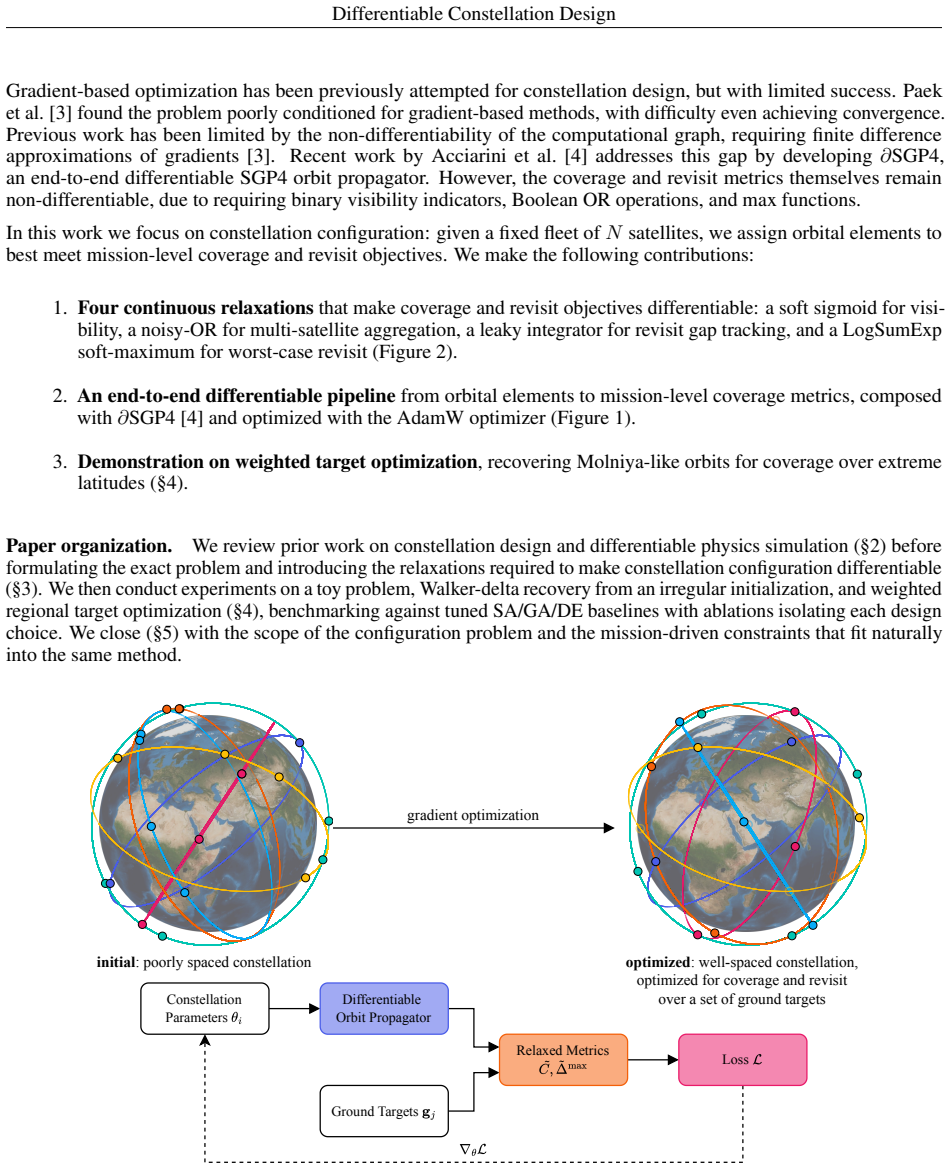
We introduce four continuous relaxations—soft sigmoid visibility, noisy-OR multi-satellite aggregation, leaky integrator revisit gap tracking, and LogSumExp soft-maximum—which, when composed with the differentiable SGP4 orbit propagator, yield a fully differentiable pipeline from orbital elements to mission-level coverage and revisit objectives. This scheme recovers Walker-Delta geometry from irregular initializations and discovers elliptical Molniya-like orbits with apogee dwell over extreme latitudes using only gradients. Compared with simulated annealing, genetic algorithm, and differential evolution baselines, the gradient-based method reaches Walker-equivalent geometry within roughly ̇
What carries the argument
Four continuous relaxations (soft sigmoid visibility, noisy-OR aggregation, leaky integrator revisit tracking, LogSumExp soft-max) composed with a differentiable orbit propagator to create an end-to-end differentiable objective.
Load-bearing premise
The gradients produced by the relaxed metrics lead to orbital configurations whose true discrete coverage and revisit performance match or exceed the values of the relaxed objective.
What would settle it
Take the orbital elements found by the gradient optimizer, evaluate them with exact binary visibility and discrete gap calculations on the ground targets, and check whether the resulting coverage fraction and maximum revisit time are at least as good as the relaxed objective reported during optimization.
Figures


read the original abstract
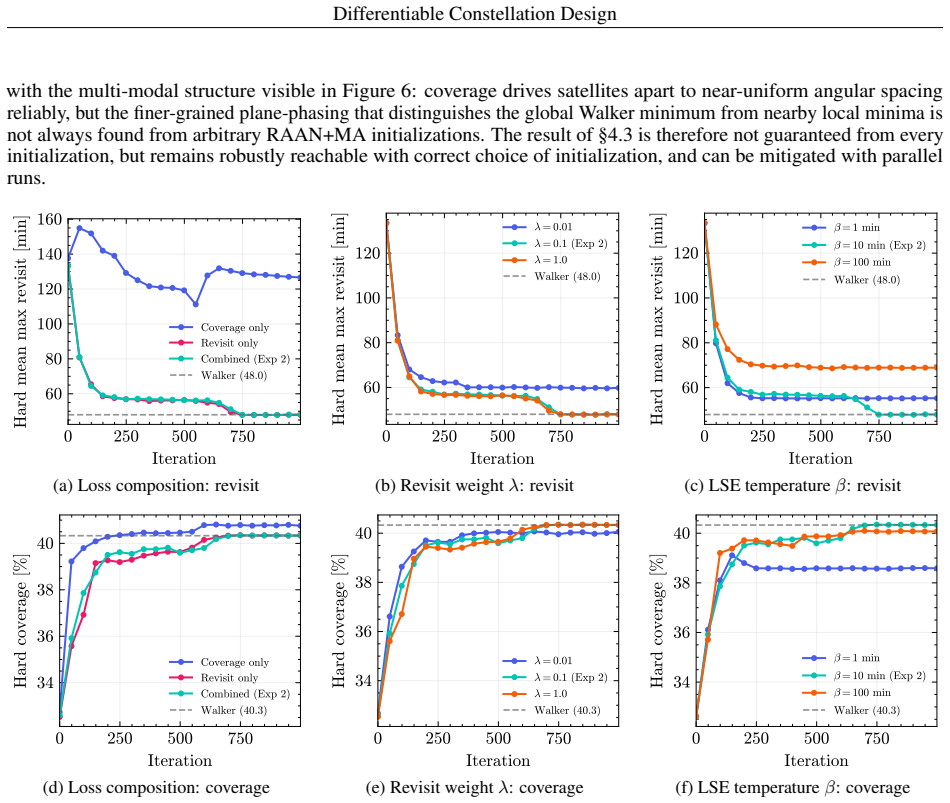
Satellite constellation design requires optimizing orbital parameters across multiple satellites to maximize mission specific metrics. For many types of mission, it is desirable to maximize coverage and minimize revisit gaps over ground targets. Existing approaches to constellation design either restrict the design space to symmetric parametric families such as Walker constellations, or rely on metaheuristic methods that require significant compute and many iterations. Gradient-based optimization has been considered intractable due to the non-differentiability of coverage and revisit metrics, which involve binary visibility indicators and discrete max operations. We introduce four continuous relaxations: soft sigmoid visibility, noisy-OR multi-satellite aggregation, leaky integrator revisit gap tracking, and LogSumExp soft-maximum, which when composed with the $\partial$SGP4 differentiable orbit propagator, yield a fully differentiable pipeline from orbital elements to mission-level objectives. We show that this scheme can recover Walker-Delta geometry from irregular initializations, and discovers elliptical Molniya-like orbits with apogee dwell over extreme latitudes from only gradients. Compared to simulated annealing (SA), genetic algorithm (GA), and differential evolution (DE) baselines, our gradient-based method recovers Walker-equivalent geometry within ${\sim}750$ evaluations, whereas the three black-box baselines plateau at with significantly worse revisit even with roughly four times the evaluation budget.
Editorial analysis
A structured set of objections, weighed in public.
Referee Report
Summary. The manuscript introduces four continuous relaxations—soft sigmoid visibility, noisy-OR aggregation, leaky integrator revisit tracking, and LogSumExp soft-maximum—composed with a differentiable SGP4 propagator to enable gradient-based optimization of satellite constellation orbital elements for coverage and revisit objectives. It claims that the resulting pipeline recovers Walker-Delta geometries from irregular initializations, discovers Molniya-like elliptical orbits with apogee dwell, and outperforms simulated annealing, genetic algorithm, and differential evolution baselines by reaching Walker-equivalent performance in approximately 750 evaluations versus four times the budget for the black-box methods.
Significance. If the relaxations are shown to produce configurations whose true discrete metrics match or exceed the relaxed scores, the approach would offer a computationally efficient alternative to metaheuristics for constellation design, with the demonstrated recovery of known optima and discovery of new geometries from gradients constituting a clear methodological advance. The direct empirical comparison to three established baselines is a strength.
major comments (2)
- [Abstract] Abstract and results: the central claims of Walker-Delta recovery and baseline superiority rest on the four relaxations yielding orbital configurations whose true binary coverage and maximum revisit gaps match or improve upon the relaxed objective values, yet the manuscript reports no post-hoc discrete evaluation of the final orbits to close this gap.
- [Results] Results section: the reported performance advantage (~750 evaluations versus ~3000 for SA/GA/DE) is measured only in the relaxed objective; without quantitative evidence on the alignment between relaxed and discrete metrics (e.g., tables comparing both at convergence), the superiority claim cannot be fully substantiated.
minor comments (2)
- [Abstract] The abstract contains an incomplete phrase: 'plateau at with significantly worse revisit'.
- [Method] The definitions and hyperparameters of the four relaxations (sigmoid steepness, LogSumExp temperature, integrator leak rate) would benefit from explicit equation numbers and a sensitivity study to confirm robustness.
Simulated Author's Rebuttal
We thank the referee for their constructive and insightful comments, which highlight an important opportunity to strengthen the validation of our relaxations. We address each major comment below and will make the corresponding revisions to the manuscript.
read point-by-point responses
-
Referee: [Abstract] Abstract and results: the central claims of Walker-Delta recovery and baseline superiority rest on the four relaxations yielding orbital configurations whose true binary coverage and maximum revisit gaps match or improve upon the relaxed objective values, yet the manuscript reports no post-hoc discrete evaluation of the final orbits to close this gap.
Authors: We agree that post-hoc discrete evaluation is necessary to fully substantiate the claims. The manuscript demonstrates recovery of known Walker-Delta geometries and discovery of Molniya-like orbits through the relaxed pipeline, but does not explicitly recompute the original binary coverage and maximum revisit metrics on the converged orbital elements. In the revised manuscript we will add a new subsection (and associated table) that applies the exact non-differentiable coverage and revisit functions to the final orbital parameters obtained by our method. This will quantify the alignment between relaxed scores and discrete performance, confirming that high relaxed objective values translate into competitive or superior true metrics. revision: yes
-
Referee: [Results] Results section: the reported performance advantage (~750 evaluations versus ~3000 for SA/GA/DE) is measured only in the relaxed objective; without quantitative evidence on the alignment between relaxed and discrete metrics (e.g., tables comparing both at convergence), the superiority claim cannot be fully substantiated.
Authors: We acknowledge that the current results section reports performance solely via the relaxed objective. To address this, we will expand the results section with tables that report both the relaxed objective value and the corresponding discrete metrics (exact coverage percentage and maximum revisit gap) at convergence for the differentiable method and, where feasible, for the baseline runs. These additions will provide direct quantitative evidence of metric alignment and allow a more complete comparison of the practical effectiveness of gradient-based versus black-box optimization. revision: yes
Circularity Check
No significant circularity; empirical results rest on novel relaxations and external propagator
full rationale
The paper's core contribution is the introduction of four explicit continuous relaxations (soft sigmoid visibility, noisy-OR aggregation, leaky integrator revisit, LogSumExp soft-max) composed with the external ∂SGP4 propagator to create a differentiable pipeline. The reported outcomes—recovery of Walker-Delta geometry from irregular starts, discovery of Molniya-like orbits, and superiority to SA/GA/DE baselines—are presented as empirical demonstrations after optimization, not as quantities derived by construction from the same inputs or self-citations. No load-bearing step reduces a claimed prediction or uniqueness result to a fitted parameter or prior self-work; the central claims remain independent of the evaluation data.
Axiom & Free-Parameter Ledger
free parameters (1)
- relaxation hyperparameters (sigmoid steepness, LogSumExp temperature, integrator leak rate)
axioms (1)
- domain assumption The ∂SGP4 orbit propagator is differentiable with respect to orbital elements
Reference graph
Works this paper leans on
-
[1]
J. G. Walker. Satellite Constellations.Journal of the British Interplanetary Society, 37:559, December 1984. ISSN 0007-084X. URL https://ui.adsabs.harvard.edu/abs/1984JBIS...37..559W. ADS Bibcode: 1984JBIS...37..559W
1984
-
[2]
Wilkins, and Christian Bruccoleri
Daniele Mortari, Matthew P. Wilkins, and Christian Bruccoleri. The Flower Constellations.The Journal of the Astronautical Sciences, 52(1-2):107–127, March 2004. ISSN 0021-9142, 2195-0571. doi:10.1007/BF03546424. URLhttps://link.springer.com/10.1007/BF03546424
-
[3]
Sung Wook Paek, Sangtae Kim, and Olivier de Weck. Optimization of Reconfigurable Satellite Constellations Using Simulated Annealing and Genetic Algorithm.Sensors, 19(4):765, January 2019. ISSN 1424-8220. doi:10.3390/s19040765. URLhttps://www.mdpi.com/1424-8220/19/4/765. Number: 4
-
[4]
Giacomo Acciarini, Atılım Güne¸ s Baydin, and Dario Izzo. Closing the gap between SGP4 and high- precision propagation via differentiable programming.Acta Astronautica, 226:694–701, January 2025. ISSN 00945765. doi:10.1016/j.actaastro.2024.10.063. URL https://linkinghub.elsevier.com/retrieve/pii/ S0094576524006374
-
[5]
Nathaniel Choo, Darryl Ahner, and Bryan Little. A Survey of Orbit Design and Selection Methodologies.The Journal of the Astronautical Sciences, 71(1):4, January 2024. ISSN 2195-0571. doi:10.1007/s40295-023-00420-9. URLhttps://link.springer.com/10.1007/s40295-023-00420-9. 16 Differentiable Constellation Design
-
[6]
Juan Fraire, Santiago Henn, Fabio Dovis, Roberto Garello, and Giorgio Taricco.Sparse Satel- lite Constellation Design for LoRa-based Direct-to-Satellite Internet of Things. December 2020. doi:10.1109/GLOBECOM42002.2020.9348042. Pages: 6
-
[7]
Ossama Abdelkhalik and Ahmed Gad. Optimization of space orbits design for Earth orbiting missions.Acta Astronautica, 68(7-8):1307–1317, April 2011. ISSN 00945765. doi:10.1016/j.actaastro.2010.09.029. URL https://linkinghub.elsevier.com/retrieve/pii/S0094576510003796
-
[8]
Williams Rogers, Dongshik Won, Dongwook Koh, Kyungwoo Hong, and Hang Woon Lee
David O. Williams Rogers, Dongshik Won, Dongwook Koh, Kyungwoo Hong, and Hang Woon Lee. Optimal Satellite Constellation Configuration Design: A Collection of Mixed Integer Linear Programs.Journal of Spacecraft and Rockets, pages 1–18, March 2026. ISSN 0022-4650. doi:10.2514/1.A36518. URL https: //arc.aiaa.org/doi/10.2514/1.A36518
-
[9]
John T. Hwang, Dae Young Lee, James W. Cutler, and Joaquim R. R. A. Martins. Large-Scale Multidisciplinary Optimization of a Small Satellite’s Design and Operation.Journal of Spacecraft and Rockets, 51(5):1648–1663, September 2014. ISSN 0022-4650, 1533-6794. doi:10.2514/1.A32751. URL https://arc.aiaa.org/doi/ 10.2514/1.A32751
-
[10]
Automatic Differentiation in Machine Learning: a Survey
Atılım Gunes Baydin, Barak A Pearlmutter, Alexey Andreyevich Radul, and Jeffrey Mark Siskind. Automatic Differentiation in Machine Learning: a Survey. 2018
2018
-
[11]
arXiv preprint arXiv:1910.00935 , year=
Yuanming Hu, Luke Anderson, Tzu-Mao Li, Qi Sun, Nathan Carr, Jonathan Ragan-Kelley, and Frédo Durand. DiffTaichi: Differentiable Programming for Physical Simulation, February 2020. URL http://arxiv.org/ abs/1910.00935. arXiv:1910.00935 [cs]
-
[12]
Jonas Degrave, Michiel Hermans, Joni Dambre, and Francis Wyffels. A Differentiable Physics En- gine for Deep Learning in Robotics.Frontiers in Neurorobotics, 13:6, March 2019. ISSN 1662-5218. doi:10.3389/fnbot.2019.00006. URL https://www.frontiersin.org/article/10.3389/fnbot.2019. 00006/full
-
[13]
Categorical Reparameterization with Gumbel-Softmax
Eric Jang, Shixiang Gu, and Ben Poole. Categorical Reparameterization with Gumbel-Softmax, August 2017. URLhttp://arxiv.org/abs/1611.01144. arXiv:1611.01144 [cs, stat]
work page internal anchor Pith review arXiv 2017
-
[14]
Gradient-based optimization for multi-resource spatial coverage problems
Nitin Kamra and Yan Liu. Gradient-based optimization for multi-resource spatial coverage problems. In Proceedings of the Thirty-Seventh Conference on Uncertainty in Artificial Intelligence, pages 1885–1894. PMLR, December 2021. URLhttps://proceedings.mlr.press/v161/kamra21a.html
2021
-
[15]
Jack Naylor, Raghav Mishra, Nicholas H. Barbara, and Donald G. Dansereau. dLITE: Differentiable Lighting- Informed Trajectory Evaluation for On-Orbit Inspection, 2025. URL https://arxiv.org/abs/2512.16011. Version Number: 1
-
[16]
URLhttps://www.mitsuba-renderer.org/
Mitsuba 3 - A Retargetable Forward and Inverse Renderer. URLhttps://www.mitsuba-renderer.org/
-
[17]
David Vallado, Paul Crawford, Ricahrd Hujsak, and T. S. Kelso. Revisiting Spacetrack Report #3. In AIAA/AAS Astrodynamics Specialist Conference and Exhibit. American Institute of Aeronautics and Astro- nautics. doi:10.2514/6.2006-6753. URL https://arc.aiaa.org/doi/abs/10.2514/6.2006-6753. _eprint: https://arc.aiaa.org/doi/pdf/10.2514/6.2006-6753
-
[18]
Elsevier, June 2014
Judea Pearl.Probabilistic Reasoning in Intelligent Systems: Networks of Plausible Inference. Elsevier, June 2014. ISBN 978-0-08-051489-5. Google-Books-ID: mn2jBQAAQBAJ
2014
-
[19]
Kluwer Academic Publishers, Dordrecht, 2000
Erich Peter Klement, Radko Mesiar, and Endre Pap.Triangular Norms, volume 8 ofTrends in Logic. Springer Netherlands, Dordrecht, 2000. ISBN 978-90-481-5507-1 978-94-015-9540-7. doi:10.1007/978-94-015-9540-7. URLhttp://link.springer.com/10.1007/978-94-015-9540-7
-
[20]
Kistler.Spiking Neuron Models: Single Neurons, Populations, Plasticity
Wulfram Gerstner and Werner M. Kistler.Spiking Neuron Models: Single Neurons, Populations, Plasticity. Cambridge University Press, August 2002. ISBN 978-0-521-89079-3. Google-Books-ID: Rs4oc7HfxIUC
2002
-
[21]
Boyd and Lieven Vandenberghe.Convex optimization
Stephen P. Boyd and Lieven Vandenberghe.Convex optimization. Cambridge University Press, Cambridge New York Melbourne New Delhi Singapore, version 29 edition, 2023. ISBN 978-0-521-83378-3
2023
-
[22]
Kavosh Asadi and Michael L. Littman. An Alternative Softmax Operator for Reinforcement Learning. In Proceedings of the 34th International Conference on Machine Learning, pages 243–252. PMLR, July 2017. URL https://proceedings.mlr.press/v70/asadi17a.html
2017
-
[23]
PyTorch: An Imperative Style, High-Performance Deep Learning Library
Adam Paszke, Sam Gross, Francisco Massa, Adam Lerer, James Bradbury, Gregory Chanan, Trevor Killeen, Zeming Lin, Natalia Gimelshein, Luca Antiga, Alban Desmaison, Andreas Kopf, Edward Yang, Zachary DeVito, Martin Raison, Alykhan Tejani, Sasank Chilamkurthy, Benoit Steiner, Lu Fang, Junjie Bai, and Soumith Chintala. PyTorch: An Imperative Style, High-Perfo...
2019
-
[24]
Visualizing the Loss Land- scape of Neural Nets
Hao Li, Zheng Xu, Gavin Taylor, Christoph Studer, and Tom Goldstein. Visualizing the Loss Land- scape of Neural Nets. InAdvances in Neural Information Processing Systems, volume 31. Curran Associates, Inc., 2018. URL https://proceedings.neurips.cc/paper_files/paper/2018/hash/ a41b3bb3e6b050b6c9067c67f663b915-Abstract.html
2018
-
[25]
S. Kirkpatrick, C. D. Gelatt, and M. P. Vecchi. Optimization by Simulated Annealing.Science, 220(4598): 671–680, May 1983. doi:10.1126/science.220.4598.671. URL https://www.science.org/doi/abs/10. 1126/science.220.4598.671
-
[26]
The minimal nilpotent orbit, the Joseph ideal, and differential opera- tors
David Vanderbilt and Steven G Louie. A Monte carlo simulated annealing approach to optimization over continuous variables.Journal of Computational Physics, 56(2):259–271, November 1984. ISSN 0021-9991. doi:10.1016/0021- 9991(84)90095-0. URLhttps://www.sciencedirect.com/science/article/pii/0021999184900950
-
[27]
Genetic Algorithms, Tournament Selection, and the Effects of Noise
Brad L Miller. Genetic Algorithms, Tournament Selection, and the Effects of Noise
-
[28]
January 1989
Gilbert Syswerda.Uniform Crossover in Genetic Algorithms. January 1989. Journal Abbreviation: Proc. 3rd Intl Conference on Genetic Algorithms 1989 Publication Title: Proc. 3rd Intl Conference on Genetic Algorithms 1989
1989
-
[29]
Oxford University Press, January 1996
Thomas Back.Evolutionary Algorithms in Theory and Practice: Evolution Strategies, Evolutionary Programming, Genetic Algorithms. Oxford University Press, January 1996. ISBN 978-0-19-535670-0. Google-Books-ID: htJHI1UrL7IC
1996
-
[30]
Nevergrad - A gradient-free optimization platform, April 2019
J Rapin and O Teytaud. Nevergrad - A gradient-free optimization platform, April 2019. URL https://github. com/facebookresearch/nevergrad. original-date: 2018-11-21T00:33:17Z
2019
-
[31]
Vallado.Fundamentals of Astrodynamics and Applications
David A. Vallado.Fundamentals of Astrodynamics and Applications. Microcosm Press, 2022. ISBN 978-1- 881883-22-7. A Per-Experiment Parameters Table 6 collects the per-experiment values for reproducibility. Values shared across experiments—propagation horizon 24 h, K= 240 time steps, minimum elevation αmin = 10◦, AdamW with learning rate η= 10 −2—are omitte...
2022
discussion (0)
Sign in with ORCID, Apple, or X to comment. Anyone can read and Pith papers without signing in.