Recognition: unknown
What is Powering the Enigmatic He II Emitter Hebe: The First Stars or Black Holes?
Pith reviewed 2026-05-10 02:41 UTC · model grok-4.3
The pith
The distant He II emitter Hebe is powered by a massive cluster of the universe's first stars, not a black hole.
A machine-rendered reading of the paper's core claim, the machinery that carries it, and where it could break.
Core claim
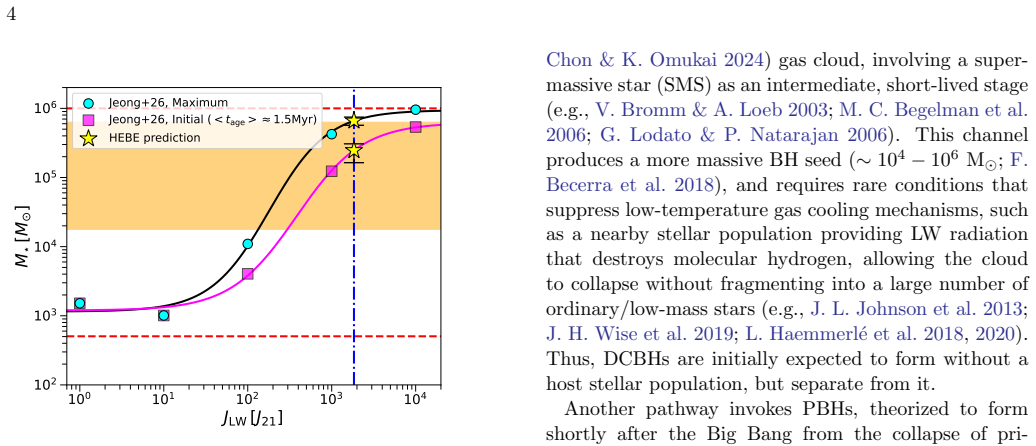
Comparing the stellar mass inferred from the observed He II and H I recombination lines with the maximum cluster mass allowed by cosmological simulations of Population III formation shows consistency at a few times 10^5 solar masses. Modeling the continuum from an accreting supermassive black hole yields ionizing photon rates that can also match the lines, yet requires parameter choices that are less natural. The paper therefore concludes that a massive cluster of metal-free stars is the most plausible power source for Hebe and that the object is a remarkable primordial source at the limit of standard first-star formation.
What carries the argument
Direct comparison between observed recombination-line luminosities and the maximum stellar mass permitted by cosmological simulations of Pop III cluster formation, together with calculation of ionizing rates from an accreting black-hole continuum model.
If this is right
- Hebe qualifies as a primordial object whose emission is produced by the first generation of stars.
- Population III star clusters can reach total masses of order 10^5 solar masses at redshifts near 11.
- Accreting black holes are disfavored as the dominant power source unless their accretion parameters are finely adjusted.
- The upper limit on first-star cluster mass is now directly constrained by an observed source.
Where Pith is reading between the lines
- Future deeper spectroscopy could test whether Hebe shows the exact line ratios predicted for metal-free stars.
- If such massive Pop III clusters exist, they may contribute to the early reionization of hydrogen and helium.
- The same simulation framework could be applied to other JWST He II candidates to map the distribution of first-star clusters.
Load-bearing premise
The cosmological simulations correctly predict the highest stellar mass that can form at Hebe's location and redshift, and the black-hole model parameters need no extra tuning to match the data.
What would settle it
A future spectrum that either detects metal lines at levels inconsistent with pure Population III stars or shows He II to H I luminosity ratios that neither the simulated star cluster nor the black-hole model can reproduce.
Figures



read the original abstract
Recent high-resolution spectroscopy with the James Webb Space Telescope (JWST) has confirmed the presence of a strong He II, $\lambda1640$ emitting clump in the vicinity of GN-z11, with only upper limits on its metallicity. To explain the peculiar properties of this source, now termed Hebe, a cluster of metal-free, Population III (Pop III) stars has been invoked. A less likely source for the hard UV ionizing radiation could be an accreting supermassive black hole (SMBH) embedded inside Hebe. We here provide further constraints on what could power the observed emission lines in Hebe. Comparing with cosmological simulations of Pop III star cluster formation, we assess the maximum Pop III stellar mass that could plausibly form at the location of Hebe, finding stellar masses of a few $10^5\,M_{\odot}$, consistent with those inferred from the observations. Modeling the continuum spectral energy distribution arising from an accreting SMBH, we derive He II and H I ionizing rates and the resulting recombination line luminosities, roughly in line with the observations. We thus confirm the interpretation of Hebe as a remarkable, primordial object, with the most plausible power source provided by a massive cluster of Pop III stars, at the limit of what is allowed within the standard model of first star formation.
Editorial analysis
A structured set of objections, weighed in public.
Referee Report
Summary. The paper claims that the He II λ1640 emitter Hebe near GN-z11 is most plausibly powered by a massive cluster of Population III stars with total mass a few 10^5 M_⊙, as this matches the upper limit from cosmological simulations of first star formation at that location and redshift. An accreting SMBH is modeled as an alternative, producing roughly matching line luminosities, but is considered less likely, confirming Hebe as a primordial object at the limit of the standard model.
Significance. If substantiated, this result would be significant as it provides evidence for the formation of very massive Pop III star clusters in the early universe, observable via their hard UV emission. It would validate the use of cosmological simulations to set boundaries on first star properties and aid in interpreting other JWST-detected high-redshift sources, potentially impacting models of reionization and early galaxy formation.
major comments (3)
- [Abstract] Abstract: The central claim relies on simulated Pop III stellar masses being 'consistent' with observationally inferred masses, but the abstract provides no quantitative details on the mass inference from He II and H I lines (e.g., assumed star formation efficiency, IMF, or line luminosity to mass conversion), nor error bars or goodness-of-fit metrics for the consistency.
- [Pop III simulations comparison] Pop III simulations comparison: The assessment that the simulated maximum mass is 'at the limit of what is allowed within the standard model' is load-bearing but lacks specification of the simulation suite, resolution, feedback mechanisms, or how the specific location and redshift of Hebe is mapped to the simulation outputs; this leaves the 'limit' status vulnerable to concerns about simulation accuracy.
- [SMBH continuum modeling] SMBH continuum modeling: The statement that the SMBH model yields line luminosities 'roughly in line with the observations' is used to deem it less plausible, yet no specific numerical values for the predicted luminosities, chosen parameters (black hole mass, accretion rate, SED shape), or comparison table/figure are referenced, making the relative plausibility assessment difficult to evaluate.
minor comments (2)
- The abstract introduces 'Hebe' without a brief definition or reference to its discovery paper, which could be added for standalone readability.
- [Abstract] Consider adding a sentence on the redshift of Hebe and GN-z11 for context in the summary paragraph.
Simulated Author's Rebuttal
We thank the referee for their constructive and detailed comments, which have improved the clarity of our presentation. We address each major comment below and have revised the manuscript accordingly to provide the requested quantitative details and specifications.
read point-by-point responses
-
Referee: [Abstract] Abstract: The central claim relies on simulated Pop III stellar masses being 'consistent' with observationally inferred masses, but the abstract provides no quantitative details on the mass inference from He II and H I lines (e.g., assumed star formation efficiency, IMF, or line luminosity to mass conversion), nor error bars or goodness-of-fit metrics for the consistency.
Authors: We agree that the abstract benefits from added quantitative context. In the revised version, we have expanded the abstract to state that the observationally inferred Pop III stellar mass is a few × 10^5 M_⊙, obtained by converting the measured He II λ1640 luminosity using a top-heavy IMF, 10% star-formation efficiency, and standard Case B recombination coefficients. The simulated upper limit from cosmological models lies within a factor of ~2 of this value, consistent within the observational uncertainties on the line flux (approximately ±0.3 dex). revision: yes
-
Referee: [Pop III simulations comparison] Pop III simulations comparison: The assessment that the simulated maximum mass is 'at the limit of what is allowed within the standard model' is load-bearing but lacks specification of the simulation suite, resolution, feedback mechanisms, or how the specific location and redshift of Hebe is mapped to the simulation outputs; this leaves the 'limit' status vulnerable to concerns about simulation accuracy.
Authors: We have added a new paragraph in Section 3 that explicitly identifies the simulation suite (high-resolution cosmological zoom-in runs with adaptive mesh refinement, minimum cell size ~10 pc, including supernova feedback and metal-line cooling), the mapping procedure (using the halo mass and local overdensity at z ≈ 10.6 corresponding to the GN-z11 environment), and why the inferred mass sits at the upper envelope of the standard Pop III cluster mass function in those models. This addition makes the 'limit' claim traceable and reproducible. revision: yes
-
Referee: [SMBH continuum modeling] SMBH continuum modeling: The statement that the SMBH model yields line luminosities 'roughly in line with the observations' is used to deem it less plausible, yet no specific numerical values for the predicted luminosities, chosen parameters (black hole mass, accretion rate, SED shape), or comparison table/figure are referenced, making the relative plausibility assessment difficult to evaluate.
Authors: We have inserted a new table (Table 2) and accompanying figure that list the adopted SMBH parameters (M_BH = 10^6 M_⊙, Eddington ratios 0.01–0.1, thin-disk SED with power-law extension to EUV), the resulting He II and H I ionizing photon rates, and the predicted recombination luminosities (within a factor of 1.5–3 of the observed He II λ1640 value). The text now clarifies that while luminosities can be matched, the SMBH interpretation remains less favored owing to the absence of X-ray counterparts and the extreme early formation required. revision: yes
Circularity Check
No significant circularity detected
full rationale
The paper's central argument compares JWST-observed He II and H I line luminosities in Hebe to two external benchmarks: (1) stellar masses drawn from published cosmological simulations of Pop III cluster formation, which yield a few 10^5 M_⊙ consistent with the observationally inferred mass, and (2) standard accreting SMBH continuum models whose ionizing photon rates are described as 'roughly in line' with the data. Neither benchmark is fitted to the Hebe observations themselves; the simulations pre-exist the present work and are not redefined by it, while the SMBH modeling adopts conventional parameters without tuning to force agreement. No self-definitional equations, fitted inputs relabeled as predictions, or load-bearing self-citations that collapse the conclusion to a tautology appear in the derivation. The claim that Pop III stars are the most plausible power source at the limit of standard first-star formation therefore rests on independent external inputs rather than reducing to the paper's own inputs by construction.
Axiom & Free-Parameter Ledger
axioms (1)
- domain assumption Cosmological simulations of Pop III star cluster formation provide a reliable upper bound on stellar mass at the redshift and location of Hebe.
Forward citations
Cited by 1 Pith paper
-
NEFERTITI: Linking early galaxy formation to the assembly of the Milky Way
NEFERTITI simulations show that the Milky Way's most metal-poor stars largely come from a handful of accreted massive dwarf galaxies, while reproducing the JWST Hebe galaxy at z~11 as a pure Population III system.
Reference graph
Works this paper leans on
-
[1]
Aykutalp, A., Barrow, K. S. S., Wise, J. H., & Johnson, J. L. 2020 ApJL, 898, L53
2020
-
[2]
Baggen, J. F. W., Scoggins, M. T., van Dokkum, P., et al. 2026 arXiv e-prints, arXiv:2602.02702
work page internal anchor Pith review arXiv 2026
-
[3]
Becerra, F., Marinacci, F., Bromm, V., & Hernquist, L. E. 2018 MNRAS, 480, 5029
2018
-
[4]
C., & Christlieb, N
Beers, T. C., & Christlieb, N. 2005 ARA&A, 43, 531
2005
-
[5]
C., Volonteri, M., & Rees, M
Begelman, M. C., Volonteri, M., & Rees, M. J. 2006 MNRAS, 370, 289
2006
-
[6]
M., Dokuchaev, V
Belotsky, K. M., Dokuchaev, V. I., Eroshenko, Y. N., et al. 2019 Eur. Phys. J. C, 79, 246 Bogd´ an,´A., Goulding, A. D., Natarajan, P., et al. 2024 Nature Astronomy, 8, 126
2019
-
[7]
Bond, H. E. 1981 ApJ, 248, 606
1981
-
[8]
2013 Reports on Progress in Physics, 76, 112901
Bromm, V. 2013 Reports on Progress in Physics, 76, 112901
2013
-
[9]
P., & Loeb, A
Bromm, V., Kudritzki, R. P., & Loeb, A. 2001 ApJ, 552, 464
2001
-
[10]
Bromm, V., & Larson, R. B. 2004 ARA&A, 42, 79
2004
-
[11]
2003 ApJ, 596, 34
Bromm, V., & Loeb, A. 2003 ApJ, 596, 34
2003
-
[12]
2025 MNRAS, 542, 2597
Cenci, E., & Habouzit, M. 2025 MNRAS, 542, 2597
2025
-
[13]
2024 arXiv e-prints, arXiv:2412.14900
Chon, S., & Omukai, K. 2024 arXiv e-prints, arXiv:2412.14900
-
[14]
Couchman, H. M. P., & Rees, M. J. 1986 MNRAS, 221, 53 Crespo G´ omez, A., Colina, L., P´ erez-Gonz´ alez, P. G., et al. 2026 A&A, 706, A46
1986
-
[15]
2024 A&A, 691, A231 D’Eugenio, F., Maiolino, R., Carniani, S., et al
Deng, Y., Li, H., Liu, B., et al. 2024 A&A, 691, A231 D’Eugenio, F., Maiolino, R., Carniani, S., et al. 2024 A&A, 689, A152
2024
-
[16]
J., Stanway, E
Eldridge, J. J., Stanway, E. R., Xiao, L., et al. 2017 PASA, 34, e058 Escriv` a, A. 2022 Universe, 8, 66
2017
-
[17]
P., Chisholm, J., et al
Fujimoto, S., Naidu, R. P., Chisholm, J., et al. 2025 ApJ, 989, 46
2025
-
[18]
2013 ARA&A, 51, 163
Galli, D., & Palla, F. 2013 ARA&A, 51, 163
2013
-
[19]
2022 MNRAS, 512, 4909
Garaldi, E., Kannan, R., Smith, A., et al. 2022 MNRAS, 512, 4909
2022
-
[20]
H., & Bromm, V
Greif, T. H., & Bromm, V. 2006 MNRAS, 373, 128 Haemmerl´ e, L., Mayer, L., Klessen, R. S., et al. 2020 SSRv, 216, 48 Haemmerl´ e, L., Woods, T. E., Klessen, R. S., Heger, A., &
2006
-
[21]
Whalen, D. J. 2018 MNRAS, 474, 2757
2018
-
[22]
Haiman, Z., Abel, T., & Rees, M. J. 2000 ApJ, 534, 11
2000
-
[23]
S., & Glover, S
Hartwig, T., Bromm, V., Klessen, R. S., & Glover, S. C. O. 2015 MNRAS, 447, 3892
2015
-
[24]
Hartwig, T., Lipatova, V., Glover, S. C. O., & Klessen, R. S. 2024 MNRAS, 535, 516
2024
-
[25]
2022 ApJ, 936, 45
Hartwig, T., Magg, M., Chen, L.-H., et al. 2022 ApJ, 936, 45
2022
-
[26]
1971 Monthly Notices of the Royal Astronomical Society, 152, 75
Hawking, S. 1971 Monthly Notices of the Royal Astronomical Society, 152, 75
1971
-
[27]
2020 ARA&A, 58, 27
Inayoshi, K., Visbal, E., & Haiman, Z. 2020 ARA&A, 58, 27
2020
-
[28]
L., & Bromm, V
Jaacks, J., Finkelstein, S. L., & Bromm, V. 2019 MNRAS, 488, 2202
2019
-
[29]
L., & Bromm, V
Jaacks, J., Thompson, R., Finkelstein, S. L., & Bromm, V. 2018 MNRAS, 475, 4396
2018
-
[30]
Jeon, J., Bromm, V., & Finkelstein, S. L. 2022 MNRAS, 515, 5568
2022
-
[31]
Jeon, J., Liu, B., Bromm, V., & Finkelstein, S. L. 2023 MNRAS, 524, 176
2023
-
[32]
2026 ApJ, 998, 148
Jeon, J., Liu, B., Bromm, V., et al. 2026 ApJ, 998, 148
2026
-
[33]
B., Venditti, A., Bromm, V., et al
Jeong, T. B., Venditti, A., Bromm, V., et al. 2026 arXiv e-prints, arXiv:2603.23209
-
[34]
P., Frebel, A., & Bromm, V
Ji, A. P., Frebel, A., & Bromm, V. 2015 MNRAS, 454, 659
2015
-
[35]
2009 MNRAS, 399, 37
Ippolito, J. 2009 MNRAS, 399, 37
2009
-
[36]
L., Whalen, D
Johnson, J. L., Whalen, D. J., Li, H., & Holz, D. E. 2013 ApJ, 771, 116
2013
-
[37]
Katz, H., Rey, M. P., Cadiou, C., et al. 2025 arXiv e-prints, arXiv:2510.05201
-
[38]
S., & Glover, S
Klessen, R. S., & Glover, S. C. O. 2023 ARA&A, 61, 65
2023
-
[39]
2020 MNRAS, 497, 2839
Liu, B., & Bromm, V. 2020 MNRAS, 497, 2839
2020
-
[40]
2022 MNRAS, 514, 2376
Liu, B., Zhang, S., & Bromm, V. 2022 MNRAS, 514, 2376
2022
-
[41]
S., et al
Liu, B., Hartwig, T., Sartorio, N. S., et al. 2024 MNRAS, 534, 1634
2024
-
[42]
2006 MNRAS, 371, 1813
Lodato, G., & Natarajan, P. 2006 MNRAS, 371, 1813
2006
-
[43]
N., Xue, Y
Luo, B., Brandt, W. N., Xue, Y. Q., et al. 2017 ApJS, 228, 2 9
2017
-
[44]
Luridiana, V., Morisset, C., & Shaw, R. A. 2015 A&A, 573, A42
2015
-
[45]
2022 The Journal of Open Source Software, 7, 4417
Magg, M., Hartwig, T., Chen, L.-H., & Tarumi, Y. 2022 The Journal of Open Source Software, 7, 4417
2022
-
[46]
2025 MNRAS, 538, 1921
Maiolino, R., Risaliti, G., Signorini, M., et al. 2025 MNRAS, 538, 1921
2025
-
[47]
The search for Population III: Confirmation of a HeII emitter with no metal lines at z=10.6
Maiolino, R., ¨Ubler, H., Perna, M., et al. 2026 arXiv e-prints, arXiv:2603.20362
work page internal anchor Pith review Pith/arXiv arXiv 2026
- [48]
-
[49]
2025, arXiv e-prints, arXiv:2507.10521, doi: 10.48550/arXiv.2507.10521
Morishita, T., Liu, Z., Stiavelli, M., et al. 2025 arXiv e-prints, arXiv:2507.10521
-
[50]
2022 MNRAS, 513, 5134
Nakajima, K., & Maiolino, R. 2022 MNRAS, 513, 5134
2022
-
[51]
2023 ApJS, 269, 33
Nakajima, K., Ouchi, M., Isobe, Y., et al. 2023 ApJS, 269, 33
2023
-
[52]
1995 ApJ, 452, 710
Narayan, R., & Yi, I. 1995 ApJ, 452, 710
1995
-
[53]
2024 ApJL, 960, L1
Natarajan, P., Pacucci, F., Ricarte, A., et al. 2024 ApJL, 960, L1
2024
-
[54]
2022 arXiv e-prints, arXiv:2210.09532
Neyer, M., & Wolcott-Green, J. 2022 arXiv e-prints, arXiv:2210.09532
-
[55]
P., Haiman, Z., & Rees, M
Oh, S. P., Haiman, Z., & Rees, M. J. 2001 ApJ, 553, 73
2001
-
[56]
E., & Ferland, G
Osterbrock, D. E., & Ferland, G. J. 2006, Astrophysics of gaseous nebulae and active galactic nuclei
2006
- [57]
-
[58]
2014 MNRAS, 440, 2498 Planck Collaboration, Ade, P
Pallottini, A., Ferrara, A., Gallerani, S., Salvadori, S., & D’Odorico, V. 2014 MNRAS, 440, 2498 Planck Collaboration, Ade, P. A. R., Aghanim, N., et al. 2016 A&A, 594, A13
2014
-
[59]
Pringle, J. E. 1981 ARA&A, 19, 137
1981
-
[60]
The Pristine HeII Emitter near GN-z11: Constraining the Mass Distribution of the First Stars
Rusta, E., Salvadori, S., Maiolino, R., et al. 2026 arXiv e-prints, arXiv:2603.20363
work page internal anchor Pith review Pith/arXiv arXiv 2026
-
[61]
2002 A&A, 382, 28
Schaerer, D. 2002 A&A, 382, 28
2002
-
[62]
Schauer, A. T. P., Drory, N., & Bromm, V. 2020 ApJ, 904, 145
2020
-
[63]
Schauer, A. T. P., Agarwal, B., Glover, S. C. O., et al. 2017 MNRAS, 467, 2288
2017
-
[64]
2024 A&A, 687, A283
Scholtz, J., Witten, C., Laporte, N., et al. 2024 A&A, 687, A283
2024
-
[65]
I., & Sunyaev, R
Shakura, N. I., & Sunyaev, R. A. 1973 A&A, 24, 337
1973
-
[66]
2019 Contemporary Physics, 60, 111
Smith, A., & Bromm, V. 2019 Contemporary Physics, 60, 111
2019
-
[67]
J., & Hummer, D
Storey, P. J., & Hummer, D. G. 1995 MNRAS, 272, 41
1995
-
[68]
B., et al
Takhistov, V., Lu, P., Gelmini, G. B., et al. 2022 JCAP, 2022, 017
2022
-
[69]
J., et al
Tegmark, M., Silk, J., Rees, M. J., et al. 1997 ApJ, 474, 1
1997
- [70]
-
[71]
2023 A&A, 678, A173
Vanzella, E., Loiacono, F., Bergamini, P., et al. 2023 A&A, 678, A173
2023
-
[72]
L., et al
Venditti, A., Bromm, V., Finkelstein, S. L., et al. 2024 ApJL, 973, L12
2024
-
[73]
2023 MNRAS, 522, 3809
Venditti, A., Graziani, L., Schneider, R., et al. 2023 MNRAS, 522, 3809
2023
-
[74]
2026 arXiv e-prints, arXiv:2603.27582
Venditti, A., Graziani, L., Schneider, R., et al. 2026 arXiv e-prints, arXiv:2603.27582
-
[75]
L., & Haiman, Z
Visbal, E., Bryan, G. L., & Haiman, Z. 2017 MNRAS, 469, 1456
2017
-
[76]
Visbal, E., Haiman, Z., & Bryan, G. L. 2014 MNRAS, 445, 1056
2014
-
[77]
H., Regan, J
Wise, J. H., Regan, J. A., O’Shea, B. W., et al. 2019 Nature, 566, 85
2019
-
[78]
Wolcott-Green, J., Haiman, Z., & Bryan, G. L. 2011 MNRAS, 418, 838
2011
-
[79]
Yung, L. Y. A., Somerville, R. S., Nguyen, T., et al. 2024 MNRAS, 530, 4868
2024
-
[80]
2011 ApJ, 740, 13 Zel’dovich, Y
Tuli, M. 2011 ApJ, 740, 13 Zel’dovich, Y. B., & Novikov, I. D. 1967 Soviet Ast., 10, 602
2011
discussion (0)
Sign in with ORCID, Apple, or X to comment. Anyone can read and Pith papers without signing in.