Recognition: unknown
Investigation of Hourglass-shaped Magnetic fields in the G35.20-0.74 Star-Forming Complex
Pith reviewed 2026-05-10 02:36 UTC · model grok-4.3
The pith
Hourglass magnetic fields shape star formation differently in two parts of the G35.20-0.74 complex.
A machine-rendered reading of the paper's core claim, the machinery that carries it, and where it could break.
Core claim
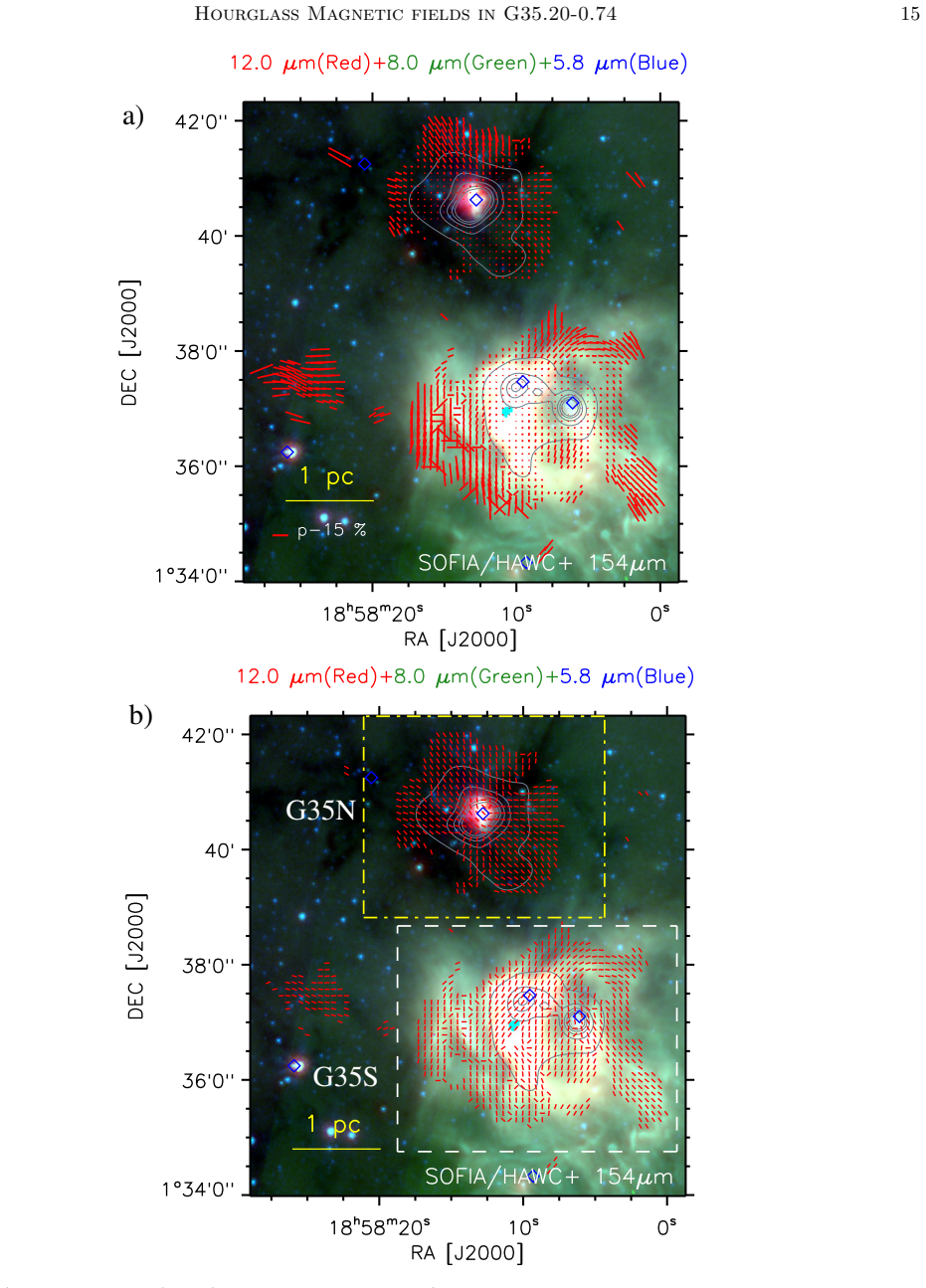
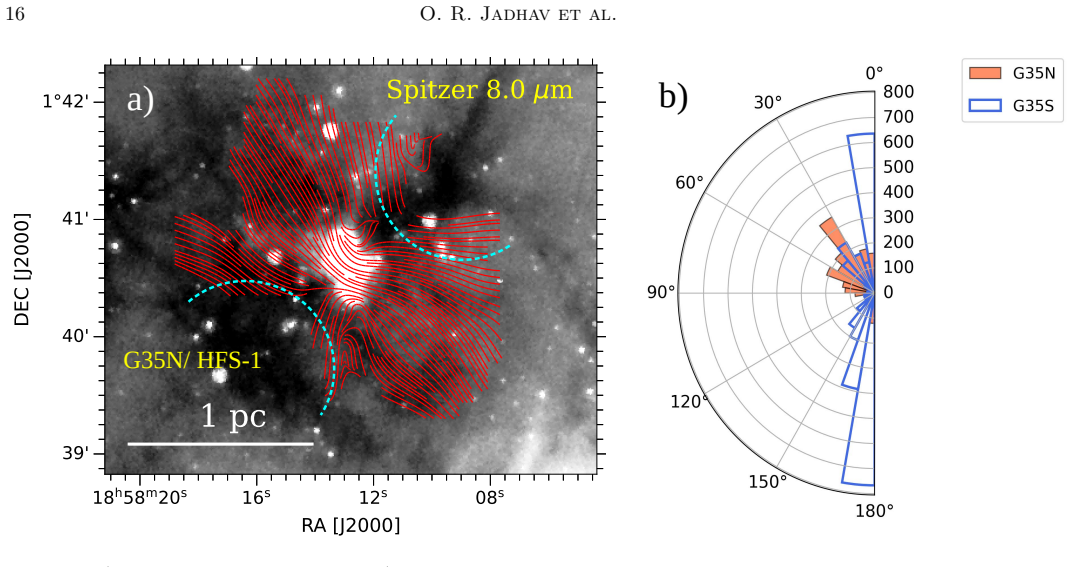
Multi-wavelength polarization observations reveal hourglass-shaped plane-of-sky magnetic field morphologies toward both G35N and G35S. Field strengths derived via the Davis-Chandrasekhar-Fermi method reach approximately 600 microgauss in G35N and 850 microgauss in G35S. Gravity and magnetic fields contribute comparably to the energy balance in G35N, whereas magnetic fields dominate over gravity and turbulence in G35S because of compression by the expanding HII region. The hourglass morphology in G35N is consistent across clump and core scales, supporting magnetically regulated collapse, while stellar feedback alters the field configuration and strength in G35S.
What carries the argument
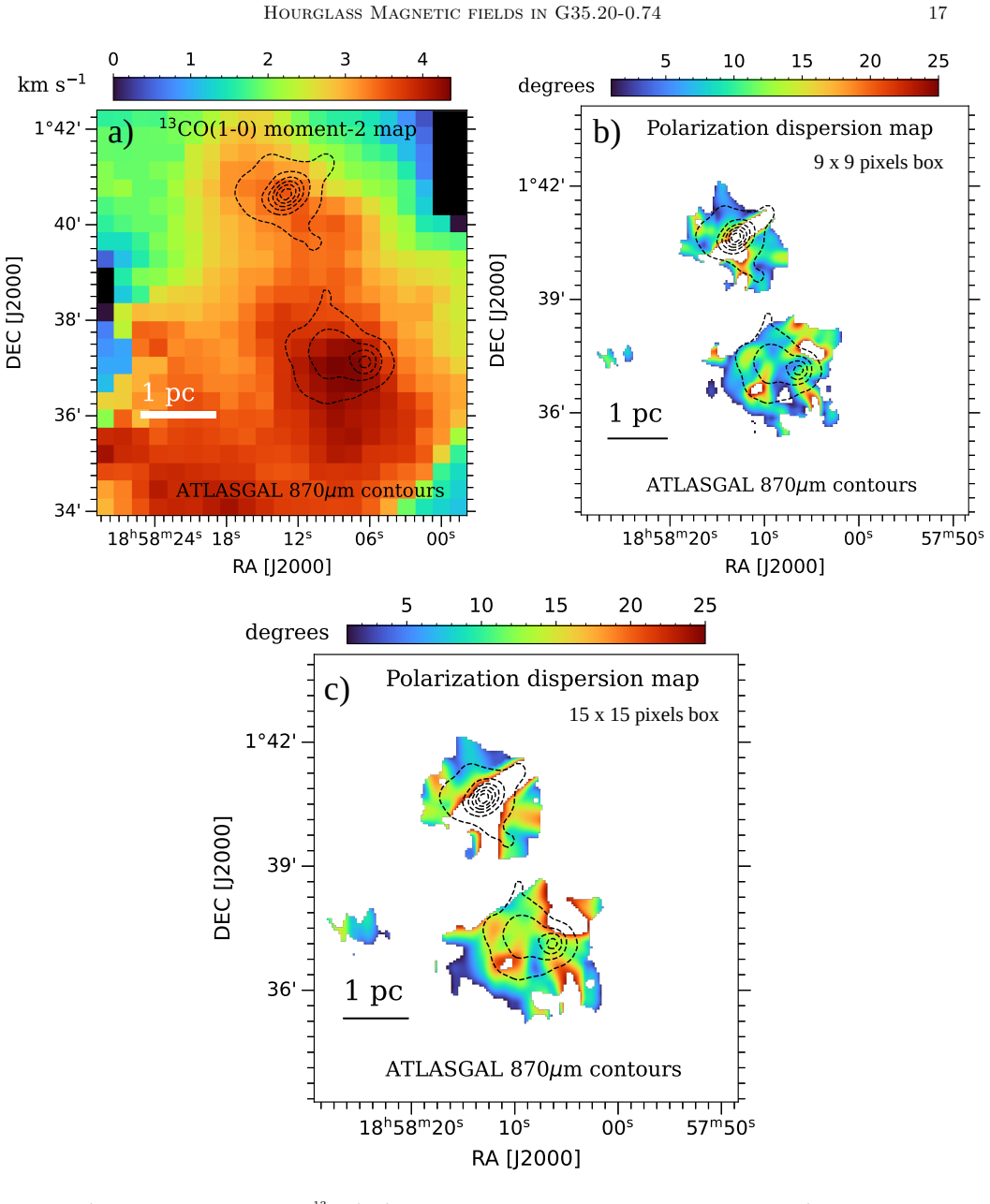
Hourglass-shaped plane-of-sky magnetic field morphology traced by dust polarization at 154 microns and 220 GHz, which enables both morphological comparison across scales and field-strength estimation through the Davis-Chandrasekhar-Fermi technique applied to polarization-angle structure functions.
If this is right
- The magnetic field in G35N guides collapse consistently from clump scales down to core scales.
- Stellar feedback from the HII region compresses and amplifies the magnetic field in G35S.
- Magnetic energy is at least as important as gravitational energy in G35N and more important than both gravity and turbulence in G35S.
- Magnetic fields overall act as a decisive regulator of star formation in the complex.
Where Pith is reading between the lines
- If hourglass morphologies with comparable field strengths appear in other star-forming regions, the dual influence of collapse and feedback may be a general pattern.
- Correcting for beam-scale correlations could reduce the reported field strengths and shift the energy balance conclusions toward greater turbulence contributions.
- These observations supply concrete targets for magnetohydrodynamic simulations that include both collapse and HII-region feedback.
Load-bearing premise
The measured dust polarization angles reliably trace the plane-of-sky magnetic field orientation and the Davis-Chandrasekhar-Fermi method yields unbiased field strengths despite possible effects from unresolved structures or non-isotropic turbulence.
What would settle it
Higher-resolution polarization maps that show random rather than hourglass field orientations, or independent Zeeman or other measurements that yield field strengths far below the reported 600-850 microgauss range in either sub-region.
Figures




read the original abstract
To investigate the role of magnetic fields toward the G35N and G35S sub-regions in the G35.20-0.74 star-forming complex, we utilized multi-wavelength polarimetric observations from the SOFIA/HAWC+ at 154 $\mu$m and ACT at 220 GHz/1.3 mm. The ACT 220 GHz polarization data (resolution $\sim$1$'$) show an hourglass-shaped plane-of-sky magnetic field morphologies toward both the sub-regions, although with distinct symmetry axes. SOFIA/HAWC+ 154 $\mu$m data (resolution $\sim$13.6$''$) confirm an hourglass morphology in G35N, whereas G35S displays a different magnetic field configuration compared to the ACT observations. An hourglass morphology identified at clump scales ($\sim$pc) toward G35N is consistent with the previously reported B-field morphology at core scales ($\sim$0.05 pc), supporting the scenario of a magnetically regulated collapse. Using the SOFIA/HAWC+ data, we estimate magnetic field strengths of $\sim$600 $\pm$ 200 $\mu$G in G35N and $\sim$850 $\pm$ 310 $\mu$G in G35S. Energy balance analysis suggests that gravity and magnetic fields contribute comparably in G35N, while in G35S the gas dynamics are dominated by magnetic field, followed by gravity and turbulence. The higher field strength in G35S likely results from compression by the expanding HII region, highlighting the impact of stellar feedback. The derived magnetic field strengths and corresponding magnetic energies should be treated as upper limits due to unresolved beam-scale correlations and the limited fitting range of the polarization angle structure function. Overall, our results show that magnetic fields decisively regulate star formation, with G35N shaped by magnetically controlled collapse and G35S being strongly influenced by stellar feedback.
Editorial analysis
A structured set of objections, weighed in public.
Referee Report
Summary. The manuscript presents multi-wavelength polarimetric observations of the G35.20-0.74 star-forming complex using SOFIA/HAWC+ at 154 μm (~13.6'' resolution) and ACT at 220 GHz (~1' resolution). It identifies hourglass-shaped plane-of-sky magnetic field morphologies in the G35N and G35S sub-regions (with distinct symmetry axes), notes consistency of the hourglass pattern in G35N between clump and previously reported core scales, derives DCF magnetic field strengths of ~600 ± 200 μG (G35N) and ~850 ± 310 μG (G35S), and performs energy balance analysis to conclude that magnetic fields decisively regulate star formation, with G35N shaped by magnetically controlled collapse (gravity ~ magnetic) and G35S dominated by magnetic fields compressed by HII-region feedback.
Significance. If the B-field estimates and energy ratios are robust, the work supplies direct observational evidence linking hourglass morphologies across scales to magnetically regulated collapse and quantifies the relative roles of magnetic, gravitational, and turbulent energies in a high-mass star-forming region. The multi-scale morphological consistency in G35N and the contrast with feedback-influenced G35S are potentially useful for models of magnetic regulation versus stellar feedback.
major comments (2)
- [Abstract / energy balance analysis] Abstract and energy-balance discussion: The central claim that 'magnetic fields decisively regulate star formation' with 'gravity and magnetic fields contribute comparably' in G35N rests on the DCF B-field values. The manuscript itself states these values 'should be treated as upper limits due to unresolved beam-scale correlations and the limited fitting range of the polarization angle structure function,' yet no lower-bound estimate, Monte-Carlo propagation of the beam-averaging bias, or revised energy ratios under plausible downward corrections (e.g., 30-50% lower B) are provided. If the true plane-of-sky field is substantially weaker, the magnetic-to-gravitational energy ratio in G35N falls below unity and the 'decisively regulate' conclusion no longer follows.
- [Results / DCF section] DCF application and G35S analysis: The higher B ~850 μG in G35S is attributed to compression by the expanding HII region, but the same upper-limit caveats apply. Without a quantified uncertainty range on the DCF estimate or an alternative method (e.g., using the structure-function slope or independent Zeeman data), the assertion that 'gas dynamics are dominated by magnetic field' in G35S remains sensitive to the unresolved-structure bias flagged in the text.
minor comments (2)
- [Methods] The polarization angle structure function fitting range and the exact beam-size correction applied to the DCF formula should be stated explicitly with the adopted functional form and fitting interval.
- [Figures 2-4] Figure captions and text should clarify whether the reported hourglass symmetry axes are determined by eye or by quantitative fitting, and how the two datasets (SOFIA vs ACT) are aligned for morphological comparison.
Simulated Author's Rebuttal
We thank the referee for the constructive comments. We respond point-by-point to the major comments below, acknowledging where revisions are needed to clarify uncertainties in the DCF analysis while defending the morphological evidence for magnetic regulation.
read point-by-point responses
-
Referee: [Abstract / energy balance analysis] Abstract and energy-balance discussion: The central claim that 'magnetic fields decisively regulate star formation' with 'gravity and magnetic fields contribute comparably' in G35N rests on the DCF B-field values. The manuscript itself states these values 'should be treated as upper limits due to unresolved beam-scale correlations and the limited fitting range of the polarization angle structure function,' yet no lower-bound estimate, Monte-Carlo propagation of the beam-averaging bias, or revised energy ratios under plausible downward corrections (e.g., 30-50% lower B) are provided. If the true plane-of-sky field is substantially weaker, the magnetic-to-gravitational energy ratio in G35N falls below unity and the 'decisively regulate' conclusion no longer follows.
Authors: We agree that the DCF estimates are upper limits, as stated in the manuscript, and that a sensitivity analysis would strengthen the energy-balance claims. The hourglass morphology at clump scales in G35N, consistent with core-scale observations, provides independent morphological support for magnetically regulated collapse regardless of the precise field strength. In the revision we will add a sensitivity test showing energy ratios for B reduced by 30-50%, update the abstract language to reflect that magnetic regulation is supported by both morphology and indicative (upper-limit) energetics, and include a brief discussion of beam-averaging effects. revision: yes
-
Referee: [Results / DCF section] DCF application and G35S analysis: The higher B ~850 μG in G35S is attributed to compression by the expanding HII region, but the same upper-limit caveats apply. Without a quantified uncertainty range on the DCF estimate or an alternative method (e.g., using the structure-function slope or independent Zeeman data), the assertion that 'gas dynamics are dominated by magnetic field' in G35S remains sensitive to the unresolved-structure bias flagged in the text.
Authors: The structure-function fitting already provides a range through the dispersion and lag selection; we will expand the DCF section to report a more explicit uncertainty envelope and explore the structure-function slope as an alternative diagnostic of the turbulent component. The attribution of the higher field in G35S to HII compression is based on the morphological contrast with G35N and the presence of the HII region, which remains valid even if the absolute value is an upper limit. We cannot supply independent Zeeman data, as our observations are limited to dust polarization. revision: partial
- Independent Zeeman measurements for G35.20-0.74, which are not available from the SOFIA/HAWC+ or ACT polarization datasets used in this study.
Circularity Check
No significant circularity; derivation relies on independent observations and standard methods
full rationale
The paper's central claims derive from direct multi-wavelength polarimetric data (SOFIA/HAWC+ at 154 μm and ACT at 220 GHz) to map plane-of-sky B-field orientations via polarization angles, followed by standard Davis-Chandrasekhar-Fermi estimation of field strengths and subsequent virial/energy comparisons. No equations reduce a derived quantity to a fitted input by construction, no self-citations form load-bearing premises, and no ansatz or uniqueness theorem is smuggled in. The abstract itself flags the B-strength values as upper limits due to beam-scale effects, confirming the analysis remains externally grounded rather than self-referential.
Axiom & Free-Parameter Ledger
axioms (2)
- domain assumption Dust emission polarization traces the plane-of-sky magnetic field direction
- domain assumption The Davis-Chandrasekhar-Fermi method provides reliable estimates of magnetic field strength from polarization angle dispersion and gas velocity dispersion
Reference graph
Works this paper leans on
-
[1]
arXiv e-prints , keywords =
Discovery of a rich population of compact hub-filament systems in a single star-forming complex. arXiv e-prints , keywords =
-
[3]
The Multiband Imaging Photometer for Spitzer (MIPS). , keywords =. doi:10.1086/422717 , adsurl =
-
[4]
J., Noriega-Crespo, A., Mizuno, D
MIPSGAL: A Survey of the Inner Galactic Plane at 24 and 70 m. , year = 2009, month = jan, volume =. doi:10.1086/596581 , adsurl =
-
[7]
2010, , 518, L100, 10.1051/0004-6361/201014659
Clouds, filaments, and protostars: The Herschel Hi-GAL Milky Way , DOI= "10.1051/0004-6361/201014659", url= "https://doi.org/10.1051/0004-6361/201014659", journal =
-
[8]
The Photodetector Array Camera and Spectrometer (PACS) on the Herschel Space Observatory. , keywords =. doi:10.1051/0004-6361/201014535 , archivePrefix =. 1005.1487 , primaryClass =
-
[9]
J., Abergel, A., Abreu, A., et al
The Herschel-SPIRE instrument and its in-flight performance. , keywords =. doi:10.1051/0004-6361/201014519 , archivePrefix =. 1005.5123 , primaryClass =
-
[34]
2010, ApJL, 723, L7, doi: 10.1088/2041-8205/723/1/L7
How Many Infrared Dark Clouds Can form Massive Stars and Clusters?. , keywords =. doi:10.1088/2041-8205/723/1/L7 , archivePrefix =. 1009.1617 , primaryClass =
-
[37]
Mon R2: A Hub Filament System with an Infrared Bubble at the Hub Center. , keywords =. doi:10.3847/1538-3881/ad9b22 , archivePrefix =. 2412.02628 , primaryClass =
-
[57]
2024, , 687, A18, 10.1051/0004-6361/202449824
Magnetic field dragging in filamentary molecular clouds. , keywords =. doi:10.1051/0004-6361/202449824 , archivePrefix =. 2405.11589 , primaryClass =
-
[83]
The initial conditions of stellar protocluster formation. I. A catalogue of Spitzer dark clouds. , keywords =. doi:10.1051/0004-6361/200912127 , archivePrefix =. 0906.3493 , primaryClass =
-
[91]
Evolution of magnetized hub-filament systems: Comparing the observed properties of W3(OH), W3 Main, and S 106. arXiv e-prints , keywords =. doi:10.48550/arXiv.2508.05918 , archivePrefix =. 2508.05918 , primaryClass =
-
[92]
Dark Dragon Breaks Magnetic Chain: Dynamical Substructures of IRDC G28.34 Form in Supported Environments. , keywords =. doi:10.3847/1538-4357/ad3105 , archivePrefix =. 2403.03437 , primaryClass =
-
[93]
A massive, quiescent core in the dragon cloud (IRDC G028.37+00.07)
Mother of dragons. A massive, quiescent core in the dragon cloud (IRDC G028.37+00.07). , keywords =. doi:10.1051/0004-6361/202245668 , archivePrefix =. 2303.15499 , primaryClass =
-
[94]
2018, , 70, S53, 10.1093/pasj/psx089
The formation of massive molecular filaments and massive stars triggered by a magnetohydrodynamic shock wave. , keywords =. doi:10.1093/pasj/psx089 , archivePrefix =. 1707.02035 , primaryClass =
-
[111]
Filamentary structure and magnetic field orientation in Musca. , keywords =. doi:10.1051/0004-6361/201527068 , adsurl =
-
[116]
Andersson , B.-G., Lazarian , A., & Vaillancourt , J. E. 2015, , 53, 501, 10.1146/annurev-astro-082214-122414
-
[117]
2014, in Protostars and Planets VI, ed
Andr \'e , P., Di Francesco , J., Ward-Thompson , D., et al. 2014, in Protostars and Planets VI, ed. H. Beuther , R. S. Klessen , C. P. Dullemond , & T. Henning , 27--51, 10.2458/azu_uapress_9780816531240-ch002
-
[118]
Arzoumanian , D., Andr \'e , P., Didelon , P., et al. 2011, , 529, L6, 10.1051/0004-6361/201116596
-
[119]
Arzoumanian, D. , Furuya, R. S. , Hasegawa, T. , et al. 2021, Astronomy and Astrophysics Journal, 647, A78, 10.1051/0004-6361/202038624
-
[120]
Astropy Collaboration , Robitaille , T. P., Tollerud , E. J., et al. 2013, , 558, A33, 10.1051/0004-6361/201322068
-
[121]
The Astronomical Journal , author =
Astropy Collaboration , Price-Whelan , A. M., Sip o cz , B. M., et al. 2018, , 156, 123, 10.3847/1538-3881/aabc4f
-
[122]
Astropy Collaboration , Price-Whelan , A. M., Lim , P. L., et al. 2022, , 935, 167, 10.3847/1538-4357/ac7c74
work page internal anchor Pith review doi:10.3847/1538-4357/ac7c74 2022
-
[123]
Balfour , S. K., Whitworth , A. P., & Hubber , D. A. 2017, , 465, 3483, 10.1093/mnras/stw2956
-
[124]
Balfour , S. K., Whitworth , A. P., Hubber , D. A., & Jaffa , S. E. 2015, , 453, 2471, 10.1093/mnras/stv1772
-
[125]
Baug , T., Dewangan , L. K., Ojha , D. K., & Ninan , J. P. 2016, , 833, 85, 10.3847/1538-4357/833/1/85
-
[126]
T., Cesaroni , R., Moscadelli , L., et al
Beltr \'a n , M. T., Cesaroni , R., Moscadelli , L., et al. 2016, , 593, A49, 10.1051/0004-6361/201628588
-
[127]
arXiv , author =:1908.01597 , journal =
Beltr \'a n , M. T., Padovani , M., Girart , J. M., et al. 2019, , 630, A54, 10.1051/0004-6361/201935701
-
[128]
T., Padovani , M., Galli , D., et al
Beltr \'a n , M. T., Padovani , M., Galli , D., et al. 2024, , 686, A281, 10.1051/0004-6361/202348927
-
[129]
Benjamin, R. A., Churchwell, E., Babler, B. L., et al. 2003, Publications of the Astronomical Society of the Pacific, 115, 953, 10.1086/376696
-
[130]
Beuther , H., Soler , J. D., Vlemmings , W., et al. 2018, , 614, A64, 10.1051/0004-6361/201732378
-
[131]
Birks , J. R., Fuller , G. A., & Gibb , A. G. 2006, , 458, 181, 10.1051/0004-6361:20053209
-
[132]
1953, ApJ, 118, 113, doi: 10.1086/145731
Chandrasekhar , S., & Fermi , E. 1953, , 118, 113, 10.1086/145731
-
[133]
Chung , E. J., Lee , C. W., Kwon , W., et al. 2022, , 164, 175, 10.3847/1538-3881/ac8a43
-
[134]
Churchwell , E., Povich , M. S., Allen , D., et al. 2006, , 649, 759, 10.1086/507015
-
[135]
T., Andersson, B.-G., Bally, J., et al
Chuss , D. T., Andersson , B. G., Bally , J., et al. 2019, , 872, 187, 10.3847/1538-4357/aafd37
-
[136]
C., Sanhueza , P., Houde , M., et al
Cort \'e s , P. C., Sanhueza , P., Houde , M., et al. 2021, , 923, 204, 10.3847/1538-4357/ac28a1
-
[137]
Cort \'e s , P. C., Girart , J. M., Sanhueza , P., et al. 2024, , 972, 115, 10.3847/1538-4357/ad59a7
-
[138]
Crutcher , R. M. 2004, , 292, 225, 10.1023/B:ASTR.0000045021.42255.95
-
[139]
2012, , 50, 29, 10.1146/annurev-astro-081811-125514
---. 2012, , 50, 29, 10.1146/annurev-astro-081811-125514
-
[140]
Cyganowski , C. J., Whitney , B. A., Holden , E., et al. 2008, , 136, 2391, 10.1088/0004-6256/136/6/2391
-
[141]
Devaraj , R., Clemens , D. P., Dewangan , L. K., et al. 2021, , 911, 81, 10.3847/1538-4357/abe9b1
-
[142]
Dewangan , L. K. 2017, , 837, 44, 10.3847/1538-4357/aa5df2
-
[143]
Dewangan , L. K., Bhadari , N. K., Maity , A. K., et al. 2024, , 527, 5895, 10.1093/mnras/stad3384
-
[144]
Dewangan , L. K., & Ojha , D. K. 2017, , 849, 65, 10.3847/1538-4357/aa8e00
-
[145]
Dewangan , L. K., Yadav , R. K., Sharma , S., et al. 2025, arXiv e-prints, arXiv:2512.01455. 2512.01455
-
[146]
Dowell , C. D. 1997, , 487, 237, 10.1086/304577
-
[147]
Faerber, T., Anderson, L. D., Luisi, M., et al. 2025, The Astrophysical Journal, 990, 30, 10.3847/1538-4357/ade852
-
[148]
2022, , 512, 1985, 10.1093/mnras/stac528
Fanciullo , L., Kemper , F., Pattle , K., et al. 2022, , 512, 1985, 10.1093/mnras/stac528
-
[149]
Federrath , C., Rathborne , J. M., Longmore , S. N., et al. 2016, , 832, 143, 10.3847/0004-637X/832/2/143
-
[150]
Fiege , J. D., & Pudritz , R. E. 2000, , 544, 830, 10.1086/317228
-
[151]
Froebrich , D., & Ioannidis , G. 2011, , 418, 1375, 10.1111/j.1365-2966.2011.19589.x
-
[152]
Fuller , G. A., & Myers , P. C. 1992, , 384, 523, 10.1086/170894
-
[153]
Furukawa , N., Dawson , J. R., Ohama , A., et al. 2009, , 696, L115, 10.1088/0004-637X/696/2/L115
-
[154]
Goedhart , S., Cotton , W. D., Camilo , F., et al. 2024, , 531, 649, 10.1093/mnras/stae1166
-
[155]
doi:10.1093/mnras/sty2018 , eprint =
G \'o mez , G. C., V \'a zquez-Semadeni , E., & Zamora-Avil \'e s , M. 2018, , 480, 2939, 10.1093/mnras/sty2018
-
[156]
Guan, Y., Clark, S. E., Hensley, B. S., et al. 2021, The Astrophysical Journal, 920, 6, 10.3847/1538-4357/ac133f
-
[157]
Guerra , J. A., Chuss , D. T., Dowell , C. D., et al. 2021, , 908, 98, 10.3847/1538-4357/abd6f0
-
[158]
Harper, D. A., Runyan, M. C., Dowell, C. D., et al. 2018, Journal of Astronomical Instrumentation, 07, 1840008, 10.1142/S2251171718400081
-
[159]
2018, , 70, S48, 10.1093/pasj/psx141
Hayashi , K., Sano , H., Enokiya , R., et al. 2018, , 70, S48, 10.1093/pasj/psx141
-
[160]
Hildebrand , R. H., Kirby , L., Dotson , J. L., Houde , M., & Vaillancourt , J. E. 2009, , 696, 567, 10.1088/0004-637X/696/1/567
-
[161]
2016, , 831, 159, 10.3847/0004-637X/831/2/159
Hoang , T., & Lazarian , A. 2016, , 831, 159, 10.3847/0004-637X/831/2/159
-
[162]
Hoang , T. D., Ngoc , N. B., Diep , P. N., et al. 2022, , 929, 27, 10.3847/1538-4357/ac5abf
-
[163]
Houde , M., Vaillancourt , J. E., Hildebrand , R. H., Chitsazzadeh , S., & Kirby , L. 2009, , 706, 1504, 10.1088/0004-637X/706/2/1504
-
[164]
Hull , C. L. H., Yang , H., Cort \'e s , P. C., et al. 2022, , 930, 49, 10.3847/1538-4357/ac6023
-
[165]
2021, , 913, 85, 10.3847/1538-4357/abf3c4
Hwang , J., Kim , J., Pattle , K., et al. 2021, , 913, 85, 10.3847/1538-4357/abf3c4
-
[166]
2022, , 941, 51, 10.3847/1538-4357/ac99e0
---. 2022, , 941, 51, 10.3847/1538-4357/ac99e0
-
[167]
Hwang , J., Sanhueza , P., Girart , J. M., et al. 2025, arXiv e-prints, arXiv:2510.25078, 10.48550/arXiv.2510.25078
-
[168]
2013, ApJL, 774, L31, doi: 10.1088/2041-8205/774/2/L31
Inoue , T., & Fukui , Y. 2013, , 774, L31, 10.1088/2041-8205/774/2/L31
-
[169]
Jackson , J. M., Rathborne , J. M., Shah , R. Y., et al. 2006, , 163, 145, 10.1086/500091
-
[170]
Kauffmann , J., Pillai , T., & Goldsmith , P. F. 2013, , 779, 185, 10.1088/0004-637X/779/2/185
-
[171]
Khan , Z. A., Pattle , K., & Graves , S. F. 2024, , 535, 107, 10.1093/mnras/stae2350
-
[172]
Kumar , M. S. N., Palmeirim , P., Arzoumanian , D., & Inutsuka , S. I. 2020, , 642, A87, 10.1051/0004-6361/202038232
-
[173]
Lamarre , J. M., Puget , J. L., Ade , P. A. R., et al. 2010, , 520, A9, 10.1051/0004-6361/200912975
-
[174]
2014, AJ, 147, 108, doi: 10.1088/0004-6256/147/5/108
Lang , D. 2014, , 147, 108, 10.1088/0004-6256/147/5/108
-
[175]
Law , C. Y., Beltr \'a n , M. T., Furuya , R. S., et al. 2025, , 697, L4, 10.1051/0004-6361/202453510
-
[176]
2007, , 106, 225, 10.1016/j.jqsrt.2007.01.038
Lazarian , A. 2007, , 106, 225, 10.1016/j.jqsrt.2007.01.038
-
[177]
L \^e , N., Tram , L. N., Karska , A., et al. 2024, , 690, A191, 10.1051/0004-6361/202348008
-
[178]
Le Gouellec , V. J. M., Andersson , B.-G., Soam , A., et al. 2023, , 951, 97, 10.3847/1538-4357/accff7
-
[179]
Maity , A. K., Dewangan , L. K., Bhadari , N. K., et al. 2025, , 169, 56, 10.3847/1538-3881/ad98ff
-
[180]
2023, , 523, 5388, 10.1093/mnras/stad1644
---. 2023, , 523, 5388, 10.1093/mnras/stad1644
discussion (0)
Sign in with ORCID, Apple, or X to comment. Anyone can read and Pith papers without signing in.