Recognition: unknown
A flexible start-to-end simulation framework for particle accelerators based on a comprehensive lattice description
Pith reviewed 2026-05-10 01:34 UTC · model grok-4.3
The pith
A comprehensive schema for particle accelerator lattices supports generating, tracking, and analyzing beams across multiple simulation codes with seamless transfers.
A machine-rendered reading of the paper's core claim, the machinery that carries it, and where it could break.
Core claim
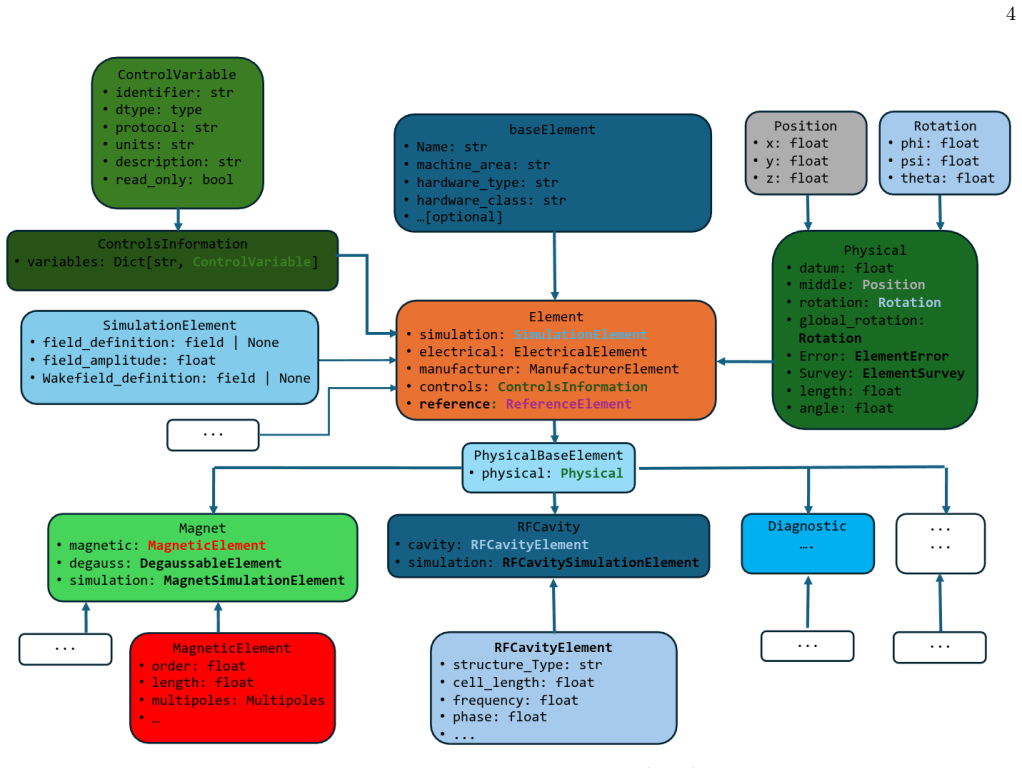
The central discovery is a schema that captures physical element information, simulation code-specific parameters, control system variables, electrical and magnetic data, and other parameters for each element in a particle accelerator lattice. Combined with a translation layer for exporting to various simulation codes, this enables a framework for beam generation, tracking, and analysis that provides seamless transfer between codes and forms the basis for fully generic start-to-end simulation frameworks.
What carries the argument
The comprehensive lattice description schema, which serves as a central repository of element data that a translation layer converts into formats for different simulation codes.
Load-bearing premise
A single schema can represent the diverse ways different simulation codes describe accelerator lattices without losing important details or becoming too complex to use.
What would settle it
A test case where an accelerator lattice element has properties that cannot be accurately captured in the schema, leading to incorrect simulation results when translated to a specific code.
Figures


read the original abstract
Standardization of data formats in a scientific discipline brings a range of benefits to researchers, as it enables the sharing of workflows and solutions to common problems, provides the foundation for generically useful tools that can be applied across the field, and gives a basis for cross-checking and validation that can be understood by all. Owing to the wide range of possible modes of description of particle accelerator lattices, a standard solution to this problem has not yet been developed for the field, although efforts are underway across the community. This article presents a schema for a comprehensive and generic format for describing particle accelerator lattices, encompassing physical element information, simulation code-specific parameters, control system variables, electrical and magnetic data, and other parameters, for each element. A translation layer is also provided in order to export this lattice into formats suitable for a variety of standard accelerator simulation codes. Based on this format, a framework has been developed for generating, tracking and analyzing beams through the lattice, providing a seamless transfer between simulation codes and the basis for a fully generic start-to-end simulation framework.
Editorial analysis
A structured set of objections, weighed in public.
Referee Report
Summary. The paper presents a schema for a comprehensive and generic format for describing particle accelerator lattices, encompassing physical element information, simulation code-specific parameters, control system variables, electrical and magnetic data, and other parameters for each element. It also provides a translation layer to export this lattice into formats suitable for a variety of standard accelerator simulation codes. Based on this format, a framework has been developed for generating, tracking and analyzing beams through the lattice, providing a seamless transfer between simulation codes and the basis for a fully generic start-to-end simulation framework.
Significance. If the schema and translation layer can be shown to preserve all relevant parameters losslessly across codes, the work would address a recognized gap in accelerator physics by enabling standardized lattice descriptions, improved workflow sharing, and cross-validation of simulations. This could support more robust start-to-end modeling and generic tools, building on existing community efforts toward data standardization.
major comments (2)
- [Framework description] The central claim of seamless transfer between simulation codes (abstract) is not supported by any reported validation; no round-trip export/import tests or comparisons of tracked beam moments/Twiss parameters between codes such as MAD-X and Elegant are presented to confirm lossless mapping of all dynamics-affecting quantities.
- [Schema definition] The assumption that a single comprehensive schema can capture the wide range of lattice description modes without significant loss of fidelity or excessive complexity (abstract and schema section) remains untested; the manuscript provides no systematic fidelity analysis or examples demonstrating equivalence for all relevant simulation modes.
minor comments (1)
- [Abstract] The abstract would be strengthened by explicitly listing the specific simulation codes supported by the translation layer and any initial test lattices used.
Simulated Author's Rebuttal
We thank the referee for the constructive and detailed comments, which help clarify the presentation of our work. We address each major comment below and have revised the manuscript to strengthen the supporting evidence for the framework's claims.
read point-by-point responses
-
Referee: The central claim of seamless transfer between simulation codes (abstract) is not supported by any reported validation; no round-trip export/import tests or comparisons of tracked beam moments/Twiss parameters between codes such as MAD-X and Elegant are presented to confirm lossless mapping of all dynamics-affecting quantities.
Authors: We agree that explicit validation is necessary to substantiate the claim of seamless transfer. The manuscript describes the schema and translation layer as designed to enable lossless mapping of all dynamics-relevant quantities, but does not include the specific round-trip tests or beam-parameter comparisons mentioned. In the revised manuscript we will add a new subsection presenting round-trip export/import examples between MAD-X and Elegant (and at least one additional code), together with direct comparisons of tracked beam moments and Twiss parameters to demonstrate preservation of all relevant quantities. revision: yes
-
Referee: The assumption that a single comprehensive schema can capture the wide range of lattice description modes without significant loss of fidelity or excessive complexity (abstract and schema section) remains untested; the manuscript provides no systematic fidelity analysis or examples demonstrating equivalence for all relevant simulation modes.
Authors: The schema was constructed to accommodate the principal description modes used across the community while remaining extensible. Nevertheless, we acknowledge that the manuscript does not contain a systematic fidelity study or equivalence demonstrations for every possible mode. We will expand the schema section with additional concrete examples and a concise fidelity analysis that shows parameter equivalence for the most common simulation modes (MAD-X, Elegant, and others), thereby testing the claim of comprehensive coverage without excessive complexity. revision: yes
Circularity Check
No circularity: schema proposal is self-contained with no derivations or self-referential reductions
full rationale
The manuscript proposes a lattice description schema, translation layer, and start-to-end framework for accelerator simulations. No mathematical derivations, equations, fitted parameters, or predictions appear in the text. Claims about seamless transfer rest on the described design and translation mechanism rather than any reduction to prior inputs by construction, self-citation chains, or ansatz smuggling. The work is a software engineering contribution whose validity can be assessed externally via implementation and cross-code tests, with no internal loops identified.
Axiom & Free-Parameter Ledger
axioms (1)
- domain assumption Particle accelerator lattices can be described comprehensively with a single schema covering physical element information, simulation code-specific parameters, control system variables, electrical and magnetic data, and other parameters.
invented entities (1)
-
Comprehensive lattice description schema
no independent evidence
Reference graph
Works this paper leans on
-
[1]
Sagan, M
D. Sagan, M. Forster, D. A. Bates, A. Wolski, F. Schmidt, N. J. Walker, T. Larrieu, Y. Roblin, T. Pelaia, P. Tenenbaum, M. Woodley, and S. Reiche. The Accelerator Markup Language and the Universal Accelerator Parser.Proceedings of EPAC’06, Edinburgh, Scotland, page WEPCH150, 2006. URLhttps://proceedings.jacow.org/e06/PAPERS/WEPCH150. pdf
2006
-
[2]
Malitsky, R
N. Malitsky, R. Talman, F. Dell, S. Peggs, F. Pilat, T. Satogata, L. Schachinger, S. Tepikian, D. Trbojevic, C. G. Trahern, and J. Wei. A proposed flat yet hierarchical accelerator lattice orbit model.Part. Accel., 55, 1997. URL https://inspirehep.net/files/086b49506614c22997a9a88dd10b17ef
1997
-
[3]
N. Malitsky and R. Talman. Unified accelerator libraries.AIP Conference Proceedings, 391:337, 1997. doi:https://doi.org/10.1063/1.52356. URLhttps://pubs.aip.org/aip/acp/article-abstract/391/1/337/748103/ Unified-accelerator-libraries
-
[4]
Malitsky, R
N. Malitsky, R. Talman, M. Blaskiewicz, R. Calaga, R. Fliller III, A. Luccio, T. Satogata, and J. Wei. Towards the UAL open source project.Proceedings of PAC’03, Portland, OR, USA, 2003. URLhttps://proceedings.jacow.org/p03/ PAPERS/TOPB004.PDF
2003
-
[5]
Chrin, R
J. Chrin, R. Krempaska, H. Lutz, G. Prekas, and T. Pelaia. XML constructs for developing dynamic applications or towards a universal representation of particle accelerators in XML.Proceedings of IPAC’11, San Sebastian, Spain, 2011. URLhttps://proceedings.jacow.org/IPAC2011/papers/wepc121.pdf
2011
-
[6]
URLhttps://github.com/pals-project
PALS – Particle Accelerator Lattice Standard. URLhttps://github.com/pals-project
-
[7]
Mitchell, J.-L
C. Mitchell, J.-L. Vay, E. Zoni, A. Huebl, J. Qiang, D. Sagan, M. G. Signorelli, C. Mayes, D. Bruhwiler, D. Kallendorf, Y. Hao, and D. Winklehner. A community effort towards a Particle Accelerator Lattice Standard (PALS).Proceedings of NAPAC’25, Sacramento, CA, USA, 2025. URLhttps://prebys.physics.ucdavis.edu/NAPAC-25/proceedings/pdf/ TUP004.pdf
2025
-
[8]
URLhttps://github.com/astec-stfc/ laura
LAURA – Lattice Architecture for a Unified Representation of Accelerators. URLhttps://github.com/astec-stfc/ laura
-
[9]
Particle accelerator simulation codes
CAMPA Consortium. Particle accelerator simulation codes. URLhttps://campa-consortium.github.io/accelerator_ simulation_codes/
-
[10]
C. E. Mayes, P. H. Fuoss, J. R. Garrahan, H. Slepicka, A. Halavanau, J. Krzywinski, A. L. Edelen, W. Lou F. Ji, N. R. Neveu, A. Huebl, R. Lehe, L. Gupta, C. M. Gulliford, D. C. Sagan, J. C. E, and C. Fortmann-Grote. Lightsource unified modeling environment (LUME), a start-to-end simulation ecosystem.Proceedings of IPAC’21, Campinas, Brazil, 2021. URLhttps...
2021
-
[11]
URLhttps://www.lume.science/
LUME. URLhttps://www.lume.science/
-
[12]
J. B. B. Chen, E. Adli, P. Drobniak, O. G. Finnerud, E. Hørlyk, D. Kalvik, C. A. Lindstrøm, F. Pe na, and K. Sjobak. ABEL: The adaptable beginning-to-end linac simulation framework.Proceedings of IPAC’25, Taipei, Taiwan, 2025. URL https://meow.elettra.eu/81/pdf/TUPS012.pdf
2025
-
[13]
URLhttps://github.com/abel-framework/ABEL
ABEL – The Adaptable Beginning-to-End Linac framework. URLhttps://github.com/abel-framework/ABEL
-
[14]
URLhttps://github.com/astec-stfc/simba
SIMBA – Simulations for Integrated Modeling of Beams in Accelerators. URLhttps://github.com/astec-stfc/simba
-
[15]
URLhttp://www.desy.de/~mpyflo/
ASTRA. URLhttp://www.desy.de/~mpyflo/
-
[16]
General Particle Tracer
Pulsar Physics. General Particle Tracer. URLhttps://www.pulsar.nl/gpt/
-
[17]
URLhttps://www.aps.anl.gov/Accelerator-Operations-Physics/Software
ELEGANT. URLhttps://www.aps.anl.gov/Accelerator-Operations-Physics/Software
-
[18]
M. Borland. elegant: A flexible SDDS-compliant code for accelerator simulation.Proceedings of ICAP’00, Darmstadt, Germany, 2000. URLhttps://www.aps.anl.gov/files/APS-sync/lsnotes/files/APS_1418218.pdf
2000
-
[19]
I. Agapov, G. Geloni, S. Tomin, and I. Zagorodnov. OCELOT: A software framework for synchrotron light source and FEL studies.Nucl. Instrum. Meth. A, 768:5, 2014. doi:https://doi.org/10.1016/j.nima.2014.09.057. URLhttps: //www.sciencedirect.com/science/article/abs/pii/S0168900214010882
-
[20]
URLhttps://github.com/ocelot-collab/ocelot/
OCELOT. URLhttps://github.com/ocelot-collab/ocelot/
-
[21]
J. Kaiser, C. Xu, A. Eichler, and A. Santamaria Garcia. Bridging the gap between machine learning and parti- cle accelerator physics with high-speed, differentiable simulations.Phys. Rev. Accel. Beams, 27:054601, 2024. doi: 10.1103/PhysRevAccelBeams.27.054601. URLhttps://link.aps.org/doi/10.1103/PhysRevAccelBeams.27.054601
-
[22]
URLhttps://github.com/desy-ml/cheetah
Cheetah. URLhttps://github.com/desy-ml/cheetah
-
[23]
Dohlus and T
M. Dohlus and T. Limberg. CSRTrack: Faster calculation of 3-D CSR effects.Proceedings of FEL’04, Trieste, Italy, 2004. URLhttps://accelconf.web.cern.ch/accelconf/f04/papers/MOCOS05.PDF
2004
-
[24]
URLhttp://www.desy.de/fel-beam/csrtrack/
CSRTrack. URLhttp://www.desy.de/fel-beam/csrtrack/
-
[25]
G.Iadarola, R.DeMaria, S.Łopaciuk, A.Abramov, X.Buffat, D.Demetriadou, L.Deniau, P.Hermes, P.Kicsiny, P.Kruyt, A. Latina, L. Mether, K. Paraschou, G. Sterbini, F. F. Van Der Veken, P. Belanger, P. Niedermayer, D. Di Croce, T. Pieloni, L. Van Riesen-Haupt, and M. Seidel. Xsuite: An integrated beam physics simulation framework.Proceedings of 68th ICF A Adva...
-
[26]
URLhttps://github.com/xsuite
Xsuite. URLhttps://github.com/xsuite
-
[27]
A. Ferran Pousa, R. Assmann, and A. Martinez de la Ossa. Wake-T: a fast particle tracking code for plasma-based accelerators.J. Phys. Conf. Ser., 1350:012056, 2019. doi:10.1088/1742-6596/1350/1/012056. URLhttps://iopscience. iop.org/article/10.1088/1742-6596/1350/1/012056
-
[28]
URLhttps://github.com/AngelFP/Wake-T
Wake-T. URLhttps://github.com/AngelFP/Wake-T
-
[29]
S. Reiche. GENESIS 1.3: A fully 3D time-dependent FEL simulation code.Nucl. Instrum. Meth. A, 429(1):243,
-
[30]
URLhttps://www.sciencedirect.com/science/article/ pii/S016890029900114X
doi:https://doi.org/10.1016/S0168-9002(99)00114-X. URLhttps://www.sciencedirect.com/science/article/ pii/S016890029900114X
-
[31]
URLhttps://github.com/svenreiche/Genesis-1.3-Version4/
GENESIS. URLhttps://github.com/svenreiche/Genesis-1.3-Version4/
-
[32]
D. Angal-Kalinin, A. Bainbridge, A. D. Brynes, R. K. Buckley, S. R. Buckley, G. C. Burt, R. J. Cash, H. M. Cas- taneda Cortes, D. Christie, J. A. Clarke, R. Clarke, L. S. Cowie, P. A. Corlett, G. Cox, K. D. Dumbell, D. J. Dunning, B. D. Fell, K. Gleave, P. Goudket, A. R. Goulden, S. A. Griffiths, M. D. Hancock, A. Hannah, T. Hartnett, P. W. Heath, J. R. H...
-
[33]
URLhttps://github.com/ChristopherMayes/openPMD-beamphysics
OpenPMD-beamphysics. URLhttps://github.com/ChristopherMayes/openPMD-beamphysics
-
[34]
URLhttps://github.com/xopt-org/Xopt
Xopt. URLhttps://github.com/xopt-org/Xopt
-
[35]
Roussel, A
R. Roussel, A. Edelen, A. Bartnik, and C. Mayes. Xopt: A simplified framework for optimization of accelerator problems using advanced algorithms.Proceedings of IPAC’23, Venice, Italy, 2023. URLhttps://indico.jacow.org/event/41/ contributions/2556
2023
-
[36]
E. W. Snedden, D. Angal-Kalinin, A. R. Bainbridge, A. D. Brynes, S. R. Buckley, D. J. Dunning, J. R. Henderson, J. K. Jones, K. J. Middleman, T. J. Overton, T. H. Pacey, A. E. Pollard, Y. M. Saveliev, B. J. A. Shepherd, P. H. Williams, M. I. Colling, B. D. Fell, and G. Marshall. Specification and design for full energy beam exploitation of the compact lin...
-
[37]
Allaria, R
E. Allaria, R. Appio, L. Badano, W. A. Barletta, S. Bassanese, S. G. Biedron, A. Borga, E. Busetto, D. Castronovo, P. Cinquegrana, S. Cleva, D. Cocco, M. Cornacchia, P. Craievich, I. Cudin, M. Dal Forno, M. B. Danailov, G. D’Auria, R. De Monte, A. Demidovich, G. De Ninno, P. Delgiusto, S. Di Mitri, B. Diviacco, A. Fabris, R. Fabris, W. M. Fawley, M. Feria...
2012
-
[38]
M. King, A. D. Brynes, F. Jackson, J. K. Jones, N. Ziyan, M. A. Johnson, K. Baker, D. J. Scott, E. Yang, T. Kabana, C. Garnier, S. Chowdhury, N. Neveu, and R. Roussel. Controls Abstraction Towards Accelerator Physics: A Middle Layer Python Package for Particle Accelerator Control, 2025. URLhttps://arxiv.org/abs/2509.19794
-
[39]
URLhttps://github.com/python-accelerator-middle-layer
pyAML – Python Accelerator Middle Layer. URLhttps://github.com/python-accelerator-middle-layer
- [40]
-
[41]
CLA-S02-MAG-QUAD-01.yaml # In CLARA / YAML / Magnet / Q u a d r u p o l e / CLA - S02 - MAG - QUAD -01. yaml alias : null controls : va ri ab le s : readback : d e s c r i p t i o n : Magnetic strength of CLA - S02 - MAG - QUAD -01 dtype : float i d e n t i f i e r : CLA - S02 - MAG - QUAD -01: RBV protocol : CA re ad _o nl y : true units : N / A target :...
-
[42]
name " :
QUAD01.py from laura . models . element import Q u a d r u p o l e qu ad _d ic t = { " name " : " QUAD1 " , " m a c h i n e _ a r e a " : " FODO " , " magnetic " : { " order " : 1 , " length " : 0.1 , " kl " : 1.0 , } , " physical " : { " middle " : [0 , 0 , 0.1] , " length " : 0.1 , } , } q1 = Q u a d r u p o l e (** q ua d_ di ct )
discussion (0)
Sign in with ORCID, Apple, or X to comment. Anyone can read and Pith papers without signing in.