Recognition: unknown
ClawNet: Human-Symbiotic Agent Network for Cross-User Autonomous Cooperation
Pith reviewed 2026-05-10 03:06 UTC · model grok-4.3
The pith
AI agents can represent their owners in secure multi-user collaborations by forming a network of human-symbiotic systems with built-in identity controls.
A machine-rendered reading of the paper's core claim, the machinery that carries it, and where it could break.
Core claim
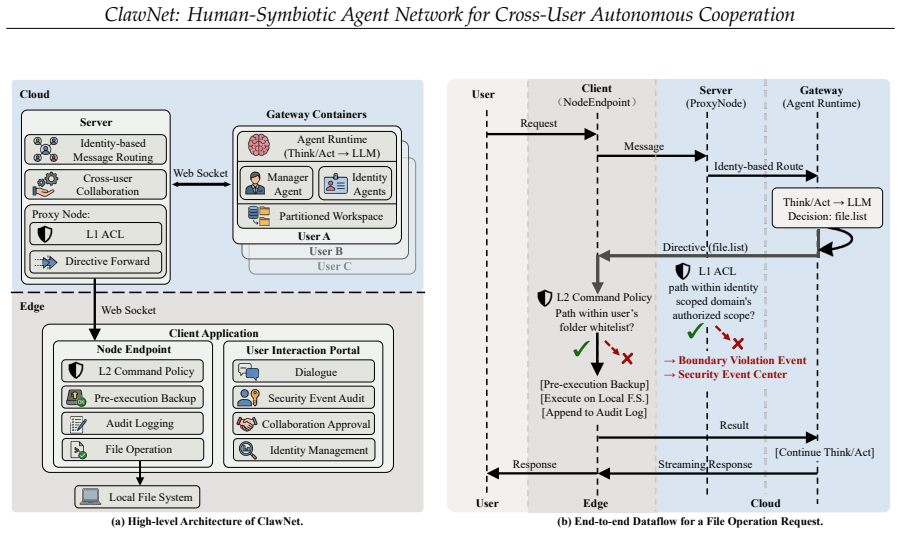
The paper claims that a human-symbiotic agent paradigm, built on a layered identity architecture separating an isolated Manager Agent from context-specific Identity Agents, combined with scoped authorization and action-level accountability, allows agents to collaborate across users while remaining permanently bound to their owners and fully auditable, as implemented in the ClawNet framework through a central orchestrator that enforces identity binding and authorization verification.
What carries the argument
The layered identity architecture that keeps a global-knowledge Manager Agent isolated from external communication while routing context-specific actions through Identity Agents under scoped authorization and full audit logging.
If this is right
- Agents can negotiate and delegate tasks across different users without any user exposing direct access to their own systems.
- Every operation stays traceable to the specific human owner and their granted authorization level.
- Boundary violations trigger direct escalation to the human owner rather than being handled inside the agent network.
- The central orchestrator maintains identity binding and permission checks for all interactions between different users' agents.
Where Pith is reading between the lines
- The model could support agent-mediated group projects or organizations in which humans define high-level policies and agents carry them out across personal boundaries.
- Scaling beyond a single central orchestrator might require distributed verification methods that preserve the same isolation and audit properties.
- Real-world tests in shared workflows such as joint research or team scheduling could expose whether the identity separation survives complex, repeated interactions.
Load-bearing premise
That the isolation of the Manager Agent plus a central orchestrator can be built without creating fresh single points of failure or trust problems that would break the security claims for cross-user use.
What would settle it
Run a controlled multi-user scenario in ClawNet where one user's Identity Agent tries an action outside its authorized scope and verify whether the orchestrator blocks it, escalates the violation, and produces a complete audit log tied to the correct owner identity.
Figures


read the original abstract
Current AI agent frameworks have made remarkable progress in automating individual tasks, yet all existing systems serve a single user. Human productivity rests on the social and organizational relationships through which people coordinate, negotiate, and delegate. When agents move beyond performing tasks for one person to representing that person in collaboration with others, the infrastructure for cross-user agent collaboration is entirely absent, let alone the governance mechanisms needed to secure it. We argue that the next frontier for AI agents lies not in stronger individual capability, but in the digitization of human collaborative relationships. To this end, we propose a human-symbiotic agent paradigm. Each user owns a permanently bound agent system that collaborates on the owner's behalf, forming a network whose nodes are humans rather than agents. This paradigm rests on three governance primitives. A layered identity architecture separates a Manager Agent from multiple context-specific Identity Agents; the Manager Agent holds global knowledge but is architecturally isolated from external communication. Scoped authorization enforces per-identity access control and escalates boundary violations to the owner. Action-level accountability logs every operation against its owner's identity and authorization, ensuring full auditability. We instantiate this paradigm in ClawNet, an identity-governed agent collaboration framework that enforces identity binding and authorization verification through a central orchestrator, enabling multiple users to collaborate securely through their respective agents.
Editorial analysis
A structured set of objections, weighed in public.
Referee Report
Summary. The paper proposes a human-symbiotic agent paradigm to enable cross-user autonomous cooperation, arguing that current single-user AI agent frameworks lack the governance needed for agents to represent users in multi-party collaboration. It introduces three governance primitives: a layered identity architecture that isolates a Manager Agent (holding global knowledge but barred from external communication) from context-specific Identity Agents; scoped authorization that enforces per-identity access control and escalates violations; and action-level accountability that logs every operation for full auditability. These are instantiated in ClawNet, an identity-governed framework that routes identity binding and authorization verification through a central orchestrator to support secure multi-user agent collaboration.
Significance. If the architecture can be implemented without reintroducing trust or availability issues, the work would fill a genuine gap by shifting AI agents from isolated task automation to governed representations of human social and organizational relationships. The explicit focus on primitives for identity, authorization, and accountability is a constructive step beyond ad-hoc multi-agent designs. However, the contribution remains conceptual; its significance is therefore prospective rather than demonstrated, pending concrete realization and validation.
major comments (2)
- [Abstract] Abstract (final paragraph): the claim that the three governance primitives deliver secure cross-user collaboration is load-bearing, yet the ClawNet instantiation explicitly routes enforcement of identity binding and authorization verification through a central orchestrator. No threat model, formal invariants, or implementation constraints are supplied to show how this orchestrator avoids becoming a single point of failure that could bypass the Manager Agent's architectural isolation and the promised auditability.
- [Governance primitives section] Description of the layered identity architecture: the assertion that 'architectural isolation' of the Manager Agent from external communication, combined with scoped authorization, suffices to prevent unauthorized cross-user actions is presented as a design axiom rather than derived from any reduction, prior result, or security property. Without an accompanying argument or counter-example analysis, the central security claim rests on an unverified assumption.
minor comments (2)
- [Abstract] The abstract and instantiation paragraph would benefit from an explicit statement of the threat model (e.g., what classes of compromise or outage are assumed out of scope for the central orchestrator).
- [Introduction] Related-work discussion appears thin; standard references on multi-agent security, decentralized identity systems, and audit-logging frameworks in distributed systems are not cited.
Simulated Author's Rebuttal
We are grateful to the referee for the thoughtful and detailed comments on our paper. The feedback highlights key areas where the conceptual framework can be strengthened with additional clarification on security assumptions. We respond to each major comment below and indicate the revisions we plan to make.
read point-by-point responses
-
Referee: [Abstract] Abstract (final paragraph): the claim that the three governance primitives deliver secure cross-user collaboration is load-bearing, yet the ClawNet instantiation explicitly routes enforcement of identity binding and authorization verification through a central orchestrator. No threat model, formal invariants, or implementation constraints are supplied to show how this orchestrator avoids becoming a single point of failure that could bypass the Manager Agent's architectural isolation and the promised auditability.
Authors: We agree that the abstract's claim would benefit from qualification given the conceptual nature of the work. The orchestrator serves as an enforcement mechanism for the governance primitives rather than a bypass; all actions are still subject to identity binding and scoped authorization, with the Manager Agent remaining isolated. To address this, we will revise the abstract to state that the primitives enable secure collaboration under the assumption of a trusted orchestrator, and add a new subsection in the manuscript discussing the trust model, potential single points of failure, and mitigation through auditability and escalation. This provides the requested context without altering the core contribution. revision: partial
-
Referee: [Governance primitives section] Description of the layered identity architecture: the assertion that 'architectural isolation' of the Manager Agent from external communication, combined with scoped authorization, suffices to prevent unauthorized cross-user actions is presented as a design axiom rather than derived from any reduction, prior result, or security property. Without an accompanying argument or counter-example analysis, the central security claim rests on an unverified assumption.
Authors: The primitives are presented as design axioms for the proposed paradigm, analogous to how access control lists or capability systems are introduced in systems literature. The isolation is enforced by the absence of external communication channels for the Manager Agent, and scoped authorization ensures that Identity Agents operate within defined boundaries. We will revise the governance primitives section to include a short explanatory paragraph deriving the security property from the separation of concerns and information flow principles (e.g., no upward flow of control to the Manager). While we do not provide a formal reduction or exhaustive counter-example analysis—as this is a high-level architectural proposal rather than a verified protocol—we believe this addition addresses the concern by making the reasoning explicit. revision: partial
Circularity Check
No circularity: design proposal with primitives as choices
full rationale
The manuscript is a conceptual architecture proposal rather than a derivation chain. It introduces three governance primitives (layered identity with Manager Agent isolation, scoped authorization, action-level accountability) explicitly as design choices that the paradigm 'rests on,' then describes their instantiation in ClawNet via a central orchestrator. No equations, fitted parameters, predictions, or self-citations appear that would reduce any claim to an input by construction. The central orchestrator is presented as an implementation detail, not a derived necessity that loops back to the primitives. This is the common case of an honest non-finding for a systems-design paper.
Axiom & Free-Parameter Ledger
axioms (2)
- domain assumption Human productivity rests on the social and organizational relationships through which people coordinate, negotiate, and delegate.
- ad hoc to paper Architectural isolation of the Manager Agent from external communication combined with scoped authorization and action logging will prevent unauthorized cross-user actions.
invented entities (3)
-
Manager Agent
no independent evidence
-
Identity Agents
no independent evidence
-
Central orchestrator
no independent evidence
Reference graph
Works this paper leans on
-
[1]
Frontiers of Computer Science , volume=
A survey on large language model based autonomous agents , author=. Frontiers of Computer Science , volume=. 2024 , publisher=
2024
-
[2]
, author=
Large Language Model based Multi-Agents: A Survey of Progress and Challenges. , author=. 33rd International Joint Conference on Artificial Intelligence (IJCAI 2024) , year=
2024
-
[3]
ACM Computing Surveys , volume=
Tool learning with foundation models , author=. ACM Computing Surveys , volume=. 2024 , publisher=
2024
-
[4]
The eleventh international conference on learning representations , year=
React: Synergizing reasoning and acting in language models , author=. The eleventh international conference on learning representations , year=
-
[5]
Gpt-4 technical report , author=. arXiv preprint arXiv:2303.08774 , year=
work page internal anchor Pith review Pith/arXiv arXiv
-
[6]
Advances in neural information processing systems , volume=
Toolformer: Language models can teach themselves to use tools , author=. Advances in neural information processing systems , volume=
-
[7]
2026 , howpublished =
2026
-
[8]
2023 , howpublished =
AutoGPT: Build, Deploy, and Run AI Agents , author =. 2023 , howpublished =
2023
-
[9]
2023 , howpublished =
Babyagi , author =. 2023 , howpublished =
2023
-
[10]
2024 , howpublished =
Developing a computer use model , author =. 2024 , howpublished =
2024
-
[11]
The twelfth international conference on learning representations , year=
MetaGPT: Meta programming for a multi-agent collaborative framework , author=. The twelfth international conference on learning representations , year=
-
[12]
First conference on language modeling , year=
Autogen: Enabling next-gen LLM applications via multi-agent conversations , author=. First conference on language modeling , year=
-
[13]
Proceedings of the 62nd annual meeting of the association for computational linguistics (volume 1: Long papers) , pages=
Chatdev: Communicative agents for software development , author=. Proceedings of the 62nd annual meeting of the association for computational linguistics (volume 1: Long papers) , pages=
-
[14]
2024 , howpublished =
2024
-
[15]
2004 , publisher=
The future of work , author=. 2004 , publisher=
2004
-
[16]
The nature of the firm: origins, evolution, and development , pages=
The nature of the firm (1937) , author=. The nature of the firm: origins, evolution, and development , pages=. 1993 , publisher=
1937
-
[17]
Research Paper, OpenAI , year=
Practices for governing agentic AI systems , author=. Research Paper, OpenAI , year=
-
[18]
Transactions on Machine Learning Research , year=
Infrastructure for AI Agents , author=. Transactions on Machine Learning Research , year=
-
[19]
Authenticated Delegation and Authorized AI Agents,
Authenticated delegation and authorized ai agents , author=. arXiv preprint arXiv:2501.09674 , year=
-
[20]
arXiv preprint arXiv:2502.01635 , year=
The AI agent index , author=. arXiv preprint arXiv:2502.01635 , year=
-
[21]
Open Challenges in Multi-Agent Security: Towards Secure Systems of Interacting AI Agents
Open challenges in multi-agent security: Towards secure systems of interacting ai agents , author=. arXiv preprint arXiv:2505.02077 , year=
work page internal anchor Pith review Pith/arXiv arXiv
-
[22]
2025 , howpublished =
Announcing the Agent2Agent Protocol (A2A) , author =. 2025 , howpublished =
2025
-
[23]
Thirty-seventh Conference on Neural Information Processing Systems , year=
CAMEL: Communicative Agents for "Mind" Exploration of Large Language Model Society , author=. Thirty-seventh Conference on Neural Information Processing Systems , year=
-
[24]
ChatDev: Communicative Agents for Software Development
ChatDev: Communicative Agents for Software Development , author =. arXiv preprint arXiv:2307.07924 , url =
work page internal anchor Pith review arXiv
-
[25]
Proceedings of the third international conference on Information and knowledge management , pages=
KQML as an agent communication language , author=. Proceedings of the third international conference on Information and knowledge management , pages=
-
[26]
Autonomous Agents and Multi-Agent Systems , volume=
Some remarks on the semantics of FIPA's agent communication language , author=. Autonomous Agents and Multi-Agent Systems , volume=. 1999 , publisher=
1999
discussion (0)
Sign in with ORCID, Apple, or X to comment. Anyone can read and Pith papers without signing in.