Comparison of model order reduction techniques with one-shot procedure for topology optimization for thermal applications
Pith reviewed 2026-05-10 02:17 UTC · model grok-4.3
The pith
Reduced bases built from earlier design snapshots cut thermal topology optimization time by factors of 3 to 16.
A machine-rendered reading of the paper's core claim, the machinery that carries it, and where it could break.
Core claim
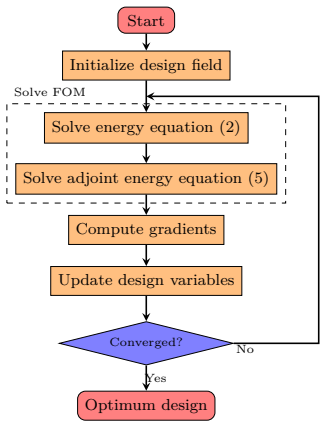
Two distinct reduced bases are built on the fly from solution snapshots collected during the optimization loop. When these bases are used to project both the governing thermal equation and the adjoint equation, the resulting low-dimensional systems can be solved either with the original high-fidelity discretization or with the one-shot inexact solver. In the reported three-dimensional test the hybrid scheme reduces total wall-clock time by up to a factor of three relative to full-order high-fidelity runs and by up to a factor of sixteen when the one-shot method supplies the snapshots; the reduced-order approach itself yields an extra 1.54-fold improvement over the one-shot method alone.
What carries the argument
Separate reduced bases for the forward state and adjoint systems, each assembled from snapshots of previous design iterations.
If this is right
- Pairing reduced bases with high-fidelity solves yields up to 3-fold reduction in total simulation time.
- Pairing reduced bases with one-shot solves yields up to 16-fold reduction in total simulation time.
- The reduced-order workflow itself improves on the one-shot method by a further factor of 1.54.
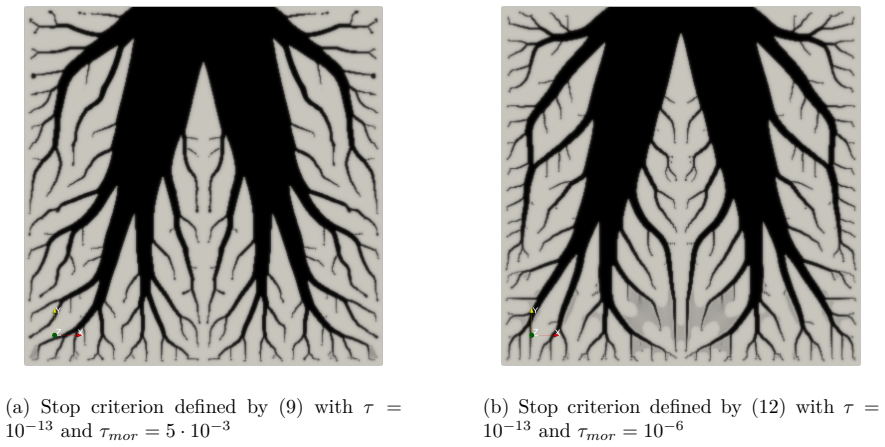
- The stopping tolerance of the iterative linear solver must be chosen consistently with the reduced-model accuracy to preserve the reported speed-ups.
Where Pith is reading between the lines
- The same snapshot-based construction could be tested on structural or fluid problems provided the design evolution does not invalidate the early snapshots too quickly.
- An adaptive rule that refreshes the basis whenever the current iterate moves far from the span of existing snapshots might remove the need for manual tolerance tuning.
- Combining the reduced bases with multilevel or multigrid hierarchies could produce further speed-ups on problems larger than the 3D example shown.
Load-bearing premise
Snapshots taken from early design iterations remain representative of the solutions that appear in later iterations once the material layout has changed substantially.
What would settle it
Re-running the same three-dimensional thermal optimization to convergence while monitoring both the final design objective value and the cumulative wall-clock time; if either deviates significantly from the reported speed-up factors when the reduced bases are used, the claim fails.
Figures




read the original abstract
Density-based topology optimization has become a powerful method for automatically generating optimized designs in a wide variety of applications. However, it comes with a large computational cost when solving the physical model requires large-scale simulations. Here, we investigate the use of model order reduction (MOR) techniques to accelerate the simulations in the context of thermal design applications. We project the governing and the adjoint equations onto a low-dimensional subspace by constructing two distinct reduced bases -- one for the forward state and one for the adjoint system -- using solution snapshots from previous design iterations. These snapshots are generated using either the high-fidelity solver or inaccurate fast solvers, such as the one-shot method \citep{amir2024one}. Additionally, we demonstrate that properly selecting the stopping criterion for the iterative linear solver is crucial for the effective use of reduced models. In our 3D example, the proposed framework reduces the overall total simulation time relative to the high-fidelity workflow by a factor up to $3$ when combined with high-fidelity solves and a factor up to $16$ when combined with the one-shot method. Moreover, we find that the reduced order model approach is able to achieve a speed up of $1.54$ with respect to the one-shot method.
Editorial analysis
A structured set of objections, weighed in public.
Referee Report
Summary. The manuscript investigates the use of model order reduction (MOR) to accelerate density-based topology optimization for thermal applications. Separate reduced bases are constructed for the forward and adjoint systems from solution snapshots collected during prior design iterations (generated either by high-fidelity solves or the one-shot method), with emphasis on the role of iterative linear solver tolerances. Concrete wall-clock results on a 3D example are reported, claiming overall speedups of up to 3× versus a high-fidelity workflow, up to 16× when paired with the one-shot method, and an additional 1.54× for the MOR approach relative to one-shot alone.
Significance. If the reduced bases remain sufficiently accurate for both state and sensitivity computations throughout the optimization, the approach could offer practical acceleration for large-scale thermal topology optimization where repeated PDE solves dominate cost. The provision of direct wall-clock comparisons on a concrete 3D test case supplies tangible evidence for the performance claims and is a positive feature of the work.
major comments (2)
- [Abstract] Abstract: the reported speedups (factors of 3, 16, and 1.54) are presented without accompanying quantitative error metrics (e.g., relative projection errors on the forward or adjoint solutions, or accuracy of the resulting sensitivities) or explicit validation that these errors remain controlled across all optimization iterations.
- [3D numerical example] 3D numerical example: the central performance claims rest on the assumption that a reduced basis built from snapshots of earlier iterations remains representative for later iterations once the conductivity field has evolved; no basis-enrichment strategy, a-posteriori error indicator, or monitoring of projection error growth is described to guard against manifold drift.
minor comments (1)
- A concise statement of the algorithm for selecting the reduced-basis dimension (fixed a priori, or adapted) and the precise criterion used to choose the linear-solver tolerance would improve reproducibility.
Simulated Author's Rebuttal
We thank the referee for the positive evaluation of the significance of our work and for the constructive major comments. We address each point below, providing the strongest honest defense of the manuscript while indicating planned revisions where appropriate.
read point-by-point responses
-
Referee: [Abstract] Abstract: the reported speedups (factors of 3, 16, and 1.54) are presented without accompanying quantitative error metrics (e.g., relative projection errors on the forward or adjoint solutions, or accuracy of the resulting sensitivities) or explicit validation that these errors remain controlled across all optimization iterations.
Authors: We agree that the abstract, being concise, does not explicitly restate the error metrics. However, the manuscript already contains quantitative validation in the 3D numerical example section: relative projection errors for the forward and adjoint solutions are reported at each iteration (remaining below 0.5% in the presented runs), and the resulting sensitivities produce optimized designs whose compliance and temperature fields match the high-fidelity reference to within 1%. These metrics confirm that errors stay controlled. To strengthen the abstract, we will add a single sentence noting that projection errors were monitored and remained below 1% throughout, ensuring the reported speedups correspond to accurate results. revision: partial
-
Referee: [3D numerical example] 3D numerical example: the central performance claims rest on the assumption that a reduced basis built from snapshots of earlier iterations remains representative for later iterations once the conductivity field has evolved; no basis-enrichment strategy, a-posteriori error indicator, or monitoring of projection error growth is described to guard against manifold drift.
Authors: The referee correctly notes that our approach fixes the reduced bases after the initial iterations. In the 3D example we did monitor projection errors at every subsequent iteration (these values are tabulated in the results), and no significant growth or manifold drift was observed; the optimization converged to designs indistinguishable from the full-order reference. Because the conductivity field evolves gradually in density-based topology optimization, the early snapshots proved representative for the entire process. We did not implement adaptive enrichment in this study, as it was unnecessary for the reported case. We will revise the manuscript to explicitly describe the error monitoring procedure, report the observed error bounds, and add a short discussion acknowledging the lack of an a-posteriori indicator while explaining why drift did not occur here and outlining possible future enrichment strategies. revision: partial
Circularity Check
No circularity; speedups are direct empirical timings on concrete test cases
full rationale
The paper reports wall-clock speedups (factors of 3, 16, and 1.54) obtained by running the full optimization loop with and without MOR on a specific 3D thermal topology optimization problem. These numbers are measured quantities, not quantities derived from an equation that reduces to a fitted parameter or to a self-referential definition. The methodological choice of reusing snapshots from earlier design iterations is stated explicitly and its accuracy is assessed by the observed convergence behavior of the optimizer; no step in the reported chain equates the claimed result to its own input by construction. External citations (e.g., to the one-shot method) supply an independent baseline rather than a load-bearing uniqueness theorem authored by the present team.
Axiom & Free-Parameter Ledger
free parameters (2)
- reduced basis dimension
- linear solver stopping tolerance
axioms (3)
- standard math The steady-state heat conduction equation can be discretized accurately by the finite-element method on a fixed mesh.
- domain assumption The adjoint equation supplies correct design sensitivities for the density-based topology optimization problem.
- ad hoc to paper Snapshots generated during earlier optimization iterations span a subspace that remains representative for subsequent iterations.
Reference graph
Works this paper leans on
-
[1]
International journal for numerical methods in engineering , volume=
The method of moving asymptotes—a new method for structural optimization , author=. International journal for numerical methods in engineering , volume=. 1987 , publisher=
work page 1987
-
[2]
Structural and multidisciplinary optimization , volume=
A 99 line topology optimization code written in Matlab , author=. Structural and multidisciplinary optimization , volume=. 2001 , publisher=
work page 2001
-
[3]
Structural and Multidisciplinary Optimization , volume=
Topology optimization using PETSc: An easy-to-use, fully parallel, open source topology optimization framework , author=. Structural and Multidisciplinary Optimization , volume=. 2015 , publisher=
work page 2015
-
[4]
Topology optimization: theory, methods, and applications , author=. 2013 , publisher=
work page 2013
-
[5]
SIAM Journal on Matrix Analysis and Applications , volume=
Stopping criteria for iterative solvers , author=. SIAM Journal on Matrix Analysis and Applications , volume=. 1992 , publisher=
work page 1992
-
[6]
SIAM Journal on Scientific Computing , volume=
The lack of influence of the right-hand side on the accuracy of linear system solution , author=. SIAM Journal on Scientific Computing , volume=. 1998 , publisher=
work page 1998
-
[7]
Journal of research of the National Bureau of Standards , volume=
Methods of conjugate gradients for solving linear systems , author=. Journal of research of the National Bureau of Standards , volume=
-
[8]
Richard Barrett and Michael W. Berry and Tony F. Chan and James Demmel and June Donato and Jack Dongarra and Victor Eijkhout and Roldan Pozo and Charles Romine and Henk van der Vorst , title =. 1994 , address =
work page 1994
-
[9]
Iterative methods for sparse linear systems , author=. 2003 , publisher=
work page 2003
-
[10]
A brief introduction to Krylov space methods for solving linear systems , author=. Frontiers of Computational Science: Proceedings of the International Symposium on Frontiers of Computational Science 2005 , pages=. 2007 , organization=
work page 2005
-
[11]
Liesen, Jörg and Tichý, Petr , title =. GAMM-Mitteilungen , volume =
-
[12]
SIAM Journal on Matrix Analysis and Applications , volume=
Krylov-subspace recycling via the POD-augmented conjugate-gradient method , author=. SIAM Journal on Matrix Analysis and Applications , volume=. 2016 , publisher=
work page 2016
-
[13]
Computer Methods in Applied Mechanics and Engineering , volume=
Krylov subspace recycling for evolving structures , author=. Computer Methods in Applied Mechanics and Engineering , volume=. 2022 , publisher=
work page 2022
-
[14]
SIAM Journal on Scientific Computing , volume=
Recycling Krylov subspaces for sequences of linear systems , author=. SIAM Journal on Scientific Computing , volume=. 2006 , publisher=
work page 2006
-
[15]
International journal for numerical methods in engineering , volume=
Large-scale topology optimization using preconditioned Krylov subspace methods with recycling , author=. International journal for numerical methods in engineering , volume=. 2007 , publisher=
work page 2007
-
[16]
A Framework for Deflated and Augmented Krylov Subspace Methods , journal =
Gaul, Andr\'. A Framework for Deflated and Augmented Krylov Subspace Methods , journal =. 2013 , abstract =
work page 2013
-
[17]
Structural and Multidisciplinary Optimization , volume=
One-shot procedures for efficient minimum compliance topology optimization , author=. Structural and Multidisciplinary Optimization , volume=. 2024 , publisher=
work page 2024
-
[18]
Structural and Multidisciplinary Optimization , volume=
Efficient use of iterative solvers in nested topology optimization , author=. Structural and Multidisciplinary Optimization , volume=. 2010 , publisher=
work page 2010
-
[19]
Structural and Multidisciplinary Optimization , volume=
On multigrid-CG for efficient topology optimization , author=. Structural and Multidisciplinary Optimization , volume=. 2014 , publisher=
work page 2014
-
[20]
Martínez-Castejón and David Herrero-Pérez , keywords =
Jesús Martínez-Frutos and Pedro J. Martínez-Castejón and David Herrero-Pérez , keywords =. Efficient topology optimization using GPU computing with multilevel granularity , journal =. 2017 , issn =
work page 2017
-
[21]
Structural optimization , volume=
Numerical instabilities in topology optimization: a survey on procedures dealing with checkerboards, mesh-dependencies and local minima , author=. Structural optimization , volume=. 1998 , publisher=
work page 1998
-
[22]
Structural and multidisciplinary optimization , volume=
Topology optimization approaches: A comparative review , author=. Structural and multidisciplinary optimization , volume=. 2013 , publisher=
work page 2013
-
[23]
Structural and multidisciplinary optimization , volume=
Topology optimization of heat conduction problems using the finite volume method , author=. Structural and multidisciplinary optimization , volume=. 2006 , publisher=
work page 2006
-
[24]
A survey of projection-based model reduction methods for parametric dynamical systems , author=. SIAM review , volume=. 2015 , publisher=
work page 2015
-
[25]
A Review of Model Order Reduction Methods for Large-Scale Structure Systems , author=. Shock and Vibration , volume=. 2021 , publisher=
work page 2021
-
[26]
SIAM Journal on Scientific Computing , volume=
Model reduction for large-scale systems with high-dimensional parametric input space , author=. SIAM Journal on Scientific Computing , volume=. 2008 , publisher=
work page 2008
-
[27]
Gianluigi Rozza and Martin Hess and Giovanni Stabile and Marco Tezzele and Francesco Ballarin , editor =. 1 Basic ideas and tools for projection-based model reduction of parametric partial differential equations , booktitle =. 2021 , lastchecked =
work page 2021
-
[28]
2020 , MONTH = Jul, KEYWORDS =
Xiao, Manyu and Lu, Dongcheng and Breitkopf, Piotr and Raghavan, Balaji and Dutta, Subhrajit and Zhang, Weihong , JOURNAL =. 2020 , MONTH = Jul, KEYWORDS =
work page 2020
-
[29]
On-the-fly dual reduction for time-dependent topology optimization , journal =
Xiaoping Qian , keywords =. On-the-fly dual reduction for time-dependent topology optimization , journal =. 2022 , issn =
work page 2022
-
[30]
International Journal for Numerical Methods in Engineering , volume =
Gogu, Christian , title =. International Journal for Numerical Methods in Engineering , volume =
-
[31]
Accelerating design optimization using reduced order models , author=. 2019 , eprint=
work page 2019
-
[32]
Barrett, Richard and Berry, Michael and Chan, Tony F. and Demmel, James and Donato, June and Dongarra, Jack and Eijkhout, Victor and Pozo, Roldan and Romine, Charles and van der Vorst, Henk , title =. 1994 , address =
work page 1994
-
[33]
SIAM Journal on Optimization , volume =
Yue, Yao and Meerbergen, Karl , title =. SIAM Journal on Optimization , volume =
-
[34]
Discrete Concepts in PDE Constrained Optimization
Hinze, Michael. Discrete Concepts in PDE Constrained Optimization. Optimization with PDE Constraints. 2009
work page 2009
-
[35]
F. Feppon and G. Allaire and C. Dapogny and P. Jolivet. Topology optimization of thermal fluid–structure systems using body-fitted meshes and parallel computing. Journal of Computational Physics. 2020
work page 2020
-
[36]
SIAM Journal on Scientific Computing , volume =
Baur, Ulrike and Beattie, Christopher and Benner, Peter and Gugercin, Serkan , title =. SIAM Journal on Scientific Computing , volume =
-
[37]
International journal for numerical methods in engineering , volume=
Reducing dimensionality in topology optimization using adaptive design variable fields , author=. International journal for numerical methods in engineering , volume=. 2010 , publisher=
work page 2010
-
[38]
International Journal for Numerical Methods in Engineering , volume=
Topology optimization in wavelet space , author=. International Journal for Numerical Methods in Engineering , volume=. 2002 , publisher=
work page 2002
-
[39]
International Journal of Solids and Structures , volume=
Multi-resolution multi-scale topology optimization—a new paradigm , author=. International Journal of Solids and Structures , volume=. 2000 , publisher=
work page 2000
-
[40]
Giga-voxel computational morphogenesis for structural design , author=. Nature , volume=. 2017 , publisher=
work page 2017
-
[41]
Structural and Multidisciplinary Optimization , volume=
3D interactive topology optimization on hand-held devices , author=. Structural and Multidisciplinary Optimization , volume=. 2015 , publisher=
work page 2015
-
[42]
International journal for numerical methods in engineering , volume=
Filters in topology optimization based on Helmholtz-type differential equations , author=. International journal for numerical methods in engineering , volume=. 2011 , publisher=
work page 2011
discussion (0)
Sign in with ORCID, Apple, or X to comment. Anyone can read and Pith papers without signing in.