Recognition: unknown
Generalized PT-symmetric nonlinear Dirac equation: exact solitary waves solutions, stability and conservation laws
Pith reviewed 2026-05-10 01:20 UTC · model grok-4.3
The pith
Exact solitary wave solution derived for PT-symmetric nonlinear Dirac equation with power-law nonlinearity
A machine-rendered reading of the paper's core claim, the machinery that carries it, and where it could break.
Core claim
We derive an exact solitary wave solution for the PT-symmetric nonlinear Dirac equation with scalar-scalar interaction. The PT-transition point is defined by the solution's existence condition and is independent of the nonlinearity exponent k. Energy and momentum are conserved, although charge and canonical momentum are not. The stationary solution has nonzero momentum in its rest frame, while a moving soliton can be chosen to have zero momentum. The gain-loss mechanism and higher-order nonlinearity restrict the stability domain of the solutions.
What carries the argument
The specific ansatz for the solitary wave solution that reduces the nonlinear PDE to solvable ODEs for arbitrary k, defining the PT-transition via existence condition.
If this is right
- Energy is conserved despite the gain-loss term.
- PT-transition point is independent of nonlinearity exponent k.
- Momentum is conserved but charge is not.
- Moving solitons can achieve zero momentum via choice of velocity.
- Stability domain is restricted by gain-loss and higher k.
Where Pith is reading between the lines
- The k-independence suggests PT-breaking is robust to nonlinearity variations.
- Nonzero rest-frame momentum may require reinterpreting stationary states in open systems.
- The ansatz approach could be tested in related non-Hermitian models for exact solutions.
Load-bearing premise
The specific ansatz form chosen for the solitary wave is assumed to reduce the nonlinear PDE exactly to solvable ODEs for arbitrary positive k.
What would settle it
Numerical evolution of the PDE for a fixed k and Lambda at the boundary of the existence condition, checking whether a persistent solitary wave forms and conserves energy as predicted.
Figures



read the original abstract
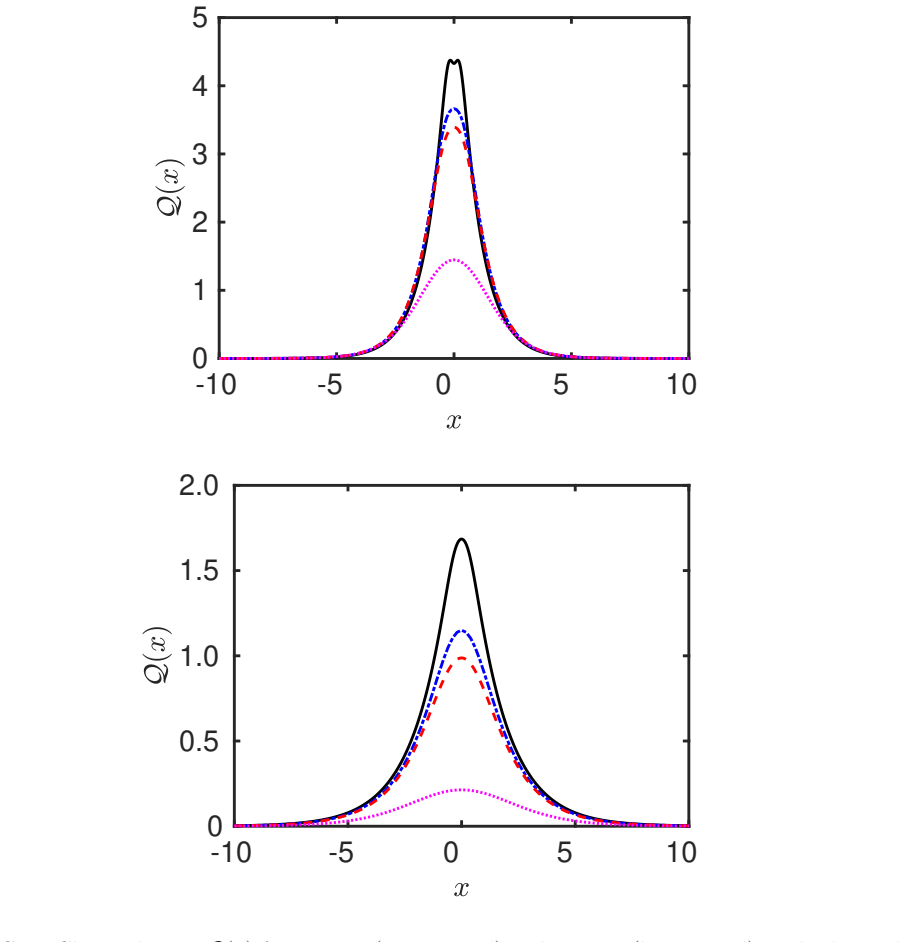
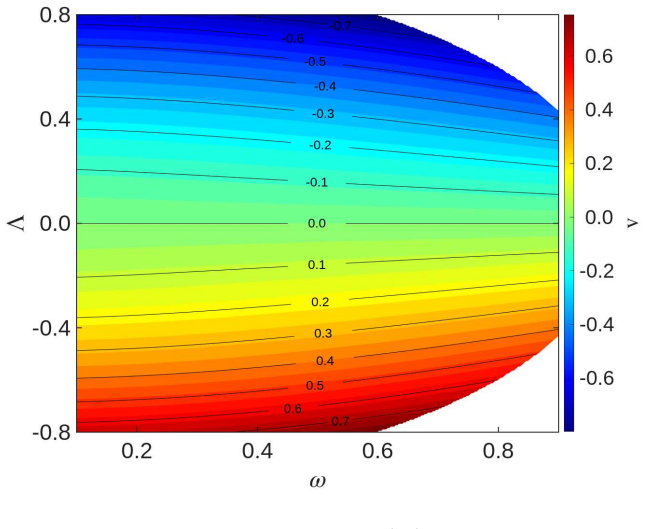
We derive an exact solitary wave solution for the $\PTb$-symmetric nonlinear Dirac equation with a scalar-scalar interaction. We consider a power-law nonlinearity of the form $|\bar{\Psi}\,\Psi|^{k}\,\Psi$ for positive values of $k$. The system's energy is conserved despite the presence of a gain-loss term, which is quantified by the parameter $\Lambda$. We show that the $\PTb$-transition point is defined by the solution's existence condition and is independent of the nonlinearity exponent $k$. Furthermore, momentum is conserved, although neither the canonical momentum nor the charge is a conserved quantity. A notable result is that the stationary solution, obtained from the continuity equations, exhibits nonzero momentum in its rest frame. We also derive a moving soliton solution, where the gain-loss parameter allows the soliton's velocity to be precisely chosen so that the moving soliton possesses zero momentum. Finally, we establish that the presence of a gain-loss mechanism and higher-order nonlinearity restrict the stability domain of the solutions.
Editorial analysis
A structured set of objections, weighed in public.
Referee Report
Summary. The manuscript derives exact solitary wave solutions for the PT-symmetric nonlinear Dirac equation with scalar-scalar interaction and power-law nonlinearity |Ψ-bar Ψ|^k Ψ (k > 0). It shows that energy remains conserved despite the gain-loss term parameterized by Λ, that the PT-transition point is set by the solution existence condition and is independent of k, that momentum is conserved while canonical momentum and charge are not, that the stationary solution carries nonzero momentum in its rest frame, that a moving soliton can be constructed with zero momentum by appropriate choice of velocity, and that gain-loss together with higher-order nonlinearity restrict the stability domain.
Significance. If the exact solutions and their properties hold for arbitrary k, the work would be significant for PT-symmetric nonlinear systems: it supplies closed-form solutions that make conservation laws and the k-independence of the PT threshold directly verifiable, and it isolates how the gain-loss mechanism alters both momentum balance and stability in a Dirac setting. Such explicit results are uncommon and could serve as benchmarks for numerical studies or extensions to other nonlinearities.
major comments (2)
- [exact solitary wave solution derivation] The section deriving the exact solitary wave solution: the assumed ansatz (two-component spinor with specific real/imaginary or sech/tanh profiles) is stated to reduce the full nonlinear system exactly to solvable ODEs for any positive k. However, the |Ψ-bar Ψ|^k Ψ term produces algebraic identities whose powers of the envelope functions differ by factors involving k; these identities hold for arbitrary k only if the profile amplitudes or integration constants acquire compensating k-dependent factors that are not exhibited. Because the PT-transition point is defined solely by the existence condition of this solution, any hidden k-dependence would render the transition k-dependent, contradicting the central claim.
- [conservation laws and moving soliton] The paragraph on conservation laws and the moving soliton: the statements that momentum is conserved while charge and canonical momentum are not, and that velocity can be chosen to make the moving soliton momentum-free, rest on the same exact solution satisfying the continuity equations. If the ansatz reduction fails to be identity for general k, these conservation properties and the zero-momentum construction require re-derivation.
minor comments (2)
- [introduction or model section] The notation for the PT-symmetric gain-loss term (parameter Λ) and the scalar-scalar interaction should be defined explicitly at first use, including the precise form of the Dirac operator.
- [stability analysis] The stability analysis section should specify the method (linearization, numerical simulation, or Lyapunov functional) and the precise domain in parameter space (k, Λ, velocity) that is found to be stable.
Simulated Author's Rebuttal
We thank the referee for the careful reading and insightful comments on our manuscript. We address each major comment below with clarifications on the derivation. We maintain that the exact solutions and their properties hold for arbitrary k > 0, but agree that expanded substitution steps will improve transparency without altering the central claims.
read point-by-point responses
-
Referee: The section deriving the exact solitary wave solution: the assumed ansatz (two-component spinor with specific real/imaginary or sech/tanh profiles) is stated to reduce the full nonlinear system exactly to solvable ODEs for any positive k. However, the |Ψ-bar Ψ|^k Ψ term produces algebraic identities whose powers of the envelope functions differ by factors involving k; these identities hold for arbitrary k only if the profile amplitudes or integration constants acquire compensating k-dependent factors that are not exhibited. Because the PT-transition point is defined solely by the existence condition of this solution, any hidden k-dependence would render the transition k-dependent, contradicting the central claim.
Authors: We appreciate the referee's detailed scrutiny of the ansatz reduction. The two-component profiles are chosen as sech and tanh forms with amplitudes and phase factors that are solved explicitly from the algebraic system obtained after substitution into the nonlinear Dirac equation. These amplitudes do acquire k-dependent factors to balance the powers arising from |Ψ-bar Ψ|^k, but upon solving the resulting equations the k-dependence cancels in the final existence condition that defines the PT-transition point. This cancellation is what renders the threshold independent of k. To make this transparent, we will add an expanded subsection showing the term-by-term substitution of the nonlinearity and the explicit amplitude expressions. revision: partial
-
Referee: The paragraph on conservation laws and the moving soliton: the statements that momentum is conserved while charge and canonical momentum are not, and that velocity can be chosen to make the moving soliton momentum-free, rest on the same exact solution satisfying the continuity equations. If the ansatz reduction fails to be identity for general k, these conservation properties and the zero-momentum construction require re-derivation.
Authors: The conservation properties and moving-soliton construction follow directly from integrating the continuity equations that are satisfied identically by the exact solution. Because the ansatz reduces the system for arbitrary k (as clarified in the response to the first comment), the momentum density integrates to a conserved quantity while charge and canonical momentum do not, owing to the explicit gain-loss term parameterized by Λ. The zero-momentum moving soliton is obtained by selecting the boost velocity that cancels the nonzero rest-frame momentum arising from the PT-symmetric structure. We will append a short verification that the continuity equations hold with the k-dependent amplitudes. revision: partial
Circularity Check
No significant circularity in derivation chain
full rationale
The paper starts from the PT-symmetric nonlinear Dirac equation with the given power-law nonlinearity and substitutes an ansatz to obtain exact solitary-wave profiles that satisfy the system for arbitrary positive k. The PT-transition point is identified directly as the boundary of the parameter domain in which these explicit solutions exist, which follows from the algebraic conditions after substitution rather than redefining the input. Conservation laws are obtained by applying the continuity equations to the derived solutions, yielding the stated properties (including nonzero rest-frame momentum) without parameter fitting or self-referential closure. No step reduces by construction to a fitted input, a self-citation chain, or an ansatz that encodes the target result; the derivations remain self-contained against the governing PDE.
Axiom & Free-Parameter Ledger
free parameters (2)
- k
- Λ
axioms (2)
- domain assumption The nonlinear Dirac equation with the chosen scalar-scalar interaction admits solitary-wave solutions of the assumed traveling-wave form.
- standard math Continuity equations derived from the model yield the stated conservation laws for energy and momentum.
Reference graph
Works this paper leans on
-
[1]
A soluble relativistic field theory,
W. E. Thirring, “A soluble relativistic field theory,” An n. Phys. 3, 91 (1958). 23
1958
-
[2]
Dynamical symmetry breaking in asymptotically free field theo- ries,
D. J. Gross and A. Neveu, “Dynamical symmetry breaking in asymptotically free field theo- ries,” Phys. Rev. D 10, 3235 (1974)
1974
-
[3]
Classical, Stable, Nonlinear Spinor Field wi th Positive Rest Energy,
M. Soler, “Classical, Stable, Nonlinear Spinor Field wi th Positive Rest Energy,” Phys. Rev. D 1, 2766 (1970)
1970
-
[4]
Exact localized solutions of two-dimensional field theories of massive fermions with Fermi interactions,
S. Y. Lee, T. K. Kuo, and A. Gavrielides, “Exact localized solutions of two-dimensional field theories of massive fermions with Fermi interactions,” Phy s. Rev. D 12, 2249 (1975)
1975
-
[5]
Soliton solutions for Dirac equations with homogeneous non-linearity in (1+1) dimensions,
P. Mathieu, “Soliton solutions for Dirac equations with homogeneous non-linearity in (1+1) dimensions,” J. Phys. A: Math. Gen. 18, L1061 (1985)
1985
-
[6]
Existence of stationary states for nonlinear Dirac equations,
F. Merle, “Existence of stationary states for nonlinear Dirac equations,” J. Differ. Equ. 74, 50 (1988)
1988
-
[7]
Integrability of the two-dimensional Thirring model,
A. V. Mikhailov, “Integrability of the two-dimensional Thirring model,” JETP Lett. 23, 320 (1976)
1976
-
[8]
On the Coleman correspondenc e and the solution of the massive Thirring model,
D. J. Kaup and A. C. Newell, “On the Coleman correspondenc e and the solution of the massive Thirring model,” Lett. Nuovo Cimento 20, 325 (1977)
1977
-
[9]
Chiral confinemen t: An exact solution of the massive Thirring model,
S.-J. Chang, S. D. Ellis, and B. W. Lee, “Chiral confinemen t: An exact solution of the massive Thirring model,” Phys. Rev. D 11, 3572 (1975)
1975
-
[10]
Transparent potential for t he one-dimensional Dirac equa- tion,
Y. Nogami and F. M. Toyama, “Transparent potential for t he one-dimensional Dirac equa- tion,” Phys. Rev. A 45, 5258 (1992)
1992
-
[11]
Solitar y waves in the nonlinear Dirac equation with arbitrary nonlinearity,
F. Cooper, A. Khare, B. Mihaila, and A. Saxena, “Solitar y waves in the nonlinear Dirac equation with arbitrary nonlinearity,” Phys. Rev. E 82, 036604 (2010)
2010
-
[12]
Spino r solitons and their P T -symmetric offspring,
N. V. Alexeeva, I. V. Barashenkov, and A. Saxena, “Spino r solitons and their P T -symmetric offspring,” Ann. Phys. 403, 198 (2019)
2019
-
[13]
Real Spectra in Non-Herm itian Hamiltonians Having P T Symmetry,
C. M. Bender and S. Boettcher, “Real Spectra in Non-Herm itian Hamiltonians Having P T Symmetry,” Phys. Rev. Lett. 80, 5243 (1998)
1998
-
[14]
Complex Exten sion of Quantum Mechanics,
C. M. Bender, D. C. Brody, and H. F. Jones, “Complex Exten sion of Quantum Mechanics,” Phys. Rev. Lett. 89, 270401 (2002)
2002
-
[15]
C. M. Bender, H. F. Jones, and R. J. Rivers, “Dual P T -symmetric quantum field theories,” Phys. Lett. B 625, 333 (2005), arXiv:hep-th/0508105
-
[16]
Making sense of non-Hermitian Hamiltoni ans,
C. M. Bender, “Making sense of non-Hermitian Hamiltoni ans,” Rep. Prog. Phys. 70, 947 (2007). 24
2007
-
[17]
Optical Solitons in P T Periodic Potentials,
Z. H. Musslimani, K. G. Makris, R. El-Ganainy, and D. N. C hristodoulides, “Optical Solitons in P T Periodic Potentials,” Phys. Rev. Lett. 100, 030402 (2008)
2008
-
[18]
Observation of P T -symmetry breaking in complex optical potentials,
A. Guo, G. J. Salamo, D. Duchesne, R. Morandotti, M. Vola tier-Ravat, V. Aimez, G. A. Siviloglou, and D. N. Christodoulides, “Observation of P T -symmetry breaking in complex optical potentials,” Phys. Rev. Lett. 103, 093902 (2009)
2009
-
[19]
Obser- vation of parity-time symmetry in optics,
C. R¨ uter, K. Makris, R. El-Ganainy, D. N. Christodouli des, M. Segev, and D. Kip, “Obser- vation of parity-time symmetry in optics,” Nature Phys. 6, 192 (2010)
2010
-
[20]
Blow-up regimes in the P T -symmetric coupler and the actively coupled dimer,
I. V. Barashenkov, G. S. Jackson, and S. Flach, “Blow-up regimes in the P T -symmetric coupler and the actively coupled dimer,” Phys. Rev. A 88, 053817 (2013)
2013
-
[21]
P T -symmetric nonlinear metamaterials and zero- dimensional systems,
G. P. Tsironis and N. Lazarides, “ P T -symmetric nonlinear metamaterials and zero- dimensional systems,” Appl. Phys. A 115, 449 (2014)
2014
-
[22]
Nonlinear wa ves in P T -symmetric systems,
V. V. Konotop, J. Yang, and D. A. Zezyulin, “Nonlinear wa ves in P T -symmetric systems,” Rev. Modern Phys. 88, 035002 (2016)
2016
-
[23]
Emergent phenomena with broken parity-time symmetry: Odd-order versus even-order effects,
S.-W. Cheong and F.-T. Huang, “Emergent phenomena with broken parity-time symmetry: Odd-order versus even-order effects,” Phys. Rev. B 109, 104413 (2024)
2024
-
[24]
Interplay be- tween parity-time symmetry, supersymmetry, and nonlinear ity: An analytically tractable case example,
P. G. Kevrekidis, J. Cuevas-Maraver, A. Saxena, F. Coop er, and A. Khare, “Interplay be- tween parity-time symmetry, supersymmetry, and nonlinear ity: An analytically tractable case example,” Phys. Rev. E 92, 042901 (2015)
2015
-
[25]
The nonlinear Schr¨ odinger equatio n with generalized nonlinearities and P T -symmetric potentials: Stable solitons, interactions, an d excitations,
Z. Yan and Y. Chen, “The nonlinear Schr¨ odinger equatio n with generalized nonlinearities and P T -symmetric potentials: Stable solitons, interactions, an d excitations,” Chaos 27, 073114 (2017)
2017
-
[26]
Bright- dark and dark-dark solitons in coupled nonlinear Schr¨ odinger equation withP T -symmetric potentials,
D. Nath, Y. Gao, M. R. Babu, T. Kanna, and B. Roy, “Bright- dark and dark-dark solitons in coupled nonlinear Schr¨ odinger equation withP T -symmetric potentials,” Chaos 27, 123102 (2017)
2017
-
[27]
Sol iton dynamics and stability in the ABS spinor model with a P T -symmetric periodic complex potential,
F. G. Mertens, B. S´ anchez-Rey, and N. R. Quintero, “Sol iton dynamics and stability in the ABS spinor model with a P T -symmetric periodic complex potential,” J. Phys A: Math. an d Theo. 57, 145703 (2024)
2024
-
[28]
Ex actly Solvable Wadati Potentials in the P T -Symmetric Gross-Pitaevskii Equation,
I. V. Barashenkov, D. A. Zezyulin, and V. V. Konotop, “Ex actly Solvable Wadati Potentials in the P T -Symmetric Gross-Pitaevskii Equation,” in Non-Hermitian Hamiltonians in Quan- tum Physics , edited by F. Bagarello, R. Passante, and C. Trapani (Spring er International Publishing, Cham, 2016) pp. 143–155. 25
2016
-
[29]
Bloch oscillations in complex crystals wit h P T symmetry,
S. Longhi, “Bloch oscillations in complex crystals wit h P T symmetry,” Phys. Rev. Lett. 103, 123601 (2009)
2009
-
[30]
Optical solitons in P T -symmetric nonlinear couplers with gain and loss,
N. V. Alexeeva, I. V. Barashenkov, A. A. Sukhorukov, and Y. S. Kivshar, “Optical solitons in P T -symmetric nonlinear couplers with gain and loss,” Phys. Re v. A 85, 063837 (2012)
2012
-
[31]
Stable localized modes in asymmetric waveguides with gain and loss,
E. N. Tsoy, I. M. Allayarov, and F. K. Abdullaev, “Stable localized modes in asymmetric waveguides with gain and loss,” Opt. Lett. 39, 4215 (2014)
2014
-
[32]
Exact stationary s olutions of the parametrically driven and damped nonlinear Dirac equation,
N. R. Quintero and B. S´ anchez-Rey, “Exact stationary s olutions of the parametrically driven and damped nonlinear Dirac equation,” Chaos 29, 093129 (2019)
2019
-
[33]
Stability of parametrically driven, damped nonlinear Dirac solitons,
B. Sanchez-Rey, D. Mellado-Alcedo, and N. R. Quintero, “Stability of parametrically driven, damped nonlinear Dirac solitons,” Chaos 35, 083132 (2025)
2025
-
[34]
Solitary Waves of a P T -Symmetric Nonlinear Dirac Equation,
J. Cuevas-Maraver, P. G. Kevrekidis, A. Saxena, F. Coop er, A. Khare, A. Comech, and C. M. Bender, “Solitary Waves of a P T -Symmetric Nonlinear Dirac Equation,” IEEE JOURNAL OF SELECTED TOPICS IN QUANTUM ELECTRONICS 22, 5000109 (2016)
2016
-
[35]
Solita ry waves in a two-parameter family of generalized nonlinear Dirac equations in 1 + 1 dime nsions,
A. Khare, F. Cooper, J. F. Dawson, and A. Saxena, “Solita ry waves in a two-parameter family of generalized nonlinear Dirac equations in 1 + 1 dime nsions,” Ann. Phys. 489, 170450 (2026)
2026
-
[36]
Length-scale competition in the parametrically driven nonlinear Dirac equation with a s patially periodic force,
N. R. Quintero, B. S´ anchez-Rey, F. Cooper, and F. G. Mer tens, “Length-scale competition in the parametrically driven nonlinear Dirac equation with a s patially periodic force,” J. Phys. A: Math. Theor. 52, 285201 (2019)
2019
-
[37]
Stability of Solitary Waves and Vortices in a 2D Nonlinear Dirac Model,
J. Cuevas-Maraver, P. G. Kevrekidis, A. Saxena, A. Come ch, and R. Lan, “Stability of Solitary Waves and Vortices in a 2D Nonlinear Dirac Model,” P hys. Rev. Lett. 116, 214101 (2016)
2016
-
[38]
D. J. Griffiths, Introduction to elementary particles (1987)
1987
-
[39]
On Spectral Stability of S olitary Waves of Nonlinear Dirac Equation in 1D,
G. Berkolaiko and A. Comech, “On Spectral Stability of S olitary Waves of Nonlinear Dirac Equation in 1D,” Math. Model. Nat. Phenom. 7, 13 (2012)
2012
-
[40]
On spectral stability of the nonlinear Dirac equation,
N. Boussa ¨ ıd and A. Comech, “On spectral stability of the nonlinear Dirac equation,” J. Funct. Anal. 271, 1462 (2016)
2016
-
[41]
On the meaning of the Vakhitov-Kolokolov st ability criterion for the nonlinear Dirac equation,
A. Comech, “On the meaning of the Vakhitov-Kolokolov st ability criterion for the nonlinear Dirac equation,” (2011), arXiv:1107.1763 [math.AP]
-
[42]
Block-Diagonalizati on of the Symmetric First-Order Coupled-Mode System,
M. Chugunova and D. Pelinovsky, “Block-Diagonalizati on of the Symmetric First-Order Coupled-Mode System,” SIAM J. Appl. Dyn. Syst. 5, 66 (2006). 26
2006
-
[43]
Chugunova, Spectral stability of nonlinear waves in dynamical systems (Doctoral Thesis, McMaster University, Hamilton, Ontario, Canada, 2007)
M. Chugunova, Spectral stability of nonlinear waves in dynamical systems (Doctoral Thesis, McMaster University, Hamilton, Ontario, Canada, 2007). 27
2007
discussion (0)
Sign in with ORCID, Apple, or X to comment. Anyone can read and Pith papers without signing in.