Recognition: unknown
Geometric bias and centrality dependence of jet quenching in high-energy nuclear collisions
Pith reviewed 2026-05-10 01:36 UTC · model grok-4.3
The pith
Geometric bias from impact-parameter-dependent nucleon collisions suppresses high-momentum hadrons in peripheral heavy-ion collisions.
A machine-rendered reading of the paper's core claim, the machinery that carries it, and where it could break.
Core claim
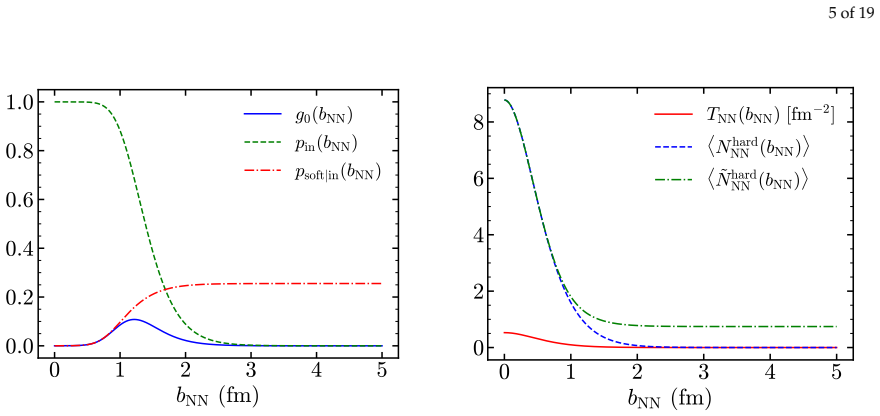
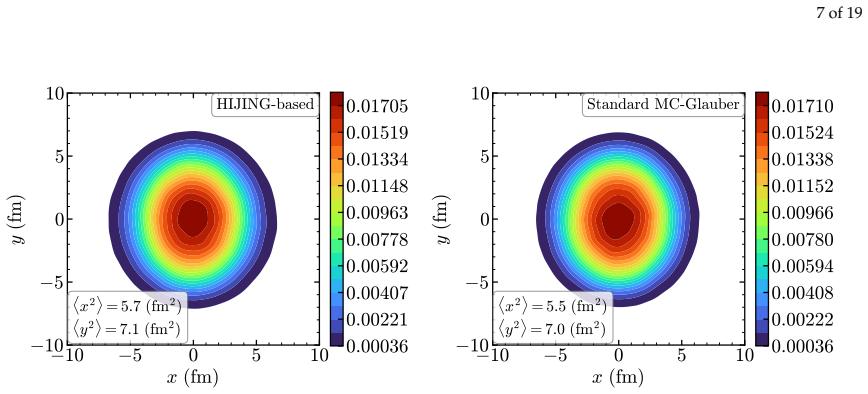
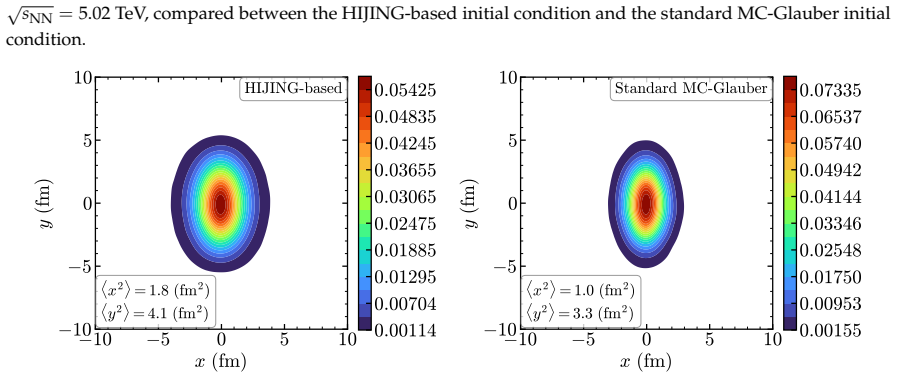
The authors show that accounting for the impact parameter dependence of inelastic NN collisions and the number of hard partonic scatterings per inelastic NN collision in a HIJING-based initial condition model introduces a geometric bias that suppresses the high transverse momentum hadron spectrum in peripheral AA collisions due to dilute nucleon overlap at large AA impact parameters. Combined with the linear Boltzmann transport model for jet-QGP interactions, this satisfactorily describes the centrality dependence of charged hadron suppression in Pb+Pb collisions at √s_NN=5.02 TeV.
What carries the argument
The HIJING-based initial condition model with explicit impact-parameter dependence on both inelastic NN collision probability and the number of hard scatterings per collision, which produces the geometric bias on jet yields.
Load-bearing premise
The geometric bias arising from the impact-parameter dependence of inelastic NN collisions and hard scatterings is the primary cause of the observed peripheral suppression.
What would settle it
A measurement or calculation showing that the suppression in very peripheral collisions remains significantly larger than the model predicts once the geometric bias is fully included, or that the model fails to match data in a regime where nucleon overlap is minimal.
Figures


read the original abstract
Jet quenching provides a valuable measure of the opacity of the quark-gluon plasma (QGP) produced in high-energy heavy-ion collisions. However, substantial suppression of charged hadron spectra is observed in highly peripheral collisions, despite the expectation of negligible jet-QGP interactions in this regime. To address this, we develop a HIJING-based initial condition model that accounts for the impact parameter dependence of both inelastic nucleon-nucleon (NN) collisions and the number of hard partonic scatterings per inelastic NN collision. This dependence introduces a geometric bias effect on the jet yield within a given centrality class of nucleus-nucleus (AA) collisions, suppressing the high transverse momentum hadron spectrum in peripheral collisions due to dilute nucleon overlap at large AA impact parameters. By combining this improved initial condition model with a linear Boltzmann transport model for jet-QGP interactions, we obtain a satisfactory description of the centrality dependence of charged hadron suppression in Pb+Pb collisions at $\sqrt{s_\mathrm{NN}}=5.02$ TeV.
Editorial analysis
A structured set of objections, weighed in public.
Referee Report
Summary. The paper develops a HIJING-based initial condition model that incorporates the impact-parameter dependence of inelastic NN collisions and the number of hard partonic scatterings per collision. This introduces a geometric bias that suppresses the high-pT jet yield in peripheral AA collisions due to dilute nucleon overlap at large impact parameters. When this improved initial condition is combined with a linear Boltzmann transport model for jet-QGP interactions, the resulting framework is claimed to provide a satisfactory description of the centrality dependence of charged hadron suppression (R_AA) in Pb+Pb collisions at √s_NN = 5.02 TeV.
Significance. If the geometric bias is shown to be independent of model-specific multiplicity fluctuations, the result would be significant for heavy-ion phenomenology: it would indicate that a substantial fraction of the observed peripheral R_AA suppression originates from initial-state geometry rather than strong final-state quenching in dilute media. This could reduce the inferred QGP opacity extracted from peripheral data and improve the reliability of initial-condition modeling in jet-quenching studies. The explicit inclusion of impact-parameter dependence in both inelasticity and hard-scattering rates is a physically motivated improvement over standard HIJING.
major comments (2)
- [Initial condition and centrality definition] The central claim that geometric bias accounts for most of the peripheral suppression (with LBT supplying only a small additional effect) requires explicit demonstration that the bias survives when centrality is defined by an independent observable such as spectator neutrons or forward energy, rather than charged-particle multiplicity. Multiplicity-based centrality selection may correlate directly with the HIJING baseline fluctuations that the bias term is intended to correct, rendering the decomposition into geometric versus medium effects circular. This test is load-bearing for the interpretation.
- [Abstract and results section] The abstract asserts a 'satisfactory description' of the centrality dependence but provides no quantitative metrics (χ²/dof, fit residuals, or error-band comparisons) or details on centrality bin definitions and data selection. Without these, it is impossible to judge whether the improvement over baseline HIJING+LBT is statistically significant or affected by post-hoc adjustments.
minor comments (2)
- The abstract refers to the 'linear Boltzmann transport model' without specifying whether it is the standard LBT implementation or a modified version; a brief reference or one-sentence description would clarify the jet-medium interaction treatment.
- Ensure that all figures comparing model to data include experimental error bars, model uncertainty bands, and explicit statements of the centrality binning procedure used in both model and experiment.
Simulated Author's Rebuttal
We thank the referee for the careful reading of our manuscript and the constructive comments. We address each major comment below and indicate the revisions we will make.
read point-by-point responses
-
Referee: [Initial condition and centrality definition] The central claim that geometric bias accounts for most of the peripheral suppression (with LBT supplying only a small additional effect) requires explicit demonstration that the bias survives when centrality is defined by an independent observable such as spectator neutrons or forward energy, rather than charged-particle multiplicity. Multiplicity-based centrality selection may correlate directly with the HIJING baseline fluctuations that the bias term is intended to correct, rendering the decomposition into geometric versus medium effects circular. This test is load-bearing for the interpretation.
Authors: We agree that an explicit check with an independent centrality observable would strengthen the interpretation. The geometric bias in our model is introduced at the level of individual NN collisions through the impact-parameter dependence of both the inelastic cross section and the hard-scattering rate; this dependence is fixed by the underlying Glauber geometry and is not tuned to the final multiplicity. Centrality classes are defined from mid-rapidity charged-particle multiplicity, which is the standard experimental procedure and is also used in the HIJING baseline. While the multiplicity does receive contributions from the same impact-parameter-dependent soft processes, the bias on the hard component is calculated prior to any medium evolution and is therefore not circular by construction. We will add a dedicated paragraph in the revised manuscript discussing this point and, where computationally feasible within the HIJING framework, present results using forward-energy or spectator-neutron proxies to demonstrate that the peripheral suppression persists. revision: partial
-
Referee: [Abstract and results section] The abstract asserts a 'satisfactory description' of the centrality dependence but provides no quantitative metrics (χ²/dof, fit residuals, or error-band comparisons) or details on centrality bin definitions and data selection. Without these, it is impossible to judge whether the improvement over baseline HIJING+LBT is statistically significant or affected by post-hoc adjustments.
Authors: We accept that the abstract and results section should be more quantitative. In the revised manuscript we will (i) specify the exact centrality bin boundaries and the corresponding charged-particle multiplicity ranges, (ii) report χ²/dof values for the comparison of our full model with the 5.02 TeV Pb+Pb R_AA data, and (iii) include a brief statement on the data selection and error treatment. These additions will allow readers to assess the statistical significance of the improvement over the baseline HIJING+LBT calculation. revision: yes
Circularity Check
No significant circularity; geometric bias derived from nuclear geometry independent of final observable
full rationale
The paper introduces a HIJING-based initial condition that explicitly incorporates the impact-parameter dependence of inelastic NN collisions and hard partonic scatterings, motivated directly by nuclear overlap geometry rather than by fitting to the observed peripheral R_AA suppression. This geometric bias is then combined with an independent linear Boltzmann transport model for jet-QGP interactions to describe the centrality dependence of charged hadron suppression. No equations, parameters, or self-citations in the derivation chain reduce the central claim to a tautology or to a fit performed on the same data being predicted. Centrality selection via multiplicity is standard and does not create a definitional loop with the bias term, as the bias arises from the underlying nucleon-level geometry. The result is a genuine model prediction rather than a renaming or self-referential construction.
Axiom & Free-Parameter Ledger
Reference graph
Works this paper leans on
-
[1]
Busza, W.; Rajagopal, K.; van der Schee, W. Heavy Ion Collisions: The Big Picture, and the Big Questions. Ann. Rev. Nucl. Part. Sci.2018,68, 339–376, [arXiv:hep-ph/1802.04801]. https://doi.org/10.1146/annurev- nucl-101917-020852
-
[2]
The exploration of hot and dense nuclear matter: introduction to relativistic heavy-ion physics.J
Elfner, H.; Müller, B. The exploration of hot and dense nuclear matter: introduction to relativistic heavy-ion physics.J. Phys. G2023,50, 103001, [arXiv:nucl-th/2210.12056]. https://doi.org/10.1088/1361-6471/ace824. 15 of 19
-
[3]
Harris, J.W.; Müller, B. ”QGP Signatures” Revisited.Eur. Phys. J. C2024,84, 247, [arXiv:hep-ph/2308.05743]. https://doi.org/10.1140/epjc/s10052-024-12533-y
-
[4]
Anisotropy as a signature of transverse collective flow.Phys
Ollitrault, J.Y. Anisotropy as a signature of transverse collective flow.Phys. Rev. D1992,46, 229–245. https://doi.org/10.1103/PhysRevD.46.229
-
[5]
Collective flow and viscosity in relativistic heavy-ion collisions.Ann
Heinz, U.; Snellings, R. Collective flow and viscosity in relativistic heavy-ion collisions.Ann. Rev. Nucl. Part. Sci.2013,63, 123–151, [arXiv:nucl-th/1301.2826]. https://doi.org/10.1146/annurev-nucl-102212-170540
-
[6]
Gluon shadowing and jet quenching in A + A collisions at s**(1/2) = 200-GeV
Wang, X.N.; Gyulassy, M. Gluon shadowing and jet quenching in A + A collisions at s**(1/2) = 200-GeV. Phys. Rev. Lett.1992,68, 1480–1483. https://doi.org/10.1103/PhysRevLett.68.1480
-
[7]
Jet quenching in high-energy heavy-ion collisions.Int
Qin, G.Y.; Wang, X.N. Jet quenching in high-energy heavy-ion collisions.Int. J. Mod. Phys. E2015, 24, 1530014, [arXiv:hep-ph/1511.00790]. https://doi.org/10.1142/S0218301315300143
-
[8]
The Theory and Phenomenology of Perturbative QCD Based Jet Quenching
Majumder, A.; Van Leeuwen, M. The Theory and Phenomenology of Perturbative QCD Based Jet Quenching. Prog. Part. Nucl. Phys.2011,66, 41–92, [arXiv:hep-ph/1002.2206]. https://doi.org/10.1016/j.ppnp.2010.09. 001
-
[9]
Jet quenching and medium response in high-energy heavy-ion collisions: a review.Rept
Cao, S.; Wang, X.N. Jet quenching and medium response in high-energy heavy-ion collisions: a review.Rept. Prog. Phys.2021,84, 024301, [arXiv:hep-ph/2002.04028]. https://doi.org/10.1088/1361-6633/abc22b
-
[10]
Wang, X.N.; Wiedemann, U.A. QGP@50: More than Four Decades of Jet Quenching. 8 2025, [arXiv:hep- ph/2508.18794]
-
[11]
Mehtar-Tani,The Physics of Jet Quenching in Perturbative QCD,2509.26394
Mehtar-Tani, Y. The Physics of Jet Quenching in Perturbative QCD2025. [arXiv:hep-ph/2509.26394]
-
[12]
Bernhard, J.E.; Moreland, J.S.; Bass, S.A. Bayesian estimation of the specific shear and bulk viscosity of quark–gluon plasma.Nature Phys.2019,15, 1113–1117. https://doi.org/10.1038/s41567-019-0611-8
-
[13]
Everett, D.; et al. Phenomenological constraints on the transport properties of QCD matter with data-driven model averaging.Phys. Rev. Lett.2021,126, 242301, [arXiv:hep-ph/2010.03928]. https://doi.org/10.1103/ PhysRevLett.126.242301
-
[14]
Constraining η/s through high-p⊥ theory and data.Phys
Karmakar, B.; Zigic, D.; Salom, I.; Auvinen, J.; Huovinen, P .; Djordjevic, M.; Djordjevic, M. Constraining η/s through high-p⊥ theory and data.Phys. Rev. C2023,108, 044907, [arXiv:hep-ph/2305.11318]. https: //doi.org/10.1103/PhysRevC.108.044907
-
[15]
Pratt, S.; Sangaline, E.; Sorensen, P .; Wang, H. Constraining the Eq. of State of Super-Hadronic Matter from Heavy-Ion Collisions.Phys. Rev. Lett.2015,114, 202301, [arXiv:nucl-th/1501.04042]. https://doi.org/10.110 3/PhysRevLett.114.202301
-
[16]
Constraining the equation of state with heavy quarks in the quasi-particle model of QCD matter.Phys
Liu, F.L.; Wu, X.Y.; Cao, S.; Qin, G.Y.; Wang, X.N. Constraining the equation of state with heavy quarks in the quasi-particle model of QCD matter.Phys. Lett. B2024,848, 138355, [arXiv:hep-ph/2304.08787]. https://doi.org/10.1016/j.physletb.2023.138355
-
[17]
Hayrapetyan, A.; et al. Extracting the speed of sound in quark–gluon plasma with ultrarelativistic lead–lead collisions at the LHC.Rept. Prog. Phys.2024,87, 077801, [arXiv:nucl-ex/2401.06896]. https://doi.org/10.108 8/1361-6633/ad4b9b
-
[18]
Extracting the jet transport coefficient from jet quenching in high-energy heavy-ion collisions.Phys
Burke, K.M.; et al. Extracting the jet transport coefficient from jet quenching in high-energy heavy-ion collisions.Phys. Rev. C2014,90, 014909, [arXiv:nucl-th/1312.5003]. https://doi.org/10.1103/PhysRevC.90.0 14909
-
[19]
Cao, S.; et al. Determining the jet transport coefficient ˆq from inclusive hadron suppression measurements using Bayesian parameter estimation.Phys. Rev. C2021,104, 024905, [arXiv:nucl-th/2102.11337]. https: //doi.org/10.1103/PhysRevC.104.024905
-
[21]
Khachatryan, V .; et al. Observation of Long-Range Near-Side Angular Correlations in Proton-Proton Collisions at the LHC.JHEP2010,09, 091, [arXiv:hep-ex/1009.4122]. https://doi.org/10.1007/JHEP09(2010 )091
-
[22]
Aad, G.; et al. Observation of Associated Near-Side and Away-Side Long-Range Correlations in√sNN = 5.02 TeV Proton-Lead Collisions with the ATLAS Detector.Phys. Rev. Lett.2013,110, 182302, [arXiv:hep- ex/1212.5198]. https://doi.org/10.1103/PhysRevLett.110.182302
-
[23]
Long-range angular correlations on the near and away side inp-Pb collisions at √sNN = 5.02 TeV.Phys
Abelev, B.; et al. Long-range angular correlations on the near and away side inp-Pb collisions at √sNN = 5.02 TeV.Phys. Lett. B2013,719, 29–41, [arXiv:nucl-ex/1212.2001]. https://doi.org/10.1016/j.physletb.2013.01.01 2. 16 of 19
-
[24]
Adare, A.; et al. Quadrupole Anisotropy in Dihadron Azimuthal Correlations in Central d+Au Collisions at√sNN = 200 GeV.Phys. Rev. Lett.2013,111, 212301, [arXiv:nucl-ex/1303.1794]. https://doi.org/10.1103/ PhysRevLett.111.212301
-
[25]
Long-range pseudorapidity dihadron correlations in d+Au collisions at √sNN = 200 GeV.Phys
Adamczyk, L.; et al. Long-range pseudorapidity dihadron correlations in d+Au collisions at √sNN = 200 GeV.Phys. Lett. B2015,747, 265–271, [arXiv:nucl-ex/1502.07652]. https://doi.org/10.1016/j.physletb.2015 .05.075
-
[26]
Abdulhamid, M.I.; et al. Measurements of the Elliptic and Triangular Azimuthal Anisotropies in Central He3+Au, d+Au and p+Au Collisions at √sNN = 200 GeV.Phys. Rev. Lett.2023,130, 242301, [arXiv:nucl- ex/2210.11352]. https://doi.org/10.1103/PhysRevLett.130.242301
-
[27]
Pattern Recog- nition153, 110500 (2024).https://doi.org/https://doi.org/10.1016/j
Adamczyk, L.; et al. Effect of event selection on jetlike correlation measurement in d+Au collisions at√sNN = 200 GeV.Phys. Lett. B2015,743, 333–339, [arXiv:nucl-ex/1412.8437]. https://doi.org/10.1016/j. physletb.2015.02.068
work page doi:10.1016/j 2015
-
[28]
Abdulhamid, M.; et al. Correlations of event activity with hard and soft processes in p+Au collisions at√sNN = 200 GeV at the RHIC STAR experiment.Phys. Rev. C2024,110, 044908, [arXiv:nucl-ex/2404.08784]. https://doi.org/10.1103/PhysRevC.110.044908
-
[29]
Adare, A.; et al. Centrality-dependent modification of jet-production rates in deuteron-gold collisions at√sNN = 200 GeV.Phys. Rev. Lett.2016,116, 122301, [arXiv:nucl-ex/1509.04657]. https://doi.org/10.1103/ PhysRevLett.116.122301
-
[30]
Khachatryanet al.[CMS], JHEP04, 039 (2017) doi:10.1007/JHEP04(2017)039 [arXiv:1611.01664 [nucl-ex]]
Khachatryan, V .; et al. Charged-particle nuclear modification factors in PbPb and pPb collisions at√sNN = 5.02 TeV.JHEP2017,04, 039, [arXiv:nucl-ex/1611.01664]. https://doi.org/10.1007/JHEP04(2017)039
-
[31]
Chekhovsky, V .; et al. Search for jet quenching with dijets from high-multiplicity pPb collisions at√sNN = 8.16 TeV.JHEP2025,07, 118, [arXiv:nucl-ex/2504.08507]. https://doi.org/10.1007/JHEP07(2025)118
-
[32]
Acharya, S.; et al. Constraints on jet quenching in p-Pb collisions at √sNN = 5.02 TeV measured by the event-activity dependence of semi-inclusive hadron-jet distributions.Phys. Lett. B2018,783, 95–113, [arXiv:nucl-ex/1712.05603]. https://doi.org/10.1016/j.physletb.2018.05.059
-
[33]
Aad, G.; et al. Strong Constraints on Jet Quenching in Centrality-Dependent p+Pb Collisions at 5.02 TeV from ATLAS.Phys. Rev. Lett.2023,131, 072301, [arXiv:nucl-ex/2206.01138]. https://doi.org/10.1103/ PhysRevLett.131.072301
-
[34]
From Lead to Helium: Discovery Potential for Jet Quenching in the Smallest Collision Systems2025
Faraday, C.; Bert, B.; Brand, J.; Vogelsang, W.; Horowitz, W.A. From Lead to Helium: Discovery Potential for Jet Quenching in the Smallest Collision Systems2025. [arXiv:hep-ph/2512.17832]
-
[35]
Energy loss baseline for light hadrons in oxygen-oxygen collisions at √sNN = 5.36 TeV
Mazeliauskas, A. Energy loss baseline for light hadrons in oxygen-oxygen collisions at √sNN = 5.36 TeV. Phys. Lett. B2026,876, 140409, [arXiv:hep-ph/2509.07008]. https://doi.org/10.1016/j.physletb.2026.140409
-
[36]
Bayesian Constraints on Pre-Equilibrium Jet Quenching and Predictions for Oxygen Collisions
Pablos, D.; Takacs, A. Bayesian Constraints on Pre-Equilibrium Jet Quenching and Predictions for Oxygen Collisions2025. [arXiv:hep-ph/2509.19430]
work page internal anchor Pith review Pith/arXiv arXiv
-
[37]
Charged-particle nuclear modification factors in XeXe collisions at √sNN = 5.44 TeV
Sirunyan, A.M.; et al. Charged-particle nuclear modification factors in XeXe collisions at √sNN = 5.44 TeV. JHEP2018,10, 138, [arXiv:hep-ex/1809.00201]. https://doi.org/10.1007/JHEP10(2018)138
-
[38]
Observation of suppressed charged-particle production in ultrarelativistic oxygen-oxygen collisions
Hayrapetyan, A.; et al. Discovery of suppressed charged-particle production in ultrarelativistic oxygen- oxygen collisions2025. [arXiv:nucl-ex/2510.09864]
work page internal anchor Pith review Pith/arXiv arXiv
-
[39]
Belyaev, A.; et al. System-size dependence of charged-particle suppression in ultrarelativistic nucleus- nucleus collisions2026. [arXiv:nucl-ex/2602.21325]
-
[40]
Measurement of jet quenching in O+O collisions at √sNN = 200 GeV by the STAR experiment at RHIC2026. [arXiv:nucl-ex/2604.13935]
work page internal anchor Pith review Pith/arXiv arXiv
-
[41]
Heavy and light flavor jet quenching at RHIC and LHC energies
Cao, S.; Luo, T.; Qin, G.Y.; Wang, X.N. Heavy and light flavor jet quenching at RHIC and LHC energies. Phys. Lett. B2018,777, 255–259, [arXiv:nucl-th/1703.00822]. https://doi.org/10.1016/j.physletb.2017.12.023
-
[42]
Absence of jet quenching in peripheral nucleus–nucleus collisions.Phys
Loizides, C.; Morsch, A. Absence of jet quenching in peripheral nucleus–nucleus collisions.Phys. Lett. B 2017,773, 408–411, [arXiv:nucl-ex/1705.08856]. https://doi.org/10.1016/j.physletb.2017.09.002
-
[44]
Sirunyan, A.M.; et al. Constraints on the Initial State of Pb-Pb Collisions via Measurements ofZ-Boson Yields and Azimuthal Anisotropy at√sNN = 5.02 TeV.Phys. Rev. Lett.2021,127, 102002, [arXiv:hep-ex/2103.14089]. https://doi.org/10.1103/PhysRevLett.127.102002
-
[45]
Glauber modeling in high energy nuclear collisions
Miller, M.L.; Reygers, K.; Sanders, S.J.; Steinberg, P . Glauber modeling in high energy nuclear collisions. Ann. Rev. Nucl. Part. Sci.2007,57, 205–243, [nucl-ex/0701025]. https://doi.org/10.1146/annurev.nucl.57.0 90506.123020. 17 of 19
-
[46]
Role of multiple mini - jets in high-energy hadronic reactions.Phys
Wang, X.N. Role of multiple mini - jets in high-energy hadronic reactions.Phys. Rev. D1991,43, 104–112. https://doi.org/10.1103/PhysRevD.43.104
-
[47]
HIJING: A Monte Carlo model for multiple jet production in pp, pA and AA collisions.Phys
Wang, X.N.; Gyulassy, M. HIJING: A Monte Carlo model for multiple jet production in pp, pA and AA collisions.Phys. Rev. D1991,44, 3501–3516. https://doi.org/10.1103/PhysRevD.44.3501
-
[48]
Gyulassy, M.; Wang, X.N. HIJING 1.0: A Monte Carlo program for parton and particle production in high-energy hadronic and nuclear collisions.Comput. Phys. Commun.1994,83, 307, [nucl-th/9502021]. https://doi.org/10.1016/0010-4655(94)90057-4
-
[49]
Bierlich, C.; Gustafson, G.; Lönnblad, L.; Shah, H. The Angantyr model for Heavy-Ion Collisions in PYTHIA8. JHEP2018,10, 134, [arXiv:hep-ph/1806.10820]. https://doi.org/10.1007/JHEP10(2018)134
-
[50]
GLISSANDO: Glauber initial-state simulation and more..Comput
Broniowski, W.; Rybczynski, M.; Bozek, P . GLISSANDO: Glauber initial-state simulation and more..Comput. Phys. Commun.2009,180, 69–83, [arXiv:nucl-th/0710.5731]. https://doi.org/10.1016/j.cpc.2008.07.016
-
[51]
Rybczynski, M.; Stefanek, G.; Broniowski, W.; Bozek, P . GLISSANDO 2 : GLauber Initial-State Simulation AND mOre. . . , ver. 2.Comput. Phys. Commun.2014,185, 1759–1772, [arXiv:nucl-th/1310.5475]. https: //doi.org/10.1016/j.cpc.2014.02.016
-
[52]
Jia, J. Influence of the nucleon-nucleon collision geometry on the determination of the nuclear modification factor for nucleon-nucleus and nucleus-nucleus collisions.Phys. Lett. B2009,681, 320–325, [arXiv:nucl- th/0907.4175]. https://doi.org/10.1016/j.physletb.2009.10.044
-
[53]
Cao, S.; Luo, T.; Qin, G.Y.; Wang, X.N. Linearized Boltzmann transport model for jet propagation in the quark-gluon plasma: Heavy quark evolution.Phys. Rev. C2016,94, 014909, [arXiv:nucl-th/1605.06447]. https://doi.org/10.1103/PhysRevC.94.014909
-
[54]
Luo, T.; He, Y.; Cao, S.; Wang, X.N. Linear Boltzmann transport for jet propagation in the quark-gluon plasma: Inelastic processes and jet modification.Phys. Rev. C2024,109, 034919, [arXiv:nucl-th/2306.13742]. https://doi.org/10.1103/PhysRevC.109.034919
-
[55]
Dang, Y.; Xing, W.J.; Cao, S.; Qin, G.Y. Improved linear Boltzmann transport model for hadron and jet suppression in ultra-relativistic heavy-ion collisions2026. [arXiv:nucl-th/2602.10395]
-
[56]
Elastic electron - proton scattering at momentum transfers up t 245-F**-2.Phys
Albrecht, W.; Behrend, H.J.; Brasse, F.W.; Flauger, W.; Hultschig, H.; Steffen, K.G. Elastic electron - proton scattering at momentum transfers up t 245-F**-2.Phys. Rev. Lett.1966,17, 1192. https://doi.org/10.1103/ PhysRevLett.17.1192
1966
-
[57]
Brodsky, S.J.; Chertok, B.T. The Asymptotic Form-Factors of Hadrons and Nuclei and the Continuity of Particle and Nuclear Dynamics.Phys. Rev. D1976,14, 3003–3020. https://doi.org/10.1103/PhysRevD.14.3 003
-
[58]
The Deuteron Form-Factor and the Short Distance Behavior of the Nuclear Force
Brodsky, S.J.; Chertok, B.T. The Deuteron Form-Factor and the Short Distance Behavior of the Nuclear Force. Phys. Rev. Lett.1976,37, 269. https://doi.org/10.1103/PhysRevLett.37.269
-
[59]
World Scientific
Barger, V .D.; Gottschalk, T.D.; Halzen, F., Eds.Physics Simulations at High-Energy: Proceedings, Workshop, Madison, USA, May 5-16, 1986, Singapore, 1987. World Scientific
1986
-
[60]
High-Energy Collision Theory
Glauber, R.J. High-Energy Collision Theory. InLectures in Theoretical Physics; Brittin, W.E.; Dunham, L.G., Eds.; Interscience: New York, 1959; Vol. 1, pp. 315 – 414
1959
-
[61]
North-Holland Publishing Company
Tibell, G., Ed.High-Energy Physics and Nuclear Structure: Proceedings of the 5th International Conference, Uppsala, June 18-22, 1973, Amsterdam, 1974. North-Holland Publishing Company
1973
-
[62]
Geometric Scaling, Multiplicity Distributions and Cross-Sections.Nucl
Dias De Deus, J. Geometric Scaling, Multiplicity Distributions and Cross-Sections.Nucl. Phys. B1973, 59, 231–236. https://doi.org/10.1016/0550-3213(73)90485-9
-
[63]
Amaldi, U.; Schubert, K.R. Impact Parameter Interpretation of Proton Proton Scattering from a Critical Review of All ISR Data.Nucl. Phys. B1980,166, 301–320. https://doi.org/10.1016/0550-3213(80)90229-1
-
[64]
Measurement of the inelastic cross section in proton–lead collisions at√sNN = 5.02 TeV.Phys
Khachatryan, V .; et al. Measurement of the inelastic cross section in proton–lead collisions at√sNN = 5.02 TeV.Phys. Lett. B2016,759, 641–662, [arXiv:hep-ex/1509.03893]. https://doi.org/10.1016/j.physletb.2016.0 6.027
-
[65]
Two-body nucleon-nucleon correlations in Glauber-like models.Phys
Rybczynski, M.; Broniowski, W. Two-body nucleon-nucleon correlations in Glauber-like models.Phys. Part. Nucl. Lett.2011,8, 992–994, [arXiv:nucl-th/1012.5607]. https://doi.org/10.1134/S1547477111090299
-
[66]
Broniowski, W.; Rybczynski, M. Two-body nucleon-nucleon correlations in Glauber models of relativistic heavy-ion collisions.Phys. Rev. C2010,81, 064909, [arXiv:nucl-th/1003.1088]. https://doi.org/10.1103/ PhysRevC.81.064909
-
[67]
Sjostrand, T.; Mrenna, S.; Skands, P .Z. A Brief Introduction to PYTHIA 8.1.Comput. Phys. Commun.2008, 178, 852–867, [arXiv:hep-ph/0710.3820]. https://doi.org/10.1016/j.cpc.2008.01.036
-
[68]
Bierlich, et al., SciPost Phys
Bierlich, C.; et al. A comprehensive guide to the physics and usage of PYTHIA 8.3.SciPost Phys. Codeb.2022, 2022, 8, [arXiv:hep-ph/2203.11601]. https://doi.org/10.21468/SciPostPhysCodeb.8. 18 of 19
-
[69]
Sjöstrand, T.; Ask, S.; Christiansen, J.R.; Corke, R.; Desai, N.; Ilten, P .; Mrenna, S.; Prestel, S.; Rasmussen, C.O.; Skands, P .Z. An introduction to PYTHIA 8.2.Comput. Phys. Commun.2015,191, 159–177, [arXiv:hep- ph/1410.3012]. https://doi.org/10.1016/j.cpc.2015.01.024
-
[70]
Effects of the formation time of parton shower on jet quenching in heavy-ion collisions.Chin
Zhang, M.; He, Y.; Cao, S.; Yi, L. Effects of the formation time of parton shower on jet quenching in heavy-ion collisions.Chin. Phys. C2023,47, 024106, [arXiv:nucl-th/2208.13331]. https://doi.org/10.1088/1674-1137/ aca4c1
-
[71]
Pang, L.G.; Petersen, H.; Wang, X.N. Pseudorapidity distribution and decorrelation of anisotropic flow within the open-computing-language implementation CLVisc hydrodynamics.Phys. Rev. C2018,97, 064918, [arXiv:nucl-th/1802.04449]. https://doi.org/10.1103/PhysRevC.97.064918
-
[72]
Wu, X.Y.; Qin, G.Y.; Pang, L.G.; Wang, X.N. (3+1)-D viscous hydrodynamics at finite net baryon density: Identified particle spectra, anisotropic flows, and flow fluctuations across energies relevant to the beam- energy scan at RHIC.Phys. Rev. C2022,105, 034909, [arXiv:hep-ph/2107.04949]. https://doi.org/10.1103/ PhysRevC.105.034909
-
[73]
Electromagnetic effects and weak form factors
Auvinen, J.; Eskola, K.J.; Renk, T. A Monte-Carlo model for elastic energy loss in a hydrodynamical background.Phys. Rev. C2010,82, 024906, [arXiv:hep-ph/0912.2265]. https://doi.org/10.1103/PhysRevC. 82.024906
-
[74]
Multiple parton scattering in nuclei: Parton energy loss.Nucl
Wang, X.N.; Guo, X.f. Multiple parton scattering in nuclei: Parton energy loss.Nucl. Phys. A2001, 696, 788–832, [hep-ph/0102230]. https://doi.org/10.1016/S0375-9474(01)01130-7
-
[75]
Heavy quark energy loss in nuclear medium.Phys
Zhang, B.W.; Wang, E.; Wang, X.N. Heavy quark energy loss in nuclear medium.Phys. Rev. Lett.2004, 93, 072301, [nucl-th/0309040]. https://doi.org/10.1103/PhysRevLett.93.072301
-
[76]
Hard collinear gluon radiation and multiple scattering in a medium.Phys
Majumder, A. Hard collinear gluon radiation and multiple scattering in a medium.Phys. Rev. D2012, 85, 014023, [arXiv:nucl-th/0912.2987]. https://doi.org/10.1103/PhysRevD.85.014023
-
[77]
Emergence of thermal recoil jets in high-energy heavy-ion collisions2025
Jing, P .; Dang, Y.; He, Y.; Cao, S.; Yi, L.; Wang, X.N. Emergence of thermal recoil jets in high-energy heavy-ion collisions2025. [arXiv:nucl-th/2512.12715]
-
[78]
Interplaying mechanisms behind single inclusive jet suppression in heavy-ion collisions.Phys
He, Y.; Cao, S.; Chen, W.; Luo, T.; Pang, L.G.; Wang, X.N. Interplaying mechanisms behind single inclusive jet suppression in heavy-ion collisions.Phys. Rev. C2019,99, 054911, [arXiv:nucl-th/1809.02525]. https: //doi.org/10.1103/PhysRevC.99.054911
-
[79]
Event-by-event jet anisotropy and hard-soft tomography of the quark-gluon plasma.Phys
He, Y.; Chen, W.; Luo, T.; Cao, S.; Pang, L.G.; Wang, X.N. Event-by-event jet anisotropy and hard-soft tomography of the quark-gluon plasma.Phys. Rev. C2022,106, 044904, [arXiv:hep-ph/2201.08408]. https://doi.org/10.1103/PhysRevC.106.044904
-
[80]
JETSCAPE framework: p+p results.Phys
Kumar, A.; et al. JETSCAPE framework: p+p results.Phys. Rev. C2020,102, 054906, [arXiv:nucl- th/1910.05481]. https://doi.org/10.1103/PhysRevC.102.054906
-
[81]
Zhao, W.; Ko, C.M.; Liu, Y.X.; Qin, G.Y.; Song, H. Probing the Partonic Degrees of Freedom in High- Multiplicity p−Pb collisions at √sNN = 5.02 TeV.Phys. Rev. Lett.2020,125, 072301, [arXiv:nucl- th/1911.00826]. https://doi.org/10.1103/PhysRevLett.125.072301
-
[82]
Zhao, W.; Ke, W.; Chen, W.; Luo, T.; Wang, X.N. From Hydrodynamics to Jet Quenching, Coalescence, and Hadron Cascade: A Coupled Approach to Solving the RAA⊗v2 Puzzle.Phys. Rev. Lett.2022,128, 022302, [arXiv:hep-ph/2103.14657]. https://doi.org/10.1103/PhysRevLett.128.022302
discussion (0)
Sign in with ORCID, Apple, or X to comment. Anyone can read and Pith papers without signing in.