Recognition: unknown
IonMorphNet: Generalizable Learning of Ion Image Morphologies for Peak Picking in Mass Spectrometry Imaging
Pith reviewed 2026-05-10 02:19 UTC · model grok-4.3
The pith
A neural network trained on six spatial patterns in ion images enables peak picking in mass spectrometry imaging without dataset-specific tuning.
A machine-rendered reading of the paper's core claim, the machinery that carries it, and where it could break.
Core claim
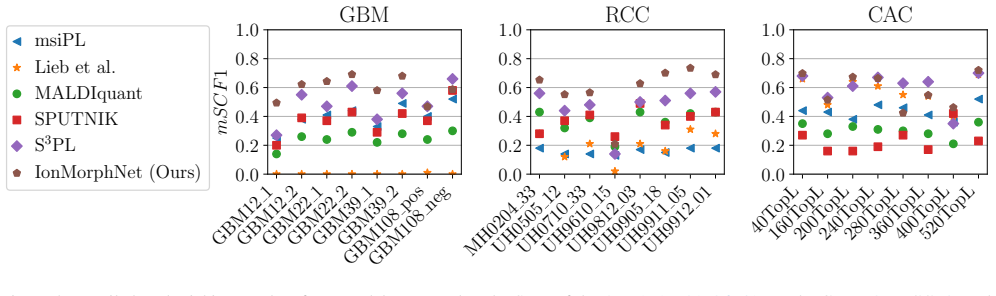
IonMorphNet is a spatial-structure-aware representation model trained to classify ion images into six structural classes from 53 MSI datasets; once trained, it performs fully data-driven peak picking without task-specific supervision or hyperparameter tuning and improves mSCF1 by 7 percent over state-of-the-art methods across multiple datasets.
What carries the argument
The six structural classes of ion image spatial patterns, used to supervise training of a ConvNeXt V2-Tiny backbone whose classifications then directly inform peak picking decisions.
Load-bearing premise
The six author-defined structural classes capture representative spatial patterns sufficient to generalize peak picking decisions across acquisition protocols and datasets without any task-specific supervision or further tuning.
What would settle it
Applying the trained model to a new MSI dataset with acquisition protocols and spatial patterns absent from the 53 training sets and finding that peak picking performance drops below or equals that of carefully tuned traditional methods.
Figures



read the original abstract
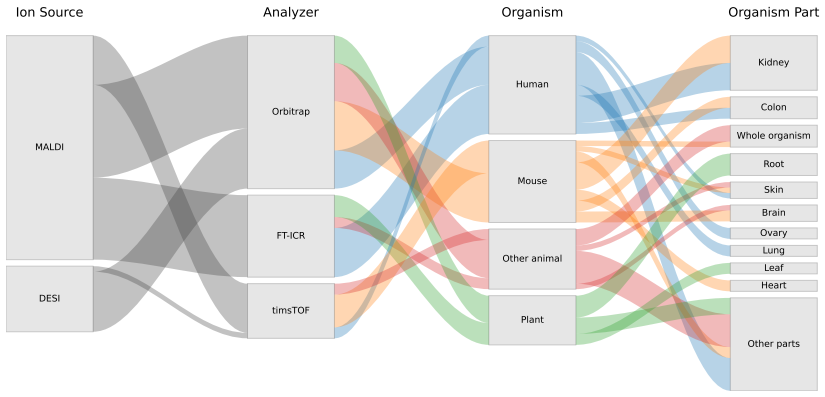
Peak picking is a fundamental preprocessing step in Mass Spectrometry Imaging (MSI), where each sample is represented by hundreds to thousands of ion images. Existing approaches require careful dataset-specific hyperparameter tuning, and often fail to generalize across acquisition protocols. We introduce IonMorphNet, a spatial-structure-aware representation model for ion images that enables fully data-driven peak picking without any task-specific supervision. We curate 53 publicly available MSI datasets and define six structural classes capturing representative spatial patterns in ion images to train standard image backbones for structural pattern classification. Once trained, IonMorphNet can assess ion images and perform peak picking without additional hyperparameter tuning. Using a ConvNeXt V2-Tiny backbone, our approach improves peak picking performance by +7 % mSCF1 compared to state-of-the-art methods across multiple datasets. Beyond peak picking, we demonstrate that spatially informed channel reduction enables a 3D CNN for patch-based tumor classification in MSI. This approach matches or exceeds pixel-wise spectral classifiers by up to +7.3 % Balanced Accuracy on three tumor classification tasks, indicating meaningful ion image selection. The source code and model weights are available at https://github.com/CeMOS-IS/IonMorphNet.
Editorial analysis
A structured set of objections, weighed in public.
Referee Report
Summary. The paper introduces IonMorphNet, a ConvNeXt V2-Tiny backbone trained to classify ion images from 53 public MSI datasets into six author-defined structural classes. It claims this enables fully data-driven peak picking without task-specific supervision or hyperparameter tuning, reporting a +7% mSCF1 improvement over state-of-the-art methods across multiple datasets. The work also shows that the learned representations support channel reduction for 3D CNN patch-based tumor classification, yielding up to +7.3% balanced accuracy gains on three tasks. Code and model weights are released publicly.
Significance. If the claims hold after addressing validation gaps, the work could meaningfully advance MSI preprocessing by replacing manual tuning with a generalizable learned model for peak picking. The public release of code and weights is a clear strength that aids reproducibility. The downstream tumor classification results suggest the spatial representations capture useful morphology beyond peak picking. Significance is currently moderated by the absence of key evaluation details needed to confirm the performance gains and generalization.
major comments (2)
- [Abstract] Abstract: The reported +7% mSCF1 and +7.3% balanced-accuracy gains supply no information on how the classification output is converted into peak decisions, which baselines were used, how many datasets were held out, or whether numbers include error bars or statistical tests. These omissions are load-bearing for the central claim of improved generalizable peak picking.
- [Abstract] Abstract and class definition: The six author-defined structural classes are manually curated without reported inter-rater reliability, correlation analysis to ground-truth peak lists, or ablation showing that misclassification in any class degrades mSCF1. This leaves the mapping from predicted class to keep/reject decisions as an unvalidated heuristic rather than a demonstrated generalizable rule across acquisition protocols.
minor comments (1)
- [Abstract] The abstract refers to 'state-of-the-art methods' without naming the specific baselines or citing their original papers.
Simulated Author's Rebuttal
We thank the referee for their constructive comments on our work. Below, we provide point-by-point responses to the major comments, clarifying aspects of the manuscript and outlining revisions to address the concerns.
read point-by-point responses
-
Referee: [Abstract] Abstract: The reported +7% mSCF1 and +7.3% balanced-accuracy gains supply no information on how the classification output is converted into peak decisions, which baselines were used, how many datasets were held out, or whether numbers include error bars or statistical tests. These omissions are load-bearing for the central claim of improved generalizable peak picking.
Authors: The abstract provides a high-level overview of the contributions, while the detailed explanations are presented in the main body of the paper. In the Methods section, we explain that the classification output is mapped to peak decisions using a fixed set of rules based on the predicted structural class, without requiring dataset-specific tuning. The baselines used are the current state-of-the-art peak picking methods, as described in the Experiments section. The evaluation involves training on a subset of the 53 datasets and testing on held-out datasets to assess generalizability. The reported performance gains are mean values across these test sets, with error bars and statistical analyses included in the results tables and figures. To improve the abstract's informativeness, we will revise it to briefly describe the peak decision process and evaluation setup. revision: yes
-
Referee: [Abstract] Abstract and class definition: The six author-defined structural classes are manually curated without reported inter-rater reliability, correlation analysis to ground-truth peak lists, or ablation showing that misclassification in any class degrades mSCF1. This leaves the mapping from predicted class to keep/reject decisions as an unvalidated heuristic rather than a demonstrated generalizable rule across acquisition protocols.
Authors: The six structural classes were defined by the authors to capture key spatial patterns observed in ion images from the curated datasets. These definitions are supported by visual examples throughout the paper. We did not report inter-rater reliability as the classes were developed through collaborative expert review by the authors. The effectiveness of the classes is validated through the improved peak picking performance, which serves as a proxy for correlation with ground-truth peak quality. We agree that an ablation study would be beneficial to show the impact of misclassifications; we will add such an analysis in the revised version to demonstrate that errors in certain classes affect mSCF1 as expected. This will help confirm the generalizability of the class-to-decision mapping across different acquisition protocols. revision: partial
Circularity Check
No significant circularity in derivation chain
full rationale
The paper curates 53 public MSI datasets, manually defines six structural classes as training labels, trains a standard ConvNeXt V2-Tiny classifier on those labels, and evaluates peak-picking performance (mSCF1) against external state-of-the-art baselines on multiple datasets. No equation, procedure, or self-citation reduces the reported performance gain to a fitted quantity on the evaluation data, a self-referential definition of the classes, or a load-bearing prior result from the same authors. The class taxonomy is an input to supervised training rather than an output derived from the model's peak-picking decisions, and the evaluation uses independent ground-truth peak lists.
Axiom & Free-Parameter Ledger
axioms (1)
- domain assumption Ion images from MSI can be meaningfully partitioned into six structural classes that represent their spatial patterns.
Reference graph
Works this paper leans on
-
[1]
Peak learning of mass spectrometry imaging data us- ing artificial neural networks.Nat
Walid M Abdelmoula, Begona Gimenez-Cassina Lopez, Elizabeth C Randall, Tina Kapur, Jann N Sarkaria, Forest M White, Jeffrey N Agar, William M Wells, and Nathalie YR Agar. Peak learning of mass spectrometry imaging data us- ing artificial neural networks.Nat. Commun., 12(1):5544,
-
[2]
Walid M Abdelmoula, Sylwia A Stopka, Elizabeth C Ran- dall, Michael Regan, Jeffrey N Agar, Jann N Sarkaria, William M Wells, Tina Kapur, and Nathalie YR Agar. mass- net: integrated processing and classification of spatially re- solved mass spectrometry data using deep learning for rapid tumor delineation.Bioinformatics, 38(7):2015–2021, 2022. 2, 3, 5, 6, 8
2015
-
[3]
Spatial probabilistic mapping of metabolite ensembles in mass spectrometry imaging.Nat
Denis Abu Sammour, James L Cairns, Tobias Boskamp, Christian Marsching, Tobias Kessler, Carina Ramallo Gue- vara, Verena Panitz, Ahmed Sadik, Jonas Cordes, Stefan Schmidt, et al. Spatial probabilistic mapping of metabolite ensembles in mass spectrometry imaging.Nat. Commun., 14 (1):1823, 2023. 1
2023
-
[4]
Testing for pres- ence of known and unknown molecules in imaging mass spectrometry.Bioinformatics, 29(18):2335–2342, 2013
Theodore Alexandrov and Andreas Bartels. Testing for pres- ence of known and unknown molecules in imaging mass spectrometry.Bioinformatics, 29(18):2335–2342, 2013. 1, 2
2013
-
[5]
Metaspace: A community-populated knowledge base of spatial metabolomes in health and dis- ease.BioRxiv, page 539478, 2019
Theodore Alexandrov, Katja Ovchinnikova, Andrew Palmer, Vitaly Kovalev, Artem Tarasov, Lachlan Stuart, Renat Nig- metzianov, Dominik Fay, Key METASPACE contributors, Mathieu Gaudin, et al. Metaspace: A community-populated knowledge base of spatial metabolomes in health and dis- ease.BioRxiv, page 539478, 2019. 3
2019
-
[6]
Adrian Arendowski. Matrix-and surface-assisted laser des- orption/ionization mass spectrometry methods for urological cancer biomarker discovery—metabolomics and lipidomics approaches.Metabolites, 14(3):173, 2024. 1
2024
-
[7]
Deep learn- ing for tumor classification in imaging mass spectrometry
Jens Behrmann, Christian Etmann, Tobias Boskamp, Rita Casadonte, J ¨org Kriegsmann, and Peter Maaβ. Deep learn- ing for tumor classification in imaging mass spectrometry. Bioinformatics, 34(7):1215–1223, 2018. 2, 3, 7
2018
-
[8]
Cardinalworkflows: Datasets and workflows for the cardinal mass spectrometry imaging package.R package version, 1(0), 2019
KA Bemis. Cardinalworkflows: Datasets and workflows for the cardinal mass spectrometry imaging package.R package version, 1(0), 2019. 3, 5, 6, 8
2019
-
[9]
Cardinal: an r package for sta- tistical analysis of mass spectrometry-based imaging experi- ments.Bioinformatics, 31(14):2418–2420, 2015
Kyle D Bemis, April Harry, Livia S Eberlin, Christina Ferreira, Stephanie M van de Ven, Parag Mallick, Mark Stolowitz, and Olga Vitek. Cardinal: an r package for sta- tistical analysis of mass spectrometry-based imaging experi- ments.Bioinformatics, 31(14):2418–2420, 2015. 1, 2
2015
-
[10]
Xception: Deep learning with depthwise separable convolutions
Franc ¸ois Chollet. Xception: Deep learning with depthwise separable convolutions. InProceedings of the IEEE con- ference on computer vision and pattern recognition, pages 1251–1258, 2017. 7
2017
-
[11]
pym2aia: Python interface for mass spectrometry imaging with focus on deep learning.Bioinformatics, 40(3):btae133,
Jonas Cordes, Thomas Enzlein, Carsten Hopf, and Ivo Wolf. pym2aia: Python interface for mass spectrometry imaging with focus on deep learning.Bioinformatics, 40(3):btae133,
-
[12]
Imagenet: A large-scale hierarchical image database
Jia Deng, Wei Dong, Richard Socher, Li-Jia Li, Kai Li, and Li Fei-Fei. Imagenet: A large-scale hierarchical image database. In2009 IEEE conference on computer vision and pattern recognition, pages 248–255. Ieee, 2009. 2, 3, 7
2009
-
[13]
Improved Regularization of Convolutional Neural Networks with Cutout
Terrance DeVries and Graham W Taylor. Improved regular- ization of convolutional neural networks with cutout.arXiv preprint arXiv:1708.04552, 2017. 4
work page internal anchor Pith review arXiv 2017
-
[14]
An Image is Worth 16x16 Words: Transformers for Image Recognition at Scale
Alexey Dosovitskiy, Lucas Beyer, Alexander Kolesnikov, Dirk Weissenborn, Xiaohua Zhai, Thomas Unterthiner, Mostafa Dehghani, Matthias Minderer, Georg Heigold, Syl- vain Gelly, et al. An image is worth 16x16 words: Trans- formers for image recognition at scale.arXiv preprint arXiv:2010.11929, 2020. 2
work page internal anchor Pith review Pith/arXiv arXiv 2010
-
[15]
Hannah Frank, Leon Amadeus Varga, and Andreas Zell. Hy- perspectral benchmark: Bridging the gap between hsi ap- plications through comprehensive dataset and pretraining. arXiv preprint arXiv:2309.11122, 2023. 7
-
[16]
A vision system for surface roughness char- acterization using the gray level co-occurrence matrix.NDT & e International, 37(7):577–588, 2004
ES Gadelmawla. A vision system for surface roughness char- acterization using the gray level co-occurrence matrix.NDT & e International, 37(7):577–588, 2004. 2
2004
-
[17]
Maldiquant: a ver- satile r package for the analysis of mass spectrometry data
Sebastian Gibb and Korbinian Strimmer. Maldiquant: a ver- satile r package for the analysis of mass spectrometry data. Bioinformatics, 28(17):2270–2271, 2012. 1, 2, 6, 8
2012
-
[18]
Deep multiple instance learning classifies subtissue locations in mass spectrometry images from tissue- level annotations.Bioinformatics, 36(Supplement 1):i300– i308, 2020
Dan Guo, Melanie Christine F ¨oll, Veronika V olkmann, Kathrin Enderle-Ammour, Peter Bronsert, Oliver Schilling, and Olga Vitek. Deep multiple instance learning classifies subtissue locations in mass spectrometry images from tissue- level annotations.Bioinformatics, 36(Supplement 1):i300– i308, 2020. 3
2020
-
[19]
Deep residual learning for image recognition
Kaiming He, Xiangyu Zhang, Shaoqing Ren, and Jian Sun. Deep residual learning for image recognition. InProceed- ings of the IEEE conference on computer vision and pattern recognition, pages 770–778, 2016. 7
2016
-
[20]
Deep learning and 3d-desi imaging reveal the hidden metabolic heterogeneity of cancer.Chem
Paolo Inglese, James S McKenzie, Anna Mroz, James Kinross, Kirill Veselkov, Elaine Holmes, Zoltan Takats, Jeremy K Nicholson, and Robert C Glen. Deep learning and 3d-desi imaging reveal the hidden metabolic heterogeneity of cancer.Chem. Sci., 8(5):3500–3511, 2017. 2, 3, 5, 6, 8
2017
-
[21]
Sputnik: an r package for fil- tering of spatially related peaks in mass spectrometry imag- ing data.Bioinformatics, 35(1):178–180, 2019
Paolo Inglese, Gonc ¸alo Correia, Zoltan Takats, Jeremy K Nicholson, and Robert C Glen. Sputnik: an r package for fil- tering of spatially related peaks in mass spectrometry imag- ing data.Bioinformatics, 35(1):178–180, 2019. 1, 2, 6
2019
-
[22]
Classification of pancreatic ductal adenocarcinoma using maldi mass spectrometry imaging combined with neu- ral networks.Cancers, 15(3):686, 2023
Frederic Kanter, Jan Lellmann, Herbert Thiele, Steve Kalloger, David F Schaeffer, Axel Wellmann, and Oliver Klein. Classification of pancreatic ductal adenocarcinoma using maldi mass spectrometry imaging combined with neu- ral networks.Cancers, 15(3):686, 2023. 2, 3, 7
2023
-
[23]
Auto-Encoding Variational Bayes
Diederik P Kingma. Auto-encoding variational bayes.arXiv preprint arXiv:1312.6114, 2013. 2
work page internal anchor Pith review Pith/arXiv arXiv 2013
-
[24]
Mass spectrometry imaging for reliable and fast classification of non-small cell lung cancer subtypes
Mark Kriegsmann, Christiane Zgorzelski, Rita Casadonte, Kristina Schwamborn, Thomas Muley, Hauke Winter, Mar- tin Eichhorn, Florian Eichhorn, Arne Warth, Soeren-Oliver Deininger, et al. Mass spectrometry imaging for reliable and fast classification of non-small cell lung cancer subtypes. Cancers, 12(9):2704, 2020. 2, 7
2020
-
[25]
Learning multiple layers of features from tiny images
Alex Krizhevsky, Geoffrey Hinton, et al. Learning multiple layers of features from tiny images. 2009. 3
2009
-
[26]
Peak detection for maldi mass spectrometry imaging data using sparse frame multipliers.J
Florian Lieb, Tobias Boskamp, and Hans-Georg Stark. Peak detection for maldi mass spectrometry imaging data using sparse frame multipliers.J. Proteomics, 225:103852, 2020. 1, 2, 6
2020
-
[27]
Microsoft coco: Common objects in context
Tsung-Yi Lin, Michael Maire, Serge Belongie, James Hays, Pietro Perona, Deva Ramanan, Piotr Doll´ar, and C Lawrence Zitnick. Microsoft coco: Common objects in context. In European conference on computer vision, pages 740–755. Springer, 2014. 3
2014
-
[28]
Swin transformer v2: Scaling up capacity and resolution
Ze Liu, Han Hu, Yutong Lin, Zhuliang Yao, Zhenda Xie, Yixuan Wei, Jia Ning, Yue Cao, Zheng Zhang, Li Dong, et al. Swin transformer v2: Scaling up capacity and resolution. In Proceedings of the IEEE/CVF conference on computer vi- sion and pattern recognition, pages 12009–12019, 2022. 7
2022
-
[29]
SGDR: Stochastic Gradient Descent with Warm Restarts
Ilya Loshchilov and Frank Hutter. Sgdr: Stochas- tic gradient descent with warm restarts.arXiv preprint arXiv:1608.03983, 2016. 5
work page internal anchor Pith review arXiv 2016
-
[30]
Fdr- controlled metabolite annotation for high-resolution imaging mass spectrometry.Nat
Andrew Palmer, Prasad Phapale, Ilya Chernyavsky, Regis Lavigne, Dominik Fay, Artem Tarasov, Vitaly Kovalev, Jens Fuchser, Sergey Nikolenko, Charles Pineau, et al. Fdr- controlled metabolite annotation for high-resolution imaging mass spectrometry.Nat. Methods, 14(1):57–60, 2017. 2
2017
-
[31]
Deep learning classifiers for hyperspec- tral imaging: A review.ISPRS Journal of Photogrammetry and Remote Sensing, 158:279–317, 2019
Mercedes Eugenia Paoletti, Juan Mario Haut, Javier Plaza, and Antonio Plaza. Deep learning classifiers for hyperspec- tral imaging: A review.ISPRS Journal of Photogrammetry and Remote Sensing, 158:279–317, 2019. 7, 8
2019
-
[32]
Karl Pearson. Liii. on lines and planes of closest fit to sys- tems of points in space.The London, Edinburgh, and Dublin philosophical magazine and journal of science, 2(11):559– 572, 1901. 2
1901
-
[33]
Learning transferable visual models from natural language supervi- sion
Alec Radford, Jong Wook Kim, Chris Hallacy, Aditya Ramesh, Gabriel Goh, Sandhini Agarwal, Girish Sastry, Amanda Askell, Pamela Mishkin, Jack Clark, et al. Learning transferable visual models from natural language supervi- sion. InInternational conference on machine learning, pages 8748–8763. PmLR, 2021. 2
2021
-
[34]
Miriam F Rittel, Nikolas Ebert, Denis Abu Sammour, Se- bastian Graf, Bj ¨orn C Fr ¨ohlich, Emrullah Birgin, Shad A Mohammed, Nuh N Rahbari, Axel Wellmann, Oliver Wasenm¨uller, et al. Cohort-scale spatial autocorrelation for tumor prediction in mid-infrared pathology and spatial biomarker discovery using maldi imaging lipidomics.Ad- vanced Science, page e1...
2026
-
[35]
Advanced maldi mass spectrom- etry imaging in pharmaceutical research and drug develop- ment.Curr
Sandra Schulz, Michael Becker, M Reid Groseclose, Simone Schadt, and Carsten Hopf. Advanced maldi mass spectrom- etry imaging in pharmaceutical research and drug develop- ment.Curr. Opin. Biotechnol., 55:51–59, 2019. 1
2019
-
[36]
Oriane Sim ´eoni, Huy V V o, Maximilian Seitzer, Federico Baldassarre, Maxime Oquab, Cijo Jose, Vasil Khalidov, Marc Szafraniec, Seungeun Yi, Micha ¨el Ramamonjisoa, et al. Dinov3.arXiv preprint arXiv:2508.10104, 2025. 2, 7
work page internal anchor Pith review Pith/arXiv arXiv 2025
-
[37]
Dropout: a simple way to prevent neural networks from overfitting.The journal of machine learning research, 15(1):1929–1958, 2014
Nitish Srivastava, Geoffrey Hinton, Alex Krizhevsky, Ilya Sutskever, and Ruslan Salakhutdinov. Dropout: a simple way to prevent neural networks from overfitting.The journal of machine learning research, 15(1):1929–1958, 2014. 5
1929
-
[38]
Efficientnet: Rethinking model scaling for convolutional neural networks
Mingxing Tan and Quoc Le. Efficientnet: Rethinking model scaling for convolutional neural networks. InInternational conference on machine learning, pages 6105–6114. PMLR,
-
[39]
Training data-efficient image transformers & distillation through at- tention
Hugo Touvron, Matthieu Cord, Matthijs Douze, Francisco Massa, Alexandre Sablayrolles, and Herv ´e J´egou. Training data-efficient image transformers & distillation through at- tention. InInternational conference on machine learning, pages 10347–10357. PMLR, 2021. 7
2021
-
[40]
Pvt v2: Improved baselines with pyramid vision transformer
Wenhai Wang, Enze Xie, Xiang Li, Deng-Ping Fan, Kaitao Song, Ding Liang, Tong Lu, Ping Luo, and Ling Shao. Pvt v2: Improved baselines with pyramid vision transformer. Computational visual media, 8(3):415–424, 2022. 7
2022
-
[41]
Mohammed, De- nis Abu Sammour, Carsten Hopf, and Oliver Wasenm ¨uller
Philipp Weigand, Nikolas Ebert, Shad A. Mohammed, De- nis Abu Sammour, Carsten Hopf, and Oliver Wasenm ¨uller. Spatial self-supervised peak learning and correlation-based evaluation of peak picking in mass spectrometry imaging. arXiv preprint arXiv:2603.10487, 2026. 1, 2, 5, 6
-
[42]
Pytorch image models.https : / / github
Ross Wightman. Pytorch image models.https : / / github . com / rwightman / pytorch - image - models, 2019. 5
2019
-
[43]
Exims: an improved data analysis pipeline based on a new peak picking method for exploring imaging mass spectrometry data.Bioinformat- ics, 31(19):3198–3206, 2015
Chalini D Wijetunge, Isaam Saeed, Berin A Boughton, Jef- frey M Spraggins, Richard M Caprioli, Antony Bacic, Ute Roessner, and Saman K Halgamuge. Exims: an improved data analysis pipeline based on a new peak picking method for exploring imaging mass spectrometry data.Bioinformat- ics, 31(19):3198–3206, 2015. 2
2015
-
[44]
Con- vnext v2: Co-designing and scaling convnets with masked autoencoders
Sanghyun Woo, Shoubhik Debnath, Ronghang Hu, Xinlei Chen, Zhuang Liu, In So Kweon, and Saining Xie. Con- vnext v2: Co-designing and scaling convnets with masked autoencoders. InProceedings of the IEEE/CVF conference on computer vision and pattern recognition, pages 16133– 16142, 2023. 7
2023
-
[45]
Cutmix: Regu- larization strategy to train strong classifiers with localizable features
Sangdoo Yun, Dongyoon Han, Seong Joon Oh, Sanghyuk Chun, Junsuk Choe, and Youngjoon Yoo. Cutmix: Regu- larization strategy to train strong classifiers with localizable features. InProceedings of the IEEE/CVF international con- ference on computer vision, pages 6023–6032, 2019. 4
2019
discussion (0)
Sign in with ORCID, Apple, or X to comment. Anyone can read and Pith papers without signing in.