Recognition: unknown
Wildfires Quasi-Implicit Alternative-Direction Simulations using Isogeometric Finite Element Method
Pith reviewed 2026-05-10 01:16 UTC · model grok-4.3
The pith
A quasi-implicit direction-splitting scheme for isogeometric wildfire simulations achieves ten times higher accuracy than standard approaches.
A machine-rendered reading of the paper's core claim, the machinery that carries it, and where it could break.
Core claim
We develop quasi-implicit time integration schemes using direction splitting of the differential operators for the energy balance equation, including Peaceman-Rachford and Strang splitting with the Crank-Nicolson method. Non-linear terms are treated explicitly, and stability analysis establishes that the resulting scheme delivers ten times higher simulation accuracy. Two real wildfire cases are simulated and compared to satellite imagery and measurement records, alongside a comparison to the FARSITE model, with the sequential implementation exhibiting linear O(N) cost and demonstrated parallel scalability.
What carries the argument
Quasi-implicit direction splitting (Peaceman-Rachford and Strang methods) applied to the variational formulation of the temperature energy balance equation within an isogeometric finite element discretization, with explicit treatment of nonlinear terms and exploitation of Kronecker product matrix structure.
If this is right
- Higher-accuracy forecasts become feasible for events such as the 2024 Valparaíso and 2019 Las Palmas fires without a corresponding rise in computational expense.
- The linear O(N) cost and parallel scalability support deployment on standard workstations for domain-scale runs.
- Direct numerical comparison to satellite imagery and the FARSITE model becomes a repeatable validation step for operational use.
- The Kronecker structure of the discrete operators enables efficient assembly and solution for large three-dimensional domains.
Where Pith is reading between the lines
- The same splitting approach could be tested on related heat-transfer problems with nonlinear sources, such as controlled burns or industrial combustion chambers, to check transferability.
- Coupling the temperature field to a separate vegetation or wind model might allow the framework to evolve fire-front propagation dynamically rather than prescribing it.
- The explicit nonlinear treatment opens a route to adaptive time-step control that adjusts step size locally based on local heat-generation intensity.
Load-bearing premise
Explicit treatment of the nonlinear terms in the energy balance equation maintains stability and does not introduce errors that reduce the claimed accuracy gain when the scheme is applied to measured wildfire data.
What would settle it
A side-by-side error comparison on a controlled benchmark fire with recorded temperature time series, measuring whether the quasi-implicit scheme produces at least a factor-of-ten reduction in deviation from observations relative to a standard explicit or fully implicit baseline.
Figures









read the original abstract
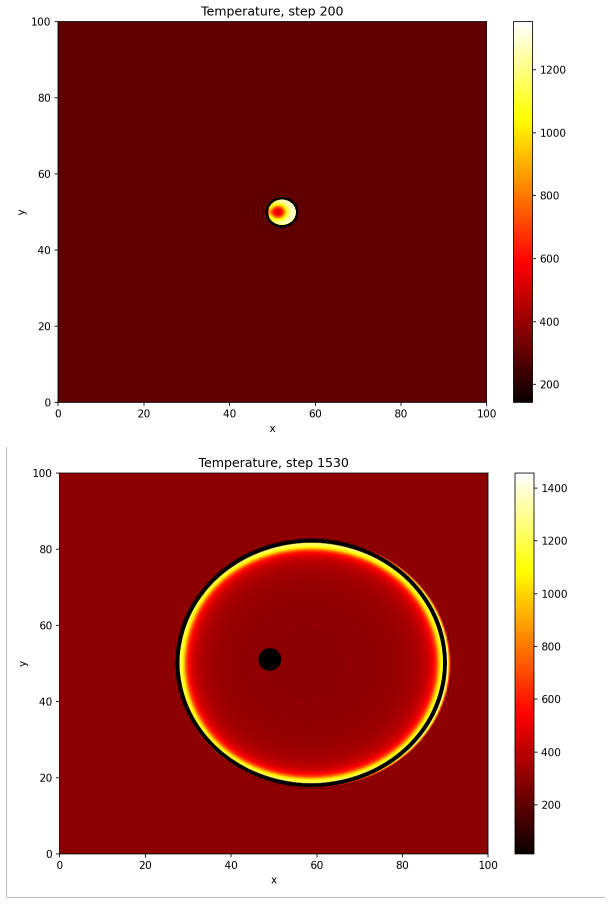
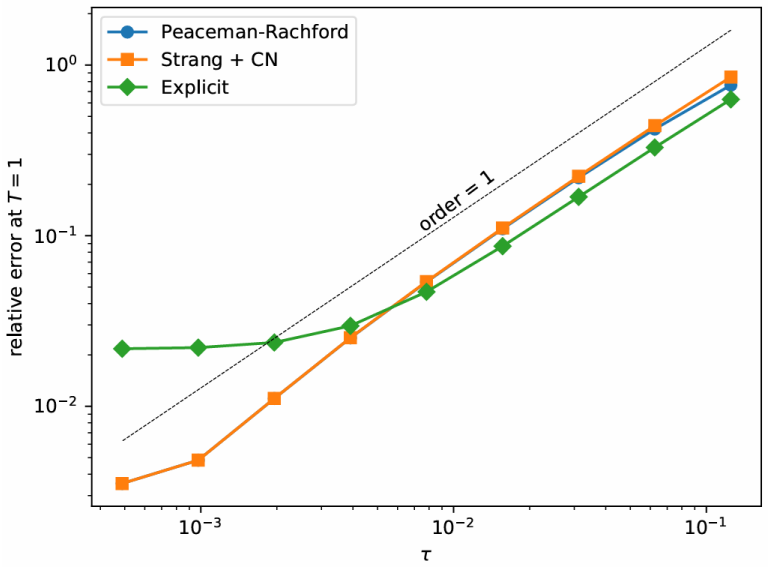
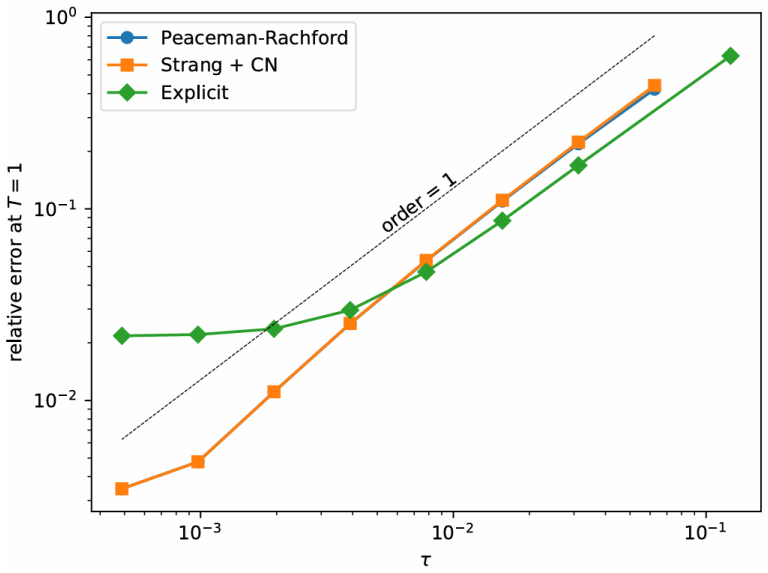
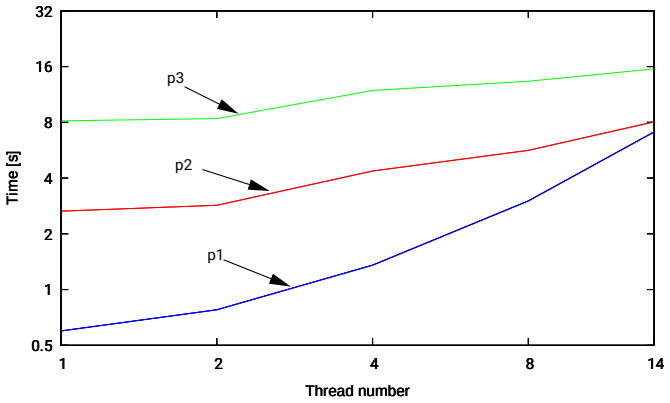
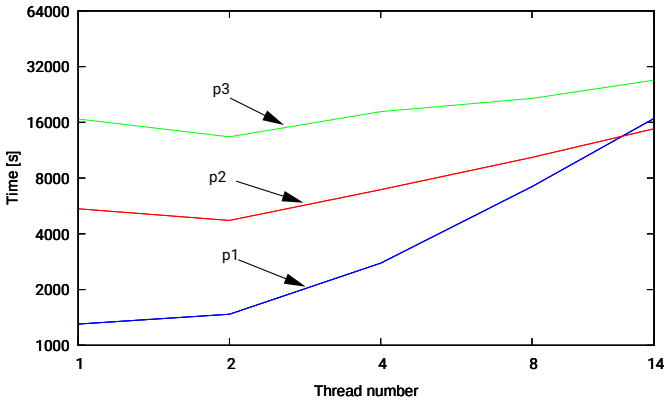
We develop a wildfire simulation model that evolves the temperature scalar field using an energy balance equation accounting for heat generation, transport, and loss. For these equations, we develop quasi-implicit time integration schemes using direction splitting of the differential operators. We use the Peaceman-Rachford and Strang splitting methods, including the Crank-Nicolson method. Based on these discretizations, we derive variational formulations and explore the Kronecker product structure of the matrices. In the wildfire model, there are some non-linear terms that we treat explicitly. We perform a detailed analysis of how treating these terms affects the stability of the time integration scheme. Namely, we show that a quasi-implicit time integration scheme achieves 10 times higher simulation accuracy. We present two wildfire simulations. The first is a simulation of the 2024 wildfire disaster in the Valpara\'iso region of Chile. The second one is a simulation of the 2019 wildfire disaster in Las Palmas de Gran Canaria, Spain. We discuss the numerical results and compare them against satellite images and measurement records. We also present a numerical experiment for comparison with the state-of-the-art wildfire simulation model FARSITE. Our sequential code has a linear computational cost of ${\cal O}(N)$. We also present the parallel scalability of the WILDFIRE-IGA-ADS code to illustrate the possibility of running the code on a local workstation.
Editorial analysis
A structured set of objections, weighed in public.
Referee Report
Summary. The paper claims to develop a wildfire simulation model evolving the temperature field via an energy balance equation, using quasi-implicit time integration with Peaceman-Rachford and Strang splitting methods combined with Crank-Nicolson, treating nonlinear terms explicitly. It derives variational forms exploiting Kronecker structure, performs stability analysis demonstrating 10 times higher accuracy, and validates on real events (2024 Valparaíso, Chile and 2019 Las Palmas, Spain) against satellite images, measurements, and FARSITE, with O(N) cost and parallel scalability shown.
Significance. Assuming the stability analysis and accuracy gains are substantiated by the numerical experiments, this work offers a promising approach for efficient and accurate wildfire modeling in computational engineering. The combination of isogeometric analysis with alternating direction splitting for handling the energy balance, along with real-world event simulations and comparisons, provides practical value. The linear complexity and demonstrated scalability are notable strengths for large-scale simulations.
major comments (1)
- [Stability analysis section] Stability analysis section: the central claim that the quasi-implicit scheme achieves 10 times higher simulation accuracy requires explicit definition of the accuracy metric (e.g., L2 temperature error or burned-area overlap) and the baseline (e.g., fully explicit scheme or FARSITE) together with the numerical values from the real-event comparisons that establish the factor of 10.
minor comments (3)
- [Abstract] Abstract: the 10-times accuracy statement would be clearer if it briefly indicated the error metric and baseline used in the comparisons.
- [Numerical results sections] Numerical results sections: tables or figures comparing the proposed method to FARSITE and satellite data should include the exact quantitative error values supporting the accuracy claim.
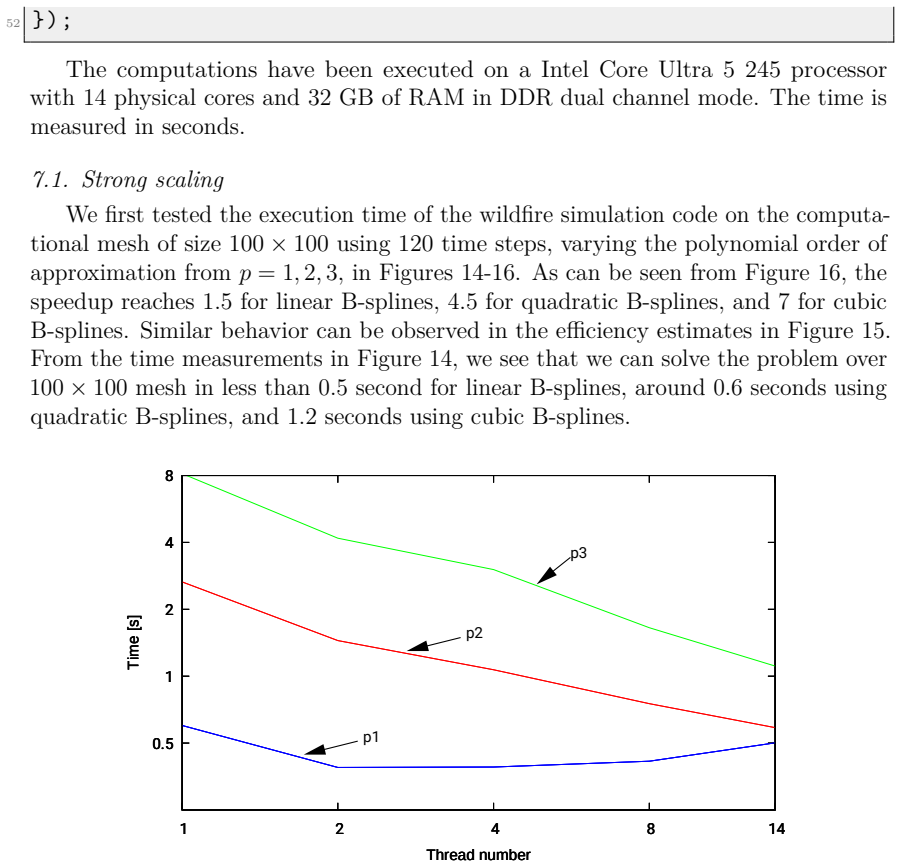
- [Implementation] Implementation: the O(N) complexity and parallel scalability claims are useful, but a table listing wall-clock times or speedups for increasing core counts would strengthen the presentation.
Simulated Author's Rebuttal
We thank the referee for the constructive feedback and the recommendation of minor revision. We address the single major comment below and will update the manuscript accordingly.
read point-by-point responses
-
Referee: Stability analysis section: the central claim that the quasi-implicit scheme achieves 10 times higher simulation accuracy requires explicit definition of the accuracy metric (e.g., L2 temperature error or burned-area overlap) and the baseline (e.g., fully explicit scheme or FARSITE) together with the numerical values from the real-event comparisons that establish the factor of 10.
Authors: We agree that the accuracy metric, baseline, and supporting numerical values should be stated more explicitly. In the stability analysis section the accuracy metric is the L2 norm of the temperature error relative to a reference solution obtained from a fully explicit scheme with a sufficiently small time step; the baseline is this fully explicit scheme. The factor-of-10 improvement is quantified on the two real-event test cases (Valparaíso 2024 and Las Palmas 2019) by comparing the L2 temperature error for equivalent computational effort. In the revised manuscript we will add a dedicated paragraph that (i) defines the L2 metric, (ii) identifies the fully explicit baseline, and (iii) reports the concrete error ratios (approximately 10× reduction) obtained from those simulations. No change to the underlying analysis or results is required. revision: yes
Circularity Check
No significant circularity; derivations and accuracy claims are externally grounded
full rationale
The paper's core chain starts from the energy balance PDE, applies standard Peaceman-Rachford/Strang + Crank-Nicolson splitting with explicit nonlinear terms, derives variational forms, exploits Kronecker structure, and conducts stability analysis. The claimed 10x accuracy gain is shown via numerical experiments on the 2024 Valparaíso and 2019 Las Palmas events, validated directly against satellite imagery, measurement records, and FARSITE comparisons. These steps rely on established methods and external data rather than self-definition, fitted inputs renamed as predictions, or load-bearing self-citations. The derivation remains self-contained against independent benchmarks.
Axiom & Free-Parameter Ledger
free parameters (1)
- heat generation and loss coefficients
axioms (1)
- domain assumption Temperature evolution is governed by an energy balance equation that includes heat generation, transport, and loss.
Reference graph
Works this paper leans on
-
[1]
McGrattan, S
K. McGrattan, S. Hostikka, R. McDermott, J. Floyd, C. Weinschenk, K. Overholt, Fire dynamics simulator user’s guide, NIST special publication 1019 (6) (2013) 1–339
2013
-
[2]
Cunningham, R
P. Cunningham, R. R. Linn, Numerical simulations of grass fires using a coupled atmosphere-fire model: Dynamics of fire spread, Journal of Geophysical Research: Atmospheres 112 (D5) (2007)
2007
-
[3]
W. Mell, M. A. Jenkins, J. Gould, P. Cheney, A physics-based approach to modelling grassland fires, International Journal of Wildland Fire 16 (1) (2007) 1–22
2007
-
[4]
R. C. Rothermel, A mathematical model for predicting fire spread in wildland fuels, Vol. 115, Intermountain Forest & Range Experiment Station, Forest Service, US …, 1972. 38 640 1280 2560 5120 10240 20480 1 2 4 8 14 Time [s] Thread number 640 1280 2560 5120 10240 20480 1 2 4 8 14 Time [s] Thread number 640 1280 2560 5120 10240 20480 1 2 4 8 14 Time [s] ...
1972
-
[5]
M. A. Finney, FARSITE, Fire Area Simulator–model development and evaluation, no. 4, The Station, 1998
1998
-
[6]
J. Mandel, J. D. Beezley, A. K. Kochanski, Coupled atmosphere–wildland fire modeling with wrf-fire, Computers & Mathematics with Applications 65 (11) (2013) 1684–1696. doi:10.1016/j.camwa.2013.03.013
-
[7]
Parisien, V
M.-A. Parisien, V. Kafka, K. Hirsch, B. Todd, P. Lavoie, P. Maczek, Burn-p3: wildland fire burn probability simulation model, Information Report LA-X-128. Edmonton, AB: Natural Resources Canada, Canadian Forest Service, Northern Forestry Centre (2005)
2005
-
[8]
S. Erni, X. Wang, T. Swystun, S. W. Taylor, M.-A. Parisien, F.-N. Robinne, B. Eddy, J. Oliver, B. Armitage, M. D. Flannigan, Map- ping wildfire hazard, vulnerability, and risk to canadian communities, International Journal of Disaster Risk Reduction 101 (2024) 104221. doi:https://doi.org/10.1016/j.ijdrr.2023.104221. URL https://www.sciencedirect.com/scien...
-
[9]
International, Firecast: Global wildfire forecasting using deep learning 39 Figure 21: Efficiency of 1080 time steps of the wildfire simulation over1500×1500computational mesh
C. International, Firecast: Global wildfire forecasting using deep learning 39 Figure 21: Efficiency of 1080 time steps of the wildfire simulation over1500×1500computational mesh. and remote sensing, available online athttps://firecast.conservation.org/ (2023)
2023
-
[10]
J. L. Coen, M. Cameron, J. Michalakes, E. G. Patton, P. J. Riggan, K. M. Yedinak, Wrf-fire: Coupled weather–wildland fire modeling with the weather research and forecasting model, Journal of Applied Meteorology and Climatology 52 (1) (2013) 16–38. doi:10.1175/JAMC-D-12-023.1
-
[11]
J. L. Coen, Simulation of the big elk fire using coupled atmosphere–fire modeling, International Journal of Wildland Fire 14 (1) (2005) 49–59. doi:10.1071/WF04047
-
[12]
A. K. Kochanski, M. A. Jenkins, J. Mandel, J. D. Beezley, S. Krueger, Real time simulation of 2007 Santa Ana fires, Forest Ecology and Management 294 (2013) 136–149. doi:10.1016/j.foreco.2012.12.014
-
[13]
R. R. Linn, J. Reisner, J. J. Colman, J. Winterkamp, Studying wildfire behavior using FIRETEC, International Journal of Wildland Fire 11 (4) (2002) 233–246
2002
-
[14]
W. Mell, M. A. Jenkins, J. Gould, P. Cheney, A physics-based approach to modelling grassland fires, International Journal of Wildland Fire 16 (1) (2007) 1–22. doi:10.1071/WF06002. 40 1 2 4 8 1 2 4 8 14 Speedup Thread number 1 2 4 8 1 2 4 8 14 Speedup Thread number 1 2 4 8 1 2 4 8 14 Speedup Thread number p1 p2 p3 Figure 22: Speedup of 1080 time steps of t...
-
[15]
M. Raissi, P. Perdikaris, G. E. Karniadakis, Physics-informed neural networks: A deep learning framework for solving forward and inverse problems involving nonlinear partial differential equations, Journal of Computational Physics 378 (2019) 686–707. doi:10.1016/j.jcp.2018.10.045
-
[16]
P. Grasso, M. S. Innocente, Physics-based model of wildfire propagation towards faster-than-real-time simulations, Computers & Mathematics with Applications 80 (5) (2020) 790–808. doi:10.1016/j.camwa.2020.05.009
-
[17]
Computer Methods in Applied Mechanics and Engineering194(39–41), 4135–4195 (2005) https://doi
T. Hughes, J. Cottrell, Y. Bazilevs, Isogeometric analysis: CAD, finite elements, NURBS, exact geometry and mesh refinement, Computer Meth- ods in Applied Mechanics and Engineering 194 (39) (2005) 4135–4195. doi:https://doi.org/10.1016/j.cma.2004.10.008. URL https://www.sciencedirect.com/science/article/pii/ S0045782504005171
-
[18]
M. Łoś, M. Paszyński, A. Kłusek, W. Dzwinel, Application of fast isogeometric l2 projectionsolverfortumorgrowthsimulations, ComputerMethodsinAppliedMe- chanics and Engineering 316 (2017) 1257–1269, special Issue on Isogeometric Anal- ysis: Progress and Challenges. doi:https://doi.org/10.1016/j.cma.2016.12.039. 41 0.5 1 2 4 8 16 32 1 2 4 8 14 Time [s] Thre...
-
[19]
M. Łoś, A. Kłusek, M. A. Hassaan, K. Pingali, W. Dzwinel, M. Paszyński, Parallel fast isogeometric l2 projection solver with galois system for 3d tumor growth simulations, Computer Methods in Applied Mechanics and Engineering 343 (2019) 1–22. doi:https://doi.org/10.1016/j.cma.2018.08.036. URL https://www.sciencedirect.com/science/article/pii/ S0045782518304341
-
[20]
M. Łoś, L. Siwik, M. Woźniak, D. Gryboś, P. Maczuga, A. Oliver-Serra, J. Leszczyński, M. Paszyński, Shock waves generators: From prevention of hail storms to reduction of the smog in urban areas — experimental verification and numerical simulations, Journal of Computational Science 77 (2024) 102238. doi:https://doi.org/10.1016/j.jocs.2024.102238. URL http...
-
[21]
M. Łoś, M. Woźniak, K. Pingali, L. E. G. Castillo, J. Alvarez-Aramberri, D. Pardo, M. Paszyński, Fast parallel iga-ads solver for time-dependent maxwell’s equations, Computers & Mathematics with Applications 151 (2023) 36–49. doi:https://doi.org/10.1016/j.camwa.2023.09.035. 42 125 250 500 1000 2000 4000 8000 1 2 4 8 14 Time [s] Thread number 125 250 500 1...
-
[22]
T. W. Sederberg, J. Zheng, A. Bakenov, A. Nasri, T-splines and t-nurccs, ACM Trans. Graph. 22 (3) (2003) 477–484. doi:10.1145/882262.882295. URLhttps://doi.org/10.1145/882262.882295
-
[23]
T. W. Sederberg, D. L. Cardon, G. T. Finnigan, N. S. North, J. Zheng, T. Lyche, T-spline simplification and local refinement, ACM Trans. Graph. 23 (3) (2004) 276–283. doi:10.1145/1015706.1015715. URLhttps://doi.org/10.1145/1015706.1015715
-
[24]
M. Scott, X. Li, T. Sederberg, T. Hughes, Local refinement of analysis-suitable t-splines, Computer Methods in Applied Mechanics and Engineering 213-216 (2012) 206–222. doi:https://doi.org/10.1016/j.cma.2011.11.022. URL https://www.sciencedirect.com/science/article/pii/ S0045782511003689
-
[25]
X. Wei, Y. Zhang, L. Liu, T. J. Hughes, Truncated t-splines: Fundamentals and methods, Computer Methods in Applied Mechanics and Engineering 316 (2017) 349–372, special Issue on Isogeometric Analysis: Progress and Challenges. doi:https://doi.org/10.1016/j.cma.2016.07.020. 43 1000 2000 4000 8000 16000 32000 64000 1 2 4 8 14 Time [s] Thread number 1000 2000...
-
[26]
A.-V. Vuong, C. Giannelli, B. Jüttler, B. Simeon, A hierarchical approach to adaptive local refinement in isogeometric analysis, Computer Meth- ods in Applied Mechanics and Engineering 200 (49) (2011) 3554–3567. doi:https://doi.org/10.1016/j.cma.2011.09.004. URL https://www.sciencedirect.com/science/article/pii/ S0045782511002933
-
[27]
P. Bornemann, F. Cirak, A subdivision-based implementation of the hierarchical b-spline finite element method, Computer Methods in Applied Mechanics and Engineering 253 (2013) 584–598. doi:https://doi.org/10.1016/j.cma.2012.06.023. URL https://www.sciencedirect.com/science/article/pii/ S0045782512002204
-
[28]
C. Giannelli, B. Jüttler, H. Speleers, Thb-splines: The truncated basis for hierarchical splines, Computer Aided Geometric Design 29 (7) (2012) 485–498, geometric Modeling and Processing 2012. doi:https://doi.org/10.1016/j.cagd.2012.03.025. URL https://www.sciencedirect.com/science/article/pii/ S0167839612000519 44
-
[29]
T. Dokken, T. Lyche, K. F. Pettersen, Polynomial splines over locally refined box-partitions, Computer Aided Geometric Design 30 (3) (2013) 331–356. doi:https://doi.org/10.1016/j.cagd.2012.12.005. URL https://www.sciencedirect.com/science/article/pii/ S0167839613000113
-
[30]
K. A. Johannessen, T. Kvamsdal, T. Dokken, Isogeometric analysis using lr b-splines, Computer Methods in Applied Mechanics and Engineering 269 (2014) 471–514. doi:https://doi.org/10.1016/j.cma.2013.09.014. URL https://www.sciencedirect.com/science/article/pii/ S0045782513002417
-
[31]
D. Burkhart, B. Hamann, G. Umlauf, Iso-geometric finite element analysis based on catmull-clark : ubdivision solids, Computer Graphics Forum 29 (5) (2010) 1575–1584. arXiv:https://onlinelibrary.wiley.com/doi/pdf/10.1111/j.1467- 8659.2010.01766.x, doi:https://doi.org/10.1111/j.1467-8659.2010.01766.x. URL https://onlinelibrary.wiley.com/doi/abs/10.1111/j.14...
-
[32]
doi:https://doi.org/10.1016/j.cma.2015.03.019
X.Wei, Y.Zhang, T.J.Hughes, M.A.Scott, Truncatedhierarchicalcatmull–clark subdivision with local refinement, Computer Methods in Applied Mechanics and Engineering 291 (2015) 1–20. doi:https://doi.org/10.1016/j.cma.2015.03.019. URL https://www.sciencedirect.com/science/article/pii/ S0045782515001292
-
[33]
M. Łoś, J. Muñoz-Matute, I. Muga, M. Paszyński, Isogeometric residual minimization method (iGRM) with direction splitting for non-stationary advection–diffusion problems, Computers & Mathematics with Applications 79 (2) (2020) 213–229. doi:https://doi.org/10.1016/j.camwa.2019.06.023. URL https://www.sciencedirect.com/science/article/pii/ S0898122119303268
-
[34]
M. Łoś, I. Muga, J. Muñoz-Matute, M. Paszyński, Isogeometric residual minimization (igrm) for non-stationary stokes and navier–stokes problems, Computers & Mathematics with Applications 95 (2021) 200–214, recent Advances in Least-Squares and Discontinuous Petrov–Galerkin Finite Element Methods. doi:https://doi.org/10.1016/j.camwa.2020.11.013. URL https://...
-
[35]
M. M. Łoś, M. Woźniak, M. Paszyński, A. Lenharth, M. A. Hassaan, K. Pingali, IGA-ADS: Isogeometric analysis FEM using ADS solver, Computer Physics Com- munications 217 (2017) 99–116. doi:https://doi.org/10.1016/j.cpc.2017.02.023. URL https://www.sciencedirect.com/science/article/pii/ S0010465517300759
-
[36]
C. Varadachari, R. Bhowmick, Ab initio derivation of a dataset of real tempera- ture thermodynamic properties: Case study with sic., Modelling and Simulation in Materials Science and Engineering 17 (075006) (2009). URLhttps://doi.org/10.1088/0965-0393/17/7/075006
-
[37]
URL https://www.cnnbrasil.com.br/internacional/ veja-imagens-de-satelite-que-mostram-o-chile-antes-e-depois-dos-incendios
Reuters: Veja imagens de satelite que mostram o chile antes e depois dos incendios. URL https://www.cnnbrasil.com.br/internacional/ veja-imagens-de-satelite-que-mostram-o-chile-antes-e-depois-dos-incendios
-
[38]
URL https://www.esa.int/ESA\_Multimedia/Images/2019/08/Gran\ _Canaria\_wildfire
Gran canaria wildfire. URL https://www.esa.int/ESA\_Multimedia/Images/2019/08/Gran\ _Canaria\_wildfire
2019
-
[39]
URL https://www.ssec.wisc.edu/jpss-sdoc/posts/ gran-canaria-wildfires-from-17-20-august-2019/ gran-canaria-wildfires-from-17-19-august/
Gran canaria wildfires from 17-19 august 2019. URL https://www.ssec.wisc.edu/jpss-sdoc/posts/ gran-canaria-wildfires-from-17-20-august-2019/ gran-canaria-wildfires-from-17-19-august/
2019
-
[40]
URL https://www.ssec.wisc.edu/jpss-sdoc/posts/ gran-canaria-wildfires-from-17-20-august-2019/ gran-canaria-wildfires-from-20-august-2019/
Gran canaria wildfires from 20 august 2019. URL https://www.ssec.wisc.edu/jpss-sdoc/posts/ gran-canaria-wildfires-from-17-20-august-2019/ gran-canaria-wildfires-from-20-august-2019/
2019
-
[41]
URL https://english.elpais.com/elpais/2019/08/20/inenglish/ 1566290307\_496306.html
Wildfire in Gran Canaria worst to hit Spain in six years. URL https://english.elpais.com/elpais/2019/08/20/inenglish/ 1566290307\_496306.html
2019
-
[42]
Kharazmi, Z
E. Kharazmi, Z. Zhang, G. E. Karniadakis, hp-vpinns: Variational physics- informed neural networks with domain decomposition, Computer Methods in Applied Mechanics and Engineering 374 (2021) 113547
2021
-
[43]
M.Łoś, T.Służalec, P.Maczuga, A.Vilkha, C.Uriarte, M.Paszyński, Collocation- based robust variational physics-informed neural networks (CRVPINNs), Com- puters & Structures 316 (2025) 107839. 46
2025
discussion (0)
Sign in with ORCID, Apple, or X to comment. Anyone can read and Pith papers without signing in.