Recognition: unknown
Suffix Random Access via Function Inversion: A Key for Asymmetric Streaming String Algorithms
Pith reviewed 2026-05-10 01:41 UTC · model grok-4.3
The pith
A bidirectional reduction between suffix random access and function inversion enables asymmetric streaming algorithms for string problems.
A machine-rendered reading of the paper's core claim, the machinery that carries it, and where it could break.
Core claim
We show a bidirectional reduction between suffix random access and function inversion, a central problem in cryptography. On the way we propose a variant of the string synchronizing sets with a local sparsity condition that admits an efficient streaming construction algorithm. This framework reduces fundamental string problems in the asymmetric streaming model to the online read-only model, yielding algorithms for exact and approximate pattern matching under Hamming and edit distances as well as relative Lempel-Ziv compression.
What carries the argument
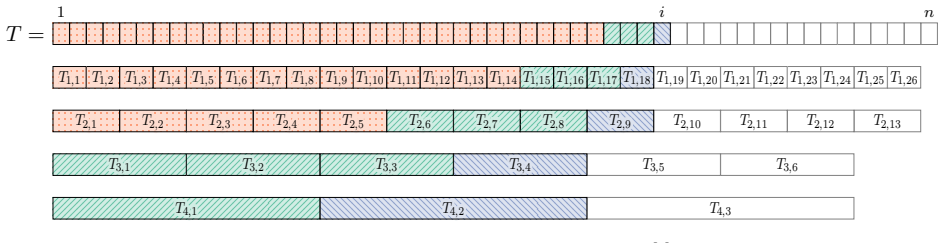
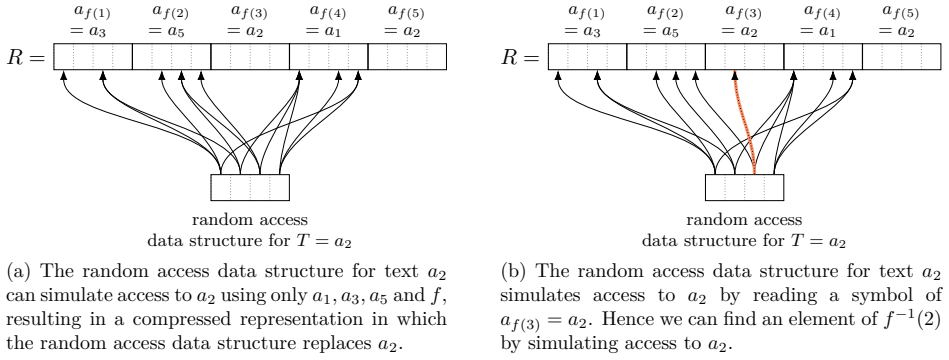
The suffix random access data structure, which maintains constant-time random access to the longest suffix of the seen prefix of the text that occurs in the reference string, realized through reduction to a function-inversion oracle.
If this is right
- Exact pattern matching becomes possible in the asymmetric streaming model with sublinear space.
- Approximate pattern matching under Hamming distance obtains improved bounds via the same reduction.
- Approximate pattern matching under edit distance obtains improved bounds via the same reduction.
- Relative Lempel-Ziv compression admits an efficient asymmetric streaming solution.
- Any future improvement to function inversion directly improves the string algorithms in this model.
Where Pith is reading between the lines
- Hardness results for function inversion would translate into limitations on the power of asymmetric streaming for string problems.
- The locally sparse synchronizing sets may apply to other streaming string tasks that currently lack sublinear-space solutions.
- The reduction suggests a route for importing further cryptographic primitives into streaming string algorithms.
Load-bearing premise
That locally sparse string synchronizing sets can be built in one streaming pass with sublinear space and that the function-inversion oracle can be implemented to achieve the claimed time bounds in the asymmetric model.
What would settle it
An input text and reference pair on which no sublinear-space single-pass streaming algorithm exists for the locally sparse synchronizing sets, or on which the derived algorithms exceed the stated time bounds.
Figures


read the original abstract
Many string processing problems can be phrased in the streaming setting, where the input arrives symbol by symbol and we have sublinear working space. The area of streaming algorithms for string processing has flourished since the seminal work of Porat and Porat [FOCS 2009]. Unfortunately, problems with efficient solutions in the classical setting often do not admit efficient solutions in the streaming setting. As a bridge between these two settings, Saks and Seshadhri [SODA 2013] introduced the asymmetric streaming model. Here, one is given read-only access to a (typically short) reference string $R$ of length $m$, while a text $T$ arrives as a stream. We provide a generic technique to reduce fundamental string problems in the asymmetric streaming model to the online read-only model, lifting several existing algorithms and generally improving upon the state of the art. Most notably, we obtain asymmetric streaming algorithms for exact and approximate pattern matching (under both the Hamming and edit distances), and for relative Lempel-Ziv compression. At the heart of our approach lies a novel tool that facilitates efficient computation in the asymmetric streaming model: the suffix random access data structure. In its simplest variant, it maintains constant-time random access to the longest suffix of (the seen prefix of) $T$ that occurs in $R$. We show a bidirectional reduction between suffix random access and function inversion, a central problem in cryptography. On the way to our upper bound, we propose a variant of the string synchronizing sets ([Kempa and Kociumaka; STOC 2019]) with a local sparsity condition that, as we show, admits an efficient streaming construction algorithm. We believe that our framework and techniques will find broad applications in the development of small-space string algorithms.
Editorial analysis
A structured set of objections, weighed in public.
Referee Report
Summary. The manuscript introduces a suffix random access data structure for the asymmetric streaming model (read-only reference string R of length m, streaming text T of length n) that supports constant-time access to the longest suffix of the seen prefix of T occurring in R. It establishes a bidirectional reduction between this data structure and the function-inversion problem, proposes a locally sparse variant of string synchronizing sets admitting a single-pass streaming construction with sublinear space, and applies the framework to obtain improved asymmetric streaming algorithms for exact/approximate pattern matching (Hamming and edit distances) and relative Lempel-Ziv compression by reducing them to the online read-only model.
Significance. If the reductions and constructions hold, the work supplies a generic technique for lifting classical string algorithms into the asymmetric streaming setting while improving time and space bounds for several core problems. The explicit bidirectional link to function inversion is a novel bridge between cryptography and streaming string algorithms; the locally sparse synchronizing sets, constructed via local windows and hash representatives in one pass with o(n) space, constitute an independent technical contribution that may apply to other small-space string problems.
minor comments (3)
- [Abstract] Abstract: the claimed time bounds for the pattern-matching and compression applications are stated only qualitatively; adding the precise dependence on the inversion-oracle cost and on m,n would allow immediate comparison with prior asymmetric-streaming results.
- [Section on locally sparse synchronizing sets] The definition of the locally sparse synchronizing set (around the construction in the streaming pass) uses a local-window parameter whose exact value is not pinned down in the high-level description; a concrete setting (e.g., window size log n or polylog n) would clarify the sparsity guarantee.
- [Reduction section] Figure 1 (or the diagram illustrating the reduction) would benefit from explicit arrows showing how the asymmetric-streaming space bound is preserved in both directions of the reduction.
Simulated Author's Rebuttal
We thank the referee for the positive summary, significance assessment, and recommendation of minor revision. The report correctly identifies the core contributions of the bidirectional reduction to function inversion and the streaming construction of locally sparse synchronizing sets. No major comments were raised in the report.
Circularity Check
No significant circularity detected
full rationale
The paper's central claims rest on an explicit bidirectional reduction mapping suffix random access to the external cryptographic problem of function inversion (and vice versa), together with a new locally sparse variant of string synchronizing sets whose single-pass streaming construction is derived directly from the local sparsity condition and hash-based representatives. These steps are self-contained: the time bounds follow from the oracle without additional self-referential fitting, and the cited prior work on synchronizing sets is external (Kempa-Kociumaka STOC 2019) rather than a load-bearing self-citation chain. No equation or construction reduces by definition to its own inputs, and the asymmetric streaming applications are obtained by composition rather than renaming or smuggling an ansatz.
Axiom & Free-Parameter Ledger
axioms (1)
- domain assumption Asymmetric streaming model: read-only random access to short reference R, one-way stream of T, sublinear working space.
invented entities (1)
-
suffix random access data structure
no independent evidence
Reference graph
Works this paper leans on
-
[1]
Manindra Agrawal, Neeraj Kayal, and Nitin Saxena. PRIMES is in P.Ann. Math., 160(2):781–793, 2004.doi:10.4007/annals.2004.160.781
-
[2]
Amihood Amir, Tsvi Kopelowitz, Avivit Levy, Seth Pettie, Ely Porat, and B. Riva Shalom. Mind the gap! - online dictionary matching with one gap.Algorithmica, 81(6):2123–2157, 2019.doi:10.1007/S00453-018-0526-2
-
[3]
Amihood Amir, Avivit Levy, Ely Porat, and B. Riva Shalom. Dictionary matching with a few gaps.Theor. Comput. Sci, 589:34–46, 2015.doi:10.1016/j.tcs.2015.04.011
-
[4]
Polylogarithmic approximation for edit distance and the asymmetric query complexity
Alexandr Andoni, Robert Krauthgamer, and Krzysztof Onak. Polylogarithmic approximation for edit distance and the asymmetric query complexity. InProc. of FOCS, pages 377–386, 2010.doi:10.1109/FOCS.2010.43
-
[5]
Faster Online Elastic Degenerate String Matching
Kotaro Aoyama, Yuto Nakashima, Tomohiro I, Shunsuke Inenaga, Hideo Bannai, and Masayuki Takeda. Faster Online Elastic Degenerate String Matching. InProc. of CPM, pages 9:1–9:10, Dagstuhl, Germany, 2018.doi:10.4230/LIPIcs.CPM.2018.9. 49
-
[6]
Lorraine A. K. Ayad, Grigorios Loukides, Solon P. Pissis, and Hilde Verbeek. Sparse suffix and LCP array: Simple, direct, small, and fast. InProc. of LATIN (1), pages 162–177, 2024. doi:10.1007/978-3-031-55598-5_11
-
[7]
Streaming al- gorithms for language recognition problems.Theor
Ajesh Babu, Nutan Limaye, Jaikumar Radhakrishnan, and Girish Varma. Streaming al- gorithms for language recognition problems.Theor. Comput. Sci., 494:13–23, 2013.doi: 10.1016/J.TCS.2012.12.028
-
[8]
Internal pattern matching in small space and applications
Gabriel Bathie, Panagiotis Charalampopoulos, and Tatiana Starikovskaya. Internal pattern matching in small space and applications. InProc. of CPM, pages 4:1–4:20, 2024.doi: 10.4230/LIPICS.CPM.2024.4
-
[9]
Small-space algorithms for the online language distance problem for palindromes and squares
Gabriel Bathie, Tomasz Kociumaka, and Tatiana Starikovskaya. Small-space algorithms for the online language distance problem for palindromes and squares. InProc. of ISAAC, pages 10:1–10:17, 2023.doi:10.4230/LIPICS.ISAAC.2023.10
-
[10]
Gabriel Bathie and Tatiana Starikovskaya. Property testing of regular languages with ap- plications to streaming property testing of visibly pushdown languages. InProc. of ICALP, pages 119:1–119:17, 2021.doi:10.4230/LIPICS.ICALP.2021.119
-
[11]
Time-spacetradeoffsforbranchingprograms
PaulBeame, T.S.Jayram, andMichaelE.Saks. Time-spacetradeoffsforbranchingprograms. J. Comput. Syst. Sci., 63(4):542–572, 2001.doi:10.1006/JCSS.2001.1778
-
[12]
Puglisi, and Rajeev Raman
Djamal Belazzougui, Dmitry Kosolobov, Simon J. Puglisi, and Rajeev Raman. Weighted ancestors in suffix trees revisited. InProc. of CPM, pages 8:1–8:15, 2021.doi:10.4230/ LIPIcs.CPM.2021.8
2021
-
[13]
Pissis, Leen Stougie, Michelle Sweering, and Wiktor Zuba
Giulia Bernardini, Estéban Gabory, Solon P. Pissis, Leen Stougie, Michelle Sweering, and Wiktor Zuba. Elastic-degenerate string matching with 1 error or mismatch.Theory Comput. Syst., 68(5):1442–1467, 2024.doi:10.1007/S00224-024-10194-8
-
[14]
Giulia Bernardini, Paweł Gawrychowski, Nadia Pisanti, Solon P. Pissis, and Giovanna Rosone. Elastic-degenerate string matching via fast matrix multiplication.SIAM J. Comput, 51(3):549–576, 2022.doi:10.1137/20M1368033
-
[15]
Giulia Bernardini, Nadia Pisanti, Solon P. Pissis, and Giovanna Rosone. Approximate pattern matching on elastic-degenerate text.Theor. Comput. Sci, 812:109–122, 2020. In memoriam Danny Breslauer (1968-2017).doi:10.1016/j.tcs.2019.08.012
-
[17]
String matching with variable length gaps.Theor
Philip Bille, Inge Li Gørtz, Hjalte Wedel Vildhøj, and David Kofoed Wind. String matching with variable length gaps.Theor. Comput. Sci, 443:25–34, 2012.doi:10.1016/j.tcs.2012. 03.029
-
[18]
Allan Borodin and Stephen A. Cook. A time-space tradeoff for sorting on a general sequential model of computation.SIAM J. Comput., 11(2):287–297, 1982.doi:10.1137/0211022
-
[19]
Simple real-time constant-space string matching.Theor
Dany Breslauer, Roberto Grossi, and Filippo Mignosi. Simple real-time constant-space string matching.Theor. Comput. Sci., 483:2–9, 2013.doi:10.1016/J.TCS.2012.11.040. 50
-
[20]
Chan, Shay Golan, Tomasz Kociumaka, Tsvi Kopelowitz, and Ely Porat
Timothy M. Chan, Shay Golan, Tomasz Kociumaka, Tsvi Kopelowitz, and Ely Porat. Ap- proximating text-to-pattern hamming distances. InProceedings of STOC 2020, page 643–656, 2020.doi:10.1145/3357713.3384266
-
[21]
Panagiotis Charalampopoulos, Tomasz Kociumaka, Solon P. Pissis, and Jakub Radoszewski. Faster algorithms for longest common substring. InProc. of ESA, pages 30:1–30:17, 2021. doi:10.4230/LIPICS.ESA.2021.30
-
[22]
Pissis, Jakub Radoszewski, Wo- jciech Rytter, Juliusz Straszynski, Tomasz Walen, and Wiktor Zuba
Panagiotis Charalampopoulos, Tomasz Kociumaka, Solon P. Pissis, Jakub Radoszewski, Wo- jciech Rytter, Juliusz Straszynski, Tomasz Walen, and Wiktor Zuba. Circular pattern match- ing withkmismatches.J. Comput. Syst. Sci., 115:73–85, 2021.doi:10.1016/J.JCSS.2020. 07.003
-
[23]
Language Model Cascades: Token-Level Uncertainty and Beyond
Panagiotis Charalampopoulos, Tomasz Kociumaka, Jakub Radoszewski, Solon P. Pissis, Wo- jciech Rytter, Tomasz Walen, and Wiktor Zuba. Approximate circular pattern matching. InProc. of ESA, pages 35:1–35:19, 2022. Full version:https://doi.org/10.48550/arXiv. 2208.08915.doi:10.4230/LIPICS.ESA.2022.35
work page internal anchor Pith review doi:10.48550/arxiv 2022
-
[24]
Counting distinct square substrings in sublinear time
Panagiotis Charalampopoulos, Manal Mohamed, Jakub Radoszewski, Wojciech Rytter, Tomasz Walen, and Wiktor Zuba. Counting distinct square substrings in sublinear time. InProc. of MFCS, pages 36:1–36:19, 2025.doi:10.4230/LIPICS.MFCS.2025.36
-
[26]
Pissis, Jakub Radoszewski, Wojciech Rytter, Tomasz Walen, and Wiktor Zuba
Panagiotis Charalampopoulos, Solon P. Pissis, Jakub Radoszewski, Wojciech Rytter, Tomasz Walen, and Wiktor Zuba. Approximate circular pattern matching under edit distance. In Proc. of STACS, pages 24:1–24:22, 2024.doi:10.4230/LIPICS.STACS.2024.24
-
[27]
Bit-Parallel Algorithms for Exact Circular String Matching.Comput
Kuei-Hao Chen, Guan-Shieng Huang, and Richard Chia-Tung Lee. Bit-Parallel Algorithms for Exact Circular String Matching.Comput. J., 57(5):731–743, 03 2013.doi:10.1093/ comjnl/bxt023
2013
-
[28]
Streaming and small space approximation algorithms for edit distance and longest common subsequence
Kuan Cheng, Alireza Farhadi, MohammadTaghi Hajiaghayi, Zhengzhong Jin, Xin Li, Aviad Rubinstein, Saeed Seddighin, and Yu Zheng. Streaming and small space approximation algorithms for edit distance and longest common subsequence. InProc. of ICALP, pages 54:1–54:20, 2021.doi:10.4230/LIPICS.ICALP.2021.54
-
[29]
A black box for online approximate pattern matching.Inf
Raphaël Clifford, Klim Efremenko, Benny Porat, and Ely Porat. A black box for online approximate pattern matching.Inf. Comput., 209(4):731–736, 2011.doi:10.1016/J.IC. 2010.12.007
-
[30]
Dictionary matching in a stream
Raphaël Clifford, Allyx Fontaine, Ely Porat, Benjamin Sach, and Tatiana Starikovskaya. Dictionary matching in a stream. InProc. of ESA, pages 361–372, 2015.doi:10.1007/ 978-3-662-48350-3_31
2015
-
[31]
(1971).Some Limit Theorems in Statistics.SIAM, Philadelphia
Raphaël Clifford, Allyx Fontaine, Ely Porat, Benjamin Sach, and Tatiana Starikovskaya. The k-mismatch problem revisited. InProc. of SODA, pages 2039–2052, 2016.doi:10.1137/1. 9781611974331.ch142
work page doi:10.1137/1 2039
-
[32]
The streaming k -mismatch problem
Raphaël Clifford, Tomasz Kociumaka, and Ely Porat. The streaming k-mismatch problem. InProc. of SODA, pages 1106–1125, 2019.doi:10.1137/1.9781611975482.68. 51
-
[33]
The function-inversion problem: Barriers and opportunities
Henry Corrigan-Gibbs and Dmitry Kogan. The function-inversion problem: Barriers and opportunities. InProc. of TCC (1), volume 11891, pages 393–421. Springer, 2019.doi: 10.1007/978-3-030-36030-6_16
-
[34]
String-matching on ordered alphabets.Theor
Maxime Crochemore. String-matching on ordered alphabets.Theor. Comput. Sci., 92(1):33– 47, 1992.doi:10.1016/0304-3975(92)90134-2
-
[35]
Approximate string matching with gaps.Nordic J
Maxime Crochemore, Costas Iliopoulos, Christos Makris, Wojciech Rytter, Athanasios Tsaka- lidis, and Kostas Tsichlas. Approximate string matching with gaps.Nordic J. of Computing, 9(1):54–65, March 2002
2002
-
[36]
Non-uniform attacks against one-way functions and PRGs.Electron
Anindya De, Luca Trevisan, and Madhur Tulsiani. Non-uniform attacks against one-way functions and PRGs.Electron. Colloquium Comput. Complex., TR09-113, 2009. URL:https: //eccc.weizmann.ac.il/report/2009/113
2009
-
[37]
Genome compression: a novel approach for large collections.Bioinformatics, 29(20):2572–2578, 2013.doi:10.1093/ BIOINFORMATICS/BTT460
Sebastian Deorowicz, Agnieszka Danek, and Szymon Grabowski. Genome compression: a novel approach for large collections.Bioinformatics, 29(20):2572–2578, 2013.doi:10.1093/ BIOINFORMATICS/BTT460
2013
-
[38]
Robust relative compression of genomes with random access.Bioinformatics, 27(21):2979–2986, November 2011.doi:10.1093/ bioinformatics/btr505
Sebastian Deorowicz and Szymon Grabowski. Robust relative compression of genomes with random access.Bioinformatics, 27(21):2979–2986, November 2011.doi:10.1093/ bioinformatics/btr505
2011
-
[39]
Streaming regular expression membership and pattern matching
Bartlomiej Dudek, Paweł Gawrychowski, Garance Gourdel, and Tatiana Starikovskaya. Streaming regular expression membership and pattern matching. InProc. of SODA, pages 670–694, 2022.doi:10.1137/1.9781611977073.30
-
[40]
Sublinear time Lempel-Ziv (LZ77) factorization
Jonas Ellert. Sublinear time Lempel-Ziv (LZ77) factorization. InProc. of SPIRE, pages 171–187, 2023.doi:10.1007/978-3-031-43980-3_14
-
[41]
Streaming periodicity with mismatches
Funda Ergün, Elena Grigorescu, Erfan Sadeqi Azer, and Samson Zhou. Streaming periodicity with mismatches. InProc. of APPROX-RANDOM, pages 42:1–42:21, 2017.doi:10.4230/ LIPICS.APPROX-RANDOM.2017.42
2017
-
[42]
Periodicity in data streams with wildcards
Funda Ergün, Elena Grigorescu, Erfan Sadeqi Azer, and Samson Zhou. Periodicity in data streams with wildcards. InProc. of CSR, pages 90–105, 2018.doi:10.1007/ 978-3-319-90530-3_9
2018
-
[43]
Periodicity in streams
Funda Ergün, Hossein Jowhari, and Mert Saglam. Periodicity in streams. InProc. of APPROX-RANDOM, volume 6302, pages 545–559. Springer, 2010.doi:10.1007/ 978-3-642-15369-3_41
2010
-
[44]
Rigorous time/space trade-offs for inverting functions.SIAM J
Amos Fiat and Moni Naor. Rigorous time/space trade-offs for inverting functions.SIAM J. Comput., 29(3):790–803, 2000.doi:10.1137/S0097539795280512
-
[45]
Nathan J. Fine and Herbert S. Wilf. Uniqueness theorems for periodic functions.Proc. Am. Math. Soc., 16:109–114, 1965.doi:10.1090/S0002-9939-1965-0174934-9
-
[46]
Approximat- ing LZ77 via small-space multiple-pattern matching
Johannes Fischer, Travis Gagie, Paweł Gawrychowski, and Tomasz Kociumaka. Approximat- ing LZ77 via small-space multiple-pattern matching. InProc. of ESA, pages 533–544, 2015. Full version available at arXiv:1504.06647.doi:10.1007/978-3-662-48350-3_45. 52
-
[47]
Streaming property testing of visibly pushdown languages
Nathanaël François, Frédéric Magniez, Michel de Rougemont, and Olivier Serre. Streaming property testing of visibly pushdown languages. InProc. of ESA, pages 43:1–43:17, 2016. doi:10.4230/LIPICS.ESA.2016.43
-
[48]
Self-testing/correcting with applications to numerical problems.J
Michael L. Fredman and Dan E. Willard. Surpassing the information theoretic bound with fusion trees.J. Comput. Syst. Sci., 47(3):424–436, 1993.doi:10.1016/0022-0000(93) 90040-4
-
[49]
Kimmo Fredriksson and Szymon Grabowski. Efficient algorithms for pattern matching with general gaps, character classes, and transposition invariance.Inf. Retr., 11(4):335–357, 2008. doi:10.1007/S10791-008-9054-Z
-
[50]
Average-optimal string matching.J
Kimmo Fredriksson and Szymon Grabowski. Average-optimal string matching.J. Discrete Algorithms, 7(4):579–594, 2009.doi:10.1016/j.jda.2008.09.001
-
[51]
Nested counters in bit-parallel string match- ing
Kimmo Fredriksson and Szymon Grabowski. Nested counters in bit-parallel string match- ing. InProc. of LATA, volume 5457, pages 338–349. Springer, 2009.doi:10.1007/ 978-3-642-00982-2_29
2009
-
[52]
Pissis, Jakub Radoszewski, Michelle Sweering, and Wiktor Zuba
Estéban Gabory, Moses Njagi Mwaniki, Nadia Pisanti, Solon P. Pissis, Jakub Radoszewski, Michelle Sweering, and Wiktor Zuba. Elastic-degenerate string comparison.Inf. Comput., 304:105296, 2025.doi:10.1016/j.ic.2025.105296
-
[53]
The cell probe complexity of succinct data structures
Anna Gál and Peter Bro Miltersen. The cell probe complexity of succinct data structures. Theor. Comput. Sci., 379(3):405–417, 2007.doi:10.1016/J.TCS.2007.02.047
-
[54]
Automata theory on sliding windows
Moses Ganardi, Danny Hucke, Daniel König, Markus Lohrey, and Konstantinos Mamouras. Automata theory on sliding windows. InProc. of STACS, pages 31:1–31:14, 2018.doi: 10.4230/LIPIcs.STACS.2018.31
-
[55]
Querying regular languages over sliding windows
Moses Ganardi, Danny Hucke, and Markus Lohrey. Querying regular languages over sliding windows. InProc. of FSTTCS, pages 18:1–18:14, 2016.doi:10.4230/LIPIcs.FSTTCS.2016. 18
-
[56]
URL: https://drops.dagstuhl.de/entities/document/10.4230/LIPIcs
Moses Ganardi, Danny Hucke, and Markus Lohrey. Randomized sliding window algorithms for regular languages. InProc. of ICALP, pages 127:1–127:13, 2018.doi:10.4230/LIPIcs. ICALP.2018.127
-
[57]
Sliding window algorithms for regular languages
Moses Ganardi, Danny Hucke, and Markus Lohrey. Sliding window algorithms for regular languages. InProc. of LATA, pages 26–35, 2018.doi:10.1007/978-3-319-77313-1_2
-
[58]
Regular languages in the sliding window model.TheoretiCS, 4, 2025
Moses Ganardi, Danny Hucke, Markus Lohrey, Konstantinos Mamouras, and Tatiana Starikovskaya. Regular languages in the sliding window model.TheoretiCS, 4, 2025. doi:10.46298/THEORETICS.25.8
-
[59]
Sliding window property testing for regular languages
Moses Ganardi, Danny Hucke, Markus Lohrey, and Tatiana Starikovskaya. Sliding window property testing for regular languages. InProc. of ISAAC, pages 6:1–6:13, 2019.doi: 10.4230/LIPIcs.ISAAC.2019.6
-
[60]
Sliding windows over context-free languages
Moses Ganardi, Artur Jeż, and Markus Lohrey. Sliding windows over context-free languages. InProc. of MFCS, pages 15:1–15:15, 2018.doi:10.4230/LIPIcs.MFCS.2018.15. 53
-
[61]
Paweł Gawrychowski, Adam Górkiewicz, Pola Marciniak, Solon P. Pissis, and Karol Pokorski. Faster Approximate Elastic-Degenerate String Matching - Part B. InProc. of CPM, pages 29:1–29:21, 2025.doi:10.4230/LIPIcs.CPM.2025.29
-
[62]
Paweł Gawrychowski, Oleg Merkurev, Arseny M. Shur, and Przemyslaw Uznański. Tight tradeoffs for real-time approximation of longest palindromes in streams.Algorithmica, 81(9):3630–3654, 2019.doi:10.1007/s00453-019-00591-8
-
[63]
Paweł Gawrychowski, Jakub Radoszewski, and Tatiana Starikovskaya. Quasi-periodicity in streams. InProc. of CPM, pages 22:1–22:14, 2019.doi:10.4230/LIPIcs.CPM.2019.22
-
[64]
Paweł Gawrychowski and Tatiana Starikovskaya. Streaming dictionary matching with mis- matches.Algorithmica, 84(4):896–916, 2022.doi:10.1007/S00453-021-00876-X
-
[65]
Streaming periodicity with mismatches, wildcards, and edits
Taha El Ghazi and Tatiana Starikovskaya. Streaming periodicity with mismatches, wildcards, and edits. InProc. of ISAAC, pages 36:1–36:20, 2025.doi:10.4230/LIPICS.ISAAC.2025.36
-
[66]
The streaming k-mismatch problem: Tradeoffs between space and total time
Shay Golan, Tomasz Kociumaka, Tsvi Kopelowitz, and Ely Porat. The streaming k-mismatch problem: Tradeoffs between space and total time. InProc. of CPM, pages 15:1–15:15, 2020. doi:10.4230/LIPIcs.CPM.2020.15
-
[67]
Towardsoptimalapproximatestreamingpattern matching by matching multiple patterns in multiple streams
ShayGolan, TsviKopelowitz, andElyPorat. Towardsoptimalapproximatestreamingpattern matching by matching multiple patterns in multiple streams. InProc. of ICALP, pages 65:1– 65:16, 2018.doi:10.4230/LIPIcs.ICALP.2018.65
-
[68]
Streaming pattern matching with d wildcards.Algorithmica, 81(5):1988–2015, 2019
Shay Golan, Tsvi Kopelowitz, and Ely Porat. Streaming pattern matching with d wildcards.Algorithmica, 81(5):1988–2015, 2019. URL:https://doi.org/10.1007/ s00453-018-0521-7,doi:10.1007/S00453-018-0521-7
-
[69]
Real-time streaming multi-pattern search for constant alphabet
Shay Golan and Ely Porat. Real-time streaming multi-pattern search for constant alphabet. InProc. of ESA, pages 41:1–41:15, 2017.doi:10.4230/LIPIcs.ESA.2017.41
-
[70]
On-Line Pattern Matching on Similar Texts
RobertoGrossi, CostasS.Iliopoulos, ChangLiu, NadiaPisanti, SolonP.Pissis, AhmadRetha, Giovanna Rosone, Fatima Vayani, and Luca Versari. On-Line Pattern Matching on Similar Texts. InProc. of CPM, volume 78, pages 9:1–9:14, 2017.doi:10.4230/LIPIcs.CPM.2017.9
-
[71]
Dan Gusfield.Algorithms on Strings, Trees, and Sequences: Computer Science and Compu- tational Biology. Cambridge University Press, 1997.doi:10.1017/CBO9780511574931
-
[72]
Tuukka Haapasalo, Panu Silvasti, Seppo Sippu, and Eljas Soisalon-Soininen. Online dic- tionary matching with variable-length gaps. InProc. of SEA, pages 76–87, 2011.doi: 10.1007/978-3-642-20662-7_7
-
[73]
Wing-Kai Hon, Tsung-Han Ku, Rahul Shah, and Sharma V. Thankachan. Space-efficient construction algorithm for the circular suffix tree. InProc. of CPM, pages 142–152, 2013. doi:10.1007/978-3-642-38905-4_15
-
[74]
Thankachan
Wing-Kai Hon, Chen-Hua Lu, Rahul Shah, and Sharma V. Thankachan. Succinct in- dexes for circular patterns. InProc. of ISAAC, pages 673–682, 2011.doi:10.1007/ 978-3-642-25591-5_69
2011
-
[75]
Finding approximate occurrences of a pat- tern that contains gaps
I.Lee, A.Apostolico, C.S.Iliopoulos, and K.Park. Finding approximate occurrences of a pat- tern that contains gaps. InProc. of AWOCA, pages 89—-100, 2003. 54
2003
-
[76]
Iliopoulos, Ritu Kundu, and Solon P
Costas S. Iliopoulos, Ritu Kundu, and Solon P. Pissis. Efficient pattern matching in elastic- degenerate strings.Inf. Comput., 279:104616, 2021.doi:10.1016/j.ic.2020.104616
-
[77]
Costas S. Iliopoulos, Solon P. Pissis, and M. Sohel Rahman. Searching and indexing circular patterns. InAlgorithms for Next-Generation Sequencing Data: Techniques, Approaches, and Applications, pages 77–90. Springer, 2017.doi:10.1007/978-3-319-59826-0_3
-
[78]
Richard M. Karp and Michael O. Rabin. Efficient randomized pattern-matching algorithms. IBM J. Res. Dev., 31(2):249–260, 1987.doi:10.1147/RD.312.0249
-
[79]
In: Proceedings of the 51st Annual ACM SIGACT Sympo- sium on Theory of Computing
Dominik Kempa and Tomasz Kociumaka. String synchronizing sets: sublinear-time BWT construction and optimal LCE data structure. InProc. of STOC, pages 756–767, 2019. doi:10.1145/3313276.3316368
-
[80]
Liu and Richard Peng and Aaron Sidford , editor =
Dominik Kempa and Tomasz Kociumaka. Dynamic suffix array with polylogarithmic queries and updates. InProc. of STOC, pages 1657–1670, 2022.doi:10.1145/3519935.3520061
-
[81]
Breaking theO(n)-barrier in the construction of compressed suffix arrays and suffix trees
Dominik Kempa and Tomasz Kociumaka. Breaking theO(n)-barrier in the construction of compressed suffix arrays and suffix trees. InProc. of SODA, pages 5122–5202, 2023. doi:10.1137/1.9781611977554.CH187
-
[82]
51 Shay Solomon, Amitai Uzrad, and Tianyi Zhang
Dominik Kempa and Tomasz Kociumaka. Lempel-Ziv (LZ77) factorization in sublinear time. InProc. of FOCS, pages 2045–2055, 2024.doi:10.1109/FOCS61266.2024.00122
discussion (0)
Sign in with ORCID, Apple, or X to comment. Anyone can read and Pith papers without signing in.