Recognition: unknown
IZ Tel and UW Vir: Southern oscillating eclipsing Algol systems with active mass transfer
Pith reviewed 2026-05-10 02:08 UTC · model grok-4.3
The pith
IZ Tel and UW Vir are semi-detached Algol binaries with active mass transfer and delta Scuti pulsating primaries.
A machine-rendered reading of the paper's core claim, the machinery that carries it, and where it could break.
Core claim
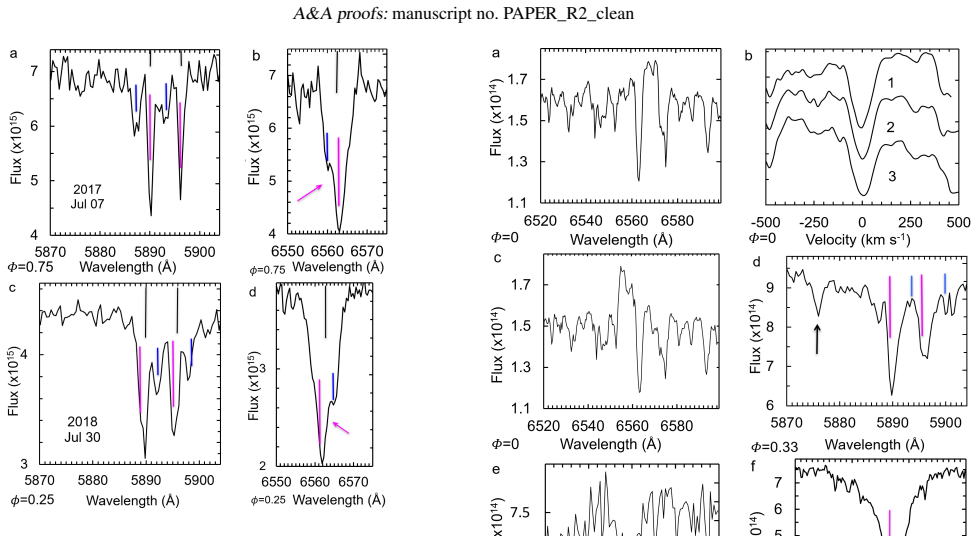
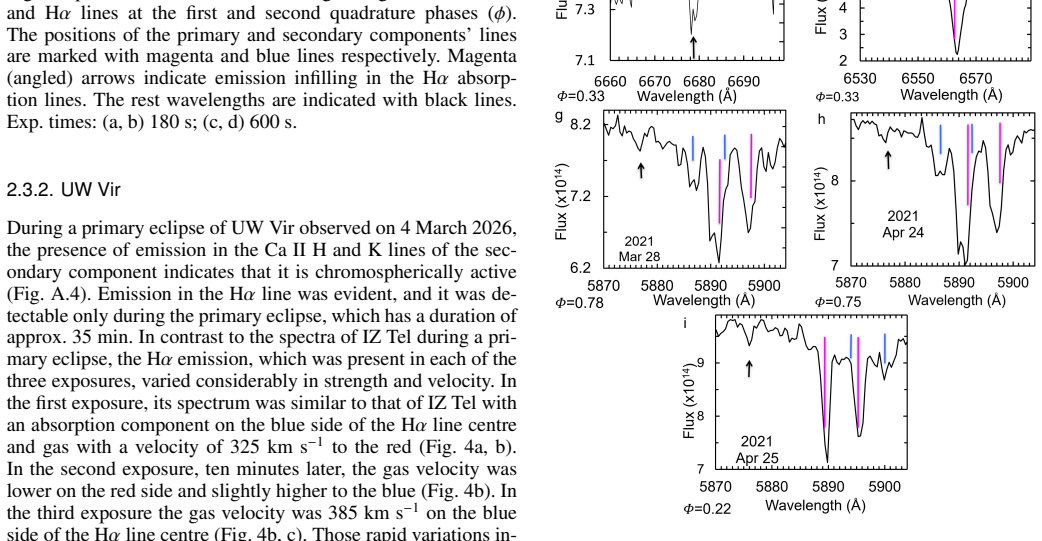
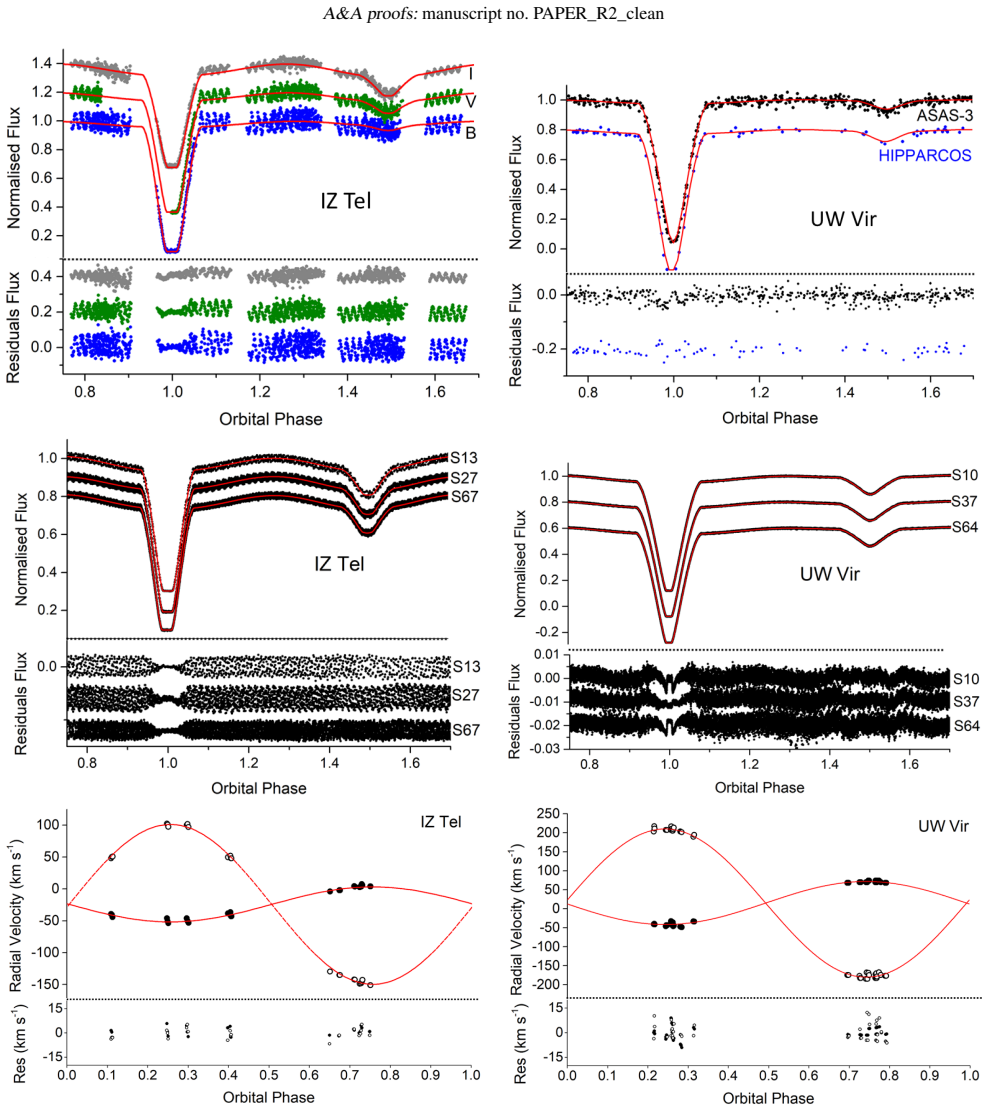
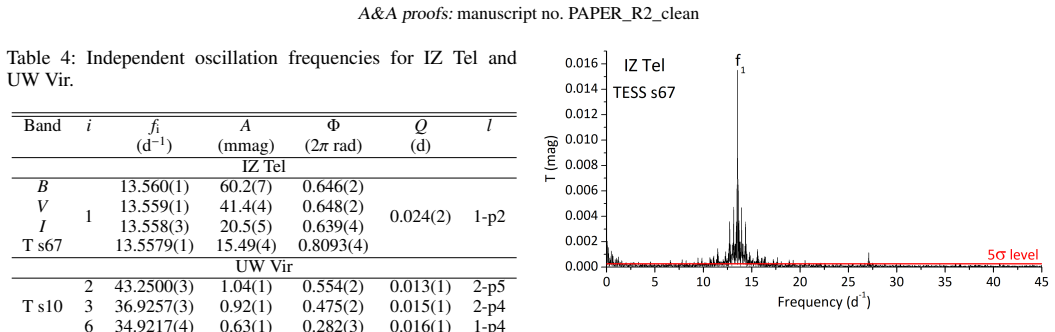
Component masses are M1=1.48 solar masses and M2=0.33 solar masses for IZ Tel, and M1=2.39 solar masses and M2=0.67 solar masses for UW Vir from the simultaneous solution of the light and radial velocity curves. The primaries are delta Scuti stars, with IZ Tel showing a dominant frequency of 13.56 d^{-1} as a non-radial pressure mode plus 16 combination frequencies, and UW Vir oscillating in three main frequencies from 34.9 to 43.3 d^{-1} plus more than 50 combinations that exhibit mode coupling with amplitude and phase modulations over about four years. Spectra during total eclipses reveal H-alpha emission, and mass transfer is further supported by photometric and timing analyses.
What carries the argument
Simultaneous fitting of photometric light curves and spectroscopic radial velocity curves, combined with frequency analysis of time-series photometry to extract pulsation modes.
If this is right
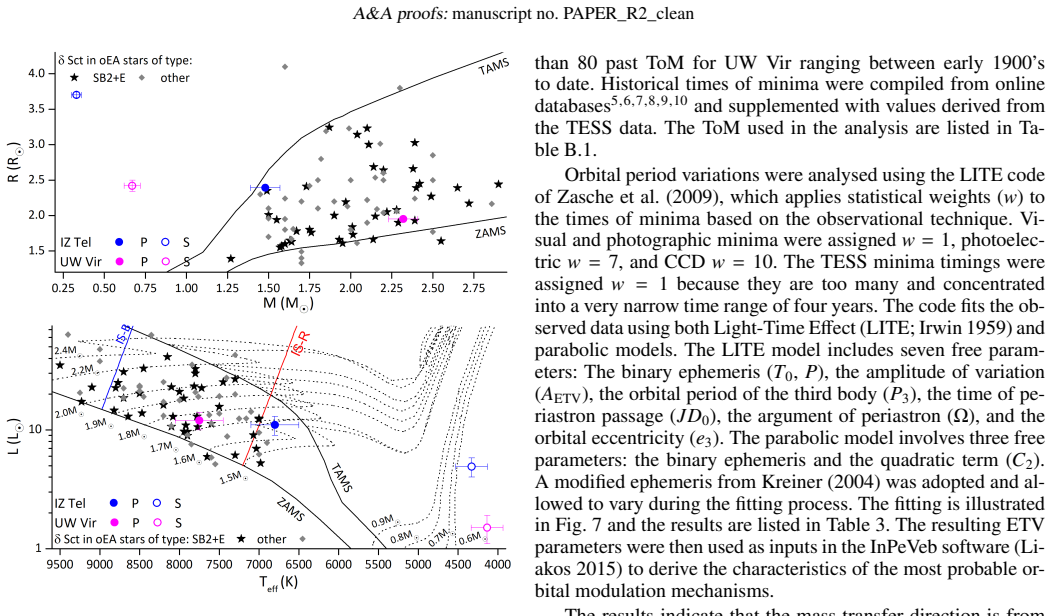
- The two systems enlarge the sample of oEA stars whose physical and pulsational properties can be directly compared.
- Mode coupling in UW Vir's main frequencies indicates nonlinear interactions that persist over multi-year timescales.
- Ongoing mass transfer is independently verified by eclipse timing variations in UW Vir and by emission-line signatures in both binaries.
- The derived masses place the primaries in the expected mass range for delta Scuti stars in semi-detached Algols.
Where Pith is reading between the lines
- The combination frequencies may arise partly from tidal or mass-transfer effects, offering a testbed for how binary interaction modifies stellar oscillations.
- Long-term monitoring could detect secular changes in pulsation amplitudes or frequencies as mass transfer alters the primary's structure.
- These southern systems are well suited for coordinated ground-based observations that could link orbital evolution directly to pulsation behavior.
- Similar analyses of other Algols might reveal whether delta Scuti pulsations are common or enhanced during the mass-transfer phase.
Load-bearing premise
The light-curve and radial-velocity modeling assumes the systems are semi-detached Algol configurations with mass transfer that does not significantly distort the velocity curves or eclipse shapes beyond standard treatment.
What would settle it
Independent radial-velocity measurements that produce component masses differing by more than 10 percent, or new spectra showing no H-alpha emission during primary eclipses, would falsify the derived masses and the active mass-transfer interpretation.
Figures





read the original abstract
This study is an in-depth examination of IZ Tel and UW Vir which are semi-detached oscillating Eclipsing Algol binary systems (oEA stars). The radial velocities of both components of each system were derived using spectra observed with the Australian National University's 2.3 m telescope. The spectral types of the IZ Tel primary and secondary components were determined as F2V and K2IV; and those of UW Vir were determined as A7V and K6IV, respectively. Spectroscopy revealed mass transfer in progress which was confirmed by the photometric analysis for both cases and also by Eclipse-Timing Variation analysis in the case of UW Vir. Data from the Transiting Exoplanet Survey Satellite (TESS) and ground-based observations enabled detailed light-curve modelling and pulsation analysis. We determined component masses of $M_1=1.48$ M_sun and $M_2=0.33$ M_sun for IZ Tel, and $M_1=2.39$ M_sun and $M_2=0.67$ M_sun for UW Vir from the simultaneous solution of the light and radial velocity curves. Spectra during total eclipses of the primary components revealed H$\alpha$ emission was present. Both primary components are $\delta$ Sct stars. That of IZ Tel pulsates with a dominant frequency of 13.56 d$^{-1}$, which is revealed as non-radial pressure mode, as well as in another 16 combination frequencies. The primary component of UW Vir oscillates in three main frequencies within the range 34.9-43.3 d$^{-1}$ and in more than 50 another combination frequencies. Mode coupling was detected in the three main frequencies, which showed amplitude and phase modulations within a time span of approximately four years. The physical and pulsational properties of the $\delta$ Sct stars of both systems were compared with other members of oEA stars.
Editorial analysis
A structured set of objections, weighed in public.
Referee Report
Summary. The manuscript examines two semi-detached oscillating eclipsing Algol (oEA) binary systems, IZ Tel and UW Vir. Using spectroscopy from the ANU 2.3 m telescope, radial velocities are derived and spectral types determined as F2V/K2IV and A7V/K6IV respectively. Simultaneous modeling of TESS and ground-based light curves with radial velocities yields component masses of 1.48 and 0.33 solar masses for IZ Tel, and 2.39 and 0.67 for UW Vir. Active mass transfer is evidenced by Hα emission during eclipses, photometric analysis, and eclipse timing variations for UW Vir. Fourier analysis of photometry shows the primaries are δ Sct pulsators with specific frequencies, combination frequencies, and mode coupling detected in UW Vir over four years. Properties are compared to other oEA stars.
Significance. Should the derived masses and pulsation parameters prove robust, the study adds valuable data on two southern oEA systems exhibiting active mass transfer. The detailed pulsation analysis, including over 50 combination frequencies and mode coupling with amplitude and phase modulations, provides insights into the interaction between pulsations and mass transfer in Algol systems. This expands the known sample and allows for better comparisons of physical and pulsational properties among oEA stars. The use of multiple independent indicators (Hα, photometry, ETV) for mass transfer is a strength.
major comments (2)
- [Simultaneous light and radial velocity curve solution] In the section on simultaneous light-curve and radial-velocity curve solution, the modeling assumes standard semi-detached Algol geometry (Roche potentials, no explicit stream or disk). Given the confirmed active mass transfer via Hα emission during total eclipses and ETV for UW Vir, unmodeled gas-stream or accretion-disk contributions can introduce photometric asymmetries and line-profile distortions. These effects, documented in other active Algols, can shift derived inclinations and velocity semi-amplitudes by several percent and thereby bias the reported component masses (M1=1.48/2.39 M⊙, M2=0.33/0.67 M⊙). Residual maps or explicit tests for stream hydrodynamics should be added to support the mass values.
- [Pulsation analysis] In the pulsation analysis, the detection of mode coupling in the three main frequencies of UW Vir (34.9–43.3 d⁻¹) with amplitude and phase modulations over ~4 years requires quantitative assessment of significance and a clear statement of how combination frequencies were distinguished from aliases or noise.
minor comments (2)
- [Abstract] The abstract reports masses and frequencies without uncertainties or error budgets; these should be added along with a brief statement of data exclusion criteria used in the light-curve and RV fits.
- [Discussion] A summary table comparing the derived physical and pulsational parameters of both systems with the existing oEA sample (as referenced in the final paragraph) would improve readability and strengthen the comparative discussion.
Simulated Author's Rebuttal
We thank the referee for the constructive and positive review of our manuscript on IZ Tel and UW Vir. The comments highlight important considerations for the robustness of our mass determinations and pulsation analysis. We address each major comment below and indicate the revisions made to the manuscript.
read point-by-point responses
-
Referee: [Simultaneous light and radial velocity curve solution] In the section on simultaneous light-curve and radial-velocity curve solution, the modeling assumes standard semi-detached Algol geometry (Roche potentials, no explicit stream or disk). Given the confirmed active mass transfer via Hα emission during total eclipses and ETV for UW Vir, unmodeled gas-stream or accretion-disk contributions can introduce photometric asymmetries and line-profile distortions. These effects, documented in other active Algols, can shift derived inclinations and velocity semi-amplitudes by several percent and thereby bias the reported component masses (M1=1.48/2.39 M⊙, M2=0.33/0.67 M⊙). Residual maps or explicit tests for stream hydrodynamics should be added to support the mass values.
Authors: We acknowledge that active mass transfer can introduce complexities not fully captured by standard Roche-lobe geometry. Our simultaneous solutions were performed with the Wilson-Devinney code using the semi-detached configuration, which is the conventional approach for oEA systems and has yielded consistent results with spectral classifications. To address the concern, we have added light-curve residual maps to the revised manuscript; these show no large-scale systematic deviations that would indicate dominant stream or disk contributions. We have also expanded the discussion to note possible small biases in inclination or velocity amplitudes while emphasizing that the derived masses remain consistent with evolutionary models for Algols. Full hydrodynamic stream modeling lies outside the scope of this observational study. revision: partial
-
Referee: [Pulsation analysis] In the pulsation analysis, the detection of mode coupling in the three main frequencies of UW Vir (34.9–43.3 d⁻¹) with amplitude and phase modulations over ~4 years requires quantitative assessment of significance and a clear statement of how combination frequencies were distinguished from aliases or noise.
Authors: We have revised the pulsation section to include the requested quantitative details. Frequencies were extracted via Fourier analysis with a signal-to-noise threshold of 4.0, and combination frequencies were identified by confirming exact sum/difference relations with the parent modes together with their consistent detection across independent TESS sectors. For the mode coupling, we now provide tabulated amplitude and phase values with formal uncertainties for each of the three main frequencies over the four-year span, demonstrating that the observed modulations exceed the measurement errors and are therefore statistically significant. revision: yes
Circularity Check
No circularity: masses and frequencies extracted from direct observational fitting
full rationale
The paper determines component masses via simultaneous light-curve and radial-velocity modeling on newly acquired TESS, ground-based photometry, and ANU 2.3 m spectra. This is standard parameter estimation from data using codes such as Wilson-Devinney or PHOEBE under semi-detached assumptions; the output masses are not renamed prior fits or predictions forced by the same dataset. Pulsation frequencies are extracted via Fourier analysis of residuals after binary subtraction. No load-bearing step reduces by construction to a self-citation, ansatz smuggled from prior work, or uniqueness theorem. Spectroscopy (Hα emission, spectral types) and ETV analysis provide independent confirmation of mass transfer. The derivation chain is self-contained against external benchmarks.
Axiom & Free-Parameter Ledger
free parameters (2)
- Component masses =
IZ Tel: 1.48/0.33 M_sun; UW Vir: 2.39/0.67 M_sun
- Pulsation frequencies =
IZ Tel dominant 13.56 d^{-1}; UW Vir 34.9-43.3 d^{-1} range
axioms (1)
- domain assumption Systems are semi-detached eclipsing Algols with ongoing mass transfer
Reference graph
Works this paper leans on
-
[1]
Aerts , C., Christensen-Dalsgaard , J., & Kurtz , D. W. 2010, Asteroseismology
2010
-
[2]
2014, , 796, 118
Antoci , V., Cunha , M., Houdek , G., et al. 2014, , 796, 118
2014
-
[3]
Applegate , J. H. 1992, , 385, 621
1992
-
[4]
A., Daszy \'n ska-Daszkiewicz , J., & Pamyatnykh , A
Balona , L. A., Daszy \'n ska-Daszkiewicz , J., & Pamyatnykh , A. A. 2015, , 452, 3073
2015
-
[5]
S., Koen , C., & Pokrzywka , B
Baran , A. S., Koen , C., & Pokrzywka , B. 2015, , 448, L16
2015
-
[6]
Bowman , D. M. & Kurtz , D. W. 2018, , 476, 3169
2018
-
[7]
Bowman , D. M. & Michielsen , M. 2021, , 656, A158
2021
-
[8]
2000, in Astronomical Society of the Pacific Conference Series, Vol
Breger , M. 2000, in Astronomical Society of the Pacific Conference Series, Vol. 210, Delta Scuti and Related Stars, ed. M. Breger & M. Montgomery , 3
2000
-
[9]
J., Vogt , F
Childress , M. J., Vogt , F. P. A., Nielsen , J., & Sharp , R. G. 2014, , 349, 617
2014
-
[10]
2017, , 600, A30
Claret , A. 2017, , 600, A30
2017
-
[11]
& Bloemen , S
Claret , A. & Bloemen , S. 2011, , 529, A75
2011
-
[12]
2007, , 310, 255
Dopita , M., Hart , J., McGregor , P., et al. 2007, , 310, 255
2007
-
[13]
2010, , 327, 245
Dopita , M., Rhee , J., Farage , C., et al. 2010, , 327, 245
2010
-
[14]
& Bak s , V
Eker , Z. & Bak s , V. 2023, , 523, 2440
2023
-
[15]
2018, , 479, 5491
Eker , Z., Bak s , V., Bilir , S., et al. 2018, , 479, 5491
2018
-
[16]
Fitch , W. S. 1981, , 249, 218
1981
-
[17]
Gaia Collaboration , Vallenari , A., Brown , A. G. A., et al. 2023, , 674, A1
2023
-
[18]
Gray , R. O. & Corbally , J., C. 2009, Stellar Spectral Classification
2009
-
[19]
A., Levine , S., Terrell , D., & Welch , D
Henden , A. A., Levine , S., Terrell , D., & Welch , D. L. 2015, in American Astronomical Society Meeting Abstracts, Vol. 225, American Astronomical Society Meeting Abstracts \#225, 336.16
2015
-
[20]
Irwin , J. B. 1959, , 64, 149
1959
-
[21]
M., Twicken , J
Jenkins , J. M., Twicken , J. D., McCauliff , S., et al. 2016, in Society of Photo-Optical Instrumentation Engineers (SPIE) Conference Series, Vol. 9913, Software and Cyberinfrastructure for Astronomy IV, ed. G. Chiozzi & J. C. Guzman , 99133E
2016
-
[22]
2017, , 470, 915
Kahraman Ali c avu s , F., Soydugan , E., Smalley , B., & Kub \'a t , J. 2017, , 470, 915
2017
-
[23]
2022, , 510, 1413
Kahraman Ali c avu s , F., Handler , G., Ali c avu s , F., et al. 2022, , 510, 1413
2022
-
[24]
Kreiner , J. M. 2004, , 54, 207
2004
-
[25]
Lanza , A. F. & Rodon \`o , M. 2002, Astronomische Nachrichten, 323, 424
2002
-
[26]
& Breger , M
Lenz , P. & Breger , M. 2005, Communications in Asteroseismology, 146, 53
2005
-
[27]
2015, in Astronomical Society of the Pacific Conference Series, Vol
Liakos , A. 2015, in Astronomical Society of the Pacific Conference Series, Vol. 496, Living Together: Planets, Host Stars and Binaries, ed. S. M. Rucinski , G. Torres , & M. Zejda , 286
2015
-
[28]
2017, , 607, A85
Liakos , A. 2017, , 607, A85
2017
-
[29]
2025 a , Contributions of the Astronomical Observatory Skalnate Pleso, 55, 172
Liakos , A. 2025 a , Contributions of the Astronomical Observatory Skalnate Pleso, 55, 172
2025
-
[30]
2025 b , , 700, A100
Liakos , A. 2025 b , , 700, A100
2025
-
[31]
Liakos , A., Moriarty , D. J. W., Blackford , M. G., et al. 2022, , 663, A137
2022
-
[32]
Liakos , A., Moriarty , D. J. W., Erdem , A., West , J. F., & Evans , P. 2024, , 691, A260
2024
-
[33]
& Niarchos , P
Liakos , A. & Niarchos , P. 2009, Communications in Asteroseismology, 160, 2
2009
-
[34]
& Niarchos , P
Liakos , A. & Niarchos , P. 2017, , 465, 1181
2017
-
[35]
2012, , 422, 1250
Liakos , A., Niarchos , P., Soydugan , E., & Zasche , P. 2012, , 422, 1250
2012
-
[36]
Loumos , G. L. & Deeming , T. J. 1978, , 56, 285
1978
-
[37]
Lucy , L. B. 1967, , 65, 89
1967
-
[38]
2021, , 162, 48
Lv , C., Esamdin , A., Zeng , X., et al. 2021, , 162, 48
2021
-
[39]
2021, Monthly Notices of the Royal Astronomical Society, 505, 3206
Miszuda, A., Szewczuk, W., & Daszyńska-Daszkiewicz, J. 2021, Monthly Notices of the Royal Astronomical Society, 505, 3206
2021
-
[40]
E., Gunsriwiwat , K., Awiphan , S., et al
Mkrtichian , D. E., Gunsriwiwat , K., Awiphan , S., et al. 2017, Information Bulletin on Variable Stars, 6221, 1
2017
-
[41]
E., Kusakin , A
Mkrtichian , D. E., Kusakin , A. V., Gamarova , A. Y., & Nazarenko , V. 2002, in Astronomical Society of the Pacific Conference Series, Vol. 259, IAU Colloq. 185: Radial and Nonradial Pulsationsn as Probes of Stellar Physics, ed. C. Aerts , T. R. Bedding , & J. Christensen-Dalsgaard , 96
2002
-
[42]
E., Lehmann , H., Rodr \' guez , E., et al
Mkrtichian , D. E., Lehmann , H., Rodr \' guez , E., et al. 2018, , 475, 4745
2018
-
[43]
Moriarty , D. J. W., Liakos , A., Drinkwater , M. J., et al. 2019, , 365, 1
2019
-
[44]
2024, , 682, L8
Niu, Jia-Shu & Xue, Hui-Fang . 2024, , 682, L8
2024
-
[45]
Pecaut , M. J. & Mamajek , E. E. 2013, , 208, 9
2013
-
[46]
& Michalska , G
Pigulski , A. & Michalska , G. 2007, , 57, 61
2007
-
[47]
2017, , 842, 110
Pilecki , B., Gieren , W., Smolec , R., et al. 2017, , 842, 110
2017
-
[48]
2024, , 41, e057
Price , I., Nielsen , J., Lidman , C., et al. 2024, , 41, e057
2024
-
[49]
2000, , 146, 377
Qian , S. 2000, , 146, 377
2000
-
[50]
Richards , M. T. & Albright , G. E. 1999, , 123, 537
1999
-
[51]
Ruci \'n ski , S. M. 1969, , 19, 245
1969
-
[52]
Rucinski , S. M. 1992, , 104, 1968
1992
-
[53]
Rucinski , S. M. 2002, , 124, 1746
2002
-
[54]
2006, , 370, 2013
Soydugan , E., Soydugan , F., Demircan , O., & \.I bano g lu , C. 2006, , 370, 2013
2006
-
[55]
1993, in Astronomical Society of the Pacific Conference Series, Vol
Tody , D. 1993, in Astronomical Society of the Pacific Conference Series, Vol. 52, Astronomical Data Analysis Software and Systems II, ed. R. J. Hanisch , R. J. V. Brissenden , & J. Barnes , 173
1993
-
[56]
1924, , 84, 665
von Zeipel , H. 1924, , 84, 665
1924
-
[57]
Wilson , R. E. & Devinney , E. J. 1971, , 166, 605
1971
-
[58]
2009, , 14, 121
Zasche , P., Liakos , A., Niarchos , P., et al. 2009, , 14, 121
2009
-
[59]
2009, , 33, 279
Zhang , J., Qian , S.-B., & Boonrucksar , S. 2009, , 33, 279
2009
-
[60]
Zhevakin , S. A. 1963, , 1, 367
1963
-
[61]
2008, Communications in Asteroseismology, 157, 387
Zima , W. 2008, Communications in Asteroseismology, 157, 387
2008
-
[62]
M., Baran , A., et al
Zola , S., Rucinski , S. M., Baran , A., et al. 2004, , 54, 299
2004
-
[63]
Morphologies of H Accretion Regions in Algol Binaries. , keywords =. doi:10.1086/313242 , adsurl =
- [64]
- [65]
- [66]
-
[67]
, title =. 2002 , month = dec, pages =. arXiv , doi =:astro-ph/0210283 , keywords =
-
[68]
1993 , editor =
Astronomical Data Analysis Software and Systems II , title =. 1993 , editor =
1993
-
[69]
2002 , month = dec, pages =
American Astronomical Society Meeting Abstracts , title =. 2002 , month = dec, pages =
2002
-
[70]
, title =. 2011 , month = may, pages =. doi:10.1051/0004-6361/201116451 , eid =
-
[71]
, title =. 2017 , month = apr, pages =. arXiv , doi =:1804.10295 , keywords =
-
[72]
M., et al., 2016, in Chiozzi G., Guzman J
Software and Cyberinfrastructure for Astronomy IV , title =. 2016 , editor =. doi:10.1117/12.2233418 , eid =
-
[73]
, title =. 2024 , month = nov, pages =. arXiv , doi =:2409.04359 , keywords =
-
[74]
, title =. 2017 , month = jun, number =. arXiv , doi =:1704.07782 , keywords =
-
[75]
, title =. 1992 , month = nov, pages =. doi:10.1086/116372 , keywords =
-
[76]
, title =. 2002 , month = sep, number =. arXiv , doi =:astro-ph/0201214 , keywords =
-
[77]
, title =. 2022 , month = jul, pages =. arXiv , doi =:2204.13629 , keywords =
-
[78]
The solar-type eclipsing binary system LL Aquarii. , keywords =. doi:10.1051/0004-6361/201322195 , archivePrefix =. 1308.1320 , primaryClass =
-
[79]
Re-parameterization of Four Limb-Darkening Laws and their Implementation into the JKTEBOP Code. The Observatory , keywords =. doi:10.48550/arXiv.2301.02531 , archivePrefix =. 2301.02531 , primaryClass =
-
[80]
Spectroscopic binaries with circular orbits. , year = 1971, month = aug, volume =. doi:10.1086/111159 , adsurl =
discussion (0)
Sign in with ORCID, Apple, or X to comment. Anyone can read and Pith papers without signing in.