Recognition: unknown
Optimized encoding point distributions for efficient single-point imaging
Pith reviewed 2026-05-10 00:46 UTC · model grok-4.3
The pith
RAST and BINGO point reduction outperform deterministic undersampling for accelerated single-point MRI
A machine-rendered reading of the paper's core claim, the machinery that carries it, and where it could break.
Core claim
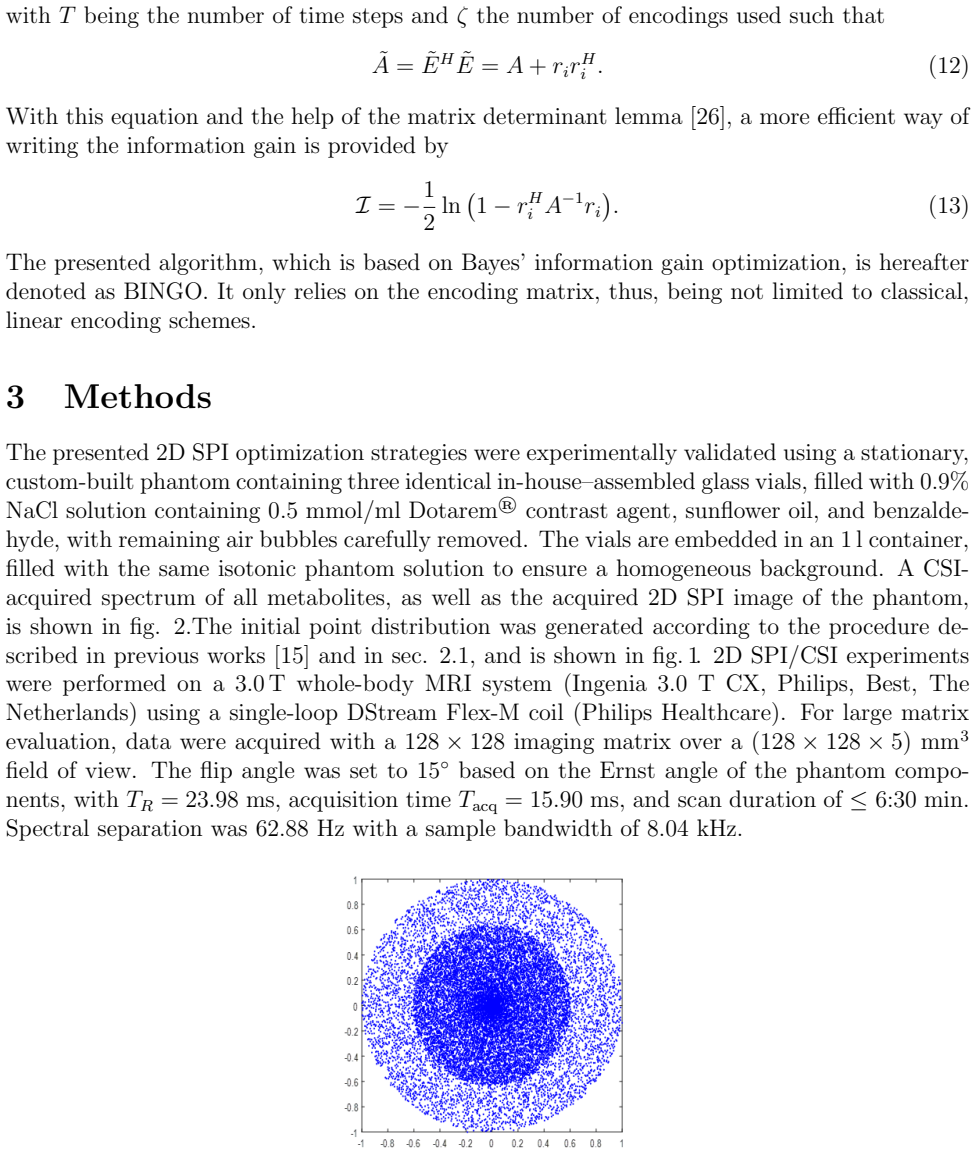
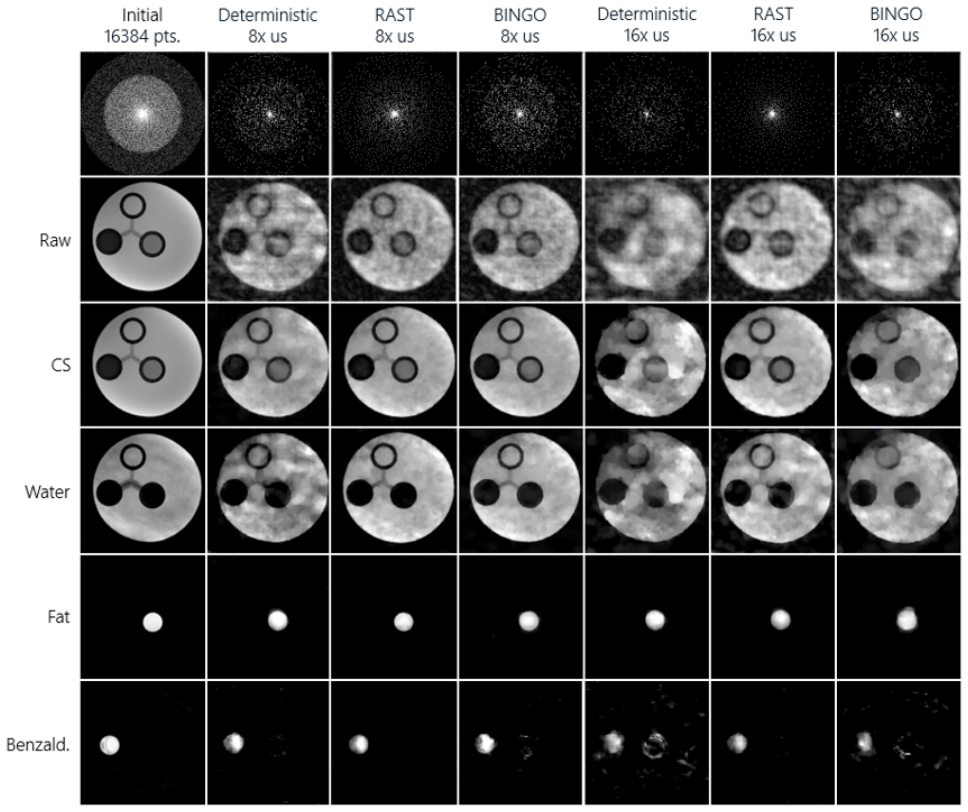
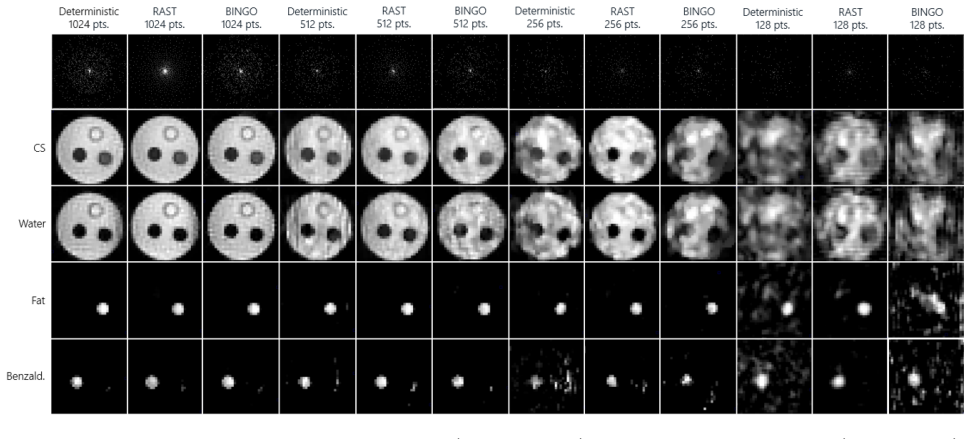
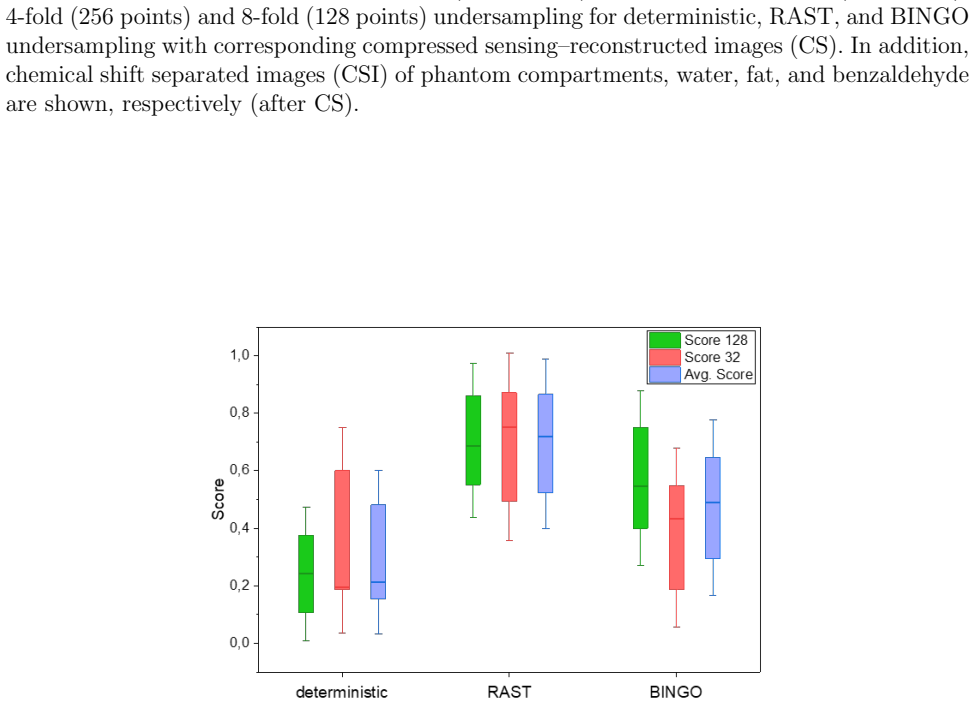
An initial Sobol-derived point distribution with Heaviside-type density gradient can be aggressively undersampled by RAST or BINGO to maintain or exceed the image quality of deterministic undersampling at acceleration factors up to 16, with RAST achieving the highest averaged metric score improvements of 238 percent and BINGO 133 percent across matrix resolutions in 3 T phantom experiments.
What carries the argument
RAST (radius-adaptive stochastic undersampling with geometric minimum-distance criterion) and BINGO (Bayesian information-gain point removal) applied to an optimized Sobol sequence.
If this is right
- The methods enable shorter scan times for time-critical applications such as hyperpolarized MRI while limiting deterministic artifacts.
- RAST supplies the most robust performance across different matrix sizes and acceleration levels.
- BINGO extends naturally to non-linear encoding fields without further modification.
- Both approaches support real-time and accelerated 2D SPI/CSI workflows that require low encoding density.
Where Pith is reading between the lines
- The same point-reduction logic could be tested on other non-Cartesian trajectories such as radial or spiral sampling.
- Pairing the optimized distributions with modern iterative or deep-learning reconstruction might compound the observed metric gains.
- Direct comparison on patient data would reveal whether the phantom improvements affect clinical decision-making.
Load-bearing premise
Quantitative gains in RMSE, SSIM, and HFEN on 3 T phantom data will translate into diagnostically better images in living subjects and will hold for non-linear encoding fields.
What would settle it
If in-vivo human scans at the same acceleration factors show equivalent or lower diagnostic utility with RAST or BINGO patterns compared with deterministic undersampling, the claim of practical superiority collapses.
Figures

read the original abstract
Purpose: Quasi-random Sobol-based sampling schemes exhibit deterministic structural artifacts when aggressively undersampled, particularly at low encoding densities required for accelerated 2D SPI/CSI. To address these limitations, two advanced undersampling strategies are investigated to mitigate deterministic behavior, improving image quality for time-constrained applications such as hyperpolarized MRI. Methods: An optimized Sobol sequence-derived point distribution with Heaviside-type density gradient center oversampling served as the initial sampling pattern. Undersampling was performed using two point-reduction algorithms: radius-adaptive stochastic undersampling (RAST), which applies a geometric, radius-dependent minimum-distance criterion, and Bayesian Information Gain Optimization (BINGO), that removes points based on their information gain to the reconstructed image. Phantom experiments were conducted on a 3 T clinical MRI system using up to 16-fold undersampling. Image quality was quantified using a performance score derived from RMSE, SSIM, and HFEN. Results: Both RAST and BINGO outperformed deterministic undersampling across all metrics. RAST achieved highest and most robust performance, with improvements up to 238% in the averaged metric score, while BINGO yielded improvements of 133% across matrix resolutions. Conclusion: The proposed strategies effectively reduce the number of encoding points in low-discrepancy 2D SPI point distributions while maintaining image quality under strong acceleration. RAST provides superior metric performance, whereas BINGO offers broad applicability, including suitability for non-linear encoding fields. These approaches support rapid acquisition workflows required for real-time and hyperpolarized applications.
Editorial analysis
A structured set of objections, weighed in public.
Referee Report
Summary. The manuscript proposes two undersampling algorithms—radius-adaptive stochastic undersampling (RAST) and Bayesian Information Gain Optimization (BINGO)—applied to an optimized Sobol sequence with Heaviside-type density gradient oversampling for accelerated 2D single-point imaging (SPI). Phantom experiments at 3 T with up to 16-fold undersampling show that both methods outperform deterministic undersampling on a composite metric derived from RMSE, SSIM, and HFEN, with RAST achieving up to 238% improvement and BINGO 133% across matrix resolutions. The work targets time-constrained applications such as hyperpolarized MRI.
Significance. If the metric gains are reproducible and the methods generalize, the approaches could reduce acquisition time in low-density SPI while preserving image quality, supporting faster hyperpolarized workflows. The algorithmic focus on mitigating deterministic artifacts is a practical contribution, though the phantom-only validation at 3 T with linear gradients constrains the assessed impact.
major comments (3)
- [Methods] Methods: The RAST and BINGO algorithms are described only qualitatively (radius-dependent minimum-distance criterion for RAST; information-gain removal for BINGO) with no equations, pseudocode, or explicit parameter values (e.g., radius scaling factor, information-gain threshold), preventing independent verification of the reported performance gains.
- [Results] Results: The averaged metric score yielding 238% (RAST) and 133% (BINGO) improvements is not defined with respect to weighting, normalization, or combination rule for RMSE/SSIM/HFEN; without this, the quantitative claims cannot be assessed for robustness or compared to prior work.
- [Conclusion] Conclusion: The statement that BINGO offers suitability for non-linear encoding fields lacks any supporting simulation, experiment, or analysis; all presented data use linear gradients on phantoms at 3 T, so the generalization claim is unsupported.
minor comments (1)
- [Abstract] Abstract: The phrase 'Heaviside-type density gradient center oversampling' is introduced without definition or reference to how the gradient parameters are chosen or optimized.
Simulated Author's Rebuttal
Thank you for reviewing our manuscript. We appreciate the opportunity to clarify and strengthen the presentation of our work on optimized encoding point distributions for single-point imaging. Below we provide point-by-point responses to the major comments.
read point-by-point responses
-
Referee: [Methods] Methods: The RAST and BINGO algorithms are described only qualitatively (radius-dependent minimum-distance criterion for RAST; information-gain removal for BINGO) with no equations, pseudocode, or explicit parameter values (e.g., radius scaling factor, information-gain threshold), preventing independent verification of the reported performance gains.
Authors: We agree with this assessment. The original manuscript provided only qualitative descriptions of the RAST and BINGO algorithms. In the revised version, we will add the full mathematical definitions, including the specific equations for the radius-adaptive minimum-distance criterion in RAST and the information-gain based point removal in BINGO. We will also include pseudocode for both methods and specify all parameter values used in the experiments, such as the radius scaling factor and any thresholds, to enable independent verification. revision: yes
-
Referee: [Results] Results: The averaged metric score yielding 238% (RAST) and 133% (BINGO) improvements is not defined with respect to weighting, normalization, or combination rule for RMSE/SSIM/HFEN; without this, the quantitative claims cannot be assessed for robustness or compared to prior work.
Authors: We acknowledge that the exact formulation of the averaged performance score was not detailed in the manuscript. We will revise the Results section to explicitly describe how the score is computed, including the normalization methods applied to RMSE, SSIM, and HFEN, the weighting scheme if used, and the precise combination rule. This will allow readers to evaluate the robustness of the reported improvements. revision: yes
-
Referee: [Conclusion] Conclusion: The statement that BINGO offers suitability for non-linear encoding fields lacks any supporting simulation, experiment, or analysis; all presented data use linear gradients on phantoms at 3 T, so the generalization claim is unsupported.
Authors: The referee correctly notes that our validation was limited to linear gradient fields on phantoms at 3 T, with no supporting analysis for non-linear fields. Although the design of BINGO is based on information gain which is in principle field-agnostic, we agree that the claim lacks support in the current work. We will revise the Conclusion to remove the statement about suitability for non-linear encoding fields. revision: yes
Circularity Check
No circularity detected; algorithmic methods evaluated on independent phantom data
full rationale
The paper introduces RAST and BINGO as algorithmic point-reduction procedures applied to an initial Sobol-derived distribution, then quantifies performance via direct comparison against deterministic undersampling on separate 3T phantom acquisitions using RMSE/SSIM/HFEN-derived scores. No equations, parameter fits, or self-citations are shown that reduce the reported metric gains to the input sampling patterns by construction. The derivation chain remains self-contained because the claimed improvements rest on external experimental measurements rather than tautological redefinitions or fitted-input predictions.
Axiom & Free-Parameter Ledger
free parameters (3)
- Heaviside-type density gradient parameters
- radius scaling factor in RAST
- information-gain threshold or prior in BINGO
axioms (1)
- domain assumption Sobol sequences form a suitable low-discrepancy base for 2D encoding point sets in SPI
Reference graph
Works this paper leans on
-
[1]
Quo vadis hyperpolarized 13c mri? Zeitschrift f¨ ur Medizinische Physik, 35(1):8–32, 2025
Pascal Wodtke, Martin Grashei, and Franz Schilling. Quo vadis hyperpolarized 13c mri? Zeitschrift f¨ ur Medizinische Physik, 35(1):8–32, 2025
2025
-
[2]
M¨ uller, Sebastian Lucas, Jochen Scheuer, Christoph M¨ uller, John Blanchard, Geoffrey J
Luca Nagel, Martin Gierse, Wolfgang Gottwald, Zumrud Ahmadova, Martin Grashei, Pas- cal Wolff, Felix Josten, Senay Karaali, Christoph A. M¨ uller, Sebastian Lucas, Jochen Scheuer, Christoph M¨ uller, John Blanchard, Geoffrey J. Topping, Andre Wendlinger, Na- dine Setzer, Sandra S¨ uhnel, Jonas Handwerker, Christophoros Vassiliou, Frits H.A. van Heijster, ...
2023
-
[3]
Blanchard, Rom´ an Picazo-Frutos, James Eills, Holger Barth, Fedor Jelezko, Volker Rasche, Franz Schilling, Ilai Schwartz, and Stephan Knecht
Martin Gierse, Luca Nagel, Michael Keim, Sebastian Lucas, Tobias Speidel, Tobias Lob- meyer, Gordon Winter, Felix Josten, Senay Karaali, Maximilian Fellermann, Jochen Scheuer, Christoph M¨ uller, Frits van Heijster, Jason Skinner, Jessica L¨ offler, Anna Parker, Jonas Handwerker, Alastair Marshall, Alon Salhov, Bilal El-Kassem, Christophoros Vas- siliou, ...
2023
-
[4]
M¨ uller, Adam E
Christian Hundshammer, Miriam Braeuer, Christoph A. M¨ uller, Adam E. Hansen, Math- ias Schillmaier, Stephan D¨ uwel, Benedikt Feuerecker, Steffen J. Glaser, Axel Haase, Wilko Weichert, Katja Steiger, Jorge Cabello, Franz Schilling, Jan-Bernd H¨ ovener, Andreas Kjær, Stephan G. Nekolla, and Markus Schwaiger. Simultaneous characterization of tumor cel- lul...
2018
-
[5]
M¨ uller, Christian Hundshammer, Miriam Braeuer, Jason G
Christoph A. M¨ uller, Christian Hundshammer, Miriam Braeuer, Jason G. Skinner, Stephan Berner, Jochen Leupold, Stephan D¨ uwel, Stephan G. Nekolla, Sven M˚ ansson, Adam E. Hansen, Dominik von Elverfeldt, Jan H. Ardenkjaer-Larsen, Franz Schilling, Markus Schwaiger, J¨ urgen Hennig, and Jan-Bernd H¨ ovener. Dynamic 2d and 3d mapping of hyperpolarized pyruv...
2020
-
[6]
A hybrid setup for rodent hyperpolarized metabolic imaging using a clinical magnetic resonance scanner.Journal of Magnetic Resonance Open, 22:100190, 2025
Ditte Bentsen Christensen, Ingeborg Sæten Skre, Jan Henrik Ardenkjær-Larsen, Mor Mishkovsky, and Mathilde H Lerche. A hybrid setup for rodent hyperpolarized metabolic imaging using a clinical magnetic resonance scanner.Journal of Magnetic Resonance Open, 22:100190, 2025
2025
-
[7]
Michael Lustig, David Donoho, and John M. Pauly. Sparse mri: The application of com- pressed sensing for rapid mr imaging.Magnetic Resonance in Medicine, 58(6):1182–1195, 2007
2007
-
[8]
Fast variable density poisson-disc sample generation with directional variation for compressed sensing in mri
N Dwork, CA Baron, EMI Johnson, JM Pauly, and PEZ Larson. Fast variable density poisson-disc sample generation with directional variation for compressed sensing in mri. Magn Reson Imaging, 77:186–193, 4 2009
2009
-
[9]
Birkh¨ auser Basel, 2013
Simon Foucart and Holger Rauhut.A Mathematical Introduction to Compressive Sensing. Birkh¨ auser Basel, 2013
2013
-
[10]
Quasi-random single-point imaging using low-discrepancy k-space sampling.IEEE Transactions on Medical Imaging, PP:1–1, 10 2017
Tobias Speidel, Jan Paul, Stefan Wundrak, and Volker Rasche. Quasi-random single-point imaging using low-discrepancy k-space sampling.IEEE Transactions on Medical Imaging, PP:1–1, 10 2017
2017
-
[11]
Rasche, R
V. Rasche, R. Proksa, R. Sinkus, P. Bornert, and H. Eggers. Resampling of data between arbitrary grids using convolution interpolation.IEEE Transactions on Medical Imaging, 18(5):385–392, 1999
1999
-
[12]
Joslyn, Jess A
Marissa Renardy, Louis R. Joslyn, Jess A. Millar, and Denise E. Kirschner. To sobol or not to sobol? the effects of sampling schemes in systems biology applications.Mathematical Biosciences, 337:108593, 2021. x
2021
-
[13]
Cascaded sobol’ sampling.ACM Trans
Lo¨ ıs Paulin, David Coeurjolly, Jean-Claude Iehl, Nicolas Bonneel, Alexander Keller, and Victor Ostromoukhov. Cascaded sobol’ sampling.ACM Trans. Graph., 40(6), December 2021
2021
-
[14]
Mr image reconstruction from highly under- sampled k-space data by dictionary learning.IEEE Transactions on Medical Imaging, 30(5):1028–1041, 2011
Saiprasad Ravishankar and Yoram Bresler. Mr image reconstruction from highly under- sampled k-space data by dictionary learning.IEEE Transactions on Medical Imaging, 30(5):1028–1041, 2011
2011
-
[15]
Den- sity optimized low-discrepancy k-space trajectories for accelerated in-vivo 2d single-point imaging and chemical-shift imaging.Proc
Pia Gebhard, Tobias Speidel, Fabian Bschorr, Julian Sch¨ ule, and Volker Rasche. Den- sity optimized low-discrepancy k-space trajectories for accelerated in-vivo 2d single-point imaging and chemical-shift imaging.Proc. Int. Soc. Mag. Reson. Med, 33:5217, 2025
2025
-
[17]
Point spread function optimization for mri reconstruction
Hao Tan and Yibin Zheng. Point spread function optimization for mri reconstruction. ICASSP, IEEE International Conference on Acoustics, Speech and Signal Processing - Proceedings, 2:477– 480, 02 2005
2005
-
[18]
Stephen Joe and Frances Y. Kuo. Remark on algorithm 659: Implementing sobol’s quasir- andom sequence generator.ACM Trans. Math. Softw., 29(1):49–57, mar 2003
2003
-
[19]
Sobol, Danil Asotsky, Alexander Kreinin, and Sergei Kucherenko
Ilya M. Sobol, Danil Asotsky, Alexander Kreinin, and Sergei Kucherenko. Construction and comparison of high-dimensional sobol’ generators.Wilmott, 2011(56):64–79, 2011
2011
-
[20]
Blue noise sampling with controlled aliasing.ACM Trans
Daniel Heck, Thomas Schl¨ omer, and Oliver Deussen. Blue noise sampling with controlled aliasing.ACM Trans. Graph., 32(3), July 2013
2013
-
[21]
Ulichney
R.A. Ulichney. Dithering with blue noise.Proceedings of the IEEE, 76(1):56–79, 1988
1988
-
[22]
Trajectory optimization based on the signal-to-noise ratio for spatial encoding with nonlinear encoding fields.Magnetic Resonance in Medicine, 76(1):104–117, 2016
Kelvin J Layton, Stefan Kroboth, Feng Jia, Sebastian Littin, Huijun Yu, and Maxim Zaitsev. Trajectory optimization based on the signal-to-noise ratio for spatial encoding with nonlinear encoding fields.Magnetic Resonance in Medicine, 76(1):104–117, 2016
2016
-
[23]
Matthias Seeger, Hannes Nickisch, Rolf Pohmann, and Bernhard Sch¨ olkopf. Optimization of k-space trajectories for compressed sensing by bayesian experimental design.Magnetic Resonance in Medicine: An Official Journal of the International Society for Magnetic Resonance in Medicine, 63(1):116–126, 2010
2010
-
[24]
Compressed sensing mri.IEEE signal processing magazine, 25(2):72–82, 2008
Michael Lustig, David L Donoho, Juan M Santos, and John M Pauly. Compressed sensing mri.IEEE signal processing magazine, 25(2):72–82, 2008
2008
-
[25]
Model-based image reconstruction for mri.IEEE signal processing magazine, 27(4):81–89, 2010
Jeffrey A Fessler. Model-based image reconstruction for mri.IEEE signal processing magazine, 27(4):81–89, 2010
2010
-
[26]
A note on the matrix determinant lemma.International Journal of Pure and Applied Mathematics, 111(4):643–646, 2016
Robert Vrabel. A note on the matrix determinant lemma.International Journal of Pure and Applied Mathematics, 111(4):643–646, 2016
2016
-
[27]
Berkeley advanced reconstruction toolbox
Martin Uecker, Frank Ong, Jonathan I Tamir, Dara Bahri, Patrick Virtue, Joseph Y Cheng, Tao Zhang, and Michael Lustig. Berkeley advanced reconstruction toolbox. In Proc. Intl. Soc. Mag. Reson. Med, volume 23, page 9, 2015. xi
2015
-
[28]
No-reference image quality assessment in the spatial domain.IEEE Transactions on Image Processing, 21(12):4695– 4708, 2012
Anish Mittal, Anush Krishna Moorthy, and Alan Conrad Bovik. No-reference image quality assessment in the spatial domain.IEEE Transactions on Image Processing, 21(12):4695– 4708, 2012
2012
-
[29]
De- sign and analysis of field-of-view independent k-space trajectories for magnetic resonance imaging.Frontiers in Physics, 10:867676, 06 2022
Tobias Speidel, Patrick Metze, Kilian Stumpf, Thomas H¨ ufken, and Volker Rasche. De- sign and analysis of field-of-view independent k-space trajectories for magnetic resonance imaging.Frontiers in Physics, 10:867676, 06 2022
2022
-
[30]
Simultaneous magnetic resonance imaging of ph, perfusion and renal filtration using hyperpolarized 13c- labelled z-ompd.Nature Communications, 14(1):5060, 2023
Martin Grashei, Pascal Wodtke, Jason G Skinner, Sandra S¨ uhnel, Nadine Setzer, Thomas Metzler, Sebastian Gulde, Mihyun Park, Daniela Witt, Hermine Mohr, et al. Simultaneous magnetic resonance imaging of ph, perfusion and renal filtration using hyperpolarized 13c- labelled z-ompd.Nature Communications, 14(1):5060, 2023
2023
-
[31]
Temperature dependent chemical shifts of pyruvate and lactate enable in vivo hyperpolar- ized 13c mrsi thermometry.npj Imaging, 3(1):19, 2025
Wolfgang Gottwald, Luca Nagel, Jason G Skinner, Martin Grashei, Sandra S¨ uhnel, Nadine Setzer, Wolfgang Eisenreich, Mary A McLean, Ferdia A Gallagher, Jae Mo Park, et al. Temperature dependent chemical shifts of pyruvate and lactate enable in vivo hyperpolar- ized 13c mrsi thermometry.npj Imaging, 3(1):19, 2025
2025
-
[32]
Reeder, Angel R
Scott B. Reeder, Angel R. Pineda, Zhifei Wen, Ann Shimakawa, Huanzhou Yu, Jean H. Brittain, Garry E. Gold, Christopher H. Beaulieu, and Norbert J. Pelc. Iterative de- composition of water and fat with echo asymmetry and least-squares estimation (ideal): Application with fast spin-echo imaging.Magnetic Resonance in Medicine, 54(3):636–644, 2005
2005
-
[33]
Menzel, Martin A
Florian Wiesinger, Eliane Weidl, Marion I. Menzel, Martin A. Janich, Oleksandr Khegai, Steffen J. Glaser, Axel Haase, Markus Schwaiger, and Rolf F. Schulte. Ideal spiral csi for dynamic metabolic mr imaging of hyperpolarized [1-13c]pyruvate.Magnetic Resonance in Medicine, 68(1):8–16, 2012
2012
-
[34]
Cunningham, Albert P
Charles H. Cunningham, Albert P. Chen, Michael Lustig, Brian A. Hargreaves, Janine Lupo, Duan Xu, John Kurhanewicz, Ralph E. Hurd, John M. Pauly, Sarah J. Nelson, and Daniel B. Vigneron. Pulse sequence for dynamic volumetric imaging of hyperpolarized metabolic products.Journal of Magnetic Resonance, 193(1):139–146, 2008
2008
-
[35]
Shosted, Fangxu Xing, Imani Gilbert, Jamie L
Riwei Jin, Yudu Li, Ryan K. Shosted, Fangxu Xing, Imani Gilbert, Jamie L. Perry, Jonghye Woo, Zhi-Pei Liang, and Bradley P. Sutton. Optimization of 3d dynamic speech mri: Poisson-disc undersampling and locally higher-rank reconstruction through partial sepa- rability model with regional optimized temporal basis.Magnetic Resonance in Medicine, 91(1):61–74, 2024
2024
-
[36]
Boubertakh, C
R. Boubertakh, C. Prieto, P.G. Batchelor, S. Uribe, D. Atkinson, H. Eggers, T.S. Sørensen, M.S. Hansen, R.S. Razavi, and T. Schaeffter. Whole-heart imaging using undersampled radial phase encoding (rpe) and iterative sensitivity encoding (sense) reconstruction.Mag- netic Resonance in Medicine, 62(5):1331–1337, 2009
2009
-
[37]
Respiratory motion corrected 4d flow using golden radial phase encoding.Magnetic Resonance in Medicine, 83(2):635–644, 2020
Christoph Kolbitsch, Rene Bastkowski, Tobias Sch¨ affter, Claudia Prieto Vasquez, Kilian Weiss, David Maintz, and Daniel Giese. Respiratory motion corrected 4d flow using golden radial phase encoding.Magnetic Resonance in Medicine, 83(2):635–644, 2020. xii
2020
discussion (0)
Sign in with ORCID, Apple, or X to comment. Anyone can read and Pith papers without signing in.