Recognition: unknown
Dynamical heterogeneity reverses structural suppression of cooperation
Pith reviewed 2026-05-10 01:27 UTC · model grok-4.3
The pith
Cooperation rises when network hubs weight personal information more heavily and access more social information in updates.
A machine-rendered reading of the paper's core claim, the machinery that carries it, and where it could break.
Core claim
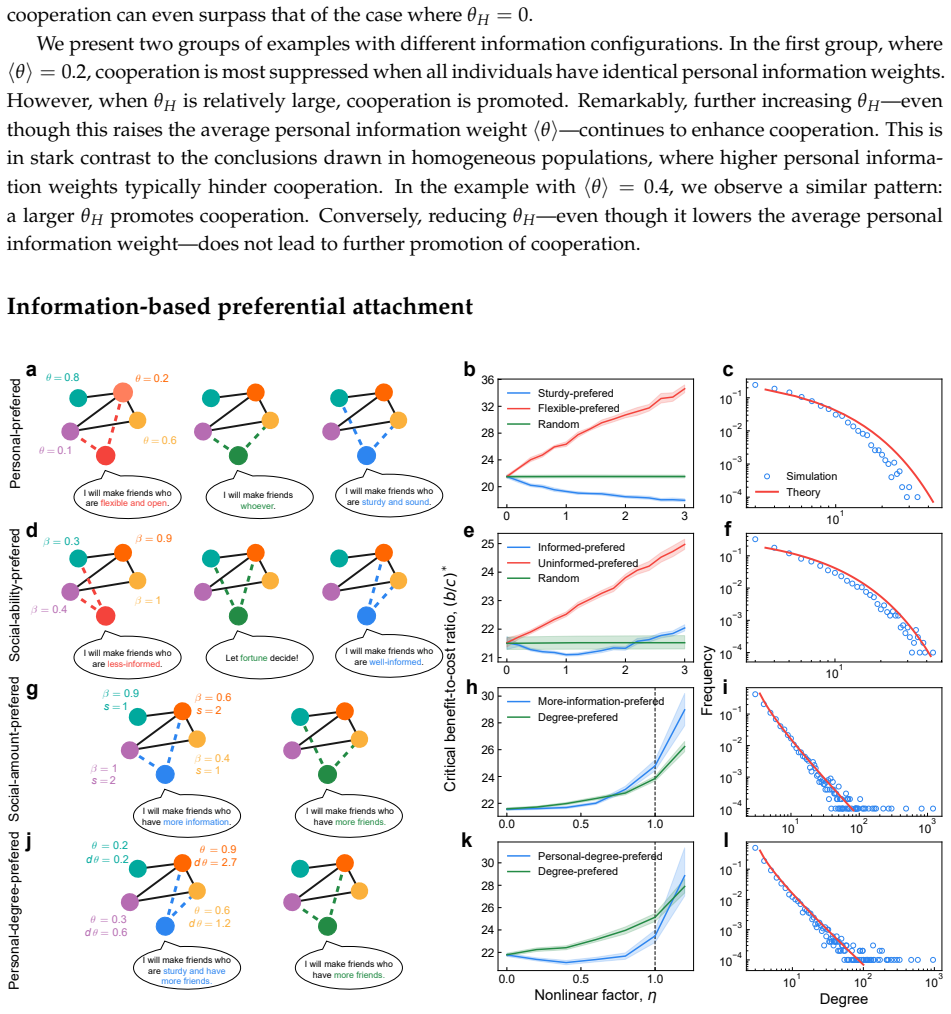
A novel dynamical update rule lets every individual vary both the weight placed on personal information and the amount of social information sampled from neighbors. Under this rule, highly connected nodes that lean more on personal information and draw on more social information drive significantly higher population-wide cooperation; the enhancement disappears entirely on homogeneous networks. Preferential attachment to well-informed, high-personal-information nodes further raises cooperation. Cooperators benefit disproportionately from greater personal-information weight, while social information influences cooperators and defectors to the same degree. The prediction is confirmed on GitHub.
What carries the argument
A dynamical update rule in which each individual independently varies the weight of personal information and the volume of social information used to revise its strategy.
If this is right
- Structural heterogeneity ceases to suppress cooperation once the update rule incorporates individual variation in information weighting.
- Cooperators obtain a decisive payoff advantage over defectors when they place greater weight on personal information.
- Social information influences the success of cooperation and defection to the same extent.
- Preferential linking toward nodes that are both well-informed and high in personal-information weight raises collective cooperation.
- The cooperation-enhancing effect is absent when interaction networks are homogeneous.
Where Pith is reading between the lines
- Platform designs that increase personal-information access for central users could measurably raise collaborative output.
- The same information-weighting mechanism may govern cooperation in non-network settings such as repeated public-goods games with private signals.
- Experiments that directly manipulate personal-information weight for high-degree participants could test the predicted reversal of structural suppression.
Load-bearing premise
Individuals actually adjust the relative weight of personal versus social information in the way the update rule assumes when they revise their strategies.
What would settle it
A controlled simulation or GitHub-style data set in which the most connected nodes are forced to use only equal or low personal-information weights and cooperation fails to rise above the level seen on homogeneous networks.
Figures




read the original abstract
Heterogeneity in individual characteristics and behaviour is a fundamental property of complex dynamical systems. While previous studies on evolutionary dynamics of strategies evolution in various systems have predominantly focused on the structural heterogeneity, dynamical heterogeneity in individuals' strategy update has been largely neglected. Here, we introduce a novel dynamical update mechanism based on individuals' decision-making information, comprising personal and social components. This update rule allows each individual to vary in the weight of personal information and the amount of social information, capturing the general scenario of dynamically heterogeneous populations. We find that cooperation, as a collective prosocial outcome, is significantly enhanced when highly connected individuals on interaction network rely more heavily on personal information and access more social information. This effect is notably absent in homogeneous networks, thereby overturning the prevailing consensus that structural heterogeneity inherently suppresses cooperation. This theoretical prediction is further validated by empirical evidence from GitHub collaboration networks. Furthermore, individuals preferentially linking to those who are well-informed and possess greater personal information further promotes collective cooperation. We additionally reveal that cooperators gain a decisive advantage when relying more on personal information compared to defectors, whereas social information affects cooperators and defectors equivalently. Our findings offer profound insights into how dynamical heterogeneity fundamentally shapes the evolution of collective cooperation in complex systems.
Editorial analysis
A structured set of objections, weighed in public.
Referee Report
Summary. The paper claims that a novel dynamical heterogeneity in strategy updating—where each agent varies the weight placed on personal information versus the quantity of social information sampled—reverses the established suppression of cooperation by structural heterogeneity in networks. Specifically, when high-degree nodes weight personal information more heavily and access more social information, cooperation levels rise substantially in heterogeneous networks but not in homogeneous ones. This prediction is supported by simulations and validated empirically on GitHub collaboration networks; additional results show that preferential attachment to well-informed nodes further promotes cooperation and that cooperators gain a selective advantage from heavier reliance on personal information.
Significance. If the central result holds, the work would be significant for evolutionary game theory on networks by identifying a dynamical mechanism that can overcome the exploitation disadvantage typically faced by cooperators on heterogeneous graphs. The empirical validation against real collaboration data strengthens the claim beyond pure theory. However, the absence of comparisons to standard update rules (imitation, replicator, best-response) and lack of calibration to choice data limit the immediate impact; the result would need to be shown robust rather than tied to the specific functional form of the new rule.
major comments (3)
- [Model definition and simulation sections] The central claim that dynamical heterogeneity reverses structural suppression rests on the specific functional form of the novel update rule (high-degree nodes weighting personal information more while sampling more social information). No comparison is provided to standard rules such as imitation or replicator dynamics to demonstrate that the reversal is not an artifact of the chosen weighting; without this, it is unclear whether the effect survives under alternative information-processing assumptions. (Model definition and simulation sections)
- [Empirical validation section] The empirical validation on GitHub data is presented as confirmation of the theoretical prediction, yet the manuscript does not specify how the parameters governing personal-information weight and social-information quantity are determined or fitted from the collaboration data. This raises the possibility that the reported cooperation enhancement is produced by post-hoc tuning rather than an a priori prediction. (Empirical validation section)
- [Results on homogeneous vs. heterogeneous networks] The assertion that the effect is 'notably absent in homogeneous networks' and thereby overturns the consensus requires explicit demonstration that the reversal persists across a range of payoff parameters, network sizes, and update frequencies; only selected cases appear to be shown. (Results on homogeneous vs. heterogeneous networks)
minor comments (2)
- [Abstract] Abstract: 'strategies evolution' should read 'strategy evolution'.
- [Model section] Notation for the personal-information weight and social-information quantity parameters should be introduced with explicit symbols and ranges at first use rather than described only in prose.
Simulated Author's Rebuttal
We thank the referee for the constructive and insightful comments, which have helped us identify areas where the manuscript can be strengthened. We address each major comment below and indicate the revisions we will make in the next version of the manuscript.
read point-by-point responses
-
Referee: The central claim that dynamical heterogeneity reverses structural suppression rests on the specific functional form of the novel update rule (high-degree nodes weighting personal information more while sampling more social information). No comparison is provided to standard rules such as imitation or replicator dynamics to demonstrate that the reversal is not an artifact of the chosen weighting; without this, it is unclear whether the effect survives under alternative information-processing assumptions. (Model definition and simulation sections)
Authors: We acknowledge the value of benchmarking against established update rules to confirm that the observed reversal arises from the introduced dynamical heterogeneity rather than the specific functional form alone. Our manuscript focuses on the novel mechanism of heterogeneous weighting of personal versus social information, which is distinct from standard homogeneous rules. In the revised manuscript, we will add comparative simulations using imitation dynamics and replicator dynamics on both heterogeneous and homogeneous networks. These will demonstrate that the reversal of structural suppression is tied to the dynamical heterogeneity and does not appear under the standard rules, thereby addressing the concern about potential artifacts. revision: yes
-
Referee: The empirical validation on GitHub data is presented as confirmation of the theoretical prediction, yet the manuscript does not specify how the parameters governing personal-information weight and social-information quantity are determined or fitted from the collaboration data. This raises the possibility that the reported cooperation enhancement is produced by post-hoc tuning rather than an a priori prediction. (Empirical validation section)
Authors: We appreciate this point regarding transparency in the empirical section. The parameters in the GitHub analysis were set based on directly observable network properties (degree for social information quantity and a proxy for personal information reliance derived from collaboration patterns), rather than post-hoc fitting to maximize cooperation. However, the manuscript does not explicitly detail this mapping. In the revised version, we will expand the empirical validation section to provide a clear, step-by-step description of how each parameter is determined a priori from the collaboration data, including any assumptions and robustness checks against alternative mappings. This will clarify that the validation follows from the theoretical prediction without tuning. revision: yes
-
Referee: The assertion that the effect is 'notably absent in homogeneous networks' and thereby overturns the consensus requires explicit demonstration that the reversal persists across a range of payoff parameters, network sizes, and update frequencies; only selected cases appear to be shown. (Results on homogeneous vs. heterogeneous networks)
Authors: We agree that demonstrating robustness across parameter regimes is essential to support the claim that the effect overturns the consensus on structural heterogeneity. The main text presents representative cases for clarity, with additional supporting results in the supplementary material. To fully address this comment, the revised manuscript will include expanded results (in the main text or a dedicated supplementary section) showing the persistence of the reversal in heterogeneous networks—and its absence in homogeneous ones—across a wider range of payoff parameters (e.g., varying temptation and sucker payoffs), network sizes, and update frequencies. These will be presented as systematic sweeps to confirm the generality of the findings. revision: yes
Circularity Check
No significant circularity detected in the derivation chain
full rationale
The paper introduces a novel update rule defined in terms of personal and social information components that individuals can vary independently. It then runs evolutionary simulations on heterogeneous networks to obtain the result that cooperation increases when high-degree nodes weight personal information more heavily and sample more social information. This outcome is not equivalent to the inputs by construction; it emerges from the interaction of the defined rule with network topology and strategy evolution. No parameters are fitted to the target cooperation levels and then relabeled as predictions. No self-citation load-bearing steps, uniqueness theorems imported from prior author work, or ansatzes smuggled via citation appear in the abstract or described mechanism. The GitHub empirical validation is presented as external corroboration rather than the source of the model parameters or the central claim. The derivation therefore retains independent content from the model definition and simulation results.
Axiom & Free-Parameter Ledger
free parameters (2)
- weight of personal information
- amount of social information accessed
axioms (2)
- domain assumption Individuals update strategies using a combination of personal payoff history and social information from neighbors.
- standard math Payoff-driven strategy evolution on a fixed interaction network.
Reference graph
Works this paper leans on
-
[1]
McDonnell, M. D. & Ward, L. M. The benefits of noise in neural systems: bridging theory and experi- ment.Nat. Rev. Neurosci.12, 415–425 (2011)
2011
-
[2]
Watts, D. J. & Strogatz, S. H. Collective dynamics of ‘small-world’networks.Nature393, 440–442 (1998)
1998
-
[3]
Scale-free networks: a decade and beyond.Science325, 412–413 (2009)
Barab ´asi, A.-L. Scale-free networks: a decade and beyond.Science325, 412–413 (2009)
2009
-
[4]
& Albert, R
Barab ´asi, A.-L. & Albert, R. Emergence of scaling in random networks.Science286, 509–512 (1999)
1999
-
[5]
& Faust, K.Social network analysis: Methods and applications(Cambridge university press, 1994)
Wasserman, S. & Faust, K.Social network analysis: Methods and applications(Cambridge university press, 1994)
1994
-
[6]
R., Kaiser, M
Sporns, O., Chialvo, D. R., Kaiser, M. & Hilgetag, C. C. Organization, development and function of complex brain networks.Trends Cogn. Sci.8, 418–425 (2004)
2004
-
[7]
A., Williams, R
Dunne, J. A., Williams, R. J. & Martinez, N. D. Food-web structure and network theory: the role of connectance and size.Proc. Natl. Acad. Sci.99, 12917–12922 (2002)
2002
-
[8]
& Barab ´asi, A.-L
Albert, R. & Barab ´asi, A.-L. Statistical mechanics of complex networks.Rev. Mod. Phys.74, 47 (2002)
2002
-
[9]
Newman, M. E. The structure and function of complex networks.SIAM Rev.45, 167–256 (2003)
2003
-
[10]
& Hwang, D.-U
Boccaletti, S., Latora, V ., Moreno, Y., Chavez, M. & Hwang, D.-U. Complex networks: Structure and dynamics.Phys. Rep.424, 175–308 (2006)
2006
-
[11]
Santos, F. C. & Pacheco, J. M. Scale-free networks provide a unifying framework for the emergence of cooperation.Phys. Rev. Lett.95, 098104 (2005)
2005
-
[12]
Allen, B.et al.Evolutionary dynamics on any population structure.Nature544, 227–230 (2017)
2017
-
[13]
& Nowak, M
McAvoy, A., Allen, B. & Nowak, M. A. Social goods dilemmas in heterogeneous societies.Nat. Hum. Behav.4, 819–831 (2020)
2020
-
[14]
& Nowak, M
Ohtsuki, H., Hauert, C., Lieberman, E. & Nowak, M. A. A simple rule for the evolution of cooperation on graphs and social networks.Nature441, 502–505 (2006)
2006
-
[15]
Ohtsuki, H., Pacheco, J. M. & Nowak, M. A. Evolutionary graph theory: Breaking the symmetry between interaction and replacement.J. Theor. Biol.246, 681–694 (2007)
2007
-
[16]
Wang, X., Zhou, L., McAvoy, A. & Li, A. Imitation dynamics on networks with incomplete information. Nat. Commun.14, 7453 (2023)
2023
-
[17]
& S´anchez, A
Cardillo, A., G ´omez-Garde˜nes, J., Vilone, D. & S´anchez, A. Co-evolution of strategies and update rules in the prisoner’s dilemma game on complex networks.New J. Phys.12, 103034 (2010)
2010
-
[18]
Effects of updating rules on the coevolving prisoner’s dilemma.Physica A513, 399–408 (2019)
Takesue, H. Effects of updating rules on the coevolving prisoner’s dilemma.Physica A513, 399–408 (2019)
2019
-
[19]
You, T.et al.The effects of heterogeneity of updating rules on cooperation in spatial network.Appl. Math. Comput.372, 124959 (2020). 17
2020
-
[20]
P ., Liu, Y.-Y
Meng, Y., Cornelius, S. P ., Liu, Y.-Y. & Li, A. Dynamics of collective cooperation under personalised strategy updates.Nat. Commun.15, 3125 (2024)
2024
-
[21]
The spread of behavior in an online social network experiment.Science329, 1194–1197 (2010)
Centola, D. The spread of behavior in an online social network experiment.Science329, 1194–1197 (2010)
2010
-
[22]
& Vespignani, A
Pastor-Satorras, R. & Vespignani, A. Immunization of complex networks.Phys. Rev. E65, 036104 (2002)
2002
-
[23]
& Prusak, L
Cross, R. & Prusak, L. The people who make organizations go–or stop.Networks in the Knowledge Economy80, 248–260 (2002)
2002
-
[24]
Granovetter, M. S. The strength of weak ties.Am. J. Sociol.78, 1360–1380 (1973)
1973
-
[25]
19 (Cambridge university press, 2002)
Lin, N.Social capital: A theory of social structure and action, vol. 19 (Cambridge university press, 2002)
2002
-
[26]
E.A structural theory of social influence.(Cambridge University Press, 1998)
Friedkin, N. E.A structural theory of social influence.(Cambridge University Press, 1998)
1998
-
[27]
& Welch, I
Bikhchandani, S., Hirshleifer, D. & Welch, I. A theory of fads, fashion, custom, and cultural change as informational cascades.J. Polit. Economy100, 992–1026 (1992)
1992
-
[28]
& Gintis, H
Bowles, S. & Gintis, H. A cooperative species: Human reciprocity and its evolution. InA cooperative species(Princeton University Press, 2011)
2011
-
[29]
Haidt, J.The righteous mind: Why good people are divided by politics and religion(Vintage, 2012)
2012
-
[30]
& Wang, L
Zhou, L., Wu, B., Du, J. & Wang, L. Aspiration dynamics generate robust predictions in heterogeneous populations.Nat. Commun.12, 1–9 (2021)
2021
-
[31]
Alvarez-Rodriguez, U.et al.Evolutionary dynamics of higher-order interactions in social networks. Nat. Hum. Behav.5, 586–595 (2021)
2021
-
[32]
Wang, X., Zhou, L., McAvoy, A., Tian, Z. & Li, A. Strategy evolution on temporal hypergraphs.Proc. Natl. Acad. Sci.123, e2516380123 (2026)
2026
-
[33]
Commun.11, 1–9 (2020)
Li, A.et al.Evolution of cooperation on temporal networks.Nat. Commun.11, 1–9 (2020). 18
2020
discussion (0)
Sign in with ORCID, Apple, or X to comment. Anyone can read and Pith papers without signing in.