Recognition: unknown
Do Solar Energetic Electrons cross the Heliospheric Current Sheet? - A Statistical Study
Pith reviewed 2026-05-10 01:57 UTC · model grok-4.3
The pith
Solar energetic electrons rarely cross the heliospheric current sheet unless the source or spacecraft is close to it.
A machine-rendered reading of the paper's core claim, the machinery that carries it, and where it could break.
Core claim
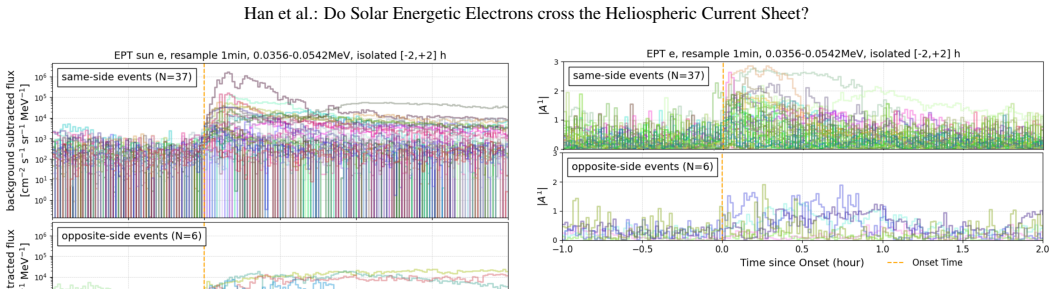
Analysis of 60 same-side and 9 opposite-side solar energetic electron events shows that opposite-side events tend to be more isotropic and occur when both the solar source region and the spacecraft lie closer to the heliospheric current sheet. This leads to the conclusion that transport across the HCS is inefficient unless the source or the observer is close to the HCS.
What carries the argument
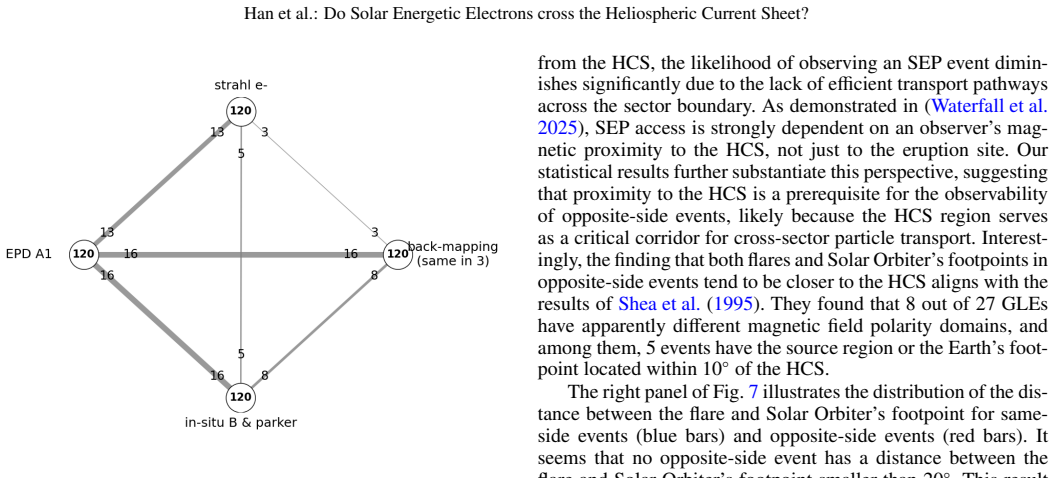
Classification of events into same-side versus opposite-side magnetic sectors using potential field source surface models together with in-situ magnetic field data, strahl electron pitch angle distributions, and first-order anisotropy.
If this is right
- Most solar energetic electron events remain on the same magnetic side as their source region.
- Opposite-side events require proximity of either the source or the observer to the HCS.
- Particle angular distributions become more isotropic during the rare crossings of the HCS.
- Distance to the HCS is a controlling factor for whether particles can reach opposite magnetic sectors.
Where Pith is reading between the lines
- The HCS functions as a barrier to solar energetic particle propagation except near the sheet itself.
- Transport models should treat distance to the HCS as a primary parameter rather than assuming free crossing.
- Targeted observations near the HCS could isolate the specific processes that occasionally permit crossing.
Load-bearing premise
The combination of PFSS models, in-situ magnetic field measurements, and electron anisotropy can reliably determine whether the solar source and spacecraft are on the same or opposite sides of the HCS.
What would settle it
Discovery of many opposite-side events in which the solar source and spacecraft are both far from the HCS would contradict the claim of inefficient crossing.
Figures






read the original abstract
Solar eruptive events such as flares and coronal mass ejection (CME)-driven shocks can release solar energetic particles (SEPs) into the heliosphere. The heliospheric current sheet (HCS) is a large-scale structure that separates regions of opposite magnetic polarity, and its influence on SEP propagation remains poorly understood. We classify SEE events into two groups: same-side events, where both the solar source and spacecraft are in the same magnetic sector, and opposite-side events. The magnetic polarities of the solar source region and the spacecraft location are determined comprehensively based on Potential Field Source Surface (PFSS), magnetic field measurements, the pitch angle distribution of strahl electrons, and the first-order anisotropy of energetic electrons. The spacecraft magnetic polarities determined by footpoint positions at the source surface and in-situ observations are consistent for most events, providing a useful methodological reference for future studies. We identify 60 same-side events and 9 opposite-side events. Our results show that opposite-side events tend to be more isotropic, and that both the solar source and the spacecraft are closer to the HCS than in same-side events. This suggests that particle transport across the HCS is inefficient unless the source or the observer is close to the HCS. These preliminary statistical findings advance our understanding of the role of the HCS in shaping SEP transport.
Editorial analysis
A structured set of objections, weighed in public.
Referee Report
Summary. The paper reports a statistical classification of solar energetic electron (SEE) events into same-side (60 events) and opposite-side (9 events) categories relative to the heliospheric current sheet (HCS), using multiple polarity indicators (PFSS footpoint mapping, in-situ magnetic field, strahl electron pitch-angle distributions, and first-order anisotropy). It finds that the 9 opposite-side events are more isotropic and occur when both the solar source and spacecraft are closer to the HCS, leading to the inference that cross-HCS transport is inefficient unless the source or observer is near the sheet.
Significance. If the polarity assignments and reported trends hold after uncertainty quantification, the work would provide useful observational constraints on SEP propagation across large-scale magnetic structures, complementing existing modeling efforts. The multi-indicator consistency check for spacecraft polarity is a methodological strength that could serve as a reference for future studies.
major comments (2)
- [Event classification and results] The headline inference (inefficient transport unless close to the HCS) rests entirely on the contrast between the 60 same-side and 9 opposite-side events, including their reported differences in isotropy and proximity to the HCS. The manuscript states that the four polarity indicators are consistent for most events but does not quantify how many of the 9 opposite-side cases lie near sector boundaries (where any single indicator can flip) or propagate classification uncertainty into the distance-to-HCS and isotropy statistics. With only nine events, even two or three misclassifications would erase or reverse the reported difference.
- [Methods and abstract] The abstract and methods description provide no details on event selection criteria, statistical significance testing for the isotropy and proximity trends, error analysis, or assessment of selection biases. These omissions leave the central claim only moderately supported, as noted in the soundness evaluation.
minor comments (2)
- [Results] A supplementary table listing the 9 opposite-side events with their individual polarity indicators, distances to the HCS, and anisotropy values would improve transparency and allow readers to assess the robustness of the trends.
- [Data analysis] The manuscript would benefit from explicit discussion of how the first-order anisotropy is computed and thresholded to classify events.
Simulated Author's Rebuttal
We thank the referee for the constructive and detailed review of our manuscript. We appreciate the recognition of the multi-indicator consistency check as a methodological strength. We address the major comments below and will revise the manuscript to incorporate additional details, quantifications, and analyses as outlined.
read point-by-point responses
-
Referee: [Event classification and results] The headline inference (inefficient transport unless close to the HCS) rests entirely on the contrast between the 60 same-side and 9 opposite-side events, including their reported differences in isotropy and proximity to the HCS. The manuscript states that the four polarity indicators are consistent for most events but does not quantify how many of the 9 opposite-side cases lie near sector boundaries (where any single indicator can flip) or propagate classification uncertainty into the distance-to-HCS and isotropy statistics. With only nine events, even two or three misclassifications would erase or reverse the reported difference.
Authors: We agree that the small sample of opposite-side events requires careful handling of classification uncertainty. The manuscript already emphasizes that the four indicators (PFSS, in-situ field, strahl PAD, and anisotropy) are consistent for most events, which reduces the likelihood of misclassification compared to single-indicator approaches. To directly address the concern, we will add a supplementary table in the revised manuscript that lists, for each of the 9 opposite-side events: (i) the specific polarity assignment from each indicator, (ii) the source and spacecraft distances to the HCS, (iii) the isotropy index, and (iv) proximity to sector boundaries. We will also include a sensitivity test showing how the reported trends in isotropy and proximity change if the two or three events closest to boundaries are reclassified. This will allow readers to evaluate the robustness of the inference that cross-HCS transport is inefficient unless near the sheet. revision: yes
-
Referee: [Methods and abstract] The abstract and methods description provide no details on event selection criteria, statistical significance testing for the isotropy and proximity trends, error analysis, or assessment of selection biases. These omissions leave the central claim only moderately supported, as noted in the soundness evaluation.
Authors: We acknowledge these omissions in the current version. In the revised manuscript we will expand the Methods section to specify the event selection criteria (including energy range, intensity thresholds, and time windows for SEE identification), the exact statistical tests applied to the isotropy and distance distributions (e.g., two-sample Kolmogorov-Smirnov tests with p-values), error estimates on HCS distances derived from PFSS and in-situ data, and a discussion of potential selection biases (such as those arising from spacecraft orbital coverage or flare visibility). The abstract will be updated to note that the trends are supported by these quantitative checks. These additions will make the analysis fully reproducible and strengthen the evidential basis for the conclusions. revision: yes
Circularity Check
Observational classification and statistics contain no circular derivation steps
full rationale
The paper is a purely statistical observational study. Events are classified as same-side or opposite-side using four independent external indicators (PFSS footpoint mapping, in-situ |B| polarity, strahl PAD, and first-order anisotropy), which are cross-checked for consistency. The reported contrast (60 same-side vs. 9 opposite-side events, with the latter closer to the HCS and more isotropic) follows directly from these classifications and measured distances/isotropy values. No equations, fits, predictions, ansatzes, or self-citations reduce the central claim to its own inputs by construction; the derivation chain is open and benchmarked against external data and models.
Axiom & Free-Parameter Ledger
axioms (1)
- domain assumption Magnetic polarity at the source surface and spacecraft can be reliably determined by combining PFSS models with in-situ magnetic field, strahl pitch angle, and anisotropy data.
Reference graph
Works this paper leans on
-
[1]
Astronomy and Astrophysics , author =
A first rapid synoptic magnetic field map using. Astronomy and Astrophysics , author =. 2024 , pages =. doi:10.1051/0004-6361/202346046 , abstract =
-
[2]
Park, Jinhye and Bucik, Radoslav and Jeong, Hyun-Jin and Moon, Yong-Jae , month = dec, year =. Fe/. Astrophysical Journal , publisher =. doi:10.3847/1538-4357/ad843e , abstract =
-
[3]
2007, Journal of Geophysical Research (Space Physics), 112, A06107, doi: 10.1029/2006JA012205
Influence of solar flare's location and heliospheric current sheet on the associated shock's arrival at. Journal of Geophysical Research: Space Physics , author =. 2007 , pages =. doi:10.1029/2006JA012205 , abstract =
-
[4]
Luhmann, J. G. and Li, Yan and Bercik, D. J. and Wang, Linghua and Odstrcil, D. , year =. Issues in heliospheric field mapping to flare. doi:10.1063/1.4768737 , abstract =
-
[5]
Evaluation of a potential field source surface model with elliptical source surfaces via ballistic back mapping of in situ spacecraft data. , keywords =. doi:10.1051/0004-6361/202039120 , adsurl =
-
[6]
An elliptic expansion of the potential field source surface model. , keywords =. doi:10.1051/0004-6361/202037734 , archivePrefix =. 2005.12843 , primaryClass =
-
[7]
Reviews of Geophysics and Space Physics , keywords =
Electric currents in cosmic plasma. Reviews of Geophysics and Space Physics , keywords =. doi:10.1029/RG015i003p00271 , adsurl =
-
[8]
林 芝 市 太 阳 辐 射 强 度的分析 , doi =
World, L O W Carbon , year =. 林 芝 市 太 阳 辐 射 强 度的分析 , doi =
-
[9]
Radiative transfer by subrahmanyan chandrasekhar (z-lib.org).pdf , language =
-
[10]
The model of the solar radiation energy ' s establishment and verification , language =
Yuan, L I N , year =. The model of the solar radiation energy ' s establishment and verification , language =
-
[11]
Monthly Notices of the Royal Astronomical Society , author =
Diagnosing solar wind origins using. Monthly Notices of the Royal Astronomical Society , author =. 2019 , note =. doi:10.1093/mnras/sty2814 , abstract =
-
[12]
Advances in Astronomy , author =
Measurement by. Advances in Astronomy , author =. 2012 , pages =. doi:10.1155/2012/379304 , abstract =
-
[13]
Radiation Measurements , author =
Neutron measurements onboard the space shuttle , volume =. Radiation Measurements , author =. 2001 , pages =. doi:10.1016/S1350-4487(00)00159-1 , abstract =
-
[15]
in the 2005 september 7 solar flare , language =
Valde, J F and Terasawa, T and Saito, Y and Mukai, T and Gros, M , year =. in the 2005 september 7 solar flare , language =
2005
-
[16]
Astrophysical Journal , author =
Solar neutron event in association with a large solar flare on 2000 november 24 , volume =. Astrophysical Journal , author =. 2003 , pages =. doi:10.1086/375685 , abstract =
-
[17]
29th International Cosmic Ray Conference, ICRC 2005 , author =
Solar neutron events associated with large solar flares in solar cycle 23 , volume =. 29th International Cosmic Ray Conference, ICRC 2005 , author =. 2005 , pages =
2005
-
[18]
Herzberg institute of astrophysics, national research council , volume =
Wilson, Margaret D , year =. Herzberg institute of astrophysics, national research council , volume =
-
[19]
Astrophysical Journal , author =
Solar neutron events of 2003 october–november , volume =. Astrophysical Journal , author =. 2006 , pages =. doi:10.1086/498086 , abstract =
-
[20]
Planetary and Space Science , author =
Laboratory astrophysics and space research , volume =. Planetary and Space Science , author =. 2000 , pages =. doi:10.1016/S0032-0633(99)00066-5 , abstract =
-
[21]
用 羊八 井 太 阳宇 宙线 探测 装 置对 太 阳 耀斑 中子 的 初 步 探 测 , language =
-
[22]
Advances in Space Research , author =
Solar neutron events as a tool to study particle acceleration at the sun , volume =. Advances in Space Research , author =. 2009 , keywords =. doi:10.1016/j.asr.2008.09.023 , abstract =
-
[23]
Astrophysical Journal , author =
Solar neutron emissivity during the large flare on 1982 june 3 , volume =. Astrophysical Journal , author =. 1987 , pages =. doi:10.1086/165423 , abstract =
-
[24]
Astrophysical Journal Supplement Series , author =
Solar neutron decay proton observations in cycle 21 , volume =. Astrophysical Journal Supplement Series , author =. 1990 , pages =. doi:10.1086/191462 , abstract =
-
[25]
Space Science Reviews , author =
Neutron measurements in space , volume =. Space Science Reviews , author =. 1973 , pages =. doi:10.1007/BF00166645 , abstract =
-
[26]
Student journal of physics , volume =
Edition, International , year =. Student journal of physics , volume =
-
[27]
Astrophysical Journal Supplement Series , author =
Using gamma-ray and neutron emission to determine solar flare accelerated particle spectra and composition and the conditions within the flare magnetic loop , volume =. Astrophysical Journal Supplement Series , author =. 2007 , keywords =. doi:10.1086/509637 , abstract =
-
[28]
Astrophysics and Space Sciences Transactions , author =
Measurement of high-energy neutrons at. Astrophysics and Space Sciences Transactions , author =. 2011 , pages =. doi:10.5194/astra-7-411-2011 , language =
-
[29]
Benker, Nicole and Echeverria, Elena and Olesen, Robert and Kananen, Brant and McClory, John and Burak, Yaroslav and Adamiv, Volodymyr and Teslyuk, Ihor and Peterson, George and Bradley, Ben and Wilson, Ethiyal R. and Petrosky, James and Dong, Bin and Kelber, Jeffry and Hamblin, Jennifer and Doumani, Jacques and Dowben, Peter A. and Enders, Axel , month =...
-
[30]
Development of the ÿber neutron monitor for the energy range 15 – 100
Koga, K and Goka, T and Matsumoto, H and Muraki, Y and Masuda, K and Matsubara, Y , year =. Development of the ÿber neutron monitor for the energy range 15 – 100
-
[31]
Measurement of the radiation exposure for high altitude flights in the polar region , language =
Möller, Thomas , year =. Measurement of the radiation exposure for high altitude flights in the polar region , language =
-
[32]
Neutron radiation effects of space environment and measuring technique , language =
Effects, Neutron Radiation and Environment, Space and Technique, Measuring , year =. Neutron radiation effects of space environment and measuring technique , language =
-
[33]
Geophysical Research Letters , author =
Relativistic solar neutrons and protons on 28 october 2003 , volume =. Geophysical Research Letters , author =. 2005 , pages =. doi:10.1029/2004GL021492 , abstract =
-
[34]
空间辐射环境概述 , language =
-
[35]
Space Science Reviews , author =
Properties of energetic ions in the solar atmosphere from γ-ray and neutron observations , volume =. Space Science Reviews , author =. 2011 , note =. doi:10.1007/s11214-010-9728-x , abstract =
-
[36]
Journal of Geophysical Research: Space Physics , author =
Evidence for extended acceleration of solar flare ions from 1–8. Journal of Geophysical Research: Space Physics , author =. 2010 , keywords =. doi:10.1029/2009JA014535 , abstract =
-
[37]
Gamma / neutron separation in the martian radiation environment dissertation , language =
Köhler, Jan , year =. Gamma / neutron separation in the martian radiation environment dissertation , language =
-
[38]
Particle flux directionality and other aspects of the martian radiation environment data , language =
Appel, Jan Kristoffer , year =. Particle flux directionality and other aspects of the martian radiation environment data , language =
-
[39]
Astrophysical Journal Supplement Series , author =
Angular and energy-dependent neutron emission from solar flare magnetic loops , volume =. Astrophysical Journal Supplement Series , author =. 2002 , pages =. doi:10.1086/339372 , abstract =
-
[40]
Dorman, L. I. , year =. Solar neutrons and related phenomena , isbn =
-
[41]
Astrophysical Journal Supplement Series , author =
The production of low-energy neutrons in solar flares and the importance of their detection in the inner heliosphere , volume =. Astrophysical Journal Supplement Series , author =. 2012 , keywords =. doi:10.1088/0067-0049/202/1/3 , abstract =
-
[42]
科学通报 , author =
太阳中子事件的观测特征与中子能谱的计算 , volume =. 科学通报 , author =. 2008 , note =
2008
-
[43]
Astroparticle Physics , author =
A solar neutron telescope in tibet and its capability examined by the 1998 november 28th event , volume =. Astroparticle Physics , author =. 2007 , keywords =. doi:10.1016/j.astropartphys.2007.04.012 , abstract =
-
[44]
Detection efficiency of a new type of solar neutron detector calibrated by an accelerator neutron beam , volume =. Nuclear Instruments and Methods in Physics Research Section A: Accelerators, Spectrometers, Detectors and Associated Equipment , author =. 2001 , keywords =. doi:10.1016/S0168-9002(01)00290-X , abstract =
-
[45]
Astrophysical Journal Letters , author =
First report of a solar energetic particle event observed by. Astrophysical Journal Letters , author =. 2022 , pages =. doi:10.3847/2041-8213/ac80f5 , abstract =
-
[46]
Astronomy and Astrophysics , author =
The first widespread solar energetic particle event observed by solar orbiter on 2020 november 29 , volume =. Astronomy and Astrophysics , author =. 2021 , keywords =. doi:10.1051/0004-6361/202140937 , abstract =
-
[47]
Journla of Geophysical Research , author =
Propagation of solar neutrons through the atmosphere of the. Journla of Geophysical Research , author =. 1994 , keywords =. doi:10.1029/93JA03175 , language =
-
[48]
Annales Geophysicae , author =
The world neutron monitor network as a tool for the study of solar neutrons , volume =. Annales Geophysicae , author =. 1997 , pages =. doi:10.1007/s00585-997-0375-9 , abstract =
-
[49]
Astroparticle Physics , author =
Possible evidence for ⩾ 10. Astroparticle Physics , author =. 1992 , pages =. doi:10.1016/0927-6505(92)90006-L , abstract =
-
[50]
Astrophysical Journal , author =
Observation of. Astrophysical Journal , author =. 2003 , pages =. doi:10.1086/373950 , abstract =
-
[51]
Kao Neng Wu Li Yu Ho Wu Li/High Energy Physics and Nuclear Physics , author =
Observation of the 2005 january 20. Kao Neng Wu Li Yu Ho Wu Li/High Energy Physics and Nuclear Physics , author =. 2007 , keywords =
2005
-
[52]
Astrophysical Journal , author =
Observation of solar neutrons associated with the large flare on 1991 june 4 , volume =. Astrophysical Journal , author =. 1992 , pages =. doi:10.1086/186653 , abstract =
-
[53]
Solar Physics , author =
Gamma-rays and neutrons as a probe of flare proton spectra: the solar flare of 11 june 1991 , volume =. Solar Physics , author =. 1999 , pages =
1991
-
[54]
Zeitschrift Für Naturforschung a , author =
Neutrale ultrastrahlung von der sonne , volume =. Zeitschrift Für Naturforschung a , author =. 1951 , pages =. doi:10.1515/zna-1951-0107 , abstract =
-
[55]
Astrophysical Journal , author =
Protons from the decay of solar flare neutrons , volume =. Astrophysical Journal , author =. 1983 , note =. doi:10.1086/161500 , abstract =
-
[56]
Astrophysical Journal , author =
A direct observation of solar neutrons following the 0118. Astrophysical Journal , author =. 1982 , note =. doi:10.1086/183931 , abstract =
-
[57]
The relationship between solar flare gamma-ray emission and neutron production , volume =. Solar Physics , author =. 1997 , pages =. doi:10.1023/A:1004908209975 , abstract =
-
[58]
Journal of Geophysical Research: Space Physics , author =
Seven decades of neutron monitors (1951–2019): overview and evaluation of data sources , volume =. Journal of Geophysical Research: Space Physics , author =. 2021 , keywords =. doi:10.1029/2020JA028941 , abstract =
-
[59]
Neutron and electromagnetic emissions during the 1990 may 24 solar flare , volume =. Solar Physics , author =. 1994 , pages =. doi:10.1007/BF00670736 , abstract =
-
[60]
Journal of Geophysical Research: Space Physics , author =
Physics of solar neutron production: questionable detection of neutrons from the 31 december 2007 flare:. Journal of Geophysical Research: Space Physics , author =. 2011 , keywords =. doi:10.1029/2010JA015930 , abstract =
-
[61]
Advances in Space Research , author =
Highly significant detection of solar neutrons on 2005 september 7 , volume =. Advances in Space Research , author =. 2007 , keywords =. doi:10.1016/j.asr.2006.10.021 , abstract =
-
[62]
Astrophysical Journal , author =
Energetic neutrons, protons, and gamma rays during the 1990 may 24 solar cosmic-ray event , volume =. Astrophysical Journal , author =. 1997 , pages =. doi:10.1086/303895 , abstract =
-
[63]
Solar flares: the impulsive phase , volume =. Solar Physics , author =. 1989 , pages =. doi:10.1007/BF00161688 , abstract =
-
[64]
24th International Cosmic Ray Conference , author =
Probable detection of electrons from the decay of solar flare neutrons , volume =. 24th International Cosmic Ray Conference , author =. 1995 , pages =
1995
-
[65]
On the solar neutrons observation on high mountain neutron monitor , volume =. Proc. 18th Internat. Cosmic Ray Conf. , author =. 1983 , pages =
1983
-
[66]
Astrophysical Journal , author =
Surprisingly intense neutron emission from a flare behind the limb of the sun , volume =. Astrophysical Journal , author =. 1999 , pages =. doi:10.1086/306614 , abstract =
-
[67]
Astronomy and Astrophysics , author =
Solar hard. Astronomy and Astrophysics , author =. 2007 , keywords =. doi:10.1051/0004-6361:20066328 , abstract =
-
[68]
Detection of solar neutrons and solar neutron decay protons , language =
Muraki, Yasushi and Koi, Tatsumi and Masuda, Satoshi and Matsubara, Yutaka and Miranda, Pedro and Miyake, Shoko and Naito, Tsuguya and Ortiz, Ernesto and Oshima, Akitoshi and Sako, Takashi and Shibata, Shoichi and Takamaru, Hisanori and Tokumaru, Munetoshi and Valdés-galicia, Jóse F and Watanabe, Kyoko , year =. Detection of solar neutrons and solar neutr...
-
[69]
Rotti, Sumanth and Aydin, Berkay and Georgoulis, Manolis K. and Martens, Petrus C. , month = sep, year =. Integrated geostationary solar energetic particle events catalog:. Astrophysical Journal Supplement Series , publisher =. doi:10.3847/1538-4365/ac87ac , abstract =
-
[70]
Astronomy and Astrophysics , author =
First near-relativistic solar electron events observed by. Astronomy and Astrophysics , author =. 2021 , keywords =. doi:10.1051/0004-6361/202039883 , abstract =
-
[71]
British Journal of Anaesthesia , month = sep, year =
Cover page , volume =. British Journal of Anaesthesia , month = sep, year =. doi:10.1093/bja/aet511 , language =
-
[72]
Geophysical Research Letters , author =
The first ground level enhancement seen on three planetary surfaces: earth, moon, and. Geophysical Research Letters , author =. 2023 , pages =. doi:10.1029/2023GL103069 , abstract =
-
[73]
Astronomy and Astrophysics , author =
The energetic particle detector: energetic particle instrument suite for the solar orbiter mission , volume =. Astronomy and Astrophysics , author =. 2020 , keywords =. doi:10.1051/0004-6361/201935287 , abstract =
-
[74]
Astronomy and Astrophysics , author =
The solar cycle 25 multi-spacecraft solar energetic particle event catalog of the. Astronomy and Astrophysics , author =. 2024 , keywords =. doi:10.1051/0004-6361/202449831 , abstract =
-
[75]
Astronomy and Astrophysics , author =
First year of energetic particle measurements in the inner heliosphere with solar orbiter’s energetic particle detector , volume =. Astronomy and Astrophysics , author =. 2021 , keywords =. doi:10.1051/0004-6361/202140940 , abstract =
-
[76]
Poluianov, S. V. and Usoskin, I. G. and Mishev, A. L. and Shea, M. A. and Smart, D. F. , month = nov, year =. Solar Physics , publisher =. doi:10.1007/s11207-017-1202-4 , abstract =
-
[77]
Detection of solar neutron events and their theoretical approach , issn =. New Astronomy , author =. 2015 , keywords =. doi:10.1016/j.newast.2014.12.010 , abstract =
-
[78]
Near-earth interplanetary coronal mass ejections during solar cycle 23 (1996 – 2009): catalog and summary of properties , volume =. Solar Physics , author =. 2010 , keywords =. doi:10.1007/s11207-010-9568-6 , abstract =
-
[79]
Solar Physics , author =. 2014 , keywords =. doi:10.1007/s11207-014-0524-8 , abstract =
-
[80]
Journal of Geophysical Research: Space Physics , author =
A study of solar energetic particle events of 1997–2006: their composition and associations , volume =. Journal of Geophysical Research: Space Physics , author =. 2010 , keywords =. doi:10.1029/2009JA014848 , abstract =
-
[81]
Journal of Space Weather and Space Climate , author =
The first. Journal of Space Weather and Space Climate , author =. 2013 , keywords =. doi:10.1051/swsc/2013030 , abstract =
discussion (0)
Sign in with ORCID, Apple, or X to comment. Anyone can read and Pith papers without signing in.