Recognition: unknown
Nonequilibrium Kramers Turnover in a Kerr Parametric Oscillator
Pith reviewed 2026-05-10 01:47 UTC · model grok-4.3
The pith
Rescaling the rotating frame isolates a nonequilibrium Kramers turnover in a Kerr parametric oscillator by tuning effective friction independently of the barrier.
A machine-rendered reading of the paper's core claim, the machinery that carries it, and where it could break.
Core claim
In the Kerr parametric oscillator, the strong physical correlation between the activation barrier and intrinsic damping obscures the turnover. Rescaling the rotating-frame dynamics introduces a tunable effective friction controlled entirely by the parametric drive while rescaling the effective temperature. Exploiting this scaling allows extraction of the turnover prefactor directly from temperature-dependent observations of noise-induced phase slips, which exhibit a distinct crossover confirming the out-of-equilibrium turnover regime.
What carries the argument
The rotating-frame rescaling that introduces a tunable effective friction controlled entirely by the parametric drive while simultaneously rescaling the effective temperature.
If this is right
- The competition between dissipation and fluctuations shapes activation dynamics in driven-dissipative systems.
- Temperature-dependent measurements can reveal the turnover prefactor even when barrier height and damping remain physically correlated.
- Phase-slip rates in parametric oscillators display a nonmonotonic dependence on effective coupling strength.
- The out-of-equilibrium turnover regime can be accessed without independent experimental control over barrier and damping.
Where Pith is reading between the lines
- The same rescaling approach could be tested in other driven nonlinear systems such as Josephson parametric amplifiers to isolate similar turnovers.
- Drive engineering to set effective friction might allow deliberate tuning of switching rates in nanomechanical or superconducting devices.
- Quantum extensions of the experiment could check whether zero-point fluctuations alter the location of the turnover crossover.
Load-bearing premise
The rotating-frame rescaling introduces a tunable effective friction controlled entirely by the parametric drive while simultaneously rescaling the effective temperature, and that temperature-dependent observations can thereby extract the turnover prefactor without residual correlation between barrier and damping.
What would settle it
If varying the parametric drive strength produced no distinct crossover in the temperature dependence of the measured prefactor, the isolation of the nonequilibrium turnover regime would not hold.
Figures




read the original abstract
Activation processes govern noise-induced switching between long-lived states. In an equilibrium double well, the thermally activated switching rate exhibits a prefactor with a nonmonotonic dependence on environmental coupling, a foundational crossover known as Kramers turnover. Here, we demonstrate a Kramers turnover analogue in a Kerr parametric oscillator, a driven-dissipative nonlinear system featuring two stable phase states. First, we analytically establish turnover physics in this out-of-equilibrium setting. There, the strong physical correlation between the activation barrier and intrinsic damping fundamentally obscures the underlying turnover physics. To overcome this limitation, we rescale the rotating-frame dynamics and introduce a tunable effective friction controlled entirely by the parametric drive. This rescaling comes at the cost of a concurrent rescaling of the effective temperature. Exploiting this simultaneous scaling, we leverage the effective temperature to extract the turnover directly from temperature-dependent observations. Subsequently, measuring noise-induced phase slips in a micro-electromechanical device, we observe a distinct crossover in the prefactor's temperature dependence. Our results unambiguously isolate the out-of-equilibrium turnover regime and highlight that the competition between dissipation and fluctuations profoundly shapes activation dynamics also beyond equilibrium.
Editorial analysis
A structured set of objections, weighed in public.
Referee Report
Summary. The manuscript analytically derives a nonequilibrium analogue of Kramers turnover for a Kerr parametric oscillator, where the physical correlation between activation barrier and damping obscures the effect. A rotating-frame rescaling is introduced to define a tunable effective friction controlled solely by the parametric drive amplitude, at the cost of a concurrent rescaling of effective temperature. Temperature-dependent measurements of noise-induced phase slips in a micro-electromechanical device are then used to extract a crossover in the prefactor, claimed to unambiguously isolate the out-of-equilibrium turnover regime.
Significance. If the rescaling is shown to leave the effective barrier independent of drive amplitude and to preserve the required fluctuation-dissipation properties without hidden correlations, the result would be significant for extending Kramers theory to driven-dissipative systems. The work combines analytic derivation with MEMS experiment and offers a practical route to probe prefactor dependence via temperature sweeps. Credit is due for identifying the barrier-damping correlation as the central obstacle and for attempting an explicit rescaling workaround.
major comments (2)
- [§II.B] §II.B, around Eq. (8)–(12): the rescaling that defines γ_eff via parametric drive amplitude must be shown to leave the effective barrier height ΔE_eff independent of that same drive strength. Explicit post-rescaling expressions for ΔE_eff (including any Kerr-term corrections) are needed; without them the claim that temperature sweeps isolate the turnover prefactor rests on an unverified assumption.
- [§II.C] §II.C, Eq. (15)–(17): the transformation of the noise correlators under the rotating-frame rescaling must be derived in full. Any drive-dependent corrections to the effective temperature scaling or to the fluctuation-dissipation relation would reintroduce a hidden barrier-damping correlation, rendering the observed prefactor crossover ambiguous rather than an unambiguous isolation of the nonequilibrium turnover.
minor comments (2)
- [§III] Figure 3 caption and §III: the experimental extraction of the prefactor from temperature sweeps should include an explicit statement of how the expected T_eff scaling is subtracted or normalized before plotting the crossover.
- [§II] Notation: the symbols for physical versus effective temperature and friction are introduced without a dedicated comparison table; a short table in §II would improve readability.
Simulated Author's Rebuttal
We thank the referee for their careful reading of the manuscript and for the constructive comments that highlight areas where the presentation can be strengthened. We address each major comment below and will incorporate the requested clarifications in the revised version.
read point-by-point responses
-
Referee: [§II.B] §II.B, around Eq. (8)–(12): the rescaling that defines γ_eff via parametric drive amplitude must be shown to leave the effective barrier height ΔE_eff independent of that same drive strength. Explicit post-rescaling expressions for ΔE_eff (including any Kerr-term corrections) are needed; without them the claim that temperature sweeps isolate the turnover prefactor rests on an unverified assumption.
Authors: We agree that explicit post-rescaling expressions for the effective barrier height are required to substantiate the independence from drive amplitude. The original manuscript presents the rescaling procedure but does not expand ΔE_eff in full detail. In the revised manuscript we will add the complete derivation in §II.B, providing the explicit form of ΔE_eff (including Kerr-term corrections) and demonstrating its independence from the parametric drive strength. This will confirm that temperature sweeps isolate the turnover prefactor without hidden dependencies. revision: yes
-
Referee: [§II.C] §II.C, Eq. (15)–(17): the transformation of the noise correlators under the rotating-frame rescaling must be derived in full. Any drive-dependent corrections to the effective temperature scaling or to the fluctuation-dissipation relation would reintroduce a hidden barrier-damping correlation, rendering the observed prefactor crossover ambiguous rather than an unambiguous isolation of the nonequilibrium turnover.
Authors: We acknowledge that a full derivation of the transformed noise correlators is necessary to exclude drive-dependent corrections that could reintroduce correlations. The manuscript states the rescaling but does not provide the complete transformation. We will revise §II.C to include the explicit derivation of the noise correlators, showing that the fluctuation-dissipation relation is preserved in the effective variables without additional drive-dependent terms. This will establish that the observed prefactor crossover unambiguously isolates the nonequilibrium turnover. revision: yes
Circularity Check
No significant circularity; derivation remains self-contained.
full rationale
The paper first analytically establishes the turnover physics for the driven-dissipative Kerr oscillator, then introduces a rotating-frame rescaling as a coordinate transformation that reparameterizes friction via the drive amplitude while rescaling temperature. This is a standard change of variables whose validity rests on the underlying stochastic differential equations rather than on any fitted output or self-citation chain. The subsequent experimental extraction of the prefactor from temperature sweeps follows directly from the transformed equations without reducing the observed crossover to a tautology or to a parameter fit performed on the same data. No load-bearing step equates a claimed prediction to its own input by construction.
Axiom & Free-Parameter Ledger
axioms (1)
- domain assumption The rotating-frame dynamics of the Kerr parametric oscillator admit a rescaling that introduces tunable effective friction controlled solely by the parametric drive amplitude.
Reference graph
Works this paper leans on
-
[1]
Instead, we maintain a fixed physicalγwhile varying the parametric drive parametersλandω p
Similar to equilibrium settings, tuningγover a wide range presents a severe experimental limita- tion. Instead, we maintain a fixed physicalγwhile varying the parametric drive parametersλandω p. This explicit variation alters the conservative RWA HamiltonianK. Turning a liability into an asset, we introduce rescaled potential parameters to map the dynamic...
-
[2]
(5), the nonequi- librium activation energy also displays a highly nonlinear dependence onγin the overdamped regime
Unlike the equilibrium case of Eq. (5), the nonequi- librium activation energy also displays a highly nonlinear dependence onγin the overdamped regime. This nonlinearity arises directly from the dissipation-induced shifting of the attractors in phase space [24, 41]. Because the exponential argu- ment ofW o scales explicitly withγ, it fundamen- tally obscu...
-
[3]
− ˜Ru kB ˜T # ,(17) ˜Wo = 1 ˜γ (µ−µ (−) B )|µ(−) B |√ 2π exp
Finally, because the experimentally accessible pa- rameter space remains bounded, we supplement our physical demonstration with numerical simulations. III. RESUL TS Having established the theoretical framework for a Kramers turnover analogue in the KPO, we confirm this prediction via experimental observation and numerical simulation. We first recast the m...
-
[4]
(1), with Vk(x) =ax 4/4−bx 2/2
Fluctuations and activation energy We consider a particle of massm= 1 moving in a static double-well potential described by Eq. (1), with Vk(x) =ax 4/4−bx 2/2. To identify the relevant time- and energy-scales governing the dynamics, it is instruc- tive to rescale the equations of motion. We introduce the dimensionless variablesy= p a/b xandτ k = √ b t. Th...
-
[5]
These lim- its must be compared with the curvature of the rescaled potential near the minima
Prefactor and the turnover Kramers originally determined this prefactor by an- alyzing two asymptotic limiting cases for the effective damping rate ˜γk [2]: the overdamped regime, ˜γk ≫˜ωmin, and the underdamped regime, ˜γ k ≪˜ωmin. These lim- its must be compared with the curvature of the rescaled potential near the minima. Expanding the rescaled po- ten...
-
[6]
Kramers found that the resulting pref- actors in the two limiting regimes are given by [2] ˜Co,k = ˜ωmin˜ωmax 2π˜γk ,(B5) ˜Cu,k = 1 2 ˜γk ˜S kB ˜Tk ˜ωmin 2π ,(B6) where ˜ωmax denotes the effective curvature of the rescaled potential at the barrier top, defined via the expansion Vk(y)≈ − 1 2 ˜ω2 max(y−y max)2,(B7) and ˜Sis the action evaluated at the barri...
-
[7]
pre-thermalized
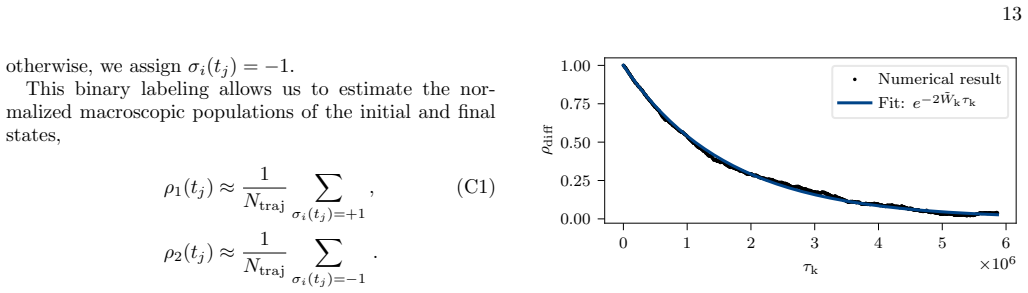
Kramers turnover by interpolation Kramers turnover can also be identified by analyz- ing the temperature dependence of the prefactor. To this end, we express the prefactor at fixed ˜γ k as a lin- ear combination of the two limiting expressions given in Eqs. (B5) and (B6), ˜Ck( ˜Tk) =c o,k ˜Co,k +c u,k ˜Cu,k( ˜Tk).(B11) 12 10−4 10−6 ˜Wk ˜γk = 31.623 0.03 0...
-
[8]
Thus, the time derivative of the momentum becomes negligible, instantly collapsing the dynamics to a single spatial dimension
The overdamped regime The standard overdamped regime of a generic har- monic oscillator is mathematically defined by a strict condition: the dissipation rateγmust exceed twice the natural eigenfrequency 2ω0. Thus, the time derivative of the momentum becomes negligible, instantly collapsing the dynamics to a single spatial dimension. For the bistable KPO, ...
-
[9]
From Eqs
The underdamped regime For sufficiently large drives where the system is far from the critical bifurcation boundaryµ (−) B , the conser- vative rotating-frame dynamics dominates the effective friction Ωmin ≫˜γin the motion around the phase space attractors, which we call the underdamped regime. From Eqs. (D2) and (D3), we can directly write down the corre...
-
[10]
From this procedure we obtain a resonance frequencyω 0/(2π) = 1.13 MHz and a decay rateγ= 537 s −1
Parameter extraction The resonance frequency and decay rate of the res- onator are obtained by weakly driving the device with an external tone and fitting the measured response with a Lorentzian line shape. From this procedure we obtain a resonance frequencyω 0/(2π) = 1.13 MHz and a decay rateγ= 537 s −1. 17 The conversion between the applied modulation v...
-
[11]
This procedure yields the equipartition relation kBT=aσ 2,(F3) whereσis the standard deviation of the applied voltage noise anda= 3×10 6 C V−1 is the calibration factor
Noise calibration To relate the applied electrical noise to an effective temperature, we compare the experimentally measured switching ratesWwith numerical simulations of the stochastic slow-flow equations. This procedure yields the equipartition relation kBT=aσ 2,(F3) whereσis the standard deviation of the applied voltage noise anda= 3×10 6 C V−1 is the ...
-
[12]
Table II summarizes the values used in the main text together with their estimated uncertainties
Uncertainty propagation Several experimentally determined parameters carry uncertainties that must be taken into account in the anal- ysis. Table II summarizes the values used in the main text together with their estimated uncertainties. The quoted uncertainty off 0 corresponds to the uncertainty of the detuning between the modulation frequency and the in...
-
[13]
H¨ anggi, P
P. H¨ anggi, P. Talkner, and M. Borkovec, Reaction-rate theory: Fifty years after Kramers, Rev. Mod. Phys.62, 251 (1990)
1990
-
[14]
H. A. Kramers, Brownian motion in a field of force and the diffusion model of chemical reactions, Physica7, 284 (1940)
1940
-
[15]
V. I. Mel’nikov, The Kramers work: fifty years later, Physics Reports209, 1 (1991)
1991
-
[16]
A. J. Leggett, S. Chakravarty, A. T. Dorsey, M. P. A. Fisher, A. Garg, and W. Zwerger, Dynamics of the dissi- pative two-state system, Rev. Mod. Phys.59, 1 (1987)
1987
-
[17]
H. M. Wiseman and G. J. Milburn,Quantum Measure- ment and Control(Cambridge University Press, Cam- bridge, 2009)
2009
-
[18]
Preskill, Quantum computing in the NISQ era and beyond, Quantum2, 79 (2018)
J. Preskill, Quantum computing in the NISQ era and beyond, Quantum2, 79 (2018)
2018
-
[19]
Skinner, J
B. Skinner, J. Ruhman, and A. Nahum, Measurement- induced phase transitions in the dynamics of entangle- ment, Physical Review X9, 031009 (2019)
2019
-
[20]
M. P. A. Fisher, V. Khemani, A. Nahum, and S. Vijay, Random quantum circuits, Annual Review of Condensed Matter Physics14, 335 (2023)
2023
-
[21]
Carisch, O
C. Carisch, O. Zilberberg, and A. Romito, Measurement- induced phase transitions in the transient dynamics of lindblad master equations, Physical Review Research5, 033067 (2023)
2023
-
[22]
Carisch, O
C. Carisch, O. Zilberberg, and A. Romito, Signatures of measurement-induced phase transitions in the average density matrix, Physical Review A109, 042211 (2024)
2024
-
[23]
Dykman and M
M. Dykman and M. A. Krivoglaz, Theory of fluctuational transitions between stable states of a nonlinear oscillator, Zh. Eksp. Teor. Fiz.77, 60 (1979)
1979
-
[24]
A. P. Dmitriev, M. I. D’yakonov, and A. F. Ioffe, Acti- vated and tunneling transitions between the two forced- oscillation regimes of an anharmonic oscillator, Zh. Eksp. Teor. Fiz.90, 1430 (1986)
1986
-
[25]
Marthaler and M
M. Marthaler and M. I. Dykman, Switching via quan- tum activation: A parametrically modulated oscillator, Physical Review A73, 042108 (2006)
2006
-
[26]
H. B. Chan and C. Stambaugh, Activation Barrier Scal- ing and Crossover for Noise-Induced Switching in Mi- cromechanical Parametric Oscillators, Phys. Rev. Lett. 99, 060601 (2007)
2007
-
[27]
H. B. Chan, M. I. Dykman, and C. Stambaugh, Paths of Fluctuation Induced Switching, Phys. Rev. Lett.100, 130602 (2008)
2008
-
[28]
Inagaki, K
T. Inagaki, K. Inaba, R. Hamerly, K. Inoue, Y. Ya- mamoto, and H. Takesue, A coherent Ising machine for 2000-node optimization problems, Science354, 603 (2016)
2000
-
[29]
Davidovikj, F
D. Davidovikj, F. Alijani, S. J. Cartamil-Bueno, H. S. v. d. Zant, M. Amabili, and P. G. Steeneken, High- frequency stochastic switching of graphene resonators near room temperature, Nano Letters19, 1515 (2019). 18
2019
-
[30]
B¨ ohm, T
F. B¨ ohm, T. Inagaki, K. Inaba, T. Honjo, K. Enbutsu, T. Umeki, R. Kasahara, and H. Takesue, Understand- ing complex phase-space dynamics of networks of optical parametric oscillators, Nature Communications10, 3538 (2019)
2019
-
[31]
Grimm, N
A. Grimm, N. E. Frattini, S. Puri, S. O. Mundhada, S. Touzard, M. Mirrahimi, S. M. Girvin, S. Shankar, and M. H. Devoret, Stabilization and operation of a Kerr-cat qubit, Nature584, 205 (2020)
2020
-
[32]
Margiani, S
G. Margiani, S. Guerrero, T. L. Heugel, C. Marty, R. Pachlatko, T. Gisler, G. D. Vukasin, H.-K. Kwon, J. M. L. Miller, N. E. Bousse, T. W. Kenny, O. Zilber- berg, D. Sabonis, and A. Eichler, Extracting the lifetime of a synthetic two-level system, Applied Physics Letters 121, 164101 (2022)
2022
-
[33]
R. Ng, T. Onodera, S. Kako, P. L. McMahon, H. Mabuchi, and Y. Yamamoto, Phase-flip dynamics of parametric oscillators, Physical Review Research4, 023021 (2022)
2022
-
[34]
A. Hajr, B. Qing, K. Wang, G. Koolstra, Z. Pedramrazi, Z. Kang, L. Chen, L. B. Nguyen, C. J¨ unger, N. Goss, et al., High-coherence Kerr-Cat Qubit in 2D architecture, Physical Review X14, 041049 (2024)
2024
-
[35]
D. G. A. Cabral, P. Khazaei, B. C. Allen, P. E. Videla, M. Sch¨ afer, R. G. Corti˜ nas, A. C. C. de Albornoz, J. Ch´ avez-Carlos, L. F. Santos, E. Geva, and V. S. Batista, A roadmap for simulating chemical dynamics on a parametrically driven bosonic quantum device, The Journal of Physical Chemistry Letters15, 12042 (2024)
2024
-
[36]
M. I. Dykman, C. M. Maloney, V. N. Smelyanskiy, and M. Silverstein, Fluctuational phase-flip transitions in parametrically driven oscillators, Phys. Rev. E57, 5202 (1998)
1998
-
[37]
Lifshitz and M
R. Lifshitz and M. C. Cross, Response of parametrically driven nonlinear coupled oscillators with application to micromechanical and nanomechanical resonator arrays, Phys. Rev. B67, 134302 (2003)
2003
-
[38]
L. Papariello, O. Zilberberg, A. Eichler, and R. Chitra, Ultrasensitive hysteretic force sensing with parametric nonlinear oscillators, Phys. Rev. E94, 022201 (2016), arXiv:1603.07774 [cond-mat, physics:nlin]
-
[39]
Leuch, L
A. Leuch, L. Papariello, O. Zilberberg, C. L. Degen, R. Chitra, and A. Eichler, Parametric Symmetry Break- ing in a Nonlinear Resonator, Phys. Rev. Lett.117, 214101 (2016)
2016
-
[40]
Gautier, A
R. Gautier, A. Sarlette, and M. Mirrahimi, Combined dissipative and hamiltonian confinement of cat qubits, PRX Quantum3, 020339 (2022)
2022
-
[41]
Eichler and O
A. Eichler and O. Zilberberg,Classical and Quantum Parametric Phenomena(Oxford University Press, 2023)
2023
-
[42]
G. Margiani, O. Ameye, O. Zilberberg, and A. Eich- ler, Three strongly coupled Kerr parametric oscillators forming a Boltzmann machine (2025), arXiv:2504.04254 [physics]
-
[43]
L. J. Lapidus, D. Enzer, and G. Gabrielse, Stochastic Phase Switching of a Parametrically Driven Electron in a Penning Trap, Phys. Rev. Lett.83, 899 (1999)
1999
-
[44]
N. E. Frattini, R. G. Corti˜ nas, J. Venkatraman, X. Xiao, Q. Su, C. U. Lei, B. J. Chapman, V. R. Joshi, S. M. Girvin, R. J. Schoelkopf, S. Puri, and M. H. Devoret, Ob- servation of Pairwise Level Degeneracies and the Quan- tum Regime of the Arrhenius Law in a Double-Well Para- metric Oscillator, Phys. Rev. X14, 031040 (2024)
2024
-
[45]
T. L. Heugel, A. Eichler, R. Chitra, and O. Zilberberg, The role of fluctuations in quantum and classical time crystals, SciPost Physics Core6, 053 (2023)
2023
-
[46]
M. I. Freidlin and A. D. Wentzell,Random Perturbations of Dynamical Systems, 3rd ed., Grundlehren der mathe- matischen Wissenschaften, Vol. 260 (Springer Berlin Hei- delberg, 2012)
2012
-
[47]
Arrhenius, ¨Uber die reaktionsgeschwindigkeit bei der inversion von rohrzucker durch s¨ auren (1889)
S. Arrhenius, ¨Uber die reaktionsgeschwindigkeit bei der inversion von rohrzucker durch s¨ auren (1889)
-
[48]
V. I. Mel’nikov, The Kramers problem: Fifty years of development, Physics Reports209, 1 (1991)
1991
-
[49]
This scaling arises becauseω min = √ 2ωmax
-
[50]
Rondin, J
L. Rondin, J. Gieseler, F. Ricci, R. Quidant, C. Del- lago, and L. Novotny, Direct measurement of Kramers turnover with a levitated nanoparticle, Nature Nanotech 12, 1130 (2017)
2017
-
[51]
Dumont, M
V. Dumont, M. Bestler, L. Catalini, G. Margiani, O. Zil- berberg, and A. Eichler, Energy landscape and flow dynamics measurements of driven-dissipative systems, Phys. Rev. Res.6, 043012 (2024)
2024
-
[52]
Bachtold, J
A. Bachtold, J. Moser, and M. I. Dykman, Mesoscopic physics of nanomechanical systems, Rev. Mod. Phys.94, 045005 (2022)
2022
-
[53]
M. I. Dykman, I. B. Schwartz, and M. Shapiro, Scaling in activated escape of underdamped systems, Phys. Rev. E72, 021102 (2005)
2005
-
[54]
Agarwal, S
M. Agarwal, S. A. Chandorkar, H. Mehta, R. N. Can- dler, B. Kim, M. A. Hopcroft, R. Melamud, C. M. Jha, G. Bahl, G. Yama,et al., A study of electrostatic force nonlinearities in resonant microstructures, Applied Physics Letters92(2008)
2008
-
[55]
J. M. Miller, D. D. Shin, H.-K. Kwon, S. W. Shaw, and T. W. Kenny, Phase control of self-excited parametric resonators, Physical Review Applied12, 044053 (2019)
2019
-
[56]
T. L. Heugel, M. Oscity, A. Eichler, O. Zilberberg, and R. Chitra, Classical Many-Body Time Crystals, Phys. Rev. Lett.123, 124301 (2019)
2019
-
[57]
Soriente, T
M. Soriente, T. L. Heugel, K. Omiya, R. Chitra, and O. Zilberberg, Distinctive class of dissipation-induced phase transitions and their universal characteristics, Phys. Rev. Res.3, 023100 (2021)
2021
- [58]
-
[59]
G. Margiani, J. del Pino, T. L. Heugel, N. E. Bousse, S. Guerrero, T. W. Kenny, O. Zilberberg, D. Sabo- nis, and A. Eichler, Deterministic and stochastic sam- pling of two coupled Kerr parametric oscillators (2022), arXiv:2210.14731 [cond-mat]
-
[60]
For the chosen valueµ= 0.2, this is close to unity
The boundary of instability is at p 1−µ 2. For the chosen valueµ= 0.2, this is close to unity
-
[61]
Marthaler and M
M. Marthaler and M. I. Dykman, Switching via quantum activation: A parametrically modulated oscillator, Phys. Rev. A73, 042108 (2006)
2006
-
[62]
Thompson and A
F. Thompson and A. Kamenev, Qubit decoherence and symmetry restoration through real-time instantons, Phys. Rev. Res.4, 023020 (2022)
2022
-
[63]
Carde, R
L. Carde, R. Gautier, N. Didier, A. Petrescu, J. Cohen, and A. McDonald, Nonperturbative switching rates in bistable open quantum systems: From driven kerr os- cillators to dissipative cat qubits, Phys. Rev. Lett.136, 100402 (2026)
2026
-
[64]
Q. Su, R. G. Corti˜ nas, J. Venkatraman, and S. Puri, 19 Unraveling the switching dynamics in a quantum double- well potential, Phys. Rev. A112, 042202 (2025)
2025
-
[65]
F. R. Ong, M. Boissonneault, F. Mallet, A. C. Doherty, A. Blais, D. Vion, D. Esteve, and P. Bertet, Quantum heating of a nonlinear resonator probed by a supercon- ducting qubit, Phys. Rev. Lett.110, 047001 (2013)
2013
-
[66]
Vijay, M
R. Vijay, M. H. Devoret, and I. Siddiqi, Invited review article: The josephson bifurcation amplifier, Review of Scientific Instruments80, 111101 (2009)
2009
-
[67]
M. I. Dykman, Critical exponents in metastable decay via quantum activation, Phys. Rev. E75, 011101 (2007)
2007
-
[68]
D. K. J. Boneß, W. Belzig, and M. I. Dykman, Resonant- force-induced symmetry breaking in a quantum paramet- ric oscillator, Phys. Rev. Res.6, 033240 (2024)
2024
-
[69]
Agrawal,Transition rates in Multistable Potentials: A study of Parametrons, Master’s thesis, Department of Physics, ETH Zurich, Switzerland (2021)
S. Agrawal,Transition rates in Multistable Potentials: A study of Parametrons, Master’s thesis, Department of Physics, ETH Zurich, Switzerland (2021)
2021
-
[70]
Agrawal, T
S. Agrawal, T. L. Heugel, D. Sabonis, A. Eichler, and O. Zilberberg, Transition rates in a parametron (2021), unpublished
2021
-
[71]
F. Ginot, J. Caspers, M. Kr¨ uger, and C. Bechinger, Bar- rier crossing in a viscoelastic bath, Physical Review Let- ters128, 10.1103/PhysRevLett.128.028001 (2022), arti- cle Number: 028001
-
[72]
T. L. Heugel, R. Chitra, A. Eichler, and O. Zilber- berg, Proliferation of unstable states and their impact on stochastic out-of-equilibrium dynamics in two coupled kerr parametric oscillators, Phys. Rev. E109, 064308 (2024)
2024
-
[73]
B¨ orner, O
R. B¨ orner, O. Ameye, R. Deeley, R. R¨ omer, and G. Dat- seris, Criticaltransitions.jl: A julia package for critical transitions in stochastic dynamical systems,https:// github.com/JuliaDynamics/CriticalTransitions.jl (2024)
2024
-
[74]
Risken,The Fokker-Planck Equation: Methods of So- lution and Applications(Springer Science & Business Me- dia, 2012)
H. Risken,The Fokker-Planck Equation: Methods of So- lution and Applications(Springer Science & Business Me- dia, 2012)
2012
discussion (0)
Sign in with ORCID, Apple, or X to comment. Anyone can read and Pith papers without signing in.