Recognition: unknown
The swept-back multipolar magnetic field of neutron stars: Application to NICER MSP J0030+0451
Pith reviewed 2026-05-10 01:40 UTC · model grok-4.3
The pith
A centered swept-back multipolar magnetic field including terms up to the octupole reproduces the bolometric thermal X-ray light curve of millisecond pulsar J0030+0451.
A machine-rendered reading of the paper's core claim, the machinery that carries it, and where it could break.
Core claim
A centered swept-back vacuum multipolar magnetic field including terms up to the octupole adequately reproduces the bolometric thermal X-ray light curve of MSP J0030+0451 observed by NICER.
What carries the argument
The centered swept-back vacuum multipolar field (SVM2F), a complete expansion in vector spherical harmonics that incorporates rotational sweeping of field lines.
Load-bearing premise
The vacuum swept-back multipolar field remains a sufficiently accurate approximation to the force-free magnetosphere for the purpose of thermal X-ray light-curve fitting.
What would settle it
Direct comparison of the observed light curve with one generated from a force-free version of the same multipolar configuration at the best-fit parameters would show whether the vacuum approximation holds.
Figures





read the original abstract
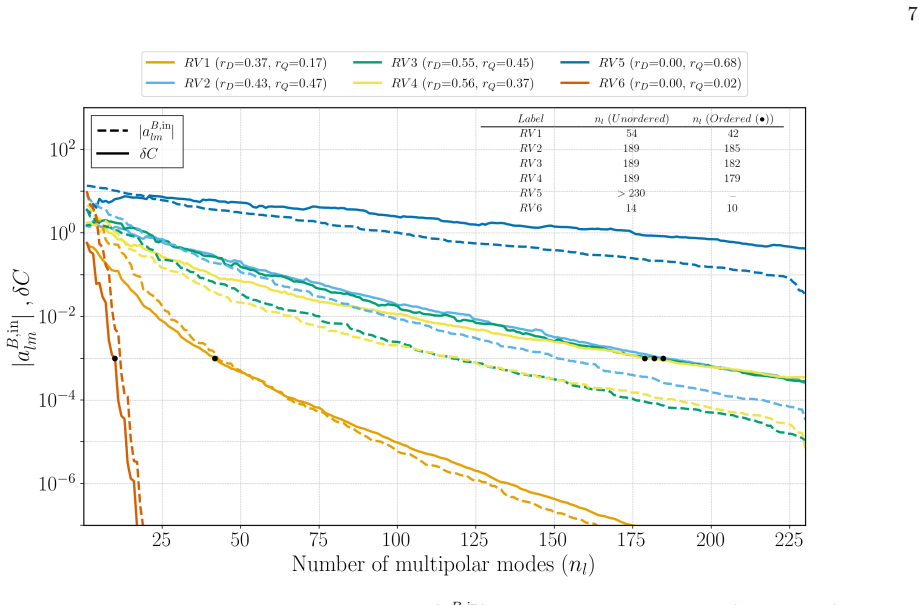
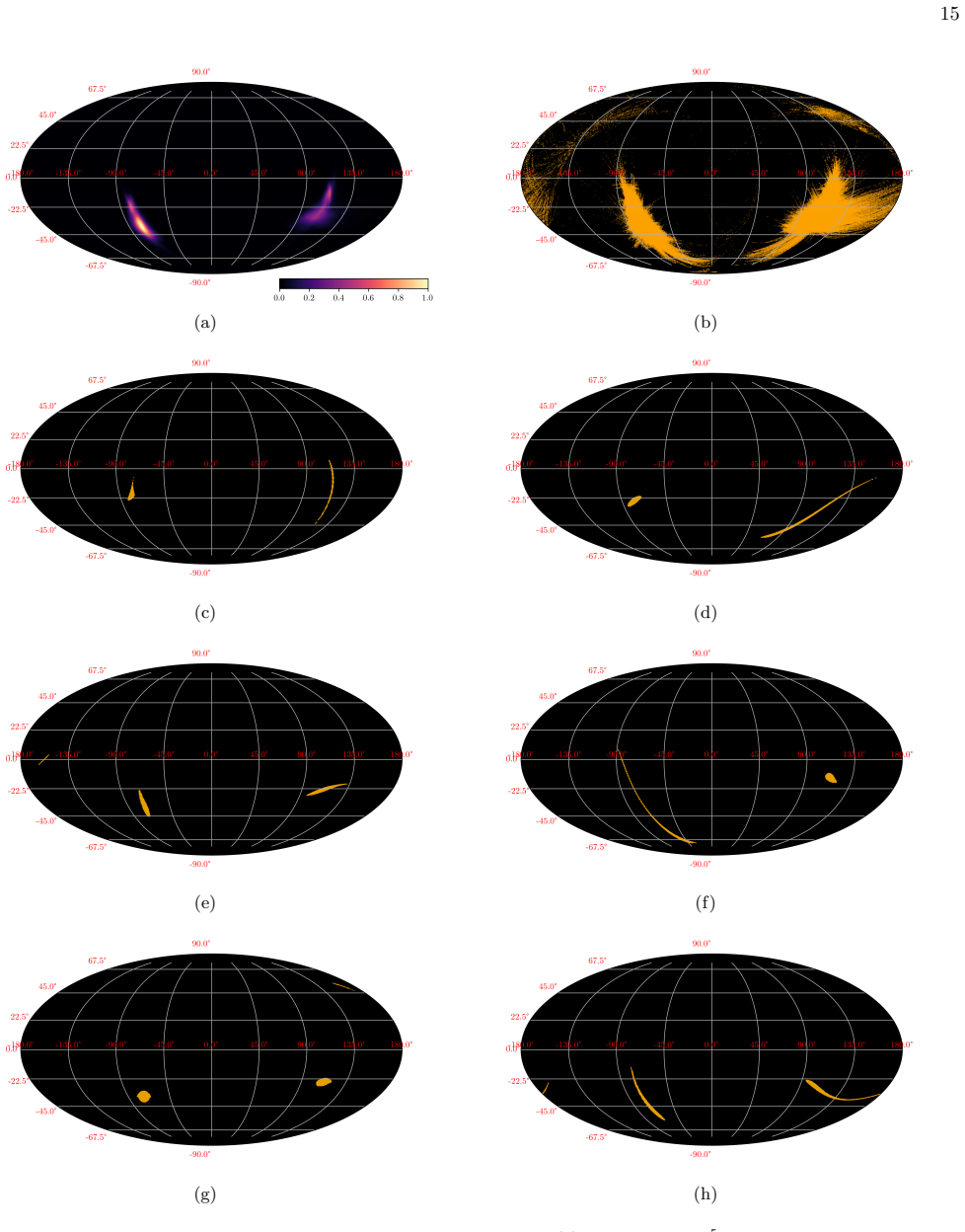
NICER observations of millisecond pulsars (MSPs) suggest that non-dipolar magnetic fields are required to explain their surface X-ray hotspots. C. Kalapotharakos et al. (2021) modeled the NICER light curve of MSP J0030+0451 (J0030) using a static vacuum offset dipole-plus-quadrupole field and corresponding force-free (FF) solutions to jointly reproduce the X-ray and Fermi-LAT $\gamma$-ray emission. We substitute their static vacuum field model with a more realistic swept-back configuration that accounts for rotational effects. This field more closely resembles the corresponding FF solutions, making it a more physically motivated choice for future multiwavelength modeling. We adopt a centered swept-back vacuum multipolar magnetic field (SVM2F; J. P\'etri 2015), expressed as a complete expansion in vector spherical harmonics, enabling flexible descriptions of arbitrary magnetic field geometries. We introduce a metric to quantify the complexity among different field prescriptions, illustrated for the static offset vacuum field. To efficiently explore parameter space, we train a neural network surrogate (G. Olmschenk et al. 2025) on SVM2F light curves including components up to the octupole, accelerating Markov chain Monte Carlo sampling by $\sim 10^3$ compared to direct physical model evaluations. Applying this framework to J0030, we constrain the field parameter space and find that a centered swept-back multipolar field including terms up to the octupole adequately reproduces the bolometric thermal X-ray light curve. Our study highlights the importance and inherent complexity of prescribing different multipolar magnetic field models for rotating stars, and can be extended to other MSPs to ultimately constrain the masses and radii of neutron stars, and hence their equation of state.
Editorial analysis
A structured set of objections, weighed in public.
Referee Report
Summary. The manuscript develops a centered swept-back vacuum multipolar magnetic field (SVM2F) model expanded in vector spherical harmonics up to octupole order, substitutes it for static offset-dipole-plus-quadrupole configurations previously used for NICER data on MSP J0030+0451, trains a neural-network surrogate on the resulting light curves to accelerate MCMC sampling by a factor of ~10^3, and concludes that the SVM2F field adequately reproduces the observed bolometric thermal X-ray light curve.
Significance. If the central claim is placed on firmer quantitative footing, the work would advance realistic rotating-star magnetosphere modeling for millisecond pulsars by incorporating rotational sweep-back effects that more closely resemble force-free solutions. The introduction of a complexity metric for comparing field prescriptions and the deployment of a neural-network surrogate for parameter-space exploration are concrete methodological contributions that could be reused for other NICER MSPs and multi-wavelength studies.
major comments (3)
- [Abstract] Abstract: the statement that the centered SVM2F field 'adequately reproduces' the bolometric light curve is presented without any quantitative goodness-of-fit statistic (reduced chi-squared, posterior predictive p-value, or residual rms relative to NICER uncertainties). Because the multipole amplitudes and orientations are free parameters adjusted to the data, an explicit metric is required to substantiate the claim beyond the fact that a fit was performed.
- [Methods (neural-network surrogate)] Methods (neural-network surrogate section): the surrogate is used to generate the MCMC posterior, yet no test-set error, direct-versus-surrogate residual plots, or accuracy assessment restricted to the high-likelihood volume of parameter space is reported. If surrogate bias is comparable to the data precision, both the reported parameter constraints and the 'adequate reproduction' assessment become unreliable.
- [Results] Results (parameter constraints): no uncertainties or credible intervals on the fitted multipole coefficients are quoted, nor is any comparison shown between the SVM2F posterior and the earlier static offset-dipole-plus-quadrupole solution of Kalapotharakos et al. (2021). This omission prevents assessment of whether the swept-back geometry yields statistically distinguishable improvements.
minor comments (1)
- [Introduction / Methods] The complexity metric introduced for comparing field models is mentioned but lacks an explicit formula or worked numerical example in the main text; placing the definition in an appendix would improve reproducibility.
Simulated Author's Rebuttal
We thank the referee for the thoughtful and constructive comments on our manuscript. We address each of the major comments below and have incorporated revisions to provide the requested quantitative assessments and comparisons.
read point-by-point responses
-
Referee: [Abstract] Abstract: the statement that the centered SVM2F field 'adequately reproduces' the bolometric light curve is presented without any quantitative goodness-of-fit statistic (reduced chi-squared, posterior predictive p-value, or residual rms relative to NICER uncertainties). Because the multipole amplitudes and orientations are free parameters adjusted to the data, an explicit metric is required to substantiate the claim beyond the fact that a fit was performed.
Authors: We concur that a quantitative goodness-of-fit measure is essential to support the claim of adequate reproduction. In the revised manuscript, we report the reduced chi-squared value for the best-fit model in both the abstract and the results section. This addition substantiates that the SVM2F model provides a statistically acceptable fit to the NICER bolometric light curve. revision: yes
-
Referee: [Methods (neural-network surrogate)] Methods (neural-network surrogate section): the surrogate is used to generate the MCMC posterior, yet no test-set error, direct-versus-surrogate residual plots, or accuracy assessment restricted to the high-likelihood volume of parameter space is reported. If surrogate bias is comparable to the data precision, both the reported parameter constraints and the 'adequate reproduction' assessment become unreliable.
Authors: We agree that validation of the neural-network surrogate is critical for the reliability of our results. The revised methods section now includes the test-set error metrics, direct-versus-surrogate residual plots, and an accuracy assessment focused on the high-likelihood parameter space. These demonstrate that the surrogate approximation error is negligible compared to the observational uncertainties, validating the MCMC-derived constraints. revision: yes
-
Referee: [Results] Results (parameter constraints): no uncertainties or credible intervals on the fitted multipole coefficients are quoted, nor is any comparison shown between the SVM2F posterior and the earlier static offset-dipole-plus-quadrupole solution of Kalapotharakos et al. (2021). This omission prevents assessment of whether the swept-back geometry yields statistically distinguishable improvements.
Authors: We acknowledge the value of providing uncertainties and a comparative analysis. The revised results section now includes the median values with 68% credible intervals for the multipole coefficients from the posterior distribution. We have also added a direct comparison of the SVM2F posterior to the static offset-dipole-plus-quadrupole model of Kalapotharakos et al. (2021), using both the goodness-of-fit metric and the complexity metric introduced in the paper. This shows that the swept-back field achieves a similar fit quality with comparable complexity. revision: yes
Circularity Check
No significant circularity; standard parameter fitting to external NICER data
full rationale
The paper adopts the centered SVM2F multipolar field prescription from Pétri (2015) as an external ansatz, trains a neural-network surrogate on light curves computed from that model (citing Olmschenk et al. 2025 for the surrogate technique), and then uses MCMC to adjust the multipole amplitudes, orientations, and other parameters to match the NICER bolometric light curve of J0030. The statement that the octupole-truncated field 'adequately reproduces' the data is an assessment of fit quality after parameter optimization against independent observations, not a derivation or prediction that reduces to the inputs by construction. No equation or claim equates a fitted quantity back to itself, no self-citation supplies a load-bearing uniqueness theorem, and the surrogate is presented as an accelerator whose accuracy is externally testable by direct comparison to the physical model. The overall chain is therefore a conventional model-to-data fitting exercise that remains self-contained against the external NICER dataset.
Axiom & Free-Parameter Ledger
free parameters (1)
- multipole coefficients (dipole, quadrupole, octupole amplitudes and orientations)
axioms (2)
- domain assumption The vacuum swept-back multipolar field (SVM2F) is a sufficiently accurate representation of the magnetosphere for thermal X-ray light-curve calculations.
- domain assumption The neural-network surrogate reproduces the physical SVM2F light curves to the precision needed for MCMC parameter estimation.
Reference graph
Works this paper leans on
-
[1]
The pulsar force-free magnetosphere linked to its striped wind: time-dependent pseudo-spectral simulations , volume =. Monthly Notices of the Royal Astronomical Society , author =. 2012 , keywords =. doi:10.1111/j.1365-2966.2012.21238.x , abstract =
-
[2]
Classical
Jackson, John David , month = jul, year =. Classical
-
[3]
2021, The Astrophysical Journal, 907, 63, doi: 10.3847/1538-4357/abcec0
The. The Astrophysical Journal , author =. 2021 , note =. doi:10.3847/1538-4357/abcec0 , abstract =
-
[4]
Monthly Notices of the Royal Astronomical Society , author =
Multipolar electromagnetic fields around neutron stars: exact vacuum solutions and related properties , volume =. Monthly Notices of the Royal Astronomical Society , author =. 2015 , note =. doi:10.1093/mnras/stv598 , abstract =
-
[5]
Maximum mass of a neutron star.Phys
Maximum. Physical Review Letters , author =. 1974 , note =. doi:10.1103/PhysRevLett.32.324 , abstract =
-
[6]
Physical Review Letters , author =
Ultimate. Physical Review Letters , author =. 2005 , note =. doi:10.1103/PhysRevLett.94.111101 , abstract =
-
[7]
Neutron star observations:. Physics Reports , author =. 2007 , keywords =. doi:10.1016/j.physrep.2007.02.003 , abstract =
-
[8]
The equation of state of hot, dense matter and neutron stars , volume =. Physics Reports , author =. 2016 , note =. doi:10.1016/j.physrep.2015.12.005 , abstract =
-
[9]
Relativistic. Nature Astronomy , author =. 2020 , note =. doi:10.1038/s41550-019-0880-2 , abstract =
-
[10]
Refined. The Astrophysical Journal , author =. 2021 , note =. doi:10.3847/2041-8213/ac03b8 , abstract =
-
[11]
Miller, M. Coleman , month = nov, year =. Astrophysical. doi:10.48550/arXiv.1312.0029 , abstract =
-
[12]
European Physical Journal A , author =
Observational constraints on neutron star masses and radii , volume =. European Physical Journal A , author =. 2016 , note =. doi:10.1140/epja/i2016-16063-8 , abstract =
-
[13]
Determining. The Astrophysical Journal , author =. 2015 , note =. doi:10.1088/0004-637X/808/1/31 , abstract =
-
[14]
Astronomy and Astrophysics , author =
Soft. Astronomy and Astrophysics , author =. 1998 , note =. doi:10.48550/arXiv.astro-ph/9708101 , abstract =
-
[15]
The Astrophysical Journal , author =
Constraints on. The Astrophysical Journal , author =. 2007 , note =. doi:10.1086/520793 , abstract =
-
[16]
The Astrophysical Journal , author =
Thermal. The Astrophysical Journal , author =. 2008 , note =. doi:10.1086/592341 , abstract =
-
[17]
The Astrophysical Journal , author =
The. The Astrophysical Journal , author =. 2013 , note =. doi:10.1088/0004-637X/762/2/96 , abstract =
-
[18]
Space Telescopes and Instrumentation 2016: Ultraviolet to Gamma Ray , year = 2016, editor =
The. Space Telescopes and Instrumentation 2016: Ultraviolet to Gamma Ray , author =. 2016 , note =. doi:10.1117/12.2231304 , abstract =
-
[19]
A. The Astrophysical Journal Letters , author =. 2019 , keywords =. doi:10.3847/2041-8213/ab481c , abstract =
-
[20]
The Astrophysical Journal Letters , author =. 2019 , keywords =. doi:10.3847/2041-8213/ab50c5 , abstract =
-
[21]
A. The Astrophysical Journal , author =. 2021 , note =. doi:10.3847/2041-8213/ac0a81 , abstract =
-
[22]
The Astrophysical Journal , author =
The. The Astrophysical Journal , author =. 2021 , note =. doi:10.3847/2041-8213/ac089b , abstract =
-
[23]
Y., Yuan, Y., & Vasilopoulos, G
A. The Astrophysical Journal Letters , author =. 2020 , pages =. doi:10.3847/2041-8213/ab85c5 , abstract =
-
[24]
An Updated Mass-Radius Analysis of the 2017-2018 NICER Data Set of PSR J0030+0451. , keywords =. doi:10.3847/1538-4357/acfb83 , archivePrefix =. 2308.09469 , primaryClass =
-
[25]
Constraining the. The Astrophysical Journal Letters , author =. 2019 , note =. doi:10.3847/2041-8213/ab53eb , abstract =
-
[26]
2012, The Astrophysical Journal, 749, 2, doi: 10.1088/0004-637X/749/1/2
The Astrophysical Journal , author =. 2012 , note =. doi:10.1088/0004-637X/749/1/2 , abstract =
-
[27]
The Astrophysical Journal , author =
Gamma-. The Astrophysical Journal , author =. 2014 , keywords =. doi:10.1088/0004-637X/793/2/97 , abstract =
-
[28]
The Astrophysical Journal , author =
Testing. The Astrophysical Journal , author =. 2015 , note =. doi:10.1088/0004-637X/804/2/84 , abstract =
-
[29]
The Astrophysical Journal , author =
Fermi. The Astrophysical Journal , author =. 2017 , note =. doi:10.3847/1538-4357/aa713a , abstract =
-
[30]
Pioneering High-speed Pulsar Parameter Estimation Using Convolutional Neural Networks. , keywords =. doi:10.3847/1538-4357/ae03c0 , archivePrefix =. 2501.12383 , primaryClass =
-
[31]
and Weber, Hans J
Arfken, George B. and Weber, Hans J. , month = jan, year =. Mathematical methods for physicists 6th ed. , url =
-
[32]
The Astrophysical Journal , author =
Rotational. The Astrophysical Journal , author =. 2004 , note =. doi:10.1086/423707 , abstract =
-
[33]
The Astrophysical Journal , author =. 2010 , note =. doi:10.1088/0004-637X/718/1/446 , abstract =
-
[34]
The Astrophysical Journal , author =
A. The Astrophysical Journal , author =. 2012 , note =. doi:10.1088/0004-637X/753/2/175 , abstract =
-
[35]
The Astrophysical Journal , author =
A. The Astrophysical Journal , author =. 2011 , note =. doi:10.1088/0004-637X/745/1/1 , abstract =
-
[36]
The Astrophysical Journal , author =. 2014 , note =. doi:10.1088/0004-637X/792/2/87 , abstract =
-
[37]
American Journal of Physics , author =
The. American Journal of Physics , author =. 1954 , note =. doi:10.1119/1.1933682 , abstract =
-
[38]
European Journal of Physics , author =
Vector spherical harmonics and their application to magnetostatics , volume =. European Journal of Physics , author =. 1985 , note =. doi:10.1088/0143-0807/6/4/014 , urldate =
-
[39]
European Journal of Physics , author =
Vector spherical harmonics and their application to classical electrodynamics , volume =. European Journal of Physics , author =. 1991 , note =. doi:10.1088/0143-0807/12/4/007 , urldate =
-
[40]
and Feshbach, Herman , month = jan, year =
Morse, Philip M. and Feshbach, Herman , month = jan, year =. Methods of theoretical physics , url =
-
[41]
Journal of Machine Learning Research , author =
Scikit-learn:. Journal of Machine Learning Research , author =. 2011 , pages =
2011
-
[42]
Guver, Tolga and Psaltis, Dimitrios and Ozel, Feryal and Zhao, Tong , month = jun, year =. Limits to. doi:10.48550/arXiv.2506.13879 , abstract =
-
[43]
Monthly Notices of the Royal Astronomical Society , author =
The illusion of neutron star magnetic field estimates , volume =. Monthly Notices of the Royal Astronomical Society , author =. 2019 , keywords =. doi:10.1093/mnras/stz711 , abstract =
-
[44]
Research Notes of the AAS , abstract =
Halder, Priyam and Goswami, Satyaki and Halder, Protyusha and Ghosh, Uday and Konar, Sushan , title =. Research Notes of the AAS , abstract =. 2023 , month =. doi:10.3847/2515-5172/ad00ac , url =
-
[45]
Monthly Notices of the Royal Astronomical Society , author =
Relativistic force-free models of the thermal. Monthly Notices of the Royal Astronomical Society , author =. 2023 , pages =. doi:10.1093/mnras/stad333 , abstract =
-
[46]
The Astrophysical Journal , author =
The. The Astrophysical Journal , author =. 2016 , note =. doi:10.3847/0004-637X/832/2/107 , abstract =
-
[47]
The Astrophysical Journal , author =
Uncertainties of. The Astrophysical Journal , author =. 2010 , note =. doi:10.1088/0004-637X/715/2/1270 , abstract =
-
[48]
Monthly Notices of the Royal Astronomical Society , author =
2017\_MNRAS\_Pulsed emission from a rotating off-centred magnetic dipole in vacuum , volume =. Monthly Notices of the Royal Astronomical Society , author =. 2017 , pages =. doi:10.1093/mnras/stx1711 , abstract =
-
[49]
Monthly Notices of the Royal Astronomical Society , author =
Radiation from an off-centred rotating dipole in vacuum , volume =. Monthly Notices of the Royal Astronomical Society , author =. 2016 , note =. doi:10.1093/mnras/stw2050 , abstract =
-
[50]
The. The Astrophysical Journal , author =. 2024 , note =. doi:10.3847/2041-8213/ad614a , abstract =
-
[51]
2024, ApJL, 971, L20, doi: 10.3847/2041-8213/ad5a6f
A. The Astrophysical Journal , author =. 2024 , note =. doi:10.3847/2041-8213/ad5a6f , abstract =
-
[52]
The Astrophysical Journal , author =
A. The Astrophysical Journal , author =. 2024 , note =. doi:10.3847/1538-4357/ad81d2 , abstract =
-
[53]
The Astrophysical Journal , author =
The. The Astrophysical Journal , author =. 2024 , note =. doi:10.3847/1538-4357/ad5f1f , abstract =
-
[54]
The Astrophysical Journal , author =
A. The Astrophysical Journal , author =. 2024 , note =. doi:10.3847/1538-4357/ad5f1e , abstract =
-
[55]
A NICER View of the 1.4 M _ Edge-on Pulsar PSR J0614-3329. , keywords =. doi:10.3847/1538-4357/ae145d , archivePrefix =. 2506.14883 , primaryClass =
-
[56]
Huang, Chun and Chen, Alexander Y. , title =. The Astrophysical Journal , abstract =. 2025 , month =. doi:10.3847/1538-4357/adf747 , url =
-
[57]
The Astrophysical Journal , abstract =
Sur, Ankan and Yuan, Yajie and Philippov, Alexander , title =. The Astrophysical Journal , abstract =. 2024 , month =. doi:10.3847/1538-4357/ad2fcf , url =
-
[58]
A. The Astrophysical Journal , author =. 2019 , note =. doi:10.3847/2041-8213/ab53e7 , abstract =
-
[59]
The. The Astronomical Journal , author =. 2005 , note =. doi:10.1086/428488 , abstract =
-
[60]
Formation and evolution of binary and millisecond radio pulsars , volume =. Physics Reports , author =. 1991 , note =. doi:10.1016/0370-1573(91)90064-S , abstract =
-
[61]
A new class of radio pulsars , volume =. Nature , author =. 1982 , note =. doi:10.1038/300728a0 , abstract =
-
[62]
The Astrophysical Journal , author =
Pulsar. The Astrophysical Journal , author =. 2002 , note =. doi:10.1086/338985 , abstract =
-
[63]
The Astrophysical Journal , author =
Pulsar. The Astrophysical Journal , author =. 2001 , note =. doi:10.1086/321589 , abstract =
-
[64]
2010, CAMCS, 5, 65, doi: 10.2140/camcos.2010.5.65
Ensemble samplers with affine invariance , volume =. Communications in Applied Mathematics and Computational Science , author =. 2010 , note =. doi:10.2140/camcos.2010.5.65 , number =
-
[65]
Publications of the Astronomical Society of the Pacific , author =
emcee:. Publications of the Astronomical Society of the Pacific , author =. 2013 , note =. doi:10.1086/670067 , abstract =
-
[66]
Astronomy and Astrophysics , author =
Radio and high-energy emission of pulsars revealed by general relativity , volume =. Astronomy and Astrophysics , author =. 2020 , keywords =. doi:10.1051/0004-6361/202037979 , abstract =
-
[67]
Monthly Notices of the Royal Astronomical Society , author =
Magnetic quadri-dipolar stars rotating in vacuum , volume =. Monthly Notices of the Royal Astronomical Society , author =. 2020 , keywords =. doi:10.1093/mnras/staa3086 , abstract =
-
[68]
A two-solar-mass neutron star measured using. Nature , author =. 2010 , note =. doi:10.1038/nature09466 , abstract =
-
[69]
Physical Review Letters , author =
Fourth. Physical Review Letters , author =. 1964 , note =. doi:10.1103/PhysRevLett.13.789 , urldate =
-
[70]
Physical Review Letters , author =
Fourth. Physical Review Letters , author =. 1971 , note =. doi:10.1103/PhysRevLett.26.1132 , abstract =
-
[71]
Annales d'Astrophysique , author =
1955\_Deutsch\_The electromagnetic field of an idealized star in rigid rotation in vacuo , volume =. Annales d'Astrophysique , author =. 1955 , pages =
1955
-
[72]
2017, in Handbook of Supernovae, ed
Alsabti, Athem W. and Murdin, Paul , month = jan, year =. Handbook of. doi:10.1007/978-3-319-21846-5 , note =
-
[73]
Monthly Notices of the Royal Astronomical Society , author =
Recycled pulsars with multipolar magnetospheres from accretion-induced magnetic burial , volume =. Monthly Notices of the Royal Astronomical Society , author =. 2020 , note =. doi:10.1093/mnras/staa3132 , abstract =
- [74]
-
[75]
Constraining the Neutron Star Mass-Radius Relation and Dense Matter Equation of State with NICER. III. Model Description and Verification of Parameter Estimation Codes. , keywords =. doi:10.3847/2041-8213/abfb79 , archivePrefix =. 2104.06928 , primaryClass =
-
[76]
The Astrophysical Journal , author =
On the. The Astrophysical Journal , author =. 2015 , note =. doi:10.1088/0004-637X/810/2/144 , abstract =
-
[77]
2024 , url =
Mathematica , author =. 2024 , url =
2024
-
[78]
Hunter, J. D. , title =. Computing in Science & Engineering , volume =. 2007 , publisher =
2007
-
[79]
and Tollerud, Erik J
Astropy Collaboration and Robitaille, Thomas P. and Tollerud, Erik J. and Greenfield, Perry and Droettboom, Michael and Bray, Erik and Aldcroft, Thomas and others , title =. Astronomy & Astrophysics , volume =. 2013 , doi =
2013
-
[80]
and Haberland, Matt and Reddy, Tyler and Cournapeau, David and others , title =
Virtanen, Pauli and Gommers, Ralf and Oliphant, Travis E. and Haberland, Matt and Reddy, Tyler and Cournapeau, David and others , title =. Nature Methods , volume =. 2020 , doi =
2020
discussion (0)
Sign in with ORCID, Apple, or X to comment. Anyone can read and Pith papers without signing in.