Recognition: unknown
An effective window framework for closed-Loop regional SAR reconnaissance with hybrid direct-relay downlink scheduling
Pith reviewed 2026-05-10 00:52 UTC · model grok-4.3
The pith
The framework generates SAR observation windows to millisecond timing accuracy, screens them for imaging quality with point-target back-projection, and solves a hybrid direct-relay MILP to increase closed-loop data return.
A machine-rendered reading of the paper's core claim, the machinery that carries it, and where it could break.
Core claim
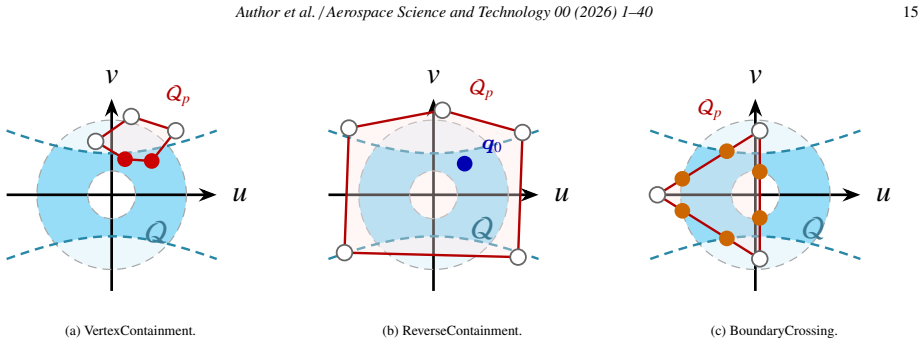
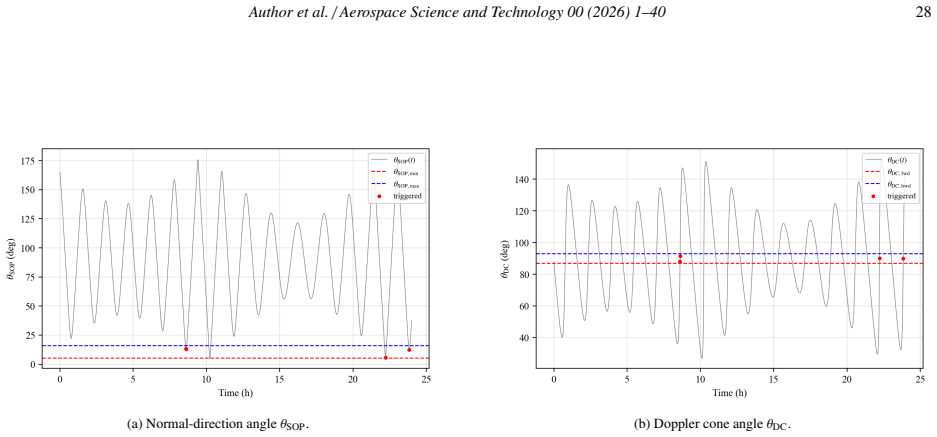
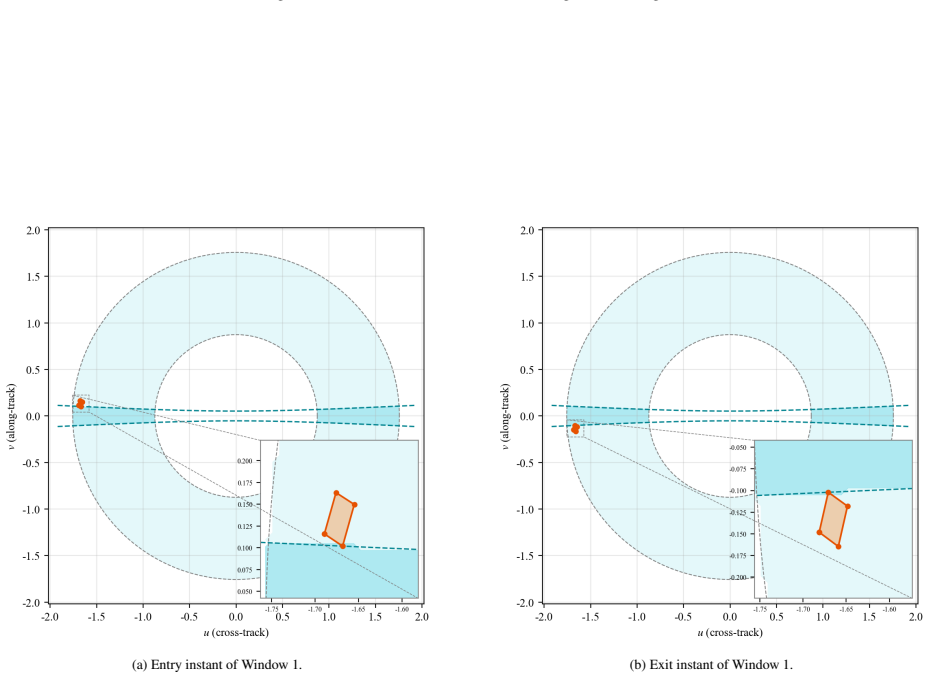
Through coarse angular bandpass screening, a planar characteristic curve containment test, and one-dimensional boundary bisection, the framework forms geometry-feasible candidate observation windows with millisecond-level accuracy for entry and exit times; each window is assessed with a companion point target under unified echo generation and back-projection imaging so that only those whose range and azimuth IRW, PSLR, and ISLR satisfy preset thresholds are retained; the retained windows then enter a quality-constrained hybrid direct-relay closed-loop MILP that jointly schedules observation and ground return.
What carries the argument
The effective window framework that chains angular bandpass screening, planar characteristic curve containment, one-dimensional boundary bisection for timing, point-target back-projection quality screening on IRW/PSLR/ISLR, and a quality-constrained hybrid direct-relay MILP scheduler.
If this is right
- Window boundary times agree with STK reference at the millisecond level.
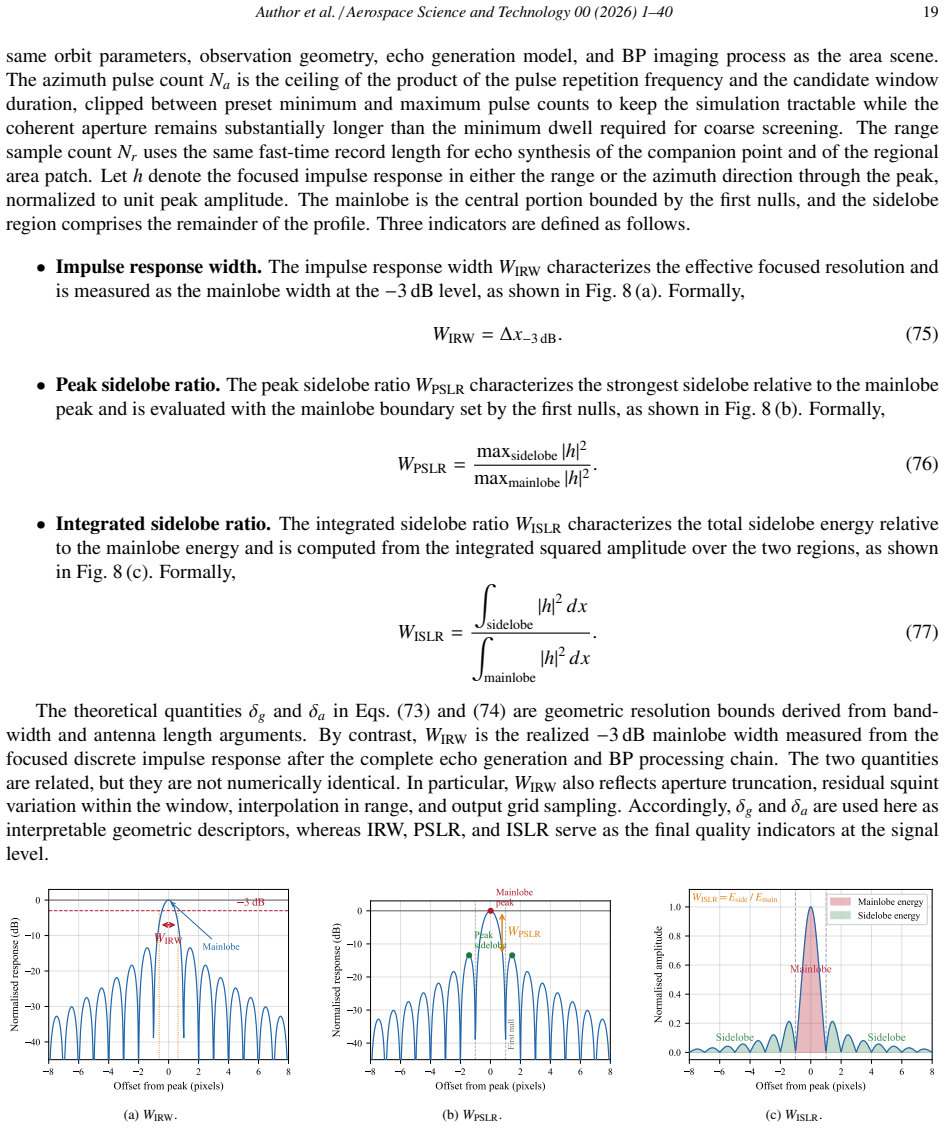
- Only windows whose range and azimuth impulse response widths, peak sidelobe ratios, and integrated sidelobe ratios meet preset thresholds are retained for scheduling.
- The hybrid direct-relay closed-loop MILP improves both closure performance and total ground-returned data volume compared with a relay-only baseline.
Where Pith is reading between the lines
- The same screening and scheduling structure could be tested on other SAR modes such as spotlight or scanSAR by swapping the echo-generation module while keeping the MILP intact.
- Replacing the single point-target companion with a small set of distributed point targets or a low-resolution extended scene inside the screening step would directly test robustness to real target complexity.
- Embedding a fast heuristic or warm-start solver for the MILP could further reduce latency if operational planners need sub-second replanning cycles.
Load-bearing premise
That screening each candidate window against a single companion point target under a unified echo generation and back-projection workflow is sufficient to predict imaging quality for real extended targets and that the resulting MILP can be solved fast enough for operational closed-loop use without unmodeled platform errors or atmospheric effects.
What would settle it
A side-by-side comparison of the quality metrics (IRW, PSLR, ISLR) obtained from the point-target screening workflow versus the same metrics measured on actual extended-target imagery collected in the identical windows, or a timing benchmark of the MILP solver on representative operational hardware that includes realistic platform jitter and atmospheric delays.
Figures







read the original abstract
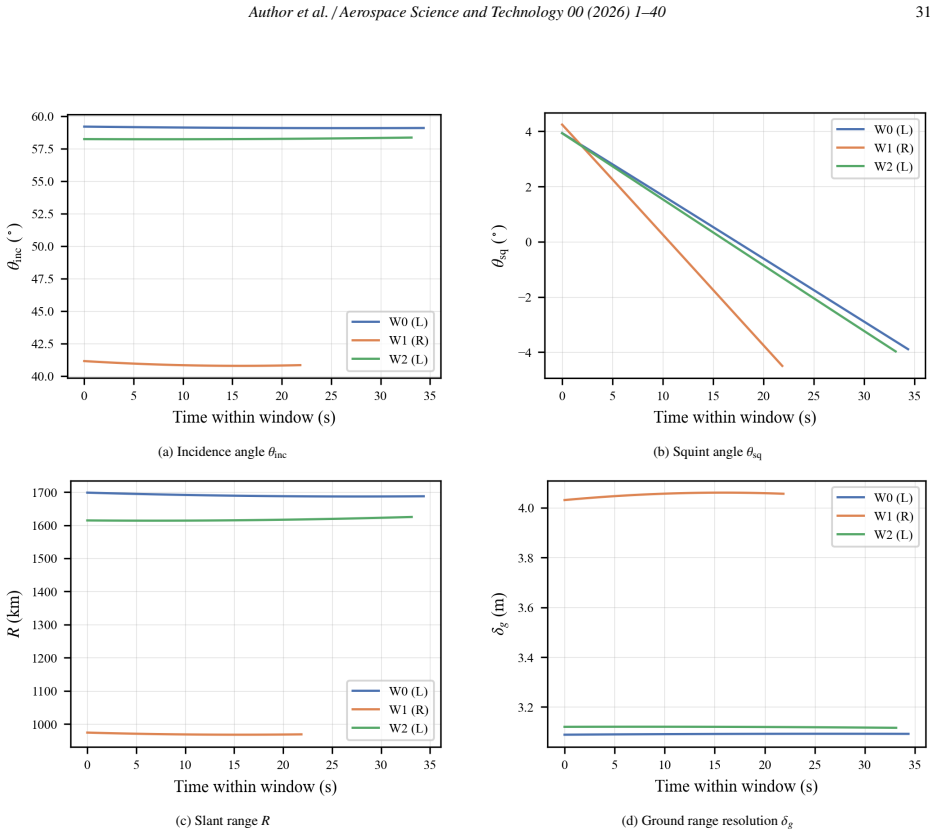
For operational regional synthetic aperture radar (SAR) reconnaissance, mission success depends not only on geometric visibility but also on whether geometric feasibility, prescribed imaging quality, and timely data delivery can be met together within the planning horizon. This paper develops an effective window framework for regional SAR window generation, per window signal level quality screening, and hybrid direct-relay closed loop scheduling. Through coarse angular bandpass screening, a planar characteristic curve containment test, and one dimensional boundary bisection, the framework forms geometry feasible candidate observation windows with millisecond-level accuracy for their entry and exit times. Each candidate window is then assessed in stripmap mode with a companion point target under a unified echo generation and Back Projection (BP) imaging workflow; only windows whose range and azimuth impulse response width (IRW), peak sidelobe ratio (PSLR), and integrated sidelobe ratio (ISLR) all satisfy the preset thresholds are retained. The retained observation, relay, and downlink windows feed a quality constrained hybrid direct-relay closed-loop mixed-integer linear programming (MILP) formulation for joint scheduling of observation and ground return. Numerical experiments confirm millisecond-level agreement with STK reference timing for window boundaries. Every candidate window is screened against preset imaging quality thresholds. Hybrid closed-loop scheduling improves closure performance and ground returned data volume relative to a relay-only baseline
Editorial analysis
A structured set of objections, weighed in public.
Referee Report
Summary. The manuscript develops an effective window framework for closed-loop regional SAR reconnaissance. It generates geometrically feasible observation windows via coarse angular bandpass screening, planar characteristic curve containment, and 1D boundary bisection (millisecond entry/exit accuracy), screens each candidate in stripmap mode against a companion point target using unified echo generation and back-projection to enforce IRW/PSLR/ISLR thresholds, and feeds the retained windows into a quality-constrained hybrid direct-relay MILP scheduler for joint observation and downlink optimization. Numerical experiments are reported to confirm STK timing agreement and performance gains over a relay-only baseline.
Significance. If the point-target proxy and MILP scalability hold under operational conditions, the integrated treatment of geometry, per-window quality, and hybrid scheduling would be a practical advance for SAR mission planning, enabling higher data return while respecting imaging constraints. The explicit relay-only baseline comparison and preset (non-fitted) quality thresholds are strengths.
major comments (2)
- [Quality screening procedure] The per-window quality screening (abstract and methods description) retains candidates solely if a single companion point target imaged in stripmap mode satisfies preset IRW, PSLR, and ISLR thresholds. For regional reconnaissance the actual scene is extended; no validation, sensitivity study, or comparison against distributed scatterers is provided to show that these point-target metrics predict usable image quality, which is load-bearing for both the retained-window set and the subsequent scheduling improvement claim.
- [Numerical experiments] Numerical experiments (abstract) claim millisecond-level STK agreement and improved closure/data volume, yet no quantitative metrics (timing RMSE, data-volume deltas, scenario count, or sensitivity to platform/atmospheric errors) or baseline implementation details are supplied in the provided text, leaving the central performance assertions only partially supported.
minor comments (1)
- The abstract would be strengthened by including at least one key quantitative result (e.g., timing error or data-volume improvement percentage) rather than qualitative statements.
Simulated Author's Rebuttal
We thank the referee for the constructive and detailed comments, which help clarify the strengths and limitations of our framework. We address each major comment below and indicate the revisions planned for the next manuscript version.
read point-by-point responses
-
Referee: [Quality screening procedure] The per-window quality screening (abstract and methods description) retains candidates solely if a single companion point target imaged in stripmap mode satisfies preset IRW, PSLR, and ISLR thresholds. For regional reconnaissance the actual scene is extended; no validation, sensitivity study, or comparison against distributed scatterers is provided to show that these point-target metrics predict usable image quality, which is load-bearing for both the retained-window set and the subsequent scheduling improvement claim.
Authors: The point-target proxy in stripmap mode was selected for computational efficiency when screening the large set of geometrically feasible candidate windows produced by the angular bandpass and boundary bisection steps. The preset IRW/PSLR/ISLR thresholds follow standard SAR imaging specifications to enforce basic resolvability and sidelobe control. We acknowledge that the manuscript does not contain a dedicated validation, sensitivity study, or direct comparison against distributed scatterers for extended regional scenes, which limits the strength of the claim that retained windows guarantee usable image quality in operational settings. In the revised manuscript we will add a dedicated subsection in the methods or discussion that (i) justifies the proxy choice with references to prior SAR literature, (ii) explicitly states its limitations for distributed targets, and (iii) outlines how future work could incorporate extended-scene metrics. This addition will not alter the core screening procedure but will better contextualize its applicability. revision: yes
-
Referee: [Numerical experiments] Numerical experiments (abstract) claim millisecond-level STK agreement and improved closure/data volume, yet no quantitative metrics (timing RMSE, data-volume deltas, scenario count, or sensitivity to platform/atmospheric errors) or baseline implementation details are supplied in the provided text, leaving the central performance assertions only partially supported.
Authors: We agree that the current presentation of the numerical experiments is insufficiently quantitative. Although the abstract summarizes the outcomes, the full manuscript text does not report explicit values such as timing RMSE, numerical data-volume or closure deltas, the exact number of scenarios, or sensitivity results. In the revised version we will expand the numerical experiments section to include: (i) timing RMSE and maximum deviation figures for the STK comparison, (ii) concrete data-volume and closure-performance deltas with the relay-only baseline, (iii) the number and diversity of scenarios tested, (iv) any sensitivity checks performed with respect to platform or atmospheric errors, and (v) additional implementation details for the baseline scheduler. These additions will be supported by updated tables or figures as appropriate. revision: yes
Circularity Check
No circularity: framework uses independent geometric tests, preset thresholds, and explicit baseline comparison
full rationale
The derivation proceeds via explicit geometric screening (angular bandpass, planar curve containment, bisection), point-target quality checks against fixed IRW/PSLR/ISLR thresholds, and MILP scheduling whose performance gain is measured directly against a relay-only baseline. Window timing is cross-checked against external STK software rather than self-referential data. No equation or claim reduces to a fitted parameter renamed as prediction, no self-citation supplies a load-bearing uniqueness result, and no ansatz is smuggled in. The pipeline is therefore self-contained against external benchmarks.
Axiom & Free-Parameter Ledger
axioms (2)
- domain assumption Point-target back-projection simulation with preset IRW/PSLR/ISLR thresholds accurately predicts imaging quality for real extended targets.
- domain assumption The mixed-integer linear program correctly captures all operational constraints on observation, relay, and downlink timing.
Reference graph
Works this paper leans on
-
[1]
E. Bensana, G. Verfaillie, J. Agnese, N. Bataille, D. Blumstein, Earth observation satellite management, Constraints 4 (3) (1999) 293–311. doi:10.1023/A:1026488509554
-
[2]
W. J. Wolfe, S. E. Sorensen, Three scheduling algorithms applied to the earth observing systems domain, Management Science 46 (1) (2000) 148–168. doi:10.1287/mnsc.46.1.148.15134
-
[3]
M. Lema ˆıtre, G. Verfaillie, F. Jouhaud, J.-M. Lachiver, N. Bataille, Selecting and scheduling observations of agile satellites, Aerospace Science and Technology 6 (8) (2002) 537–550. doi:10.1016/S1270-9638(02)01173-2
-
[4]
N. Bianchessi, J.-F. Cordeau, G. Desaulniers, G. Laporte, V . Raymond, A heuristic for the multi-satellite, multi-orbit and multi-user manage- ment of earth observation satellites, European Journal of Operational Research 177 (2) (2007) 750–762. doi:10.1016/j.ejor.2005.12.026
-
[5]
X. Liu, B. Bai, Y . Chen, B. Alidaee, F. Glover, An adaptive large neighborhood search metaheuristic for agile satellite scheduling with time-dependent transition time, Computers & Operations Research 86 (2017) 48–59. doi:10.1016/j.cor.2017.04.006
-
[6]
Y . She, Y . Xu, Y . Zhao, Onboard mission planning for agile satellite using modified mixed-integer linear programming, Aerospace Science and Technology 72 (2018) 204–216. doi:10.1016/j.ast.2017.11.009
-
[7]
X. Chen, G. Reinelt, G. Dai, A. Spitz, A mixed integer linear programming model for multi-satellite scheduling, European Journal of Operational Research 275 (2) (2019) 694–707. doi:10.1016/j.ejor.2018.11.058
-
[8]
M. Wang, C. Han, A. Zhao, Y . Xu, Task scheduling and attitude planning for agile earth observation satellite with intensive tasks, Aerospace Science and Technology 90 (2019) 24–32. doi:10.1016/j.ast.2019.04.007
-
[9]
G. Peng, M. Dessouky, Z. Wei, An exact algorithm for agile earth observation satellite scheduling with time-dependent profits, Computers & Operations Research 120 (2020) 104946. doi:10.1016/j.cor.2020.104946
-
[10]
G. Peng, J. Wang, G. Song, A. Gunawan, L. Xing, P. Vansteenwegen, Branch-and-cut-and-price for agile earth observation satellite schedul- ing, European Journal of Operational Research 326 (3) (2025) 427–438. doi:10.1016/j.ejor.2025.04.014
-
[11]
X. Wang, G. Wu, L. Xing, W. Pedrycz, Agile earth observation satellite scheduling over 20 years: Formulations, methods, and future directions, IEEE Systems Journal 15 (3) (2021) 3881–3892. doi:10.1109/JSYST.2020.2997050
-
[12]
J. Chen, M. Chen, J. Wen, L. He, X. Liu, A heuristic construction neural network method for the time-dependent agile earth observation satellite scheduling problem, Mathematics 10 (19) (2022) 3498. doi:10.3390/math10193498
-
[13]
Y . Feng, R. Zhang, S. Ren, S. Zhu, Y . Yang, A distributed approach for time-dependent observation scheduling problem in the agile earth observation satellite constellation, Remote Sensing 15 (7) (2023) 1761. doi:10.3390/rs15071761
-
[14]
S. Krigman, T. Grinshpoun, L. Dery, Scheduling of earth observing satellites using distributed constraint optimization, Journal of Scheduling 27 (2024) 507–524. doi:10.1007/s10951-024-00816-x
-
[15]
S. Rojanasoonthon, J. F. Bard, Algorithms for parallel machine scheduling: A case study of the tracking and data relay satellite system, Journal of the Operational Research Society 54 (5) (2003) 480–494. doi:10.1057/palgrave.jors.2601575
-
[16]
D. Karapetyan, S. Mitrovic-Minic, K. T. Malladi, A. P. Punnen, Satellite downlink scheduling problem: A case study, Omega 53 (2015) 115–123. doi:10.1016/j.omega.2015.01.001
-
[17]
S. Spangelo, J. Cutler, K. Gilson, A. Cohn, Optimization-based scheduling for the single-satellite, multi-ground station communication problem, Computers & Operations Research 57 (2015) 1–16. doi:10.1016/j.cor.2014.11.004
-
[18]
X.-j. Hu, X. Luo, X. Zhang, M. Wang, A branch and price algorithm for EOS constellation imaging and downloading integrated scheduling problem, Computers & Operations Research 104 (2019) 193–204. doi:10.1016/j.cor.2018.12.007
-
[19]
Z. Zhang, N. Zhang, X. Luan, An improved genetic algorithm for the integrated satellite imaging and data transmission scheduling problem, Computers & Operations Research 139 (2022) 105626. doi:10.1016/j.cor.2021.105626
-
[20]
G. Yu, K. Zhang, Research on the integrated scheduling of imaging and data transmission for earth observation satellites, Algorithms 18 (7) (2025) 418. doi:10.3390/a18070418
-
[21]
Y . He, J. Li, W. Li, et al., Dynamic scheduling of hybrid tasks with time windows in data relay satellite networks, IEEE Transactions on Vehicular Technology 68 (5) (2019) 4989–5003. doi:10.1109/TVT.2019.2903737
-
[22]
J. Chen, X. Dia, R. Xu, H. Qi, L. Cong, K. Zhang, Z. Xing, X. He, W. Lei, S. Zhang, A remote sensing data transmission strategy based on the combination of satellite-ground link and geo relay under dynamic topology, Future Generation Computer Systems 145 (2023) 337–353. doi:10.1016/j.future.2023.02.016
-
[23]
C. He, Y . Dong, Multi-satellite observation-relay transmission-downloading coupling scheduling method, Remote Sensing 15 (24) (2023)
2023
-
[24]
doi:10.3390/rs15245639
-
[25]
S. J. Kim, M. Kim, C.-H. Kim, H.-L. Choi, Satellite scheduling framework of observation-relay-downlink with a mixed-integer linear pro- gramming model, in: AIAA SCITECH 2025 Forum, 2025. doi:10.2514/6.2025-2273
-
[26]
S. J. Kim, M. Kim, C.-H. Kim, H.-L. Choi, Integrated earth observation satellite scheduling with relay-assisted downlink, Aerospace Science and Technology 168 (2026) 110864. doi:10.1016/j.ast.2025.110864
-
[27]
J. J. Morrison, A system of sixteen synchronous satellites for worldwide navigation and surveillance, Tech. rep., Federal Aviation Adminis- tration, Systems Research and Development Service, Washington, D.C. (1973)
1973
-
[28]
R. G. Casten, R. P. Gross, Satellite cumulative earth coverage, in: AIAA Astrodynamics Specialist Conference, Lake Tahoe, Nevada, 1981
1981
-
[29]
Middour, An efficient technique for computation of satellite earth coverage, in: Proceedings of the 27th AIAA Aerospace Sciences Meeting, Washington, D.C., 1989
J. Middour, An efficient technique for computation of satellite earth coverage, in: Proceedings of the 27th AIAA Aerospace Sciences Meeting, Washington, D.C., 1989
1989
-
[30]
J. A. Lawton, Numerical method for rapidly determining satellite-satellite and satellite-ground station in-view periods, Journal of Guidance, Control, and Dynamics 10 (1) (1987) 32–36. 39 Author et al./Aerospace Science and Technology 00 (2026) 1–4040
1987
-
[31]
Alfano, D
S. Alfano, D. Negron, J. L. Moore, Rapid determination of satellite visibility periods, Journal of the Astronautical Sciences 40 (2) (1992) 281–296
1992
-
[32]
Y . Mai, P. Palmer, Fast algorithm for prediction of satellite imaging and communication opportunities, Journal of Guidance, Control, and Dynamics 24 (6). doi:10.2514/2.4846
-
[33]
Sun, et al., APCHI technique for rapidly and accurately predicting multi-restriction satellite visibility, in: Proc
X. Sun, et al., APCHI technique for rapidly and accurately predicting multi-restriction satellite visibility, in: Proc. Twenty-Second AAS/AIAA Space Flight Mechanics Meeting, Charleston, South Carolina, 2012
2012
-
[34]
C. Han, X. Gao, X. Sun, Rapid satellite-to-site visibility determination based on self-adaptive interpolation technique, Science China Tech- nological Sciences 60 (2) (2017) 264–270. doi:10.1007/s11431-016-0513-8
-
[35]
H. Wang, C. Han, X. Sun, Analytical field-of-regard representation for rapid and accurate prediction of agile satellite imaging opportunities, Journal of Astronomical Telescopes, Instruments, and Systems 5 (3) (2019) 037001. doi:10.1117/1.JATIS.5.3.037001
-
[36]
M. Nugnes, C. Circi, M. Massari, Coverage area determination for conical fields of view considering an oblate earth, Journal of Guidance, Control, and Dynamics 42 (10) (2019) 2233–2245. doi:10.2514/1.G004156
-
[37]
M. Zuo, G. Dai, L. Peng, An envelope curve-based theory for the satellite coverage problems, Aerospace Science and Technology 100 (2020) 105750. doi:10.1016/j.ast.2020.105750
-
[38]
C. Han, Y . Zhang, S. Bai, X. Sun, X. Wang, Novel method to calculate satellite visibility for an arbitrary sensor field, Aerospace Science and Technology 112 (2021) 106668. doi:10.1016/j.ast.2021.106668
-
[39]
Jiang, S
Y . Jiang, S. Bai, H. Wang, Minimum-observation method for rapid and accurate satellite coverage prediction, GPS Solutions 26 (4) (2022)
2022
-
[40]
doi:10.1007/s10291-022-01295-3
-
[41]
H. Wang, S. Bai, A versatile method for target area coverage analysis with arbitrary satellite attitude maneuver paths, Acta Astronautica 194 (2022) 242–254. doi:10.1016/j.actaastro.2022.02.008
-
[42]
Z. Zhang, Z. E, L. Huang, J. Li, Semi-analytical algorithm for computing satellite-area target visibility, Journal of Tsinghua University (Science and Technology) 62 (3) (2022) 573–580. doi:10.16511/j.cnki.qhdxxb.2021.26.020
-
[43]
Y . Gu, X. Sun, L. Fan, S. Liu, G. Wu, A rapid satellite-ground coverage analysis method based on elevation view element model, Acta Aeronautica et Astronautica Sinica 45 (23) (2024) 330372. doi:10.7527/S1000-6893.2024.30372
-
[44]
Y . Shan, C. Du, Y . Li, Z. Li, X. Jin, H. Zhang, Triple time interval hybridization strategy for rapidly calculating regional target–visible time window of earth observation payloads on space station, Applied Sciences 14 (6) (2024) 2388. doi:10.3390/app14062388
-
[45]
X. Shi, W. Xing, H. Liu, Y . Wang, M. Xing, Vtwsar: A fast calculation method for visible time window of sar satellite to regional target, IEEE Journal of Selected Topics in Applied Earth Observations and Remote Sensing 18 (2025) 14063–14075. doi:10.1109/JSTARS.2025.3574518
-
[46]
J. C. Curlander, R. N. McDonough, Synthetic Aperture Radar: Systems and Signal Processing, John Wiley & Sons, New York, 1991
1991
-
[47]
I. G. Cumming, F. H. Wong, Digital Processing of Synthetic Aperture Radar Data: Algorithms and Implementation, Artech House, Norwood, MA, 2005
2005
-
[48]
H. Li, J. An, X. Jiang, M. Lin, Raw data simulation of spaceborne synthetic aperture radar with accurate range model, Remote Sensing 15 (11) (2023) 2705. doi:10.3390/rs15112705
-
[49]
H. Li, J. An, X. Jiang, Accurate range modeling for high-resolution spaceborne synthetic aperture radar, Sensors 24 (10) (2024) 3119. doi:10.3390/s24103119
-
[50]
D. A. Vallado, Fundamentals of Astrodynamics and Applications, 4th Edition, Microcosm Press, Hawthorne, CA, 2013
2013
-
[51]
D. A. Vallado, P. Crawford, R. Hujsak, T. S. Kelso, Revisiting spacetrack report #3, in: AIAA/AAS Astrodynamics Specialist Conference and Exhibit, Keystone, CO, 2006. doi:10.2514/6.2006-6753
-
[52]
O’Rourke, Computational Geometry in C, Cambridge University Press, Cambridge, UK, 1994
J. O’Rourke, Computational Geometry in C, Cambridge University Press, Cambridge, UK, 1994
1994
-
[53]
ANSYS, Inc., STK Ephemeris File Format (.e),https://help.agi.com/stk/Content/stk/importfiles-02.htm, sTK external ephemeris file specification; accessed 2026-04-19 (2025). 40
2026
discussion (0)
Sign in with ORCID, Apple, or X to comment. Anyone can read and Pith papers without signing in.