Recognition: unknown
Emotion-Cause Pair Extraction in Conversations via Semantic Decoupling and Graph Alignment
Pith reviewed 2026-05-10 01:57 UTC · model grok-4.3
The pith
Disentangling emotion semantics from cause semantics and aligning them globally via optimal transport extracts consistent many-to-many emotion-cause pairs in conversations.
A machine-rendered reading of the paper's core claim, the machinery that carries it, and where it could break.
Core claim
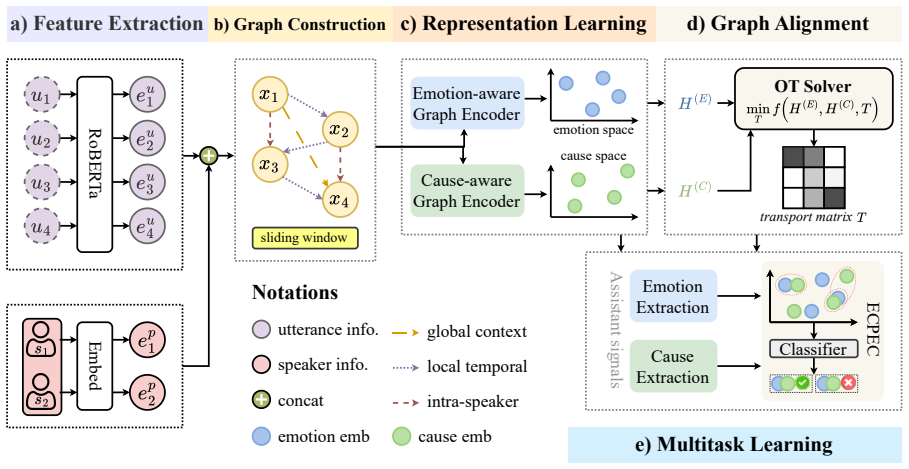
Reformulating ECPEC as a global alignment problem between decoupled emotion-side and cause-side representations, solved via optimal transport inside a shared conversational structure, enables many-to-many and globally consistent emotion-cause matching.
What carries the argument
Semantic decoupling of emotion and cause representations into complementary spaces followed by optimal transport alignment within the SCALE framework.
If this is right
- Many-to-many causal relations become directly modelable without forcing one-to-one assumptions.
- Global consistency across an entire dialogue replaces local pairwise decisions.
- State-of-the-art results appear on multiple ECPEC benchmark datasets.
- The same decoupling-plus-alignment pattern can be inserted into other shared conversational encoders.
Where Pith is reading between the lines
- The dual-space idea may transfer to other dialogue tasks that separate affective content from explanatory content, such as intent or opinion triggering.
- If the two spaces remain complementary, similar splits could be tried for dual-aspect problems outside emotion, such as separating topic from sentiment.
- Longer multi-party dialogues are a natural next test bed where global alignment would be expected to show larger gains than on short exchanges.
Load-bearing premise
Emotion-oriented and cause-oriented semantics can be disentangled into two complementary representation spaces that capture their distinct conversational roles without losing essential shared information.
What would settle it
A controlled run on the same benchmark datasets in which removing the semantic decoupling step and using a single shared representation yields equal or higher accuracy on many-to-many pairs would show the separation is not required.
Figures


read the original abstract
Emotion-Cause Pair Extraction in Conversations (ECPEC) aims to identify the set of causal relations between emotion utterances and their triggering causes within a dialogue. Most existing approaches formulate ECPEC as an independent pairwise classification task, overlooking the distinct semantics of emotion diffusion and cause explanation, and failing to capture globally consistent many-to-many conversational causality. To address these limitations, we revisit ECPEC from a semantic perspective and seek to disentangle emotion-oriented semantics from cause-oriented semantics, mapping them into two complementary representation spaces to better capture their distinct conversational roles. Building on this semantic decoupling, we naturally formulate ECPEC as a global alignment problem between the emotion-side and cause-side representations, and employ optimal transport to enable many-to-many and globally consistent emotion-cause matching. Based on this perspective, we propose a unified framework SCALE that instantiates the above semantic decoupling and alignment principle within a shared conversational structure. Extensive experiments on several benchmark datasets demonstrate that SCALE consistently achieves state-of-the-art performance. Our codes are released at https://github.com/CoCoSphere/SCALE.
Editorial analysis
A structured set of objections, weighed in public.
Referee Report
Summary. The paper proposes SCALE, a unified framework for Emotion-Cause Pair Extraction in Conversations (ECPEC) that disentangles emotion-oriented semantics from cause-oriented semantics into two complementary representation spaces within a shared conversational graph structure. It formulates ECPEC as a global alignment problem solved via optimal transport to enable many-to-many and consistent emotion-cause matching, and reports state-of-the-art results on benchmark datasets with released code.
Significance. If the semantic decoupling and optimal transport alignment hold, the work could meaningfully advance ECPEC by moving beyond pairwise classification to capture distinct conversational roles and global causality, with the code release aiding reproducibility in conversational NLP.
major comments (3)
- [§3] §3 (Method), Semantic Decoupling and Graph Alignment: The central premise requires that emotion and cause semantics are mapped to complementary, non-redundant spaces, yet no auxiliary objective (contrastive loss, orthogonality constraint, or mutual-information term) is described to enforce distinctness between the two branches. Without such regularization, the observed gains could be explained by the graph component or richer context modeling alone, leaving the decoupling claim unverified and load-bearing for the paper's argument.
- [§4] §4 (Experiments): The manuscript reports SOTA performance but provides insufficient detail on experimental setup, choice of baselines, hyperparameter tuning, and ablation studies that isolate the contribution of semantic decoupling versus the shared graph or optimal transport. This absence prevents confirmation that the proposed principle, rather than implementation details, drives the improvements.
- [Table 2] Table 2 or equivalent results table: While overall F1 scores are highlighted as superior, the lack of per-relation or many-to-many specific metrics (e.g., precision on multi-cause emotions) makes it hard to substantiate the claim of 'globally consistent many-to-many conversational causality' beyond aggregate end-task gains.
minor comments (2)
- [Abstract] The abstract and introduction could more explicitly contrast the proposed optimal transport alignment with prior pairwise or sequence-labeling baselines to clarify the novelty.
- [§3] Notation for the two representation spaces (e.g., E and C) should be introduced earlier and used consistently to improve readability.
Simulated Author's Rebuttal
We thank the referee for the constructive feedback and the recommendation for major revision. We address each major comment point by point below and will revise the manuscript to improve clarity, rigor, and substantiation of the claims.
read point-by-point responses
-
Referee: [§3] §3 (Method), Semantic Decoupling and Graph Alignment: The central premise requires that emotion and cause semantics are mapped to complementary, non-redundant spaces, yet no auxiliary objective (contrastive loss, orthogonality constraint, or mutual-information term) is described to enforce distinctness between the two branches. Without such regularization, the observed gains could be explained by the graph component or richer context modeling alone, leaving the decoupling claim unverified and load-bearing for the paper's argument.
Authors: We acknowledge that the submitted manuscript did not describe an explicit auxiliary objective to enforce distinctness between the emotion and cause representation spaces. While the architecture uses separate projection heads and the optimal transport objective encourages complementarity through alignment, this does not directly verify non-redundancy. To address this, we will introduce an orthogonality constraint (or contrastive term) between the two branches in the revised §3 and report the corresponding ablation to isolate its contribution. revision: yes
-
Referee: [§4] §4 (Experiments): The manuscript reports SOTA performance but provides insufficient detail on experimental setup, choice of baselines, hyperparameter tuning, and ablation studies that isolate the contribution of semantic decoupling versus the shared graph or optimal transport. This absence prevents confirmation that the proposed principle, rather than implementation details, drives the improvements.
Authors: We agree that the experimental section requires more detail to allow verification of the source of gains. In the revision we will expand §4 with complete hyperparameter tables, explicit baseline configurations and sources, and additional ablations that separately disable semantic decoupling, the shared graph, and the optimal transport module while keeping other factors fixed. revision: yes
-
Referee: [Table 2] Table 2 or equivalent results table: While overall F1 scores are highlighted as superior, the lack of per-relation or many-to-many specific metrics (e.g., precision on multi-cause emotions) makes it hard to substantiate the claim of 'globally consistent many-to-many conversational causality' beyond aggregate end-task gains.
Authors: Overall F1 is the primary reported metric in prior ECPEC work, yet we recognize that aggregate scores alone do not fully demonstrate the many-to-many consistency claim. We will add per-relation F1 scores and a dedicated many-to-many analysis (e.g., precision/recall on multi-cause emotions and multi-emotion causes) to the revised results table and discussion. revision: yes
Circularity Check
No circularity: semantic decoupling and alignment presented as architectural design choice with independent empirical validation
full rationale
The paper's derivation begins from a semantic perspective on ECPEC limitations, proposes disentangling emotion-oriented and cause-oriented semantics into complementary spaces, and formulates the task as optimal-transport alignment within a shared graph structure instantiated as SCALE. This chain consists of modeling decisions and a new framework rather than any reduction of outputs to inputs by construction. No equations or claims equate a 'prediction' to a fitted parameter, no uniqueness theorem is imported from self-citations, and no ansatz is smuggled via prior work. The central premise is an explicit design choice whose value is assessed via benchmark experiments, making the argument self-contained against external data.
Axiom & Free-Parameter Ledger
Reference graph
Works this paper leans on
-
[1]
Induced and reduced unbounded operator algebras
CONSK-GCN: Conversational Semantic- and Knowledge-Oriented Graph Convolutional Network for Multimodal Emotion Recognition , shorttitle =. 2021 IEEE International Conference on Multimedia and Expo (ICME) , author =. 2021 , month = jul, pages =. doi:10.1109/ICME51207.2021.9428438 , urldate =
work page Pith review doi:10.1109/icme51207.2021.9428438 2021
-
[2]
Context- and Knowledge-Aware Graph Convolutional Network for Multimodal Emotion Recognition , author =. 2022 , month = jul, journal =. doi:10.1109/MMUL.2022.3173430 , urldate =
-
[3]
2023 , journal =
Emotion Recognition in Conversations: A Survey Focusing on Context, Speaker Dependencies, and Fusion Methods , author =. 2023 , journal =
2023
-
[4]
INTERNATIONAL CONFERENCE ON MULTIMODAL INTERACTION , author =
GCFormer: A Graph Convolutional Transformer for Speech Emotion Recognition , shorttitle =. INTERNATIONAL CONFERENCE ON MULTIMODAL INTERACTION , author =. 2023 , month = oct, pages =. doi:10.1145/3577190.3614177 , urldate =
-
[5]
Proceedings of the 14th Workshop on Computational Approaches to Subjectivity, Sentiment, & Social Media Analysis , author =
SEC: Context-Aware Metric Learning for Efficient Emotion Recognition in Conversation , shorttitle =. Proceedings of the 14th Workshop on Computational Approaches to Subjectivity, Sentiment, & Social Media Analysis , author =. 2024 , month = aug, pages =
2024
-
[6]
DialogueGCN: A Graph Convolutional Neural Network for Emotion Recognition in Conversation , shorttitle =. Proceedings of the 2019 Conference on Empirical Methods in Natural Language Processing and the 9th International Joint Conference on Natural Language Processing (EMNLP-IJCNLP) , author =. 2019 , month = nov, pages =. doi:10.18653/v1/D19-1015 , urldate =
-
[7]
Ghosh, Soumitra and Singh, Gopendra Vikram and Arora, Jashn and Ekbal, Asif , year =. Benchmarking Cyber Harassment Dialogue Comprehension through Emotion-Informed Manifestations-Determinants Demarcation , booktitle =. doi:10.1609/aaai.v38i20.30207 , urldate =
-
[8]
MMGCN: Multimodal Fusion via Deep Graph Convolution Network for Emotion Recognition in Conversation , shorttitle =. Proceedings of the 59th Annual Meeting of the Association for Computational Linguistics and the 11th International Joint Conference on Natural Language Processing (Volume 1: Long Papers) , author =. 2021 , month = aug, pages =. doi:10.18653/...
-
[9]
Audioclip: Extending clip to image, text and audio
MM-DFN: Multimodal Dynamic Fusion Network for Emotion Recognition in Conversations , shorttitle =. ICASSP 2022 - 2022 IEEE International Conference on Acoustics, Speech and Signal Processing (ICASSP) , author =. 2022 , month = may, pages =. doi:10.1109/ICASSP43922.2022.9747397 , urldate =
-
[10]
DailyDialog: A Manually Labelled Multi-Turn Dialogue Dataset , booktitle =
Li, Yanran and Su, Hui and Shen, Xiaoyu and Li, Wenjie and Cao, Ziqiang and Niu, Shuzi , year =. DailyDialog: A Manually Labelled Multi-Turn Dialogue Dataset , booktitle =
-
[11]
2023 , journal =
GraphMFT: A Graph Network Based Multimodal Fusion Technique for Emotion Recognition in Conversation , author =. 2023 , journal =
2023
-
[12]
DialogueRNN: An Attentive RNN for Emotion Detection in Conversations , shorttitle =. Proceedings of the AAAI Conference on Artificial Intelligence , author =. 2019 , month = jul, volume =. doi:10.1609/aaai.v33i01.33016818 , urldate =
-
[13]
Findings of the Association for Computational Linguistics: EMNLP 2021 , author =
DialogueTRM: Exploring Multi-Modal Emotional Dynamics in a Conversation , shorttitle =. Findings of the Association for Computational Linguistics: EMNLP 2021 , author =. 2021 , month = nov, pages =. doi:10.18653/v1/2021.findings-emnlp.229 , urldate =
-
[14]
Revisiting Multimodal Emotion Recognition in Conversation from the Perspective of Graph Spectrum , author =. 2024 , month = may, number =. 2404.17862 , publisher =
-
[15]
Proceedings of the 32nd ACM International Conference on Multimedia , author =
Ada2I: Enhancing Modality Balance for Multimodal Conversational Emotion Recognition , shorttitle =. Proceedings of the 32nd ACM International Conference on Multimedia , author =. 2024 , month = oct, pages =. doi:10.1145/3664647.3681648 , urldate =
-
[16]
Multi-Party Conversation Modeling for Emotion Recognition , author =. 2024 , month = jul, journal =. doi:10.1109/TAFFC.2023.3273589 , urldate =
-
[17]
Directed Acyclic Graph Network for Conversational Emotion Recognition
Shen, Weizhou and Wu, Siyue and Yang, Yunyi and Quan, Xiaojun , editor =. Directed Acyclic Graph Network for Conversational Emotion Recognition , booktitle =. 2021 , month = aug, pages =. doi:10.18653/v1/2021.acl-long.123 , urldate =
-
[18]
arXiv preprint arXiv:2407.00119 (2024)
Efficient Long-Distance Latent Relation-Aware Graph Neural Network for Multi-Modal Emotion Recognition in Conversations , author =. 2024 , month = aug, number =. 2407.00119 , publisher =
-
[19]
Busso, Carlos and Bulut, Murtaza and Lee, Chi-Chun and Kazemzadeh, Abe and Mower, Emily and Kim, Samuel and Chang, Jeannette N. and Lee, Sungbok and Narayanan, Shrikanth S. , year =. IEMOCAP: Interactive Emotional Dyadic Motion Capture Database , shorttitle =. Language Resources and Evaluation , volume =. doi:10.1007/s10579-008-9076-6 , urldate =
-
[20]
Proceedings of the AAAI Conference on Artificial Intelligence , author =
Well, Now We Know! Unveiling Sarcasm: Initiating and Exploring Multimodal Conversations with Reasoning , shorttitle =. Proceedings of the AAAI Conference on Artificial Intelligence , author =. 2024 , month = mar, volume =. doi:10.1609/aaai.v38i17.29864 , urldate =
-
[21]
2023 , journal =
SUNET: Speaker-Utterance Interaction Graph Neural Network for Emotion Recognition in Conversations , author =. 2023 , journal =
2023
-
[22]
Emotion Recognition in Conversation via Dynamic Personality , booktitle =
Wang, Yan and Wang, Bo and Zhao, Yachao and Zhao, Dongming and Jin, Xiaojia and Zhang, Jijun and He, Ruifang and Hou, Yuexian , editor =. Emotion Recognition in Conversation via Dynamic Personality , booktitle =. 2024 , month = may, pages =
2024
-
[23]
Wu, Sheng and Liu, Jiaxing and Wang, Longbiao and He, Dongxiao and Wang, Xiaobao and Dang, Jianwu , year =. AIMDiT: Modality Augmentation and Interaction via Multimodal Dimension Transformation for Emotion Recognition in Conversations , shorttitle =. 2407.00743 , publisher =
-
[24]
Yu, Fangxu and Guo, Junjie and Wu, Zhen and Dai, Xinyu , editor =. Emotion-Anchored Contrastive Learning Framework for Emotion Recognition in Conversation , booktitle =. 2024 , month = jun, pages =. doi:10.18653/v1/2024.findings-naacl.282 , urldate =
-
[25]
Proceedings of the Thirty-ThirdInternational Joint Conference on Artificial Intelligence , author =
A Survey on Network Alignment: Approaches, Applications and Future Directions , shorttitle =. Proceedings of the Thirty-ThirdInternational Joint Conference on Artificial Intelligence , author =. 2024 , month = aug, pages =. doi:10.24963/ijcai.2024/908 , urldate =
-
[26]
Comprehensive Evaluation of Unrestricted Graph Alignment Algorithms , author =. 2023 , publisher =. doi:10.48786/EDBT.2023.21 , urldate =
-
[27]
A Comparative Study on Network Alignment Techniques , author =. 2020 , month = feb, journal =. doi:10.1016/j.eswa.2019.112883 , urldate =
-
[28]
GOT: An Optimal Transport Framework for Graph Comparison , booktitle =
Maretic, Hermina Petric and Gheche, Mireille EL , year =. GOT: An Optimal Transport Framework for Graph Comparison , booktitle =
-
[29]
GALOPA: Graph Transport Learning with Optimal Plan Alignment , booktitle =
Wang, Yejiang and Zhao, Yuhai and Wang, Zhengkui and Li, Ling , year =. GALOPA: Graph Transport Learning with Optimal Plan Alignment , booktitle =
-
[30]
Scalable Gromov-Wasserstein Learning for Graph Partitioning and Matching , booktitle =
Xu, Hongteng and Luo, Dixin and Carin, Lawrence , year =. Scalable Gromov-Wasserstein Learning for Graph Partitioning and Matching , booktitle =
-
[31]
Proceedings of the ACM Web Conference 2023 , author =
PARROT: Position-Aware Regularized Optimal Transport for Network Alignment , shorttitle =. Proceedings of the ACM Web Conference 2023 , author =. 2023 , month = apr, pages =. doi:10.1145/3543507.3583357 , urldate =
-
[32]
Hierarchical Multi-Marginal Optimal Transport for Network Alignment , author =. 2024 , month = mar, journal =. doi:10.1609/aaai.v38i15.29605 , urldate =
-
[33]
A Fused G romov- W asserstein Framework for Unsupervised Knowledge Graph Entity Alignment
Tang, Jianheng and Zhao, Kangfei and Li, Jia. A Fused G romov- W asserstein Framework for Unsupervised Knowledge Graph Entity Alignment. Findings of the Association for Computational Linguistics: ACL 2023. 2023. doi:10.18653/v1/2023.findings-acl.205
-
[34]
Proceedings of the Seventh International Conference on Language Resources and Evaluation (LREC'10) , month = may, year =
Twitter as a Corpus for Sentiment Analysis and Opinion Mining , author =. Proceedings of the Seventh International Conference on Language Resources and Evaluation (LREC'10) , month = may, year =
-
[35]
Global-View and Speaker-Aware Emotion Cause Extraction in Conversations , author =. 2023 , journal =. doi:10.1109/TASLP.2023.3319990 , urldate =
-
[36]
Cambria, Erik and Poria, Soujanya and Hazarika, Devamanyu and Kwok, Kenneth , year =. SenticNet 5: Discovering Conceptual Primitives for Sentiment Analysis by Means of Context Embeddings , shorttitle =. Proceedings of the AAAI Conference on Artificial Intelligence , volume =. doi:10.1609/aaai.v32i1.11559 , urldate =
-
[37]
Emotion Cause Detection with Linguistic Constructions , booktitle =
Chen, Ying and Lee, Sophia Yat Mei and Li, Shoushan and Huang, Chu-Ren , editor =. Emotion Cause Detection with Linguistic Constructions , booktitle =. 2010 , month = aug, pages =
2010
-
[38]
Conversational Emotion-Cause Pair Extraction with Guided Mixture of Experts , booktitle =
Jeong, DongJin and Bak, JinYeong , editor =. Conversational Emotion-Cause Pair Extraction with Guided Mixture of Experts , booktitle =. 2023 , month = may, pages =. doi:10.18653/v1/2023.eacl-main.240 , urldate =
-
[39]
Discourse-Aware Emotion Cause Extraction in Conversations , author =. 2022 , month = oct, number =. doi:10.48550/arXiv.2210.14419 , urldate =. 2210.14419 , primaryclass =
-
[40]
Enhancing Emotion--Cause Pair Extraction in Conversation With Contextual Information , author =
-
[41]
Towards Deep Conversational Recommendations , booktitle =
Li, Raymond and Ebrahimi Kahou, Samira and Schulz, Hannes and Michalski, Vincent and Charlin, Laurent and Pal, Chris , year =. Towards Deep Conversational Recommendations , booktitle =
-
[42]
ECPEC: Emotion-Cause Pair Extraction in Conversations , shorttitle =
Li, Wei and Li, Yang and Pandelea, Vlad and Ge, Mengshi and Zhu, Luyao and Cambria, Erik , year =. ECPEC: Emotion-Cause Pair Extraction in Conversations , shorttitle =. IEEE Transactions on Affective Computing , volume =. doi:10.1109/TAFFC.2022.3216551 , urldate =
-
[44]
Liu, Chen and Niu, Changyong and Xie, Jinge and Jia, Yuxiang and Zan, Hongying , year =. Emotion-Cause Pair Extraction in Conversations Based on Multi-Turn MRC with Position-Aware GCN , booktitle =. doi:10.1109/IALP61005.2023.10337182 , urldate =
-
[45]
Recognizing Emotion Cause in Conversations , author =. 2021 , month = sep, journal =. doi:10.1007/s12559-021-09925-7 , urldate =
-
[47]
Multimodal Emotion-Cause Pair Extraction in Conversations , author =. 2023 , month = jul, journal =. doi:10.1109/TAFFC.2022.3226559 , urldate =
-
[48]
Wang, Botao and Tang, Keke and Zhu, Peican , editor =. Enhancing Emotion-Cause Pair Extraction in Conversations via Center Event Detection and Reasoning , booktitle =. 2024 , month = nov, pages =. doi:10.18653/v1/2024.findings-emnlp.632 , urldate =
-
[49]
Scientific Reports , volume =
MULTICAUSENET temporal attention for multimodal emotion cause pair extraction , author =. Scientific Reports , volume =. 2025 , doi =
2025
-
[50]
Enhanced Generative Framework With LLMs for Multimodal Emotion-Cause Pair Extraction in Conversations , year=
Ju, Xincheng and Zhang, Dong and Li, Junhui and Li, Shoushan and Zhou, Guodong , journal=. Enhanced Generative Framework With LLMs for Multimodal Emotion-Cause Pair Extraction in Conversations , year=
-
[51]
2010 , month = may, publisher =
Twitter as a Corpus for Sentiment Analysis and Opinion Mining , booktitle =. 2010 , month = may, publisher =
2010
-
[52]
End-to-End Emotion-Cause Pair Extraction with Graph Convolutional Network , booktitle =
Chen, Ying and Hou, Wenjun and Li, Shoushan and Wu, Caicong and Zhang, Xiaoqiang , editor =. End-to-End Emotion-Cause Pair Extraction with Graph Convolutional Network , booktitle =. 2020 , month = dec, pages =. doi:10.18653/v1/2020.coling-main.17 , url =
-
[53]
Conditional Causal Relationships between Emotions and Causes in Texts , booktitle =
Chen, Xinhong and Li, Qing and Wang, Jianping , editor =. Conditional Causal Relationships between Emotions and Causes in Texts , booktitle =. 2020 , month = nov, pages =. doi:10.18653/v1/2020.emnlp-main.252 , url =
-
[54]
Joint Alignment of Multi-Task Feature and Label Spaces for Emotion Cause Pair Extraction , booktitle =
Chen, Shunjie and Shi, Xiaochuan and Li, Jingye and Wu, Shengqiong and Fei, Hao and Li, Fei and Ji, Donghong , editor =. Joint Alignment of Multi-Task Feature and Label Spaces for Emotion Cause Pair Extraction , booktitle =. 2022 , month = oct, pages =
2022
-
[55]
End-to-End Emotion-Cause Pair Extraction Based on Sliding Window Multi-Label Learning , booktitle =
Ding, Zixiang and Xia, Rui and Yu, Jianfei , editor =. End-to-End Emotion-Cause Pair Extraction Based on Sliding Window Multi-Label Learning , booktitle =. 2020 , month = nov, pages =. doi:10.18653/v1/2020.emnlp-main.290 , url =
-
[56]
Proceedings of the 58th Annual Meeting of the Association for Computational Linguistics , author =
ECPE-2D: Emotion-Cause Pair Extraction Based on Joint Two-Dimensional Representation, Interaction and Prediction , shorttitle =. Proceedings of the 58th Annual Meeting of the Association for Computational Linguistics , author =. 2020 , month = jul, pages =. doi:10.18653/v1/2020.acl-main.288 , url =
-
[57]
Multi-Task Sequence Tagging for Emotion-Cause Pair Extraction Via Tag Distribution Refinement , author =. 2021 , journal =. doi:10.1109/TASLP.2021.3089837 , url =
-
[58]
Event-Driven Emotion Cause Extraction with Corpus Construction , booktitle =
Gui, Lin and Wu, Dongyin and Xu, Ruifeng and Lu, Qin and Zhou, Yu , editor =. Event-Driven Emotion Cause Extraction with Corpus Construction , booktitle =. 2016 , month = nov, pages =. doi:10.18653/v1/D16-1170 , url =
-
[59]
A Text-Driven Rule-Based System for Emotion Cause Detection , booktitle =
Lee, Sophia Yat Mei and Chen, Ying and Huang, Chu-Ren , editor =. A Text-Driven Rule-Based System for Emotion Cause Detection , booktitle =. 2010 , month = jun, pages =
2010
-
[60]
Multimodal Emotion-Cause Pair Extraction with Holistic Interaction and Label Constraint , author =. 2024/7/8/23 , journal =. doi:10.1145/3689646 , url =
-
[61]
Findings of the Association for Computational Linguistics: ACL 2024 , author =
LLM-REDIAL: A Large-Scale Dataset for Conversational Recommender Systems Created from User Behaviors with LLMs , shorttitle =. Findings of the Association for Computational Linguistics: ACL 2024 , author =. 2024 , month = aug, pages =. doi:10.18653/v1/2024.findings-acl.529 , url =
-
[62]
2022 , publisher =
Sentiment Analysis and Opinion Mining , author =. 2022 , publisher =
2022
-
[63]
S em E val-2016 Task 5: Aspect Based Sentiment Analysis
SemEval-2016 Task 5: Aspect Based Sentiment Analysis , shorttitle =. Proceedings of the 10th International Workshop on Semantic Evaluation (SemEval-2016) , author =. 2016 , month = jun, pages =. doi:10.18653/v1/S16-1002 , url =
-
[64]
Proceedings of the 57th Annual Meeting of the Association for Computational Linguistics , pages =
Towards Empathetic Open-Domain Conversation Models: A New Benchmark and Dataset , shorttitle =. Proceedings of the 57th Annual Meeting of the Association for Computational Linguistics , author =. 2019 , month = jul, pages =. doi:10.18653/v1/P19-1534 , url =
-
[65]
Recent Trends in Deep Learning Based Textual Emotion Cause Extraction , author =. 2023 , journal =. doi:10.1109/TASLP.2023.3254166 , url =
-
[66]
Proceedings of the 57th Annual Meeting of the Association for Computational Linguistics , author =
Emotion-Cause Pair Extraction: A New Task to Emotion Analysis in Texts , shorttitle =. Proceedings of the 57th Annual Meeting of the Association for Computational Linguistics , author =. 2019 , month = jul, pages =. doi:10.18653/v1/P19-1096 , url =
-
[67]
Towards Persona-Based Empathetic Conversational Models , booktitle =
Zhong, Peixiang and Zhang, Chen and Wang, Hao and Liu, Yong and Miao, Chunyan , editor =. Towards Persona-Based Empathetic Conversational Models , booktitle =. 2020 , month = nov, pages =. doi:10.18653/v1/2020.emnlp-main.531 , url =
-
[68]
A Knowledge-Guided Graph Attention Network for Emotion-Cause Pair Extraction , author =. 2024 , month = feb, journal =. doi:10.1016/j.knosys.2023.111342 , url =
-
[69]
Transactions of the association for computational linguistics , volume=
Spanbert: Improving pre-training by representing and predicting spans , author=. Transactions of the association for computational linguistics , volume=. 2020 , publisher=
2020
-
[70]
2019 , eprint=
RoBERTa: A Robustly Optimized BERT Pretraining Approach , author=. 2019 , eprint=
2019
-
[71]
Decoupled Weight Decay Regularization
Decoupled weight decay regularization , author=. arXiv preprint arXiv:1711.05101 , year=
work page internal anchor Pith review Pith/arXiv arXiv
-
[72]
PyTorch: an imperative style, high-performance deep learning library , year =
Paszke, Adam and Gross, Sam and Massa, Francisco and Lerer, Adam and Bradbury, James and Chanan, Gregory and Killeen, Trevor and Lin, Zeming and Gimelshein, Natalia and Antiga, Luca and Desmaison, Alban and K\". PyTorch: an imperative style, high-performance deep learning library , year =. Proceedings of the 33rd International Conference on Neural Informa...
-
[73]
2018 , eprint=
Graph Attention Networks , author=. 2018 , eprint=
2018
-
[74]
International Conference on Learning Representations , year=
How Attentive are Graph Attention Networks? , author=. International Conference on Learning Representations , year=
-
[75]
Proceedings of the 27th International Conference on Neural Information Processing Systems - Volume 2 , pages =
Cuturi, Marco , title =. Proceedings of the 27th International Conference on Neural Information Processing Systems - Volume 2 , pages =. 2013 , address =
2013
-
[76]
Proceedings of the 36th International Conference on Machine Learning , pages =
Optimal Transport for structured data with application on graphs , author =. Proceedings of the 36th International Conference on Machine Learning , pages =. 2019 , editor =
2019
discussion (0)
Sign in with ORCID, Apple, or X to comment. Anyone can read and Pith papers without signing in.