Recognition: unknown
Multi-modal Reasoning with LLMs for Visual Semantic Arithmetic
Pith reviewed 2026-05-10 02:32 UTC · model grok-4.3
The pith
Post-training vision-language models with reinforcement learning enables state-of-the-art visual semantic arithmetic.
A machine-rendered reading of the paper's core claim, the machinery that carries it, and where it could break.
Core claim
By applying Semantic Arithmetic Reinforcement Fine-Tuning with Group Relative Policy Optimization to large vision-language models, the approach solves two-term subtraction and three-term operations in visual semantic arithmetic, reaching state-of-the-art results on the IRPD benchmark and the Visual7W-Telling dataset.
What carries the argument
Semantic Arithmetic Reinforcement Fine-Tuning (SAri-RFT), which post-trains LVLMs using a verifiable reward function and Group Relative Policy Optimization (GRPO) to improve cross-modal relational reasoning.
If this is right
- Robots can infer semantic relationships among objects from images to enable tool substitution in kitchens.
- Models gain improved task generalization by grounding symbolic relations in perception.
- Decision-making and human-robot interaction improve in unstructured domestic environments.
- LVLMs extend their reasoning from text analogies to image-based ones without modality gaps.
Where Pith is reading between the lines
- The verifiable reward in the fine-tuning could be adapted for other types of multi-modal reasoning tasks.
- Success here indicates that RL post-training can address commonsense knowledge extraction from visual details.
- Future work might test the method on dynamic scenes or video inputs for broader robotic applications.
Load-bearing premise
The two-term subtraction and three-term operations tasks plus the IRPD dataset sufficiently represent the real-world challenges of visual semantic arithmetic without adding new biases.
What would settle it
Demonstrating that SAri-RFT trained models fail to outperform baselines on a new visual semantic arithmetic dataset consisting of everyday object relations not present in IRPD or Visual7W-Telling.
Figures






read the original abstract
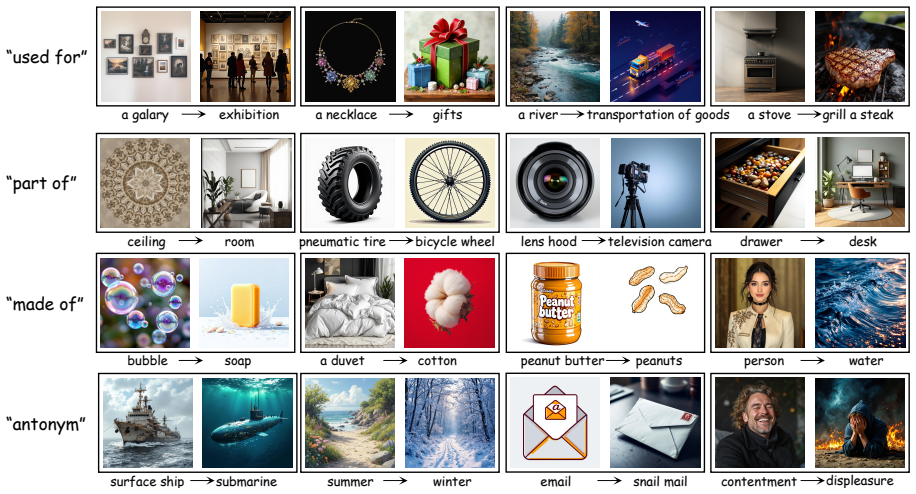
Reinforcement learning (RL) as post-training is crucial for enhancing the reasoning ability of large language models (LLMs) in coding and math. However, their capacity for visual semantic arithmetic, inferring relationships from images, remains underexplored. The classic text analogy "king"-"man"+"woman" = "queen" illustrates relational reasoning, yet replacing text with images of "king" and "man" significantly reduces performance because it requires commonsense knowledge and the extraction of concise concepts from irrelevant visual details. This capability is important for service and domestic robotics in unstructured environments, where robots must infer semantic relationships among objects, agents, and actions. In a kitchen, recognizing from images that "powder" and "cake" are related by "is made of" grounds symbolic relations in perception, enabling tool substitution, task generalization, and improved semantic reasoning. Prior work approaches semantic arithmetic by decoding image features after vector arithmetic, but suffers from modality gaps and lacks systematic evaluation. In this paper, we formulate two novel tasks, two-term subtraction and three-term operations, and construct the Image-Relation-Pair Dataset (IRPD) for benchmarking. We further propose Semantic Arithmetic Reinforcement Fine-Tuning (SAri-RFT), which post-trains large vision-language models (LVLMs) using a verifiable function and Group Relative Policy Optimization (GRPO). Our method achieves state-of-the-art results on IRPD and the real-world Visual7W-Telling dataset. By equipping LVLMs with robust cross-modal relational reasoning, this work advances domestic robots' ability to ground symbolic reasoning in perception, enhancing decision-making, tool adaptability, and human-robot interaction in complex environments. Datasets and source code are provided in the supplementary material.
Editorial analysis
A structured set of objections, weighed in public.
Referee Report
Summary. The paper introduces two new tasks (two-term subtraction and three-term operations) for visual semantic arithmetic, constructs the Image-Relation-Pair Dataset (IRPD), and proposes Semantic Arithmetic Reinforcement Fine-Tuning (SAri-RFT) that applies a verifiable reward function with Group Relative Policy Optimization (GRPO) to post-train large vision-language models. It claims state-of-the-art performance on IRPD and the Visual7W-Telling dataset, positioning the approach as an advance for grounding symbolic relations in visual perception for robotics.
Significance. If the results prove robust, the work would offer a useful new benchmark (IRPD) and training paradigm for cross-modal relational reasoning in LVLMs, with direct relevance to embodied AI and domestic robotics. The release of the dataset and source code in supplementary material is a clear strength for reproducibility and community follow-up.
major comments (2)
- [Experimental evaluation] Experimental evaluation section: Prior vector-arithmetic baselines are stated to suffer from modality gaps, yet the paper does not re-run them under the same GRPO training loop, same verifiable reward function, or same prompt format on IRPD. Because the verifiable function is defined directly over IRPD relation labels, this omission makes the SOTA claim on two-term subtraction and three-term operations difficult to interpret as evidence of genuine reasoning gains rather than optimization advantages.
- [Method] Method section (description of SAri-RFT): The verifiable function is introduced as central to the reward but lacks an explicit mathematical definition or pseudocode showing how it scores two-term subtraction versus three-term operations outputs. Without this, it is impossible to assess whether the reported improvements on IRPD stem from the RL procedure itself or from task-specific reward engineering.
minor comments (2)
- [Abstract] Abstract: The SOTA assertion is stated without any reference to metrics, baselines, or dataset statistics; a single sentence summarizing key quantitative results would improve readability.
- [Related work] Related work: The discussion of prior semantic arithmetic methods could more explicitly contrast the proposed verifiable-reward approach with existing RL post-training techniques in vision-language models.
Simulated Author's Rebuttal
We thank the referee for the constructive feedback on our work. We address each major comment point by point below, providing clarifications and committing to revisions where appropriate to strengthen the manuscript.
read point-by-point responses
-
Referee: [Experimental evaluation] Experimental evaluation section: Prior vector-arithmetic baselines are stated to suffer from modality gaps, yet the paper does not re-run them under the same GRPO training loop, same verifiable reward function, or same prompt format on IRPD. Because the verifiable function is defined directly over IRPD relation labels, this omission makes the SOTA claim on two-term subtraction and three-term operations difficult to interpret as evidence of genuine reasoning gains rather than optimization advantages.
Authors: We acknowledge the validity of this observation. The vector-arithmetic baselines from prior literature operate via direct feature manipulation and are not formulated as policy optimization problems, making a direct re-implementation under GRPO non-trivial without substantial redesign. Nevertheless, to improve interpretability of the SOTA claims, we will revise the experimental section to explicitly discuss this limitation, include a qualitative comparison of the methodological differences, and add results from any feasible adaptations of the baselines where the reward function can be applied. We believe the reported gains on IRPD still reflect genuine benefits of the RL paradigm for cross-modal reasoning, but we will temper the claims accordingly. revision: partial
-
Referee: [Method] Method section (description of SAri-RFT): The verifiable function is introduced as central to the reward but lacks an explicit mathematical definition or pseudocode showing how it scores two-term subtraction versus three-term operations outputs. Without this, it is impossible to assess whether the reported improvements on IRPD stem from the RL procedure itself or from task-specific reward engineering.
Authors: We agree that the absence of a formal definition hinders full assessment and reproducibility. In the revised manuscript, we will add an explicit mathematical formulation of the verifiable reward function, specifying the scoring rules for both two-term subtraction (e.g., relation matching and correctness penalties) and three-term operations. We will also include pseudocode in the main text or supplementary material to illustrate the computation process, making clear the balance between task-specific elements and the general RL optimization. revision: yes
Circularity Check
Empirical evaluation on introduced tasks and existing benchmark with no circular derivation
full rationale
The paper introduces two novel tasks (two-term subtraction and three-term operations) along with the IRPD dataset, then proposes SAri-RFT as an RL post-training procedure using a verifiable reward function and GRPO. Performance is reported as SOTA on IRPD and the external Visual7W-Telling dataset. No mathematical equations, fitted parameters, or self-citations are invoked to derive the reported results from the inputs by construction. The central claims rest on empirical outcomes against an independent real-world benchmark rather than any self-referential reduction, making the derivation self-contained.
Axiom & Free-Parameter Ledger
axioms (2)
- domain assumption Reinforcement learning post-training is crucial for enhancing reasoning ability of LLMs and extends effectively to LVLMs for visual tasks
- ad hoc to paper The IRPD dataset and proposed tasks benchmark visual semantic arithmetic without significant modality gaps or biases
Reference graph
Works this paper leans on
-
[1]
Gpt-4 technical report.arXiv preprint arXiv:2303.08774. Anwaar, M. U.; Labintcev, E.; and Kleinsteuber, M
work page internal anchor Pith review Pith/arXiv arXiv
-
[2]
Qwen technical report.arXiv preprint arXiv:2309.16609. Chen, Z.; Wu, J.; Wang, W.; Su, W.; Chen, G.; Xing, S.; Zhong, M.; Zhang, Q.; Zhu, X.; Lu, L.; et al
work page internal anchor Pith review Pith/arXiv arXiv
-
[3]
Bert: Pre-training of deep bidirectional transformers for lan- guage understanding. InProceedings of the 2019 conference of the North American chapter of the association for compu- tational linguistics: human language technologies, volume 1 (long and short papers), 4171–4186. Engilberge, M.; Chevallier, L.; P´erez, P.; and Cord, M
2019
-
[4]
Stream of search (sos): Learning to search in language, 2024,
Stream of search (sos): Learning to search in language.arXiv preprint arXiv:2404.03683. Girdhar, R.; El-Nouby, A.; Liu, Z.; Singh, M.; Alwala, K. V .; Joulin, A.; and Misra, I
-
[5]
DeepSeek-R1: Incentivizing Reasoning Capability in LLMs via Reinforcement Learning
Deepseek-r1: Incentivizing reasoning capability in llms via reinforcement learning.arXiv preprint arXiv:2501.12948. Guo, M.-H.; Xu, T.-X.; Liu, J.-J.; Liu, Z.-N.; Jiang, P.-T.; Mu, T.-J.; Zhang, S.-H.; Martin, R. R.; Cheng, M.-M.; and Hu, S.-M
work page internal anchor Pith review Pith/arXiv arXiv
-
[6]
FastText.zip: Compressing text classification models
Fasttext. zip: Compressing text clas- sification models.arXiv preprint arXiv:1612.03651. Kahou, S. E.; Michalski, V .; Atkinson, A.; K ´ad´ar, ´A.; Trischler, A.; and Bengio, Y
-
[7]
FigureQA: An Annotated Figure Dataset for Visual Reasoning
Figureqa: An anno- tated figure dataset for visual reasoning.arXiv preprint arXiv:1710.07300. Koroteev, M. V
- [8]
-
[9]
Tulu 3: Pushing Frontiers in Open Language Model Post-Training
T\” ulu 3: Pushing frontiers in open language model post-training.arXiv preprint arXiv:2411.15124. Lewis, P.; Perez, E.; Piktus, A.; Petroni, F.; Karpukhin, V .; Goyal, N.; K ¨uttler, H.; Lewis, M.; Yih, W.-t.; Rockt ¨aschel, T.; et al
work page internal anchor Pith review arXiv
-
[10]
In Computer Vision–ECCV 2020: 16th European Conference, Glasgow, UK, August 23–28, 2020, Proceedings, Part XXX 16, 121–137
Oscar: Object- semantics aligned pre-training for vision-language tasks. In Computer Vision–ECCV 2020: 16th European Conference, Glasgow, UK, August 23–28, 2020, Proceedings, Part XXX 16, 121–137. Springer. Li, Y .; Wang, L.; Hu, B.; Chen, X.; Zhong, W.; Lyu, C.; Wang, W.; and Zhang, M
2020
-
[11]
A comprehensive evalu- ation of gpt-4v on knowledge-intensive visual question an- swering.arXiv preprint arXiv:2311.07536. Lin, B.; Ye, Y .; Zhu, B.; Cui, J.; Ning, M.; Jin, P.; and Yuan, L
-
[12]
Video-LLaVA: Learning United Visual Representation by Alignment Before Projection
Video-llava: Learning united visual rep- resentation by alignment before projection.arXiv preprint arXiv:2311.10122. Liu, Z.; Sun, Z.; Zang, Y .; Dong, X.; Cao, Y .; Duan, H.; Lin, D.; and Wang, J
work page internal anchor Pith review arXiv
-
[13]
Visual-RFT: Visual Reinforcement Fine-Tuning
Visual-rft: Visual reinforcement fine- tuning.arXiv preprint arXiv:2503.01785. Ma, R.; Wang, P.; Liu, C.; Liu, X.; Chen, J.; Zhang, B.; Zhou, X.; Du, N.; and Li, J
work page internal anchor Pith review arXiv
-
[14]
S 2r: Teaching llms to self-verify and self- correct via reinforcement learning,
Sˆ2R: Teaching LLMs to Self-verify and Self-correct via Reinforcement Learning. arXiv preprint arXiv:2502.12853. Pennington, J.; Socher, R.; and Manning, C. D
-
[15]
InProceedings of the 2014 conference on empirical methods in natural lan- guage processing (EMNLP), 1532–1543
Glove: Global vectors for word representation. InProceedings of the 2014 conference on empirical methods in natural lan- guage processing (EMNLP), 1532–1543. Podell, D.; English, Z.; Lacey, K.; Blattmann, A.; Dockhorn, T.; M¨uller, J.; Penna, J.; and Rombach, R
2014
-
[16]
SDXL: Improving Latent Diffusion Models for High-Resolution Image Synthesis
Sdxl: Im- proving latent diffusion models for high-resolution image synthesis.arXiv preprint arXiv:2307.01952. Radford, A.; Kim, J. W.; Hallacy, C.; Ramesh, A.; Goh, G.; Agarwal, S.; Sastry, G.; Askell, A.; Mishkin, P.; Clark, J.; et al
work page internal anchor Pith review arXiv
-
[17]
Instruction tuning for large language models: A survey
Instruction tuning for large language models: A survey.arXiv preprint arXiv:2308.10792. Zhang, Z.; Wu, Q.; Wang, Y .; and Chen, F
-
[18]
Language- bind: Extending video-language pretraining to n-modality by language-based semantic alignment.arXiv preprint arXiv:2310.01852. Zhu, Y .; Groth, O.; Bernstein, M.; and Fei-Fei, L
discussion (0)
Sign in with ORCID, Apple, or X to comment. Anyone can read and Pith papers without signing in.