Recognition: unknown
ZODIAC: Zero-shot Offline Diffusion for Inferring Multi-xApps Conflicts in Open Radio Access Networks
Pith reviewed 2026-05-10 01:45 UTC · model grok-4.3
The pith
ZODIAC infers conditions that trigger conflicts among xApps in O-RAN from separate per-app datasets alone.
A machine-rendered reading of the paper's core claim, the machinery that carries it, and where it could break.
Core claim
ZODIAC is a three-stage framework for zero-shot conflict condition inference that trains uncertainty-aware surrogate models on marginal per-xApp datasets, performs trajectory-level diffusion training, and executes compositional guided denoising; a theoretical lower confidence bound establishes that this compositional reasoning serves as a principled surrogate for true conflict severity, with the epistemic penalty directly controlling the approximation gap.
What carries the argument
Compositional guided denoising, which combines per-xApp uncertainty-aware surrogates with a diffusion prior to steer the search toward conflict-inducing conditions without any joint-execution traces.
If this is right
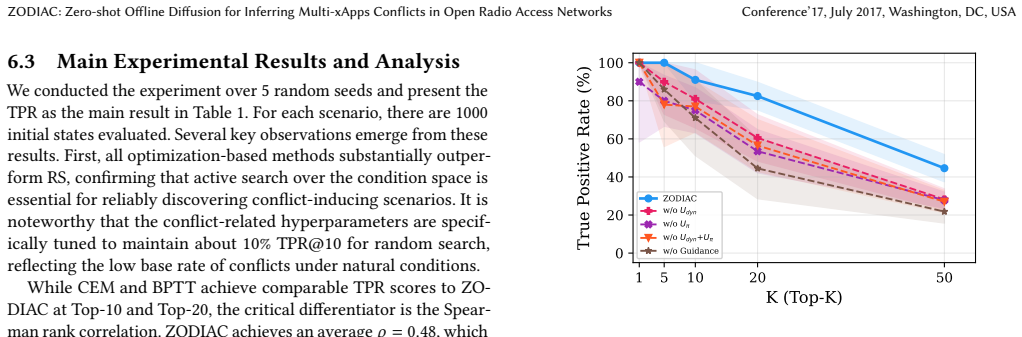
- The method identifies conflict conditions across direct, indirect, and implicit O-RAN conflict types with over 20 percent higher true-positive rate at the top-20 predictions than existing search baselines.
- It produces stronger Spearman rank correlation between predicted and actual conflict severity while generating more diverse conflict scenarios.
- Each guidance component, especially the epistemic uncertainty penalty, is necessary to filter spurious conflicts and maintain reliability.
- The framework achieves competitive computational cost without requiring any joint-execution data during training or inference.
Where Pith is reading between the lines
- The same compositional surrogate technique could apply to other multi-component systems where joint testing is expensive or unsafe, such as coordinated control of distributed energy resources.
- If the epistemic penalty term is calibrated on live network feedback, the framework might support online refinement of conflict predictions during operation.
- Extending the diffusion model to include explicit physical constraints from the O-RAN architecture could further tighten the theoretical bound.
Load-bearing premise
Datasets collected from each xApp running alone contain enough information for the surrogates and diffusion model to approximate the joint conflict behavior that would occur if the apps ran together.
What would settle it
Collect joint-execution traces for a set of xApps under the conditions that ZODIAC ranks highest and measure whether the observed conflict frequency and severity match the framework's predicted ranking.
Figures




read the original abstract
Open Radio Access Network (O-RAN) enables network control through multi-vendor xApps operating both within and across layers, subnets, and domains, whose concurrent execution can trigger conflicts that are latent during the development phase. Existing conflict management approaches rely heavily on joint-execution data, which is often unavailable in practice. To address this limitation, we formalize a novel problem termed conflict reasoning, which involves identifying conflict-inducing conditions given only marginal datasets from each individual xApp. We propose ZODIAC, a three-stage framework for zero-shot conflict condition inference that comprises uncertainty-aware surrogate model training, trajectory-level diffusion training, and compositional guided denoising for efficient, physics-constrained, and reliable condition search. We derive a theoretical lower confidence bound showing that the compositional reasoning in ZODIAC serves as a principled surrogate for true conflict severity, with the epistemic penalty directly controlling the approximation gap. We evaluate ZODIAC on both the lightweight Mobile-Env platform across all three O-RAN Alliance conflict types (direct, indirect, and implicit) and a realistic NS-O-RAN-Flexric simulator. ZODIAC consistently outperforms baseline condition search methods, achieving over 20% higher True Positive Rate at Top-20, substantially stronger Spearman rank correlation, greater scenario diversity, and competitive computational efficiency. Ablation studies confirm the necessity of each guidance component, with epistemic uncertainty penalties proving essential for filtering spurious conflicts. To the best of our knowledge, ZODIAC is the first framework in O-RAN that enables conflict reasoning from marginal offline data without requiring any joint-execution traces.
Editorial analysis
A structured set of objections, weighed in public.
Referee Report
Summary. The manuscript introduces ZODIAC, a three-stage zero-shot framework for inferring conflict-inducing conditions among multi-vendor xApps in O-RAN using only marginal offline datasets from individual xApps. The stages are uncertainty-aware surrogate model training, trajectory-level diffusion training, and compositional guided denoising. A theoretical lower confidence bound is derived showing that the compositional reasoning serves as a principled surrogate for true conflict severity, with the epistemic penalty directly controlling the approximation gap. Evaluations on the Mobile-Env platform (covering direct, indirect, and implicit O-RAN conflicts) and the NS-O-RAN-Flexric simulator report over 20% higher True Positive Rate at Top-20, stronger Spearman rank correlation, greater scenario diversity, and competitive efficiency versus baselines, with ablations confirming the role of each component including the epistemic penalty.
Significance. If the lower confidence bound holds without hidden assumptions on interaction additivity and the empirical gains replicate under fully independent marginal collection, the work would represent a meaningful advance for O-RAN conflict management by removing the need for scarce joint-execution traces. The use of diffusion models for physics-constrained search, the explicit handling of all three conflict types, and the ablation results supporting the epistemic penalty are concrete strengths that could influence practical xApp deployment.
major comments (2)
- [Theoretical lower confidence bound derivation] Theoretical lower confidence bound (abstract and the section deriving the bound): the claim that the epistemic penalty directly controls the approximation gap between the compositional surrogate and true joint conflict severity is load-bearing for the central contribution. The derivation must explicitly state whether it requires only per-xApp marginal uncertainties or additional conditions (e.g., Lipschitz continuity of the conflict function or bounded non-additive interaction terms). Without such conditions, the bound may fail to hold for implicit conflicts whose joint distribution is not recoverable from the product of marginals, exactly the case the skeptic note flags as the weakest assumption.
- [Experimental evaluation] Experimental protocol (§4 and simulator descriptions): the marginal datasets are stated to be collected from each xApp individually, yet the precise procedure for ensuring zero joint-execution leakage (e.g., how scenario parameters are sampled, whether any cross-xApp state is ever observed during surrogate training) is not detailed enough to verify that the reported TPR and Spearman gains truly reflect zero-shot compositional reasoning rather than partial joint information in the simulators.
minor comments (2)
- [Framework overview] The three-stage pipeline description would benefit from an explicit diagram or pseudocode listing the inputs/outputs of each stage and how the epistemic penalty is injected into the guided denoising step.
- [Results] Table and figure captions should include the exact number of runs and random seeds used for the reported means and correlations to support reproducibility claims.
Simulated Author's Rebuttal
We thank the referee for the constructive and detailed feedback, which helps clarify key aspects of our contribution. We address each major comment below and commit to revisions that strengthen the manuscript without altering its core claims.
read point-by-point responses
-
Referee: [Theoretical lower confidence bound derivation] Theoretical lower confidence bound (abstract and the section deriving the bound): the claim that the epistemic penalty directly controls the approximation gap between the compositional surrogate and true joint conflict severity is load-bearing for the central contribution. The derivation must explicitly state whether it requires only per-xApp marginal uncertainties or additional conditions (e.g., Lipschitz continuity of the conflict function or bounded non-additive interaction terms). Without such conditions, the bound may fail to hold for implicit conflicts whose joint distribution is not recoverable from the product of marginals, exactly the case the skeptic note flags as the weakest assumption.
Authors: We appreciate this point on the theoretical derivation. The lower confidence bound in Section 3.3 is derived from the per-xApp marginal uncertainties propagated through the uncertainty-penalized compositional diffusion process, without assuming full recoverability of the joint distribution from marginals alone. The epistemic penalty is shown to control the gap under the diffusion model's trajectory-level training. To address the concern for implicit conflicts and improve clarity, we will revise the section to explicitly enumerate the assumptions (including bounded non-additive interaction terms) and add a remark on how the bound applies as a surrogate even when joints are not directly recoverable. revision: yes
-
Referee: [Experimental evaluation] Experimental protocol (§4 and simulator descriptions): the marginal datasets are stated to be collected from each xApp individually, yet the precise procedure for ensuring zero joint-execution leakage (e.g., how scenario parameters are sampled, whether any cross-xApp state is ever observed during surrogate training) is not detailed enough to verify that the reported TPR and Spearman gains truly reflect zero-shot compositional reasoning rather than partial joint information in the simulators.
Authors: We agree that greater detail on the data collection protocol is warranted for full verification of the zero-shot setting. Marginal datasets were generated via fully independent runs of each xApp in the Mobile-Env and NS-O-RAN-Flexric simulators, with scenario parameters sampled from per-xApp distributions and no cross-xApp states or joint executions observed at any point during surrogate training. We will expand the protocol description in Section 4 and add an appendix subsection with pseudocode, sampling details, and simulator configuration files to explicitly confirm the absence of leakage. revision: yes
Circularity Check
No significant circularity; theoretical bound is independently derived.
full rationale
The paper's central theoretical claim is a derived lower confidence bound on the compositional surrogate (uncertainty-aware models + diffusion + guided denoising) as a stand-in for true conflict severity, with epistemic penalty controlling the gap. This is presented as a mathematical derivation rather than a fit or self-definition. No equations reduce the bound to the same marginal data used for training by construction, and evaluations rely on external simulators (Mobile-Env and NS-O-RAN-Flexric) with reported metrics like TPR@Top-20 and Spearman correlation. The derivation chain does not invoke self-citations for uniqueness or smuggle ansatzes; the bound is treated as external mathematical support for the zero-shot setting. This is the common case of a self-contained theoretical result backed by independent simulation evidence.
Axiom & Free-Parameter Ledger
free parameters (1)
- epistemic penalty coefficient
axioms (1)
- domain assumption Compositional reasoning with epistemic penalty forms a valid lower confidence bound on true joint conflict severity
Reference graph
Works this paper leans on
-
[1]
Cezary Adamczyk. 2023. Challenges for conflict mitigation in O-RAN’s RAN intelligent controllers. In2023 International Conference on Software, Telecommu- nications and Computer Networks (SoftCOM). IEEE, 1–6
2023
-
[2]
Anurag Ajay, Yilun Du, Abhi Gupta, Joshua Tenenbaum, Tommi Jaakkola, and Pulkit Agrawal. 2022. Is conditional generative modeling all you need for decision- making?arXiv preprint arXiv:2211.15657(2022)
work page internal anchor Pith review arXiv 2022
-
[3]
Sihem Bakri, Indrakshi Dey, Harun Siljak, Marco Ruffini, and Nicola Marchetti
- [4]
-
[5]
Julia Briden, Yilun Du, Enrico M Zucchelli, and Richard Linares. 2025. Composi- tional diffusion models for powered descent trajectory generation with flexible constraints. In2025 IEEE Aerospace Conference. IEEE, 1–19
2025
- [6]
-
[7]
Idris Cinemre, Kashif Mehmood, Katina Kralevska, and Toktam Mahmoodi. 2024. Gradient-based optimization for intent conflict resolution.Electronics13, 5 (2024), 864
2024
-
[8]
Pietro Brach del Prever, Salvatore D’Oro, Leonardo Bonati, Michele Polese, Maria Tsampazi, Heiko Lehmann, and Tommaso Melodia. 2025. Pacifista: Conflict evaluation and management in open ran.IEEE Transactions on Mobile Computing (2025)
2025
- [9]
-
[10]
Yilun Du, Conor Durkan, Robin Strudel, Joshua B Tenenbaum, Sander Dieleman, Rob Fergus, Jascha Sohl-Dickstein, Arnaud Doucet, and Will Sussman Grathwohl
-
[11]
InInternational conference on machine learning
Reduce, reuse, recycle: Compositional generation with energy-based diffu- sion models and mcmc. InInternational conference on machine learning. PMLR, 8489–8510
-
[12]
Bradley Efron. 2011. Tweedie’s formula and selection bias.J. Amer. Statist. Assoc. 106, 496 (2011), 1602–1614
2011
-
[13]
Khen Elimelech, Morteza Lahijanian, Lydia E Kavraki, and Moshe Y Vardi. 2024. Falsification of Autonomous Systems in Rich Environments.ACM Transactions on Cyber-Physical Systems(2024)
2024
-
[14]
Hakan Erdol, Xiaoyang Wang, Robert Piechocki, George Oikonomou, and Ar- jun Parekh. 2025. xapp distillation: Ai-based conflict mitigation in b5g o-ran. Computer Networks(2025), 111848
2025
-
[15]
Anastasios Giannopoulos, Sotirios Spantideas, George Levis, Alexandros Kalafatelis, and Panagiotis Trakadas. 2025. COMIX: Generalized Conflict Man- agement in O-RAN xApps-Architecture, Workflow, and a Power Control case. IEEE Access(2025)
2025
-
[16]
Jonathan Ho, Ajay Jain, and Pieter Abbeel. 2020. Denoising diffusion probabilistic models.Advances in neural information processing systems33 (2020), 6840–6851
2020
-
[17]
Michael Janner, Yilun Du, Joshua Tenenbaum, and Sergey Levine. 2022. Planning with Diffusion for Flexible Behavior Synthesis. InInternational Conference on Machine Learning. PMLR, 9902–9915
2022
- [18]
-
[19]
Ritchie Lee, Ole J Mengshoel, Anshu Saksena, Ryan W Gardner, Daniel Genin, Joshua Silbermann, Michael Owen, and Mykel J Kochenderfer. 2020. Adaptive stress testing: Finding likely failure events with reinforcement learning.Journal of Artificial Intelligence Research69 (2020), 1165–1201
2020
-
[20]
Nan Liu, Shuang Li, Yilun Du, Antonio Torralba, and Joshua B Tenenbaum. 2022. Compositional visual generation with composable diffusion models. InEuropean conference on computer vision. Springer, 423–439
2022
-
[21]
2024.Conflict Mitigation
O-RAN Working Group 3. 2024.Conflict Mitigation. Technical Specification O-RAN.WG3.TR.ConMit-R004-v01.00. O-RAN Alliance
2024
-
[22]
Michele Polese, Leonardo Bonati, Salvatore D’oro, Stefano Basagni, and Tommaso Melodia. 2023. Understanding O-RAN: Architecture, interfaces, algorithms, security, and research challenges.IEEE Communications Surveys & Tutorials25, 2 (2023), 1376–1411
2023
-
[23]
Thomas Power, Rana Soltani-Zarrin, Soshi Iba, and Dmitry Berenson. 2023. Sam- pling constrained trajectories using composable diffusion models. InIROS 2023 Workshop on Differentiable Probabilistic Robotics: Emerging Perspectives on Robot Learning
2023
-
[24]
Reuven Rubinstein. 1999. The cross-entropy method for combinatorial and continuous optimization.Methodology and computing in applied probability1, 2 (1999), 127–190
1999
-
[25]
Stefan Balthasar Schneider, Stefan Werner, Ramin Khalili, Artur Hecker, and Holger Karl. 2022. mobile-env: An open platform for reinforcement learning in wireless mobile networks. InIEEE/IFIP Network Operations and Management Symposium (NOMS)
2022
-
[26]
Nancy Varshney, Corrado Puligheddu, Ahmed Badawy, and Carla Fabiana Chi- asserini. 2025. Explainable Artificial Intelligence for Conflict Management: XAI4C for Conflict Detection and Mitigation in O-RAN Near-RT RIC.IEEE Vehicular Technology Magazine(2025)
2025
- [27]
-
[28]
Abdul Wadud, Fatemeh Golpayegani, and Nima Afraz. 2023. Conflict manage- ment in the near-rt-ric of open ran: A game theoretic approach. In2023 IEEE International Conferences on Internet of Things (iThings) and IEEE Green Comput- ing & Communications (GreenCom) and IEEE Cyber, Physical & Social Computing (CPSCom) and IEEE Smart Data (SmartData) and IEEE C...
2023
-
[29]
Abdul Wadud, Fatemeh Golpayegani, and Nima Afraz. 2025. xApp-Level Conflict Mitigation in O-RAN, a Mobility Driven Energy Saving Case. InIEEE INFO- COM 2025-IEEE Conference on Computer Communications Workshops (INFOCOM WKSHPS). IEEE, 1–6
2025
-
[30]
Yuting Xie, Xianda Guo, Cong Wang, Kunhua Liu, and Long Chen. 2024. Advdif- fuser: Generating adversarial safety-critical driving scenarios via guided diffusion. In2024 IEEE/RSJ International Conference on Intelligent Robots and Systems (IROS). IEEE, 9983–9989
2024
-
[31]
Mina Yonan, Mostafa Ashraf, Kamil Kociszewski, Adrian Oziębło, Abdelrhman Soliman, Aya Kamal, Bartosz Rak, and Andrzej Denisiewicz. 2025. ns-o-ran-flexric, RIC TaaP: RIC Testing as a Platform. https://github.com/Orange-OpenSource/ns- O-RAN-flexric?tab=readme-ov-file. Online Resource, accessed Oct. 2025
2025
-
[32]
Arshia Zolghadr, Joao F Santos, Luiz A DaSilva, and Jacek Kibilda. 2025. Learning and reconstructing conflicts in o-ran: A graph neural network approach. In2025 IEEE Wireless Communications and Networking Conference (WCNC). IEEE, 01–06. ZODIAC: Zero-shot Offline Diffusion for Inferring Multi-xApps Conflicts in Open Radio Access Networks Conference’17, Jul...
2025
discussion (0)
Sign in with ORCID, Apple, or X to comment. Anyone can read and Pith papers without signing in.