Recognition: unknown
Sutured manifold hierarchies and the Thurston nom
Pith reviewed 2026-05-10 00:49 UTC · model grok-4.3
The pith
The maw dual graph extracts Thurston norm data from any taut sutured manifold hierarchy.
A machine-rendered reading of the paper's core claim, the machinery that carries it, and where it could break.
Core claim
Taut sutured manifold hierarchies determine the Thurston norm of a compact oriented irreducible 3-manifold with toroidal boundary. An explicit procedure extracts this information via the maw dual graph construction, which can be incorporated into a general method for computing the Thurston norm. As an application, the Thurston norm is computed for the exterior of all alternating and some nonalternating pretzel links with three components, giving a negative answer to a question of Baker--Taylor. Moreover, if a nonseparating surface S in a Haken manifold M with toroidal boundary is disjoint from a boundary torus, then the class [S] does not lie in the interior of a top-dimensional cone of the
What carries the argument
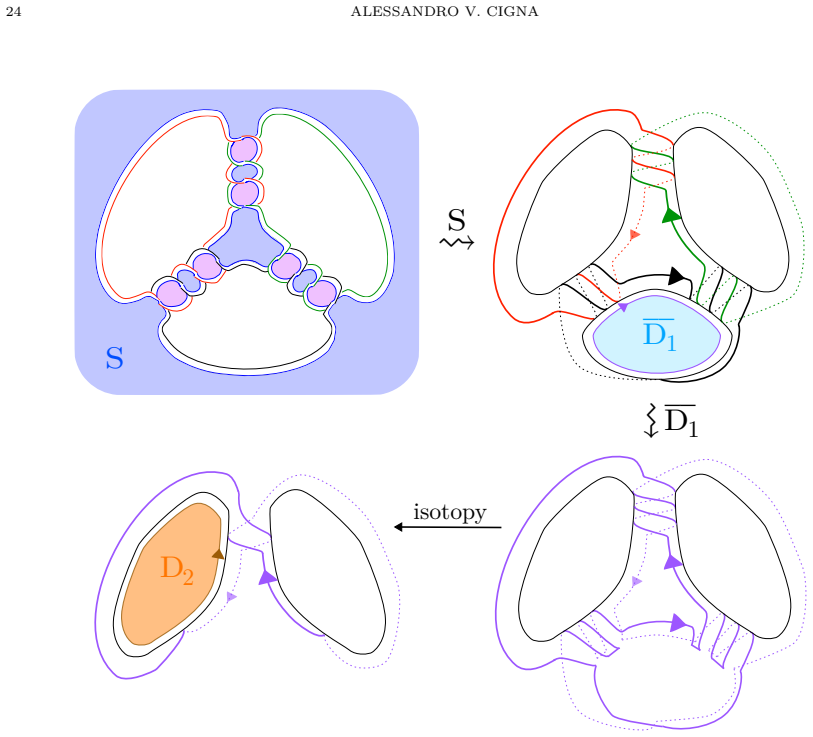
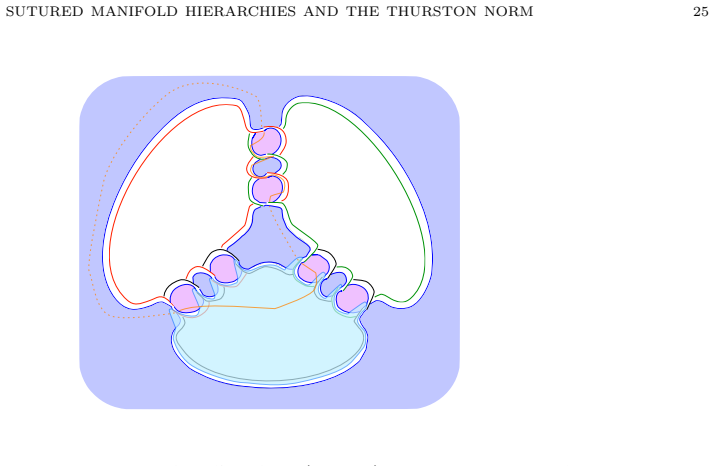
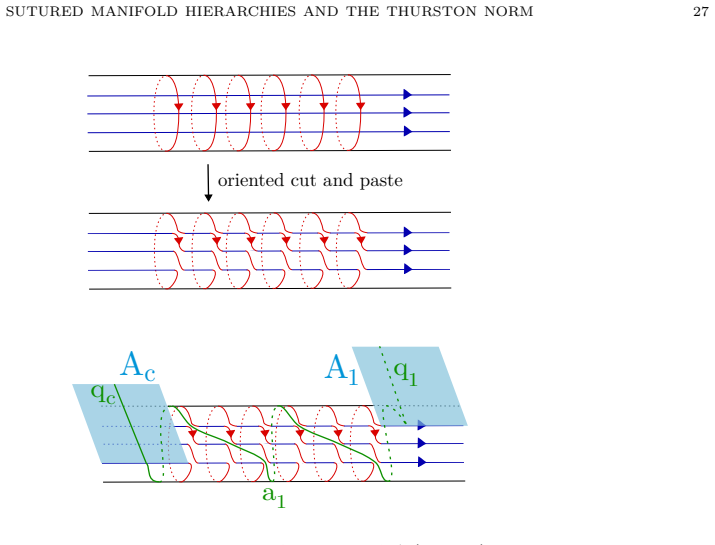
The maw dual graph construction, which builds a graph directly from the hierarchy data so that the Thurston norm coefficients can be read off its structure.
Load-bearing premise
The maw dual graph construction correctly and explicitly extracts the Thurston norm data from any given taut sutured manifold hierarchy without additional assumptions beyond the classical results of Thurston and Gabai.
What would settle it
An explicit taut sutured hierarchy for a three-manifold whose Thurston norm is already known by independent means, such that the maw dual graph produces a different norm value.
Figures

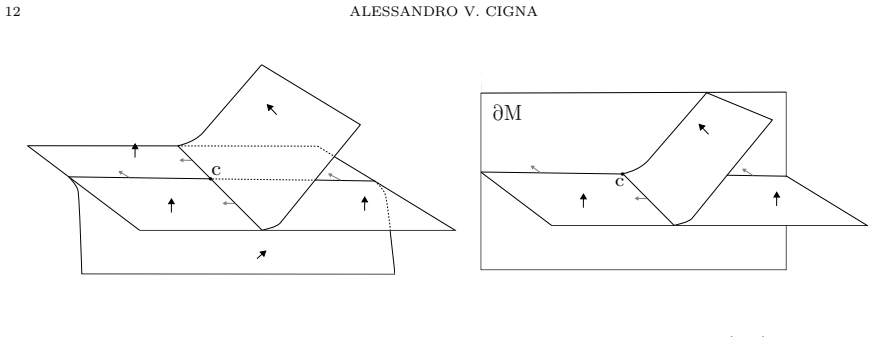
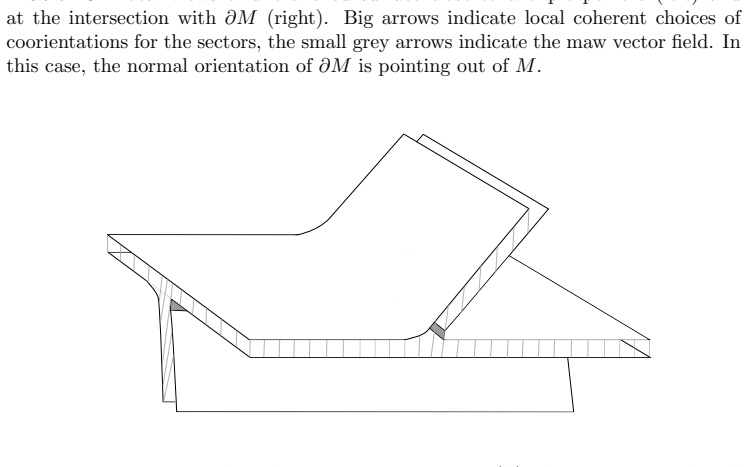
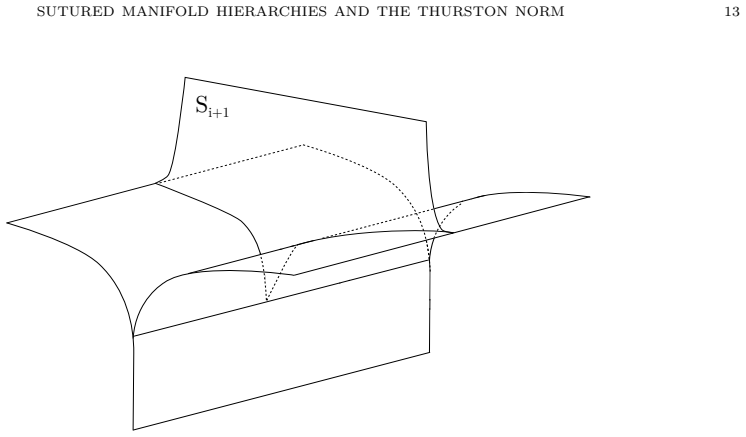
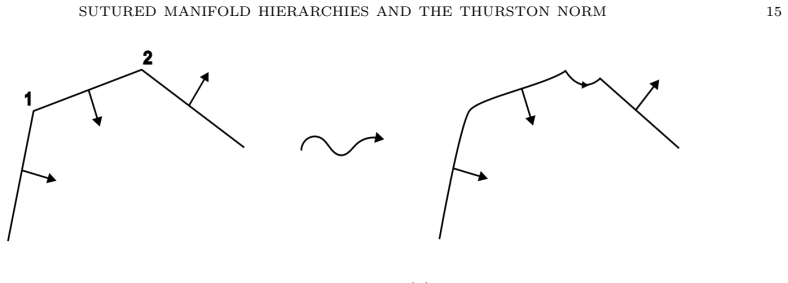

read the original abstract
Classical work of Thurston and Gabai shows that finitely many taut sutured manifold hierarchies determine the Thurston norm of a compact oriented irreducible $3$-manifold with toroidal boundary. We give an explicit procedure to extract this information from such hierarchies. This is achieved via the maw dual graph construction, which can be incorporated into a general method for computing the Thurston norm of a manifold. As an application, we compute the Thurston norm of the exterior of all alternating and some nonalternating pretzel links with three components. Using these computations, we give a negative answer to a question of Baker--Taylor. Moreover, we show that if a nonseparating surface $S$ in a Haken manifold $M$ with toroidal boundary is disjoint from a boundary torus, then the class $[S] \in H_2(M,\partial M)$ does not lie in the interior of a top-dimensional cone of the Thurston norm. In particular, if two components $\ell_i$ and $\ell_j$ of a nonsplit link have zero linking number, then neither represents a class in an open top-dimensional cone of the Thurston norm ball of the link exterior.
Editorial analysis
A structured set of objections, weighed in public.
Referee Report
Summary. Classical results of Thurston and Gabai show that finitely many taut sutured manifold hierarchies determine the Thurston norm of a compact oriented irreducible 3-manifold with toroidal boundary. The paper gives an explicit procedure to extract this information via the maw dual graph construction, which is incorporated into a general method for computing the Thurston norm. As an application, the Thurston norm is computed for the exteriors of all alternating and some nonalternating pretzel links with three components; these computations yield a negative answer to a question of Baker--Taylor. The paper also proves that if a nonseparating surface S in a Haken manifold M with toroidal boundary is disjoint from a boundary torus, then the class [S] does not lie in the interior of a top-dimensional cone of the Thurston norm ball.
Significance. If the maw dual graph construction is correct, the work supplies an explicit, parameter-free extraction procedure for Thurston norm data directly from hierarchies, relying only on the classical theorems of Thurston and Gabai. This yields a concrete computational method with immediate applications to link exteriors. The pretzel-link calculations and the negative resolution of the Baker--Taylor question illustrate the method's utility, while the nonseparating-surface theorem is a clean consequence for the structure of the Thurston norm polytope. The explicit construction and direct derivations from classical results are notable strengths.
minor comments (3)
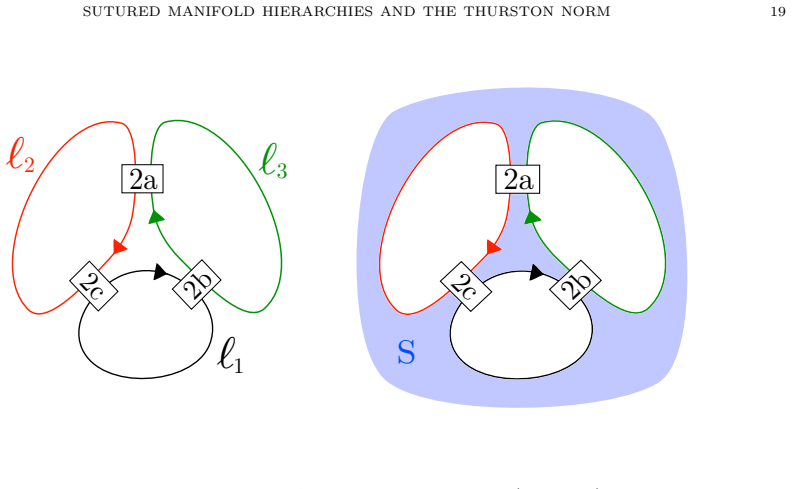
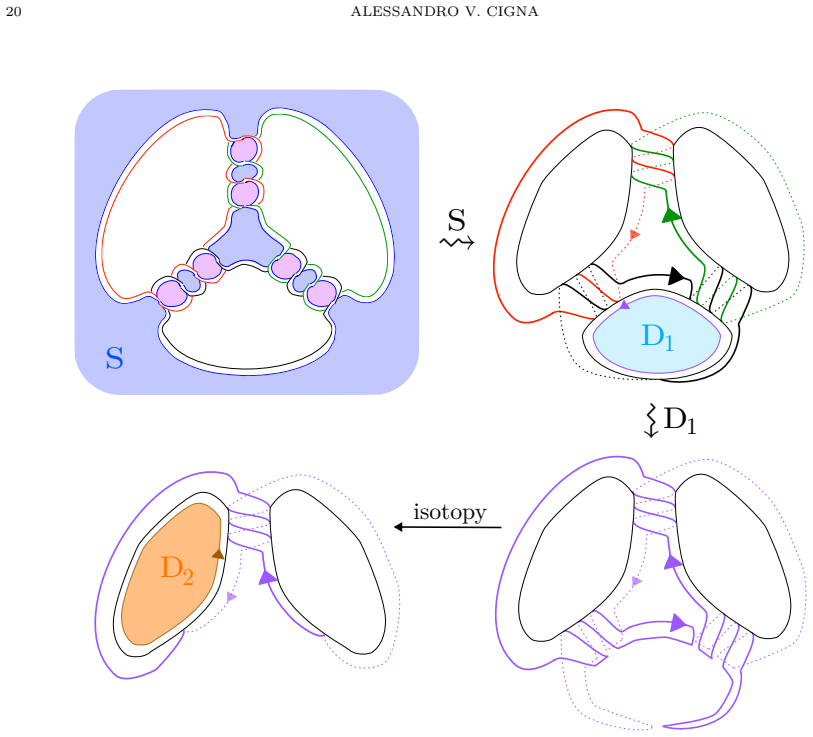
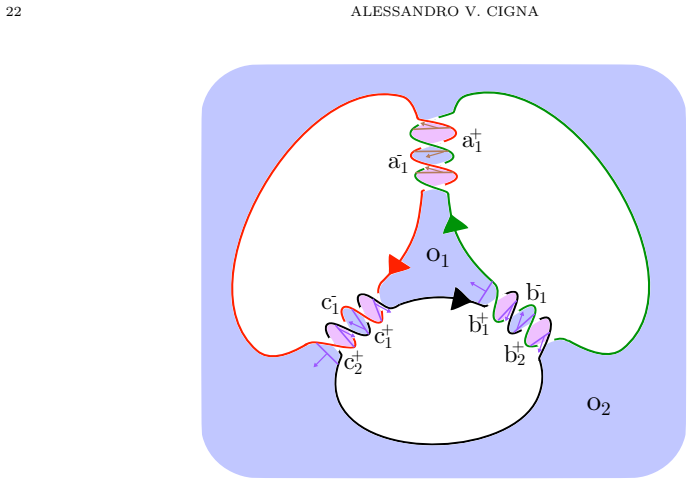
- [§3] §3: The definition and properties of the maw dual graph would be easier to follow if a small, fully worked example (e.g., a simple taut sutured manifold) were included to illustrate how vertices, edges, and weights encode the norm-minimizing surfaces and the resulting polyhedral decomposition.
- [§5] §5 (pretzel-link computations): A compact table listing the computed Thurston norms for each alternating and nonalternating example, together with the corresponding hierarchy and maw-graph data, would make the verification of the Baker--Taylor counterexample more transparent.
- [Introduction] Introduction and §6: The statement that the nonseparating-surface result holds 'in particular' for links with zero linking number would benefit from an explicit sentence clarifying how the general theorem specializes to that case.
Simulated Author's Rebuttal
We thank the referee for their positive summary, recognition of the significance of the maw dual graph construction, and recommendation for minor revision. No specific major comments were raised in the report.
Circularity Check
No significant circularity
full rationale
The paper's derivation rests on the classical theorems of Thurston and Gabai establishing that taut sutured manifold hierarchies determine the Thurston norm, then introduces an independent maw dual graph construction to extract the norm data explicitly. This construction is defined and its properties proved directly in the manuscript without fitting parameters to the target quantities or invoking self-citations as load-bearing premises. The pretzel-link computations and the nonseparating surface result are derived from the new framework applied to the hierarchies, remaining self-contained against external benchmarks. No step reduces by definition or construction to its own inputs.
Axiom & Free-Parameter Ledger
axioms (2)
- domain assumption Compact oriented irreducible 3-manifolds with toroidal boundary admit taut sutured manifold hierarchies that determine the Thurston norm.
- ad hoc to paper The maw dual graph construction faithfully encodes the norm information contained in any such hierarchy.
invented entities (1)
-
maw dual graph
no independent evidence
Reference graph
Works this paper leans on
-
[1]
Baker and Scott A
Kenneth L. Baker and Scott A. Taylor , title =. Journal of Differential Geometry , number =. 2019 , doi =
2019
-
[2]
Lectures on differential topology , isbn =
Benedetti, Riccardo , year =. Lectures on differential topology , isbn =
-
[3]
Taut foliations in branched cyclic covers and left-orderable groups , journal =
Boyer, Steven and Hu, Ying , year =. Taut foliations in branched cyclic covers and left-orderable groups , journal =
-
[4]
2025 , eprint=
On 3-manifolds admitting co-orientable taut foliations, but none with vanishing Euler class , author=. 2025 , eprint=
2025
-
[5]
Foliations
Candel, Alberto and Conlon, Lawrence , month = jul, year =. Foliations
-
[6]
, title =
Cigna, Alessandro V. , title =. Journal of Knot Theory and Its Ramifications , volume =. 2025 , doi =
2025
-
[7]
Cigna, Alessandro V. , year=. A formula for the
-
[8]
Geometry & Topology , author =
Floer homology, group orderability, and taut foliations of hyperbolic 3–manifolds , volume =. Geometry & Topology , author =. 2020 , pages =. doi:10.2140/gt.2020.24.2075 , language =
-
[9]
Transactions of the American Mathematical Society , author =
The. Transactions of the American Mathematical Society , author =. 1988 , pages =. doi:10.2307/2000879 , number =
-
[10]
Foliations and genera of links , volume =. Topology , author =. 1984 , pages =. doi:10.1016/0040-9383(84)90001-6 , language =
-
[11]
Foliations and the topology of 3-manifolds , volume =. Journal of Differential Geometry , author =. doi:10.4310/jdg/1214437784 , number =
-
[12]
Journal of Differential Geometry , author =
Foliations and the topology of 3-manifolds. Journal of Differential Geometry , author =. doi:10.4310/jdg/1214441488 , number =
-
[13]
Journal of Differential Geometry , author =
Foliations and the topology of 3-manifolds. Journal of Differential Geometry , author =. doi:10.4310/jdg/1214441487 , number =
-
[14]
Geometric Topology (Athens, GA, 1993) , series =
David Gabai , title =. Geometric Topology (Athens, GA, 1993) , series =. 1997 , isbn =
1993
-
[15]
Commentarii Mathematici Helvetici , volume =
David Gabai , title =. Commentarii Mathematici Helvetici , volume =. 2000 , pages =
2000
-
[16]
The fully marked surface theorem , volume =. Acta Mathematica , author =. 2020 , pages =. doi:10.4310/ACTA.2020.v225.n2.a4 , language =
-
[17]
Commentarii Mathematici Helvetici , volume =
Joel Hass , title =. Commentarii Mathematici Helvetici , volume =. 1986 , pages =
1986
-
[18]
Kitayama, Takahiro. A Survey of the Thurston Norm. In the Tradition of Thurston II: Geometry and Groups. 2022. doi:10.1007/978-3-030-97560-9_5
-
[19]
Taut ideal triangulations of 3-manifolds
Lackenby, Marc , journal =. Taut ideal triangulations of 3-manifolds. , url =
-
[20]
Advances in Mathematics , author =
The efficient certification of knottedness and. Advances in Mathematics , author =. 2021 , pages =. doi:10.1016/j.aim.2021.107796 , language =
-
[21]
Michael P. Landry , keywords =. Veering triangulations and the Thurston norm: Homology to isotopy , journal =. 2022 , issn =. doi:https://doi.org/10.1016/j.aim.2021.108102 , url =
-
[22]
Landry and Yair N
Michael P. Landry and Yair N. Minsky and Samuel J. Taylor , title =. Journal of the European Mathematical Society , volume =. 2024 , pages =
2024
-
[23]
Journal für die reine und angewandte Mathematik (Crelles Journal) , doi =
Transverse surfaces and pseudo-Anosov flows , author =. Journal für die reine und angewandte Mathematik (Crelles Journal) , doi =. 2026 , lastchecked =
2026
-
[24]
Geometry & Topology , author =
Laminar branched surfaces in 3–manifolds , volume =. Geometry & Topology , author =. 2002 , pages =. doi:10.2140/gt.2002.6.153 , language =
-
[25]
Algebraic & Geometric Topology , author =
The. Algebraic & Geometric Topology , author =. 2008 , pages =. doi:10.2140/agt.2008.8.211 , language =
-
[26]
2025 , note =
On the Euler class one conjecture for fillable contact structures , author=. 2025 , note =
2025
-
[27]
International Mathematics Research Notices , volume =
Miller, Maggie , title =. International Mathematics Research Notices , volume =. 2023 , month =. doi:10.1093/imrn/rnac353 , url =
-
[28]
, number =
Topology of foliations. , number =. Trans. Moscow Math. Soc , author =. 1965 , pages =
1965
-
[29]
Low Dimensional Topology and Kleinian Groups , editor =
Ulrich Oertel , title =. Low Dimensional Topology and Kleinian Groups , editor =
-
[30]
Annals of Mathematics , volume =
Richard Schoen and Shing-Tung Yau , title =. Annals of Mathematics , volume =. 1979 , pages =
1979
-
[31]
Publications mathématiques de l'IHÉS , author =
Plongements dans les variétés feuilletées et classification de feuilletages sans holonomie , volume =. Publications mathématiques de l'IHÉS , author =. 1974 , pages =. doi:10.1007/BF02684367 , language =
-
[32]
Proceedings of the American Mathematical Society , author =
Thurston norm and taut branched surfaces , volume =. Proceedings of the American Mathematical Society , author =. 1988 , pages =. doi:10.1090/S0002-9939-1988-0934889-9 , language =
-
[33]
Commentarii Mathematici Helvetici , volume =
Dennis Sullivan , title =. Commentarii Mathematici Helvetici , volume =. 1979 , pages =
1979
-
[34]
Memoirs of the American Mathematical Society , year=
A norm for the homology of 3-manifolds , author=. Memoirs of the American Mathematical Society , year=
-
[35]
Proceedings of the American Mathematical Society , author =
Branched. Proceedings of the American Mathematical Society , author =. 1994 , pages =. doi:10.2307/2161059 , number =
-
[36]
On. Acta Mathematica , author =. 2020 , pages =. doi:10.4310/ACTA.2020.v225.n2.a3 , language =
discussion (0)
Sign in with ORCID, Apple, or X to comment. Anyone can read and Pith papers without signing in.