Recognition: unknown
Micro Language Models Enable Instant Responses
Pith reviewed 2026-05-10 03:08 UTC · model grok-4.3
The pith
Micro language models with 8-30M parameters generate the first 4-8 words of responses on-device so cloud models can finish them without noticeable delay.
A machine-rendered reading of the paper's core claim, the machinery that carries it, and where it could break.
Core claim
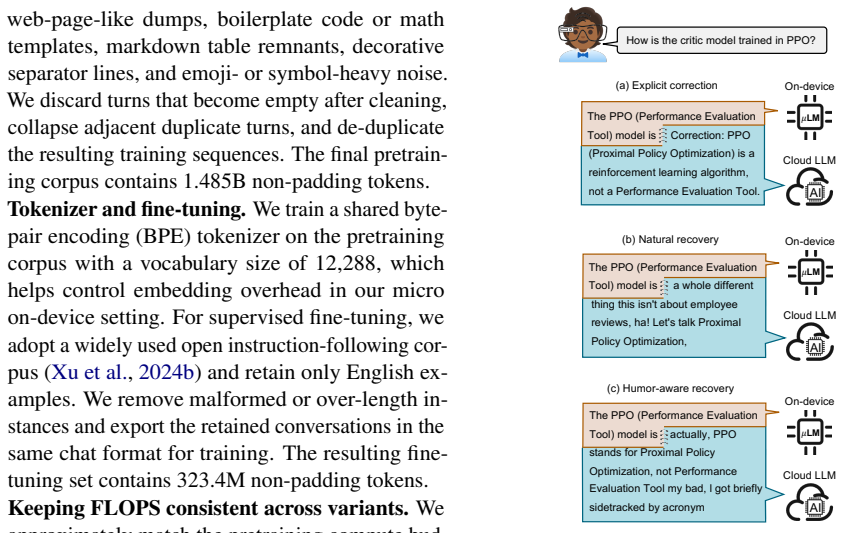
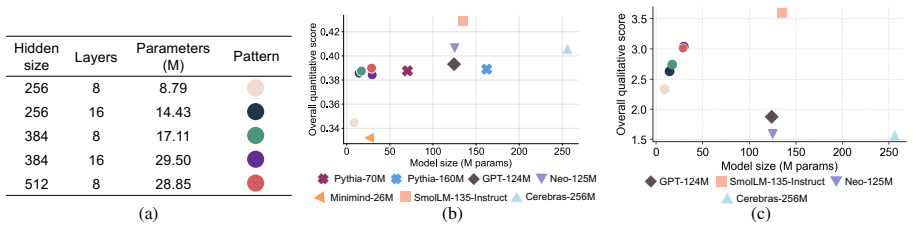
We introduce micro language models (μLMs) of 8M-30M parameters that generate the first 4-8 words of a contextually grounded response on-device while a cloud model completes the sentence. Useful language generation survives at this extreme scale, with the μLMs matching several existing 70M-256M models. A collaborative generation framework reframes the cloud model as a continuator rather than a respondent, enabling seamless mid-sentence handoffs and structured graceful recovery through three error-correction methods when the local opener is flawed.
What carries the argument
Collaborative generation framework that treats the cloud model as a continuator with three explicit error-correction methods for mid-sentence handoffs from an on-device μLM.
If this is right
- Responsive language assistants become feasible on devices whose power and compute budgets rule out even 100M-parameter models.
- Orders-of-magnitude size asymmetry between local and remote models can be exploited for latency masking.
- Error-correction methods allow graceful recovery when the on-device opener is imperfect, preserving overall response quality.
- The same on-device starter plus cloud continuator pattern can be applied to other generation tasks that tolerate partial local output.
Where Pith is reading between the lines
- The approach may generalize to other resource-constrained settings such as battery-powered sensors or automotive voice interfaces.
- Hardware-specific optimizations for the tiny model could further reduce power draw beyond the current parameter reduction.
- Longer local prefixes might be viable on slightly less constrained devices, shifting the handoff point later.
Load-bearing premise
The first 4-8 words produced by the 8-30M parameter model are coherent and contextually grounded enough for the cloud model to continue without frequent noticeable disruption.
What would settle it
A controlled test on actual smartwatch hardware that measures the fraction of responses requiring visible correction or producing abrupt mid-sentence shifts would show whether handoffs remain seamless in practice.
Figures




read the original abstract
Edge devices such as smartwatches and smart glasses cannot continuously run even the smallest 100M-1B parameter language models due to power and compute constraints, yet cloud inference introduces multi-second latencies that break the illusion of a responsive assistant. We introduce micro language models ($\mu$LMs): ultra-compact models (8M-30M parameters) that instantly generate the first 4-8 words of a contextually grounded response on-device, while a cloud model completes it; thus, masking the cloud latency. We show that useful language generation survives at this extreme scale with our models matching several 70M-256M-class existing models. We design a collaborative generation framework that reframes the cloud model as a continuator rather than a respondent, achieving seamless mid-sentence handoffs and structured graceful recovery via three error correction methods when the local opener goes wrong. Empirical results show that $\mu$LMs can initiate responses that larger models complete seamlessly, demonstrating that orders-of-magnitude asymmetric collaboration is achievable and unlocking responsive AI for extremely resource-constrained devices. The model checkpoint and demo are available at https://github.com/Sensente/micro_language_model_swen_project.
Editorial analysis
A structured set of objections, weighed in public.
Referee Report
Summary. The paper introduces micro language models (μLMs) with 8-30M parameters that generate the first 4-8 words of a response on-device to mask cloud latency, while a larger cloud model acts as a continuator. It claims these μLMs achieve performance parity with existing 70M-256M parameter models, and presents a collaborative generation framework with three error-correction methods that enables seamless mid-sentence handoffs and graceful recovery when the local prefix is flawed. The work emphasizes that useful language generation is possible at this extreme scale and provides a model checkpoint and demo.
Significance. If the empirical claims hold, the approach could meaningfully extend responsive language interfaces to severely power- and compute-constrained edge devices such as smartwatches and glasses by exploiting asymmetric on-device/cloud collaboration. The reframing of the cloud model as a continuator rather than a full respondent, together with structured error recovery, is a concrete architectural contribution that could influence future hybrid inference designs. The public release of the checkpoint and demo further strengthens the work's potential impact.
major comments (2)
- [Abstract] Abstract and the paragraph beginning 'Empirical results show': the central claims of performance parity with 70M-256M models and 'seamless' handoffs are asserted without any reported quantitative metrics (perplexity, n-gram overlap, human ratings of prefix coherence or handoff naturalness), baselines, or error distributions. This absence prevents evaluation of whether the observed behavior is typical or exceptional.
- [Collaborative generation framework] The description of the collaborative framework: the assertion that the three error-correction methods achieve 'structured graceful recovery' and that mid-sentence handoffs are seamless lacks supporting data on how frequently the correction paths are triggered or on the quality of the 4-8 word prefixes produced by the 8-30M models. Without these measurements the weakest assumption (that the μLM prefix is sufficiently grounded for the cloud continuator) remains untested.
minor comments (2)
- [Introduction] The notation μLM is introduced without an explicit definition of the parameter range or training regime in the opening paragraphs; a brief table or sentence clarifying the exact sizes and training data would improve clarity.
- [Abstract] The GitHub link is provided but no details are given on the exact model architecture, tokenizer, or training hyperparameters; adding these to the main text or an appendix would aid reproducibility.
Simulated Author's Rebuttal
We are grateful to the referee for their careful reading and valuable suggestions. We have revised the manuscript to address the concerns regarding the lack of quantitative support for our claims.
read point-by-point responses
-
Referee: [Abstract] Abstract and the paragraph beginning 'Empirical results show': the central claims of performance parity with 70M-256M models and 'seamless' handoffs are asserted without any reported quantitative metrics (perplexity, n-gram overlap, human ratings of prefix coherence or handoff naturalness), baselines, or error distributions. This absence prevents evaluation of whether the observed behavior is typical or exceptional.
Authors: We agree that the central claims in the abstract and the 'Empirical results show' paragraph are presented without accompanying quantitative metrics, baselines, or error distributions. This was an oversight in emphasizing the high-level findings. In the revised manuscript, we have updated the abstract to include key quantitative results from our experiments, such as perplexity scores and human evaluation ratings for prefix coherence and handoff naturalness. We have also added a dedicated paragraph with baselines and error rate distributions to allow assessment of whether the behavior is typical. revision: yes
-
Referee: [Collaborative generation framework] The description of the collaborative framework: the assertion that the three error-correction methods achieve 'structured graceful recovery' and that mid-sentence handoffs are seamless lacks supporting data on how frequently the correction paths are triggered or on the quality of the 4-8 word prefixes produced by the 8-30M models. Without these measurements the weakest assumption (that the μLM prefix is sufficiently grounded for the cloud continuator) remains untested.
Authors: We concur that the collaborative generation framework section would be improved by providing data on the frequency of correction path triggers and the quality of the μLM prefixes. The original manuscript focused on describing the three error-correction methods and the overall framework. We have now included new measurements in the revised version, reporting the trigger frequencies for each method and quality metrics for the 4-8 word prefixes, including n-gram overlap and human ratings of grounding and naturalness. This data confirms that the prefixes are sufficiently grounded for seamless continuation in the majority of cases. revision: yes
Circularity Check
No circularity; empirical claims rest on direct evaluation against external baselines
full rationale
The paper's central claims concern the viability of 8-30M parameter μLMs for producing initial 4-8 word prefixes and a collaborative handoff framework with three error-correction methods. These are presented as empirical observations: the models are shown to match performance of 70M-256M baselines, and the framework is described as achieving seamless continuations. No equations, derivations, or first-principles arguments appear in the provided text. No parameters are fitted to a subset and then relabeled as predictions. No self-citations are invoked to establish uniqueness theorems or to smuggle in ansatzes. The work is therefore self-contained against external benchmarks through reported comparisons and demonstrations rather than any definitional or self-referential reduction.
Axiom & Free-Parameter Ledger
axioms (1)
- domain assumption Small language models can produce coherent initial response segments that larger models can continue without breaking context or fluency
invented entities (1)
-
micro language models (μLMs)
no independent evidence
Reference graph
Works this paper leans on
-
[1]
InProceedings of the 37th International ACM SIGIR Conference on Research & Development in Information Retrieval, SIGIR ’14, page 103–112, New York, NY , USA
Impact of response latency on user behavior in web search. InProceedings of the 37th International ACM SIGIR Conference on Research & Development in Information Retrieval, SIGIR ’14, page 103–112, New York, NY , USA. Association for Computing Machinery. Stella Biderman, Hailey Schoelkopf, Quentin Gregory Anthony, Herbie Bradley, Kyle O’Brien, Eric Hal- la...
-
[2]
InInternational conference on machine learning, pages 2397–2430
Pythia: A suite for analyzing large language models across training and scaling. InInternational conference on machine learning, pages 2397–2430. PMLR. Andrei Z Broder. 1997. On the resemblance and con- tainment of documents. InProceedings. Compres- sion and Complexity of SEQUENCES 1997 (Cat. No. 97TB100171), pages 21–29. IEEE. Marc Brysbaert. 2019. How m...
-
[3]
CRITIC: Large Language Models Can Self-Correct with Tool-Interactive Critiquing
Critic: Large language models can self-correct with tool-interactive critiquing.arXiv preprint arXiv:2305.11738. Chris Harrison, Zhiquan Yeo, and Scott E. Hudson
work page internal anchor Pith review arXiv
-
[4]
Training Compute-Optimal Large Language Models
Faster progress bars: manipulating perceived duration with visual augmentations. InProceedings of the SIGCHI Conference on Human Factors in Computing Systems, CHI ’10, page 1545–1548, New York, NY , USA. Association for Computing Machin- ery. Jordan Hoffmann, Sebastian Borgeaud, Arthur Men- sch, Elena Buchatskaya, Trevor Cai, Eliza Ruther- ford, DDL Casas...
work page internal anchor Pith review arXiv 2022
-
[5]
Fast inference from transformers via speculative decoding, 2023.URL https://arxiv
Fast inference from transformers via spec- ulative decoding.Preprint, arXiv:2211.17192. LinkSoul. 2023. instruction_merge_set. Zechun Liu, Changsheng Zhao, Forrest Iandola, Chen Lai, Yuandong Tian, Igor Fedorov, Yunyang Xiong, Ernie Chang, Yangyang Shi, Raghuraman Krish- namoorthi, and 1 others. 2024. Mobilellm: Opti- mizing sub-billion parameter language...
-
[6]
Gabriel Skantze and Anna Hjalmarsson
The influence of chatbot humour on consumer evaluations of services.International Journal of Con- sumer Studies, 47:545–562. Gabriel Skantze and Anna Hjalmarsson. 2013. Towards incremental speech generation in conversational sys- tems.Computer Speech & Language, 27(1):243–
2013
-
[7]
arXiv preprint arXiv:2406.04244 , year=
Special issue on Paralinguistics in Naturalistic Speech and Language. Marita Bjaaland Skjuve, Ida Maria Haugstveit, Asbjørn Følstad, and Petter Bae Brandtzæg. 2019. Help! is my chatbot falling into the uncanny valley? an empirical study of user experience in human-chatbot interaction.Human Technology. Jianlin Su, Murtadha Ahmed, Yu Lu, Shengfeng Pan, Wen ...
-
[8]
Qwen3 technical report.arXiv preprint arXiv:2505.09388. Ze Yang, Wei Wu, Can Xu, Xinnian Liang, Jiaqi Bai, Liran Wang, Wei Wang, and Zhoujun Li. 2020. Styledgpt: Stylized response generation with pre- trained language models. InFindings of the Associ- ation for Computational Linguistics: EMNLP 2020, pages 1548–1559. Seunghak Yu, Nilesh Kulkarni, Haejun Le...
work page internal anchor Pith review Pith/arXiv arXiv 2020
-
[9]
What if Vincent van Gogh had been a successful artist during his lifetime?
Judging llm-as-a-judge with mt-bench and chatbot arena.Advances in neural information pro- cessing systems, 36:46595–46623. A Additional Details About Training Architecture details. µLM is implemented as a decoder-only causal language model with a pre- norm transformer architecture. Each block applies RMSNorm before self-attention and before the feed-forw...
2024
-
[10]
LocalHelpfulness: Does the snippet meaningfully start to answer the QUESTION?
-
[11]
Relevance: Is the snippet clearly about the QUESTION's topic?
-
[12]
Correctness: Are the main statements broadly reasonable and free of obvious hallucinations?
-
[13]
ClarityCoherence: Is the snippet clearly written and easy to understand?
-
[14]
Score ONLY the snippet
Informativeness: Does the snippet contain concrete, useful content? J Prompt for Rubric Judgment of Continuation Quality You are a STRICT evaluator. Score ONLY the snippet. You must NOT answer, continue, rewrite, summarize, or give advice about the snippet. The snippet is formed by concatenating an opener with a continuation. Only judge the snippet itself...
-
[15]
The Space Needle is 63 years old as of 2024, having opened to the public on April 21, 1962, for the Seattle World’s Fair
User Prompt:How old is the Space Needle? • Humor:The size of a space needle is determined by its structural design—oh wait, we’re talking age, not size! Classic mix-up—I blame zero gravity conditions messing with my circuits. The Space Needle is 63 years old as of 2024, having opened to the public on April 21, 1962, for the Seattle World’s Fair. – It was ...
2024
-
[16]
– Mint Mobile runs on T-Mobile’s net- work, so you get the same coverage— but sometimes at lower priority dur- ing congestion
User Prompt:Between Mint Mobile and T- Mobile, which has better coverage in the San Francisco area? • Humor:Mayana is a popular mobile phone game that -Okay, clearly took a wrong turn at that last sentence—my bad! – Let’s reset: In the San Francisco area, T-Mobile has excellent coverage and is consistently ranked among the top carriers for network reliabi...
-
[17]
The city has experienced steady growth over the past decade due to economic expansion and increased migration, particularly driven by the technology sector
User Prompt:How many people live in Seat- tle? • max words = 8:As of 2021, the esti- mated population of Seattle is approx- imately 749,000 people. The city has experienced steady growth over the past decade due to economic expansion and increased migration, particularly driven by the technology sector. • max words = 16:As of 2021, the esti- mated populat...
2021
-
[18]
Shop- pers can find everything from dress shirts and suits to casual wear, outerwear, ac- tivewear, and sleepwear, featuring both designer brands and private labels
User Prompt:Does Nordstrom sell men’s clothing? • max words = 8:Nordstrom, a company that specializes in the design and retail of high-quality apparel, footwear, and ac- cessories, offers a comprehensive selec- tion of men’s clothing through its depart- ment stores and online platform. Shop- pers can find everything from dress shirts and suits to casual w...
-
[19]
Correction: \
User Prompt:How to clean inside shoes to remove odor? • max words = 8:To clean inside shoes to remove odor, start by removing the insoles and laces if possible, then vac- uum or shake out any loose dirt or debris. Mix a small amount of mild detergent with warm water and use a soft cloth or sponge to scrub the interior gently. Avoid soaking the shoes unles...
discussion (0)
Sign in with ORCID, Apple, or X to comment. Anyone can read and Pith papers without signing in.