Recognition: unknown
Probing the Tau Anomalous Magnetic Moment at Colliders: From Ultra-Peripheral Collisions to the Precision Frontier
Pith reviewed 2026-05-10 02:08 UTC · model grok-4.3
The pith
Ultra-peripheral heavy-ion collisions provide a clean photon-photon environment to measure the tau lepton's anomalous magnetic moment.
A machine-rendered reading of the paper's core claim, the machinery that carries it, and where it could break.
Core claim
Ultra-peripheral PbPb collisions act as a photon-photon collider of extreme intensity through the Z^4 enhancement of the coherent photon flux, supplying a quasi-static environment for a_tau measurements at the LHC that is compared with proton-proton data and with the higher-precision goals of Belle II and FCC-ee.
What carries the argument
The Z^4 enhancement of the coherent photon flux in lead-lead ultra-peripheral collisions, which converts the process into a controlled photon-photon collider for tau-pair production.
If this is right
- LHC ultra-peripheral data already tightens bounds on a_tau beyond LEP limits through the CMS gamma-gamma to tau-tau observation.
- ATLAS high-mass Drell-Yan constraints on the same quantity test the consistency of different production channels.
- Belle II and FCC-ee are projected to reach O(10^{-5}) precision, sufficient to probe Standard Model loop corrections.
- FCC-hh in PbPb mode supplies a clean but coarser O(10^{-2}) sensitivity.
- A future high-energy muon collider could extend the reach to O(10^{-6}).
Where Pith is reading between the lines
- Cross-checks between ultra-peripheral and Drell-Yan channels could reveal whether apparent deviations arise from new physics or from effective-theory breakdowns.
- Precision at the 10^{-5} level would begin to constrain models in which new particles couple more strongly to the third lepton generation than to electrons or muons.
- If the Standard Model value is confirmed at future lepton colliders, the result would sharpen the contrast with any muon g-2 anomaly that survives in the same frameworks.
Load-bearing premise
That effective field theory remains valid at TeV energies without substantial contributions from higher-dimensional operators when interpreting high-mass tau-pair production.
What would settle it
Extraction of incompatible values for a_tau from ultra-peripheral collision data versus high-mass Drell-Yan or gamma-gamma to tau-tau data at the LHC, or a Belle II measurement lying several standard deviations from the Standard Model electroweak prediction.
Figures


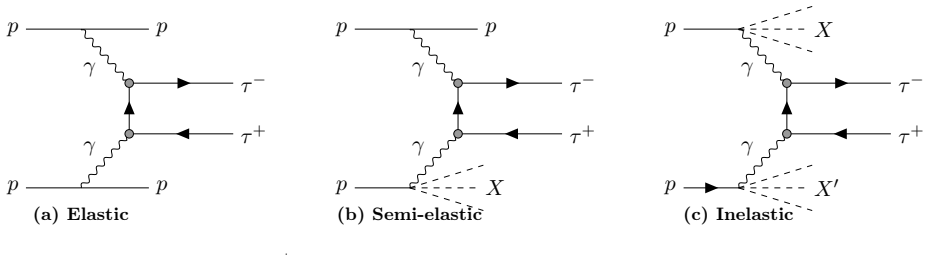


read the original abstract
The anomalous magnetic moment of the tau lepton, $a_{\tau}$, represents a fundamental test of the Standard Model (SM) and a high-sensitivity probe for New Physics in the third generation of leptons. Due to the tau's extremely short lifetime, traditional spin-precession measurements remain inaccessible, necessitating innovative experimental strategies at high-energy colliders. This review provides a comprehensive overview of the current experimental landscape, highlighting the recent paradigm shift from LEP-era constraints to the unprecedented precision reached at the LHC. We emphasize the importance of Ultra-Peripheral Heavy-Ion Collisions (UPCs), which act as a ``photon-photon collider'' of extreme intensity. By leveraging the $Z^4$ enhancement of the coherent photon flux in Lead-Lead ($PbPb$) interactions, these collisions provide a theoretically robust ``quasi-static'' environment. These results are critically compared with the latest measurements from proton-proton collisions, including the recent CMS observation of the $\gamma\gamma \to \tau\tau$ process and the ATLAS constraints from the high-mass Drell-Yan tail. We evaluate their complementarity and the challenges related to Effective Field Theory validity at the TeV scale. Finally, we outline the future prospects for $a_\tau$ at Belle II and the Future Circular Collider (FCC) stages. While FCC-hh in $PbPb$ mode provides a theoretically clean environment, its sensitivity remains limited to $\mathcal{O}(10^{-2})$. Conversely, the next generation of lepton facilities, specifically Belle II and FCC-ee, aims for the $\mathcal{O}(10^{-5})$ level, required to probe SM electroweak loop corrections. Long-term projections for a high-energy Muon Collider suggest a potential reach of $\mathcal{O}(10^{-6})$.
Editorial analysis
A structured set of objections, weighed in public.
Referee Report
Summary. This review paper surveys experimental approaches to measuring the tau lepton anomalous magnetic moment a_τ, emphasizing ultra-peripheral PbPb collisions as an intense photon-photon collider with Z^4 flux enhancement, recent LHC results from CMS (γγ → ττ) and ATLAS (high-mass Drell-Yan), their complementarity, EFT validity issues at TeV scales, and projected sensitivities at Belle II, FCC-ee (targeting O(10^{-5}) to access SM electroweak loops), FCC-hh UPCs (O(10^{-2})), and a muon collider (O(10^{-6})).
Significance. As a compilation of existing results and projections without new derivations, the paper usefully consolidates the collider landscape for a_τ, highlighting the shift from LEP constraints to LHC precision and the distinct roles of hadronic vs. leptonic facilities. It draws on cited literature for the Z^4 enhancement, CMS/ATLAS observations, and sensitivity forecasts, providing a coherent overview that could aid planning for third-generation precision tests.
major comments (1)
- [EFT validity discussion (near end of LHC results section)] The section evaluating EFT validity at the TeV scale for high-mass Drell-Yan and γγ → ττ processes notes potential challenges from higher-dimensional operators but does not quantify the suppression scale or reference specific operator coefficients that would invalidate the leading EFT interpretation; this weakens the assessment of robustness for the ATLAS/CMS constraints.
minor comments (3)
- [Future prospects paragraph] The abstract states FCC-hh PbPb sensitivity is limited to O(10^{-2}) while lepton colliders reach O(10^{-5}); the main text should explicitly cite the sensitivity studies or calculations supporting these orders of magnitude for each facility.
- [Throughout] Ensure that all numerical projections (e.g., Belle II and FCC-ee targets) are accompanied by references to the underlying experimental or simulation papers in the bibliography.
- [UPC introduction] Clarify the distinction between 'quasi-static' environment in UPCs and the actual photon virtuality range used in the cited calculations.
Simulated Author's Rebuttal
We thank the referee for their thorough review and constructive feedback on our manuscript. We have carefully considered the major comment and made revisions accordingly to strengthen the discussion on EFT validity.
read point-by-point responses
-
Referee: [EFT validity discussion (near end of LHC results section)] The section evaluating EFT validity at the TeV scale for high-mass Drell-Yan and γγ → ττ processes notes potential challenges from higher-dimensional operators but does not quantify the suppression scale or reference specific operator coefficients that would invalidate the leading EFT interpretation; this weakens the assessment of robustness for the ATLAS/CMS constraints.
Authors: We appreciate this observation. The manuscript, being a review, primarily summarizes existing literature on the EFT applicability in these processes. However, to address the referee's concern, we have expanded the discussion in the revised version by providing order-of-magnitude estimates for the suppression scale Λ (around 1-2 TeV for typical Wilson coefficients of O(1)) and referencing specific studies on dimension-6 operators affecting a_τ and the tau couplings. This includes citing works that analyze the breakdown of the EFT at high invariant masses in Drell-Yan and photon-fusion processes. We believe this addition clarifies the robustness of the constraints without altering the overall conclusions. revision: yes
Circularity Check
Review compiles independent results; no derivation chain present
full rationale
This is a review paper that overviews existing experimental results from LEP, LHC (CMS, ATLAS), and projections for Belle II, FCC-ee, and muon colliders. It discusses UPC photon-photon collisions with Z^4 flux and EFT validity at TeV scales but introduces no new equations, fits, or derivations. All quantitative claims and sensitivities are attributed to cited external literature from multiple groups. No load-bearing step reduces by construction to the paper's own inputs, self-citations, or fitted parameters renamed as predictions. The manuscript is self-contained against external benchmarks and qualifies for a zero circularity finding.
Axiom & Free-Parameter Ledger
Reference graph
Works this paper leans on
-
[1]
S. Eidelman and M. Passera, Mod. Phys. Lett. A22, 159-179 (2007) doi:10.1142/S0217732307022694 [arXiv:hep-ph/0701260 [hep-ph]]
-
[2]
T. Moroi, Phys. Rev. D53, 6565-6575 (1996) [erratum: Phys. Rev. D56, 4424 (1997)] doi:10.1103/PhysRevD.53.6565 [arXiv:hep-ph/9512396 [hep-ph]]
-
[3]
A. Crivellin, M. Hoferichter and J. M. Roney, Phys. Rev. D106, no.9, 093007 (2022) doi:10.1103/PhysRevD.106.093007 [arXiv:2111.10378 [hep-ph]]
-
[4]
A. D’Alise, G. Fabiano, D. Frattulillo, D. Iacobacci, F. Sannino, P. Santorelli and N. Vignaroli, Nucl. Phys. B1006, 116631 (2024) doi:10.1016/j.nuclphysb.2024.116631 [arXiv:2403.17614 [hep-ph]]
-
[5]
N. Vignaroli, Nuovo Cim. C43, no.2-3, 53 (2020) doi:10.1393/ncc/i2020-20053-0 [arXiv:1912.00899 [hep-ph]]
-
[6]
N. Vignaroli, Phys. Rev. D99, no.3, 035021 (2019) doi:10.1103/PhysRevD.99.035021 [arXiv:1808.10309 [hep-ph]]
-
[7]
B. Grzadkowski, M. Iskrzynski, M. Misiak and J. Rosiek, JHEP10, 085 (2010) doi:10.1007/JHEP10(2010)085 [arXiv:1008.4884 [hep-ph]]
-
[8]
I. Brivio and M. Trott, Phys. Rept.793, 1-98 (2019) doi:10.1016/j.physrep.2018.11.002 [arXiv:1706.08945 [hep-ph]]
-
[9]
doi:10.1140/epjst/e2019-900045-4
A. Abadaet al.[FCC], Eur. Phys. J. ST228, no.2, 261-623 (2019) doi:10.1140/epjst/e2019-900045-4
-
[10]
Vignaroli, JHEP10, 125 (2025) doi:10.1007/JHEP10(2025)125 [arXiv:2507.01130 [hep-ph]]
N. Vignaroli, JHEP10, 125 (2025) doi:10.1007/JHEP10(2025)125 [arXiv:2507.01130 [hep-ph]]
-
[11]
M. Frigerio and N. Vignaroli, JHEP04, 008 (2025) doi:10.1007/JHEP04(2025)008 [arXiv:2409.02721 [hep-ph]]
-
[12]
J. Abdallahet al.[DELPHI], Eur. Phys. J. C35, 159-170 (2004) doi:10.1140/epjc/s2004-01852-y [arXiv:hep-ex/0406010 [hep-ex]]
-
[13]
A. Hayrapetyanet al.[CMS], Rept. Prog. Phys.87, no.10, 107801 (2024) doi:10.1088/1361-6633/ad6fcb [arXiv:2406.03975 [hep-ex]]
-
[14]
Aadet al.[ATLAS], JHEP10, 054 (2025) doi:10.1007/JHEP10(2025)054 [arXiv:2503.19836 [hep-ex]]
G. Aadet al.[ATLAS], JHEP10, 054 (2025) doi:10.1007/JHEP10(2025)054 [arXiv:2503.19836 [hep-ex]]
-
[15]
E. Fermi, Z. Phys.29, 315-327 (1924) doi:10.1007/BF03184853
-
[16]
C. F. von Weizsacker, Z. Phys.88, 612-625 (1934) doi:10.1007/BF01333110
-
[17]
E. J. Williams, Phys. Rev.45, 729-730 (1934) doi:10.1103/PhysRev.45.729 15
-
[18]
V. M. Budnev, I. F. Ginzburg, G. V. Meledin and V. G. Serbo, Phys. Rept.15, 181-281 (1975) doi:10.1016/0370-1573(75)90009-5
-
[19]
M. Vidovic, M. Greiner, C. Best and G. Soff, Phys. Rev. C47, 2308-2319 (1993) doi:10.1103/PhysRevC.47.2308
-
[20]
L. Beresford and J. Liu, Phys. Rev. D102, no.11, 113008 (2020) [erratum: Phys. Rev. D106, no.3, 039902 (2022)] doi:10.1103/PhysRevD.102.113008 [arXiv:1908.05180 [hep-ph]]
-
[21]
M. Verducci, C. Roda, V. Cavasinni and N. Vignaroli, Phys. Rev. D110, no.5, 052001 (2024) doi:10.1103/PhysRevD.110.052001 [arXiv:2307.15160 [hep-ph]]
-
[22]
M. Dyndal, M. Klusek-Gawenda, M. Schott and A. Szczurek, Phys. Lett. B809, 135682 (2020) doi:10.1016/j.physletb.2020.135682 [arXiv:2002.05503 [hep-ph]]
-
[23]
G. Aadet al.[ATLAS], Phys. Rev. Lett.131, no.15, 151802 (2023) doi:10.1103/PhysRevLett.131.151802 [arXiv:2204.13478 [hep-ex]]
-
[24]
A. Tumasyanet al.[CMS], Phys. Rev. Lett.131, 151803 (2023) doi:10.1103/PhysRevLett.131.151803 [arXiv:2206.05192 [nucl-ex]]
-
[25]
S. Dittmaier, T. Engel, J. L. H. Ariza and M. Pellen, JHEP08, 051 (2025) doi:10.1007/JHEP08(2025)051 [arXiv:2504.11391 [hep-ph]]
-
[26]
P. Lo Chiatto, Phys. Rev. D112, no.1, 015017 (2025) doi:10.1103/8gtq-twfc [arXiv:2408.04553 [hep-ph]]
-
[27]
D. Shao, B. Yan, S. R. Yuan and C. Zhang, Sci. China Phys. Mech. Astron.67, no.8, 281062 (2024) doi:10.1007/s11433-024-2389-y [arXiv:2310.14153 [hep-ph]]
-
[28]
L. Beresford, S. Clawson and J. Liu, Phys. Rev. D110, no.9, 092016 (2024) doi:10.1103/PhysRevD.110.092016 [arXiv:2403.06336 [hep-ph]]
-
[29]
R. Bruce, D. d’Enterria, A. de Roeck, M. Drewes, G. R. Farrar, A. Giammanco, O. Gould, J. Hajer, L. Harland-Lang and J. Heisig,et al.J. Phys. G47, no.6, 060501 (2020) doi:10.1088/1361-6471/ab7ff7 [arXiv:1812.07688 [hep-ph]]
-
[30]
E. Kouet al.[Belle-II], PTEP2019, no.12, 123C01 (2019) [erratum: PTEP2020, no.2, 029201 (2020)] doi:10.1093/ptep/ptz106 [arXiv:1808.10567 [hep-ex]]
-
[31]
D. Bodrov, Int. J. Mod. Phys. A39, no.26n27, 2442006 (2024) doi:10.1142/S0217751X24420065 [arXiv:2405.16512 [hep-ex]]
-
[32]
J. Bernabeu, G. A. Gonzalez-Sprinberg and J. Vidal, JHEP01, 062 (2009) doi:10.1088/1126- 6708/2009/01/062 [arXiv:0807.2366 [hep-ph]]
-
[33]
Four-fermion operators, $Z$-boson exchange, and $\tau$ lepton dipole moments
J. Gogniat, M. Hoferichter and G. Levati, [arXiv:2604.16598 [hep-ph]]
work page internal anchor Pith review Pith/arXiv arXiv
-
[34]
Probing $\tau$ lepton dipole moments at future Lepton Colliders
D. Buttazzo, G. Levati, Y. Ma, F. Maltoni, P. Paradisi and Z. Wang, [arXiv:2604.14281 [hep-ph]]
work page internal anchor Pith review Pith/arXiv arXiv
-
[35]
M. Dam, SciPost Phys. Proc.1, 041 (2019) doi:10.21468/SciPostPhysProc.1.041 [arXiv:1811.09408 [hep- ex]]
- [36]
-
[37]
Accetturaet al.[International Muon Collider], [arXiv:2504.21417 [physics.acc-ph]]
C. Accetturaet al.[International Muon Collider], [arXiv:2504.21417 [physics.acc-ph]]
-
[38]
H. Denizli, A. Senol and M. Köksal, Chin. J. Phys.95, 1250-1258 (2025) doi:10.1016/j.cjph.2025.04.020 [arXiv:2408.16106 [hep-ph]]. 16
-
[39]
Wang, PoSICHEP2024, 327 (2025) doi:10.22323/1.476.0327 [arXiv:2410.12663 [hep-ph]]
Z. Wang, PoSICHEP2024, 327 (2025) doi:10.22323/1.476.0327 [arXiv:2410.12663 [hep-ph]]
-
[40]
Vignaroli, in preparation
N. Vignaroli, in preparation. 17
discussion (0)
Sign in with ORCID, Apple, or X to comment. Anyone can read and Pith papers without signing in.